Manufacturing
November 11 2026
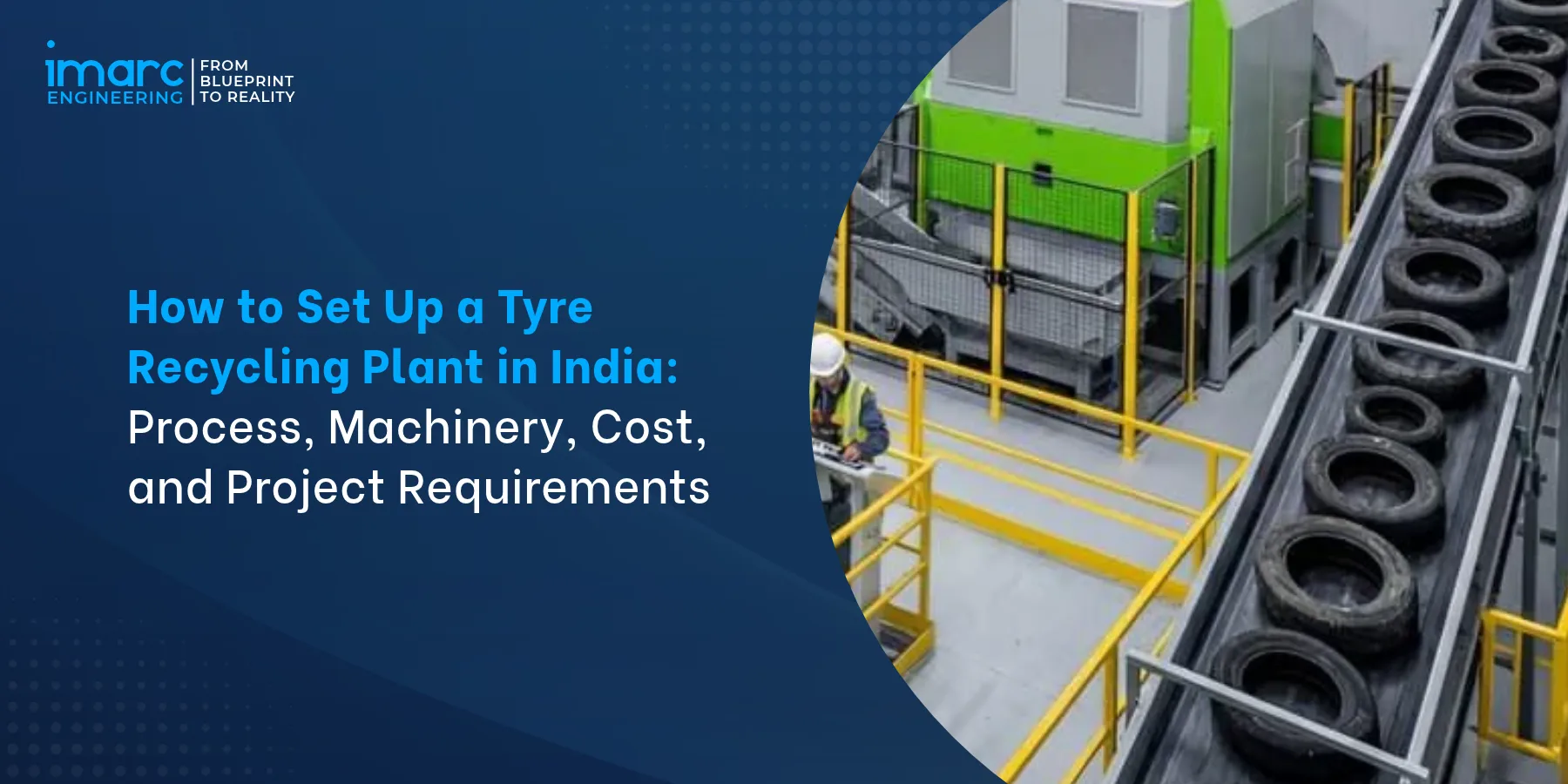
How to Set Up a Tyre Recycling Plant in India: Process, Machinery, Cost, and Project Requirements
Introduction
For investors, project sponsors and tyre manufacturers evaluating tyre recycling plant setup in India, the first decision is not machinery selection but project classification. Mechanical tyre recycling primarily involves physical size reduction and material separation at ambient temperature. Depending on feedstock quality and end-product requirements, the process may also include washing and drying. Tyre pyrolysis is a separate thermal process involving reactors, condensers, gas handling, oil storage and additional environmental and fire-safety controls.
A tyre pyrolysis plant is a high-temperature thermal process with condensable vapors, combustible gas, liquid fuel storage and a materially different air-emission and fire-risk profile. Mechanical tyre recycling and pyrolysis both process waste tyres, but they differ substantially in equipment, environmental controls, safety requirements and commercial risks. Each technology should therefore be assessed independently during feasibility planning and project design.
Scope of this Guide
This guide answers one question: how can investors set up a tyre recycling plant in India, select the appropriate recycling technology, estimate project costs, prepare a detailed project report and comply with environmental regulations? It covers mechanical shredding, crumb rubber production and pyrolysis-based recovery at commercial scale, from feedstock contracting through commissioning and mass-balance documentation and deliberately keeps the two technology families separate because their process trains, emission controls and regulatory obligations differ. Capacities, yields, land requirements and costs are project-specific planning estimates. They should be validated through process design, vendor quotations, site assessments and applicable regulatory requirements.
Table of Contents
- Introduction
- Why Tyre Recycling Plant Setup in India Matters for Investors in 2026
- What a Tyre Recycling Plant Is and Why It Matters for Tyre Recycling Plant Setup in India
- Tyre Recycling Plant Setup in India: Technology Types, Capacity and Product Planning
- Raw Materials and Feedstock for Tyre Recycling Plant Setup in India
- Core Process Steps for Tyre Recycling Plant Setup in India, Part 1: Shredding, Granulation and Separation
- Core Process Steps for Tyre Recycling Plant Setup in India, Part 2: Pyrolysis, Finishing and Quality Control
- Machinery and Utilities for Tyre Recycling Plant Setup in India
- Effluent, Licenses and Project Economics for Tyre Recycling Plant Setup in India
- Conclusion
1. Why Tyre Recycling Plant Setup in India Matters for Investors in 2026
Four structural conditions shape a tyre recycling plant setup in India in 2026, and each changes what an investor should model before committing land.
1.1 End-of-Life Tyre Generation, Import Restrictions and Localization
India's end-of-life tyre pool arises from one of the world's larger commercial vehicle and two-wheeler fleets, and it is structurally dispersed: retreaders, puncture repair shops, fleet operators, mining and port haulage contractors, and organized scrap aggregators each control a slice. The pool is large in aggregate but thin at any single point, which is why feedstock aggregation can be a major constraint for new tyre recycling facilities, particularly where collection networks are fragmented. Investors should assess local waste tyre availability, supplier reliability, delivered costs and competition for feedstock before finalising plant capacity.
Import of waste tyres is subject to the Hazardous and Other Wastes Rules and applicable MoEFCC and DGFT permissions. Eligible actual users may import waste tyres for approved recycling and recovery activities, such as crumb rubber and reclaim rubber production. However, imports for producing tyre pyrolysis oil or char are prohibited under the waste tyre EPR framework. Investors should verify the applicable import conditions before finalising their feedstock strategy.
1.2 Tyre Extended Producer Responsibility and Producer Obligations
The Hazardous and Other Wastes (Management and Transboundary Movement) Amendment Rules, 2022 introduced an Extended Producer Responsibility framework for waste tyres under Schedule IX. Producers, recyclers and retreaders must register on the CPCB portal and comply with applicable reporting and record-keeping requirements. Producers meet their EPR obligations through eligible recycling or retreading certificates generated under the prescribed framework.Tyre producers should also consider EPR obligations when planning a new tyre manufacturing plant in India.
EPR certificate generation depends on eligible recycled products, prescribed conversion factors, applicable weightages and CPCB portal requirements. Recyclers should maintain verifiable records of waste tyre receipts, processing quantities, product output and sales to support compliance and certificate generation.
1.3 Investment Ecosystem, Machinery Supply and Offtake Depth
India has domestic suppliers of tyre shredding, granulation, separation and pyrolysis equipment. However, machinery availability, technical capability, delivery schedules and after-sales support vary by supplier. Investors should evaluate vendors based on equipment specifications, demonstrated throughput, product quality, energy consumption, safety systems and maintenance support.
Offtake is equally segmented: crumb rubber moves to moulded goods, sports surfaces, modified bitumen and retreaders; recovered steel to foundries and rolling mills; pyrolysis oil to industrial furnace and kiln operators.
1.4 The Cost of Treating the Two Technologies as One Project
A significant project planning risk is combining mechanical recycling and pyrolysis assumptions within a single financial model. These technologies have different machinery requirements, operating costs, environmental controls, product recovery rates and revenue structures. Separate technical and financial assessments are necessary to evaluate their commercial feasibility.
A mechanical recycling line's economics depend on feedstock quality, target particle size, separation efficiency, energy consumption and product prices. Pyrolysis economics depends on reactor performance, product yields, energy balance, pollution-control costs and the market acceptance of pyrolysis oil and recovered carbon black.
Regulatory treatment differs too: pyrolysis attracts stack emission conditions, flammable liquid storage rules and fire authority scrutiny that a dry granulation hall does not. Modelling both on a single per-tonne capital figure produces a project neither a lender nor an insurer will accept.
2. What a Tyre Recycling Plant Is and Why It Matters for Tyre Recycling Plant Setup in India
A tyre recycling plant is defined by its process boundary, its product slate and the mass balance it can actually sustain.
2.1 Definition and the Two Project Families
A tyre recycling plant is an industrial facility that processes end-of-life tyres into reusable materials or recovered products. Depending on the selected technology, these products may include tyre chips, crumb rubber, reclaimed rubber, recovered steel, textile fibre, tyre-derived oil and carbon-rich char.
Mechanical recycling uses physical processes such as cutting, shredding, granulation, screening and material separation. Additional operations, including washing and drying, may be incorporated depending on feedstock quality and product specifications.
Pyrolysis is a separate thermal process that decomposes waste tyres in an oxygen-limited environment. It produces oil, combustible gas, char and recovered steel. The two technology routes require different equipment, process controls, pollution-control systems and safety measures. Investors should select the technology based on feedstock availability, target products, buyer requirements, regulatory conditions and project economics.
2.2 Functional Plant Sections and Battery Limits
The plant configuration depends on the selected recycling technology, feedstock condition and required product specifications. A mechanical recycling facility may include tyre receiving, weighbridge, feedstock storage, bead removal, primary shredding, granulation, magnetic separation, fibre classification, screening and finished-product storage. Washing, drying and effluent treatment may be included where required by the process or product specifications.
A pyrolysis facility requires additional systems for feed preparation, reactor operation, heating, condensation, gas handling, oil storage, char discharge and finishing. Pollution-control and fire-safety infrastructure must also be incorporated into the design.
Defining the process boundary is important when preparing equipment specifications, estimating project costs and obtaining vendor quotations. The design should clearly identify equipment, utilities, storage, material-handling systems, pollution-control facilities and battery-limit interfaces.
2.3 Scale Determinants
Plant capacity depends on feedstock availability, collection and transportation costs, product specifications, operating hours, maintenance requirements and equipment configuration. Investors should assess the economically viable feedstock sourcing radius using local tyre availability, delivered prices and logistics costs.
Product specifications also influence capacity. Finer crumb rubber grades may require additional milling, screening and separation stages, affecting throughput and energy consumption. Annual operating days should account for planned maintenance, equipment availability and the selected process configuration.
Equipment redundancy is another important consideration. A plant dependent on a single critical shredder or processing unit may experience significant production losses during equipment breakdowns. The feasibility study should assess maintenance arrangements, spare-parts availability and backup capacity.
2.4 Plant Sections
| Plant section | Function | Key equipment or systems |
|---|---|---|
| Feedstock receiving | Receipt, weighing and inspection of waste tyres | Weighbridge, unloading equipment and sorting area |
| Feedstock storage | Temporary storage and segregation | Designated storage area and material-handling equipment |
| Bead removal | Removal of tyre beads and steel components where required | Bead breaker and bead-removal equipment |
| Primary shredding | Initial size reduction | Twin-shaft shredder and conveyors |
| Granulation and milling | Further size reduction | Granulator, rasp mill and screening equipment |
| Material separation | Recovery of steel and textile fibre | Magnetic separators and air classifiers |
| Washing and drying, where required | Cleaning and moisture reduction | Washing system, dewatering equipment and dryer |
| Pyrolysis system | Thermal decomposition of prepared waste tyres | Reactor, heating system and feed-handling equipment |
| Condensation and gas handling | Recovery and management of vapours and non-condensable gas | Condensers, gas-treatment system and flare |
| Char finishing | Processing of carbon-rich solid residue | Steel separation, milling and finishing equipment |
| Utilities | Supply of electricity, water, cooling and compressed air | Transformer, pumps, cooling systems and compressors |
| Pollution control | Management of process emissions and wastewater | Dust collection, scrubbers and effluent-treatment systems, as applicable |
The final equipment configuration should be established through process design, vendor specifications and applicable regulatory requirements.
3. Tyre Recycling Plant Setup in India: Technology Types, Capacity and Product Planning
Technology selection fixes the equipment train, the product slate and the consent pathway in a tyre recycling plant setup in India.
3.1 Mechanical Shredding and Tyre Chip Production
Mechanical shredding is generally the first major processing stage in a tyre recycling plant. Whole tyres are fed into industrial shredders that reduce them into smaller pieces. The required output size depends on the intended application, such as further granulation, material recovery or use as tyre-derived fuel.
Shredder selection depends on tyre dimensions, steel content, feedstock composition, required throughput, cutter design and drive configuration. Equipment specifications should also cover jam-release arrangements, cutter maintenance, energy consumption and spare-parts availability.
Shredded tyre material may be supplied to authorised cement and co-processing facilities or processed further to recover crumb rubber, steel and textile fibre. Commercial viability depends on product specifications, transportation costs, buyer acceptance and applicable environmental requirements. Investors should secure suitable offtake arrangements before finalising plant capacity and machinery selection.
3.2 Crumb Rubber and Reclaim Routes
Crumb rubber production involves additional processing after primary shredding. The material passes through granulation, milling, screening and separation stages to obtain the required particle-size distribution. Magnetic separation recovers steel, while air classification or aspiration removes textile fibre.
Ambient grinding and cryogenic grinding are two methods used to produce crumb rubber. Ambient grinding reduces rubber through mechanical cutting and shearing. Cryogenic grinding uses low temperatures to make rubber brittle before size reduction. The choice depends on the required particle size, product quality, energy consumption and operating economics.
Devulcanization and rubber reclaiming are separate processing routes that aim to modify or regenerate vulcanised rubber for further use. They require additional technology and process controls and should be evaluated as distinct project configurations.
Crumb rubber quality depends on particle-size distribution, moisture, steel and textile contamination, and other buyer-specific parameters. ASTM D5603-23 provides a classification framework for recycled vulcanizate particulate rubber, while ASTM D5644-23 covers particle-size distribution testing. Product acceptance limits should be established through buyer specifications and representative testing.
3.3 Pyrolysis and Thermal Recovery
Tyre pyrolysis is a thermal process that decomposes prepared waste tyres in an oxygen-limited environment. Depending on the reactor configuration, the process produces tyre-derived oil, non-condensable gas, carbon-rich char and recovered steel.
The main equipment includes a feed-preparation system, reactor, heating arrangement, vapour-condensation train, gas-treatment system, oil storage and char-handling equipment. Gas recovery and reuse may help meet process-energy requirements, subject to gas quality, system design and operating conditions. External energy may still be required during startup and operation.
The char produced by pyrolysis requires further processing, including steel separation and suitable finishing, before it can be evaluated as recovered carbon black. Its commercial suitability depends on composition, processing quality and buyer specifications.
Pyrolysis units may use batch or continuous reactor configurations. Their selection should consider feedstock preparation, capacity, process control, automation, pollution-control infrastructure, safety systems and operating costs. Investors should use the revised January 2025 CPCB Standard Operating Procedure for tyre pyrolysis units when evaluating plant design, site requirements and regulatory compliance.
3.4 Capacity, Product Mix and Location Selection
Plant capacity should be specified in terms of waste tyre input per day, with the expected output quantities calculated separately for each recovered product. Input capacity alone does not establish the commercial output of a facility. Feedstock composition, processing efficiency, product grade and operating conditions influence the final material balance.
A mechanical recycling plant and a pyrolysis facility with the same input capacity are not directly comparable. Their equipment requirements, utility consumption, pollution-control infrastructure, operating costs and product markets differ.
Location selection should consider waste tyre availability, collection and transportation costs, industrial land-use permissions, power and water availability, road connectivity, proximity to buyers and applicable pollution-control requirements. The proposed site should also be evaluated against the relevant CPCB and SPCB requirements, particularly for pyrolysis facilities.
3.5 Comparison of Tyre Recycling Technologies
Technology selection determines the machinery, recovered products, utility requirements, pollution-control systems and investment structure of a tyre recycling plant. The three main configurations are mechanical shredding, crumb rubber production and pyrolysis.
| Parameter | Mechanical Shredding | Crumb Rubber Production | Pyrolysis |
|---|---|---|---|
| Process | Physical cutting and size reduction | Shredding, granulation, milling and separation | Thermal decomposition in an oxygen-limited environment |
| Main equipment | Tyre cutters, bead breakers, primary shredders and conveyors | Shredders, granulators, mills, magnetic separators, air classifiers and screens | Feed preparation, reactor, heating system, condensers, gas handling and oil storage |
| Main products | Shredded tyre chips, steel and fibre | Crumb rubber, recovered steel and fibre | Tyre-derived oil, carbon-rich char, steel and non-condensable gas |
| Utilities | Electricity and material-handling systems | Electricity, with water and drying requirements where wet processing is used | Heating energy, electricity, cooling systems and process-specific gas supplies |
| Environmental controls | Dust collection and suitable material-handling controls | Dust collection and wastewater treatment where washing is included | Reactor emission control, gas treatment, wastewater and residue management |
The final technology choice should be based on feedstock availability, target product specifications, buyer demand, site conditions, regulatory requirements and project economics. These configurations should be assessed separately because their equipment, operating costs and environmental-control requirements differ.
3.6 Step-by-Step Process for Setting Up a Tyre Recycling Plant in India
Setting up a tyre recycling plant requires coordinated planning across feedstock procurement, technology selection, engineering, regulatory approvals and commissioning. The following sequence provides a practical framework for project development. Similar planning considerations apply to other recycling plant setups in India.
Step 1: Assess Feedstock Availability and Market Demand
Evaluate the availability, quality and delivered cost of waste tyres in the proposed sourcing area. Identify potential suppliers, collection channels and buyers for the recovered products. Assess demand for tyre chips, crumb rubber, recovered steel, pyrolysis oil and processed carbon-rich material, depending on the proposed technology.
Step 2: Select the Recycling Technology
Choose between mechanical shredding, crumb rubber production and pyrolysis based on feedstock characteristics, product requirements, market demand and regulatory considerations. Define the intended product mix and processing route before finalising plant capacity.
Step 3: Determine Plant Capacity and Site Requirements
Estimate input capacity using contracted or realistically available feedstock, planned operating hours and expected utilisation. Assess industrial land availability, power and water supply, road connectivity, storage requirements and environmental constraints. Confirm site suitability with the relevant authorities.
Step 4: Prepare the Detailed Project Report
Develop a DPR covering market assessment, process design, material balance, machinery, plant layout, utilities, environmental controls, project costs, working capital and financial projections. Include a regulatory assessment and project implementation schedule.
Step 5: Obtain Applicable Registrations and Approvals
Identify the applicable CPCB registration, State Pollution Control Board consents, hazardous-waste authorisation and other statutory permissions. For pyrolysis projects, incorporate the applicable CPCB SOP and related safety and pollution-control requirements into the design and approval process.
Step 6: Finalise Machinery and Procure Equipment
Prepare technical specifications and obtain quotations from suitable equipment suppliers. Evaluate machinery performance, energy requirements, maintenance arrangements, safety features and after-sales support. Finalise contracts based on the approved process design and capacity.
Step 7: Develop Infrastructure and Install Equipment
Complete site development, civil works, electrical systems, utilities, storage areas and pollution-control infrastructure. Install machinery according to the approved plant layout and equipment specifications.
Step 8: Test, Commission and Start Operations
Conduct equipment trials, safety checks and process-performance tests. Verify throughput, product quality, utility consumption and pollution-control performance. Complete applicable inspections and obtain the required permissions before commencing commercial operations.
Step 9: Establish Production and Compliance Records
Implement procedures for feedstock inspection, production monitoring, product testing, dispatch documentation and input-output traceability. Maintain the records required under the applicable CPCB EPR framework and environmental approvals.
The sequence and duration of individual activities will vary depending on project capacity, technology, site readiness, equipment delivery and regulatory approval requirements.
4. Raw Materials and Feedstock for Tyre Recycling Plant Setup in India
Feedstock quality decides yield, product grade and downtime more than any machinery choice in a tyre recycling plant setup in India.
4.1 Feedstock Categories and Quality Specifications
Waste tyre feedstock may include passenger car tyres, truck and bus tyres, two- and three-wheeler tyres, tractor tyres and off-the-road tyres. These categories differ in dimensions, construction, steel content, textile content and rubber composition. Such variations influence processing requirements, equipment wear and material recovery.
Feedstock may also contain mud, water, stones and other contaminants. These can affect processing efficiency, product quality and maintenance requirements. Investors should establish a feedstock specification covering acceptable tyre categories, contamination limits, moisture conditions and rejection procedures.
Representative samples should be tested before finalising plant capacity, equipment specifications and expected product yields. Feedstock quality assumptions used in the DPR should reflect the material that can realistically be sourced through the proposed collection network.
4.2 Process Chemistry, Consumables and Additives
Mechanical tyre recycling primarily consumes cutter blades, screen meshes, lubricants and other equipment-maintenance consumables. Washing operations, where included, may also require water and suitable cleaning agents.
Pyrolysis systems may use treatment chemicals for gas scrubbing and inert gas for purging and safety-related operations. The type and quantity of chemicals depend on the reactor configuration, gas-treatment system and operating procedures.
Consumable requirements should be estimated using equipment specifications, vendor recommendations, process design and expected operating hours. Material safety data sheets, storage arrangements, handling procedures and waste-management requirements should be incorporated into the plant's safety and environmental plans.
4.3 Feedstock Collection Networks and Contracting
Feedstock procurement is a critical operating requirement for tyre recycling plants. Potential sourcing channels include organised waste tyre aggregators, fleet operators, commercial vehicle workshops, mining and transport operators, and retreading businesses.
Supply agreements should specify tyre categories, minimum quantities, delivered prices, transportation responsibilities, contamination limits, inspection procedures and payment terms. Investors should assess supplier reliability and the availability of alternative sourcing channels before committing to plant capacity.
Annual feedstock requirements should be calculated using rated input capacity, planned operating days and expected utilisation. Inventory levels should reflect supplier lead times, collection patterns, transport availability, storage capacity and fire-safety requirements.
Importing waste tyres is subject to applicable MoEFCC and DGFT permissions. Imports for producing tyre pyrolysis oil or char are prohibited under the waste tyre EPR framework. Investors should verify current import conditions before including imported feedstock in their procurement plan.
4.4 Storage, Fire Safety and Hazardous Area Classification
Waste tyre and shredded rubber storage requires careful planning because accumulated material can create significant fire loads and produce dense smoke during a fire. Storage arrangements should consider stockpile size, separation distances, access for firefighting, ignition control, emergency routes and material-handling requirements.
Fire protection systems should be designed in accordance with applicable state fire regulations, local building requirements and relevant provisions of the National Building Code of India, 2016, where adopted. The required firefighting infrastructure should be established through a site-specific fire-risk assessment and consultation with the competent authority.
Pyrolysis facilities require additional safeguards for combustible gas, reactor operation, oil storage, char handling and emergency flaring. Tank design, containment, electrical equipment and hazardous-area classification should be assessed against the applicable regulations, CPCB SOP and approved plant design. Fire-safety permissions and inspections should be completed as required by the relevant authorities.
5. Core Process Steps for Tyre Recycling Plant Setup in India, Part 1: Shredding, Granulation and Separation
The mechanical train converts whole tyres into graded crumb through four sequential stages, each with parameters that belong in the equipment specification.
5.1 De-wiring, Debeading and Primary Shredding
Waste tyres may undergo bead removal or de-wiring before primary shredding, depending on tyre construction and the selected processing line. Bead-removal equipment extracts steel components that could increase cutter wear or affect downstream processing.
The prepared tyres are fed into an industrial shredder that reduces them into smaller pieces. Equipment selection should account for tyre dimensions, steel content, feedstock composition, required output size and processing capacity. Drive power, shaft torque, cutter design, jam-release arrangements and maintenance requirements should also be evaluated.
Vendors should demonstrate equipment performance using representative samples of the proposed feedstock. Throughput, energy consumption, cutter life and spare-parts availability should be documented before machinery procurement.
5.2 Granulation, Milling and Screening
After primary shredding, tyre pieces may pass through granulators and secondary mills to achieve the required particle size. The number of processing stages depends on the target crumb grade and the characteristics of the feedstock. Screening equipment separates material into different particle-size fractions. Oversized particles may be returned for further milling, while suitable fractions move to subsequent separation or finishing stages.
Finer crumb rubber grades generally require additional processing and may reduce throughput. Equipment capacity, screen configuration, energy consumption and particle-size distribution should therefore be confirmed through vendor trials and technical performance guarantees for the intended product grade.
5.3 Magnetic and Air Separation of Steel and Fiber
Magnetic separation recovers steel from shredded and granulated tyre material. Depending on the process configuration, overband magnets, drum magnets or other magnetic separation systems may be installed at different stages of the production line.
Textile fibre can be separated through air classification or aspiration. These systems use controlled airflow to separate lighter fibre from heavier rubber particles. Additional separation and screening stages may be incorporated where required to achieve the intended product specification.
Separation efficiency should be assessed through representative product testing. Steel and fibre contamination limits depend on the intended application and buyer requirements. Recovered steel should also be evaluated for residual rubber and other contaminants before dispatch.
5.4 Washing, Drying and Baling
Washing may be included where feedstock contamination or end-product specifications require additional cleaning. The process may use soaking, agitation, friction washing, rinsing and mechanical dewatering, depending on the plant configuration.
Drying requirements depend on the washing process, product moisture specifications and storage conditions. Water recirculation and effluent treatment should be incorporated where wet processing is used, in accordance with the plant design and applicable SPCB consent conditions.
Finished crumb rubber may be packed in bags, jumbo bags or other formats suitable for handling and transportation. Packaging should protect the product from contamination and moisture and should follow buyer requirements. Dust collection and emission-control systems should be designed in accordance with applicable consent conditions and process requirements.
6. Core Process Steps for Tyre Recycling Plant Setup in India, Part 2: Pyrolysis, Finishing and Quality Control
The thermal train and the finishing train convert intermediate streams into products that sell against a certificate rather than a spot price.
6.1 Pyrolysis Reactor Operation and Condensation
Prepared waste tyres are processed in a pyrolysis reactor under oxygen-limited conditions. The reactor configuration, feed preparation, temperature, heating rate, residence time and process controls influence the quantity and characteristics of the recovered products.
Vapours generated during thermal decomposition pass through a condensation system to recover liquid products. The non-condensable gas stream requires suitable handling and treatment and may be reused as process fuel where the gas quality and system design permit.
The plant should include appropriate reactor controls, temperature monitoring, pressure management, gas-handling systems, emergency flaring and pollution-control infrastructure. Reactor operating conditions and safety arrangements must comply with the revised CPCB SOP and applicable SPCB consent conditions.
6.2 Carbon Black Milling, Densification and Oil Handling
The solid residue discharged from a tyre pyrolysis reactor contains carbon-rich material and may also contain steel and other impurities. Steel separation is followed by suitable processing and finishing operations, which may include milling, classification and densification.
The resulting material should be assessed for composition and physical properties before it is marketed as recovered carbon black. Its suitability for rubber compounding or other applications depends on processing quality and buyer specifications. It should not be treated as equivalent to virgin furnace carbon black without appropriate testing and qualification.
Recovered oil may require settling, filtration or other treatment to meet the intended buyer's specifications. Its storage, handling, transportation and sale must comply with applicable safety, environmental and regulatory requirements.
6.3 Testing, Standards and Inspection Methods
Crumb rubber quality can be evaluated through particle-size distribution, moisture, steel contamination, textile contamination and other parameters specified by the buyer. ASTM D5603-23 provides a classification framework for recycled vulcanizate particulate rubber, while ASTM D5644-23 specifies a method for determining particle-size distribution.
Pyrolysis oil may be assessed for parameters such as density, viscosity, flash point, sulphur and water content, depending on the intended application. Carbon-rich char and processed recovered carbon black may require testing for ash, volatile matter, particle size and other buyer-specific parameters.
Routine in-house testing can support production control. More specialised analysis may be conducted through suitable external laboratories. The testing programme should be established according to product specifications, buyer requirements and applicable standards.
6.4 Packaging, Dispatch and Mass Balance Traceability
Product traceability supports quality control, commercial transactions and compliance with the waste tyre EPR framework. Recyclers should maintain records of waste tyre receipts, processing quantities, recovered product quantities, dispatches and relevant weighbridge transactions.
Batch records should identify the input material, production date, output grade, quantity and relevant test results. Packaging should follow the product's physical characteristics, storage requirements and buyer specifications. Crumb rubber may be supplied in bags or bulk packaging, recovered steel in suitable containers or bales, and pyrolysis oil through appropriate tankers or storage containers.
EPR certificate generation is governed by eligible end products, prescribed conversion factors, applicable weightages and CPCB portal requirements. Maintaining input-output records supports compliance but does not by itself guarantee certificate eligibility.
7. Machinery and Utilities for Tyre Recycling Plant Setup in India
Machinery, utilities and plant layout are important determinants of investment requirements, operational efficiency and maintenance costs. Their relative financial contribution depends on the selected recycling technology, processing capacity, site conditions and equipment configuration.
7.1 Shredding, Granulation and Separation Machinery
Machinery selection should be based on feedstock characteristics, required product grades, rated input capacity and planned operating hours. A mechanical recycling line may include bead-removal equipment, primary shredders, granulators, secondary mills, magnetic separators, fibre classifiers, vibrating screens and material-handling systems.
Equipment specifications should cover throughput under the proposed feedstock mix, drive power, shaft torque, cutter design, energy consumption, maintenance access and safety arrangements. Washing and drying equipment may be included where required by product specifications or process conditions.
Vendor evaluation should consider demonstrated performance, equipment reliability, spare-parts availability, after-sales support and operating costs. Trials using representative waste tyres can help validate throughput and product quality before procurement.
7.2 Utilities: Power, Water, Compressed Air and Steam
Utility requirements depend on plant capacity, equipment selection, operating hours and process configuration. Electrical demand should be calculated from the installed equipment list, operating loads and expected production schedule. The electrical infrastructure should be designed around the sanctioned load and applicable electrical safety requirements.
Water requirements depend on whether the plant includes washing, cooling or other water-consuming operations. Compressed air, cooling systems, inert gas and backup power should be included where required by the selected process and equipment.
Firewater storage and firefighting infrastructure should be determined through the applicable fire-safety design and regulatory requirements. A project-specific utility balance should be prepared during engineering to establish connected loads, consumption estimates and infrastructure requirements.
7.3 Layout, Material Handling and Fire Protection
Plant layout should support an efficient flow of waste tyres, intermediate materials and finished products. The arrangement should consider receiving, storage, bead removal, shredding, granulation, separation, optional washing and drying, finished-product storage and dispatch. Vehicle movement, equipment access, maintenance space and emergency routes should be incorporated into the layout.
Raw material and finished-product handling should be planned to minimise unnecessary movement and avoid cross-contamination. Utilities, pollution-control equipment, workshops and administrative facilities should be positioned according to process requirements and site constraints.
Fire protection, access roads, emergency exits, storage separation and firefighting infrastructure should be designed in accordance with applicable state fire regulations, local building rules and relevant provisions of NBC 2016, where adopted. Pyrolysis facilities require additional safeguards for reactors, combustible gas, oil storage and emergency flaring under the applicable CPCB SOP and consent conditions.
7.4 Key Machinery
| Process category | Main equipment | Selection considerations |
|---|---|---|
| Feed preparation | Tyre cutters and bead breakers | Tyre dimensions, construction and steel content |
| Primary size reduction | Twin-shaft or equivalent industrial shredder | Throughput, cutter design and drive configuration |
| Granulation | Granulator and secondary mill | Required particle size and processing capacity |
| Screening | Vibrating screens and classifiers | Product grade and particle-size distribution |
| Steel separation | Magnetic separators | Separation efficiency and material flow |
| Fibre separation | Air classifier and aspiration system | Fibre removal efficiency and dust control |
| Washing and drying, where required | Washing, dewatering and drying equipment | Feedstock contamination and moisture specifications |
| Pyrolysis | Reactor and heating system | Approved configuration, capacity and process controls |
| Condensation and gas handling | Condensers, gas-treatment system and flare | Gas recovery, emissions and operational safety |
| Char finishing | Steel separation, milling and finishing equipment | Product quality and buyer requirements |
| Pollution control | Dust collection, scrubbers and effluent-treatment systems, as applicable | Process emissions and applicable consent conditions |
Final equipment ratings and capacities should be established through engineering calculations, vendor quotations and performance guarantees.
8. Effluent, Licenses and Project Economics for Tyre Recycling Plant Setup in India
Effluent, emissions and approvals determine whether an otherwise well-engineered tyre recycling plant setup in India is allowed to run at design capacity.
8.1 Effluent, Emissions and Solid Residues
Mechanical tyre recycling may generate dust during shredding, granulation, screening and material handling. Dust collection and filtration systems should be designed according to the process configuration and applicable SPCB consent conditions. Facilities that include washing may also generate wastewater containing suspended solids and other contaminants. Its treatment, reuse and disposal should follow the approved effluent-management design and regulatory requirements.
Pyrolysis facilities require additional controls for reactor emissions, process gases, vapours, wastewater and solid residues. The plant should incorporate the pollution-control and waste-management systems prescribed under the applicable CPCB Standard Operating Procedure and SPCB consent conditions. The revised January 2025 CPCB SOP should be consulted when designing these systems.
Wastewater treatment, air-emission control and residue management should be established through process design and environmental assessment. Waste streams should be characterised, handled and disposed of through authorised routes wherever required.
8.2 Licenses, Approvals and Authorities
Tyre recycling facilities must assess the approvals applicable to their technology, capacity and location. Under Schedule IX of the Hazardous and Other Wastes (Management and Transboundary Movement) Rules, 2016, as amended in 2022, producers, recyclers and retreaders are required to register on the CPCB waste tyre EPR portal. Recyclers must comply with applicable reporting, record-keeping and certificate-generation requirements.
Consent to Establish and Consent to Operate requirements should be confirmed with the relevant State Pollution Control Board or Pollution Control Committee. Hazardous-waste authorisation and waste-handling requirements should be assessed according to the process and waste streams generated.
Pyrolysis facilities must also comply with the applicable CPCB Standard Operating Procedure, including its requirements for pollution control, process safety, waste management and fire protection. The Ministry confirmed that CPCB revised its tyre-pyrolysis SOP in January 2025.
Environmental Clearance applicability should be assessed against the EIA Notification, 2006 and the proposed project's activities. Factory plan approval, permission and licensing should be reviewed under the Occupational Safety, Health and Working Conditions Code, 2020, and applicable state rules. The four Labour Codes came into effect on 21 November 2025.
Fire approvals, local permissions and other statutory requirements should be identified in consultation with the competent authorities. Udyam registration may be considered separately where the enterprise meets the applicable MSME eligibility criteria; it is not a substitute for operating licences or environmental approvals.
8.3 CAPEX and OPEX Composition
Fixed-asset CAPEX for a tyre recycling plant may include land and site development, civil works, process machinery, electrical systems, utilities, pollution-control equipment, fire-safety infrastructure and installation. The total project outlay should separately identify pre-operative expenses, applicable interest during construction, project contingency and working-capital margin.
The cost structure differs between shredding, crumb rubber production and pyrolysis. A mechanical recycling facility may require substantial investment in shredding, granulation, separation and material handling. A pyrolysis facility has additional requirements for reactors, heating, condensation, gas handling, oil storage, pollution control and fire safety.
Operating expenditure may include waste tyre procurement, transportation, electricity, labour, consumables, equipment maintenance, pollution-control operations, waste management and administration. The relative contribution of each cost item depends on plant capacity, location, technology, operating efficiency and procurement arrangements.
CAPEX and OPEX estimates should be developed using vendor quotations, engineering calculations, site-specific requirements and realistic operating assumptions. A project-specific DPR should clearly document the basis of each estimate.
8.4 Project Economics
A Detailed Project Report (DPR) establishes the technical, financial and commercial feasibility of a proposed tyre recycling plant. It provides the basis for investment decisions, financing discussions, engineering development and project implementation. A tyre recycling plant DPR should cover the following components:
- Executive Summary: Project objective, proposed location, selected technology, input capacity, target products and estimated investment.
- Market Assessment: Waste tyre availability, feedstock sourcing channels, demand for recovered products, potential buyers and market pricing.
- Technology and Process Selection: Comparison of mechanical shredding, crumb rubber production and pyrolysis, including the selected process route and its justification.
- Feedstock Assessment: Tyre categories, expected quantities, quality parameters, procurement costs, supplier arrangements and storage requirements.
- Technical Design: Process flow diagrams, material balance, equipment specifications, plant capacity, production assumptions and quality-control requirements.
- Site and Infrastructure Planning: Land requirements, plant layout, civil works, power, water, utilities, storage and material-handling arrangements.
- Environmental and Regulatory Assessment: Applicable CPCB registration, SPCB consents, pollution-control systems, waste management, fire safety and other statutory requirements.
- Project Cost Estimation: Land, civil works, machinery, utilities, pollution control, installation, pre-operative expenses and working capital.
- Financial Projections: Expected revenue, operating costs, cash flows, profitability, debt-servicing capacity and investment returns.
- Implementation Plan: Approval requirements, procurement milestones, construction, equipment installation, testing and commissioning schedule.
- Risk Assessment: Feedstock availability, product-price fluctuations, equipment performance, regulatory compliance, market acceptance and financing risks.
The DPR should use vendor quotations, site assessments, market inputs and engineering calculations wherever available. Its financial assumptions should be consistent with the proposed process design and expected production capacity.
8.5 Project Implementation Schedule
A project implementation schedule translates the DPR into a sequence of activities, responsibilities and milestones. It helps investors coordinate regulatory approvals, engineering, procurement, construction and commissioning.
| Project stage | Major activities | Key deliverables |
|---|---|---|
| Feasibility and planning | Feedstock assessment, market study, technology selection and site evaluation | Feasibility assessment and preliminary project plan |
| DPR and engineering | Process design, material balance, layout, machinery specifications and cost estimation | DPR and engineering documents |
| Regulatory approvals | CPCB registration, SPCB consents and other applicable permissions | Required registrations and approvals |
| Procurement | Vendor evaluation, technical finalisation and machinery orders | Purchase orders and procurement schedule |
| Site development | Land preparation, civil works, buildings and utility infrastructure | Construction and infrastructure readiness |
| Equipment installation | Machinery erection, electrical connections and integration of process systems | Installed and integrated plant |
Some activities may proceed in parallel, subject to regulatory requirements and site readiness. The project schedule should account for approval lead times, equipment manufacturing and delivery, construction progress, installation requirements and commissioning trials. Actual timelines should be established for each project rather than assumed as standard industry durations.
8.6 Financial Feasibility and Profitability Assessment
Financial feasibility determines whether a proposed tyre recycling plant can generate sufficient revenue to cover operating expenses, meet financing obligations and provide an acceptable return on investment. The assessment should be based on realistic feedstock availability, processing yields, product prices, capacity utilisation and project costs.
1. Estimate Feedstock Requirements and Product Recovery
Start with the planned waste tyre input and expected operating capacity. Estimate the quantity of each recovered product using process-specific recovery assumptions and a material balance.
For example:
Annual feedstock processed = Daily input capacity × Operating days × Capacity utilisation.
Annual product output = Annual feedstock processed × Applicable recovery yield.
Recovery assumptions should be supported by representative feedstock testing, process design, equipment performance data or vendor trials. Mechanical recycling and pyrolysis require separate material balances.
2. Calculate Revenue from Recovered Products
Estimate annual revenue by multiplying the expected saleable quantity of each product by its net selling price.
Annual revenue = Sum of (Annual saleable product quantity × Net realisation price).
Only products meeting the intended buyer's quality specifications and applicable regulatory requirements should be included as saleable output. Revenue assumptions should distinguish confirmed offtake arrangements from potential markets and account for processing losses, product rejection and transportation costs where applicable.
Potential revenue streams may include tyre chips, crumb rubber, recovered steel, textile fibre, tyre-derived oil and processed recovered carbon black, depending on the selected technology. Revenue assumptions should reflect product quality, buyer specifications, transportation costs and actual market demand.
3. Estimate Operating Costs
Operating expenditure should include waste tyre procurement, transportation, electricity, labour, consumables, maintenance, pollution-control operations, waste management, packaging and administration. Pyrolysis projects should separately assess heating requirements, reactor maintenance, gas handling and oil storage costs.
4. Assess Profitability and Cash Flow
Prepare projected profit and loss statements and cash flows using realistic production and sales assumptions. Assess operating margins, EBITDA, depreciation, interest, tax and net profit. Include working capital requirements and the timing of customer receipts and supplier payments.
5. Evaluate Financing and Investment Returns
Financial evaluation should include the following indicators:
- Break-even point: The production or sales level at which total revenue equals total costs.
- Payback period: The time required for cumulative project cash flows to recover the initial investment.
- Net Present Value (NPV): The present value of projected future cash flows less the initial investment, calculated using an appropriate discount rate.
- Internal Rate of Return (IRR): The discount rate at which the project's NPV becomes zero.
- Debt Service Coverage Ratio (DSCR): Cash flow available for debt servicing divided by the scheduled principal and interest payments.
These indicators should be assessed using the project's financing structure, repayment schedule, cost of capital and applicable lender requirements. There is no single universal benchmark for an acceptable IRR or DSCR across all tyre recycling projects.
6. Conduct Sensitivity and Risk Analysis
Test how changes in waste tyre procurement costs, recovered product prices, material recovery rates, electricity costs, capacity utilisation and financing terms affect project returns. Prepare alternative scenarios to assess the project's resilience to market and operational changes.
A financially viable project should demonstrate that feedstock can be procured consistently, recovered products have credible buyers and projected cash flows can support operating expenses and debt obligations. All financial assumptions should be documented in the DPR and supported by project-specific evidence.
8.7 Tyre Recycling Plant Setup Checklist
Investors should review the following requirements before committing to a tyre recycling project and during implementation.
Pre-Investment Checklist
- Assess waste tyre availability, quality and procurement costs.
- Identify potential feedstock suppliers and collection channels.
- Evaluate demand and potential buyers for recovered products.
- Compare mechanical shredding, crumb rubber production and pyrolysis.
- Finalise the proposed technology, product mix and plant capacity.
- Assess site suitability, industrial zoning, power, water and logistics.
- Prepare the DPR, material balance and project cost estimate.
- Evaluate financial feasibility, funding requirements and project risks.
Implementation Checklist
- Identify and initiate applicable statutory registrations and approvals.
- Finalise process design, plant layout and equipment specifications.
- Evaluate vendors and place machinery orders.
- Complete civil works and utility infrastructure.
- Install machinery and pollution-control systems.
- Conduct equipment trials, safety checks and performance testing.
- Verify product quality and buyer specifications.
- Establish feedstock, production, dispatch and EPR documentation systems.
- Complete applicable inspections and obtain required permissions before commercial operations.
The checklist should be adapted to the selected technology, site conditions and applicable regulatory requirements.
Conclusion
A successful tyre recycling project in India depends on three key factors: reliable feedstock supply, appropriate technology selection and confirmed demand for recovered products. These factors determine plant capacity, machinery requirements, pollution-control systems, regulatory approvals and overall investment.
Investors should evaluate mechanical recycling and pyrolysis as separate project options, as each involves different processes, compliance requirements and commercial considerations. They should also secure reliable feedstock sources and assess product specifications and buyer requirements before procuring machinery. CPCB registration, Consent to Establish and input-output traceability should be incorporated into project planning from the outset. Addressing these requirements early helps reduce implementation risks and supports the long-term commercial viability of the plant.
PURSUING A TYRE RECYCLING PLANT IN INDIA?
IMARC Engineering supports investors, tyre manufacturers, recycling businesses and project sponsors with feedstock assessment, technology selection, capacity and feasibility planning, plant layout, equipment specification, utilities and effluent treatment design, CPCB and State Pollution Control Board approvals, EPR scheme structuring and capital investment planning. The advisory covers mechanical shredding, crumb rubber production and pyrolysis configurations, including de-wiring, size reduction, steel and fiber separation, reactor operation, recovered carbon black finishing and commissioning planning.
→ Schedule a tyre recycling scoping consultation with an IMARC specialist
Frequently Asked Questions
Start by assessing waste tyre availability, feedstock quality and potential buyers for the recovered products. Select the appropriate technology, such as mechanical shredding, crumb rubber production or pyrolysis, and determine the plant capacity and location. Prepare a Detailed Project Report (DPR) covering process design, machinery, utilities, project costs and financial feasibility. Obtain applicable CPCB registrations, SPCB consents and other statutory approvals before commissioning the facility.
The main methods include mechanical shredding, crumb rubber production and pyrolysis. Mechanical shredding converts whole tyres into smaller chips, while granulation and milling produce crumb rubber of different particle sizes. Pyrolysis uses thermal decomposition in an oxygen-limited environment to recover tyre-derived oil, char, steel and combustible gas. Each method requires a different process configuration, equipment and pollution-control system.
A mechanical recycling plant may require bead breakers, tyre cutters, primary shredders, granulators, magnetic separators, fibre classifiers, vibrating screens and material-handling systems. Washing and drying equipment may be added depending on feedstock quality and product specifications. A pyrolysis plant requires a reactor, heating system, condenser train, gas-treatment equipment, oil storage and char-handling systems. Final equipment selection depends on plant capacity, technology and target product grades.
The investment depends on the selected technology, processing capacity, product specifications, site conditions, machinery configuration and pollution-control requirements. A shredding unit, crumb rubber facility and pyrolysis plant have different equipment and infrastructure needs. A project-specific cost estimate should cover land, civil works, machinery, utilities, pollution control, fire safety, installation, pre-operative expenses and working capital.
Mechanical recycling is a physical process that uses shredding, granulation and separation to recover tyre chips, crumb rubber, steel and fibre. Pyrolysis thermally decomposes waste tyres in an oxygen-limited environment to produce tyre-derived oil, char, steel and combustible gas. Mechanical recycling primarily requires size-reduction and material-separation equipment, while pyrolysis needs reactors, condensers, gas handling and additional emission and fire-safety controls.
Land requirements depend on plant capacity, technology, feedstock storage, equipment layout, finished-product storage, vehicle movement and pollution-control infrastructure. Pyrolysis facilities may require additional space for reactor systems, oil storage, gas handling and safety clearances. The final land requirement should be established through a project-specific layout and applicable siting and regulatory requirements.
Mechanical recycling can recover tyre chips, crumb rubber, steel and textile fibre. These materials may be used in applications such as moulded rubber products, sports surfaces, modified bitumen and cement-kiln co-processing, subject to product quality and buyer requirements. Pyrolysis produces tyre-derived oil, carbon-rich char, steel and non-condensable gas. Further processing and quality assessment are required before char can be marketed as recovered carbon black.
Key requirements may include CPCB registration under Schedule IX of the Hazardous and Other Wastes (Management and Transboundary Movement) Rules, applicable State Pollution Control Board Consent to Establish and Consent to Operate, and hazardous-waste authorisation where required. Pyrolysis facilities must also comply with the applicable CPCB Standard Operating Procedure and fire-safety requirements. Factory plan approval, permission and licensing should be assessed under the Occupational Safety, Health and Working Conditions Code, 2020, and applicable state rules. Environmental Clearance and other local permissions should be assessed based on the proposed project.
The waste tyre Extended Producer Responsibility framework under Schedule IX requires producers, recyclers and retreaders to register on the CPCB portal. Producers meet their obligations through eligible recycling or retreading certificates. Certificate generation for recyclers depends on eligible products, prescribed conversion factors, applicable weightages and CPCB portal requirements. Recyclers should maintain verifiable records of waste tyre receipts, processing quantities and recovered products to support compliance.
A Detailed Project Report should define the selected technology, plant capacity, feedstock requirements and expected product mix. It should cover market assessment, process design, material balance, machinery specifications, plant layout, utilities, pollution-control systems, CAPEX, OPEX and working capital. The DPR should also include financial projections, project implementation schedules, applicable regulatory requirements and sensitivity analysis based on feedstock costs, product prices, yield and capacity utilisation.
Engineering consultants can support technology selection, feedstock assessment, capacity planning, process design, machinery selection, plant layout and project cost estimation. They can also assist with DPR preparation, utility planning, regulatory approval requirements and implementation planning. Their involvement helps investors evaluate technical and commercial feasibility before committing to plant development.
Recent Post
Trusted by Industry Leaders
We partner with global enterprises and ambitious businesses across sectors to deliver operational excellence, strategic insights, and sustainable growth through integrated solutions.









Success in Their Words
Real feedback from clients across industries. Discover how our solutions delivered measurable impact and operational excellence.

I wanted to express my sincere appreciation for your efforts in handling this matter. Your dedication and commitment have been truly commendable, and it is evident that you have put in tremendous hard work and expertise into resolving the issues at hand. We are greatly interested in continuing our collaboration with you in the future, as your professionalism and reliability have made you a trusted partner. Thank you once again for your invaluable contribution. We look forward to strengthening our partnership ahead.

It has been a pleasure working with the IMARC team. The insights provided were structured, clear, and highly valuable, helping us strengthen both our technical and financial planning with confidence. We deeply appreciate the team’s professionalism, responsiveness, and attention to detail throughout the engagement. Every requirement was well understood and effectively incorporated, resulting in a comprehensive and actionable output. Overall, our experience has been excellent, and I would gladly recommend IMARC to organizations seeking a reliable research partner.

Your service is truly exceptional. Working with the IMARC team has been a seamless and professional experience. The clarity of communication, responsiveness to queries, and consistent support at every stage made the entire engagement highly efficient. The insights shared were well-structured, practical, and perfectly aligned with our requirements, helping us make informed decisions with confidence. Overall, the dedication and professionalism demonstrated by your team stand out, and I would be glad to recommend IMARC as a reliable and trustworthy research partner.

IMARC did an outstanding job in preparing our study. They were punctual, precise, and consistently responsive throughout the entire process. The team delivered all the data we required in a clear, well-organized, and highly professional format. Their strong attention to detail, combined with their ability to meet every deadline without compromising quality, truly set them apart. Overall, their reliability and commitment made them an exceptional partner for our project, and we would gladly work with them again in the future.

IMARC made the whole process incredibly easy from start to finish. Everyone I interacted with via email was polite, professional, and straightforward to deal with, always keeping their promises regarding delivery timelines and remaining consistently solutions-focused. From my very first contact, I appreciated the professionalism and support shown by the entire IMARC team. I highly recommend IMARC to anyone seeking timely, affordable, and reliable information or advice. My experience with IMARC was excellent, and I truly cannot fault any aspect of it.

I’d like to express my sincere gratitude for the excellent work you accomplished with the study. Your ability to quickly understand our requirements and deliver high-quality results under tight timelines truly reflects your expertise, exceptional work ethic, and unwavering commitment to your customer’s success. The professionalism and responsiveness you demonstrated throughout the process made a significant difference. Our entire team and company are incredibly thankful for your dedication, reliability, and support. Once again, thank you for your outstanding contribution.