Manufacturing
May 21 2026
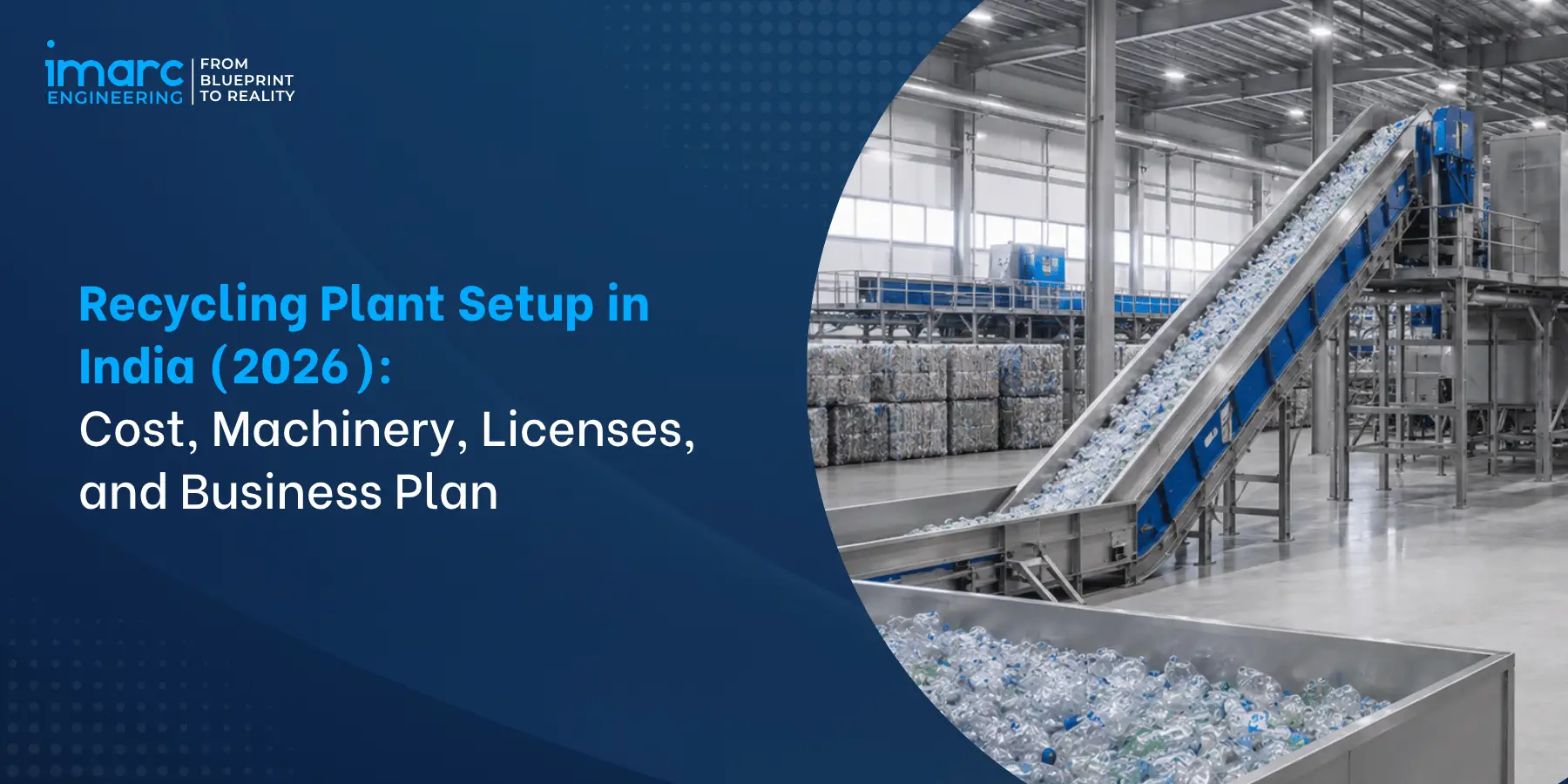
Recycling Plant Setup in India (2026): Cost, Machinery, Licenses, and Business Plan
Introduction
India's recycling and waste-management sector is at a structural inflection point in 2026. What was historically a fragmented, largely informal activity dominated by aggregators and small recyclers is now a formalised, EPR-anchored industrial category with binding compliance obligations on producers, importers, and brand owners across multiple waste streams.
Various laws and amendments related to waste management has collectively created a regulatory architecture under which formal recycling plant setup in India is no longer an optional opportunity, it is the binding mechanism through which EPR-obligated entities discharge their compliance, and it carries policy backing under Swachh Bharat Mission 2.0, AMRUT 2.0, and the broader circular-economy agenda.
The opportunity spans six principal waste streams including plastic, e-waste, lithium-ion and lead-acid batteries, end-of-life tyres, metal scrap, and construction and demolition (C&D) waste, each with its own feedstock economics, machinery profile, licensing path, and target customer base.
Drawing on IMARC Engineering's experience supporting feasibility study for recycling plant engagements, recycling plant DPR preparation, plant design, machinery selection, EPC project management, and EPR compliance in India advisory across all major waste streams, this guide lays out a structured framework for setting up a recycling plant in India in 2026.
It covers market opportunity, plant-type selection, an eight-stage setup process, land and infrastructure planning, machinery, licensing under CPCB, SPCB, and the EIA framework, cost and ROI, workforce and safety, DPR and feasibility components, common challenges, and a frequently-asked-questions section.
Table of Contents
- Introduction
- Why Recycling Plants Are Growing in India- The 2026 Market Opportunity
- Types of Recycling Plants- Profiles by Waste Stream
- Step-by-Step Recycling Plant Setup Process
- Land, Infrastructure, and Utilities Planning
- Machinery and Technology Selection
- Licenses, Regulatory Approvals, and Certifications
- Recycling Plant Cost Breakdown, ROI, and Business Model
- Workforce, Safety, DPR, and Feasibility Requirements
- Common Challenges in Recycling Projects and How to Mitigate Them
- Conclusion
1. Why Recycling Plants Are Growing in India- The 2026 Market Opportunity
The structural case for entering recycling plant setup in India in 2026 rests on four converging shifts that have transformed the demand-and-compliance landscape for formal recycling capacity over the past four years.
1.1 EPR Has Created Binding Demand for Formal Recycling Capacity
Extended Producer Responsibility (EPR), now mandated across plastic packaging, e-waste, batteries, waste tyres, and used oil under separate but parallel rules, has created binding annual recycling and recovery targets for producers, importers, and brand owners. These obligated entities must demonstrate compliance through registered recyclers and refurbishers on the CPCB online EPR portal, with EPR certificates issued against verified recycling.
CPCB recycling authorization has therefore become the gateway not only to plant operation but to monetisation of recycling capacity through the EPR certificate trade. The supply-side response is formal recycling capacity addition which has been visible across every waste stream since 2022.
1.2 Multi-Stream Regulatory Tightening
The 2022 wave of EPR notifications — Plastic Waste Management Rules amendment (February 2022), Battery Waste Management Rules (August 2022), E-Waste Rules (November 2022, effective April 2023), and Tyre EPR Guidelines (2022) has collectively tightened the compliance regime across the major waste streams. The single-use plastic ban from 1 July 2022 added a parallel demand pressure on recycled plastic alternatives.
The Vehicle Scrappage Policy 2021 and the End-of-Life Vehicles regulations notified under the Environment (Protection) Act framework have begun to formalise metal, tyre, and battery recycling demand from the automotive end-of-life stream. The net effect is multi-stream regulatory pull that did not exist five years ago.
1.3 Urban Waste Generation Trajectory and Policy Backing
India's urbanisation trajectory translates directly into rising municipal solid waste, plastic, e-waste, and C&D waste generation across Tier-1, Tier-2, and increasingly Tier-3 cities. Swachh Bharat Mission 2.0 (Urban), notified in October 2021 with an outlay of INR 1.41 lakh crore over five years, includes specific allocations for solid waste management, plastic and legacy-waste remediation, and circular-economy infrastructure.
AMRUT 2.0 and the National Mission on Sustainable Habitat reinforce the urban-infrastructure side. State-level circular-economy and recycling policies in Maharashtra, Tamil Nadu, Karnataka, Gujarat, and several others add capital and operational incentives at the state layer.
1.4 Strategic Material Recovery
Beyond environmental compliance, recycling has emerged as a strategic source of critical and recovered materials. Lithium-ion battery recycling in India is directly tied to the country's critical minerals strategy and to the PLI ACC Battery Storage Scheme, recycled lithium, cobalt, nickel, and manganese are increasingly part of the domestic feedstock outlook. E-waste recycling recovers gold, silver, copper, palladium, and rare earth elements. Tyre recycling produces crumb rubber, reclaimed rubber, and pyrolysis oil. Metal recycling, particularly from end-of-life vehicles, contributes to the steel and non-ferrous metal supply chain. Material recovery economics are increasingly an investment thesis in their own right, not merely a compliance outcome.
2. Types of Recycling Plants- Profiles by Waste Stream
The Indian recycling opportunity is segmented across six principal waste streams, each with its own feedstock economics, machinery profile, licensing requirement, and customer base. The summary below profiles all six and provides the strategic considerations that differentiate them, essential context before any recycling business plan in India is locked.
| Waste Stream | Principal Outputs | Key Regulatory Framework | Plant Profile |
|---|---|---|---|
| Plastic | PET flakes, HDPE/LDPE/PP granules, recycled pellets, RDF | Plastic Waste Management Rules 2016 (EPR Amendment 2022) | Modest-to-mid CAPEX; widely scalable; EPR-anchored |
| E-Waste | Recovered metals (Au, Ag, Cu, Pd), plastics, glass, components | E-Waste (Management) Rules 2022 | Higher technology and safety bar; EPR-anchored |
| Battery (Li-ion & Lead-Acid) | Lithium salts, cobalt, nickel, manganese (Li-ion); lead, polypropylene (lead-acid) | Battery Waste Management Rules 2022 | Hazardous waste handling; high CAPEX; high-value outputs |
| Tyre | Crumb rubber, reclaimed rubber, steel wire, pyrolysis oil and carbon | Tyre EPR Guidelines 2022; Hazardous and Other Wastes Rules 2016 | Mid CAPEX; pyrolysis adds value but technology risk |
| Metal Scrap | Re-meltable ferrous and non-ferrous metal | Vehicle Scrappage Policy 2021; ELV regulations; Hazardous Waste Rules | Volume-led; depends on auto-end-of-life and industrial scrap flow |
| C&D Waste | Recycled aggregates, manufactured sand, recycled bricks | Construction and Demolition Waste Management Rules 2016 | Site-and-volume dependent; municipal-tender-driven |
2.1 Plastic Recycling
Plastic recycling spans mechanical recycling (the dominant route in India today is washing, shredding, granulation, and pelletisation of PET, HDPE, LDPE, PP, and other polymers), chemical recycling (depolymerisation, glycolysis, pyrolysis for select streams), and energy recovery (refuse-derived fuel for cement kilns).
The EPR amendment of 2022 categorises plastic packaging into four categories with annual recycling, reuse, and end-of-life management targets. Plastic recycling plant cost sits at the lower end of the recycling CAPEX structure for mechanical plants and rises materially for chemical recycling and advanced pyrolysis facilities.
2.2 E-Waste Recycling
An e-waste recycling plant in India typically combines manual or semi-automated dismantling of end-of-life electronics, mechanical separation of materials, and downstream metal recovery through partner refiners (precious metal refining is generally specialist downstream activity rather than in-plant).
The E-Waste Rules 2022 strengthened the EPR framework and introduced refurbisher and recycler categories on the CPCB portal. Capital intensity is higher than basic plastic recycling because of the safety, environmental control, and traceability requirements; value recovery per tonne is also materially higher given the precious-metal content of printed circuit boards and electronic components.
2.3 Battery Recycling
Battery recycling in India covers two principal sub-streams, lead-acid batteries (a mature, well-formalised activity) and lithium-ion batteries (emerging rapidly with the EV ecosystem and PLI ACC roll-out). Battery recycling plant setup in India for lithium-ion typically involves mechanical pre-processing (discharge, dismantling, shredding) followed by hydrometallurgical or pyrometallurgical recovery of lithium, cobalt, nickel, and manganese.
The Battery Waste Management Rules 2022 mandate EPR for all battery categories and create a structured supply path from collection through recycling. CAPEX is at the higher end of the recycling spectrum given the hazardous-waste handling, environmental controls, and downstream chemistry.
2.4 Tyre Recycling
End-of-life tyre recycling produces crumb rubber, reclaimed rubber, steel wire, and (in pyrolysis routes) carbon black and pyrolysis oil. Mechanical crumb-rubber plants are mid-CAPEX and have established markets in road construction, sports flooring, rubber goods, and as part of modified bitumen. Pyrolysis routes add complexity, technology risk, and approval friction but deliver higher-value outputs. The Tyre EPR Guidelines 2022 anchor formal recycling demand from tyre producers and importers.
2.5 Metal Scrap Recycling
Metal scrap recycling in India (primarily ferrous (steel) and non-ferrous (aluminium, copper, lead)) has historically been the largest and most formalised of India's recycling categories, dominated by induction furnace and electric arc furnace operators and non-ferrous re-melters.
The Vehicle Scrappage Policy 2021 and the subsequent End-of-Life Vehicles regulations are formalising the ELV-to-metal flow that has historically been informal. Authorised vehicle scrapping facilities (RVSFs) are now a defined category requiring registration.
2.6 C&D Waste Recycling
Construction and demolition waste recycling produces recycled coarse and fine aggregates, manufactured sand, and recycled bricks, used in non-structural concrete, road sub-base, and paving applications. The Construction and Demolition Waste Management Rules 2016 require urban local bodies to set up processing facilities or empanel private operators. C&D recycling business models are typically tied to municipal contracts and to specific large-city demolition project pipelines, making location strategy more concentrated than for other waste streams.
3. Step-by-Step Recycling Plant Setup Process
A disciplined recycling plant setup in India programme unfolds across eight sequential stages, ideally spread over 10-18 months from kickoff to commercial operation. The framework below addresses how to set up a recycling plant in India across all six waste streams; specific durations vary by plant type, capacity, and approval complexity.
| Stage | Activity | Owner | Typical Calendar |
|---|---|---|---|
| 1. Strategy and waste-stream selection | Segment choice, capex envelope, target market | Promoter + advisor | Month 1 |
| 2. Feasibility study and DPR | Market, feedstock, technology, financial modelling | Advisor + promoter | Month 1-3 |
| 3. Site selection and land acquisition | Land, location, utility availability, zoning | Promoter + advisor | Month 2-4 |
| 4. Detailed engineering and machinery selection | Layout, P&IDs, equipment specs, vendor selection | Engineering + procurement | Month 4-6 |
| 5. Approvals and licenses | CPCB EPR, SPCB CTE/CTO, EC, factory licence, fire NOC | Compliance + advisor | Month 4-8 |
| 6. Construction and equipment installation | Civil/mechanical/electrical works, equipment installation | Project execution team | Month 6-14 |
| 7. Trial run and commissioning | Hot trials, capacity validation, EPR registration | Plant team + EPC | Month 13-15 |
| 8. Operational ramp-up | Sustained operation, feedstock scale-up, EPR certificate generation | Plant head | Month 14-18 |
3.1 Stage 1- Strategy and Waste-Stream Selection
Set out the strategic objective in measurable terms — target waste stream, planned annual processing capacity, target customers (EPR-obligated entities, downstream off-takers, direct end-users), capex envelope, and timeline tolerance. Test the segment-fit against feedstock availability in the planned location and the founder team's technical capability. Lock the strategic frame before commissioning detailed work; mid-project waste-stream pivots are extremely expensive.
3.2 Stage 2- Feasibility Study and DPR
Commission a structured recycling plant feasibility study and a corresponding recycling plant DPR (Detailed Project Report). The feasibility study covers market and demand analysis, feedstock mapping and contracting strategy, technology evaluation, plant layout concept, capex and opex modelling, financial projections, and risk assessment. The DPR consolidates the technical, financial, and regulatory components into the document required for term-loan applications, government subsidy claims, and statutory approvals.
3.3 Stage 3- Site Selection and Land Acquisition
Site selection must optimise across feedstock proximity, utility availability (power, water, effluent disposal options), road and logistics access, zoning compatibility (industrial estate, dedicated waste-management zone, or compatible industrial area), labour availability, and the state-level incentive stack. State-notified industrial estates and dedicated waste-management zones often offer pre-cleared utilities and streamlined approvals.
3.4 Stage 4- Detailed Engineering and Machinery Selection
Move from feasibility concept to detailed engineering — plant layout, P&IDs, electrical and instrumentation drawings, civil and structural drawings, pollution-control system design, and effluent treatment plant design. Run a structured recycling plant machinery selection process — shredders, granulators, washing lines, separation systems, pyrolysis reactors, hydrometallurgical units, or whatever the chosen waste stream requires — focused on execution capability, after-sales support, spare-parts availability, and life-cycle cost rather than lowest initial price.
3.5 Stage 5- Approvals and Licenses
Run the licensing workstream in parallel with detailed engineering. The principal approvals — Environmental Clearance under the EIA Notification 2006 (where applicable), Consent to Establish and Consent to Operate from the State Pollution Control Board, registration with CPCB under the relevant EPR framework, factory licence under the Factories Act 1948, fire safety NOC, electrical inspector approval, and hazardous waste authorization (where applicable) — must be sequenced into the construction calendar to avoid commissioning delays. Section 6 details each.
3.6 Stage 6- Construction and Equipment Installation
Execute civil, structural, mechanical, and electrical works in parallel with vendor-led equipment installation. The highest-risk activity is interface management between civil completion and equipment installation — particularly for plants with effluent treatment systems, pollution-control equipment, and integrated material-handling — where misaligned interfaces drive schedule slippage. A disciplined project management structure with shared site coordination is essential.
3.7 Stage 7- Trial Run and Commissioning
Move from cold commissioning through hot trials to performance guarantee testing. Validate against the design throughput, output quality (recycled material specifications), recovery rates, energy consumption, and emissions/effluent compliance. Register the operating plant on the CPCB EPR portal as soon as trial output meets the EPR-eligible specification — early registration accelerates the EPR-certificate revenue stream.
3.8 Stage 8- Operational Ramp-Up
Sustained operation requires reliable feedstock flow, stable output quality, EPR-certificate generation rhythm, and disciplined plant operations. Feedstock contracts secured during the feasibility stage now move into delivery; off-take agreements with downstream customers are activated; the plant moves from project mode into operations mode. Most plants reach steady-state OEE over 6-12 months of post-commissioning ramp-up.
4. Land, Infrastructure, and Utilities Planning
The physical setup parameters — recycling plant land requirements India, location, and utility profile — vary materially by waste stream. The framework below provides indicative ranges; precise sizing depends on annual capacity, in-plant material storage, pollution-control system footprint, and future-expansion provision.
| Waste Stream | Typical Land (acres) | Power Profile | Water and Effluent Profile |
|---|---|---|---|
| Plastic | 1-5 | Moderate | Moderate water; closed-loop wash systems |
| E-Waste | 2-5 | Moderate | Low water; dust and fume control critical |
| Battery (Li-ion) | 3-10 | High | Moderate water; effluent treatment essential |
| Tyre (mechanical) | 2-8 | Moderate-to-high | Low water; dust control critical |
| Metal scrap | 5-30+ | High (induction/EAF) | Cooling water; emissions control |
| C&D Waste | 5-15+ | Moderate | Dust suppression water |
4.1 Location Strategy
The dominant best location for recycling plant in India considerations are feedstock proximity (urban catchment areas for municipal-stream waste; auto-cluster proximity for ELV-derived streams; port proximity for imported feedstock where permitted), utility availability, zoning compatibility, road and logistics infrastructure, and the state-level incentive stack (capital subsidy, electricity duty exemption, stamp duty waiver, GST reimbursement under state circular-economy and industrial policies). Industrial estates and dedicated waste-management zones typically offer the most favourable combined profile.
4.2 Power, Water, and Effluent Treatment
Connected-load requirements scale with plant capacity and process intensity. Mechanical recycling lines (plastic granulation, tyre shredding, C&D crushing) have moderate but steady power demand. Hydrometallurgical battery recycling, induction-furnace metal recycling, and certain pyrolysis operations have materially higher and often peaky load profiles. Water demand varies similarly — plastic wash lines and effluent-generating chemistry require structured effluent treatment plants and (in many states) zero-liquid-discharge (ZLD) compliance. The pollution control system — wet scrubbers, bag filters, electrostatic precipitators, ETP, and (where applicable) ZLD — is itself a significant CAPEX line and a non-negotiable design element.
4.3 Other Utilities and Infrastructure
Compressed air, dust extraction and ventilation, fire-detection and suppression systems, weighbridges, material storage yards (covered and open as appropriate), workshop and maintenance facilities, and administrative blocks complete the infrastructure picture. Material storage planning is often under-sized in early designs — feedstock storage, work-in-progress, and finished-product storage need realistic days-of-coverage assumptions built into the layout from the outset.
5. Machinery and Technology Selection
Selecting the right recycling plant machinery is one of the highest-leverage decisions in any recycling project. The wrong choice locks in suboptimal throughput, output quality, and operating cost for the life of the plant. The brief below summarises the principal equipment categories by waste stream.
5.1 Plastic Recycling Machinery
A typical plastic recycling line comprises sorting (manual sorting belts, optical sorters, eddy-current and magnetic separators), shredding, washing (cold or hot wash systems with friction washers and decontamination steps), drying (mechanical dryers and centrifuges), agglomeration (for film), extrusion and pelletisation, and quality testing. PET recycling additionally requires specific decontamination steps for food-grade output. Chemical recycling routes use depolymerisation reactors, glycolysis or methanolysis systems, and downstream purification. Pyrolysis routes use rotary or batch reactors with downstream condensation and fractionation.
5.2 E-Waste Dismantling and Recovery Equipment
E-waste plants combine manual or semi-automated dismantling stations, mechanical shredding and granulation, eddy-current separation, electrostatic separation, density-based separation, and dust and fume control. Printed circuit board processing is typically a separate downstream activity — either in-house with precious-metal recovery equipment (which has very high CAPEX) or by contract with specialist refiners. Battery removal, CRT processing, and hazardous-component segregation are mandatory upstream steps.
5.3 Battery Recycling- Mechanical and Hydrometallurgical Equipment
Lithium-ion battery recycling typically begins with discharge (to render cells safe), mechanical pre-processing (dismantling, crushing/shredding in inert atmosphere, separation of plastics, metals, and the active-material 'black mass'), followed by hydrometallurgical recovery (leaching with acid or chelating agents, solvent extraction, precipitation, and crystallisation of cobalt, nickel, manganese, and lithium salts). Pyrometallurgical routes (smelting) are simpler upstream but recover fewer of the high-value elements. Lead-acid battery recycling uses a relatively mature smelting-and-refining flow.
5.4 Tyre, Metal, and C&D Recycling Equipment
Tyre recycling lines include bead removal, primary shredding, secondary granulation, magnetic separation of steel wire, fibre separation, and (for crumb-rubber output) fine grinding. Pyrolysis adds rotary or batch reactors with downstream oil-gas-carbon separation. Metal scrap recycling uses shredders, balers, induction furnaces, electric arc furnaces, and downstream casting equipment. C&D waste plants use jaw and impact crushers, screens, washing systems, magnetic separators, and (in some configurations) wet processing for higher-quality recycled aggregates.
6. Licenses, Regulatory Approvals, and Certifications
Navigating the licensing and approvals regime is non-negotiable for any recycling plant operator. The framework has multiple layers, central environmental clearance, state pollution-control consents, EPR registration with CPCB, factory licensing, fire safety, electrical, and (for hazardous waste streams) additional authorizations. Sequencing these approvals correctly is one of the most common timeline determinants in recycling projects.
6.1 CPCB EPR Registration and Recycling Authorization
Under each of the EPR-anchored rules (Plastic Waste Management 2022 amendment, E-Waste Rules 2022, Battery Waste Management Rules 2022, Tyre EPR Guidelines 2022, Used Oil EPR Guidelines 2023), recyclers must register with the Central Pollution Control Board through the dedicated online EPR portal.
CPCB EPR registration for recyclers is plant-specific, capacity-specific, and conditional on meeting infrastructure, technology, and environmental compliance standards. Registered recyclers generate EPR certificates on verified recycling that are tradable with EPR-obligated producers, importers, and brand owners. CPCB recycling authorization is therefore both a compliance requirement and a revenue enabler.
6.2 SPCB Consent- CTE and CTO
Consent to Establish (CTE) from the relevant State Pollution Control Board is required before plant construction. Consent to Operate (CTO) is required before commercial operation. CTE/CTO applications cover plant design, pollution-control infrastructure, effluent and emission parameters, hazardous-waste handling, and proposed monitoring framework. SPCB consents are renewed periodically and are conditional on continued compliance with the prescribed standards.
6.3 Environmental Clearance Under the EIA Notification 2006
Environmental Clearance under the EIA Notification 2006 (and subsequent amendments) is required for projects above specified thresholds, typically depending on capacity, location (proximity to ecologically sensitive areas), and process type. The EC process involves screening (Category A or B), terms of reference issuance, environmental impact assessment study, public consultation (for most categories), and final clearance by the appropriate authority (MoEFCC for Category A; SEIAA for Category B). Smaller plants in industrial estates may be eligible for general-condition relaxations.
6.4 Factory Licence and Other Statutory Approvals
Factory licence under the Factories Act 1948 from the state factory inspectorate is mandatory for any plant employing the threshold worker numbers under the Act. Additional statutory approvals include fire safety NOC from the state fire services, electrical inspector approval, building plan approval from the local urban authority, water connection and sewerage NOC, and (for hazardous-waste-handling plants) Hazardous Waste Authorization under the Hazardous and Other Wastes (Management and Transboundary Movement) Rules 2016.
6.5 Other Recycling-Specific Approvals
For battery and e-waste recycling, additional approvals around transboundary movement (if imported feedstock is involved), labelling, traceability, and end-of-life material tracking apply. For metal recycling and ELV processing, registration as an Authorized Vehicle Scrapping Facility (RVSF) under the Vehicle Scrappage Policy framework applies. For C&D waste, contractual alignment with the urban local body or municipal authority is typically required where municipal feedstock is the principal input.
7. Recycling Plant Cost Breakdown, ROI, and Business Model
Understanding the cost structure, the realistic ROI profile, and the revenue model is central to investment decisions. The framework below sets out recycling plant cost in India buckets and the principal variables that drive total project economics; precise figures vary materially by waste stream, capacity, technology choice, and the realised incentive and EPR-certificate revenue stack.
7.1 CAPEX Buckets
A recycling plant CAPEX template typically tracks six buckets. First, land and site development. Second, civil and structural construction comprising processing bay, storage yards, utility blocks, ETP/pollution-control infrastructure, administrative areas. Third, plant and machinery (primary processing equipment, secondary processing equipment, material handling, and quality testing).
Fourth, pollution control infrastructure which includes wet scrubbers, bag filters, ESPs, effluent treatment plant, ZLD (where required), continuous emission monitoring systems (CEMS). Fifth, instrumentation, controls, weighbridge, and IT. Sixth, project development and pre-operative like design fees, regulatory approvals, certifications, project management, commissioning, working capital.
7.2 Indicative CAPEX Profile by Plant Type
| Plant Type | Indicative CAPEX Position | Largest CAPEX Bucket | Notes |
|---|---|---|---|
| Plastic recycling (mechanical) | Lower end of recycling CAPEX | Plant and machinery | Modular; capacity-scalable |
| E-Waste recycling | Mid spectrum | Pollution control + dismantling | Higher safety and EHS infrastructure cost |
| Battery recycling (Li-ion) | Higher end of spectrum | Hydrometallurgical chemistry + safety | Hazardous-waste handling drives cost |
| Tyre recycling (mechanical) | Mid spectrum | Plant and machinery | Pyrolysis routes materially higher |
| Metal scrap (induction/EAF) | Higher end of spectrum | Furnace + pollution control | Scale-driven economics |
| C&D waste recycling | Lower-to-mid spectrum | Crushers and screens | Typically mobile/semi-mobile possible |
7.3 OPEX Structure and Revenue Model
Operating cost is dominated by feedstock procurement (which varies from negative, being paid to take certain waste streams, to positive procurement cost depending on stream and market), energy and utilities, labour, consumables and reagents (for hydrometallurgical and chemical recycling), pollution-control consumables, and maintenance.
Revenue typically combines three streams: sale of recovered material to downstream customers, EPR-certificate income from registered recycling, and (in select cases) tipping fees from waste generators.
7.4 ROI, Payback, and Business Model
Payback periods on recycling plant payback period in India analyses vary materially by waste stream, scale, technology, and the realised stack of EPR-certificate income and state incentives. Lower-CAPEX mechanical plants (plastic, tyre mechanical, C&D) typically reach operational break-even faster than higher-CAPEX hydrometallurgical or smelter-based facilities, but the unit margins differ correspondingly.
A robust business model is built around contracted feedstock supply, contracted off-take or established spot markets for output, a defensible EPR-certificate-income stream, and disciplined working-capital management. The right recycling business plan in India models multiple scenarios and stress-tests for feedstock-price volatility, output-price cyclicality, and EPR-certificate-market evolution.
8. Workforce, Safety, DPR, and Feasibility Requirements
Workforce planning, EHS infrastructure, and a robust DPR-and-feasibility document set are foundational deliverables for any recycling project. Each is often under-resourced in early-stage planning and over-corrected at high cost during commissioning.
8.1 Workforce Requirements
Recycling plant workforce profiles span unskilled and semi-skilled labour (manual sorting, material handling, basic operations), skilled operators (machine operators, line supervisors, quality inspectors), and technical and managerial staff (plant manager, EHS manager, maintenance engineer, electrical and instrumentation engineers, laboratory and quality assurance, EPR compliance officer, plant accountant, and security personnel). The right balance varies by waste stream, e-waste and battery recycling carry higher skill density than mechanical plastic or C&D operations.
8.2 Safety, Environment, Health, and Worker Welfare
EHS is non-negotiable in recycling operations given the inherent hazards, sharp edges and pinch points, dust exposure, chemical exposure (for chemistry-based recycling), high-voltage equipment, hot surfaces, fire and explosion risk (notably in pyrolysis and battery operations), and heavy material handling.
The plant design must integrate personal protective equipment (PPE) stations, ventilation and dust extraction, fire detection and suppression, emergency response infrastructure, occupational health surveillance, and Factories Act-compliant worker welfare facilities.
8.3 DPR Structure
A DPR for recycling plant in India typically covers: executive summary; promoter and company background; project rationale and market analysis; feedstock and demand analysis; technology and process description; plant layout and infrastructure; machinery and equipment list with vendor short-listing; utilities and pollution control; regulatory approvals and licensing roadmap; project schedule; manpower plan; CAPEX with detailed breakdown; OPEX projections; revenue projections; financial statements (P&L, balance sheet, cash flow); financial ratios and viability analysis; risk assessment and mitigation; and annexures with vendor quotations, regulatory documents, and supporting analysis. The DPR is the operational document on which term-loan applications, subsidy claims, and statutory approvals are evaluated.
8.4 Feasibility Study Components
A pre-DPR feasibility study is typically structured around six components: market and demand viability (is there sufficient feedstock and downstream demand?), technical viability (is the chosen technology proven at the planned scale?), financial viability (does the project clear required return thresholds across base, upside, and downside cases?), regulatory viability (are all required approvals achievable in the planned timeline?), location viability (does the chosen site meet all operational requirements?), and risk viability (are the identified risks acceptable and mitigable?). The output of the feasibility study is a go/no-go recommendation and, where positive, the input set for the DPR.
9. Common Challenges in Recycling Projects and How to Mitigate Them
The challenges below are the recurring patterns we see across recycling plant projects, and the ones most likely to compromise project economics, extend timelines, or threaten viability. Each is paired with the discipline or design choice that mitigates it.
9.1 Feedstock Reliability and Quality Variability
The most common failure mode is committing CAPEX against an assumed feedstock flow that has not been contractually secured, or against a feedstock quality profile that has not been tested against the planned process.
The pattern: plant capacity is over-built relative to actual feedstock availability, or the process struggles with feedstock variability.
Discipline: secure 60-80% of design-capacity feedstock through binding contracts before financial close; commission feedstock characterisation studies at the feasibility stage; design process flexibility into the plant for realistic feedstock variation.
9.2 EPR-Certificate Market Volatility
EPR-certificate prices are market-determined and have shown material volatility as the framework matures across waste streams.
The pattern: financial models assume stable EPR-certificate prices and the realised average diverges materially.
Discipline: stress-test the project at multiple EPR-price scenarios; structure long-term offtake agreements with EPR-obligated producers where possible; ensure the underlying recovered-material economics work even at conservative EPR pricing assumptions.
9.3 Technology Choice and Obsolescence Risk
Recycling technology is evolving rapidly, particularly in lithium-ion battery recycling, advanced plastic recycling (chemical and pyrolysis routes), and tyre pyrolysis.
The pattern: locked technology choices become sub-optimal within 3-5 years as competing routes mature.
Discipline: modular plant design that allows incremental technology refresh; vendor selection that includes technology-roadmap visibility; budget provision for mid-life technology upgrades.
9.4 Working Capital Cycle and Cash Flow
Recycling operations have non-trivial working capital cycles, feedstock procurement (often immediate payment), processing time, finished-goods inventory, customer credit periods, and EPR-certificate verification and trading cycles all consume cash. The pattern: working-capital requirements are under-estimated in financial models, leading to liquidity stress in the operational ramp-up phase.
Discipline: model working-capital cycles realistically by stream; build adequate working-capital facilities into the financing structure; manage feedstock inventory and finished-goods inventory tightly.
9.5 Informal Sector Competition for Feedstock
The informal sector continues to handle a material share of plastic, e-waste, metal, and tyre feedstock in many regions, often offering simpler logistics for waste generators.
The pattern: formal recycling capacity is built on the assumption that EPR will divert feedstock to formal players, but the diversion is slower than projected.
Discipline: structured feedstock contracting with EPR-obligated producers (whose compliance requires formal channelisation); aggregator partnerships; municipal contract structures where applicable; realistic ramp-up assumptions in financial models.
9.6 Output Price Cyclicality
Recovered material prices, recycled plastic pellets, recovered metals, crumb rubber, recycled aggregates, track underlying commodity and virgin-material price cycles.
The pattern: project economics that look attractive at peak prices look thin at trough prices.
Discipline: model multiple price scenarios; structure off-take agreements with floor-price mechanisms where possible; maintain operational flexibility to flex output mix where the process allows.
Conclusion
India’s recycling and waste-management sector in 2026 has evolved into a structured, EPR-driven industrial category backed by regulation, capital investment, and growing formal demand. Rising focus on CPCB EPR registration for recyclers, material recovery, and organized waste processing has made waste management plant setup and recycling plant setup in India increasingly attractive across segments such as tyre recycling plant in India, lithium-ion battery recycling in India, metal scrap recycling plant in India, and C&D waste recycling in India.
For entrepreneurs and investors evaluating how to set up a recycling plant in India, success depends on integrating feedstock sourcing, technology selection, licensing, and engineering from the outset. Key considerations include recycling plant license requirements in India, recycling plant land requirements in India, and identifying the best location for recycling plant in India based on waste availability and logistics.
A strong recycling plant project report, backed by engineering-led planning and professional recycling plant EPC services or recycling plant turnkey solutions, is increasingly the difference between scalable execution and operational failure.
STILL HAVE ANY DOUBTS?
Contact our team to commission a recycling plant feasibility study and DPR, waste-stream selection, location and incentive optimisation, machinery and technology evaluation, licensing roadmap, and an executable plant setup roadmap tailored to your strategic objectives.
Frequently Asked Questions
The ideal waste stream depends on feedstock availability, downstream demand, capital budget, technical capability, and EPR alignment. Plastic and C&D recycling plants offer lower CAPEX entry, while battery and e-waste recycling provide higher margins with greater technical complexity. A feasibility study should compare multiple streams before investment.
The best location for a recycling plant in India is typically driven by feedstock availability and logistics economics. Metro regions suit plastic, e-waste, and C&D recycling, while automotive hubs like Pune, Sanand, Chennai, and Pithampur are stronger for tyre, battery, and metal recycling operations.
Recycling plant setup cost in India varies significantly by waste stream, plant capacity, automation level, and pollution-control infrastructure. Plastic and C&D recycling projects sit at the lower end, while lithium-ion battery recycling and integrated metal recycling plants require substantially higher CAPEX investment.
Recycling plants in India are typically financed through promoter equity, bank term loans, equipment financing, and state industrial subsidies. MSME projects may qualify for PMEGP support, while larger recycling ventures can access SIDBI green finance and institutional sustainability-linked funding.
Key recycling plant license requirements in India include CPCB EPR registration, SPCB Consent to Establish and Operate, factory licence, fire NOC, and hazardous waste authorization where applicable. Additional approvals depend on the waste category, project scale, and plant location.
Registered recyclers generate EPR certificates through the CPCB portal based on verified recycling output. Producers, importers, and brand owners purchase these certificates to meet compliance obligations, making EPR revenue an important commercial component for organized recycling businesses.
Environmental Clearance under EIA regulations is required only for recycling projects above specified thresholds or within ecologically sensitive zones. Smaller recycling plants may not require full EC approval but still need SPCB consent, factory licences, and CPCB EPR registration.
IMARC Engineering provides end-to-end recycling plant EPC services, including feasibility studies, DPR preparation, plant design, machinery selection, licensing support, CPCB EPR registration, EPC execution, commissioning, and post-implementation operational advisory across major recycling sectors.
IMARC Engineering supports plastic recycling, e-waste dismantling, lithium-ion and lead-acid battery recycling, tyre recycling, metal scrap recycling, ELV processing, and C&D waste recycling projects. The team also advises on hazardous waste, biomedical waste, and used-oil management facilities.
Recent Post
Trusted by Industry Leaders
We partner with global enterprises and ambitious businesses across sectors to deliver operational excellence, strategic insights, and sustainable growth through integrated solutions.




Success in Their Words
Real feedback from clients across industries. Discover how our solutions delivered measurable impact and operational excellence.

I wanted to express my sincere appreciation for your efforts in handling this matter. Your dedication and commitment have been truly commendable, and it is evident that you have put in tremendous hard work and expertise into resolving the issues at hand. We are greatly interested in continuing our collaboration with you in the future, as your professionalism and reliability have made you a trusted partner. Thank you once again for your invaluable contribution. We look forward to strengthening our partnership ahead.

It has been a pleasure working with the IMARC team. The insights provided were structured, clear, and highly valuable, helping us strengthen both our technical and financial planning with confidence. We deeply appreciate the team’s professionalism, responsiveness, and attention to detail throughout the engagement. Every requirement was well understood and effectively incorporated, resulting in a comprehensive and actionable output. Overall, our experience has been excellent, and I would gladly recommend IMARC to organizations seeking a reliable research partner.

Your service is truly exceptional. Working with the IMARC team has been a seamless and professional experience. The clarity of communication, responsiveness to queries, and consistent support at every stage made the entire engagement highly efficient. The insights shared were well-structured, practical, and perfectly aligned with our requirements, helping us make informed decisions with confidence. Overall, the dedication and professionalism demonstrated by your team stand out, and I would be glad to recommend IMARC as a reliable and trustworthy research partner.

IMARC did an outstanding job in preparing our study. They were punctual, precise, and consistently responsive throughout the entire process. The team delivered all the data we required in a clear, well-organized, and highly professional format. Their strong attention to detail, combined with their ability to meet every deadline without compromising quality, truly set them apart. Overall, their reliability and commitment made them an exceptional partner for our project, and we would gladly work with them again in the future.

IMARC made the whole process incredibly easy from start to finish. Everyone I interacted with via email was polite, professional, and straightforward to deal with, always keeping their promises regarding delivery timelines and remaining consistently solutions-focused. From my very first contact, I appreciated the professionalism and support shown by the entire IMARC team. I highly recommend IMARC to anyone seeking timely, affordable, and reliable information or advice. My experience with IMARC was excellent, and I truly cannot fault any aspect of it.

I’d like to express my sincere gratitude for the excellent work you accomplished with the study. Your ability to quickly understand our requirements and deliver high-quality results under tight timelines truly reflects your expertise, exceptional work ethic, and unwavering commitment to your customer’s success. The professionalism and responsiveness you demonstrated throughout the process made a significant difference. Our entire team and company are incredibly thankful for your dedication, reliability, and support. Once again, thank you for your outstanding contribution.