Manufacturing
November 10 2026
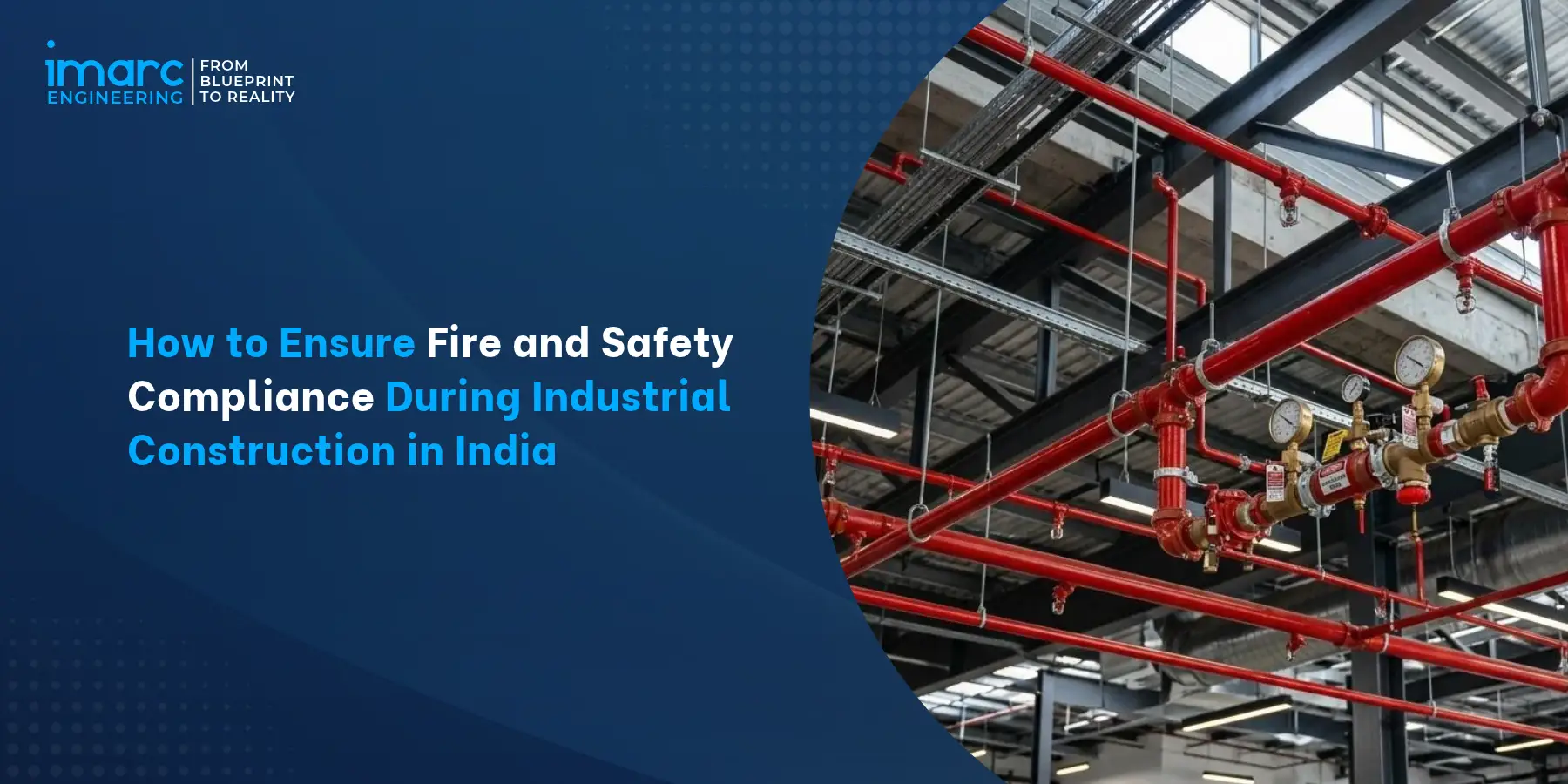
How to Ensure Fire and Safety Compliance During Industrial Construction in India
Introduction
For manufacturing plant owners, industrial developers, EPC contractors, and project managers evaluating fire and safety compliance during industrial construction in India in 2026, the starting point is recognizing that construction-phase safety is a distinct discipline from permanent-facility fire protection.
The site is dynamic, workers are mobile, hot work is widespread, temporary electrical installations are everywhere, and combustible materials are stored next to welding operations. Construction-phase incidents can injure workers and delay projects or push up their cost, which is why safety has to be managed as a system from site mobilisation onwards.
Scope of this Guide
This guide walks through industrial construction safety compliance from regulatory framework through responsibilities, fire prevention, permit-to-work systems, worker safety, inspection checklists, documentation, incident response, and chemical/pharmaceutical sector-specific considerations - calibrated to the OSH Code 2020 (in force from 21 November 2025, consolidating the Factories Act 1948, BOCW Act 1996 and other labour statutes) and the OSH (Central) Rules, 2026 notified in May 2026, the Code on Social Security 2020 for BOCW cess and construction-worker welfare, NBC 2016 Part 7, state fire services legislation, and the BIS safety codes current as of October 2026.
State rules under the labour codes are at different stages of notification, so state-specific requirements should be confirmed for each project location. Permanent facility fire protection design and standalone Fire NOC applications are covered elsewhere.
Table of Contents
- Why Fire and Safety Compliance During Industrial Construction in India Matters in 2026
- Regulatory Framework for Fire and Safety Compliance During Industrial Construction in India
- Project Owner, Contractor and Safety Officer Responsibilities on Industrial Construction Sites in India
- Fire Prevention and Hot Work Permit Systems for Industrial Construction in India
- Worker Safety: Working at Height, Lifting, Excavation, Confined Spaces and PPE Compliance for Industrial Construction in India
- Construction Fire and Safety Inspection Checklist for Industrial Projects in India
- Safety Documentation, Incident Reporting and Corrective Action for Industrial Construction in India
- Chemical and Pharmaceutical Plant Construction Safety and EPCM Support in India
- Conclusion
1. Why Fire and Safety Compliance During Industrial Construction in India Matters in 2026
Four drivers make disciplined fire and safety compliance strategically important for industrial construction in India in 2026.
1.1 Construction-Phase Incident Exposure
Industrial construction sites concentrate the conditions for fire and injury - hot work on structural steel, temporary wiring across wet floors, flammable solvents and gas cylinders alongside welding, scaffolding and work at height, excavation adjacent to live services, and heavy lifting over active work zones. Construction site fire safety India is a continuous-management discipline, not a one-time Fire NOC event.
1.2 Statutory Accountability Under OSH Code 2020
The Occupational Safety, Health and Working Conditions Code, 2020, in force from 21 November 2025, consolidates the Factories Act 1948, the Building and Other Construction Workers (Regulation of Employment and Conditions of Service) Act 1996, the Contract Labour (Regulation and Abolition) Act 1970, and other labour statutes. It assigns duties to several parties rather than to one: the employer of each worker (a term the Code extends to contractors), the principal employer, and the employer of the construction establishment.
The Code defines the principal employer of an establishment such as a construction site as the person responsible for its supervision and control, so the project owner is not automatically the principal employer; that depends on how the site is controlled and on the contract structure, and should be confirmed for each project. Non-compliance can attract penalties and, where an inspector finds imminent danger, prohibitory orders that halt work.
1.3 Owner Oversight of the Contractor Workforce
Even where the contractor is the legal employer, the project owner cannot treat contractor and subcontractor workers as solely the contractor's concern. Where the owner is the principal employer, the Code places specific obligations on it for contract labour; where it is not, the contract usually still gives it approval, audit and stop-work rights, and incident investigations examine owner oversight as well as contractor conduct.
Fatal and serious incidents attract investigation by the Inspector-cum-Facilitator under the OSH Code, ESIC or employees' compensation claims under the Code on Social Security 2020 and, where the project holds an environmental clearance, possible scrutiny of compliance with its conditions. Factory construction safety requirements on the owner's side therefore extend to vetting, inducting, inspecting, and documenting the entire tiered construction workforce, with each statutory duty assigned in the contract to the party that legally holds it.
1.4 Lender, Insurer, and Buyer Expectations
Project lenders often require Environmental, Health, and Safety (EHS) covenants and periodic audit evidence. Insurers underwriting Contractor's All Risk (CAR) policies may take site safety practices and loss history into account when setting terms. Export-oriented plants face buyer audits on worker safety. Treating safety as a documented management system during construction - not an informal site activity - unlocks these commercial pathways.
2. Regulatory Framework for Fire and Safety Compliance During Industrial Construction in India
The industrial site safety regulations India stack for the construction phase combines the OSH Code 2020 and its rules, the Code on Social Security 2020 for BOCW cess and construction-worker welfare, state fire services legislation, PESO rules, NBC 2016 Part 7, applicable BIS safety codes, and project-specific environmental clearance conditions.
| Instrument | What it governs during construction | Authority |
|---|---|---|
| OSH Code 2020; OSH (Central) Rules, 2026 and state rules | Establishment registration, safety and welfare duties, safety officers and committees, accident notices, inspections | Inspector-cum-Facilitator |
| Code on Social Security 2020 (Chapter VIII) | BOCW welfare cess (1% of construction cost) and construction-worker registration with welfare boards; ESIC and employees' compensation | State BOCW welfare board; ESIC |
| NBC 2016 Part 7 | Construction management practices and site safety: excavation, scaffolding, formwork, lifting, demolition, temporary works, fire precautions | Reference code applied through building bye-laws and contracts |
| State fire services legislation | Fire NOC approvals, fire tender access and interim fire safety measures, where the state rules specify them | State fire service (Chief Fire Officer) |
| Gas Cylinders Rules, 2016; Petroleum Rules, 2002 | Storage of compressed gas cylinders and petroleum fuels above exempted quantities | PESO |
| CEA (Measures relating to Safety and Electric Supply) Regulations, 2023 | Electrical installations on site, including temporary supply | Electrical Inspector |
| Environmental clearance conditions | Project-specific conditions, including dust control and construction waste | MoEF&CC regional office; State Pollution Control Board |
2.1 OSH Code 2020 and the Erstwhile BOCW Framework
The OSH Code 2020 replaced the Building and Other Construction Workers (Regulation of Employment and Conditions of Service) Act 1996, and the Code on Social Security 2020 replaced the Building and Other Construction Workers' Welfare Cess Act 1996. Three separate obligations follow, and they should not be confused:
| Obligation | Legal basis | Who acts | Notes |
|---|---|---|---|
| Establishment registration | OSH Code 2020, Section 3; applies to building or other construction work employing 10 or more workers | Employer of the construction establishment | Register through the appropriate government's portal |
| Construction-worker registration | Code on Social Security 2020, Chapter VIII | Eligible workers register as beneficiaries with the state BOCW welfare board; employers facilitate | Gives workers access to welfare board benefits |
| Welfare cess payment | Code on Social Security 2020, Section 100; rate notified at 1% of the cost of construction (S.O. 2322(E), 8 May 2026) | Employer incurring the cost of construction | Assessment and payment follow the state procedure |
Coverage needs to be checked project by project. The Code's definition of building or other construction work excludes work related to any factory or mine, and certain own-residence works below the prescribed cost. Construction inside an operating factory, such as a brownfield expansion, may therefore be treated as factory-related work under the Code's factory provisions rather than as building or other construction work, while a greenfield plant built before any factory exists is more likely to be covered. The Code's contract labour provisions apply separately where workers are engaged through contractors. Coverage should be settled with legal advice and the local authority's interpretation before registration and cess decisions are made.
2.2 NBC 2016 Part 7
The National Building Code of India 2016 Part 7 - Construction Management, Practices and Safety - is the main technical reference for construction-site safety, covering excavation, scaffolding, formwork, lifting, demolition, temporary works, electrical safety on site and fire precautions during construction. The NBC is a model code: its provisions become enforceable only where they are adopted through applicable laws, building bye-laws, development control regulations, approval conditions or contracts, so the project should state which parts it adopts. NBC 2016 Part 4 (Fire and Life Safety) is primarily for permanent-facility design but informs construction-phase fire planning, such as fire tender access and early provision of firefighting water.
2.3 State Fire Services Rules
Fire services are a state subject, and each state or union territory has its own fire services legislation and rules - for example, the Maharashtra Fire Prevention and Life Safety Measures Act 2006, the Gujarat Fire Prevention and Life Safety Measures Act 2013 and the Delhi Fire Service Act 2007. Construction-phase provisions such as temporary fire points, fire tender access, combustible storage and interim measures until permanent systems are commissioned differ by state and building category, so they must be confirmed with the local fire authority.
Whether a Fire NOC is needed, and at which stages (for example, a provisional approval with the building plan and a final NOC before occupancy), depends on the state, the building's height and occupancy classification, the industrial use and the approval route, so the requirement should be mapped for each project rather than assumed.
2.4 Applicable BIS Safety Codes
BIS standards apply to a construction activity only where a statute or rule, an approval condition, the contract specification or the owner's site standard invokes them; no standard is automatically mandatory for every activity. The codes most often referenced for construction-site safety are listed below. Several are old, and some have been revised or issued in parts, so confirm the current edition and amendments on the BIS portal before citing a standard in contracts. Together with the OSH Code and its rules, the standards relevant to each activity form the operational specification for a construction fire prevention measures programme.
| Standard | Subject | Typically relevant when |
|---|---|---|
| IS 2190:2024 | Selection, installation and maintenance of fire extinguishers | Fire extinguishers are provided on site |
| IS 818 | Safety and health requirements in electric and gas welding and cutting | Welding or gas cutting is carried out |
| IS 3696 (Parts 1 and 2) | Safety code for scaffolds (Part 1) and ladders (Part 2) | Scaffolds or ladders are used |
| IS 4014 (Parts 1 and 2) | Steel tubular scaffolding: definitions and materials; safety regulations | Steel tubular scaffolding is erected |
| IS 7205 | Safety code for erection of structural steelwork | Structural steel is erected |
| IS 3764 | Safety code for excavation work | Excavation or trenching is carried out |
| IS 13416 (Parts 1-5) | Preventive measures against hazards at workplaces, including falling material and fall prevention | Building and demolition work exposes workers to these hazards |
| IS 2925 | Industrial safety helmets | Head protection is required |
| IS 3521 (issued in parts, including Part 1:2021) | Industrial safety belts and harnesses for fall protection | Work at height needs fall arrest or restraint |
| IS 5983 and IS 1179 | Eye protectors; eye and face protection during welding | Eye or face hazards are present |
| IS 15298 (Part 2):2016 | Safety footwear | Foot protection is required |
| IS 732:2019 and IS 3043 | Electrical wiring installations; earthing | Temporary or permanent electrical installations are built |
3. Project Owner, Contractor and Safety Officer Responsibilities on Industrial Construction Sites in India
Clear separation of safety responsibilities between the project owner, the main contractor, subcontractors and the on-site safety officer, together with a written record of which party is the employer and which is the principal employer under the OSH Code, is central to contractor safety compliance. Overlap or ambiguity creates compliance gaps that surface in incident investigations.
3.1 Project Owner Responsibilities
The project owner's statutory role depends on how the site is structured: it is the principal employer only where it is the person responsible for supervision and control of the establishment, and it is the employer of any workers it engages directly. Whatever its statutory role, the owner usually sets site-wide safety governance through the contract - approving the project safety plan, enforcing contractor pre-qualification against safety criteria, mandating safety induction, securing the approvals that fall to the owner, commissioning third-party safety audits, reviewing incident records, confirming that the liable party has assessed and paid the BOCW cess, and holding contractual stop-work authority for serious non-compliance.
3.2 Main Contractor Responsibilities
The main contractor is usually the employer of most workers on site and so holds direct statutory duties under the OSH Code, including registration, accident notices and welfare provisions where it is the employer of the construction establishment. Contractually, it is responsible for executing the project safety plan - deploying qualified safety personnel per site strength, implementing the permit-to-work system, maintaining daily safety inspections, enforcing PPE discipline, conducting toolbox talks, maintaining worker registers and competency records, running the fire-watch programme during hot work, maintaining fire extinguishers and emergency equipment, coordinating with the owner on incident reporting, and managing subcontractor safety performance.
3.3 Subcontractor Responsibilities
Subcontractors are employers of their own workers and hold the statutory duties that come with that role, while working within the main contractor's safety management framework. They are responsible for worker-level induction, task-level toolbox talks, work-permit compliance, PPE issue and replacement, tool and equipment safety certification (particularly lifting tackle, scaffolding components, power tools), near-miss reporting, and participation in root-cause analysis for incidents in their work scope.
3.4 Safety Officer Role and Responsibility Matrix
Statutory and contractual safety staffing should be kept separate. Under Section 22(2) of the OSH Code 2020, the employer must appoint safety officers for building or other construction work where 250 or more workers are ordinarily employed. The number of officers and their qualifications are prescribed by the appropriate government's rules - the OSH (Central) Rules, 2026 where the Central Government is the appropriate government, and state rules elsewhere - so the applicable rule should be checked for each site. Owners commonly go further through the contract, requiring a qualified safety officer or competent safety supervisor on smaller or high-risk sites and setting staffing levels by risk, shift pattern and number of work fronts. The matrix below separates who is accountable, who implements and who monitors each area; the final allocation should follow the statutory roles confirmed for the project and the contract.
| Area | Accountable | Implements | Monitors |
|---|---|---|---|
| Project HSE plan | Main contractor (owner approves) | Main contractor and subcontractors | Owner or owner's engineer |
| Statutory registration, notices and returns | Party holding the statutory role (employer or principal employer) | That party's site management | Owner or owner's engineer (compliance tracking) |
| Contractor pre-qualification | Owner | Owner, EPCM or PMC team | Owner's management review |
| Permit-to-work | Main contractor | Permit issuers and work supervisors | Safety officer; owner audits |
| Daily inspections and PPE | Main contractor | Subcontractor supervisors | Safety officer |
| Induction and toolbox training | Employer of each worker | Contractor and subcontractor supervisors | Safety officer |
| Incident notification and investigation | Employer of the injured worker (statutory notice) | Site management with the safety officer | Owner; Inspector-cum-Facilitator where notifiable |
| Safe work at task level | Each worker's supervisor | Workers (follow procedures, use PPE, report hazards) | Supervisors and safety officer |
4. Fire Prevention and Hot Work Permit Systems for Industrial Construction in India
Fire is one of the highest-consequence incident categories on industrial construction sites, although falls from height are widely reported as a leading cause of construction fatalities. A disciplined hot work permit system India alongside storage, housekeeping, and electrical safety controls addresses the most common ignition sources on site.
4.1 Hot Work Permit System
A hot work permit is a time-bound written authorisation for any work generating heat, flame, or sparks - welding, flame cutting, grinding, brazing, soldering, torch-applied roofing. The permit specifies the location, activity, duration (often a single shift, but the validity period is set by the approved site procedure), controls (removal or shielding of combustibles within the clearance radius set by the site hot work procedure, fire blankets, a fire-watch person with an extinguisher, suitable PPE), and post-work verification (a fire watch maintained for the period the procedure specifies after work stops).
Whether a permit is needed, the clearance distance, fire-watch arrangements and post-work monitoring should all follow the approved site procedure, applicable regulations, the insurer's requirements and the task risk assessment rather than a generic figure. Permits are closed by signed verification.
4.2 Flammable, Oxidising and Combustible Material Storage
Construction stores hold four hazard groups that need different controls: flammable liquids (paints, thinners, solvents, fuels); fuel gases (LPG, dissolved acetylene); oxidising gases (oxygen cylinders, which do not burn themselves but intensify a fire and must be kept apart from fuel gases, oil and grease); and ordinary combustible materials (timber formwork, packaging, polystyrene and other insulation, bitumen).
Storage is segregated by compatibility, bunded for liquids, ventilated and secured for cylinders, located away from hot work zones and signposted, with daily issue quantities limited to the shift requirement. PESO licensing depends on the substance and quantity.
Under Rule 44 of the Gas Cylinders Rules, 2016, possession for own use is exempt from licensing up to, for example, 25 cylinders (and no more than 200 kg in total) of flammable non-toxic gas, 25 cylinders of dissolved acetylene, 200 cylinders of non-flammable non-toxic gas such as nitrogen or argon, and 5 cylinders of toxic gas, with separate limits for LPG.
For petroleum, PESO guidance treats storage below 30 litres of Class A, 2,500 litres of Class B and 45 kilolitres of Class C as exempt from licensing under the Petroleum Rules, 2002, although Class C storage still needs a one-time approval. Confirm current limits and conditions with PESO for each site.
4.3 Temporary Electrical Safety
Temporary site electrical installations are a major fire and shock hazard. Protection should follow the temporary electrical design, the classification of equipment and tools, the CEA (Measures relating to Safety and Electric Supply) Regulations, 2023, IS 732:2019 wiring practice, IS 3043 earthing and the site risk assessment. Typical measures include residual current protection on circuits feeding portable tools and wet or outdoor areas, double-insulated or properly earthed tools, weatherproof distribution boards, cable routing that keeps cables off walking surfaces and wet floors, armoured cable or protected trenching for buried runs, earthing designed for DG sets and temporary transformers, lightning protection where the risk assessment calls for it, and lockout-tagout for electrical isolation. The installation should be designed, tested and inspected by competent persons, with approvals obtained where the regulations require them.
4.4 Fire Equipment and Emergency Access
Portable fire extinguishers selected and maintained per IS 2190:2024 are placed at hot work zones, electrical panels, fuel storage, and worker rest areas - typed to the expected fire class (Class A for ordinary combustibles, Class B for flammable liquids, Class C for flammable gases, Class D for combustible metals, Class F for cooking oils where a site canteen operates), with CO2 or other non-conductive extinguishers at electrical panels, since electrical fires are not a separate class under the Indian classification. Where the risk assessment, the insurer or the fire authority requires it, interim hydrants or standpipes fed from the site water supply provide firefighting water until the permanent system is commissioned. Fire tender access is maintained throughout construction - haul roads, muster points, and emergency assembly areas are planned from day one. Fire safety during construction is site-wide, not confined to the plant room.
4.5 Emergency Response and Evacuation
Every site needs a written emergency response plan, briefed at induction and updated as the layout changes. It should cover an alarm audible across the site (siren, air horn or public-address system) with a distinct evacuation signal; marked escape routes and muster points, with headcount checked against the day's gate or attendance records; an emergency contact list at the gate and site office, including the national emergency number 112, fire service 101, ambulance 108 (in most states), the nearest hospital and the owner's and contractor's emergency coordinators; trained fire wardens and first-aiders on every shift; first-aid and rescue equipment matched to site hazards, including work-at-height and confined-space rescue; arrangements to meet and guide the fire service at the gate; and evacuation and fire drills at the frequency set in the plan, with lessons recorded and acted on.
5. Worker Safety: Working at Height, Lifting, Excavation, Confined Spaces and PPE Compliance for Industrial Construction in India
Beyond fire prevention, construction site safety audit on industrial sites covers the high-consequence activities - working at height, lifting operations, confined space entry, excavation, and PPE discipline.
5.1 Working at Height
The height above which work-at-height controls apply should be taken from the applicable OSH rules, NBC 2016 Part 7 and the owner's site standard, and stated explicitly in the project HSE plan. Controls include scaffolding per IS 3696 and IS 4014, inspected by a competent person before first use, after alteration, damage or severe weather, and at the intervals set by the applicable rules and site procedure, with tags showing its status, fall-arrest system (full-body harness per IS 3521 with suitable anchor), edge protection and toe boards, debris nets, access via proper stair towers rather than ladders, work-at-height permit for roofing and tall-structure work, and competency training for all working-at-height workers. IS 13416 Parts 1 and 2 cover preventive measures against falling material and fall of persons.
5.2 Lifting Operations
Lifting operations use mobile cranes, tower cranes, forklifts, and chain hoists. Controls include lifting equipment with current examination certificates, qualified operator certification, rigger competency, lift plan for critical lifts (lifts above the share of rated capacity defined in the site lifting procedure, tandem lifts, blind lifts), tagline-controlled loads, exclusion zone under lifted load, wind-speed limit for crane operation, daily pre-use inspection logs, and periodic examination and certification of lifting machines and tackle by a competent person at the intervals prescribed under the OSH Code rules.
5.3 Excavation and Underground Services
Excavation near live underground services is one of the highest-risk activities on industrial sites, especially in brownfield expansions with buried power cables, process lines and drains. Before digging, the site should obtain and check service drawings, scan with cable and pipe locators, hand-dig trial pits to confirm locations, and issue an excavation permit that names isolations and safe digging methods near services.
During work, controls include sloping, benching or shoring designed for the soil and depth (IS 3764 and NBC 2016 Part 7 give guidance), keeping spoil, materials and plant back from the edge, barricading and lighting the excavation, safe access and egress, dewatering, atmospheric checks in deep or enclosed trenches, and inspection by a competent person at the start of each shift and after rain or any event affecting stability. Requirements should be aligned with the applicable rules and the task risk assessment.
5.4 Confined Space Entry
Confined spaces during industrial construction include tanks, vessels, pits, manholes, basements, and partially-enclosed structures. Entry requirements should follow the applicable rules and a task risk assessment; typical controls are a confined-space entry permit, atmospheric testing (oxygen, flammability, toxic gases) before and during entry, forced ventilation, standby attendant, retrieval equipment, two-way communication, and emergency rescue plan. Entry is prohibited without a current permit.
5.5 PPE Compliance
Site-wide PPE includes IS 2925 safety helmets, IS 5983 eye protectors (safety glasses), IS 1179 welding eye and face protection, IS 15298 safety footwear with protective toecaps, high-visibility jackets per site standard, cut-resistant gloves for handling steel, respiratory protection where dust or fume is present, and hearing protection in high-noise zones. PPE issue, inspection, replacement, and daily enforcement are documented. Workers without correct PPE do not enter the active work zone.
6. Construction Fire and Safety Inspection Checklist for Industrial Projects in India
A disciplined industrial construction safety checklist drives daily and weekly site walkdowns and produces documented evidence of compliance.
| Frequency | Key checkpoints | Responsible | Evidence |
|---|---|---|---|
| Daily | PPE, housekeeping, hot work permits and fire watch, scaffolding tags, ladders, electrical panels, extinguisher access, emergency routes, signage | Site safety officer, contractor supervisors | Walkdown log with photographs |
| Weekly | Full scaffolding inspection, lifting equipment logs, extinguisher pressure and seals, first-aid stock, earth continuity, RCD tests, fuel and solvent stores, confined-space equipment, toolbox talk coverage | Contractor safety team, verified by owner | Weekly inspection report |
| Monthly | Statutory compliance (cess, welfare board registration, ESIC), permit audit trail, incident log, PPE records, lifting certificates, training coverage, NC close-out | Owner safety lead; periodic third-party auditor | Audit report and action plan |
| Before statutory visits | Site condition and document pack: layout, permit log, incident records, worker registers, cess challans | Owner and main contractor | Inspection file |
6.1 Daily Walkdown Checkpoints
Daily walkdown checkpoints cover PPE compliance across workforce, housekeeping (debris clearance, trip hazards, cable routing), hot work in progress (permit current, fire watch present, extinguisher adjacent, combustibles cleared), scaffolding tags, ladder condition, electrical panel accessibility, fire extinguisher availability and accessibility, emergency route clearance, worker rest area hygiene, and signage visibility. Observations are logged with photographs.
6.2 Weekly Inspection Items
Weekly inspection items cover scaffolding full inspection and tag renewal, lifting equipment pre-use logs review, fire extinguisher pressure and seal check, first-aid box replenishment, check of emergency arrangements (alarms, routes, muster points), DG and temporary transformer earth continuity, RCD function test on temporary panels, fuel and solvent storage inspection, confined space equipment inventory, and training records against planned toolbox talks.
6.3 Monthly Audit Items
Monthly audits by the project safety officer and periodic third-party audits cover statutory compliance (BOCW cess payment, worker welfare board registration, EPFO/ESIC enrolment, hot work permit audit trail, incident log, non-conformance closure), permit-to-work system effectiveness, PPE issue records against workforce strength, validity of competent-person examination certificates for lifting equipment, safety training coverage, and corrective action close-out from the previous audit. Monthly audit findings feed the owner's governance review.
6.4 Statutory Inspection Preparation
Statutory inspections during construction include visits by the Factory Inspector (now the Inspector-cum-Facilitator under the OSH Code 2020), state Chief Fire Officer, state Electrical Inspector, state Pollution Control Board inspector for construction waste and air quality, and labour commissioner. Supervisors prepare the physical site and the documentation package - layout, permit log, incident records, worker registers, cess payment challans - for each inspection. Proactive preparation is central to fire safety compliance for factories at the construction stage.
7. Safety Documentation, Incident Reporting and Corrective Action for Industrial Construction in India
Rigorous construction safety documentation India turns on-site activity into verifiable evidence for the statutory authority, lender, insurer, and buyer audit.
7.1 Core Documentation Set
Records fall into two groups, and the distinction matters in inspections and investigations. Statutory records are those a law, rule, licence or approval requires; the exact list and formats depend on the applicable Central or state rules and the project's licences. Recommended project HSE records are not all required by law, but they are the evidence that controls were planned and applied.
| Statutory records (where applicable) | Recommended project HSE records |
|---|---|
| Registration certificate of the establishment under the OSH Code | Project HSE plan and safety-risk register |
| Registers, notices and returns prescribed under the applicable OSH rules | Permit-to-work log (hot work, confined space, work at height, excavation, electrical isolation) |
| Notices of accidents and dangerous occurrences sent to authorities | Daily and weekly inspection reports and audit reports |
| Examination certificates for lifting machines, tackle and pressure equipment issued by competent persons | Toolbox talk, induction and training records |
| Cess assessment and payment records; ESIC records | PPE issue records and scaffolding inspection tags |
| PESO licences or approvals; electrical, fire and environmental approvals and their conditions | Safety Data Sheets, emergency response plan, drill records and Non-Conformance Register |
7.2 Incident Reporting
Internal reporting and statutory notification are different obligations. Every first-aid case, medical treatment case, near-miss, fire, property damage event and spill should be reported internally under the project HSE plan, because the trend data drives prevention. Statutory notification applies to narrower categories, set by Sections 10 and 11 of the OSH Code 2020 and the applicable Central or state rules, which prescribe the authorities, forms and deadlines:
| Event | Statutory notification | To whom |
|---|---|---|
| Fatal accident | Required (OSH Code, Section 10) | Inspector-cum-Facilitator and other authorities named in the applicable rules |
| Injury that prevents work for 48 hours or more | Required (OSH Code, Section 10) | Inspector-cum-Facilitator, as prescribed |
| Dangerous occurrence listed in the rules | Required even if no one is injured (OSH Code, Section 11) | Inspector-cum-Facilitator and others, as prescribed |
| Employment injury to an ESIC-insured worker | Accident report under ESIC procedures | ESIC |
| First-aid case, minor injury, near-miss, minor property damage | Internal reporting only, unless a rule, licence or contract says otherwise | Owner and contractor management; insurer as the policy requires |
| Environmental spill or release | Where consent or clearance conditions require it | State Pollution Control Board or other named authority |
Deadlines run from the time of the event and differ by category, so the applicable rules should be checked for each site and built into the emergency response plan. Documented incident reports with root-cause analysis protect all parties during subsequent investigation.
7.3 Non-Conformance and Corrective Action
Non-conformance observations from daily walkdowns, weekly inspections, monthly audits, and statutory inspections are logged in a Non-Conformance Register with responsible owner, target closure date, verification status, and photographic evidence of closure. Repeat non-conformance by the same contractor or in the same category triggers escalation - formal letter, performance review, and stop-work in serious cases. Closure trend is a leading indicator of project safety health.
Track performance with defined formulas and a stated convention. This guide follows IS 3786: frequency and severity rates are expressed per 1,000,000 man-hours worked, and a lost-time injury is one causing disablement beyond the day or shift of the accident (IS 3786 also defines a rate based on reportable injuries, those keeping a worker off for 48 hours or more, for statutory comparison). Incident rates alone do not show whether a site is safe: they are lagging measures, and low numbers on a small workforce can be chance. Read them alongside leading indicators such as permit compliance, corrective-action closure and closure of high-risk observations.
| Indicator | Formula | Data source |
|---|---|---|
| Lost-time injury frequency rate (LTIFR) | Lost-time injuries × 1,000,000 ÷ man-hours worked | Incident register, attendance records |
| Severity rate | Man-days lost due to lost-time injuries × 1,000,000 ÷ man-hours worked | Incident register, medical records |
| Permit compliance (%) | Permits audited with all controls in place ÷ permits audited × 100 | Permit audit records |
| Corrective-action closure rate (%) | Corrective actions closed by target date ÷ actions due in the period × 100 | Non-Conformance Register |
| High-risk observation closure (%) | High-risk observations closed within the agreed time ÷ high-risk observations raised × 100 | Observation log |
| Induction coverage (%) | Workers inducted before starting work ÷ workers mobilised × 100 | Induction and gate records |
| Near-miss reporting rate | Near-misses reported × 1,000,000 ÷ man-hours worked | Near-miss log |
7.4 Construction Fire Safety vs Permanent Fire NOC
Construction-phase fire safety is distinct from permanent facility fire protection design and the Fire NOC application. Construction fire safety is the active-management discipline during the building period - interim extinguishers, hot work permits, combustible controls, access, and worker evacuation. Permanent fire protection is the designed system - hydrants, sprinklers, detection, alarm, evacuation routes - often installed, tested and commissioned in phases as construction progresses, and in many cases inspected by the fire authority before a final Fire NOC is issued. Whether that NOC precedes the occupancy certificate and plant start-up, and in what sequence, depends on state and local requirements. Once parts of the permanent system are live, construction controls must protect them from damage and manage any isolations.
8. Chemical and Pharmaceutical Plant Construction Safety and EPCM Support in India
Chemical, pharmaceutical, and other high-hazard plant projects carry additional construction-phase risks over general industrial construction - and industrial construction EHS management must flex accordingly.
8.1 Chemical Plant Construction
Chemical plant construction brings pre-commissioning and interface risks: residual solvents in piping, nitrogen purging of vessels, hydrostatic or pneumatic pressure testing, leak testing with tracer gases (helium is common; other tracers are used only where the procedure and materials allow), and tie-ins to live units in brownfield expansion. Permit discipline is tighter. Hot work on or near process equipment requires gas testing and, where the site procedure uses them, gas-free certificates issued by an authorised person, with continuous atmospheric monitoring in confined spaces. Brownfield tie-ins add four controls: simultaneous operations (SIMOPS) planning between construction and production; respect for hazardous-area classification, keeping hot work and non-certified equipment out of classified zones unless specifically authorised; positive process isolation (blinds, double block and bleed) with lockout-tagout coordinated with the operating plant; and management of change for any modification to process equipment, piping or safeguards. Environmental clearance conditions and PESO licence conditions apply alongside OSH Code obligations.
8.2 Pharmaceutical Plant Construction
Pharmaceutical plant construction combines worker-safety discipline with clean-room protocol. Dust and fume control, segregation of clean and non-clean zones, controlled entry to finished clean areas and air-quality checks before equipment installation are additional checkpoints. Qualification activities (DQ, IQ, OQ, PQ) are planned according to the equipment, system criticality and applicable GMP requirements, and often overlap with late-stage construction; from a safety standpoint, the priority is managing the interface between qualification teams and construction crews through the permit system. Permit discipline covers hot work, confined space and clean-room entry together.
8.3 Brownfield Expansion
Brownfield expansion inside an operating plant adds live-plant interface risks - vibration from construction affecting adjacent process units, process emissions in the construction area, incompatible materials (sparks near hydrocarbon vapour), and interference with existing emergency routes. A joint safety committee between the operating plant and the construction team, daily interface review, and tightly controlled hot work in process areas are essential. The owner's existing safety management system typically takes precedence.
8.4 EPCM Role in Construction Safety
Depending on the agreed scope, an EPCM or project management consultant can take on construction-safety coordination and oversight: developing or reviewing the project HSE plan, contractor pre-qualification against safety criteria, setting up the permit-to-work system, monitoring contractor safety staffing against statutory and contractual requirements, running daily and weekly audits, supporting incident investigations, coordinating with statutory authorities, and supporting lender EHS reporting and insurer coordination. These are potential responsibilities, not standard deliverables: statutory duties stay with the employer or principal employer, and the consultant's role should be written into its contract. IMARC Engineering's relevant services include Fire and Safety Compliance During Construction, Health and Safety Compliance Audits, EHS Training and Construction Management Services, with the scope defined for each engagement.
Conclusion
An effective fire and safety compliance during industrial construction programme in India rests on three things: knowing which party holds each statutory role under the OSH Code and the Code on Social Security, rather than assuming the owner holds them all; controlling high-risk work - hot work, temporary electrics, lifting, excavation, work at height and confined spaces - through permits and procedures matched to the site's risks and the applicable rules; and keeping statutory records and project HSE evidence complete enough to stand up to inspection, investigation, lender and insurer review.
Construction-phase fire safety is also distinct from permanent fire protection and the Fire NOC, whose requirements and sequence vary by state. Owners who settle these points at contract stage, rather than after the first incident or inspection, carry less compliance risk into commissioning.
PURSUING A MANUFACTURING PLANT PROJECT IN INDIA?
IMARC Engineering provides construction-phase HSE advisory covering contractor safety, permit-to-work systems, fire protection, emergency planning, OSH Code and BOCW compliance, safety inspections, audits, incident reporting, and statutory approvals. Its support spans greenfield, brownfield and expansion projects across manufacturing sectors, from site mobilisation and construction through installation, commissioning and handover, with project-specific safety dashboards and compliance reporting.
→ Schedule a construction safety compliance consultation with an IMARC specialist
Frequently Asked Questions
Industrial site safety regulations India include the OSH Code 2020, in force from 21 November 2025 (consolidating the Factories Act 1948 and BOCW Act 1996), and its rules; the Code on Social Security 2020 for BOCW cess and worker welfare; NBC 2016 Part 7; state fire services legislation; PESO rules for gas cylinders and fuels; and BIS codes such as IS 2190:2024, IS 818, IS 3696 and IS 4014.
Fire safety during construction uses a disciplined hot work permit system with combustible clearance and fire watch, combustible storage controls, temporary electrical safety per IS 732:2019 and IS 3043, portable fire extinguishers per IS 2190:2024, fire-tender access, and a cadence of daily walkdowns, weekly inspections and monthly audits.
Statutory duties sit with the party that holds each role under the OSH Code: the employer of the workers (usually the contractor), the principal employer (the person responsible for supervision and control of the establishment, which may or may not be the owner) and the employer of the construction establishment. Contractually, project owners typically approve the HSE plan, enforce contractor pre-qualification, audit performance and hold stop-work authority, while contractors execute the plan, provide safety staffing, run the permit system, carry out daily inspections and manage subcontractors.
Under Section 22(2) of the OSH Code 2020, the employer must appoint safety officers for building or other construction work where 250 or more workers are ordinarily employed, with the number and qualifications prescribed by the applicable Central or state rules. Below that threshold, the contract and risk assessment should still require a competent safety supervisor.
A hot work permit is a time-bound written authorisation for any work generating heat, flame or sparks - welding, flame cutting, grinding, brazing, torch-applied roofing. When it is required, and the controls it specifies (combustible clearance, fire blankets, fire watch and post-work monitoring), are set by the approved site procedure, applicable regulations and the task risk assessment; most sites require one for any such work outside a designated hot work area.
Construction-phase fire safety is managed through site controls rather than a Fire NOC. Whether a Fire NOC is needed for the finished facility, and at which stages, depends on the state's fire legislation, the building's height and occupancy classification, the industrial use and the approval route. Many projects obtain a provisional approval with the building plan and a final NOC before occupancy, but this should be confirmed for each project.
Construction fire prevention measures include hot work permits, combustible material segregation, PESO-compliant gas cylinder storage, temporary electrical protection designed to the applicable regulations, portable fire extinguishers per IS 2190:2024, interim hydrants where the risk assessment or fire authority requires them, fire-tender access routes, daily housekeeping, worker toolbox talks, and emergency evacuation drills.
Statutory records depend on the applicable rules and licences, and typically include the establishment registration, prescribed registers and returns, accident and dangerous occurrence notices, competent-person examination certificates for lifting equipment, cess and ESIC records, and PESO, electrical and fire approvals where applicable. Recommended project HSE records include the HSE plan, risk register, permit-to-work log, inspection and audit reports, toolbox talk and induction records, PPE issue records, SDS, the emergency response plan and drill records, the incident register and the non-conformance log.
BOCW compliance for construction now sits under two labour codes, and coverage must be checked first: the OSH Code excludes building or other construction work related to any factory, so work inside an operating plant may fall under factory provisions instead. Where the site is covered, the employer registers the establishment under the OSH Code (building or other construction work with 10 or more workers), eligible workers register as beneficiaries with the state welfare board, and the employer pays the welfare cess, notified at 1% of construction cost, under the Code on Social Security 2020.
Internal inspections follow the project plan: daily walkdowns (PPE, housekeeping, hot work, scaffolding, electrical panels, extinguishers), weekly inspections (scaffolding, lifting logs, fire equipment, electrical protection tests) and monthly audits (compliance, permit effectiveness, training, non-conformance closure). Statutory inspections are separate: the Inspector-cum-Facilitator, fire authority, Electrical Inspector, Pollution Control Board and other authorities inspect as the law provides, and competent-person examinations of lifting and pressure equipment follow the intervals in the applicable rules.
Chemical plants add gas testing (with gas-free certification where the site procedure requires it), nitrogen purging, pressure test discipline, simultaneous-operations planning, hazardous-area controls, positive isolation and management of change for brownfield tie-ins. Pharmaceutical plants add clean-room protocol overlap, dust and HVAC control, and coordination with qualification activities. Both call for tighter permit discipline and closer safety supervision than general construction.
EPCM consultants can, depending on the agreed scope, support HSE plan development, contractor pre-qualification, permit system setup, monitoring of safety staffing, audits, incident investigation support, coordination with authorities, lender EHS reporting and insurer coordination. These are coordination and oversight roles defined by contract; statutory duties remain with the employer and principal employer.
Recent Post




Trusted by Industry Leaders
We partner with global enterprises and ambitious businesses across sectors to deliver operational excellence, strategic insights, and sustainable growth through integrated solutions.











Success in Their Words
Real feedback from clients across industries. Discover how our solutions delivered measurable impact and operational excellence.

I wanted to express my sincere appreciation for your efforts in handling this matter. Your dedication and commitment have been truly commendable, and it is evident that you have put in tremendous hard work and expertise into resolving the issues at hand. We are greatly interested in continuing our collaboration with you in the future, as your professionalism and reliability have made you a trusted partner. Thank you once again for your invaluable contribution. We look forward to strengthening our partnership ahead.

It has been a pleasure working with the IMARC team. The insights provided were structured, clear, and highly valuable, helping us strengthen both our technical and financial planning with confidence. We deeply appreciate the team’s professionalism, responsiveness, and attention to detail throughout the engagement. Every requirement was well understood and effectively incorporated, resulting in a comprehensive and actionable output. Overall, our experience has been excellent, and I would gladly recommend IMARC to organizations seeking a reliable research partner.

Your service is truly exceptional. Working with the IMARC team has been a seamless and professional experience. The clarity of communication, responsiveness to queries, and consistent support at every stage made the entire engagement highly efficient. The insights shared were well-structured, practical, and perfectly aligned with our requirements, helping us make informed decisions with confidence. Overall, the dedication and professionalism demonstrated by your team stand out, and I would be glad to recommend IMARC as a reliable and trustworthy research partner.

IMARC did an outstanding job in preparing our study. They were punctual, precise, and consistently responsive throughout the entire process. The team delivered all the data we required in a clear, well-organized, and highly professional format. Their strong attention to detail, combined with their ability to meet every deadline without compromising quality, truly set them apart. Overall, their reliability and commitment made them an exceptional partner for our project, and we would gladly work with them again in the future.

IMARC made the whole process incredibly easy from start to finish. Everyone I interacted with via email was polite, professional, and straightforward to deal with, always keeping their promises regarding delivery timelines and remaining consistently solutions-focused. From my very first contact, I appreciated the professionalism and support shown by the entire IMARC team. I highly recommend IMARC to anyone seeking timely, affordable, and reliable information or advice. My experience with IMARC was excellent, and I truly cannot fault any aspect of it.

I’d like to express my sincere gratitude for the excellent work you accomplished with the study. Your ability to quickly understand our requirements and deliver high-quality results under tight timelines truly reflects your expertise, exceptional work ethic, and unwavering commitment to your customer’s success. The professionalism and responsiveness you demonstrated throughout the process made a significant difference. Our entire team and company are incredibly thankful for your dedication, reliability, and support. Once again, thank you for your outstanding contribution.