Protect Manufacturing Facilities Through Integrated Fire Safety and Security Solutions
Safeguard your manufacturing facility with a comprehensive fire safety and security system design that meets regulatory standards, protects personnel and equipment, and ensures business continuity through advanced protection strategies.

Fire Safety and Security System Advisory in India
India’s manufacturing, warehousing, logistics, and industrial sectors are facing increasing pressure to strengthen fire safety, security preparedness, and regulatory compliance as facilities become larger and more complex. According to the National Crime Records Bureau (NCRB), thousands of fire incidents are reported annually across industrial and commercial establishments, highlighting the importance of proactive risk assessment, compliance planning, and safety management.
Regulatory frameworks such as the National Building Code (NBC), state fire department regulations, Factory Act requirements, and insurance guidelines require organizations to evaluate fire and security risks throughout the facility lifecycle.
IMARC Engineering provides Fire Safety and Security System Advisory Services in India to help manufacturers, industrial developers, investors, and facility owners assess risks, evaluate compliance requirements, and develop effective fire safety and security strategies. Our team supports clients through fire risk assessments, compliance reviews, fire NOC advisory, security infrastructure evaluation, emergency preparedness planning, and coordination with engineering and implementation partners.
By identifying vulnerabilities and recommending appropriate protection measures, we help organizations improve regulatory compliance, strengthen asset protection, reduce operational risks, and enhance business continuity across industrial operations.
Our Approach to Fire Safety and Security Design
Our systematic design methodology combines comprehensive risk assessment, regulatory compliance analysis, and advanced technology integration to deliver complete protection solutions. This proven four-phase approach ensures thorough coverage of fire safety and security requirements across your entire facility.
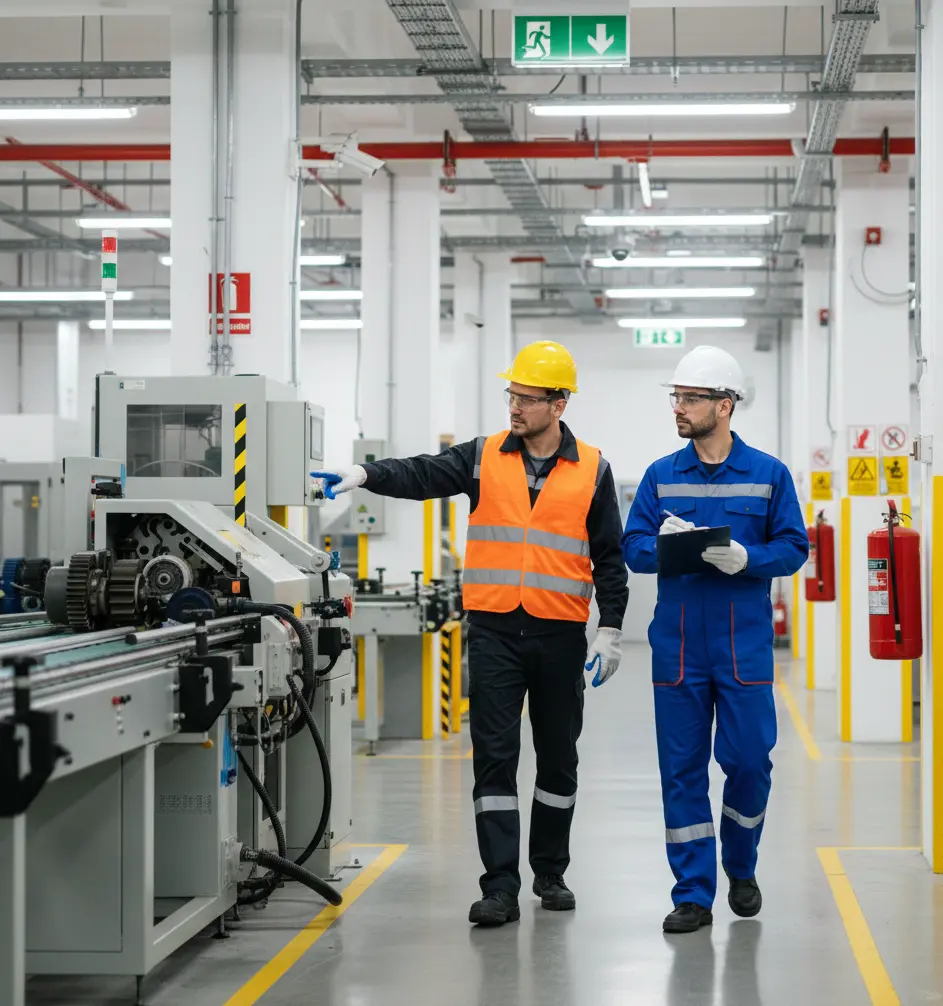

Facility Assessment & Risk Analysis
Conducting comprehensive facility walkthroughs, identifying fire hazards and security vulnerabilities, evaluating existing systems, and establishing protection priorities based on operations.

System Design & Technology Selection
Developing integrated fire detection, suppression, alarm systems, and security infrastructure including, surveillance, access control, and intrusion detection tailored to facility needs.

Regulatory Compliance & Documentation
Ensuring designs meet NFPA codes, NBC requirements, local fire safety regulations, insurance standards, and industry-specific compliance obligations with complete engineering documentation.

Implementation Support & Commissioning Guidance
Providing detailed specifications, vendor coordination support, installation oversight assistance, system testing protocols, and comprehensive training documentation for facility operations teams.
Why Choose IMARC Engineering for Fire Safety and Security System Advisory in India?
Our integrated design approach combines fire protection engineering expertise with advanced security technology knowledge to deliver comprehensive solutions. This holistic methodology ensures seamless coordination between safety systems, regulatory compliance, and operational requirements.

NBC and State Fire Regulation Compliance Expertise
Fire safety compliance in India spans the National Building Code 2016, state-specific fire service acts, Factories Act 1948, TAC insurance standards, and PESO regulations for hazardous material handling facilities, each imposing different requirements by occupancy, hazard classification, and building height. IMARC Engineering maps every applicable regulatory obligation to the facility’s specific sector, location, and scale, ensuring compliance assessment covers the complete requirement set and fire NOC applications are supported by documentation that satisfies state fire authority standards.

Sector-Specific Fire Hazard Assessment
Fire risk in pharmaceutical solvent handling areas, chemical reactor zones, FMCG aerosol storage, food processing combustible dust environments, and industrial painting booths differs fundamentally, requiring hazard-specific suppression strategies that generic fire safety checklists do not identify. IMARC Engineering’s fire risk assessments apply sector-specific hazard identification frameworks covering flammable liquid and gas classification under PESO, explosion risk assessment, and fire load analysis calibrated to the actual hazard profile of each manufacturing environment.

Fire NOC Application Support
Fire NOC applications for industrial facilities in India are frequently rejected or held for additional information due to incomplete suppression system documentation, inadequate escape route drawings, or non-compliant system specifications submitted by facility owners without fire safety advisory support. IMARC Engineering prepares fire NOC application packages to the specific documentation standards of each state fire authority, identifying gaps before submission and co-ordinating with fire service officers to resolve technical queries, reducing the approval cycles that delay Factory Act licensing and facility occupation.

Insurance Risk Alignment
Industrial insurance underwriters in India assess fire protection system adequacy against TAC and Tariff Advisory Committee standards before issuing coverage terms, with inadequate protection resulting in premium loading or coverage exclusions. IMARC Engineering’s advisory aligns fire suppression system specifications with TAC standards for industrial risk categories, identifies the protection gaps that create insurance premium exposure, and prepares risk improvement documentation that demonstrates proactive fire safety management to underwriters during policy placement and claims assessment.

Security System Evaluation
Industrial facility security vulnerabilities, inadequate perimeter fencing, unmonitored entry points, insufficient CCTV coverage in high-value storage areas, and absence of access control in controlled substance or chemical storage zones, create theft, sabotage, and regulatory compliance risks that fire safety assessment alone does not address. IMARC Engineering evaluates physical security infrastructure requirements concurrently with fire safety advisory, providing integrated recommendations that address both life safety and asset protection within a single assessment engagement.

Emergency Preparedness Planning
Fire risk assessments and compliance reviews generate value only when their findings are converted into practiced emergency response capability. IMARC Engineering develops facility-specific emergency response plans covering evacuation procedures, muster point locations, fire warden responsibilities, emergency service co-ordination, and incident escalation protocols, integrated with drill programme recommendations that verify response capability under realistic scenario conditions. For chemical and agrochemical facilities, plans address HAZCHEM incident response within the Chemical Accidents Rules 1996 framework.
Fire Safety and Security System Advisory Across Key Sectors in India
IMARC Engineering delivers fire risk assessment, NBC and state fire regulation compliance review, fire NOC advisory, TAC insurance alignment, security system evaluation, and emergency preparedness planning across India’s most active manufacturing sectors.
Fire safety advisory for pharmaceutical facilities across Hyderabad, Baddi, and Ahmedabad. PESO-compliant flammable solvent storage and handling risk assessment, Schedule M GMP cleanroom fire suppression specification review, fire NOC application support for Factory Act licensing, TAC standard fire protection alignment for pharmaceutical facility insurance, and emergency response plan development for solvent fire incidents.
Fire safety advisory for food processing facilities across Punjab, Maharashtra, and Karnataka. Combustible dust explosion risk assessment for flour, sugar, and spray drying operations, ammonia refrigerant release fire and explosion scenario planning, FSSAI-compliant fire safety management integration, fire NOC application for food processing facility Factory Act licensing, and fire protection system adequacy review for cold chain and dry storage warehousing.
Fire safety advisory for chemical manufacturing in Gujarat’s Dahej, Ankleshwar, and Vapi corridors. PESO flammable liquid and gas hazard risk assessment, explosion risk zoning and suppression specification, Chemical Accidents Rules 1996 on-site emergency plan fire scenario coverage, fire NOC for chemical facility licensing, TAC industrial risk fire protection alignment, and CPCB consent condition fire safety compliance verification.
Fire safety advisory for FMCG manufacturing facilities. Aerosol propellant and flammable solvent storage fire risk assessment, NBC occupancy-based sprinkler and fire detection specification review, fire NOC application support, TAC fire protection adequacy for FMCG warehouse and production facility insurance, security system evaluation for finished goods storage and dispatch areas, and emergency response plan development.
Fire safety advisory for agrochemical facilities in PESO-notified chemical zones. PESO flammable solvent and toxic chemical fire hazard assessment, explosion risk analysis for technical grade synthesis areas, Chemical Accidents Rules 1996 fire emergency scenario integration, fire NOC for agrochemical facility Factory Act licensing, and security infrastructure evaluation for controlled pesticide storage areas.
Fire safety advisory for medical device manufacturing in state device parks. NBC fire safety compliance review for cleanroom manufacturing occupancies, fire suppression specification for ISO 13485-qualified manufacturing areas, fire NOC application support for CDSCO facility licensing, security system evaluation for controlled medical device component storage, and emergency response plan development for cleanroom fire incidents.
Fire safety advisory for heavy manufacturing in MIDC, GIDC, SIDCO, and RIICO industrial areas. NBC high-bay industrial building fire protection compliance review, Factory Act fire safety inspection documentation, welding and cutting fire hazard control assessment, TAC industrial risk fire protection alignment for manufacturing facility insurance, security perimeter and access control evaluation for high-value equipment and material storage, and emergency response plan for industrial fire scenarios.
Explore Related Services

Fire Safety and Security System Design
Protect Manufacturing Facilities Through Integrated Fire Safety and Security Solutions
Learn more

Fire and Safety Compliance During Construction
Comprehensive Safety Management and Regulatory Compliance Services
Learn more

Health and Safety Compliance Audits
Protect Your Workforce Through Proactive Safety Excellence
Learn more

Regulatory Compliance (GMP, ISO, FDA, BIS)
End-to-End GMP, ISO, FDA, and BIS Compliance in India
Learn more
Frequently Asked Questions: Fire Safety and Security System Advisory in India
We have compiled answers to common questions investors, facility owners, and project developers ask about fire safety and security system design. These insights address investment requirements, regulatory compliance, technology selection, and operational considerations.
Trusted by Industry Leaders
We partner with global enterprises and ambitious businesses across sectors to deliver operational excellence, strategic insights, and sustainable growth through integrated solutions.







Success in Their Words
Real feedback from clients across industries. Discover how our solutions delivered measurable impact and operational excellence.

I wanted to express my sincere appreciation for your efforts in handling this matter. Your dedication and commitment have been truly commendable, and it is evident that you have put in tremendous hard work and expertise into resolving the issues at hand. We are greatly interested in continuing our collaboration with you in the future, as your professionalism and reliability have made you a trusted partner. Thank you once again for your invaluable contribution. We look forward to strengthening our partnership ahead.

It has been a pleasure working with the IMARC team. The insights provided were structured, clear, and highly valuable, helping us strengthen both our technical and financial planning with confidence. We deeply appreciate the team’s professionalism, responsiveness, and attention to detail throughout the engagement. Every requirement was well understood and effectively incorporated, resulting in a comprehensive and actionable output. Overall, our experience has been excellent, and I would gladly recommend IMARC to organizations seeking a reliable research partner.
Your service is truly exceptional. Working with the IMARC team has been a seamless and professional experience. The clarity of communication, responsiveness to queries, and consistent support at every stage made the entire engagement highly efficient. The insights shared were well-structured, practical, and perfectly aligned with our requirements, helping us make informed decisions with confidence. Overall, the dedication and professionalism demonstrated by your team stand out, and I would be glad to recommend IMARC as a reliable and trustworthy research partner.

IMARC did an outstanding job in preparing our study. They were punctual, precise, and consistently responsive throughout the entire process. The team delivered all the data we required in a clear, well-organized, and highly professional format. Their strong attention to detail, combined with their ability to meet every deadline without compromising quality, truly set them apart. Overall, their reliability and commitment made them an exceptional partner for our project, and we would gladly work with them again in the future.

IMARC made the whole process incredibly easy from start to finish. Everyone I interacted with via email was polite, professional, and straightforward to deal with, always keeping their promises regarding delivery timelines and remaining consistently solutions-focused. From my very first contact, I appreciated the professionalism and support shown by the entire IMARC team. I highly recommend IMARC to anyone seeking timely, affordable, and reliable information or advice. My experience with IMARC was excellent, and I truly cannot fault any aspect of it.

I’d like to express my sincere gratitude for the excellent work you accomplished with the study. Your ability to quickly understand our requirements and deliver high-quality results under tight timelines truly reflects your expertise, exceptional work ethic, and unwavering commitment to your customer’s success. The professionalism and responsiveness you demonstrated throughout the process made a significant difference. Our entire team and company are incredibly thankful for your dedication, reliability, and support. Once again, thank you for your outstanding contribution.
Ready to Protect Your Manufacturing Investment?
Contact our fire safety and security engineering team today to discuss your facility protection requirements and discover how IMARC Engineering can deliver comprehensive safety solutions. Let us safeguard your assets, personnel, and operations together.