
Protect Your Workforce Through Proactive Safety Excellence
Safeguard employees and operations through comprehensive health and safety compliance audits that identify hazards, strengthen protection systems, and establish robust workplace safety programs meeting regulatory standards.

Health & Safety Compliance Audit in India
Health and safety compliance audits in India are essential for organizations operating in manufacturing, construction, chemicals, and other high-risk sectors. Regulatory frameworks such as the Occupational Safety, Health and Working Conditions Code, 2020 and the Factories Act, 1948 require organizations to maintain safe workplaces, proper documentation, and effective risk control systems.
IMARC Engineering supports health and safety compliance audits in India through structured assessments of safety systems, equipment conditions, and regulatory adherence. The approach focuses on identifying compliance gaps, improving risk controls, and strengthening safety management systems, helping organizations enhance audit readiness, reduce incidents, and build safer, more resilient operations.
A health and safety compliance audit evaluates workplace conditions, safety practices, equipment, and documentation to ensure alignment with statutory requirements and industry standards. These audits help identify hazards, assess risk exposure, and strengthen preventive measures, reducing accidents, operational disruptions, and compliance risks.
Our Comprehensive Approach to Health and Safety Compliance Audits
Our systematic methodology combines facility inspections, documentation reviews, employee interviews, and risk assessments to evaluate workplace safety comprehensively. This approach guarantees thorough identification of hazards, compliance gaps, and improvement opportunities while building organizational capabilities.


Facility Inspection & Hazard Identification
Conducting detailed facility walkthroughs examining machinery, work areas, chemical storage, electrical systems, and operational practices to identify safety hazards and compliance deficiencies.

Regulatory Compliance Assessment & Documentation Review
Evaluating compliance with applicable regulations, reviewing safety documentation including permits and training records, and assessing management system effectiveness against regulatory requirements.

Risk Evaluation & Control Effectiveness Analysis
Assessing risk severity and likelihood for identified hazards, evaluating existing control measures, determining residual risks, and prioritizing remediation based on risk levels.

Improvement Planning & Implementation Support
Developing prioritized action plans with specific recommendations, providing implementation guidance, establishing monitoring mechanisms, and building organizational capabilities for continuous safety improvement.
Why Choose IMARC Engineering for Health and Safety Compliance Audits in India?
Our comprehensive approach combines technical expertise, regulatory knowledge, and practical implementation experience, delivering actionable improvements. This balances regulatory compliance with operational realities while building safety cultures where worker protection becomes embedded in organizational values.

Multi-Framework Compliance Assessment
Health and safety compliance in Indian manufacturing facilities is governed by a multi-layer regulatory framework whose requirements differ by sector, facility type, workforce size, and state jurisdiction and failure to satisfy any applicable layer creates enforcement exposure that can halt operations. The Occupational Safety, Health and Working Conditions Code 2020 consolidates, and updates obligations previously spread across the Factories Act, the Mines Act, and other labour legislation, with state-specific rules introducing additional requirements. The BOCW Act 1996 applies to construction activities. PESO regulations govern safety in hazardous material handling. IBR prescribes safety standards for pressure systems. Factory Inspector jurisdiction overlaps with PESO and CPCB in chemical and process manufacturing. IMARC Engineering’s safety compliance audits apply a comprehensive assessment framework that maps every applicable regulatory obligation to the facility’s specific sector, workforce, and state jurisdiction, identifying gaps across all applicable frameworks simultaneously rather than auditing each in isolation.

Sector-Specific Hazard Assessment
Generic health and safety audit checklists applied uniformly across manufacturing sectors consistently miss the sector-specific hazards that generate the actual incidents and regulatory enforcement actions in Indian manufacturing. A chemical plant audit conducted with a general industrial safety checklist will apply machine guarding and working-at-height assessment criteria that are less relevant than the toxic gas exposure management, HAZCHEM emergency response readiness, and PESO permit-to-work system compliance that are the actual high-consequence risk categories in chemical manufacturing. A pharmaceutical cleanroom audit that does not assess GMP-aligned contamination prevention practices and controlled substance handling protocols is missing the safety risks specific to regulated pharmaceutical environments. IMARC Engineering’s safety audits apply sector-specific hazard assessment frameworks calibrated to the actual risk profile of each manufacturing sector, ensuring that audit effort concentrates on the hazard categories most likely to cause incidents and regulatory findings in that specific operational context.

OSH Code 2020 Compliance Assessment
The Occupational Safety, Health and Working Conditions Code 2020 represents the most significant reform of Indian workplace safety legislation in decades, consolidating thirteen central labour laws, extending occupational health and safety obligations to establishments employing ten or more workers across all industries, introducing new provisions for hazardous processes, and establishing a national occupational safety and health standard framework that replaces the fragmented sector-specific regulations of the previous regime. Many Indian manufacturing facilities have not fully assessed their compliance obligations against the OSH Code 2020 because state-specific rules are still being notified and the transition from Factories Act compliance to OSH Code compliance creates uncertainty about which provisions apply when. IMARC Engineering’s safety compliance audits include a specific OSH Code 2020 compliance assessment that maps the new obligations against the facility’s current safety management systems, identifying the adaptation required from the Factories Act compliance framework to the OSH Code requirements as state rules are progressively notified.

ESG Safety Performance Documentation
International project finance lenders applying IFC Performance Standards, Equator Principles, or institutional ESG frameworks increasingly require structured health and safety compliance assessments as a condition of disbursement and continued compliance reporting. IFC Performance Standard 2 requires that facilities financed by IFC-supported lenders maintain an Occupational Health and Safety management system with regular audit documentation demonstrating systematic safety management rather than reactive incident response. European brands sourcing manufactured products from Indian facilities require supply chain safety audits meeting SA8000 or Sedex SMETA standards as procurement qualification requirements. Export market food and consumer goods customers require FSSC 22000 and BRCGS supplier safety audits. IMARC Engineering structures health and safety compliance audit documentation to satisfy Indian statutory requirements and the international ESG and supply chain audit standards simultaneously, producing a single audit engagement that generates compliance evidence for multiple reporting obligations.

Incident Investigation Capability Assessment
The quality of a manufacturing facility’s incident investigation process is one of the most reliable indicators of its overall safety management maturity because facilities with rigorous investigation practices identify systemic hazards and implement effective preventive measures, while facilities with superficial investigation practices record incidents as individual human errors without addressing the underlying conditions that will generate recurrence. Health and safety compliance audits that evaluate only the prevention side of the safety management system without assessing incident investigation quality miss this critical safety system component. IMARC Engineering’s safety compliance audit includes a structured assessment of incident investigation quality, reviewing whether past incidents have been investigated to root cause, whether corrective actions have addressed systemic conditions rather than individual behaviours, and whether near miss reporting culture is active enough to identify hazards before they cause injuries. This investigation quality assessment reveals safety management maturity that physical hazard observation alone cannot assess.

Corrective Action Programme Management
Health and safety compliance audits that produce findings reports without structured corrective action programme management consistently fail to achieve the risk reduction that the audit investment is intended to produce because facilities that receive audit findings without accountability for implementation routinely defer corrective actions under operational pressure until the next audit reveals the same findings remain unaddressed. IMARC Engineering structures safety compliance audit engagements with corrective action programme management as an integral component, classifying audit findings by risk severity, assigning implementation responsibility and target completion dates, conducting a follow-up verification assessment at a defined interval after the initial audit to confirm that high-severity findings have been genuinely resolved, and tracking CAPA completion through a structured register that management reviews at defined intervals. This accountability framework ensures that safety audit investment generates actual incident risk reduction rather than compliance reporting only.
Health and Safety Compliance Audits Across Key Sectors in India
IMARC Engineering delivers multi-framework statutory compliance assessment, sector-specific hazard evaluation, OSH Code 2020 gap analysis, ESG safety documentation, incident investigation quality review, and corrective action programme management across India’s most active manufacturing sectors.
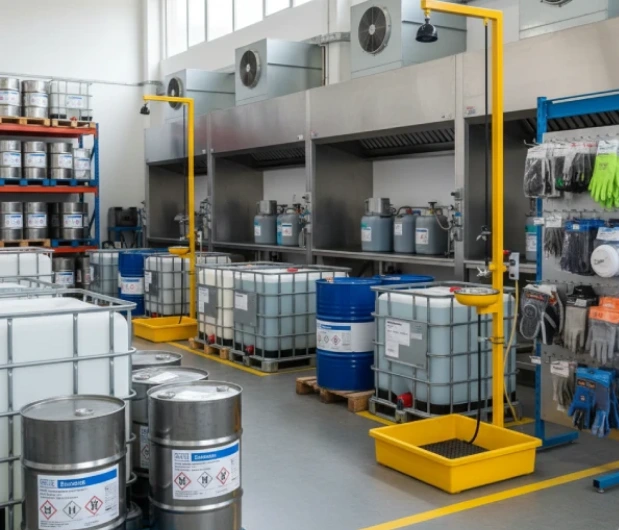
Health and safety compliance audits for pharmaceutical manufacturing facilities across Hyderabad, Baddi, Ahmedabad, and Aurangabad clusters. Factories Act and OSH Code 2020 compliance assessment for pharmaceutical occupational health obligations, chemical exposure and solvent handling safety audit, GMP-aligned contamination prevention and controlled substance safety compliance, BOCW Act compliance for construction workforces during brownfield expansion, IFC Performance Standard 2 safety documentation for project finance lenders, and ISO 45001 occupational health management system gap assessment.
Health and safety compliance audits for food processing facilities across Punjab, Maharashtra, and Karnataka. Factories Act Schedule 1 hazardous process safety compliance for ammonia refrigeration and high-temperature processing operations, BOCW-compliant construction safety for seasonal facility expansion workforces, FSSAI-aligned food safety and hygiene risk assessment integration with occupational health audit, SA8000 and SMETA supply chain safety audit for food retail customer compliance, OSH Code 2020 gap assessment, and IFC Performance Standard 2 safety documentation.
Health and safety compliance audits for chemical manufacturing facilities in Gujarat’s Dahej, Ankleshwar, and Vapi industrial corridors. PESO safety compliance audit for petroleum, LPG, and hazardous chemical handling installations, Chemical Accidents Rules 1996 emergency preparedness audit for threshold-quantity hazardous chemical facilities, CPCB consent condition EHS compliance assessment, Process Safety Management audit for HAZCHEM facilities, OSH Code 2020 compliance for chemical manufacturing workforces, and IFC PS2-compliant ESG safety audit documentation for internationally financed chemical projects.
Health and safety compliance audits for FMCG manufacturing facilities. Factories Act compliance assessment for multi-shift high-speed manufacturing operations, aerosol propellant and flammable solvent handling safety audit, BOCW Act compliance for brownfield expansion construction workforces, SA8000 and SMETA supply chain safety audit for international retail customer compliance, OSH Code 2020 gap assessment for FMCG facility compliance transition, and ESG safety documentation for international brand owner supplier qualification requirements.
Health and safety compliance audits for agrochemical manufacturing facilities in PESO-notified chemical zones. PESO compliance audit for flammable solvent and toxic chemical handling, Chemical Accidents Rules 1996 on-site emergency plan compliance for threshold-quantity pesticide manufacturing, respiratory protection and personal decontamination programme audit for toxic process workers, CPCB environmental health compliance assessment, Factories Act Schedule 1 hazardous process compliance, and IFC Performance Standard 2 safety management documentation for internationally financed agrochemical projects.
Health and safety compliance audits for medical device manufacturing facilities. Factories Act and OSH Code 2020 compliance for medical device manufacturing workforces, biomedical waste handling safety audit under Biomedical Waste Management Rules 2016 for quality testing laboratory operations, ISO 45001 occupational health management system gap assessment for ISO 13485-certified facilities, cleanroom chemical handling and ergonomics safety audit, SA8000 supply chain safety audit for international medical device customer qualification, and ESG safety documentation for state medical device park investment reporting.
Health and safety compliance audits for heavy manufacturing facilities in MIDC, GIDC, SIDCO, and RIICO industrial areas. Factories Act structural safety and occupational health compliance assessment, crane and lifting equipment safety audit with Factory Act certification compliance verification, welding fume, cutting fluid, and surface treatment chemical exposure audit, BOCW Act compliance for construction workforces during greenfield facility development, OSH Code 2020 transition gap assessment for large industrial employers, and IFC Performance Standard 2 ESG safety documentation for industrial project finance lenders.
Explore Related Services

Regulatory Compliance (GMP, ISO, FDA, BIS)
End-to-End GMP, ISO, FDA, and BIS Compliance in India
Learn more

Environmental Compliance Audits
Safeguard Operations Through Proactive Environmental Stewardship
Learn more

CAPA (Corrective and Preventive Action) Support
Strengthen Quality Systems Through Structured CAPA Implementation
Learn more
Frequently Asked Questions: Health and Safety Compliance Audits in India
We have compiled answers to common questions investors and manufacturing leaders ask about health and safety compliance audits. These insights address audit scope, investment requirements, business benefits, regulatory implications, and strategic value of proactive safety management.
Trusted by Industry Leaders
We partner with global enterprises and ambitious businesses across sectors to deliver operational excellence, strategic insights, and sustainable growth through integrated solutions.









Success in Their Words
Real feedback from clients across industries. Discover how our solutions delivered measurable impact and operational excellence.

I wanted to express my sincere appreciation for your efforts in handling this matter. Your dedication and commitment have been truly commendable, and it is evident that you have put in tremendous hard work and expertise into resolving the issues at hand. We are greatly interested in continuing our collaboration with you in the future, as your professionalism and reliability have made you a trusted partner. Thank you once again for your invaluable contribution. We look forward to strengthening our partnership ahead.

It has been a pleasure working with the IMARC team. The insights provided were structured, clear, and highly valuable, helping us strengthen both our technical and financial planning with confidence. We deeply appreciate the team’s professionalism, responsiveness, and attention to detail throughout the engagement. Every requirement was well understood and effectively incorporated, resulting in a comprehensive and actionable output. Overall, our experience has been excellent, and I would gladly recommend IMARC to organizations seeking a reliable research partner.
Your service is truly exceptional. Working with the IMARC team has been a seamless and professional experience. The clarity of communication, responsiveness to queries, and consistent support at every stage made the entire engagement highly efficient. The insights shared were well-structured, practical, and perfectly aligned with our requirements, helping us make informed decisions with confidence. Overall, the dedication and professionalism demonstrated by your team stand out, and I would be glad to recommend IMARC as a reliable and trustworthy research partner.

IMARC did an outstanding job in preparing our study. They were punctual, precise, and consistently responsive throughout the entire process. The team delivered all the data we required in a clear, well-organized, and highly professional format. Their strong attention to detail, combined with their ability to meet every deadline without compromising quality, truly set them apart. Overall, their reliability and commitment made them an exceptional partner for our project, and we would gladly work with them again in the future.

IMARC made the whole process incredibly easy from start to finish. Everyone I interacted with via email was polite, professional, and straightforward to deal with, always keeping their promises regarding delivery timelines and remaining consistently solutions-focused. From my very first contact, I appreciated the professionalism and support shown by the entire IMARC team. I highly recommend IMARC to anyone seeking timely, affordable, and reliable information or advice. My experience with IMARC was excellent, and I truly cannot fault any aspect of it.

I’d like to express my sincere gratitude for the excellent work you accomplished with the study. Your ability to quickly understand our requirements and deliver high-quality results under tight timelines truly reflects your expertise, exceptional work ethic, and unwavering commitment to your customer’s success. The professionalism and responsiveness you demonstrated throughout the process made a significant difference. Our entire team and company are incredibly thankful for your dedication, reliability, and support. Once again, thank you for your outstanding contribution.
Speak to Our Health and Safety Compliance Audit Team
Whether you are a pharmaceutical, food, chemical, FMCG, agrochemical, medical device, or industrial manufacturer, IMARC Engineering provides end-to-end occupational health and safety compliance support. This includes statutory audits, hazard assessments, ESG safety documentation, and ISO 45001 gap analysis aligned with the Factories Act, OSH Code 2020, and Petroleum and Explosives Safety Organisation requirements, ensuring workforce safety, regulatory compliance, and audit readiness across your manufacturing operations in India.