Manufacturing
November 10 2026
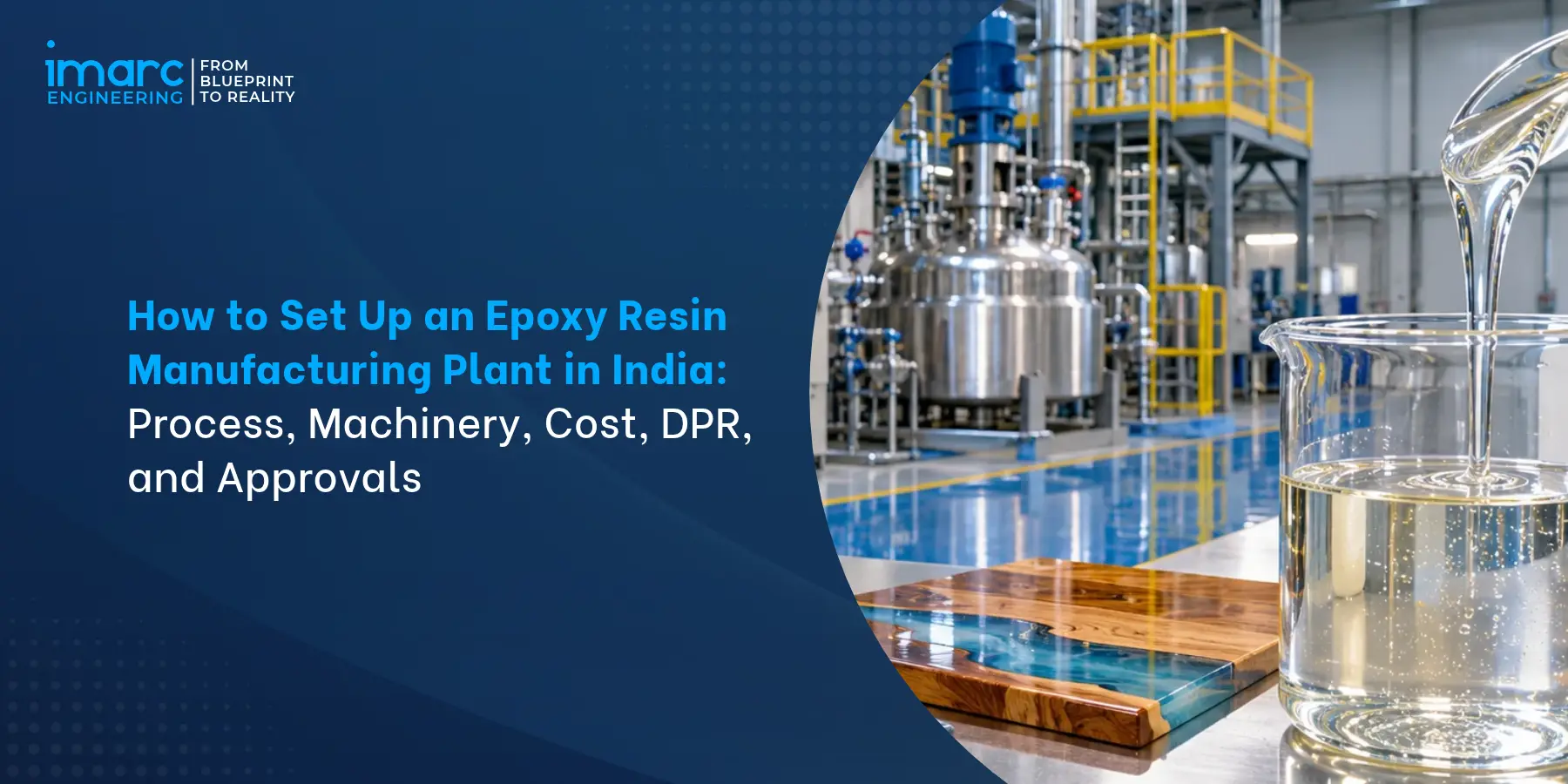
How to Set Up an Epoxy Resin Manufacturing Plant in India: Process, Machinery, Cost, DPR, and Approvals
Introduction
For investors planning an epoxy resin manufacturing plant in India, the first decision is whether to manufacture base resin or formulate products using purchased resin. Base resin production involves reacting bisphenol A with epichlorohydrin, while formulation involves blending purchased resin with curing agents, diluents and fillers. These models have different equipment, safety, environmental and investment requirements.
Scope of this Guide
This guide answers one question: how can investors set up an epoxy resin manufacturing plant in India, and what should a DPR include to evaluate production technology, machinery, investment costs, approvals and project profitability? It covers both base resin synthesis Taffy-process liquid DGEBA, epichlorohydrin recovery, advancement to solid flake and formulation-only facilities producing epoxy systems from purchased resin. It stops at commissioned, quality-released production; downstream adhesive manufacture, application development and distribution are outside scope. Capacity, cost and utility figures are indicative planning ranges.
Table of Contents
- Introduction
- Why an Epoxy Resin Manufacturing Plant in India Matters for Investors in 2026
- What an Epoxy Resin Manufacturing Plant in India Is and Why It Matters
- Epoxy Resin Manufacturing Plant in India: Product Types and Capacity Planning
- Raw Materials and Chemicals for an Epoxy Resin Manufacturing Plant in India
- Core Process Steps for an Epoxy Resin Manufacturing Plant in India: Resin Synthesis
- Core Process Steps for an Epoxy Resin Manufacturing Plant in India: Finishing, Testing and Quality Release
- Machinery, Cleanroom and Utilities for an Epoxy Resin Manufacturing Plant in India
- Wastewater, Licences and Project Economics for an Epoxy Resin Manufacturing Plant in India
- Conclusion
1. Why an Epoxy Resin Manufacturing Plant in India Matters for Investors in 2026
Four structural conditions make a disciplined epoxy resin manufacturing plant in India commercially compelling in 2026, and each one changes the configuration an investor should fund.
1.1 Import Dependence and Localisation of Liquid and Solid Grades
Domestic epoxy resin demand comes from applications such as protective coatings, wind-energy composites, electrical components, flooring and adhesives. Investors should assess grade-wise domestic production, imports, exports, customer requirements and competing suppliers. Import-substitution potential depends on product quality, raw material costs, logistics, pricing and the ability to meet customer specifications.
1.2 Policy Framework, Chemical Zoning and Incentive Verification
An epoxy resin project must be assessed under applicable environmental, industrial siting and chemical-safety requirements. The State Pollution Control Board determines the relevant industry category and consent requirements based on the process and pollution potential. Environmental Clearance applicability must be assessed under the EIA Notification 2006, including Schedule item 5(f), where relevant. State incentives should be verified against current government notifications and project-specific eligibility conditions.
1.3 Investment Ecosystem and Chemical Cluster Depth
Cluster depth matters more than land price for an epoxy resin manufacturing business India project. Gujarat's Ankleshwar, Jhagadia, Dahej and Vapi belts, Maharashtra's Tarapur-Roha corridor, Tamil Nadu's SIPCOT chemical parks and the Visakhapatnam-Kakinada cluster supply glass-lined reactor fabricators, thermic-fluid and vacuum-system contractors, NABL-accredited testing laboratories, hazardous-waste TSDF access and operators who have handled epichlorohydrin before.
A site outside established chemical clusters may require additional vendor development, logistics planning, technical support and waste-management arrangements. Any resulting effect on project cost and implementation time should be assessed through location-specific enquiries.
1.4 The Cost of Poor Planning in Epoxy Resin Factory Setup
Poor planning can affect reactor performance, raw-material recovery and wastewater treatment costs. Reactor sizing should account for heat transfer, mixing and batch cycle time. Epichlorohydrin recovery should be evaluated for its effect on raw-material consumption and emissions. Effluent treatment should be designed using process-water balances and actual wastewater characteristics. Delayed engineering decisions can increase project costs and commissioning time.
2. What an Epoxy Resin Manufacturing Plant in India Is and Why It Matters
An epoxy resin manufacturing plant in India is defined by the chemistry it performs in-house, not by the product it sells.
2.1 Definition: Base Resin Synthesis versus Formulation
Epoxy resin is a reactive prepolymer containing epoxide groups. A key specification is epoxide equivalent weight (EEW), which measures the mass of resin containing one equivalent of epoxide groups and is expressed in g/eq. Diglycidyl ether of bisphenol A (DGEBA) is a widely used commercial epoxy resin. Base resin synthesis involves reacting bisphenol A with epichlorohydrin under alkaline conditions, while formulation blends purchased resin with curing agents, diluents and fillers.
| Parameter | Base resin synthesis | Formulation-only plant |
|---|---|---|
| Manufacturing activities | Chemical reaction of bisphenol A and epichlorohydrin, separation, washing, recovery and resin finishing | Blending purchased epoxy resin with curing agents, reactive diluents, fillers, pigments and performance additives |
| Principal raw materials | Bisphenol A, epichlorohydrin, sodium hydroxide and process chemicals | Purchased liquid or solid epoxy resin, curing agents, diluents, fillers and additives |
| Main machinery | Reaction vessels, raw-material storage, separation and washing equipment, recovery systems and finishing equipment | Storage tanks, mixers, dispersers, mills where required, filtration and filling systems |
| Environmental considerations | Process wastewater, saline streams, chemical emissions, solvent or monomer recovery and hazardous residues | Cleaning wastewater, dust from powder handling, chemical handling, packaging waste and residues from formulation |
| CAPEX Complexity | Generally more engineering-intensive because of reaction systems, recovery, process safety and effluent management | Depends on product range, automation, dispersion requirements, storage and packaging configuration |
| Utilities | May require process heating, cooling, vacuum, nitrogen, compressed air and effluent treatment | Primarily electricity, cooling, compressed air and other utilities determined by mixing and finishing requirements |
| Target Products | Liquid DGEBA, solid epoxy resin and selected speciality base-resin grades | Coating systems, flooring compounds, casting and encapsulation systems, adhesives and other formulated epoxy products |
The two models should be evaluated as separate investment propositions. Base resin synthesis requires a chemical manufacturing setup with reaction, separation, recovery and effluent-management infrastructure. Formulation-only operations avoid the base resin synthesis stage but require suitable blending, dispersion, quality-control and packaging systems. An integrated project may combine both models, although its investment, process-safety and environmental requirements must be assessed across the complete manufacturing route.
2.2 Two Facility Archetypes and Their Boundaries
A base resin synthesis plant generally requires reaction equipment, raw-material storage, separation and washing systems, epichlorohydrin recovery where applicable, product finishing and effluent treatment. A formulation plant generally requires storage systems, mixers, dispersers, milling equipment where needed, filtration, filling and packaging lines. Equipment and environmental requirements depend on the selected process, product range and site conditions.
2.3 Scale Determinants for an Epoxy Resin Plant
Production capacity depends on reactor working volume, batch size, reaction and cleaning cycle time, operating days and equipment availability. Integrated plants must also align recovery, separation, finishing and packing capacities with reactor output. Solid resin production requires separate assessment of advancement, flaking and milling throughput. The DPR should establish annual capacity through process-wise mass balances and equipment utilisation calculations.
2.4 Plant Sections
| Plant section | Function | Core or commonly required equipment | Optional or process-dependent equipment |
|---|---|---|---|
| Raw-material storage and handling | Storage, transfer and dosing of raw materials | Compatible storage tanks, pumps, transfer lines and weighing or dosing systems | Nitrogen blanketing, specialised unloading systems and heated storage, depending on material properties |
| Resin reaction | Controlled chemical reaction for base resin production | Reaction vessel, agitator, heating and cooling arrangement, process instrumentation | Glass-lined construction, internal coils and specialised reactor configurations, depending on chemistry and corrosion assessment |
| Separation and washing | Removal of aqueous phases, salts and residual process chemicals | Suitable phase-separation and washing equipment | Decanter centrifuge, disc-stack centrifuge or other separation systems, depending on process design |
| Epichlorohydrin recovery | Recovery of excess monomer where applicable | Suitable recovery and condensation arrangement | Distillation column, wiped-film evaporator or other evaporation equipment, depending on recovery requirements |
| Resin advancement | Production of selected higher-molecular-weight or solid resin grades | Suitable advancement reactor or other validated process equipment | Twin-screw extruder or continuous processing system, depending on technology |
| Resin finishing | Cooling, solidification, size reduction or adjustment of product properties | Equipment appropriate to the final resin grade | Belt flaker, crusher, pulveriser and milling systems, where solid grades are produced |
| Formulation and blending | Mixing purchased resin with additives and curing agents | Suitable storage, mixers, dosing and filling equipment | High-speed disperser, bead mill, three-roll mill and vacuum mixer, depending on viscosity and product specifications |
| Quality control | Testing of incoming materials, intermediates and finished products | Suitable laboratory instruments and testing arrangements | Specialised analytical equipment or external laboratory services, depending on product requirements |
| Utilities and waste management | Supply of process utilities and treatment of waste streams | Utilities and waste-management systems established from the process design | Thermic-fluid systems, chilling, nitrogen generation, MEE, ATFD or ZLD systems, where justified by process requirements or regulatory conditions |
The final equipment list should be developed from the selected manufacturing route, product grades, process design, material compatibility, utility balance and environmental assessment. Equipment listed as optional should not be included in the project cost until its technical requirement has been established.
3. Epoxy Resin Manufacturing Plant in India: Product Types and Capacity Planning
Grade selection and capacity planning for an epoxy resin manufacturing plant in India decide reactor metallurgy, distillation duty and working capital profile before any equipment is quoted.
3.1 Liquid Epoxy Resin Grades and Liquid Epoxy Resin Manufacturing
Liquid DGEBA grades are differentiated by EEW, viscosity, colour, hydrolysable chloride, total chloride and other application-specific properties. Specifications vary by manufacturer and end use. Electrical, laminating and casting applications may require tighter controls over impurities, moisture and product consistency. The target product specifications should be established using customer requirements and manufacturer technical data sheets.
3.2 Solid, Solution and Multifunctional Resin Types
Epoxy resins are available in liquid, semi-solid, solid, solution and multifunctional grades. They differ in EEW, viscosity, softening point, molecular weight and application requirements. Speciality products include epoxy novolac, brominated epoxy and glycidyl amine resins. Their specifications and production routes vary by manufacturer. Investors should define the target grade portfolio using customer requirements, technical data sheets and market validation.
3.3 Capacity, Throughput and Product Mix for an Epoxy Resin Production Plant in India
Production capacity should be calculated from the process configuration rather than selected only from a target annual tonnage. For batch-based resin manufacturing, the calculation begins with the reactor's working volume and the actual batch size. The usable batch quantity depends on the operating volume, material density, process limitations and required headspace.
The annual production estimate should then account for batch cycle time, operating days, equipment availability, product yield and expected utilisation. A simplified calculation is:
Annual saleable output = Saleable output per batch × Effective Annual batches
Where: Saleable batch output is the quantity of finished product obtained after accounting for process losses and off-specification material. Annual batches are determined by available production hours divided by the complete batch cycle time, including charging, reaction, discharge, and necessary cleaning.
Utilisation factor accounts for planned maintenance, changeovers, downtime, and other operating constraints.
For example, a reactor's nominal volume should not be treated as its production capacity. The calculation must use the validated working volume and actual batch mass. Where multiple reactors or downstream equipment operate in sequence, the annual output is constrained by the bottleneck operation.
Installed capacity and saleable annual output are also different. Installed capacity represents the designed production capability under defined operating assumptions. Saleable output reflects actual production after accounting for utilisation, yield, quality rejections, cleaning and grade changeovers.
Product mix has a direct effect on throughput. A plant producing several grades may require additional cleaning, line clearance, sampling and quality-release time between batches. High-viscosity products, filled formulations and speciality grades may also require longer mixing, dispersion or finishing cycles. The DPR should therefore calculate output separately for each major grade or product family and consolidate the results into an annual production plan.
Capacity scenarios should be evaluated against customer demand, equipment availability, raw-material supply, storage capacity, and the expected sales mix.
3.4 Location and Cluster Selection for Epoxy Resin Plant Investment
Site selection should consider access to raw materials, transport infrastructure, reliable electricity, fuel, steam, cooling water, nitrogen, skilled manpower and hazardous-waste treatment facilities. Land-use permissions, industrial zoning and chemical-safety requirements must also be assessed. Utility demand should be calculated from the process design, while land requirements should be established through a preliminary plot plan covering production, storage, utilities, fire access, effluent treatment and future expansion.
4. Raw Materials and Chemicals for an Epoxy Resin Manufacturing Plant in India
Epoxy resin raw materials dominate both the cost structure and the safety case of an epoxy resin manufacturing plant in India, and both begin with two commodity molecules.
4.1 Bisphenol A and Epichlorohydrin Specification and Stoichiometry
Bisphenol A and epichlorohydrin are the principal raw materials for conventional DGEBA synthesis. Purchase specifications should cover purity, moisture and impurities that may affect reaction performance and product quality. The epichlorohydrin-to-bisphenol A ratio and sodium hydroxide requirement depend on the process route and target resin grade. Raw-material consumption should be calculated using process stoichiometry, expected yield, recovery efficiency and material losses.
4.2 Alkali, Solvents and Advancement Catalysts
Sodium hydroxide is used in conventional DGEBA synthesis to support the reaction between bisphenol A and epichlorohydrin. Its concentration, dosing rate and total consumption depend on the selected process route, raw-material specifications and target resin grade. The resulting aqueous streams may contain salts and residual process chemicals, which must be considered in the wastewater treatment design.
Solvents may be used in selected resin synthesis, recovery, cleaning or formulation operations. Their selection and required purity depend on process chemistry, product specifications, compatibility and recovery arrangements. Solvent storage, transfer, ventilation and fire protection should be designed around the properties and quantities handled.
Catalysts may be used during advancement or in selected formulation systems. The catalyst type and dosage must be established through the selected process technology and product validation. Nitrogen blanketing or inerting may be required for particular operations based on process conditions and hazard assessment. The DPR should document the chemical specifications, consumption assumptions, storage requirements and safety controls for each process input.
4.3 Formulation Additives and Consumables
The raw-material basket for an epoxy formulation plant depends on the intended application and required performance characteristics. Common inputs include purchased epoxy resin, curing agents, reactive diluents, fillers, pigments, accelerators, coupling agents and other performance additives.
Curing-agent selection and dosage depend on the resin's epoxy equivalent weight, the curing agent's amine hydrogen equivalent weight or other relevant reaction characteristics, and the required mixing ratio. Reactive diluents are selected according to their effect on viscosity, reactivity and final product properties. Filler type and loading depend on the intended application, particle characteristics, dispersion requirements and performance specifications.
The formulation should be developed and validated for each product grade. The raw-material assessment should therefore include supplier specifications, technical data sheets, safety data sheets, compatibility, storage requirements, consumption rates and quality-control parameters. The DPR should use grade-wise bills of materials rather than applying a common additive dosage across the entire product portfolio.
4.4 Hazardous Chemical Storage and Safety Engineering
Epichlorohydrin is a hazardous and flammable chemical requiring appropriate storage, handling and exposure controls. Storage systems should be designed according to chemical compatibility, inventory, applicable safety rules and site-specific hazard assessment. Measures may include closed transfer, ventilation, containment, emergency isolation, fire protection and leak detection. Bund capacity and alarm thresholds should follow applicable requirements and documented risk assessment.
5. Core Process Steps for an Epoxy Resin Manufacturing Plant in India: Resin Synthesis
The epoxy resin manufacturing process runs from a single exothermic condensation through recovery, washing and devolatilisation before any advancement takes place.
5.1 Taffy Process for Liquid DGEBA
In the conventional Taffy process, bisphenol A reacts with epichlorohydrin under alkaline conditions to produce epoxy resin and salt-containing aqueous streams. The process involves controlled charging, reaction, phase separation, washing and removal or recovery of excess epichlorohydrin. Temperature, addition rate, agitation, cooling and batch time depend on the selected process and target resin specification.
5.2 Epichlorohydrin Recovery, Washing and Devolatilisation
Excess epichlorohydrin may be recovered through a suitable distillation or evaporation system and recycled where it meets the required quality specifications. The resin is washed and separated to reduce residual alkali, salts and other impurities. Subsequent drying or devolatilisation is designed to meet product specifications. The recovery system should be sized using the process material balance, expected recovery stream composition, required recycle quality and the plant's operating schedule.
5.3 Advancement to Solid Epoxy Resin
Selected solid epoxy resin grades are produced by advancing liquid epoxy resin through further reaction with bisphenol A or other suitable reactants. This increases molecular weight and changes properties such as epoxide equivalent weight, viscosity and softening behaviour.
The advancement route may use batch or continuous processing equipment, depending on the required product grade, production scale and selected technology. The process design must establish the reaction conditions, catalyst requirements, heat-transfer arrangements, atmosphere control and product discharge method.
After advancement, the resin may undergo cooling or solidification, followed by flaking, crushing or milling where required by the final product specification. The choice of finishing equipment depends on the resin's physical properties, target particle size, handling characteristics and customer requirements.
The DPR should define the target solid resin grades and their specifications before finalising the advancement and finishing equipment. Operating temperatures, catalyst loading, cooling conditions and particle-size requirements should be taken from the selected process design and validated product specifications rather than treated as universal operating parameters.
5.4 Manufacturing Process for Formulated Epoxy Resin Systems
A formulation-only plant uses purchased epoxy resin to manufacture application-specific products, including coating systems, flooring compounds, casting materials and adhesive formulations. Depending on the product, manufacturing may involve blending resin with reactive diluents, fillers, pigments and performance additives. For two-component epoxy systems, the resin and curing-agent components are generally prepared, quality-tested and packaged separately to prevent premature curing.
The manufacturing process includes raw-material inspection, storage, controlled dosing, mixing, dispersion where required, deaeration, filtration, quality testing and packaging. Equipment selection should account for resin viscosity, formulation chemistry, mixing requirements, batch size and the risk of cross-contamination between incompatible components.
The Detailed Project Report (DPR) should define the manufacturing sequence, equipment requirements, material consumption, batch cycle times, quality-control parameters and packaging specifications for each product family.
The process generally involves the following stages:
- Incoming raw-material inspection: Purchased resin, curing agents, diluents and additives are checked against supplier specifications, purchase requirements and the approved formulation. Relevant parameters may include appearance, viscosity, moisture, density and other grade-specific properties.
- Storage and material preparation: Raw materials are stored under the conditions specified by suppliers and the plant's safety procedures. Materials are weighed, transferred and prepared according to the approved batch formulation.
- Dosing and mixing: The required ingredients are added in a controlled sequence. Mixing conditions depend on resin viscosity, formulation chemistry, equipment geometry and the characteristics of the additives.
- Dispersion and homogenisation: Fillers, pigments and other solid additives may require high-shear mixing, dispersers, bead mills or three-roll mills to achieve the required dispersion. The equipment selection depends on the product and its performance specifications.
- Deaeration and filtration: Vacuum deaeration may be used where entrained air affects product quality. Filtration is applied where required to remove contaminants or oversized particles, with the filtration arrangement selected according to viscosity, filler content and product specifications.
- Quality testing and batch release: Finished products are tested for the parameters relevant to their intended application. These may include viscosity, appearance, density, filler dispersion, pot life, curing behaviour and other customer-defined performance properties.
- Filling and packaging: Approved batches are transferred to suitable containers and labelled according to product, storage, handling and transport requirements.
The process flow, mixing equipment, filtration arrangements and quality-control requirements should be established separately for each product family. The DPR should include grade-wise batch formulations, equipment requirements, expected batch cycle times, material losses and packaging specifications.
6. Core Process Steps for an Epoxy Resin Manufacturing Plant in India: Finishing, Testing and Quality Release
Finishing and validation convert reactor output into a repeatable product, and this is where an epoxy resin manufacturing plant in India earns or loses its quality premium.
6.1 Filtration, Blending and Formulation
Filtration and blending requirements depend on the resin grade, viscosity, product formulation, presence of fillers and final application. Liquid resin may require filtration before packing to remove foreign particles or other contaminants. The filter type and rating should be selected according to the product specification, flow characteristics and acceptable pressure drop.
Formulated epoxy systems require controlled addition and mixing of resin, curing agents, diluents, fillers and other additives. Mixing equipment may include conventional mixers, high-speed dispersers, bead mills or three-roll mills, depending on the viscosity and dispersion requirements of the product. Vacuum mixing or deaeration may be considered where entrained air affects product performance.
The plant layout and equipment specifications should account for batch size, mixing time, material transfer, cleaning requirements, grade changeovers and finished-product quality. Batch sizes and production rates should be calculated from equipment capacity and validated operating cycles rather than adopted as standard industry values.
6.2 Flaking, Milling and Packaging
Solid epoxy resin may require cooling or solidification, flaking, crushing and milling to achieve the required physical form and particle-size distribution. The selection of finishing equipment depends on the resin grade, physical properties, throughput and customer specifications.
Storage and packaging conditions should be determined from the product's moisture sensitivity, handling characteristics, shelf-life requirements and supplier or manufacturer guidance. Liquid and solid resins may require different packaging materials and container configurations. The selected packaging must be compatible with the product and suitable for storage, handling and transport.
Nitrogen blanketing, moisture-barrier liners, temperature-controlled storage or humidity control may be required for particular products or operating conditions. These provisions should be established through product specifications, chemical-safety assessment and transport requirements. Packaging formats and container sizes should be selected after assessing customer requirements, logistics and filling-line capability.
6.3 Quality Control Tests and Standards
Quality-control requirements for epoxy resin manufacturing depend on the resin grade, production process and intended application. Common parameters include epoxy equivalent weight (EEW), viscosity, colour, density, residual chloride content, volatile matter and softening point for applicable solid grades.
Formulated epoxy systems may require additional testing for mixing ratio, pot life, curing behaviour, mechanical properties, adhesion and other application-specific performance requirements.
Test methods should be selected from applicable ASTM, ISO, BIS or customer-approved specifications. The laboratory should maintain calibrated equipment, documented procedures, defined acceptance limits and appropriate sampling arrangements.
The final testing programme should be established separately for base resins and formulated products. Applicable method versions and testing conditions should be verified before including them in procurement specifications or quality-release procedures.
6.4 Pilot Validation and Scale-Up
Scale-up from laboratory or pilot production to commercial manufacturing requires more than increasing the batch size. The assessment should consider reaction kinetics, heat generation, heat-transfer capability, mixing behaviour, mass transfer, raw-material addition, process control and product quality.
For reactive synthesis routes, reaction calorimetry and process safety assessment may be necessary to understand heat release, accumulation potential and the consequences of process deviations. Reactor geometry, agitation, cooling capacity and control-system design should be evaluated against the proposed commercial operating conditions.
For formulation plants, scale-up should focus on mixing efficiency, dispersion quality, temperature rise, material transfer, deaeration, cleaning and batch consistency. A formulation that performs well at laboratory scale may behave differently in larger equipment because of changes in mixing and heat-transfer characteristics.
Pilot trials, engineering calculations, vendor testing and production validation may all contribute to scale-up, depending on process complexity and risk. The number and scale of validation batches should be determined by the technology, product range, process-safety requirements and acceptance criteria. Commercial commissioning should proceed only after the relevant process and product specifications have been demonstrated.
7. Machinery, Cleanroom and Utilities for an Epoxy Resin Manufacturing Plant in India
Epoxy resin plant machinery and utility sizing are decided by heat removal, vacuum depth and corrosion duty, not by vessel count.
7.1 Reactor Trains and Materials of Construction
Reactor selection for an epoxy resin manufacturing plant should be based on the chemistry, operating conditions, batch size, heat-transfer requirements and corrosion characteristics of the process. Materials of construction must be evaluated against the chemical composition, temperature, pressure, cleaning procedures and expected service conditions.
Depending on the process, equipment may use suitable grades of stainless steel, glass-lined construction or other compatible materials. The final selection should be supported by a corrosion assessment, process design requirements and equipment supplier recommendations.
Reactor specifications should define working volume, design pressure and temperature, agitation requirements, heating and cooling arrangements, instrumentation, safety interlocks and applicable mechanical design codes. Vacuum capability, nitrogen blanketing, internal coils and specialised agitator configurations should be included only where required by the process.
The equipment datasheet should be developed from the process design package and reviewed against the selected technology, material compatibility, operating envelope and process safety assessment. No single material of construction or reactor configuration should be assumed suitable for every epoxy resin grade or manufacturing route.
7.2 Utilities: Thermic Fluid, Steam, Chilled Water and Nitrogen
Utility requirements depend on production capacity, process route, operating schedule and equipment configuration. The DPR should calculate electricity, steam, thermic-fluid heating, cooling water, chilled water, nitrogen, compressed air and fire-water demand. Capacities should be supported by process heat balances, equipment data sheets and vendor quotations. For formulation-only plants, utility requirements may differ substantially from those of synthesis facilities because the project may not require reaction heating, monomer recovery or the same level of process cooling.
7.3 Layout, Material Handling and Cleanroom Classification
Plant layout should be developed around the selected manufacturing route, process sequence, chemical inventory, material movement, equipment access and emergency-response requirements. Storage, production, utilities, quality control, finished-goods handling and waste-management areas should be positioned to support safe operations and efficient material flow.
Chemical storage and transfer arrangements should account for compatibility, containment, ventilation, fire protection and access for unloading and emergency response. Production and packaging areas should be designed to minimise cross-contamination and prevent incompatible materials from coming into contact.
Solid resin and powder-form additives may require dust-control and housekeeping measures. Liquid resin and chemical handling areas may require suitable containment and ventilation based on the materials and process risks. Controlled temperature, humidity or cleanliness conditions may be necessary for selected high-purity or contamination-sensitive products where customer specifications or product performance justify them.
A formal cleanroom classification is not a general requirement for epoxy resin manufacturing. Environmental controls should be determined from the product specification, process risk assessment, customer requirements and applicable regulatory conditions. The preliminary plot plan should also account for fire access, maintenance clearances, future expansion and the location of effluent and waste-management facilities.
7.4 Key Machinery
| Equipment category | Base resin synthesis plant | Formulation-only plant |
|---|---|---|
| Raw-material handling | Storage tanks, pumps, transfer lines and dosing systems for synthesis chemicals | Storage tanks, drums or IBC handling, weighing and dosing systems |
| Main production equipment | Reaction vessels and associated heating, cooling and agitation systems | Mixers, blending vessels and suitable dispersers |
| Separation and purification | Phase-separation and washing equipment, as required by the process | Generally not required for standard blending operations |
| Recovery systems | Epichlorohydrin recovery and associated condensation or distillation equipment, where applicable | Solvent recovery only where required by the selected formulation and cleaning process |
| Advancement and finishing | Advancement reactor or continuous processing system for selected solid grades; flaking and milling equipment where required | Bead mill, three-roll mill or other dispersion equipment for selected products |
| Filtration and filling | Suitable filtration and resin-filling equipment | Product-specific filtration, filling and packaging equipment |
| Quality control | Laboratory equipment for incoming materials, process samples and finished resin testing | Laboratory equipment for raw materials, formulation control and finished-product performance testing |
| Utilities and waste management | Process heating, cooling, vacuum, nitrogen and effluent-management systems as required | Electrical, cooling, compressed air, ventilation and waste-management systems as required |
The final machinery schedule should be supported by process flow diagrams, equipment datasheets, utility calculations, vendor quotations and the required production capacity. The table is a planning guide and should not be treated as a universal equipment specification.
8. Wastewater, Licences and Project Economics for an Epoxy Resin Manufacturing Plant in India
Effluent, approvals and economics determine whether an epoxy resin manufacturing plant in India is permitted to run and whether it repays its capital.
8.1 Effluent, Saline Stream and Emission Control
Wastewater characteristics depend on the manufacturing route, washing requirements, raw materials and recovery efficiency. Effluent assessment should cover flow, pH, COD, dissolved solids, chloride and other relevant parameters. Treatment may involve segregation, neutralisation, physical or chemical treatment, biological treatment and evaporation, depending on effluent characteristics and regulatory requirements. ZLD should be included where mandated or selected for the project. Process residues and sludge must be characterised under applicable waste-management rules before disposal.
8.2 Licences and Approvals for an Epoxy Resin Plant in India
The approvals required for an epoxy resin manufacturing plant depend on its manufacturing route, site location, production capacity, chemical inventory, pollution potential and applicable Central and State regulations. The approval strategy should be established during site selection and feasibility assessment, before major construction or equipment commitments.
| Approval or compliance area | What the project needs to assess |
|---|---|
| Environmental Clearance | Assess whether the proposed project falls under the EIA Notification, 2006, including the relevant provisions of Schedule item 5(f) and applicable amendments. Applicability depends on the actual manufacturing activity, project configuration, capacity and other notification conditions |
| Consent to Establish | Obtain the applicable State Pollution Control Board approval before establishing the project, in accordance with the relevant State requirements and consent conditions |
| Consent to Operate | Obtain the applicable operating consent before commencing commercial operations. Compliance with the conditions attached to the consent must be maintained during operation |
| Hazardous-waste authorisation | Assess applicability under the Hazardous and Other Wastes (Management and Transboundary Movement) Rules, 2016, based on the waste streams generated and the relevant regulatory provisions |
| Factory and occupational safety requirements | Assess factory registration, plan approval, licensing and occupational safety obligations under the legislation and rules in force in the relevant State |
| Fire and emergency approvals | Determine fire prevention, fire-fighting, emergency access and fire approval requirements based on the building, occupancy, chemical inventory and applicable State fire regulations |
| Chemical safety and storage | Assess requirements for hazardous chemical identification, storage, handling, emergency planning, safety documentation and reporting under applicable rules |
| PESO approvals | Determine whether any storage, handling or equipment arrangement falls within the Petroleum and Explosives Safety Organisation's statutory jurisdiction. Applicability should be checked against the actual chemicals, quantities and storage arrangements |
| Building, land-use and local permissions | Confirm industrial land-use compatibility, building-plan approval, local authority permissions and other site-specific requirements |
Environmental Clearance applicability should not be assumed solely because the project manufactures epoxy resin. The project team should examine the relevant Schedule entry, including item 5(f), the precise activity proposed and the applicable amendments and interpretations. A project-specific regulatory assessment should be completed before finalising the site and project configuration.
Consent to Establish and Consent to Operate are separate stages. The former relates to establishing the facility, while the latter governs its operation. The project schedule should account for the applicable approval process, required submissions, inspections and consent conditions.
The final approvals register should identify the responsible authority, application stage, required documents, dependencies, validity and renewal obligations. Requirements should be confirmed with the relevant regulatory authorities and qualified environmental and safety professionals before implementation.
8.3 CAPEX and OPEX Composition
The capital and operating cost structure of an epoxy resin manufacturing plant depends on whether the project involves base resin synthesis or formulation using purchased resin. These models should be estimated separately because their process equipment, utility requirements, environmental infrastructure and raw-material costs differ.
A. Capital expenditure (CAPEX)
| CAPEX component | Base resin synthesis plant | Formulation-only plant |
|---|---|---|
| Land and site development | Industrial land, site preparation, internal roads, drainage and site infrastructure | Industrial land, site preparation and infrastructure based on the selected layout |
| Civil and structural works | Reactor foundations, process buildings, storage areas, utility structures and other civil works | Production building, warehouse, laboratory, packaging and storage areas |
| Process machinery | Reactors, storage tanks, separation and washing equipment, recovery systems and finishing machinery | Storage and dosing systems, mixers, dispersers, mills where required, filtration and filling equipment |
| Utilities | Process heating, cooling, vacuum, nitrogen, compressed air, electrical distribution and other process-specific systems | Electrical systems, cooling, compressed air, ventilation and other requirements of the formulation process |
| Environmental infrastructure | Effluent treatment, waste handling, emission control and recovery systems as required | Wastewater handling, dust control and waste-management arrangements as required |
| Safety systems | Chemical storage protection, containment, fire protection, emergency systems and process safety instrumentation | Chemical storage protection, fire protection, ventilation, containment and emergency systems |
| Laboratory and quality control | Testing equipment for raw materials, intermediates and finished resin | Testing equipment for incoming resin, formulation control and finished products |
| Engineering and project costs | Process design, detailed engineering, project management, installation, testing and commissioning | Layout and process engineering, equipment integration, installation and commissioning |
| Pre-operative expenses | Recruitment, training, trial runs, approvals, insurance and other start-up costs | Recruitment, training, formulation trials, approvals and other start-up costs |
| Working capital provision | Inventory and receivables funding, operating expenses and other current-asset requirements | Purchased resin and additive inventory, packaging, receivables and other current-asset requirements |
B. Operational expenditure (OPEX)
| OPEX component | Base resin synthesis plant | Formulation-only plant |
|---|---|---|
| Raw materials | Bisphenol A, epichlorohydrin, sodium hydroxide and other process chemicals | Purchased epoxy resin, curing agents, diluents, fillers and additives |
| Utilities | Electricity, process heating, cooling, water, nitrogen and compressed air as applicable | Electricity, cooling, compressed air and other process-specific utilities |
| Manpower | Production, process, maintenance, laboratory, safety and administrative personnel | Production, formulation, quality control, maintenance and administrative personnel |
| Maintenance | Reactor, recovery, separation, utility and effluent-treatment equipment | Mixers, dispersers, mills, filling lines and utility equipment |
| Packaging | Drums, IBCs, bulk transport arrangements and other grade-specific packaging | Product-specific containers, liners, labels and packaging materials |
| Waste management | Wastewater treatment, saline stream management, hazardous residues and disposal costs | Cleaning waste, rejected material, dust and other process-related waste |
| Logistics | Inbound raw materials, finished resin dispatch and waste transport | Inbound resin and additive transport, packaging and finished-product distribution |
| Quality and compliance | Laboratory testing, calibration, inspections and statutory compliance | Raw-material and finished-product testing, inspections and statutory compliance |
How to estimate the costs
CAPEX should be built from a preliminary plot plan, process flow diagrams, equipment lists, equipment quotations, civil estimates, utility calculations, installation costs and pre-operative expenses. Contingencies and financing-related costs should be shown separately and supported by stated assumptions.
OPEX should be calculated using grade-wise production plans and bills of materials. Raw-material consumption should account for process yield, recovery, handling losses and rejected output. Utility costs should be based on process and equipment demand, while manpower, maintenance, packaging, waste treatment and logistics should be estimated from the proposed operating model.
Working capital should be estimated separately using inventory holding requirements, supplier credit, customer credit, production cycle and receivable assumptions. The project report should clearly distinguish fixed investment, pre-operative expenditure, initial working capital and recurring operating costs. All major estimates should be supported by vendor quotations, supplier inputs or documented engineering calculations.
8.4 DPR Framework and Financial Projections
A Detailed Project Report (DPR) should establish the technical feasibility, commercial viability, investment requirement and implementation plan for the proposed epoxy resin manufacturing plant. The report should distinguish between base resin synthesis and formulation-only operations because their process requirements, cost structures and risk profiles differ.
| DPR component | Key inputs and assessment | Expected output |
|---|---|---|
| Executive summary | Project scope, proposed location, manufacturing model, target products, capacity, investment and funding assumptions | Concise overview of the project and its commercial proposition |
| Market feasibility | Demand by resin grade and end-use sector, customer requirements, competing suppliers, import and export trends, pricing and potential offtake | Market assessment, target customer segments and sales assumptions |
| Technology and process selection | Synthesis or formulation route, product specifications, process alternatives, technology provider, process risks and equipment requirements | Selected manufacturing route, process description and technology justification |
| Raw-material assessment | Grade-wise raw-material requirements, supplier availability, specifications, sourcing options, prices, logistics and inventory assumptions | Raw-material sourcing plan and consumption estimates |
| Plant capacity and machinery | Reactor or mixer working volumes, batch sizes, cycle times, operating days, yields, equipment utilisation and product mix | Installed capacity, saleable output estimates and machinery schedule |
| Site and infrastructure | Land suitability, industrial zoning, access, buildings, storage, utilities, logistics, waste treatment and safety infrastructure | Site assessment, preliminary layout and infrastructure plan |
| Capital expenditure | Land, civil works, process machinery, utilities, environmental systems, safety infrastructure, installation, engineering and pre-operative expenses | Itemised project cost and contingency assumptions |
| Operating expenditure | Raw materials, utilities, manpower, maintenance, packaging, waste treatment, logistics and quality-control expenses | Grade-wise and annual operating cost estimates |
| Funding and working capital | Promoter contribution, proposed debt, interest and repayment assumptions, inventory days, supplier credit and customer receivables | Funding structure, working-capital requirement and financing plan |
| Financial projections | Production, utilisation, sales, operating costs, depreciation, interest, taxes and projected financial statements | Projected profit and loss, cash flow and balance sheet |
| Investment appraisal | Project cash flows, discount rate, funding assumptions and scenario inputs | EBITDA, DSCR, NPV, IRR, payback period and debt-servicing assessment |
| Regulatory, implementation and risk assessment | Approval requirements, project dependencies, procurement schedule, construction and commissioning plan, raw-material price exposure, selling-price risk and utilisation scenarios | Approvals register, implementation schedule, risk register and sensitivity analysis |
Financial assumptions and validation
The financial model should connect the market assessment, production plan, raw-material consumption, selling prices, CAPEX and OPEX. Each material assumption should be supported by a supplier quotation, equipment quotation, customer input, regulatory requirement or documented estimation basis.
The model should include base, downside and upside scenarios. Sensitivity analysis should examine changes in raw-material prices, product selling prices, capacity utilization, production yield, project implementation time and working-capital requirements. DSCR should be assessed against the proposed debt structure and repayment schedule, while NPV and IRR should be calculated using clearly stated cash-flow and discount-rate assumptions. A DPR should not rely on generic profitability benchmarks. Its financial outputs should follow from the proposed plant configuration, validated operating assumptions and market evidence.
8.5 Illustrative Project Economics for an Epoxy Resin Formulation Plant
Project economics should be evaluated using the proposed plant capacity, product mix, expected utilisation, selling prices, raw-material consumption and operating expenses. The following hypothetical example demonstrates how an investor can build an initial operating model for a formulation-only facility.
Illustrative operating assumptions
| Parameter | Hypothetical assumption |
|---|---|
| Installed annual capacity | 10,000 tonnes |
| Capacity utilisation | 70% |
| Annual saleable output | 7,000 tonnes |
| Average selling price | INR 2,20,000 per tonne |
| Raw-material cost | INR 1,65,000 per tonne |
| Other variable operating costs | INR 10,000 per tonne |
| Annual fixed operating costs | INR 12 crore |
Illustrative annual operating calculation
| Particulars | Calculation | Amount |
|---|---|---|
| Annual saleable output | 10,000 tonnes × 70% | 7,000 tonnes |
| Revenue | 7,000 × INR 2,20,000 | INR 154.00 crore |
| Raw-material costs | 7,000 × INR 1,65,000 | INR 115.50 crore |
| Other variable operating costs | 7,000 × INR 10,000 | INR 7.00 crore |
| Fixed operating costs | Assumed annual amount | INR 12.00 crore |
| Total operating costs | Raw materials + variable costs + fixed costs | INR 134.50 crore |
| Illustrative EBITDA | Revenue − total operating costs | INR 19.50 crore |
The example indicates how changes in utilisation, selling price and raw-material cost affect operating earnings. It does not establish project profitability because depreciation, interest, taxes, financing costs, capital expenditure and other cash-flow items have not been included.
Working-capital assessment
Working capital should be estimated using inventory, receivables, payables and the operating cycle. For illustration, assume 45 days of raw-material inventory, 30 days of customer receivables and 30 days of supplier credit.
| Component | Illustrative calculation | Amount |
|---|---|---|
| Raw-material inventory | INR 115.50 crore × 45/365 | INR 14.24 crore |
| Customer receivables | INR 154.00 crore × 30/365 | INR 12.66 crore |
| Supplier payables | INR 115.50 crore × 30/365 | INR 9.49 crore |
| Indicative net working capital | Inventory + receivables − payables | INR 17.41 crore |
These assumptions are for demonstrating the calculation only. Actual inventory and credit periods should be obtained from supplier terms, customer contracts, product shelf-life requirements and the proposed procurement strategy.
From EBITDA to project cash flow
A complete DPR should extend the operating model to include depreciation, interest, taxes, capital expenditure, changes in working capital and debt repayments. It should prepare projected cash flows and evaluate DSCR, NPV, IRR and payback under different operating scenarios.
The same model should be prepared separately for base resin synthesis and formulation-only projects. Their raw-material economics, recovery assumptions, utility consumption, waste-management costs and capital requirements are materially different. The final investment decision should be based on project-specific quotations, market validation and financial sensitivity analysis.
8.6 Implementation Schedule for an Epoxy Resin Manufacturing Plant
The implementation schedule should be developed around the selected manufacturing route, site readiness, approval requirements, equipment lead times and construction strategy. A synthesis plant may involve more complex process engineering, chemical storage, recovery and effluent-management systems than a formulation-only facility. The actual project duration should therefore be established through a project-specific schedule.
| Project stage | Main activities | Key output or milestone |
|---|---|---|
| Preliminary feasibility | Market assessment, product selection, manufacturing model and initial capacity assessment | Preliminary project feasibility |
| Detailed Project Report | Technical assessment, raw-material study, CAPEX and OPEX estimation, funding and financial projections | Completed DPR and investment assessment |
| Technology selection | Process-route evaluation, technology-provider assessment and preliminary equipment definition | Approved process and technology basis |
| Site selection and approvals planning | Site due diligence, land-use assessment, environmental screening and regulatory applicability review | Selected site and approvals register |
| Detailed engineering | Process flow diagrams, plot plan, equipment datasheets, utility calculations, civil and structural design, safety studies | Engineering package for procurement and construction |
| Statutory approvals | Applications and submissions to relevant environmental, pollution-control, factory, fire and other authorities | Applicable approvals and consents |
| Equipment procurement | Vendor finalisation, purchase orders, manufacturing, inspection and delivery coordination | Equipment available for installation |
| Civil and infrastructure works | Site development, foundations, buildings, storage areas, roads, drainage and utility infrastructure | Site ready for equipment installation |
| Installation and integration | Equipment erection, piping, electrical systems, instrumentation, utility connections and safety systems | Mechanically completed facility |
| Pre-commissioning and testing | Inspection, pressure or integrity testing where applicable, instrument checks, equipment trials and safety-system verification | Pre-commissioning completion |
| Commissioning and process validation | Utility commissioning, process trials, operating-procedure validation and product testing | Validated production process |
| Commercial readiness | Quality release procedures, operator training, documentation, approvals and production planning | Readiness for commercial operations |
The project schedule should identify dependencies between approvals, engineering, procurement, construction and commissioning. Long-lead equipment, changes in process configuration, site conditions, utility availability and regulatory review can affect the critical path. The schedule should be updated as engineering packages, vendor commitments and statutory approvals are confirmed.
Conclusion
Setting up an epoxy resin manufacturing plant in India requires a clear decision on whether to manufacture base resin or formulate products using purchased resin. This choice determines the process technology, machinery, raw-material requirements, environmental controls and investment structure.
A project-specific feasibility study and DPR should establish the product portfolio, production capacity, site requirements, regulatory approvals, capital costs and financial viability before major investment commitments. Engineering estimates and financial projections should be supported by process calculations, supplier inputs and realistic operating assumptions.
PURSUING AN EPOXY RESIN MANUFACTURING PLANT IN INDIA?
IMARC Engineering supports investors and manufacturers with feasibility studies, business planning, site selection, plant layout and process flow design, equipment selection, utilities planning and project execution support. These services help assess the technical and commercial requirements of a proposed epoxy resin manufacturing facility, from initial investment planning through implementation. Whether the project involves base resin synthesis or formulation using purchased resin, the scope of advisory support can be aligned with its manufacturing model, capacity, infrastructure and regulatory requirements.
→ Schedule an epoxy resin scoping consultation with an IMARC specialist
Frequently Asked Questions
First decide whether the project involves base resin synthesis or formulation using purchased resin. Then assess market demand, product grades, capacity, raw materials and technology. Complete a feasibility study and DPR, identify a suitable site, obtain applicable approvals and finalise equipment specifications.
Conventional liquid DGEBA is produced by reacting bisphenol A with epichlorohydrin under alkaline conditions. The process involves reaction, phase separation, washing, recovery of excess epichlorohydrin where applicable, and finishing. Solid grades may require further advancement with bisphenol A.
Synthesis involves reacting bisphenol A with epichlorohydrin to manufacture base resin. Formulation uses purchased resin blended with curing agents, diluents, fillers and additives. The two require different equipment, investment levels, chemical handling arrangements and environmental controls.
Conventional DGEBA synthesis uses bisphenol A, epichlorohydrin and sodium hydroxide. Other inputs may include process water and chemicals for washing and finishing. Formulation facilities use curing agents, reactive diluents, fillers, pigments and performance additives, depending on the target products.
Synthesis facilities may require reactors, storage tanks, separation and washing systems, epichlorohydrin recovery equipment and finishing machinery. Solid resin production may need advancement reactors and flakers. Formulation units generally require mixers, dispersers, mills, filtration and packaging equipment.
Investment depends on production capacity, process technology, product mix, site infrastructure, equipment specifications and environmental requirements. A reliable estimate should include equipment, civil works, utilities, installation, effluent treatment, pre-operative expenses and working capital, supported by project-specific engineering and vendor quotations.
A DPR should cover market demand, product grades, process selection, raw-material sourcing, plant capacity, machinery, utilities, land, environmental requirements, project costs and operating expenses. It should also include financial projections, funding structure, implementation schedules and sensitivity analysis.
The time required depends on whether the project involves base resin synthesis or formulation using purchased resin. Base resin synthesis may require more extensive process engineering, chemical storage, recovery systems, environmental infrastructure and safety reviews. Formulation-only facilities may have a different implementation sequence depending on their equipment and product range.
Approvals may include SPCB Consent to Establish and Consent to Operate, Environmental Clearance where applicable, hazardous-waste authorisation, chemical-safety compliance, fire approvals and factory-related permissions. Requirements depend on the process, site, chemical inventory and applicable Central and State regulations.
Estimate revenue using grade-wise production volumes and selling prices. Deduct raw materials, utilities, labour, maintenance, packaging, logistics and waste-treatment costs. Include working capital, depreciation, interest and taxes. Assess EBITDA, cash flow, DSCR, NPV, IRR and payback under different operating scenarios.
Land and utility requirements depend on production capacity, process configuration, storage, equipment layout and environmental infrastructure. The DPR should establish plot size through a preliminary layout and calculate electricity, steam, cooling water, nitrogen and other utilities from process and equipment requirements.
Key risks include exposure to epichlorohydrin, chemical releases, fire hazards, process emissions, saline wastewater and hazardous residues. Controls should include suitable storage, closed transfer, ventilation, containment and emergency systems. Wastewater treatment and disposal must meet applicable regulatory requirements.
Recent Post
Trusted by Industry Leaders
We partner with global enterprises and ambitious businesses across sectors to deliver operational excellence, strategic insights, and sustainable growth through integrated solutions.









Success in Their Words
Real feedback from clients across industries. Discover how our solutions delivered measurable impact and operational excellence.

I wanted to express my sincere appreciation for your efforts in handling this matter. Your dedication and commitment have been truly commendable, and it is evident that you have put in tremendous hard work and expertise into resolving the issues at hand. We are greatly interested in continuing our collaboration with you in the future, as your professionalism and reliability have made you a trusted partner. Thank you once again for your invaluable contribution. We look forward to strengthening our partnership ahead.

It has been a pleasure working with the IMARC team. The insights provided were structured, clear, and highly valuable, helping us strengthen both our technical and financial planning with confidence. We deeply appreciate the team’s professionalism, responsiveness, and attention to detail throughout the engagement. Every requirement was well understood and effectively incorporated, resulting in a comprehensive and actionable output. Overall, our experience has been excellent, and I would gladly recommend IMARC to organizations seeking a reliable research partner.

Your service is truly exceptional. Working with the IMARC team has been a seamless and professional experience. The clarity of communication, responsiveness to queries, and consistent support at every stage made the entire engagement highly efficient. The insights shared were well-structured, practical, and perfectly aligned with our requirements, helping us make informed decisions with confidence. Overall, the dedication and professionalism demonstrated by your team stand out, and I would be glad to recommend IMARC as a reliable and trustworthy research partner.

IMARC did an outstanding job in preparing our study. They were punctual, precise, and consistently responsive throughout the entire process. The team delivered all the data we required in a clear, well-organized, and highly professional format. Their strong attention to detail, combined with their ability to meet every deadline without compromising quality, truly set them apart. Overall, their reliability and commitment made them an exceptional partner for our project, and we would gladly work with them again in the future.

IMARC made the whole process incredibly easy from start to finish. Everyone I interacted with via email was polite, professional, and straightforward to deal with, always keeping their promises regarding delivery timelines and remaining consistently solutions-focused. From my very first contact, I appreciated the professionalism and support shown by the entire IMARC team. I highly recommend IMARC to anyone seeking timely, affordable, and reliable information or advice. My experience with IMARC was excellent, and I truly cannot fault any aspect of it.

I’d like to express my sincere gratitude for the excellent work you accomplished with the study. Your ability to quickly understand our requirements and deliver high-quality results under tight timelines truly reflects your expertise, exceptional work ethic, and unwavering commitment to your customer’s success. The professionalism and responsiveness you demonstrated throughout the process made a significant difference. Our entire team and company are incredibly thankful for your dedication, reliability, and support. Once again, thank you for your outstanding contribution.