
EV Charging Infrastructure - Build Right, Build to Last
Develop future-ready electric vehicle charging infrastructure with end-to-end EV charging advisory for developers, fleet operators, municipalities, and logistics players across India, covering site feasibility, DISCOM coordination, BIS compliance, charger selection, and commissioning.

EV Charging Infrastructure Advisory Services in India
IMARC Engineering provides end-to-end EV charging infrastructure advisory services in India, helping clients plan, design, and deploy electric vehicle charging stations aligned with national policies, technical standards, and site-specific requirements. Our advisory is tailored to India’s National EV Mission, FAME-II rollout, and the evolving FAME-III framework, supporting national targets such as installing over 46,000 public charging stations by 2030. Our approach aligns with the Ministry of Power’s revised EV charging guidelines and the Central Electricity Authority’s technical norms to transform policy into practical deployment pathways.
We provide India-specific regulatory guidance on BIS IS 17017 (Parts 1, 2, 21, 22) standards for EVSE equipment, state-wise DISCOM approval processes, CEA safety and electric supply regulations, and local municipal building and fire code requirements for charging sites.
IMARC Engineering advises commercial real estate developers, logistics and ride-hailing fleet operators, highway concessionaires, residential societies, manufacturing facilities, and municipal bodies planning public charging networks across India, including metro cities such as Mumbai, Delhi, Bengaluru, Pune, Hyderabad, and Chennai. As an EPCM firm, our strength lies in detailed electrical infrastructure planning, load management, AC and DC fast charger selection, DISCOM coordination, BIS and CEA compliance, capital expenditure planning, and commissioning support, providing clients with a clear path from concept to an operational charging station.
Our Structured EV Charging Infrastructure Advisory Methodology
Our comprehensive approach integrates site assessment, technology evaluation, and implementation planning. This proven methodology develops practical charging solutions through systematic analysis of electrical capacity, equipment selection, regulatory requirements, and deployment strategies.
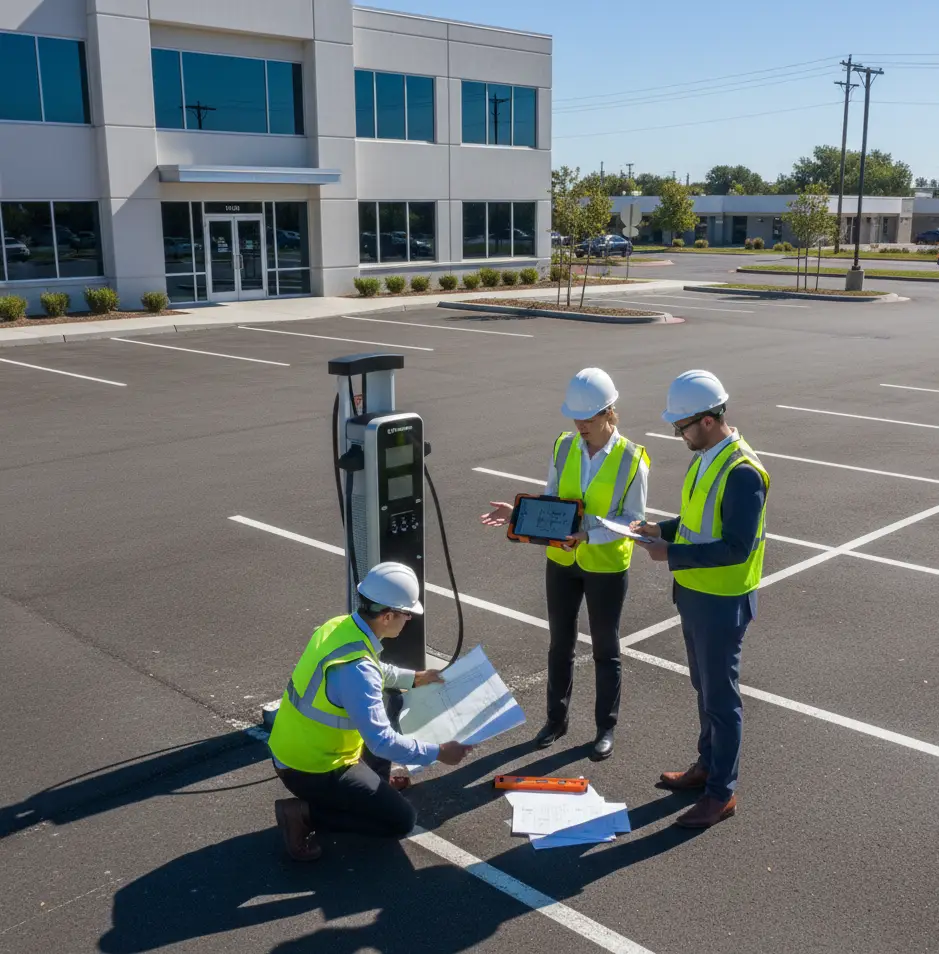

EV Charging Site Assessment and Electrical Infrastructure Analysis
Conducting detailed site inspections covering physical constraints, existing electrical infrastructure, power availability, transformer capacity, DISCOM supply feasibility, parking layouts, and civil requirements to evaluate technical readiness and define upgrade scopes for EV charging deployment.

Technology Selection and System Design Development
Assessing suitable charger types, connector standards, and power levels while designing electrical layouts, load balancing strategies, CMS architecture, and OCPP compatibility to ensure system performance aligns with operational needs and future scalability objectives.

Financial Modeling and Regulatory Compliance Planning
Supporting DISCOM applications, BIS compliance, incentive eligibility under FAME and state EV policies, and statutory approvals while developing financial models covering CapEx, OpEx, ROI, and payback analysis to strengthen overall project viability.

Implementation Strategy and Deployment Roadmap
Managing vendor evaluation, tendering, installation supervision, testing, commissioning, CMS integration, and safety validation while establishing operational procedures and training programs to ensure smooth handover and reliable long-term EV charging operations.
Why Choose IMARC for EV Charging Infrastructure Advisory Services
Our strategic advisory delivers successful charging infrastructure through technical expertise, financial analysis, and practical implementation planning. This comprehensive methodology addresses site constraints, technology options, regulatory compliance, and operational considerations throughout charging network development.

Technical Expertise and Engineering Knowledge
Leverage electrical engineering capabilities addressing power requirements, grid connections, load management, and infrastructure design. Our technical depth navigates complex electrical considerations supporting reliable, scalable charging operations.

Optimal Technology Selection and Vendor Guidance
Navigate diverse equipment options through unbiased evaluation of charging technologies, network platforms, and vendor capabilities. Our independent assessment identifies solutions matching operational requirements, budget constraints, and performance expectations.

Financial Viability and Investment Optimization
Maximize returns through detailed financial modeling, incentive program navigation, and operational cost analysis. Our assessments identify funding opportunities, evaluate revenue potential, and optimize capital deployment supporting sustainable business models.

Regulatory Navigation and Compliance Assurance
Streamline approvals through utility coordination, permitting assistance, and code compliance guidance. Our regulatory expertise accelerates deployment by navigating local requirements, interconnection procedures, and safety standards across target markets.

Scalability Planning and Future-Proof Design
Build infrastructure supporting growth through capacity planning, expandable designs, and technology roadmap alignment. Our forward-looking approach accommodates increasing demand, evolving standards, and emerging technologies.

Implementation Support and Operational Readiness
Accelerate deployment through vendor coordination, installation supervision, and commissioning support. Our guidance covers procurement, construction oversight, testing, and operational transition to ensure successful network activation.
Use-Case-Specific EV Charging Solutions
IMARC Engineering delivers industry-specific charging infrastructure advisory backed by deep sector knowledge and operational expertise. Our understanding of industry requirements, site constraints, and usage patterns supports relevant solutions for diverse business environments.
Commercial assets face electrical capacity constraints, shared parking allocation, and EV-ready compliance requirements. IMARC assesses transformer and DISCOM capacity, designs phased deployments with smart load management and supports approvals. Deliverables include power audits, phased layouts, demand management design, and DISCOM coordination. A mixed-use project achieved compliant rollout without major electrical upgrades.
Fleet depots require managing high concurrent charging, overnight scheduling, and rapid turnaround. IMARC designs depot-specific architectures with smart scheduling, evaluates BESS for peak shaving, and aligns infrastructure with fleet transition plans. Deliverables include charging architecture, scheduling strategy, BESS feasibility, and electrification roadmap. A delivery depot reduced demand charges while supporting phased fleet electrification.
Corridor charging involves variable grid access, high-power DC needs, land planning, and multi-DISCOM coordination. IMARC conducts multi-site feasibility studies, manages cross-jurisdiction approvals, and develops MoP-aligned station designs with robust revenue models. Deliverables include site assessments, approvals support, power design, and financial models. A corridor project achieved scalable, commercially viable fast-charging hubs.
Residential charging must address shared costs, metering models, parking allocation, and RWA approvals. IMARC provides technical assessments, shared infrastructure cost models, and resident-focused designs supporting phased adoption. Deliverables include capacity assessment, cost models, metering strategy, and approval documentation. A township adopted a common backbone approach enabling incremental charger additions without system overload.
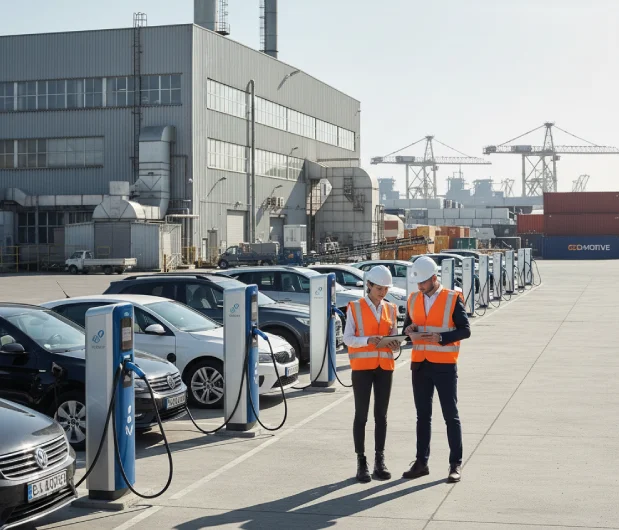
Industrial locations require seamless integration with high-tension electrical networks, structured employee charging aligned to shift operations, and dedicated access for fleet vehicles. IMARC applies its EPC-led engineering expertise to develop compliant charging solutions aligned with plant power systems and operational processes. Deliverables cover HT connectivity planning, optimized charging layouts, safety compliance frameworks, and phased implementation strategies, enabling DC fast charger deployment without impacting ongoing production activities.
Explore Related Services

Greenfield Project Management Services in India
Turning Your Industrial Land into Operational Manufacturing Ecosystems
Learn more

Brownfield Project Management Services in India
Expand, Modernize, and Optimize Your Existing Manufacturing Operations
Learn more


Project Scheduling and Cost Estimation in India
Professional Planning and Financial Analysis for Construction Success
Learn more
Frequently Asked Questions
We have compiled answers to the most common questions business owners, property managers, and fleet operators ask about EV charging infrastructure. These insights address critical concerns around feasibility, investment requirements, technology selection, and operational implementation.
Trusted by Industry Leaders
We partner with global enterprises and ambitious businesses across sectors to deliver operational excellence, strategic insights, and sustainable growth through integrated solutions.












Success in Their Words
Real feedback from clients across industries. Discover how our solutions delivered measurable impact and operational excellence.

I wanted to express my sincere appreciation for your efforts in handling this matter. Your dedication and commitment have been truly commendable, and it is evident that you have put in tremendous hard work and expertise into resolving the issues at hand. We are greatly interested in continuing our collaboration with you in the future, as your professionalism and reliability have made you a trusted partner. Thank you once again for your invaluable contribution. We look forward to strengthening our partnership ahead.

It has been a pleasure working with the IMARC team. The insights provided were structured, clear, and highly valuable, helping us strengthen both our technical and financial planning with confidence. We deeply appreciate the team’s professionalism, responsiveness, and attention to detail throughout the engagement. Every requirement was well understood and effectively incorporated, resulting in a comprehensive and actionable output. Overall, our experience has been excellent, and I would gladly recommend IMARC to organizations seeking a reliable research partner.

Your service is truly exceptional. Working with the IMARC team has been a seamless and professional experience. The clarity of communication, responsiveness to queries, and consistent support at every stage made the entire engagement highly efficient. The insights shared were well-structured, practical, and perfectly aligned with our requirements, helping us make informed decisions with confidence. Overall, the dedication and professionalism demonstrated by your team stand out, and I would be glad to recommend IMARC as a reliable and trustworthy research partner.

IMARC did an outstanding job in preparing our study. They were punctual, precise, and consistently responsive throughout the entire process. The team delivered all the data we required in a clear, well-organized, and highly professional format. Their strong attention to detail, combined with their ability to meet every deadline without compromising quality, truly set them apart. Overall, their reliability and commitment made them an exceptional partner for our project, and we would gladly work with them again in the future.

IMARC made the whole process incredibly easy from start to finish. Everyone I interacted with via email was polite, professional, and straightforward to deal with, always keeping their promises regarding delivery timelines and remaining consistently solutions-focused. From my very first contact, I appreciated the professionalism and support shown by the entire IMARC team. I highly recommend IMARC to anyone seeking timely, affordable, and reliable information or advice. My experience with IMARC was excellent, and I truly cannot fault any aspect of it.

I’d like to express my sincere gratitude for the excellent work you accomplished with the study. Your ability to quickly understand our requirements and deliver high-quality results under tight timelines truly reflects your expertise, exceptional work ethic, and unwavering commitment to your customer’s success. The professionalism and responsiveness you demonstrated throughout the process made a significant difference. Our entire team and company are incredibly thankful for your dedication, reliability, and support. Once again, thank you for your outstanding contribution.
Plan Your EV Charging Infrastructure with Confidence
Speak with IMARC’s EV advisory experts to get clear, actionable guidance for compliant, scalable, and cost-effective charging deployment.