Scale Innovation into Commercial Manufacturing with Structured Technology Transfer
Transform laboratory innovations into commercially viable manufacturing processes through structured technology transfer in India, ensuring regulatory compliance, process stability, and faster market entry across pharmaceutical, chemical, food, and industrial sectors.

Technology Transfer in India
Technology transfer in India has become a critical step for manufacturers, startups, and global companies aiming to commercialize new products efficiently while minimizing scale-up risks. With India targeting 25% manufacturing contribution to GDP by 2030 and expanding under initiatives like PLI and Make in India, the need for structured transfer from R&D to production has increased significantly.
Technology transfer involves translating lab-scale processes into stable, repeatable, and compliant manufacturing operations. This includes process scale-up, equipment alignment, validation planning, and workforce readiness. Without structured transfer, companies often face delays, quality inconsistencies, and regulatory non-compliance during commercialization.
IMARC Engineering provides technology transfer services in India through a data-driven, engineering-led approach covering process development, pilot validation, manufacturing readiness, and regulatory alignment. We bridge the gap between innovation and industrial production, helping organizations reduce commercialization risk, accelerate time-to-market, and establish scalable production systems aligned with Indian regulatory frameworks.
Our Strategic Approach to Technology Transfer
Our systematic transfer methodology combines technical evaluation, risk assessment, and validation planning to achieve successful commercialization. This proven four-phase framework addresses every critical dimension affecting technology transition and manufacturing readiness.


Process Understanding and Gap Analysis
Evaluating development process knowledge, identifying critical parameters, assessing manufacturing site capabilities, and determining gaps requiring resolution before commercial production.

Scale-Up Studies and Process Optimization
Conducting pilot-scale trials, developing manufacturing procedures, establishing process parameters, and optimizing operations translating laboratory methods into scalable commercial processes.

Validation Planning and Documentation Development
Preparing validation protocols, developing batch records, creating standard operating procedures, and establishing quality control specifications supporting regulatory compliance and consistent manufacturing.

Production Launch and Performance Verification
Supporting validation execution, troubleshooting initial production challenges, verifying process capability, and confirming manufacturing readiness before full commercial release.
Why Choose IMARC Engineering for Technology Transfer in India?
Our comprehensive transfer approach combines technical expertise, regulatory knowledge, and manufacturing experience to deliver successful commercialization. This integrated methodology addresses every dimension affecting technology transition and long-term production success.

Engineering-Led Transfer Management
Technology transfer failures in India most frequently arise not from technology limitations but from the gap between the idealised conditions of laboratory-scale development and the variable, constrained reality of commercial manufacturing. A pharmaceutical API synthesis process developed in a research laboratory using reagent-grade solvents, precisely controlled temperature equipment, and small-scale glassware produces different yield and purity outcomes at commercial scale using industrial-grade solvents, large-scale reactors with imperfect temperature uniformity, and Indian grid power with voltage variation. A food formulation developed in a product development kitchen using a laboratory mixer does not scale directly to a commercial homogeniser with different shear profile characteristics. IMARC Engineering manages technology transfer with process engineering expertise at the centre, systematically identifying the scale-sensitive parameters where laboratory conditions diverge from commercial manufacturing realities, designing the scale-up studies that characterise commercial-scale process behaviour, and establishing the process parameter ranges that achieve consistent product quality at industrial scale in Indian operating conditions.

Regulatory Compliance Integration
Technology transfer in India’s regulated manufacturing sectors is not only an engineering challenge but a regulatory documentation exercise whose outputs determine whether CDSCO manufacturing licences are granted, FSSAI facility approvals are issued, and PLI scheme production claims are supported. CDSCO requires process validation data generated during technology transfer, including scale-up batch manufacturing records, in-process and finished product analytical data, and process capability evidence, as part of pharmaceutical product dossier submissions. FSSAI requires process validation evidence for novel food processing technologies. International technology licensor agreements with US or European originators frequently require compliance with ICH, EU GMP, or US FDA technology transfer guidelines that impose documentation standards beyond those required by Indian regulations alone. IMARC Engineering designs technology transfer programmes that simultaneously satisfy Indian regulatory requirements and any applicable international licensor or export market compliance standards.

International Licensor Relationship Management
Technology transfer from international licensors, European or American pharmaceutical companies licensing API synthesis or formulation processes to Indian manufacturers, Japanese engineering companies licensing production technology to Indian industrial manufacturers, or Korean battery technology companies licensing to Indian PLI advanced chemistry cell manufacturers, requires coordination capabilities that go beyond domestic technology transfer management. International licensor engineers conducting knowledge transfer visits require coordinated site readiness that ensures the manufacturing facility is prepared to receive knowledge at the time of each visit, maximising the value extracted from expensive on-site licensor time. Licensor technical documentation in foreign languages requires accurate technical translation. Licensor process specifications for equipment from non-Indian manufacturers require adaptation for commercially available Indian or Indian-importable equipment. IMARC Engineering manages the complete international technology transfer relationship, from licensor visit programme planning through equipment adaptation and regulatory documentation translation.

Indian Raw Material and Utility Adaptation
Technologies transferred to Indian manufacturing facilities from international R&D centres or foreign manufacturing sites consistently encounter process performance challenges from Indian raw material quality characteristics and utility supply conditions that the technology was not developed and validated against. European pharmaceutical API synthesis processes validated against European pharmacopoeial reagent grades produce different impurity profiles when Indian domestic-grade solvents and reagents are substituted. Food processing technologies validated against North American or European agricultural commodity grades encounter different moisture content, particle size, and microbial load profiles from Indian agricultural raw materials. Indian grid power voltage fluctuation affects temperature-sensitive process equipment performance. IMARC Engineering adapts transferred technologies to Indian raw material and utility conditions through systematic raw material characterisation studies, equipment calibration adjustments, and process parameter re-optimisation, ensuring that transferred processes achieve target product quality with Indian-sourced inputs rather than requiring imported materials that increase cost and supply risk.

Validation Protocol and Documentation Management
Technology transfer documentation in India’s regulated sectors must meet the specific protocol format, content, and evidence standards required by CDSCO, FSSAI, and applicable international regulatory frameworks because documentation produced as a project record rather than a regulatory submission generates the deficiency observations that delay manufacturing licence issuance and product dossier approvals. Process validation protocols for pharmaceutical manufacturing must define the validation strategy, batch size and scale rationale, critical process parameters, critical quality attributes, acceptance criteria, and sampling plan in formats that CDSCO inspectors assess as evidence of a science-based validation programme. Technology transfer reports must document the donor and receiver site comparison, parameter equivalence demonstration, and any process modifications made during transfer with their scientific justification. IMARC Engineering prepares all technology transfer validation documentation to current CDSCO, WHO, and ICH Q10 pharmaceutical quality system standards from the programme inception stage.

Workforce Capability Development
Technology transfer produces commercially viable manufacturing capability only when the receiving facility’s operating team has the technical competency to operate the transferred process consistently at the required quality and throughput level. A pharmaceutical API synthesis process transferred to an Indian facility whose operators have never run a multi-stage synthesis reaction at commercial scale, whose maintenance team lacks the mechanical knowledge to maintain the specialist process equipment, and whose quality team lacks the analytical method expertise to release batches against transferred specifications will fail to achieve the consistent yield and quality that the transfer programme demonstrated in qualification batches. IMARC Engineering integrates workforce capability development into every technology transfer programme, providing operator and technician training on transferred process operations, maintenance team training on process equipment, quality team training on transferred analytical methods, and management training on process performance monitoring, ensuring that the receiving site can independently sustain transferred process performance after the transfer team exits.
Technology Transfer Across Key Sectors in India
IMARC Engineering delivers engineering-led process scale-up, international licensor management, Indian raw material adaptation, regulatory validation documentation, and workforce capability development across India’s most active manufacturing sectors.
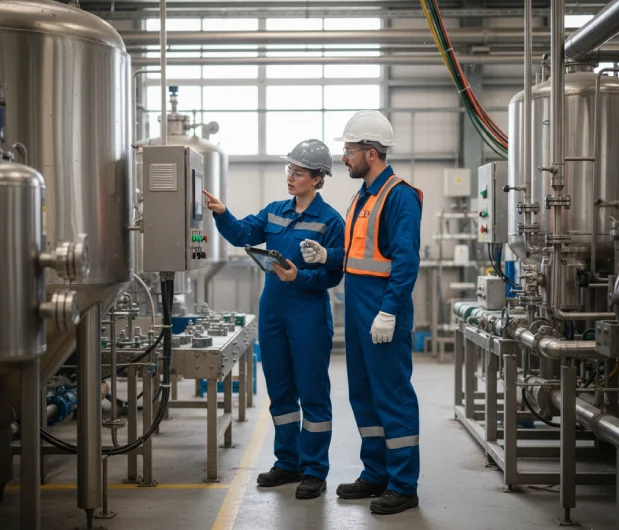
Technology transfer for pharmaceutical API synthesis, formulation development, and dosage form scale-up under CDSCO Schedule M and ICH guidelines. Process validation protocol development for CDSCO product dossier submissions, international pharma licensor knowledge transfer management, Indian solvent and reagent grade adaptation, PLI pharmaceutical scheme-linked product commercialisation support, and WHO-GMP technology transfer documentation for regulated market export product launches across Hyderabad, Baddi, and Ahmedabad clusters.
Technology transfer for novel food processing technologies, dairy product formulations, and functional food scale-up under FSSAI licensing and FSSC 22000 requirements. Indian agricultural raw material quality adaptation, critical control point validation for HACCP compliance, APEDA export product specification alignment, pilot-to-commercial scale-up for spray drying, extrusion, and fermentation processes, and PLI food processing scheme production capability documentation.
Technology transfer for specialty chemical synthesis, formulation, and process intensification from international licensors to Indian manufacturing facilities. CPCB environmental clearance process data generation, raw material adaptation for Indian feedstock grades, IBR pressure vessel and process equipment specification adaptation, PESO compliance integration for flammable solvent processes, and pilot-scale validation support for Indian specialty chemical PLI scheme-linked product commercialisation.
Technology transfer for nutraceutical formulation scale-up from laboratory to commercial manufacturing under FSSAI regulations and international GMP standards. Raw material standardisation for Indian herbal and botanical ingredient variability, encapsulation and tablet compression process scale-up, FSSAI product notification documentation support, stability study design for transferred formulations, and PLI-linked nutraceutical product commercialisation management for export-oriented health supplement manufacturers.
Technology transfer for technical grade synthesis and formulation development scale-up under CIB&RC registration requirements. Process adaptation for Indian agricultural chemical feedstock grades, effluent characterisation for CPCB ZLD compliance planning, CIB&RC product registration dossier data generation from technology transfer batches, PESO-compliant process design for flammable and toxic process technology, and export market registration documentation for EU and US market technology transfer programmes.
Technology transfer for medical device manufacturing process scale-up under CDSCO Class B and C device licensing and ISO 13485 process validation requirements. International device design history file transfer management, Indian component and material substitute qualification, cleanroom process validation for sterile and near-sterile device categories, PLI medical devices scheme technology readiness documentation, and CE marking technical file process data generation for regulated market export programmes.
Technology transfer for battery cell chemistry, solar PV manufacturing, and advanced material processing under India’s PLI scheme for Advanced Chemistry Cells and solar PV manufacturing. International licensor technical knowledge transfer management for Korean and Japanese battery technology partnerships, Indian raw material substitution feasibility assessment, pilot-scale process performance data generation for PLI scheme investment threshold planning, and process validation documentation for commercial plant design basis.
Explore Related Services

Documentation and Technical File Preparation
Transforming Technical Complexity into Regulatory Compliance Excellence
Learn more

Digital Documentation & ERP Integration
Bridging Operational Excellence with Enterprise Intelligence
Learn more

EHS (Environment, Health & Safety) Training
Building Safety Culture Through Comprehensive EHS Excellence
Learn more
Frequently Asked Questions: Technology Transfer in India
We have compiled answers to common questions investors, innovators, and business leaders ask about technology transfer. These insights address critical concerns around transfer processes, timeline expectations, cost considerations, and success factors supporting commercial manufacturing readiness.
Trusted by Industry Leaders
We partner with global enterprises and ambitious businesses across sectors to deliver operational excellence, strategic insights, and sustainable growth through integrated solutions.

Success in Their Words
Real feedback from clients across industries. Discover how our solutions delivered measurable impact and operational excellence.

I wanted to express my sincere appreciation for your efforts in handling this matter. Your dedication and commitment have been truly commendable, and it is evident that you have put in tremendous hard work and expertise into resolving the issues at hand. We are greatly interested in continuing our collaboration with you in the future, as your professionalism and reliability have made you a trusted partner. Thank you once again for your invaluable contribution. We look forward to strengthening our partnership ahead.

It has been a pleasure working with the IMARC team. The insights provided were structured, clear, and highly valuable, helping us strengthen both our technical and financial planning with confidence. We deeply appreciate the team’s professionalism, responsiveness, and attention to detail throughout the engagement. Every requirement was well understood and effectively incorporated, resulting in a comprehensive and actionable output. Overall, our experience has been excellent, and I would gladly recommend IMARC to organizations seeking a reliable research partner.
Your service is truly exceptional. Working with the IMARC team has been a seamless and professional experience. The clarity of communication, responsiveness to queries, and consistent support at every stage made the entire engagement highly efficient. The insights shared were well-structured, practical, and perfectly aligned with our requirements, helping us make informed decisions with confidence. Overall, the dedication and professionalism demonstrated by your team stand out, and I would be glad to recommend IMARC as a reliable and trustworthy research partner.
IMARC did an outstanding job in preparing our study. They were punctual, precise, and consistently responsive throughout the entire process. The team delivered all the data we required in a clear, well-organized, and highly professional format. Their strong attention to detail, combined with their ability to meet every deadline without compromising quality, truly set them apart. Overall, their reliability and commitment made them an exceptional partner for our project, and we would gladly work with them again in the future.

IMARC made the whole process incredibly easy from start to finish. Everyone I interacted with via email was polite, professional, and straightforward to deal with, always keeping their promises regarding delivery timelines and remaining consistently solutions-focused. From my very first contact, I appreciated the professionalism and support shown by the entire IMARC team. I highly recommend IMARC to anyone seeking timely, affordable, and reliable information or advice. My experience with IMARC was excellent, and I truly cannot fault any aspect of it.
I’d like to express my sincere gratitude for the excellent work you accomplished with the study. Your ability to quickly understand our requirements and deliver high-quality results under tight timelines truly reflects your expertise, exceptional work ethic, and unwavering commitment to your customer’s success. The professionalism and responsiveness you demonstrated throughout the process made a significant difference. Our entire team and company are incredibly thankful for your dedication, reliability, and support. Once again, thank you for your outstanding contribution.
Speak to Our Technology Transfer Team
Whether you are a pharmaceutical, food, chemical, agrochemical, medical device, or advanced manufacturing company, IMARC Engineering provides end-to-end technology transfer support. This includes process validation, licensor coordination, regulatory documentation aligned with regulatory bodies, and scale-up to commercial production, ensuring compliant, reliable, and scalable manufacturing operations in India.