Manufacturing
November 12 2026
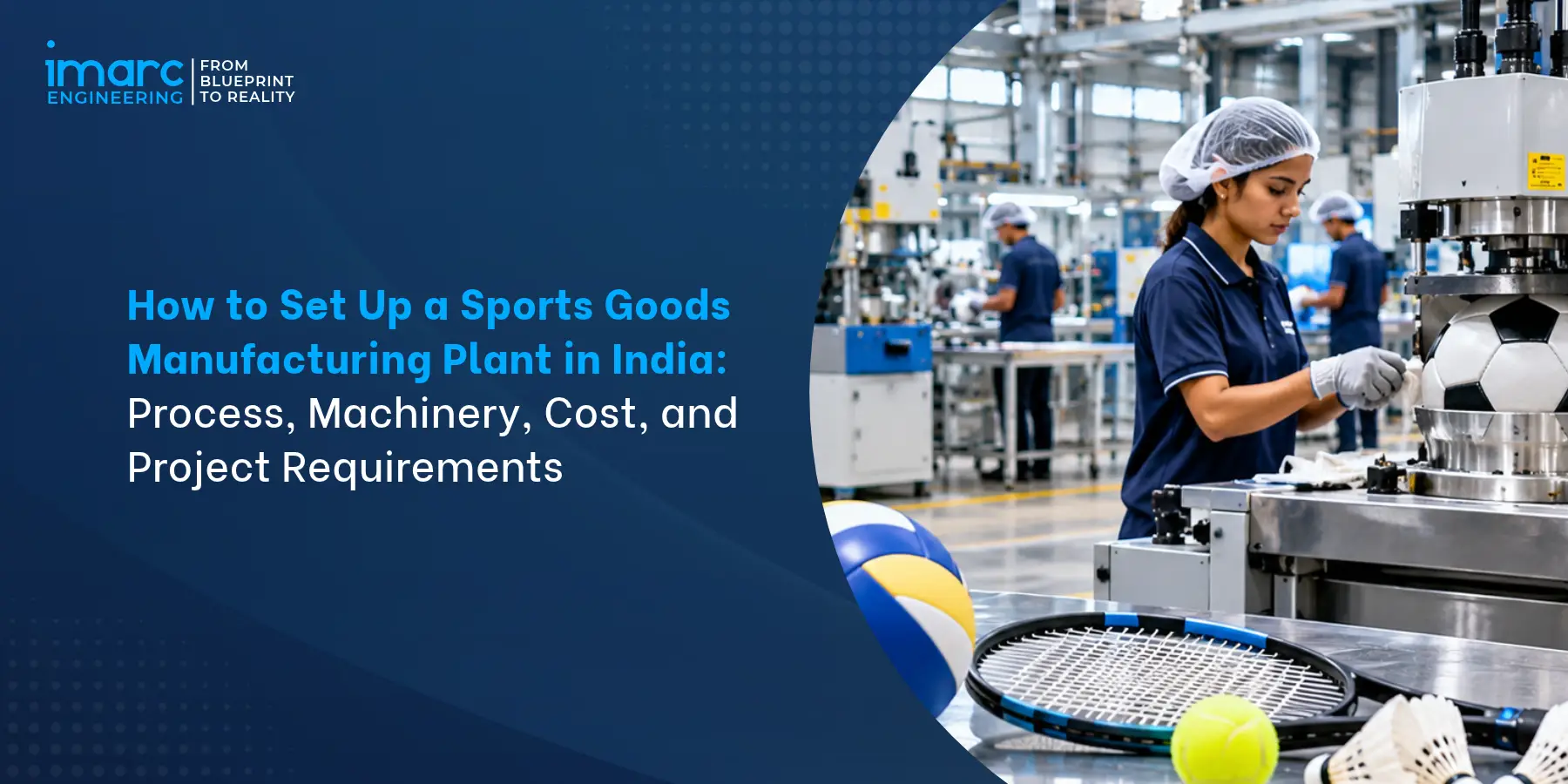
How to Set Up a Sports Goods Manufacturing Plant in India: Process, Machinery, Cost, and Project Requirements
Introduction
Sports goods manufacturing in India encompasses several distinct production activities, including cricket bat manufacturing, football stitching, badminton racket production and gym equipment fabrication. Each category involves different raw materials, manufacturing technologies, machinery, workforce skills, utility requirements and investment levels. As a result, a sports goods manufacturing plant cannot be planned to use a standard factory model. Its configuration and investment requirements must be determined by the selected product range and manufacturing processes.
Effective project planning begins with product selection and progresses through technology assessment, capacity planning, machinery selection, plant layout, utilities, quality standards and regulatory approvals. These factors ultimately determine the project's capital expenditure (CAPEX), operating expenditure (OPEX) and working capital requirements.
Scope of this Guide
This guide answers one question: how can investors set up a sports goods manufacturing plant in India, select suitable production technologies, estimate investment costs, prepare a DPR and comply with applicable regulations? It covers industrial manufacturing and investment planning only, not retail or sports participation. Costs, capacities and areas are indicative planning figures, to be replaced by vendor quotations, site surveys and state-authority confirmation. Government scheme provisions must be verified against current official notifications before entering any financial model.
Table of Contents
- Introduction
- Sports Goods Manufacturing Plant in India: Why the Investment Matters in 2026
- What a Sports Goods Manufacturing Plant in India Is and Why Product Type Matters
- Sports Goods Manufacturing Plant in India: Product Selection and Capacity Planning
- Raw Materials and Consumables for a Sports Goods Manufacturing Plant in India
- Core Process Steps of a Sports Goods Manufacturing Plant in India: Forming and Assembly
- Core Process Steps of a Sports Goods Manufacturing Plant in India: Finishing and Testing
- Machinery, Layout and Utilities for a Sports Goods Manufacturing Plant in India
- Waste, Licences and Project Economics of a Sports Goods Manufacturing Plant in India
- Conclusion
1. Sports Goods Manufacturing Plant in India: Why the Investment Matters in 2026
Four conditions make disciplined planning of a sports goods manufacturing plant in India commercially important in 2026.
1.1 Localization and Import Substitution
India has long-established sports goods clusters, notably Jalandhar in Punjab (footballs, gym and athletic goods, hockey and badminton items) and Meerut in Uttar Pradesh (cricket bats and equipment), alongside willow bat making in Jammu and Kashmir. Premium categories such as graphite racket frames, composite sticks, treadmills and technical sportswear still depend on imported components or finished goods. Backward integration into frames, bladders, foams and fabricated steel components offers localization opportunities that depend on product-specific demand and cost competitiveness.
1.2 Policy Framework
The government has introduced targeted support to strengthen India's sports goods manufacturing sector. On 28 October 2026, the Union Cabinet approved the Khelo India Sports Goods Manufacturing Scheme with an outlay of INR 1,856.67 crore for FY 2026–27 to FY 2033–34. The scheme covers manufacturing zones, investment support, production incentives, international certification, research, technology adoption and skill development.
Manufacturers may also explore applicable MSME support and state industrial incentives. However, eligibility, application procedures and funding conditions should be verified against the relevant scheme guidelines and official notifications before being included in project financial projections. Investors should prepare their base-case financial models without relying on unconfirmed incentives.
1.3 Investment Ecosystem
Cluster depth matters more than land price. Jalandhar and Meerut offer skilled stitchers, bat makers, tooling workshops, chemical and fabric suppliers and export-trade knowledge. Greenfield sites outside clusters can offer lower land cost and modern layouts but must fund vendor development, training and logistics. Export-oriented units should also weigh proximity to ports and inland container depots against domestic-market focus.
1.4 Cost of Poor Planning
Typical failures include picking a product mix before verifying material supply, such as cricket-grade willow clefts or football-grade laminated panels, under-sizing finishing and testing areas, ignoring buyer specifications on bounce, compression and durability, and modelling full capacity utilization from year one. Each converts into idle machinery, rework, rejected export consignments and working-capital stress.
2. What a Sports Goods Manufacturing Plant in India Is and Why Product Type Matters
A sports goods manufacturing plant in India is defined by its product family, because the family fixes technology, skills, utilities and capital.
2.1 Definition and Product Families
An industrial plant converts wood, rubber, synthetics, fabrics, metals and composites into sports equipment. Families include bats and sticks (cricket, hockey), inflatable balls (football, volleyball, basketball, cricket balls), racket sports (badminton and tennis frames, strings, shuttlecocks), fitness equipment (benches, racks, plates, treadmills) and sportswear and protective gear (pads, gloves, helmets, jerseys).
2.2 Why One Process Cannot Serve All Products
A cricket bat line is woodworking: seasoning, pressing, shaping and sanding. A football line is lamination and stitching or thermobonding. A graphite racket line is composite prepreg layup and autoclave or press curing. A gym equipment plant is metal fabrication: laser cutting, bending, welding and powder coating. Sharing a building is possible; sharing a process is not. A product-wise decision comes before any machinery list.
2.3 Illustrative Product Comparison
Cricket bats: willow cleft processing, press, shaping and sanding, using band saws, hydraulic presses, belt sanders and lathes. Footballs: PU or PVC lamination and stitching or thermobonding, using calendering and laminating lines, die-cutting presses, stitching and bonding machines and bladder moulds. Badminton rackets: carbon-fibre composite layup and curing, using prepreg cutters, hot-press moulds and string-tension machines. Gym equipment: structural steel fabrication and coating, using laser or plasma cutters, CNC press brakes, MIG welders and powder-coat lines. Sportswear: cut, sew and finish, using spreaders, CAD cutters, industrial sewing machines and heat presses.
2.4 Scale Determinants
Plant capacity depends on the selected product, production technology, labour availability, operating shifts and expected market demand. Capacity should be measured in units per shift or per year for a defined product specification.
Labour requirements vary significantly between hand-assisted production, semi-automated assembly and automated manufacturing. The project assessment should identify the production bottlenecks, required skills, equipment capacity and expected rejection rates before finalising plant size.
2.5 Plant Sections for Sports-Ball Manufacturing
The following table outlines the typical sections of a sports-ball manufacturing facility, particularly units producing footballs, volleyballs and basketballs. Other sports goods categories require different production areas and equipment based on their respective manufacturing processes.
| Section | Function | Key Equipment |
|---|---|---|
| Raw material storage | Receipt, inspection and storage of materials | Storage racks, handling equipment |
| Cutting and panel preparation | Cutting fabric and synthetic material into panels | Die-cutting presses, cutting tables |
| Lamination and bonding | Preparing and bonding panel materials | Laminating and bonding equipment |
| Printing and branding | Applying designs, logos and product markings | Screen-printing or digital printing equipment |
| Stitching and assembly | Joining panels and assembling products | Industrial stitching machines and assembly fixtures |
| Bladder and component assembly | Fitting bladders, valves and other components | Bladder assembly and inflation equipment |
| Finishing and inspection | Trimming, cleaning and checking finished products | Finishing tools and inspection equipment |
| Testing | Checking product performance and dimensions | Pressure, weight, size and relevant performance-testing equipment |
| Packaging and dispatch | Packing and preparing finished products for shipment | Packing equipment and storage racks |
| Utilities and support | Supplying power, compressed air and other services | Electrical systems, compressors and other required utilities |
The table is intended primarily for sports-ball manufacturing and should not be treated as a standard layout for all sports goods facilities. Cricket bat, racket, gym equipment and sportswear manufacturing units require different production sections, machinery arrangements and supporting infrastructure. The final plant layout should be developed according to the selected product range and manufacturing scope.
3. Sports Goods Manufacturing Plant in India: Product Selection and Capacity Planning
Product and capacity decisions in a sports goods manufacturing plant in India should be made together, using verified demand, material supply and skills.
3.1 Product Types and Technology Routes
Cricket bats: English-willow or Kashmir-willow clefts, air or kiln seasoning, pressing, shaping, handle fitting and finishing. Footballs: machine-stitched, hand-stitched or thermobonded constructions with PU or PVC covers. Badminton rackets: aluminium or steel frames for entry grades; carbon-fibre composites for premium grades. Gym equipment: tubular steel, plates and weights, and electronics-based cardio machines. Each route has distinct yield, labour and quality-control behaviour.
3.2 Capacity Planning
Production capacity should be determined by the output of the slowest or most resource-intensive process stage. In football manufacturing, this may involve panel preparation, stitching or thermobonding. In cricket bat manufacturing, seasoning, shaping and finishing can influence throughput. In fabrication units, welding, coating and assembly may determine production capacity.
Capacity planning should account for operating shifts, labour availability, equipment downtime, material wastage, rejection rates and expected demand. Production ramp-up assumptions should be realistic and supported by market assessment and equipment specifications.
3.3 Product Mix and Seasonality
Demand is event-driven, with cricket, football and badminton peaking around tournament and academic cycles, and export programs following buyer calendars. A balanced mix, such as footballs with volleyballs and basketballs on shared laminating and moulding assets, reduces idle time. Sportswear and protective gear can add base load but require separate skills.
3.4 Location and Cluster Selection
Compare shortlisted sites on skilled-labour availability, supplier proximity, power reliability and tariff, water, logistics to ports or ICDs, effluent disposal options and state incentive eligibility. Cluster locations reduce vendor and training risk; greenfield sites need a stronger cost case. Cluster locations can reduce supplier-development and workforce-training requirements, while greenfield sites may offer greater flexibility in facility design and future expansion. Land requirements should be established through a project-specific assessment of production capacity, manufacturing processes, machinery configuration, storage needs, utilities, logistics and planned expansion.
4. Raw Materials and Consumables for a Sports Goods Manufacturing Plant in India
Material specification drives performance, standards compliance and rejection rates in a sports goods manufacturing plant in India.
4.1 Base Materials by Product
Bats: willow clefts graded by grain count and moisture, cane handles, rubber grips. Balls: PU or PVC coated fabrics, cotton or polyester lining layers, latex or butyl bladders, polyester or nylon thread. Rackets: aluminium alloy tubing, carbon-fibre prepreg, nylon or polyester strings, grommets, grips. Gym equipment: mild-steel tubes and plates, cast iron or rubber-coated plates, foam, upholstery and fasteners.
4.2 Process Chemistries
Material and chemical requirements vary by product and manufacturing process. Football and other sports-ball production may involve PU or PVC-coated fabrics, adhesives, inks and bonding agents. Rubber bladders, where manufactured in-house, require suitable rubber compounds and moulding processes.
Composite racket production may use carbon-fibre prepregs and resin systems, while gym equipment manufacturing may involve metal pretreatment chemicals and powder coatings. Cricket bat finishing may require suitable surface coatings and adhesives. Chemical selection, storage and handling should follow supplier specifications, safety data sheets and applicable environmental and workplace safety requirements.
4.3 Consumables and Procurement
Consumables include die blades, needles, abrasive belts, moulds, printing screens, packaging cartons and polybags. Procurement should include approved suppliers, incoming material inspection and quality checks based on product specifications. Inventory levels should reflect supplier lead times, consumption rates, demand variability, import dependence and procurement strategy. These factors should be incorporated into working-capital estimates.
Willow, synthetic fabrics and carbon-fibre prepregs carry the longest lead times and import exposure, so safety stock policy should be modelled into working capital (Figures are indicative in nature, may vary).
4.4 Storage and Safety
Raw materials, chemicals and finished products should be stored according to their physical properties, handling requirements and manufacturer recommendations. Adhesives, solvents and coatings may require segregated storage, adequate ventilation, spill-control arrangements and suitable fire-protection measures based on their safety data sheets and applicable regulations.
Wooden components should be stored under conditions that minimise moisture-related damage and warping. Powder-coating and finishing areas should incorporate appropriate ventilation, dust control and ignition-prevention measures. The facility should maintain safety data sheets, employee handling procedures, emergency arrangements and suitable firefighting equipment.
5. Core Process Steps of a Sports Goods Manufacturing Plant in India: Forming and Assembly
Forming and assembly steps differ by product, and a sports goods manufacturing plant in India should document each as a controlled routing.
5.1 Football and Sports-Ball Process Flow
Football and sports-ball manufacturing begins with the preparation of outer panels using suitable synthetic or coated fabrics. The panels are cut to the required dimensions and may undergo printing or branding before assembly.
Depending on the ball construction, panels are joined through hand stitching, machine stitching or thermobonding. Bladders and valves may be procured as finished components from specialised suppliers and fitted during the ball assembly stage. If bladder manufacturing is included in the project scope, the facility will require additional rubber-compounding, moulding and curing equipment, along with the associated raw materials, utilities and quality-control arrangements. Valve production may also be handled in-house or outsourced, depending on the manufacturing strategy.
After panel joining and component assembly, the ball undergoes inflation, dimensional and visual checks, followed by finishing and packaging. Panel quality, seam or bonding strength, shape retention and inflation performance are important quality-control considerations.
5.2 Cricket Bat and Stick Forming
Cricket bat manufacturing begins with the selection and preparation of suitable willow clefts. The wood is seasoned or dried under controlled conditions before cutting, shaping and pressing, where required by the production method. The bat is then shaped, sanded and fitted with a handle and grip.
Manufacturing may use band saws, presses, lathes and sanding equipment, depending on the product and level of automation. Final inspection covers dimensions, weight, balance, surface finish and other buyer-specific requirements. Moisture management and material quality are important for reducing defects such as cracking and warping.
5.3 Racket and Composite Forming
Racket manufacturing depends on the frame material and product grade. Aluminium or steel frames generally involve metal forming, joining and finishing operations. Composite rackets use materials such as carbon-fibre prepregs, which are cut, layered and moulded under controlled processing conditions.
Composite frames undergo curing and subsequent finishing operations, including drilling, surface treatment and painting, where required. Stringing and grip fitting complete the assembly. Process controls should cover material orientation, moulding conditions, frame dimensions, weight and structural performance.
5.4 Gym Equipment Fabrication
Tubes and plates are laser or plasma cut, bent on CNC press brakes, MIG-welded in jigs, shot-blasted or chemically pretreated, powder-coated and oven-cured, then assembled with fasteners, pads and moving parts. Weld quality, dimensional accuracy and coating thickness are the main controls.
6. Core Process Steps of a Sports Goods Manufacturing Plant in India: Finishing and Testing
Finishing and testing protect brand value and export acceptance in a sports goods manufacturing plant in India.
6.1 Finishing Operations
Finishing covers sanding, buffing, screen printing, lacquering, trimming, branding, grip fitting and cleaning. Printing and coating consistency matters because visible defects drive customer rejection even when functionality is sound. Dedicated finishing zones with dust extraction improve quality and worker safety.
6.2 In-Process and Final Inspection
Inspect at cutting, lamination, stitching, moulding and final stages. Typical checks include dimensional tolerance, panel alignment, weld and seam integrity, weight, circumference, moisture content of wood, coating thickness and visual grading. Maintain batch traceability and defect logs so root causes can be corrected quickly.
6.3 Product Testing
Testing requirements depend on the product category, intended application and buyer specifications. Inflatable balls may require checks for pressure retention, circumference, weight, rebound and shape consistency. Cricket bats may be inspected for dimensions, weight, balance and material quality. Rackets may require frame strength, dimensional and string-tension checks, while gym equipment may undergo load, stability and structural integrity testing.
Testing should follow applicable Indian Standards, international sports federation requirements or buyer specifications, as relevant. Manufacturers should establish suitable inspection procedures and retain test records to support product quality and traceability.
6.4 Standards and Certification
Standards and certification requirements vary by sports goods category and target market. BIS certification is mandatory for products covered by applicable Quality Control Orders. For other products, certification may be voluntary or required by buyers, importers or international sports federations.
Manufacturers should identify the relevant Indian Standards, international specifications and market-specific requirements before finalising product design and testing procedures. Testing equipment should be calibrated, inspection records maintained and third-party certification arranged wherever required.
7. Machinery, Layout and Utilities for a Sports Goods Manufacturing Plant in India
Machinery selection, layout and utilities convert product choice into a buildable sports goods manufacturing plant in India.
7.1 Machinery by Product Category
- Football: Laminating and coating equipment, die-cutting presses, printing machines, stitching or thermobonding machines, and inflation testers. Rubber mixing mills and bladder moulding presses are additionally required where bladder manufacturing is undertaken in-house.
- Bats: Band saws, hydraulic presses, lathes, and belt and profile sanders.
- Rackets: Prepreg cutters, hot-press moulds, and stringing machines for composite rackets. Metal-frame rackets require suitable forming, joining, and finishing equipment.
- Gym Equipment: Laser or plasma cutters, CNC press brakes, MIG welding machines, shot-blasting equipment, and powder-coating lines.
Machinery should be selected based on the product specifications, manufacturing scope, production capacity, vendor capabilities, after-sales service, and spare-parts availability.
7.2 Land, Layout and Material Flow
Land and building requirements depend on production capacity, manufacturing processes, automation, raw material inventory and finished-goods storage. The layout should provide adequate space for material receiving, cutting, lamination, assembly, finishing, testing, packaging and dispatch.
Separate storage and movement areas should be planned for raw materials, chemicals and finished products. The design should also account for equipment maintenance, utilities, ventilation, fire access, worker safety and future expansion. Final land and built-up area requirements should be established through a project-specific layout.
7.3 Utilities
Utility requirements depend on the selected machinery, production capacity and manufacturing processes. Electrical demand should be calculated from the connected equipment load, operating schedule and expected production volume.
Compressed air, water, heating systems and ventilation should be included where required by the process. Powder-coating and curing operations may require additional thermal energy and exhaust systems. A project-specific utility balance should be prepared during engineering to establish power, water, fuel, compressed-air and other infrastructure requirements.
7.4 Key Machinery
| Product category | Main machinery | Selection considerations |
|---|---|---|
| Footballs and sports balls | Cutting presses, laminating equipment, stitching or thermobonding machines, bladder assembly equipment | Ball construction, panel material and production capacity |
| Cricket bats | Band saws, presses, lathes and sanding equipment | Willow quality, bat dimensions and finishing requirements |
| Badminton and tennis rackets | Metal-forming equipment or composite moulding systems, finishing and stringing machines | Frame material, product grade and design |
| Gym equipment | Cutting machines, press brakes, welding equipment, surface-treatment and coating systems | Product design, fabrication capacity and coating requirements |
| Sportswear | Fabric spreading and cutting systems, industrial sewing machines and printing equipment | Fabric type, garment design and production volume |
| Testing and quality control | Product-specific inspection and testing equipment | Applicable standards and buyer requirements |
The final machinery list should be prepared according to the selected product range, production capacity, process flow and vendor specifications.
8. Waste, Licences and Project Economics of a Sports Goods Manufacturing Plant in India
Compliance and economics determine whether a sports goods manufacturing plant in India is bankable.
8.1 Waste and Effluent
Waste generation depends on the manufacturing process and product category. Common solid waste streams include fabric offcuts, rubber scraps, wood waste, metal scrap, packaging material and rejected components. These should be segregated and sent for reuse, recycling or authorised disposal, as applicable.
Facilities using adhesives, solvents, coatings or metal pretreatment chemicals may generate chemical residues, sludge or wastewater. Such waste should be characterised and managed according to applicable environmental regulations. Effluent-treatment facilities should be provided where required by the process and SPCB consent conditions.
Dust extraction, ventilation and emission-control systems should be incorporated wherever manufacturing operations generate airborne contaminants. Waste-management and pollution-control requirements should be assessed during project planning.
8.2 Licences, Approvals and Standards
The approvals required for a sports goods manufacturing facility depend on its location, production processes, workforce and environmental impact. Key requirements may include business registration, GST registration, applicable factory plan approval, permission and licensing under the Occupational Safety, Health and Working Conditions Code, 2020, and relevant state rules.
Building and fire approvals, electricity connections and local permissions should be obtained as applicable. Consent to Establish and Consent to Operate from the State Pollution Control Board or Pollution Control Committee should be assessed based on the manufacturing processes and the relevant state classification. Hazardous-waste authorisation may be required where the facility generates regulated hazardous waste.
BIS certification is mandatory only for products covered by applicable Quality Control Orders. For other products, certification may be voluntary or required by buyers, importers or international sports federations. Manufacturers should verify the applicable Indian Standards and certification requirements for each product before production or sale.
8.3 CAPEX, OPEX and Working Capital
Capital expenditure (CAPEX) for a sports goods manufacturing plant may include land, site development, factory buildings, machinery, electrical systems, utilities, testing equipment, pollution-control infrastructure, installation and pre-operative expenses. The investment requirement depends on the selected product category, manufacturing technology, production capacity and level of automation.
Operating expenditure (OPEX) includes raw materials, labour, power, fuel, maintenance, consumables, packaging, transportation and administrative expenses. These costs should be estimated using the planned production volume, material consumption, equipment specifications, staffing requirements and supplier quotations.
A project-specific cost estimate should distinguish between fixed investment, recurring operating expenses and initial working capital. This provides a clearer basis for evaluating the overall investment requirement.
8.4 Working Capital Assessments
Working capital requirements depend on raw material inventory, work-in-progress, finished goods, production cycles, supplier credit and customer payment terms. Export-oriented manufacturers may also need to account for longer receivable cycles, shipment schedules and documentation requirements.
The assessment should estimate inventory, receivables and payables separately. Customer advances, supplier credit, order milestones and other contractual payment conditions should be incorporated into the financial model. Working capital assumptions should reflect the selected product category, procurement strategy and expected sales arrangements.
8.5 DPR Preparation, Government Support and Project Economics
A Detailed Project Report (DPR) provides a technical, commercial and financial basis for establishing a sports goods manufacturing plant. It should cover the executive summary, market assessment, product selection, manufacturing technology, raw material availability, production capacity, process flow, machinery requirements, plant layout, utilities and regulatory approvals.
The report should also include project cost estimates, operating expenses, working capital requirements, implementation schedules, manpower planning and financial projections. Equipment quotations, site assessments, supplier inputs and documented production assumptions should support the estimates.
A well-structured DPR helps project sponsors assess technical feasibility, investment requirements, funding needs and implementation risks before committing capital.
8.6 Financial Feasibility and Government Support
Financial feasibility should be assessed using projected revenue, operating costs, working capital requirements and expected cash flows. The evaluation may include break-even analysis, debt-servicing capacity, payback period and sensitivity analysis, depending on project and lender requirements.
The financial model should examine the impact of changes in raw material prices, selling prices, production utilisation, rejection rates and operating costs. Base-case and downside scenarios should use documented assumptions supported by supplier quotations, market assessment and customer inputs.
Manufacturers may also explore applicable central and state government support programmes. The Khelo India Sports Goods Manufacturing Scheme and relevant MSME or state industrial incentives may be considered where the project meets the applicable eligibility conditions. Incentives should be included in financial projections only after verifying the relevant scheme guidelines and funding provisions.
8.7 Illustrative Project: Football Manufacturing Facility
A proposed football manufacturing facility can serve as an illustrative example of how product selection, production capacity, machinery requirements and investment estimates are brought together during project planning.
For planning purposes, consider a hypothetical facility designed to manufacture 100,000 machine-stitched footballs annually. The proposed manufacturing scope includes synthetic panel preparation, lamination, printing, die-cutting, stitching, bladder and valve assembly, finishing and product testing. The facility is assumed to procure ready-made bladders and valves rather than manufacture these components in-house.
The machinery configuration may include fabric laminating equipment, printing machines, die-cutting presses, industrial stitching machines, assembly fixtures, inflation equipment and product-testing instruments. Supporting infrastructure would include raw material storage, production areas, finishing and inspection sections, packaging facilities and utilities.
Cost estimation methodology
The project cost should be developed through separate estimates for:
- Land and site development: Plot acquisition or lease, site preparation and internal infrastructure.
- Buildings and civil works: Production areas, warehouses, testing facilities, administrative space and worker amenities.
- Machinery and equipment: Production machinery, assembly equipment, testing instruments and material-handling systems.
- Utilities and supporting infrastructure: Electrical installations, compressed air, ventilation, fire protection and other process-specific requirements.
- Installation and pre-operative expenses: Equipment installation, commissioning, technical consultancy, trial production and other initial expenses.
- Working capital: Raw material inventory, work-in-progress, finished goods, receivables and operating expenses.
The final investment estimate should be based on supplier quotations, site-specific engineering, machinery specifications, civil estimates and working capital assumptions. The proposed capacity and configuration are illustrative and should not be treated as a standard industry benchmark or a confirmed project cost.
8.8 Plant Setup and DPR Preparation Checklist
Before proceeding with a sports goods manufacturing project, investors should review the following requirements:
| Project area | Key activities |
|---|---|
| Product selection | Finalise the sports goods category, product specifications and target markets |
| Market assessment | Evaluate demand, competitors, buyer requirements and sales channels |
| Manufacturing technology | Select the appropriate production process and define the in-house manufacturing scope |
| Raw materials | Identify material specifications, suppliers, procurement arrangements and inventory requirements |
| Production capacity | Determine annual output, operating shifts, process bottlenecks and expected rejection rates |
| Machinery selection | Prepare the equipment list, technical specifications and vendor quotations |
| Site selection | Evaluate land availability, labour, logistics, power supply, water and applicable incentives |
| Plant layout | Plan production areas, material movement, storage, utilities, testing and dispatch |
| Regulatory compliance | Identify applicable factory, building, fire, environmental and product certification requirements |
| Project costing | Estimate land, civil works, machinery, utilities, installation and pre-operative expenses |
| Working capital | Assess inventory, work-in-progress, receivables, payables and operating cash requirements |
| Financial feasibility | Prepare revenue projections, operating cost estimates, cash flows and sensitivity analysis |
| Implementation planning | Establish procurement, construction, installation, commissioning and trial-production milestones |
The final DPR should incorporate supporting documents such as supplier quotations, site details, process specifications, projected financial statements and applicable regulatory requirements. These inputs help establish a realistic basis for project appraisal and implementation.
Conclusion
A viable sports goods manufacturing plant in India is planned backward from product selection: the chosen category fixes the technology, machinery, skills, utilities, standards and capital. Sponsors who size capacity from the true bottleneck, verify materials and approvals early, and build a DPR with realistic utilization and incentive-free base cases arrive at a defensible investment decision and a smoother ramp-up.
Successful project planning requires three priorities. First, select the product category and define the manufacturing process before finalising machinery and capacity. Second, assess raw material availability, skilled labour and quality requirements before committing to infrastructure. Third, verify applicable approvals, standards and government incentives using current official requirements. These steps provide a sound basis for preparing the DPR and evaluating project feasibility.
PURSUING A SPORTS GOODS MANUFACTURING PLANT IN INDIA?
IMARC Engineering supports entrepreneurs, MSMEs and industrial investors with feasibility studies, business planning, plant layout, process flow design and equipment selection. Its engineering advisory services help project developers assess manufacturing requirements, plan infrastructure and evaluate investment decisions across different sports goods categories.
→ Schedule a sports goods manufacturing scoping consultation with an IMARC specialist
Frequently Asked Questions
Start by selecting a product category, such as cricket bats, footballs, rackets or gym equipment. Assess market demand, raw material availability and manufacturing requirements. Then select the technology, determine plant capacity, shortlist machinery, prepare a DPR and identify applicable approvals. Complete installation, commissioning and product testing before starting commercial production.
India's manufacturers produce cricket bats and balls, footballs and other inflatable balls, hockey sticks, badminton and tennis rackets, shuttlecocks, gym and fitness equipment, protective gear, nets and sportswear. Established clusters such as Jalandhar and Meerut specialize in particular categories, while premium composite and cardio products often combine domestic assembly with imported components.
Machinery depends on the product. Ball units need laminating lines, die-cutting presses, bladder moulding presses and stitching or thermobonding machines. Bat units use band saws, presses, lathes and sanders. Rackets need prepreg cutters and hot-press moulds. Gym equipment needs laser cutters, CNC press brakes, MIG welders and powder-coating lines, plus testing instruments.
The investment depends on the product category, manufacturing capacity, technology, automation level, site requirements and machinery configuration. A project-specific estimate should cover land, buildings, machinery, utilities, testing equipment, installation, pre-operative expenses and working capital. Vendor quotations and engineering assessments should form the basis of the cost estimate.
Common inputs include willow and cane for bats, PU or PVC coated fabrics, latex or butyl bladders and thread for balls, aluminium and carbon-fibre prepregs for rackets, and mild-steel tubes, plates, foam and powder coatings for gym equipment. Adhesives, solvents, abrasives, moulds and packaging are major consumables.
Bats follow seasoning, pressing, shaping and sanding. Footballs follow lamination, die-cutting, bladder moulding, stitching or thermobonding and inflation testing. Rackets rely on composite layup and curing. Gym equipment uses cutting, bending, welding, pretreatment and powder coating. Each category needs different skills, utilities and quality controls.
Land requirements depend on production capacity, manufacturing processes, machinery, storage, utilities and future expansion plans. Infrastructure may include production areas, raw material stores, testing facilities, utilities, packaging, dispatch and worker facilities. The final land and building requirements should be established through a project-specific layout.
Approvals may include business and GST registration, applicable factory permissions and licensing, building and fire approvals, electricity connection and State Pollution Control Board consents where required. Hazardous-waste authorisation may apply to facilities generating regulated waste. BIS certification is mandatory for products covered by applicable Quality Control Orders. Requirements depend on the product, process and location.
A DPR should cover market demand, product selection, manufacturing technology, raw material availability, plant layout, machinery, utilities, regulatory requirements and implementation schedules. It should also include project cost estimates, operating expenses, working capital, financial projections and risk analysis. Estimates should be supported by vendor quotations and site-specific assessments.
The Khelo India Sports Goods Manufacturing Scheme, approved in October 2026, supports investment, production, technology adoption, certification, research and manufacturing ecosystem development. Manufacturers may also explore applicable MSME schemes and state industrial incentives. Eligibility and funding conditions should be checked against the latest official guidelines before including benefits in financial projections.
Consultants help select products and technology, plan capacity, evaluate sites, design layouts and utilities, specify and source machinery, structure approvals and schemes, prepare the DPR with CAPEX, OPEX and financial projections, and supervise installation, commissioning and production ramp-up, reducing technical and regulatory risk.
Recent Post


Trusted by Industry Leaders
We partner with global enterprises and ambitious businesses across sectors to deliver operational excellence, strategic insights, and sustainable growth through integrated solutions.











Success in Their Words
Real feedback from clients across industries. Discover how our solutions delivered measurable impact and operational excellence.

I wanted to express my sincere appreciation for your efforts in handling this matter. Your dedication and commitment have been truly commendable, and it is evident that you have put in tremendous hard work and expertise into resolving the issues at hand. We are greatly interested in continuing our collaboration with you in the future, as your professionalism and reliability have made you a trusted partner. Thank you once again for your invaluable contribution. We look forward to strengthening our partnership ahead.

It has been a pleasure working with the IMARC team. The insights provided were structured, clear, and highly valuable, helping us strengthen both our technical and financial planning with confidence. We deeply appreciate the team’s professionalism, responsiveness, and attention to detail throughout the engagement. Every requirement was well understood and effectively incorporated, resulting in a comprehensive and actionable output. Overall, our experience has been excellent, and I would gladly recommend IMARC to organizations seeking a reliable research partner.

Your service is truly exceptional. Working with the IMARC team has been a seamless and professional experience. The clarity of communication, responsiveness to queries, and consistent support at every stage made the entire engagement highly efficient. The insights shared were well-structured, practical, and perfectly aligned with our requirements, helping us make informed decisions with confidence. Overall, the dedication and professionalism demonstrated by your team stand out, and I would be glad to recommend IMARC as a reliable and trustworthy research partner.

IMARC did an outstanding job in preparing our study. They were punctual, precise, and consistently responsive throughout the entire process. The team delivered all the data we required in a clear, well-organized, and highly professional format. Their strong attention to detail, combined with their ability to meet every deadline without compromising quality, truly set them apart. Overall, their reliability and commitment made them an exceptional partner for our project, and we would gladly work with them again in the future.

IMARC made the whole process incredibly easy from start to finish. Everyone I interacted with via email was polite, professional, and straightforward to deal with, always keeping their promises regarding delivery timelines and remaining consistently solutions-focused. From my very first contact, I appreciated the professionalism and support shown by the entire IMARC team. I highly recommend IMARC to anyone seeking timely, affordable, and reliable information or advice. My experience with IMARC was excellent, and I truly cannot fault any aspect of it.

I’d like to express my sincere gratitude for the excellent work you accomplished with the study. Your ability to quickly understand our requirements and deliver high-quality results under tight timelines truly reflects your expertise, exceptional work ethic, and unwavering commitment to your customer’s success. The professionalism and responsiveness you demonstrated throughout the process made a significant difference. Our entire team and company are incredibly thankful for your dedication, reliability, and support. Once again, thank you for your outstanding contribution.