
Maximise Equipment Uptime Through Strategic Spare Parts Planning in India
Identify, classify, and manage critical spare parts for manufacturing facilities in India through structured planning and inventory setup. Ensure component availability, reduce unplanned downtime, optimize inventory costs, and establish efficient spare parts management systems.


Spare Parts Planning and Inventory Setup in India
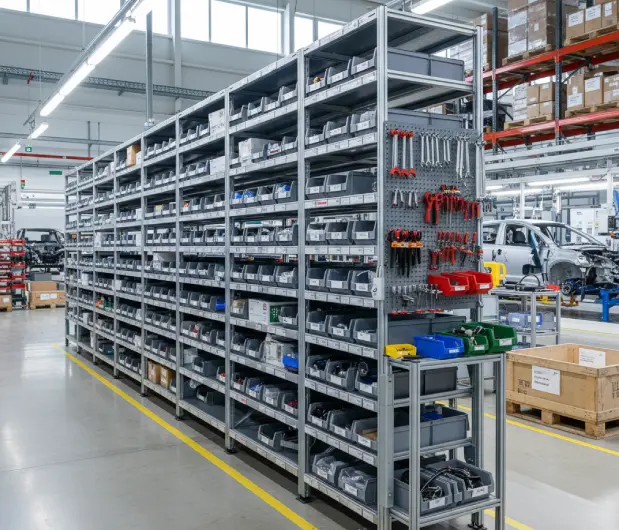
Spare parts planning and inventory setup is the engineering process of identifying, classifying, and stocking the components required to maintain manufacturing equipment availability, balancing the cost of holding inventory against the financial consequences of unplanned production downtime. In India, manufacturers typically experience 800 hours of unscheduled machine downtime annually, or more than 15 hours of paid non-productive time each week, with spare parts unavailability among the leading causes of extended breakdown durations.
IMARC Engineering’s spare parts planning and inventory setup services in India cover equipment criticality analysis, failure mode assessment, stocking level optimisation, supplier identification, and inventory management system implementation, across pharmaceuticals, food processing, chemicals, and FMCG manufacturing facilities.
India’s spare parts procurement landscape carries specific challenges, extended lead times for imported OEM spares, customs duty implications, counterfeit spare parts risk, and limited local availability for specialised process equipment. IMARC Engineering addresses each challenge systematically, identifying domestic alternatives, mapping import lead times into stocking decisions, and establishing approved supplier lists that reduce counterfeit risk and procurement cost.
Our Systematic Approach to Spare Parts Planning and Inventory Management
Our structured spare parts framework combines comprehensive equipment assessment, criticality-based prioritization, data-driven stocking decisions, and systematic inventory management implementation. This proven methodology ensures optimal spare parts availability, minimizes inventory investment, and establishes efficient parts management supporting reliable equipment performance.


Equipment Analysis & Criticality Assessment
Inventorying equipment assets, evaluating criticality based on production impact, identifying critical components, and establishing prioritization frameworks guiding spare parts decisions.

Failure Analysis & Parts Identification
Analyzing failure modes, determining wear components, reviewing maintenance histories, and identifying spare parts requiring stocking based on reliability data and operational requirements.

Stocking Strategy & Inventory Optimization
Determining optimal stock levels, establishing reorder parameters, identifying supplier agreements, and developing inventory policies balancing availability against investment requirements.

System Implementation & Management Protocols
Establishing inventory management systems, implementing tracking procedures, training maintenance personnel, and creating governance protocols ensuring sustained spare parts program effectiveness.
Why Choose IMARC Engineering for Spare Parts Planning and Inventory Setup in India?
Our spare parts planning expertise transforms maintenance operations into strategic advantages through systematic analysis, data-driven optimization, and implementation excellence. This proven approach maximizes equipment availability, minimizes inventory investment, and establishes efficient parts management supporting operational reliability and cost effectiveness.

Engineering-Led Criticality Analysis
Spare parts stocking decisions made without engineering input systematically misclassify equipment criticality, overstocking non-critical components that tie up working capital while understocking critical items whose failure causes extended production shutdowns. Maintenance teams working from OEM recommended spare parts lists stock whatever the equipment manufacturer specifies without evaluating whether the recommended parts reflect the actual failure risk profile of the equipment in the client’s specific operating environment, production schedule, and process conditions. IMARC Engineering conducts equipment criticality analysis using process engineering knowledge of the manufacturing system, identifying which equipment items sit on the production critical path with no redundancy, which failures propagate across multiple process stages, and which components have failure modes whose consequences justify inventory holding cost regardless of low failure frequency. This process-informed criticality assessment produces a spare parts priority classification that reflects actual production risk rather than generic OEM recommendations or maintenance department intuition.

Failure Mode Assessment
The connection between equipment failure modes and spare parts stocking decisions is not self-evident from equipment lists or maintenance records alone. A bearing that fails every eighteen months in a process environment with high temperature, vibration, and contamination exposure requires a stocking level that reflects both its failure frequency and the production consequence of its unavailability. A seal that fails unpredictably in a corrosive chemical environment may justify a higher stocking level than its failure history alone suggests, because the cost of a single unplanned shutdown while a replacement seal is imported from Europe far exceeds the inventory holding cost of maintaining three units in stock. IMARC Engineering applies structured failure mode assessment, drawing on FMEA methodology, equipment reliability data, and operating environment analysis, to quantify the failure risk and production consequence of each component category, and translate that risk quantification into a stocking level recommendation that balances inventory cost against downtime exposure with engineering rigour.

India-Specific Spare Parts Procurement Intelligence
Spare parts stocking levels that are appropriate for manufacturing facilities in Europe or North America, where OEM service centres are within overnight delivery range and import procedures are streamlined, are systematically inadequate for Indian manufacturing facilities where imported spare parts commonly require four to sixteen weeks from order to delivery, customs clearance adds unpredictable time and cost, and OEM service engineer availability for commissioning visits carries lead times of several weeks. IMARC Engineering embeds India-specific procurement intelligence into every stocking level decision, mapping the actual supply chain lead time for each component category from the relevant source market, assessing customs duty implications and EPCG scheme applicability for high-value imported spares, identifying domestic alternative suppliers whose product quality and delivery performance have been independently verified, and structuring stocking levels that reflect Indian procurement realities rather than global OEM assumptions.

Counterfeit Spare Parts Risk Management
Counterfeit spare parts represent a significant and underappreciated risk in Indian manufacturing spare parts procurement, with counterfeit bearings, seals, electrical components, and instrumentation parts circulating through the domestic market at prices that appear attractive relative to genuine OEM supply. The consequences of counterfeit spare parts failures in manufacturing environments range from premature equipment failure that extends rather than resolves a breakdown, to product quality contamination in pharmaceutical and food processing facilities where component material specifications are critical to GMP compliance, to safety incidents in chemical and agrochemical facilities where pressure vessel and safety system components must meet certified design standards. IMARC Engineering establishes approved supplier lists for each spare parts category that distinguish between authorised OEM distributors, qualified domestic alternative manufacturers whose products have been independently assessed for quality and specification compliance, and supplier categories whose supply chain integrity cannot be verified and should be excluded from procurement.

Stocking Level Optimisation
Spare parts inventory optimisation requires a quantitative framework that compares the annual cost of holding a spare part in stock against the probability-weighted financial consequence of not having it available when required. Overstocked spare parts inventories in Indian manufacturing facilities commonly represent significant part of the spare parts holding value in slow-moving and obsolete items that consume working capital, warehouse space, and management attention without reducing production downtime risk. Understocked inventories expose facilities to breakdown durations that extend from hours to weeks while critical components are procured through expedited channels at premium cost. IMARC Engineering applies a structured inventory optimisation methodology that quantifies downtime cost for each equipment item, estimates failure probability from operating history or reliability data, calculates the economic order quantity and reorder point for fast-moving consumables, and determines the insurance spare holding requirement for critical single-point-of-failure components, producing a stocking recommendation that minimises the combined cost of inventory holding and downtime exposure.

Inventory Management System Implementation
Spare parts planning delivers sustained value only when the stocking decisions, approved supplier lists, and reorder parameters established during the planning engagement are maintained within a functioning inventory management system that the operations team actively uses. Spare parts planning outputs that are delivered as spreadsheet reports and filed without system implementation revert to disorganised inventory management within months as components are consumed without reordering, new items are added without criticality assessment, and approved supplier lists are bypassed in favour of expedient procurement. IMARC Engineering supports the implementation of spare parts inventory management within the client’s existing ERP or CMMS platform, configuring item master records with criticality classifications, reorder parameters, approved supplier links, and minimum and maximum stock levels, and provides the initial data population, system testing, and user training required to ensure the inventory management system operates as designed from the first day of independent operation by the client’s maintenance and stores team.
Spare Parts Planning and Inventory Setup Across Key Sectors in India
IMARC Engineering delivers equipment criticality analysis, failure mode assessment, stocking level optimisation, approved supplier qualification, and inventory management system implementation across India’s most active manufacturing sectors
Spare parts planning for pharmaceutical manufacturing equipment including tablet compression, granulation, coating, capsule filling, and sterile fill-finish lines. Criticality analysis incorporating GMP batch integrity consequences of equipment failure, where a single breakdown during a sterile manufacturing batch may result in batch rejection regardless of breakdown duration. Stocking level assessment for product-contact components including punches, dies, filters, and membrane seals with GMP material certification requirements.
Spare parts planning for food processing equipment including pasteurisers, homogenisers, filling lines, and packaging systems. Criticality analysis incorporating FSSAI food safety and production schedule consequences of equipment failure during peak season operations where downtime costs are highest. Stocking level assessment for food-grade and hygienic design components including gaskets, seals, filter elements, and conveyor belts that require certified food-contact material compliance.
Spare parts planning for chemical manufacturing equipment including reactors, distillation columns, centrifuges, pumps, and heat exchangers operating in corrosive and hazardous service environments. Criticality analysis incorporating process safety consequences of equipment failure, where seal failures on hazardous chemical pumps and agitators represent both production and safety events. Materials of construction verification for spare parts in corrosive service, ensuring replacement components meet the alloy specification and corrosion resistance requirements of the original equipment design.
Spare parts planning for high-speed FMCG filling and packaging lines including filler heads, capping mechanisms, labelling systems, and shrink-wrap equipment. Criticality analysis for multi-SKU production facilities where equipment downtime disrupts multiple product lines and customer delivery commitments simultaneously. Fast-moving consumables stocking optimisation for high-replacement-frequency items including filling nozzles, seals, and conveyor components on continuous-operation packaging lines.
Spare parts planning for agrochemical manufacturing equipment operating in corrosive and flammable service environments including reactors, centrifuges, dryers, and scrubber systems. Criticality analysis incorporating both production consequence and process safety consequence of equipment failure in facilities handling toxic intermediates and flammable solvents. Mechanical seal and pump spare parts stocking with materials of construction verification for compatibility with scheduled hazardous chemicals. PESO-certified component identification for safety-critical spare parts on equipment handling petroleum class A products and compressed gases.
Spare parts planning for medical device manufacturing equipment including CNC machining centres, injection moulding machines, assembly equipment, sterilisation systems, and metrology instruments. Criticality analysis incorporating ISO 13485 process validation implications of equipment failure — where replacement of critical process equipment may trigger revalidation requirements that delay production resumption beyond the physical repair duration. Calibration-certified spare parts identification for measurement and inspection equipment where replacement components must carry traceability documentation meeting ISO 13485 calibration standards.
Spare parts planning for industrial manufacturing equipment including CNC machine tools, heat treatment furnaces, surface finishing systems, and material handling equipment. Criticality analysis for production lines where single equipment failures create cascading bottlenecks across downstream operations. Fast-moving tooling and consumables stocking optimisation for cutting tools, abrasives, and wear components with high replacement frequency on continuous-operation machine tool lines.
Frequently Asked Questions: Spare Parts Planning and Inventory Setup in India
We have compiled answers to critical questions maintenance managers, operations leaders, and asset managers ask about spare parts planning and inventory management. These insights address stocking strategies, criticality assessment, inventory optimization, supplier management, and best practices for effective spare parts programs.
Trusted by Industry Leaders
We partner with global enterprises and ambitious businesses across sectors to deliver operational excellence, strategic insights, and sustainable growth through integrated solutions.












Success in Their Words
Real feedback from clients across industries. Discover how our solutions delivered measurable impact and operational excellence.

I wanted to express my sincere appreciation for your efforts in handling this matter. Your dedication and commitment have been truly commendable, and it is evident that you have put in tremendous hard work and expertise into resolving the issues at hand. We are greatly interested in continuing our collaboration with you in the future, as your professionalism and reliability have made you a trusted partner. Thank you once again for your invaluable contribution. We look forward to strengthening our partnership ahead.

It has been a pleasure working with the IMARC team. The insights provided were structured, clear, and highly valuable, helping us strengthen both our technical and financial planning with confidence. We deeply appreciate the team’s professionalism, responsiveness, and attention to detail throughout the engagement. Every requirement was well understood and effectively incorporated, resulting in a comprehensive and actionable output. Overall, our experience has been excellent, and I would gladly recommend IMARC to organizations seeking a reliable research partner.

Your service is truly exceptional. Working with the IMARC team has been a seamless and professional experience. The clarity of communication, responsiveness to queries, and consistent support at every stage made the entire engagement highly efficient. The insights shared were well-structured, practical, and perfectly aligned with our requirements, helping us make informed decisions with confidence. Overall, the dedication and professionalism demonstrated by your team stand out, and I would be glad to recommend IMARC as a reliable and trustworthy research partner.

IMARC did an outstanding job in preparing our study. They were punctual, precise, and consistently responsive throughout the entire process. The team delivered all the data we required in a clear, well-organized, and highly professional format. Their strong attention to detail, combined with their ability to meet every deadline without compromising quality, truly set them apart. Overall, their reliability and commitment made them an exceptional partner for our project, and we would gladly work with them again in the future.

IMARC made the whole process incredibly easy from start to finish. Everyone I interacted with via email was polite, professional, and straightforward to deal with, always keeping their promises regarding delivery timelines and remaining consistently solutions-focused. From my very first contact, I appreciated the professionalism and support shown by the entire IMARC team. I highly recommend IMARC to anyone seeking timely, affordable, and reliable information or advice. My experience with IMARC was excellent, and I truly cannot fault any aspect of it.

I’d like to express my sincere gratitude for the excellent work you accomplished with the study. Your ability to quickly understand our requirements and deliver high-quality results under tight timelines truly reflects your expertise, exceptional work ethic, and unwavering commitment to your customer’s success. The professionalism and responsiveness you demonstrated throughout the process made a significant difference. Our entire team and company are incredibly thankful for your dedication, reliability, and support. Once again, thank you for your outstanding contribution.
Speak to Our Spare Parts Planning and Inventory Setup Team
Whether you are a pharmaceutical, food, chemical, FMCG, agrochemical, medical device, or industrial manufacturer, IMARC Engineering delivers engineering-led spare parts planning aligned with standards from Central Drugs Standard Control Organization, Food Safety and Standards Authority of India, and ISO 13485 requirements. Our approach combines criticality analysis, failure mode assessment, and supplier qualification with India-specific procurement intelligence. We optimise inventory levels to maximise equipment uptime while minimising total spare parts cost.