Manufacturing
September 28 2026
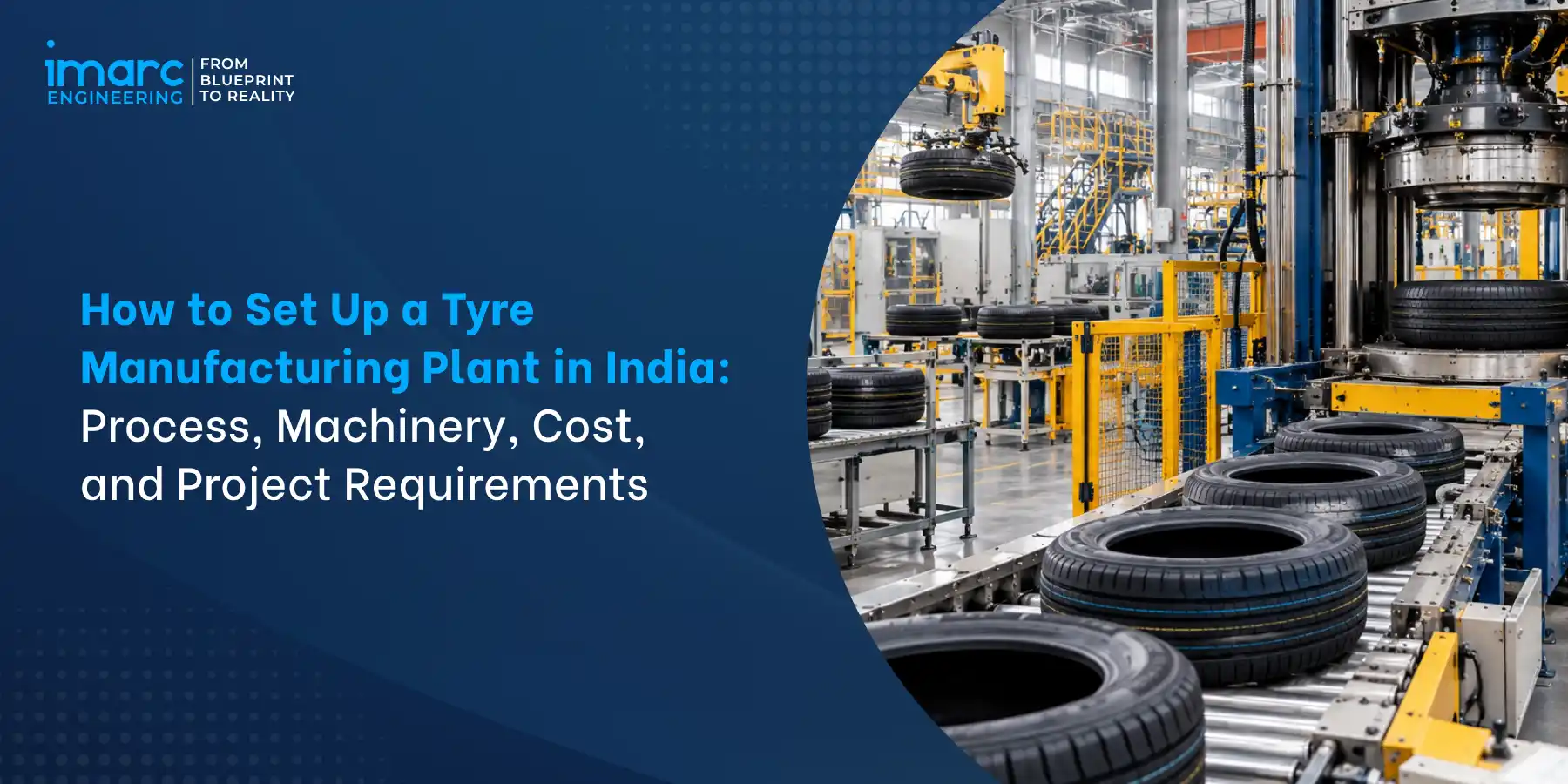
How to Set Up a Tyre Manufacturing Plant in India: Process, Machinery, Cost, and Project Requirements
Introduction
For investors, manufacturers, and project development teams planning a tyre manufacturing plant in India in 2026, disciplined integration across tyre segment selection, raw material strategy, process configuration, machinery choice, plant layout, utilities design, regulatory compliance, and project execution determines commercial viability. India ranks among the world's largest tyre producers with sustained demand from OEM automotive, replacement market, and export opportunities. Regulatory framework has strengthened with mandatory BIS certification under Pneumatic Tyres QCO 2009 and EPR obligations for waste tyres under Hazardous and Other Wastes Amendment Rules 2022.
Scope of this Guide
This guide answers the sponsor's question directly. How should investors plan a tyre manufacturing facility covering product mix, production capacity, raw materials, manufacturing technology, machinery, utilities, regulatory requirements, project cost, and execution? It walks through segment selection and capacity planning, raw material sourcing (natural/synthetic rubber, fillers, cord, bead wire), rubber compounding, component preparation, tyre building, curing, quality control, utilities and plant layout, regulatory compliance (BIS/EPR/SPCB), and CAPEX/OPEX drivers - anchored to explicit segment and capacity assumptions rather than universal claims.
Table of Contents
- Introduction
- Why Tyre Manufacturing Plant Investment Matters for India in 2026
- What a Tyre Manufacturing Plant is and Why It Matters in India
- Tyre Segment Product Mix and Production Capacity Planning for Tyre Manufacturing Plants in India
- Raw Materials and Rubber Compounding for Tyre Manufacturing in India
- Mixing Calendaring Extrusion and Component Preparation for Tyre Manufacturing in India
- Tyre Building Green Tyre and Curing Process for Tyre Manufacturing Plants in India
- Machinery Utilities Plant Layout and Quality Control for Tyre Manufacturing Plants in India
- Regulatory Environmental EPR and Project Economics for Tyre Manufacturing Plants in India
- Conclusion
1. Why Tyre Manufacturing Plant Investment Matters for India in 2026
Four drivers make disciplined tyre manufacturing plant investment a strategic opportunity for manufacturers and project sponsors in 2026.
1.1 Sustained Demand Fundamentals
India's tyre market is supported by demand from passenger cars, commercial vehicles, two-wheelers, OTR applications, replacement sales, and exports. This demand supports both greenfield capacity expansion and brownfield plant modernization.
1.2 Regulatory Framework Maturation
India's tyre regulatory framework includes mandatory BIS certification under the Pneumatic Tyres and Tubes for Automotive Vehicles (Quality Control) Order 2009, with applicable Indian Standards such as IS 15633, IS 15636, and IS 15627. Waste-tyre producers must also meet EPR requirements under the Hazardous and Other Wastes framework, including registration and applicable EPR certificate obligations through the CPCB system.
1.3 Investment Ecosystem
India's tyre manufacturing sector benefits from established raw-material supply chains, skilled engineering talent, active industry associations, and proximity to major automotive OEM clusters. Industrial policies in states such as Tamil Nadu, Gujarat, Maharashtra, and Karnataka can also support investment. However, greenfield tyre plants remain capital-intensive, with project costs varying significantly by capacity, segment, technology, and project scope.
1.4 Cost of Poor Planning
Poor project planning can cause capacity imbalances, utility constraints, quality issues, EPR compliance gaps, and inefficient material flow. Aligning segment, capacity, machinery, utilities, layout, quality, and regulatory requirements early can reduce project risks and improve plant performance.
2. What a Tyre Manufacturing Plant is and Why It Matters in India
Understanding what a tyre manufacturing plant is and why it matters in India places it as an integrated industrial project combining rubber processing, textile/steel handling, moulding, and quality-critical production.
2.1 Plant Definition
A tyre production plant converts raw materials (natural and synthetic rubbers, carbon black, silica, chemicals, steel and textile cord, bead wire) into finished tyres through sequential unit operations: rubber compounding, calendaring, extrusion, bead manufacturing, tyre building, curing (vulcanization), inspection, and testing. Modern plants handle multiple tyre categories - passenger car radial (PCR), truck-bus radial (TBR), two-wheeler, off-the-road (OTR), and specialty (agricultural, industrial) - with each category requiring specific compound formulations, cord specifications, curing profiles, and moulds.
2.2 Major Plant Areas
| Plant Area | Function | Illustrative Equipment |
|---|---|---|
| Raw material storage | Rubber, chemicals, cord, wire | Warehouses, silos, tanks |
| Compounding | Rubber compound preparation | Banbury mixers, mills |
| Component prep | Cord fabric, tread, sidewall | Calendars, extruders, bead lines |
| Tyre building | Green tyre assembly | Tyre building machines |
| Curing | Vulcanization | Curing presses, moulds |
| Testing | Quality inspection | Uniformity, balancer, X-ray |
| Utilities | Process services | Boilers, compressors, chillers |
| Warehouse | Finished goods dispatch | Storage racks, dispatch bay |
2.3 Plant Scale Determinants
Plant scale depends on target segments, market, capacity, and business model. Small specialty plants serve niche segments (OTR, retreads, agricultural). Medium multi-segment plants balance scale with product mix flexibility. Large integrated plants target commercial scale for OEM and replacement markets. Segment mix, automation level, and integration drive CAPEX intensity - decisions should follow market plan rather than default assumptions.
3. Tyre Segment Product Mix and Production Capacity Planning for Tyre Manufacturing Plants in India
Understanding tyre segment product mix and production capacity planning for tyre manufacturing plants in India is the primary early-stage decision. Segment choice cascades into raw material strategy, machinery, layout, quality infrastructure, and CAPEX.
3.1 Tyre Segments
Major tyre segments determine specifications for a tyre manufacturing plant. Passenger Car Radial (PCR) covers sedan, hatchback, SUV, and MUV tyres - typically 12-22 inch rim, tubeless radial construction, high volume, rapid model refresh. Truck-Bus Radial (TBR) and Truck-Bus Bias (TBB) serve commercial vehicles with heavier construction, higher load ratings, and longer product cycles. Two-wheeler tyres cover motorcycles, scooters, and mopeds - India's largest tyre volume segment.
Off-the-Road (OTR) tyres serve construction, mining, and agricultural equipment - lower volume but higher value per tyre. Specialty categories include agricultural implements, industrial forklifts, and defence applications. Multi-segment plants require flexibility in machinery, moulds, and compound formulations.
3.2 Product Mix Decisions
Product mix decisions shape plant configuration meaningfully. Single-segment plants (dedicated PCR or dedicated TBR) achieve production efficiency but lack market flexibility. Multi-segment plants offer flexibility but require format-change tooling, larger mould inventory, and disciplined production planning.
Segment breadth also affects raw material inventory (different compound formulations need different chemicals in stock) and quality infrastructure (each segment has specific BIS testing requirements). Common practice for medium plants: 2-3 segments with defined product SKU count per segment. Very large plants often segregate segments across dedicated production lines within the same complex.
3.3 Production Capacity Planning
Production capacity planning balances market demand forecast with plant economics. Capacity typically expressed as tyres per day (for OEM planning) or tonnes per day (for compound throughput). Small plants suit specialty and regional operations. Medium plants serve state-regional OEM and replacement markets.
Large plants target national OEM contracts and exports. Capacity should account for expected utilization ramp-up (60-70 percent Year 1, 75-85 percent Year 2, 85-95 percent Year 3+), product mix (some segments have longer cycle times than others), and expansion phasing (initial installation vs future de-bottlenecking).
3.4 Capacity Balance
Capacity balance across sequential stages is critical. Rubber mixing capacity should match tyre building demand with 15-25 percent buffer. Component preparation must feed tyre building continuously. Curing press capacity often determines plant throughput - press availability, cure cycle time, and mould inventory drive production rate.
Bottleneck at any stage caps total plant output. Common design mistake: undersizing curing capacity leading to work-in-process pile-up at green tyre stage. Capacity balance should follow disciplined material flow analysis.
4. Raw Materials and Rubber Compounding for Tyre Manufacturing in India
Understanding raw materials and rubber compounding for tyre manufacturing in India covers the material foundation of tyre performance and cost.
4.1 Rubber Raw Materials
Rubber constitutes the primary raw material. Natural rubber (typically 30-40 percent of compound weight) sourced from domestic plantations (Kerala, Karnataka, Tamil Nadu, north-east states) and imports (Thailand, Indonesia, Vietnam). Synthetic rubber includes Styrene-Butadiene Rubber (SBR) for treads, Butadiene Rubber (BR) for wear resistance, Butyl Rubber (IIR) for tubes and inner liners, Ethylene-Propylene-Diene Monomer (EPDM) for specific applications, and Nitrile Rubber (NBR) for oil-resistance. Ratio of natural to synthetic varies by segment - passenger car tyres use more synthetic, truck tyres more natural rubber. Sourcing diversification (domestic + import) manages price volatility and supply risk.
4.2 Reinforcing Materials
Reinforcing materials give tyres their strength and structure. Carbon black (typically 25-30 percent of compound) provides tread wear resistance, tensile strength, and colouration. Silica (increasingly used with silane coupling agents) improves fuel efficiency and wet grip in passenger car radials. Steel cord (brass-coated for adhesion) provides belt and carcass reinforcement in radial tyres.
Textile cord - nylon 66, polyester (PET), rayon, aramid - provides tyre carcass structure with cord type varying by tyre category. Bead wire (high-tensile steel wire) forms the tyre bead securing tyre to rim. Each material has BIS/international specifications requiring vendor qualification and incoming quality inspection.
4.3 Chemicals and Additives
Curing chemistry and property additives complete the compound. Sulphur is the primary vulcanizing agent. Accelerators (thiazoles, sulphenamides, guanidines) control cure rate and crosslink density. Activators (zinc oxide, stearic acid) enable accelerator action. Antioxidants and antiozonants protect against oxidative and ozone aging. Processing oils (aromatic, naphthenic, paraffinic) aid processing and modify properties. Bonding agents improve rubber-metal or rubber-cord adhesion. Compound formulations are proprietary intellectual property with hundreds of variations across product portfolios.
4.4 Rubber Compounding
Rubber compounding combines all raw materials into homogeneous compounds ready for downstream processing. Banbury mixer (internal mixer with intermeshing or tangential rotors) is the primary compounding equipment - operating 120-160°C, mixing 3-5 minutes per batch, batch size 200-500 kg. Multi-stage mixing typical: masterbatch (rubber + fillers + oils), remill, and final mix (curing chemistry). Open mills provide subsequent sheet forming and cooling. Compound testing (Mooney viscosity, cure characteristics, tensile properties) ensures batch consistency before release to component preparation.
5. Mixing Calendaring Extrusion and Component Preparation for Tyre Manufacturing in India
Understanding mixing calendaring extrusion and component preparation for tyre manufacturing in India covers the intermediate operations that convert compounds into tyre components.
5.1 Mixing Line Setup
The mixing line typically houses multiple Banbury mixers (2-6 units depending on capacity), open mills for sheet forming, cooling galleries, and batch-off systems. Automated weighing ensures formulation accuracy. Compound conveying via belts and dip tanks reaches component preparation. Larger plants integrate automation for compound identification. Compound testing laboratory adjacent to mixing area supports quality release before compounds move downstream.
5.2 Calendaring
Calendaring converts rubber compound into thin sheets or applies compound to reinforcing cord fabric. Multi-roll calenders (typically 3-4 rolls in inverted L or Z configuration) coat textile cord fabric with rubber compound producing calendared cord for tyre carcass and belt applications. Steel cord calendars use specialized configuration due to steel cord stiffness. Calendar output quality directly affects tyre uniformity. Calendered materials wound onto liner rolls before tyre building.
5.3 Extrusion
Extrusion forms rubber components into specific profiles. Cold-feed extruders produce tread strips, sidewall profiles, and inner liner sheets in continuous operation. Complex extrusion may combine multiple rubber compounds (dual-compound tread). Extruded components cut to length and wound on liners for tyre building. Precise dimensional control critical for finished tyre uniformity. Cooling systems prevent extrudate deformation.
5.4 Bead Manufacturing
Bead manufacturing creates the tyre bead - the ring of high-tensile steel wire that anchors the tyre to the rim. Bead wire (typically 0.8-1.5 mm diameter, brass-coated) is wound into loops (multiple wraps forming the bead ring), covered with rubber compound (bead insulation), and assembled with bead filler (apex) - a triangular rubber profile that transitions carcass geometry. Bead quality directly affects tyre pressure retention and safety. Bead lines are automated, integrating wire wrapping, insulation, and apex assembly.
5.5 Component Handling
Component preparation lines feed tyre building continuously. Components move on conveyors, trolleys, or automated guided vehicles (AGVs). Component identification (barcodes, RFID) supports traceability critical for BIS compliance and recall scenarios. Component storage buffers absorb short-term production variations. Component quality checks at each preparation stage prevent defective inputs reaching tyre building.
6. Tyre Building Green Tyre and Curing Process for Tyre Manufacturing Plants in India
Understanding tyre building green tyre and curing process for tyre manufacturing plants in India covers the operations that convert components into finished tyres.
6.1 Tyre Building
Tyre building machine assembles calendered cord fabric, extruded tread and sidewalls, beads, and inner liner into a green tyre (uncured tyre). Radial tyre building uses two-stage machines: first stage assembles carcass on a drum (inner liner, ply, beads, sidewalls), second stage adds belts and tread. Bias tyres use single-stage flat-band builders. Modern machines are highly automated with servo motors, precision material feeding, and quality vision systems. Component positioning within tenths of millimetres directly affects finished tyre uniformity and durability. Cycle times range 30-90 seconds per green tyre.
6.2 Green Tyre Handling
Green tyres (uncured, flexible) move from tyre building to curing on conveyors, trolleys, or automated systems. Green tyre inspection stations verify absence of defects before curing - defects discovered post-curing waste both compound and press time. Green tyres identified with batch tracking for full traceability from raw material lots through finished tyres.
6.3 Tyre Curing
Tyre curing transforms green tyres into finished tyres via vulcanization - a chemical crosslinking of rubber molecules by sulphur under heat and pressure. Curing press houses a mould matching the tyre pattern. Green tyre placed inside mould; press closes; internal bladder inflates against the tyre pressing it against the mould; steam and hot water circulate through the bladder providing heat (150-180°C typical); nitrogen provides pressure. Cure time varies by tyre size - passenger car tyres 8-15 minutes, truck tyres 30-90 minutes, OTR tyres several hours. Post-cure inflation systems shape and cool the tyre before mould release.
6.4 Post-Cure Testing
Post-curing operations include cure verification, cooling, and initial quality checks. Post-cure inflators hold newly cured tyres at inflation pressure while cooling to prevent shrinkage. Uniformity testing measures radial force variation, lateral force variation, and conicity - key indicators of tyre balance. Balancing machines measure static and dynamic imbalance. Visual inspection detects surface defects and BIS marking correctness. X-ray inspection verifies internal construction for premium tyres. Traceability data logged for BIS audit and warranty claims.
7. Machinery Utilities Plant Layout and Quality Control for Tyre Manufacturing Plants in India
Understanding machinery utilities and plant layout for tyre manufacturing plants in India covers the physical infrastructure that determines operational reliability, capacity, and quality outcomes.
7.1 Key Machinery
| Category | Equipment | Typical Range |
|---|---|---|
| Compounding | Banbury mixers | 200-500 kg batch, multiple units |
| Compounding | Open mills | Downstream of Banbury |
| Component prep | Calendars, extruders | Multiple lines by product type |
| Component prep | Bead manufacturing line | Automated wire winding + apex |
| Tyre building | Radial/bias building machines | Cycle 30-90 sec/tyre |
| Curing | Curing presses | Cure 8 min-hours by tyre size |
| Testing | Uniformity, balancer, X-ray | Per BIS/OEM requirements |
| Handling | Conveyors, AGVs, cranes | Material flow support |
7.2 Process Utilities
Tyre manufacturing utilities are substantial. Steam system (5-15 bar) supplies curing presses - typically the largest steam consumer requiring dedicated boiler capacity. Compressed air (7-10 bar) drives pneumatic operations across building, curing, and material handling. Chilled water cools compound during and after mixing. Cooling water services extrusion, calendaring, and curing bladder circuits.
Power requirement scales with capacity: 500 kVA-1 MVA for small plants, 3-10 MVA for large integrated operations. Water requirement covers process, cooling, and utility make-up. Nitrogen supports curing pressure. Utility sizing should follow disciplined heat and mass balance rather than default vendor assumptions.
7.3 Plant Layout
Plant layout determines material flow efficiency and operational safety. Standard flow: raw material warehouse to compounding to component preparation to tyre building to curing to testing to finished goods. Layout should minimize back-tracking and cross-flows. Compounding area with heavy mixers requires strong flooring and vibration isolation. Curing area needs steam supply and ventilation. Testing lab centrally located for sample access. Sufficient buffer areas between stages absorb short-term variations.
7.4 Quality Control
Understanding quality control inspection and testing for tyre manufacturing in India covers infrastructure that supports BIS certification and OEM quality requirements. Raw material inspection lab tests incoming rubber, chemicals, cord, and wire against specifications. Compound testing lab performs Mooney viscosity, cure characteristics (rheometer), physical properties (tensile, elongation, hardness), and chemical analysis. In-process quality checks at each production stage.
Finished tyre testing per applicable IS standards - dimensional, load-carrying capacity, high-speed durability, endurance, plunger energy test, bead unseating. BIS ISI mark requires factory inspection and periodic testing samples. Quality records maintained for audit and traceability.
8. Regulatory Environmental EPR and Project Economics for Tyre Manufacturing Plants in India
Understanding regulatory environmental EPR and project economics for tyre manufacturing plants in India completes the framework for informed investment decisions.
8.1 BIS Certification
BIS certification is mandatory for tyres sold in India under the Pneumatic Tyres and Tubes for Automotive Vehicles (Quality Control) Order 2009 (in force w.e.f. 13 May 2011). Applicable Indian Standards: IS 15633 for passenger car radial tyres, IS 15636 for truck and bus tyres, IS 15627 for two and three-wheeled motor vehicle tyres and IS 2414 for cycle and rickshaw pneumatic tyres under Cycle and Rickshaw Pneumatic Tyres (Quality Control) Order 2023.
BIS certification via Scheme 1 (ISI mark with factory audit) under BIS Act 2016. Certification process: application, product testing at BIS-recognized laboratory, factory inspection, licence grant. Typical timeline 30 days for Indian manufacturers, 180 days for foreign manufacturers.
8.2 EPR for Waste Tyres
Extended Producer Responsibility (EPR) obligation applies under Hazardous and Other Wastes (Management and Transboundary Movement) Amendment Rules 2022 under Environment (Protection) Act 1986. Compliance via CPCB Waste Tyre EPR Portal (eprtyres.cpcb.gov.in). Producers must register on portal, calculate annual EPR obligation (100 percent of new tyres manufactured/imported in Year Y-2 after transition period, with 35 percent Year 1 phased ramp), purchase EPR certificates from registered recyclers, and file quarterly and annual returns.
New units established after April 2022 receive 2-year deferred EPR obligation. Import of waste tyre for pyrolysis oil/char is prohibited. EPR certificates valid 2 years. Non-compliance triggers environmental compensation and penalties. FY 2025-26 Annual Return deadline: 30 September 2026.
8.3 Other Regulatory
Additional regulatory framework covers SPCB Consent to Establish (CTE) before construction and Consent to Operate (CTO) before production under Water Act 1974 and Air Act 1981. OSH Code 2020 factory licence (in force from 21 November 2025). Fire NOC per NBC 2016. Environmental Clearance under EIA Notification 2006 (amended 2020). These regulations are not all mandatory and are applicable as per circumstances.
Hazardous Waste Rules 2016 (amended 2022) for chemical wastes. Legal Metrology approval for tyre marking. GST registration and industrial licences from state authorities. Applicability specific to product, capacity, and location required before design finalization.
8.4 Project Economics
| Configuration | Scale Assumption (Indicative, may vary) | Investment (INR) (Indicative, may vary) |
|---|---|---|
| Small specialty | 500-2,000 tyres/day (OTR, specialty) | 100-300 crore |
| Medium multi-segment | 3,000-8,000 tyres/day | 300-1,500 crore |
| Large integrated | 10,000-30,000 tyres/day | 1,500-5,000 crore |
| Very large multi-plant | Multiple plants/complexes | 5,000+ crore |
8.5 CAPEX and OPEX Composition
CAPEX composition for tyre plants: production machinery (mixers, calendars, extruders, tyre building machines, curing presses) 45-60 percent; utilities 10-15 percent; civil/building 12-20 percent; instrumentation 5-10 percent; quality/testing 3-8 percent; engineering/commissioning 5-10 percent. OPEX drivers: raw materials 55-70 percent, utilities 8-15 percent, labour 8-15 percent, quality 2-5 percent, maintenance 3-6 percent, EPR compliance 1-3 percent. Commissioning 18-30 months for greenfield tyre plants; larger integrated projects may extend to 36 months.
Conclusion
Setting up a tyre manufacturing plant in India requires segment and capacity selection, raw material planning, rubber compounding, component preparation, tyre building, curing, quality testing, utilities, plant layout, and regulatory compliance. Key requirements may include applicable BIS certification, EPR compliance, SPCB consents, factory and fire-safety approvals, with investment and commissioning timelines varying by plant scale and product mix.
Three priorities are important for tyre plant sponsors. First, select the product segment carefully because machinery, compounds, moulds, and quality requirements vary. Second, integrate BIS and EPR requirements into project planning from the outset. Third, balance capacity across the production line rather than focusing only on nameplate capacity, as bottlenecks can limit actual output.
PURSUING A TYRE MANUFACTURING PLANT IN INDIA?
IMARC Engineering's tyre manufacturing plant advisory supports investors and manufacturers with segment selection, product mix and capacity planning, raw material strategy, rubber compounding, component preparation, tyre building, curing, testing, equipment selection, utilities, plant layout, quality systems, and regulatory compliance. The advisory also covers BIS requirements, EPR, SPCB consents, factory and fire-safety approvals, capital investment planning, and project commissioning.
→ Schedule a free tyre manufacturing plant scoping consultation with an IMARC specialist
Frequently Asked Questions
Tyre manufacturing plant in India setup involves market segment selection (passenger car/commercial/two-wheeler/OTR), production capacity planning, raw material sourcing, process design (mixing/component prep/tyre building/curing/inspection), machinery selection, plant layout, utilities design, BIS certification per applicable IS standards, EPR compliance, regulatory approvals, and staged commissioning over 18-30 months.
Tyre manufacturing process covers raw material intake (rubber, carbon black, chemicals, cord, bead wire), rubber compounding in Banbury mixer, calendaring for cord fabric, extrusion for tread/sidewall, bead manufacturing, tyre building on machines, green tyre curing in press with vulcanization, uniformity testing, balancing, inspection, and packaging.
Tyre manufacturing raw materials include natural rubber, synthetic rubber (SBR, BR, IIR), carbon black and silica fillers, steel and textile cord (nylon, polyester, aramid), bead wire, curing chemicals (sulphur, accelerators), antioxidants, processing oils, and reinforcing chemicals. Mix varies by tyre segment and specifications.
Tyre manufacturing machinery includes Banbury mixers (rubber compounding), open mill, calendar (cord fabric), extruders (tread/sidewall), bead manufacturing line, tyre building machines, curing presses (vulcanization), uniformity testers, balancers, final inspection stations. Utilities: air compressors, steam boilers, chilled water, cooling water, power distribution matched to production capacity.
Tyre type (passenger car/truck/two-wheeler/OTR/agricultural) and product mix determine machinery specifications (tyre building machine size, curing press bed dimensions, mould inventory), rubber compound formulations, capacity balance across mixing/component prep/building/curing, plant layout, utility sizing, and quality testing infrastructure. Multi-segment plants require greater equipment flexibility and mould inventory.
Tyre manufacturing utilities include steam (5-15 bar for curing), compressed air (7-10 bar for pneumatic operations), chilled water for compound cooling, cooling water, electricity (500 kVA-10 MVA depending on capacity), process water, and nitrogen for tyre curing. Effluent treatment plant and dust collection systems required.
Tyre manufacturing plant cost in India depends on production capacity, tyre segments served, product mix breadth, automation level, machinery specifications, and utilities scale. Land, civil infrastructure, regulatory requirements, technology selection, and commissioning costs also influence the overall project investment.
Tyre plants require BIS certification per IS 15633/15636/15627 under Pneumatic Tyres QCO 2009, EPR under Hazardous Waste Amendment Rules 2022 via CPCB Waste Tyre Portal, SPCB CTE/CTO under Water/Air Acts, OSH Code 2020 factory licence, Fire NOC per NBC 2016, and EIA clearance where applicable.
Recent Post

Trusted by Industry Leaders
We partner with global enterprises and ambitious businesses across sectors to deliver operational excellence, strategic insights, and sustainable growth through integrated solutions.












Success in Their Words
Real feedback from clients across industries. Discover how our solutions delivered measurable impact and operational excellence.

I wanted to express my sincere appreciation for your efforts in handling this matter. Your dedication and commitment have been truly commendable, and it is evident that you have put in tremendous hard work and expertise into resolving the issues at hand. We are greatly interested in continuing our collaboration with you in the future, as your professionalism and reliability have made you a trusted partner. Thank you once again for your invaluable contribution. We look forward to strengthening our partnership ahead.

It has been a pleasure working with the IMARC team. The insights provided were structured, clear, and highly valuable, helping us strengthen both our technical and financial planning with confidence. We deeply appreciate the team’s professionalism, responsiveness, and attention to detail throughout the engagement. Every requirement was well understood and effectively incorporated, resulting in a comprehensive and actionable output. Overall, our experience has been excellent, and I would gladly recommend IMARC to organizations seeking a reliable research partner.

Your service is truly exceptional. Working with the IMARC team has been a seamless and professional experience. The clarity of communication, responsiveness to queries, and consistent support at every stage made the entire engagement highly efficient. The insights shared were well-structured, practical, and perfectly aligned with our requirements, helping us make informed decisions with confidence. Overall, the dedication and professionalism demonstrated by your team stand out, and I would be glad to recommend IMARC as a reliable and trustworthy research partner.

IMARC did an outstanding job in preparing our study. They were punctual, precise, and consistently responsive throughout the entire process. The team delivered all the data we required in a clear, well-organized, and highly professional format. Their strong attention to detail, combined with their ability to meet every deadline without compromising quality, truly set them apart. Overall, their reliability and commitment made them an exceptional partner for our project, and we would gladly work with them again in the future.

IMARC made the whole process incredibly easy from start to finish. Everyone I interacted with via email was polite, professional, and straightforward to deal with, always keeping their promises regarding delivery timelines and remaining consistently solutions-focused. From my very first contact, I appreciated the professionalism and support shown by the entire IMARC team. I highly recommend IMARC to anyone seeking timely, affordable, and reliable information or advice. My experience with IMARC was excellent, and I truly cannot fault any aspect of it.

I’d like to express my sincere gratitude for the excellent work you accomplished with the study. Your ability to quickly understand our requirements and deliver high-quality results under tight timelines truly reflects your expertise, exceptional work ethic, and unwavering commitment to your customer’s success. The professionalism and responsiveness you demonstrated throughout the process made a significant difference. Our entire team and company are incredibly thankful for your dedication, reliability, and support. Once again, thank you for your outstanding contribution.