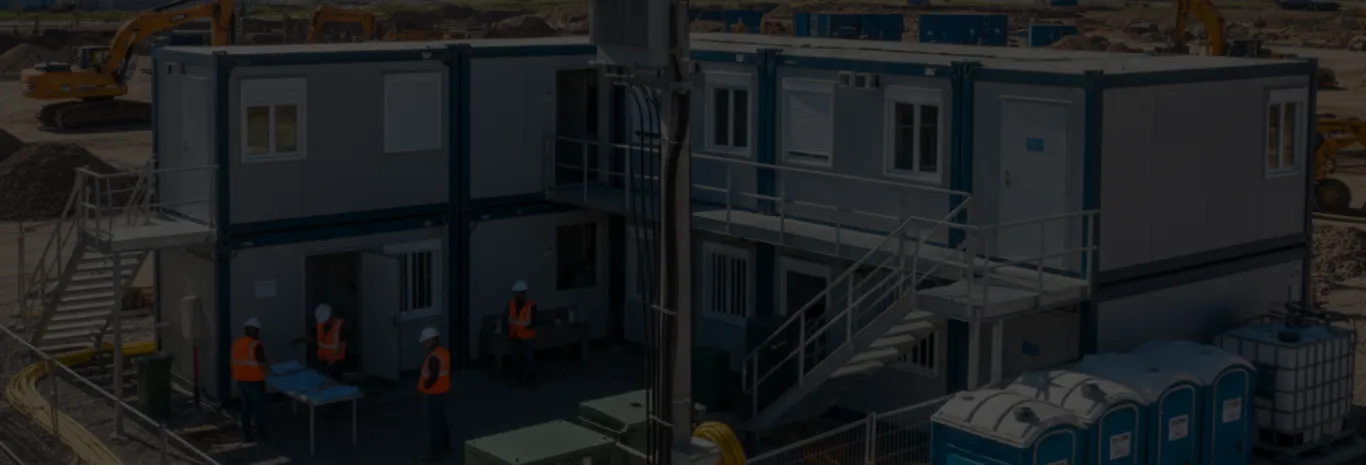
Complete Construction Site Infrastructure and Support Services
Site office installation, utility connections, welfare facilities, and infrastructure maintenance for manufacturing and industrial construction projects across India.
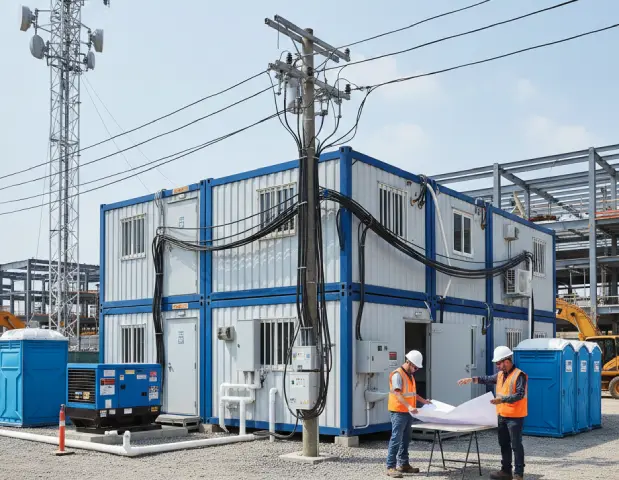
Temporary Site Office Setup and Utilities in India
Temporary site office and utility infrastructure are essential needs for all manufacturing and industrial construction projects. As per Building and Other Construction Workers (Regulation of Employment and Conditions of Service) Act, 1996, welfare facilities should be provided to all the on-site workers at any manufacturing/industrial project site in India. The National Building Code (NBC) prescribes certain provisions regarding temporary structures for such projects. Lack of proper site infrastructure results in reduced productivity, poor compliance with safety and other guidelines, and delay in project execution especially in green field projects where there are no existing facilities available.
IMARC Engineering is engaged in providing various services relating to temporary site office and utilities infrastructure for different types of manufacturing and industrial projects such as pharmaceutical, chemical, food processing, manufacturing, and other industrial construction projects in India. These services include setting up of modular offices, electric power facilities, portable water facility, communication facilities, firefighting system installation, and others as per the requirements.
We cater to project owners, EPC contractors, and others involved in construction management. Our service offerings are based on the size of each particular project requirement.
Our Structured Temporary Site Office Setup and Utilities Methodology
Our comprehensive approach integrates site assessment, infrastructure planning, and coordinated installation. This proven methodology establishes functional work environments through systematic facility deployment, utility coordination, and ongoing maintenance support.
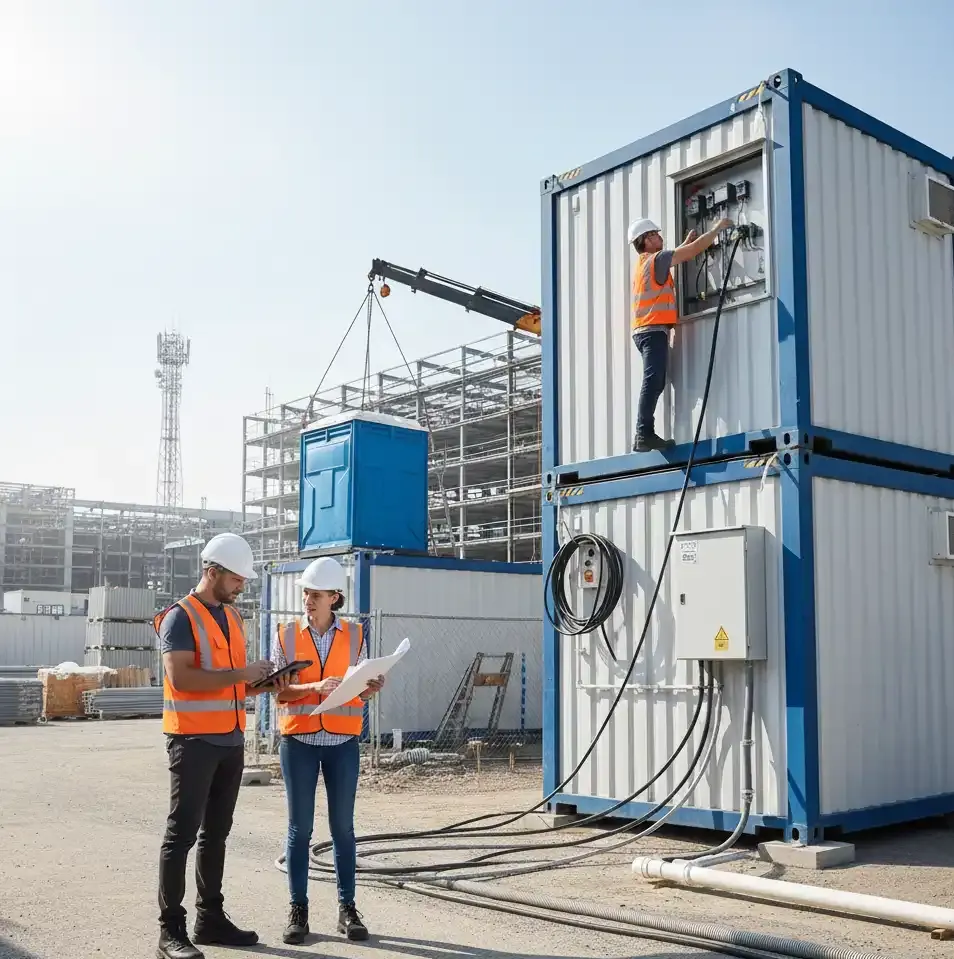

Site Assessment and Infrastructure Planning
Evaluating site characteristics, identifying utility access points, defining facility requirements, and developing deployment plans before mobilization activities.

Facility Installation and Utility Coordination
Deploying modular offices, establishing electrical services, connecting water supplies, installing sanitation facilities, and configuring communication networks.

System Commissioning and Safety Verification
Testing utility systems, verifying safety equipment, conducting inspections, and obtaining operational approvals before occupancy and construction commencement.

Maintenance Support and Site Demobilization
Providing ongoing facility maintenance, coordinating utility management, addressing operational issues, and executing systematic removal upon project completion.
Why Choose IMARC Engineering for Temporary Site Office Setup and Utilities in India?
Our professional infrastructure solutions deliver functional work environments through systematic planning, coordinated installation, and reliable maintenance. This comprehensive methodology addresses facility requirements, utility coordination, regulatory compliance, and operational support throughout construction projects.

Full Regulatory Compliance
Temporary site infrastructure on Indian manufacturing construction projects is subject to a multi-layer compliance framework that inexperienced site setup providers routinely fail to satisfy completely. The BOCW Act 1996 and BOCW (Regulation of Employment and Conditions of Service) Central Rules 1998 prescribe specific standards for worker canteens, rest shelters, crèches, first aid facilities, and drinking water provisioning that are enforced by state labour department inspectors with the authority to suspend construction operations for non-compliance. CEA electrical safety regulations govern temporary power distribution systems. NBC 2016 prescribes structural standards for temporary structures including wind load design in cyclone-prone coastal states. IMARC Engineering designs and installs all temporary site infrastructure to the full applicable regulatory standard, maintaining compliance documentation that withstands state labour department inspections, lender safety audits, and NBC structural compliance reviews throughout the construction programme.

Greenfield and Remote Site Capability
The majority of manufacturing facility greenfield projects in India are located in industrial areas and designated zones that are at varying distances from urban infrastructure, including pharmaceutical clusters in Baddi and Sikkim, chemical industrial areas in Dahej and Ankleshwar in Gujarat, food processing zones in rural Punjab and Maharashtra, and new industrial corridor zones in Rajasthan and Uttar Pradesh where municipal utility connections are either unavailable or require prohibitively long lead times. IMARC Engineering’s site infrastructure services are designed for self-sufficiency, incorporating DG power generation, bore well or tanker water supply, sewage treatment systems, and communications infrastructure that operate independently of urban utility networks. This remote site capability enables project mobilisation to proceed on schedule regardless of the availability of external utility connections at the project location.

Modular Infrastructure Sized to Project Scale and Programme Duration
Temporary site infrastructure requirements vary substantially across manufacturing construction projects, from a single modular office and generator set for a small brownfield equipment installation to a full site township accommodating five hundred construction workers, a project management team of thirty engineers, and visitor reception and conference facilities for a large greenfield pharmaceutical or chemical plant. Infrastructure sized below project requirements creates productivity losses through office space constraints, utility supply shortfalls, and sanitation facility overcrowding that compound into measurable programme delay. Infrastructure sized beyond requirements wastes capital on assets that provide no productivity benefit. IMARC Engineering conducts a site infrastructure demand assessment at project mobilisation planning stage, sizing each component, office space, power capacity, water storage, sanitation units, and communications bandwidth, to the construction programme’s peak workforce and management team requirements.

Integrated Utility Management
Site utility systems on Indian construction projects that are installed and managed by separate contractors, each responsible for their own scope without integration accountability, generate the coordination failures that are among the most common causes of site productivity loss. A DG power system installed without reference to the site office air conditioning load will be undersized for peak summer conditions in states like Rajasthan and Gujarat where ambient temperatures exceed 45°C. A water supply system designed without reference to the concrete production schedule will be inadequate during peak structural concrete pour periods. IMARC Engineering manages all site utility systems under a single infrastructure responsibility, designing each system with reference to the others, commissioning them in an integrated sequence, and maintaining them under a unified service programme that prevents the inter-system gaps that independent utility contractors generate.

Construction Period Maintenance Programme
Temporary site infrastructure that is installed and left without systematic maintenance degrades progressively across a construction programme, with DG sets developing fuel and cooling faults, water treatment systems losing performance, sanitation facilities becoming non-compliant, and communications infrastructure developing connectivity failures that disrupt project management operations. In Indian construction projects with durations of twelve to thirty-six months, inadequately maintained site infrastructure generates productivity losses and compliance risks that accumulate into measurable programme delay and regulatory exposure. IMARC Engineering provides a structured maintenance programme for all installed site infrastructure, including scheduled DG service intervals, water quality testing against BIS 10500 drinking water standards, sanitation facility inspection and cleaning schedules, and communications system performance monitoring, maintaining infrastructure performance at commissioned standards throughout the construction period.

Systematic Demobilisation and Site Reinstatement
Temporary site infrastructure demobilisation at project completion in India creates obligations that are frequently underplanned and result in delays to facility handover and final regulatory approvals. Modular structures must be dismantled and removed before Factory Act occupancy inspections. Temporary electrical connections must be formally disconnected from the permanent installation before CEA connection approval. Sanitation infrastructure must be decommissioned and the site area reinstated to meet CPCB and state PCB environmental consent conditions. Temporary construction waste storage areas must be cleared and documented for CPCB compliance closure. IMARC Engineering manages the complete demobilisation programme as a planned project phase, sequencing infrastructure removal against the construction completion and regulatory inspection schedule, ensuring that temporary infrastructure does not become an obstacle to facility handover, occupancy certification, or the commencement of production operations.
Temporary Site Office Setup and Utilities Across Key Sectors in India
IMARC Engineering delivers modular site office installation, utility provisioning, BOCW welfare compliance, and infrastructure maintenance across India’s most active manufacturing construction sectors
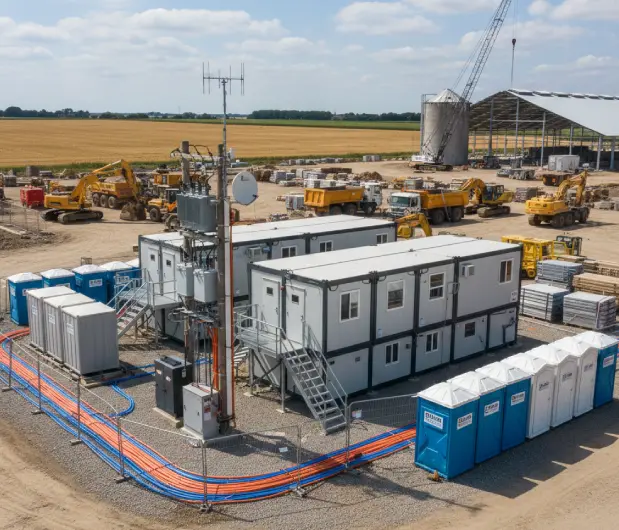
Site infrastructure for pharmaceutical facility construction projects in clusters including Baddi, Hyderabad, Ahmedabad, and Sikkim. DG power sized for cleanroom HVAC commissioning load, potable water meeting BIS 10500 for concrete production and site welfare, BOCW-compliant worker welfare facilities, and GMP construction zone demarcation and access control systems. Documentation maintained for CDSCO facility licensing and lender construction progress inspections.
Site infrastructure for food processing facility construction in agricultural processing zones across Punjab, Maharashtra, and Karnataka. Potable water supply with BIS 10500 quality testing for concrete production and worker welfare, sanitation facilities meeting BOCW standards for seasonal construction workforce, DG power provisioning for refrigeration equipment commissioning, and FSSAI construction zone hygiene controls preventing contamination of adjacent production areas during brownfield expansions.
Site infrastructure for chemical manufacturing facility construction in Gujarat’s Dahej, Ankleshwar, and Vapi industrial corridors. PESO-compliant temporary electrical systems in hazardous area construction zones, chemical spill containment infrastructure for construction material storage, CPCB-compliant temporary effluent management for construction runoff, and explosion-proof communications equipment where required by the site’s hazardous area classification during construction.
Site infrastructure for multi-product FMCG manufacturing facility construction. Modular project management offices accommodating civil, MEP, and process engineering teams, BOCW-compliant welfare facilities for high-density construction workforces on accelerated programme schedules, reliable DG power for high-speed packaging line commissioning activities, and communications infrastructure supporting multi-contractor coordination across concurrent construction disciplines.
Site infrastructure for agrochemical facility construction in designated chemical manufacturing zones. PESO-compliant temporary power distribution in classified hazardous construction areas, chemical-resistant sanitation and welfare facilities for workers in contact with construction materials in toxic process areas, CPCB consent-compliant construction runoff management, and secure site access control systems meeting requirements for facilities handling scheduled hazardous chemicals.
Site infrastructure for medical device manufacturing facility construction. Controlled access modular offices for ISO 13485-aligned construction management teams, dust-controlled site environment management for cleanroom construction zones, BOCW welfare facilities for precision manufacturing facility construction workforces, and communications infrastructure supporting remote quality inspection and lender monitoring for medical device park projects in Andhra Pradesh, Telangana, and Uttar Pradesh state investment zones.
Site infrastructure for heavy industrial manufacturing facility construction in MIDC, GIDC, SIDCO, and RIICO industrial areas. High-capacity DG power provisioning for heavy equipment testing and commissioning loads, robust modular site offices accommodating large multi-discipline construction management teams, BOCW-compliant township-scale welfare facilities for large construction workforces on extended greenfield programme schedules, and Factory Act-compliant temporary structure documentation for construction-stage statutory inspections.
Explore Related Services


Construction Management Services
Professional Project Leadership and Construction Excellence
Learn more

Fire and Safety Compliance During Construction
Comprehensive Safety Management and Regulatory Compliance Services
Learn more
Frequently Asked Questions: Temporary Site Office Setup and Utilities in India
We have compiled answers to the most common questions project developers, construction managers, and facility owners ask about temporary site infrastructure. These insights address critical concerns around facility requirements, utility coordination, cost considerations, and operational management.
Trusted by Industry Leaders
We partner with global enterprises and ambitious businesses across sectors to deliver operational excellence, strategic insights, and sustainable growth through integrated solutions.












Success in Their Words
Real feedback from clients across industries. Discover how our solutions delivered measurable impact and operational excellence.

I wanted to express my sincere appreciation for your efforts in handling this matter. Your dedication and commitment have been truly commendable, and it is evident that you have put in tremendous hard work and expertise into resolving the issues at hand. We are greatly interested in continuing our collaboration with you in the future, as your professionalism and reliability have made you a trusted partner. Thank you once again for your invaluable contribution. We look forward to strengthening our partnership ahead.

It has been a pleasure working with the IMARC team. The insights provided were structured, clear, and highly valuable, helping us strengthen both our technical and financial planning with confidence. We deeply appreciate the team’s professionalism, responsiveness, and attention to detail throughout the engagement. Every requirement was well understood and effectively incorporated, resulting in a comprehensive and actionable output. Overall, our experience has been excellent, and I would gladly recommend IMARC to organizations seeking a reliable research partner.

Your service is truly exceptional. Working with the IMARC team has been a seamless and professional experience. The clarity of communication, responsiveness to queries, and consistent support at every stage made the entire engagement highly efficient. The insights shared were well-structured, practical, and perfectly aligned with our requirements, helping us make informed decisions with confidence. Overall, the dedication and professionalism demonstrated by your team stand out, and I would be glad to recommend IMARC as a reliable and trustworthy research partner.

IMARC did an outstanding job in preparing our study. They were punctual, precise, and consistently responsive throughout the entire process. The team delivered all the data we required in a clear, well-organized, and highly professional format. Their strong attention to detail, combined with their ability to meet every deadline without compromising quality, truly set them apart. Overall, their reliability and commitment made them an exceptional partner for our project, and we would gladly work with them again in the future.

IMARC made the whole process incredibly easy from start to finish. Everyone I interacted with via email was polite, professional, and straightforward to deal with, always keeping their promises regarding delivery timelines and remaining consistently solutions-focused. From my very first contact, I appreciated the professionalism and support shown by the entire IMARC team. I highly recommend IMARC to anyone seeking timely, affordable, and reliable information or advice. My experience with IMARC was excellent, and I truly cannot fault any aspect of it.

I’d like to express my sincere gratitude for the excellent work you accomplished with the study. Your ability to quickly understand our requirements and deliver high-quality results under tight timelines truly reflects your expertise, exceptional work ethic, and unwavering commitment to your customer’s success. The professionalism and responsiveness you demonstrated throughout the process made a significant difference. Our entire team and company are incredibly thankful for your dedication, reliability, and support. Once again, thank you for your outstanding contribution.
Speak to Our Temporary Site Office Setup and Utilities Team
Whether you are a pharmaceutical, food, chemical, FMCG, medical device, or industrial manufacturer, or an EPC contractor managing construction projects, IMARC Engineering provides fully managed site infrastructure aligned with BOCW, Central Drugs Standard Control Organization, Food Safety and Standards Authority of India, PESO, and CPCB requirements. We combine regulatory expertise, utility management, and on-ground execution capability to ensure construction sites operate efficiently, safely, and compliantly from mobilisation through handover.