
Precision Calibration Management and Seamless Vendor Integration in India
Ensure manufacturing accuracy and compliance through systematic calibration programs and expert vendor coordination that maintain instrument precision, support regulatory adherence, and streamline technical service across manufacturing facilities in India.


Equipment Calibration and Vendor Coordination in India
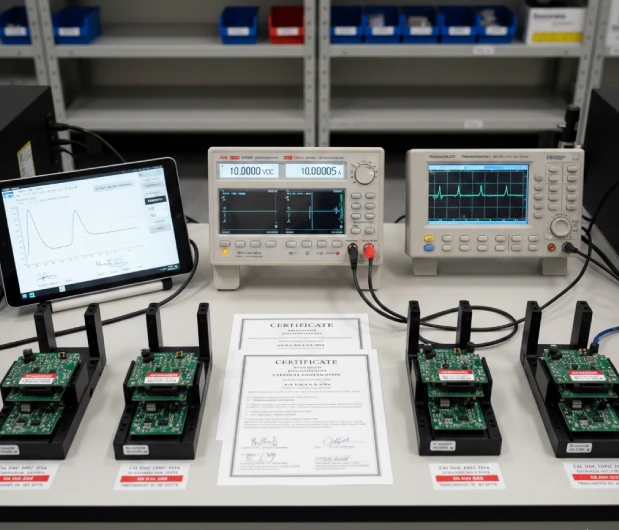
Calibration of equipment involves the testing and adjustment of measuring devices, analysis machines, and process control devices to ensure proper alignment with traceable standards. This ensures that accurate measurements are made, products manufactured are consistent, and regulatory requirements are met.
Compliance with calibration regulations in India is ensured by various methods, such as the Legal Metrology Act 2009, National Accreditation Board for Testing and Calibration Laboratories (NABL), Schedule M for good manufacturing practices in pharmaceuticals, and FSSAI standards in food processing. Instruments that are poorly calibrated or not maintained can have measurement significant inaccuracies. The result is reduced quality in the products manufactured, reduced efficiency in terms of batch size, and negative audit findings.
Services offered by IMARC Engineering for equipment calibration and coordination in India include development of calibration programs, scheduling, traceable calibration verification, document management, instrument register management, procurement of vendors, management of contracts, and documentation storage.
Calibration procedures in India too face certain distinct hurdles. These involve CDSCO inspection compliance, BIS-compatible measurement instruments, NABL certification for lab equipment, and the management of different calibration service providers within extensive, multi-location businesses. The IMARC Engineering team considers all such aspects within their scope in every project that comes to them.
Our Structured Equipment Calibration and Vendor Coordination Methodology
Our comprehensive approach integrates meticulous calibration planning, rigorous accuracy verification, and strategic vendor relationship management. This proven methodology ensures measurement reliability, regulatory documentation, and efficient technical service coordination across manufacturing operations.


Instrument Assessment and Calibration Program Development
Inventorying measurement instruments, analyzing accuracy requirements, establishing calibration frequencies, and developing documented programs that align with regulatory standards and operational needs.

Vendor Selection and Service Agreement Establishment
Evaluating qualified calibration providers, negotiating service contracts, defining performance expectations, and establishing communication protocols for technical support and emergency response requirements.

Calibration Execution and Documentation Management
Coordinating scheduled calibrations, overseeing vendor performance, maintaining certification records, managing traceability documentation, and ensuring compliance with quality system requirements throughout execution.

Performance Monitoring and Continuous Improvement
Tracking service quality metrics, analyzing instrument performance trends, optimizing scheduling efficiency, and implementing corrective actions that enhance accuracy assurance and vendor relationship effectiveness.
Why Choose IMARC Engineering for Equipment Calibration and Vendor Coordination in India?
Our systematic approach delivers measurement reliability, regulatory compliance assurance, and operational efficiency across technical service management. This comprehensive methodology addresses accuracy verification, documentation integrity, vendor performance, and cost optimization throughout calibration operations.

Structured Calibration Programme Design and Master Register Management
Indian manufacturers typically undertake calibration in a reactive manner by verifying their instrumentation equipment either prior to an inspection by regulatory authorities or following discovery that a quality problem had occurred because of an error in the equipment. Reactive calibration often leads to backlog in calibration activities, out-of-tolerance equipment being used for manufacturing products, and even findings during audits that could have been avoided had there been proper calibration programme management in place. IMARC Engineering develops customised risk-based calibration programmes that identify every single piece of equipment by its importance to the quality and regulatory aspects of manufacturing processes. This includes assigning appropriate calibration frequencies based on the category and use of each instrument, along with a master calibration list identifying the status and due date for all instruments.

NABL-Traceable Calibration Vendor Selection and Qualification
Calibration services available in India range from NABL-accredited labs to OEM-authorized calibration centers and a vast pool of unaccredited service providers, who do not provide calibration certificates which can be submitted to regulators due to non-traceability. Choosing the wrong calibration service provider results in instrument being calibrated on paper only but not holding certificates that will be acceptable at CDSCO, NABL audit or even international GMP audit for traceability of calibration process. IMARC Engineering screens the calibration service provider based on NABL accreditation coverage, traceability of calibration standards used (NPL traceable), documentation of measurement uncertainty and time factor and ensures that the generated certificate is acceptable to all regulations without any verification.

Multi-Vendor Coordination Across Diverse Instrument Categories
An average pharma, food, or chemical production plant in India will have anywhere from several to a hundred pieces of equipment for categories like analytical balances, HPLC and UV-Visible Spectrophotometer, Temperature & Humidity Measurement Instruments, Pressure Measurement Instruments, Flow Rate Measurement Instruments, pH & Conductivity Meters, Autoclave & Sterilizer Validation Instruments, and Process Control Equipment, all of which require calibration from a service provider capable of calibrating that category of instrument. Scheduling multiple service providers for different types of equipment calibration can be overwhelming, causing frequent scheduling issues and documentation errors. IMARC Engineering takes care of multi-service provider coordination under one umbrella and maintains an integrated schedule for all vendors and instruments under one programme and provides customers with a consolidated compliance view of their entire instrument inventory.

Calibration Documentation Control and Audit-Ready Record Systems
Calibration documents are considered the most analysed documents in GMP audits conducted by CDSCO auditors, WHO-GMP auditors, and certification bodies. Lack of documentation, absence of calibration certificates, out-of-tolerance not resolved, non-conformity between the calibration status label and master register entry, and certificates of vendors that are accredited for an instrumentation not covered by their scope, form audit findings that affect the facility's GMP status. IMARC Engineering develops calibration document system that conforms to GMP, NABL, and Legal Metrology documentations requirement, ensuring audit ready documents that are accurate and available without the need to recreate documentation before any audit.

Out-of-Tolerance Impact Assessment and Corrective Action Management
The calibration regulation does not stop at the recalibration of the instrument itself; it also entails a documented evaluation of whether the readings made using that instrument after the previous calibration up until the time it was discovered to be out of tolerance could have been affected and whether those readings need to be evaluated for product quality, whether batches need to be recalled, and whether customers need to be notified. An evaluation of the impact of out-of-tolerance readings is probably one of the most overlooked aspects of calibration in Indian manufacturing organizations, leading to several audit non-conformances whenever an audit finds out-of-tolerance readings, but no impact assessment performed on them.

Legal Metrology Act Compliance and Mandatory Verification Management
Legal Metrology Act 2009 and Rules mandate compulsory verification and stamping for weights and measures used in trade and commerce, which are apart from and additional to the calibration requirement under the GMP guidelines. A manufacturing site using weighing instruments in purchasing, manufacturing, and dispatch, but not having the Legal Metrology stamp on them, is in contravention of the law even if the weighing instruments have been calibrated under internal GMP programs. IMARC Engineering handles Legal Metrology mandatory verification as a part of the calibration process, where instruments requiring mandatory verification according to the state Weights and Measures law are identified, verification schedules are prepared, and Legal Metrology verification documentation is maintained to avoid Legal Metrology non-compliances resulting from the separate management of GMP and mandatory statutory calibration requirements.
Equipment Calibration and Vendor Coordination Across Manufacturing Sectors in India
IMARC Engineering delivers calibration programme management and vendor coordination across all major manufacturing sectors and instrument categories in India
Schedule M and WHO-GMP compliant calibration programme management for analytical instruments (HPLC, UV-Vis, Karl Fischer, dissolution apparatus), process instruments (temperature, pressure, humidity, flow), clean room monitoring systems, and sterility testing equipment. CDSCO inspection-ready documentation with NABL-traceable certificates and out-of-tolerance corrective action records.
FSSAI and HACCP-compliant calibration management for weighing systems, temperature monitoring, pH meters, water activity meters, and metal detection equipment. NABL-traceable verification for food safety critical instruments and Legal Metrology stamping coordination for trade weighing instruments across food processing and packaging operations.
Calibration programme management for process analytical instruments, reactor temperature and pressure systems, gas detection equipment, and effluent monitoring instrumentation. PESO-compliant calibration for hazardous area instruments and CPCB-aligned verification for environmental monitoring systems including stack emission and effluent treatment monitoring equipment.
ISO 13485-compliant calibration programme design covering production and inspection measuring equipment, cleanroom monitoring systems, sterilisation validation instrumentation, and electrical safety testing equipment. CDSCO MDR 2017 inspection-ready calibration documentation with full traceability to national standards and out-of-tolerance impact assessment records.
Calibration management for facility-wide measurement infrastructure including energy metering, compressed air pressure and flow, steam and condensate measurement, chilled water temperature and flow, and environmental monitoring systems, ensuring utility measurement accuracy for production cost attribution, regulatory compliance, and energy audit obligations.
Calibration coordination for dimensional measuring instruments (verniers, micrometers, CMMs, gauges), torque and force measurement, electrical test and measurement equipment, and NDT instruments. BIS-aligned calibration for type-approved instruments and NABL-traceable verification for quality control laboratory equipment supporting product certification.
Explore Related Services

Warranty and AMC Coordination
Maximize Equipment Value Through Strategic Warranty Management in India
Learn more

Vendor Audits and Compliance Checks
Validate Supplier Capabilities and Strengthen Supply Chain Integrity in India
Learn more

Spare Parts Planning and Inventory Setup
Maximise Equipment Uptime Through Strategic Spare Parts Planning in India
Learn more

Procurement Strategy and Cost Benchmarking
Optimizing Procurement Through Strategic Planning and Analysis
Learn more
Precision Calibration Management and Seamless Vendor Integration in India
Frequently Asked Questions: Equipment Calibration and Vendor Coordination in India
We have compiled answers to the most common questions investors, business owners, and quality managers ask about equipment calibration and vendor coordination. These insights address critical concerns around compliance requirements, operational implementation, and service management.
Trusted by Industry Leaders
We partner with global enterprises and ambitious businesses across sectors to deliver operational excellence, strategic insights, and sustainable growth through integrated solutions.












Success in Their Words
Real feedback from clients across industries. Discover how our solutions delivered measurable impact and operational excellence.

I wanted to express my sincere appreciation for your efforts in handling this matter. Your dedication and commitment have been truly commendable, and it is evident that you have put in tremendous hard work and expertise into resolving the issues at hand. We are greatly interested in continuing our collaboration with you in the future, as your professionalism and reliability have made you a trusted partner. Thank you once again for your invaluable contribution. We look forward to strengthening our partnership ahead.

It has been a pleasure working with the IMARC team. The insights provided were structured, clear, and highly valuable, helping us strengthen both our technical and financial planning with confidence. We deeply appreciate the team’s professionalism, responsiveness, and attention to detail throughout the engagement. Every requirement was well understood and effectively incorporated, resulting in a comprehensive and actionable output. Overall, our experience has been excellent, and I would gladly recommend IMARC to organizations seeking a reliable research partner.

Your service is truly exceptional. Working with the IMARC team has been a seamless and professional experience. The clarity of communication, responsiveness to queries, and consistent support at every stage made the entire engagement highly efficient. The insights shared were well-structured, practical, and perfectly aligned with our requirements, helping us make informed decisions with confidence. Overall, the dedication and professionalism demonstrated by your team stand out, and I would be glad to recommend IMARC as a reliable and trustworthy research partner.

IMARC did an outstanding job in preparing our study. They were punctual, precise, and consistently responsive throughout the entire process. The team delivered all the data we required in a clear, well-organized, and highly professional format. Their strong attention to detail, combined with their ability to meet every deadline without compromising quality, truly set them apart. Overall, their reliability and commitment made them an exceptional partner for our project, and we would gladly work with them again in the future.

IMARC made the whole process incredibly easy from start to finish. Everyone I interacted with via email was polite, professional, and straightforward to deal with, always keeping their promises regarding delivery timelines and remaining consistently solutions-focused. From my very first contact, I appreciated the professionalism and support shown by the entire IMARC team. I highly recommend IMARC to anyone seeking timely, affordable, and reliable information or advice. My experience with IMARC was excellent, and I truly cannot fault any aspect of it.

I’d like to express my sincere gratitude for the excellent work you accomplished with the study. Your ability to quickly understand our requirements and deliver high-quality results under tight timelines truly reflects your expertise, exceptional work ethic, and unwavering commitment to your customer’s success. The professionalism and responsiveness you demonstrated throughout the process made a significant difference. Our entire team and company are incredibly thankful for your dedication, reliability, and support. Once again, thank you for your outstanding contribution.
Speak to Our Equipment Calibration and Vendor Coordination Team
Whether you are a pharmaceutical, food, chemical, medical device, or industrial manufacturer, or managing multi-site operations, IMARC Engineering delivers structured calibration programme management aligned with Schedule M, WHO-GMP, Central Drugs Standard Control Organization, Food Safety and Standards Authority of India, and ISO 13485 requirements. We combine regulatory expertise, NABL-qualified vendor networks, and audit-ready documentation systems to ensure instrument accuracy and continuous compliance across your manufacturing operations.