Manufacturing
November 12 2026
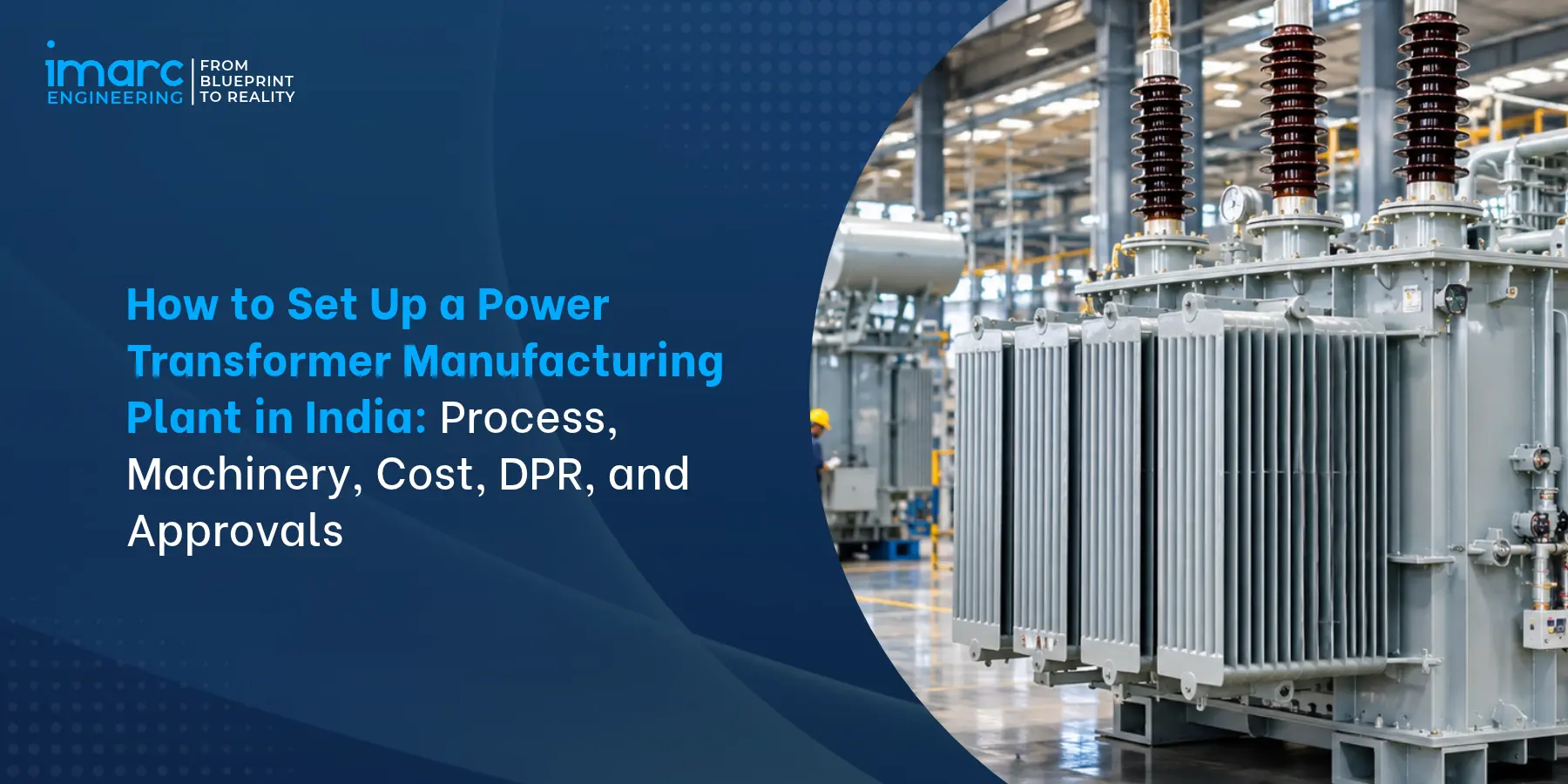
How to Set Up a Power Transformer Manufacturing Plant in India: Process, Machinery, Cost, DPR, and Approvals
Introduction
India's expanding power grid, growing renewable energy capacity, ongoing transmission infrastructure development and industrial growth are creating opportunities for power transformer manufacturers. However, establishing a manufacturing facility requires substantial capital investment and careful technology planning. Key considerations include selecting the appropriate voltage classes and MVA ratings, developing suitable testing infrastructure, and complying with applicable standards such as IS 2026 and IEC 60076. These decisions shape the plant's manufacturing capabilities, product qualification and access to target markets and procurement opportunities.
Scope of this Guide
This guide walks through power transformer manufacturing plant setup in India from product selection through manufacturing process, raw materials, machinery and testing infrastructure, plant layout, CAPEX/OPEX, DPR preparation with an illustrative example, regulatory compliance, and project risks calibrated to the Indian standards and regulatory framework in force in November 2026.
Table of Contents
- Introduction
- Why Power Transformer Manufacturing Plant Setup in India Matters for Investors in 2026
- Types of Power Transformers and Product Selection
- Power Transformer Manufacturing Process and Raw Materials
- Machinery Equipment and Transformer Testing Laboratory for a Plant in India
- Plant Layout, Utilities and Regulatory Approvals
- Power Transformer Manufacturing Plant Cost and Financial Feasibility
- DPR Preparation and Illustrative Project Example
- Project Risks Implementation Schedule and EPCM Support
- Conclusion
1. Why Power Transformer Manufacturing Plant Setup in India Matters for Investors in 2026
Four drivers make disciplined power transformer manufacturing investment strategically important in India in 2026.
1.1 Grid Expansion and Renewable Integration
India's transmission and distribution network continues to expand to connect renewable generation clusters, interstate transmission corridors, and urban demand centres. Power transformers are essential to transmission networks, power generation and large industrial installations. Their design and applicable standards depend on the transformer's function, voltage class, rating and intended application.
Distribution transformers within the scope of IS 1180 are covered separately from power transformers under the IS 2026 series. An investor-grade power transformer production facility is positioned against utility, renewable developer, and large industrial demand.
1.2 Utility Tender Dynamics
Power transformers are procured through competitive tenders issued by utilities, transmission companies, renewable developers and industrial buyers. Qualification criteria may include manufacturing experience, quality-management systems, production capability, technical compliance and evidence of applicable routine and type tests. Testing arrangements and acceptance requirements should be assessed against each tender. Plant planning should account for the testing facilities, documentation and product-validation capability needed to meet the target procurement specifications.
1.3 Import Substitution and Localisation
Domestic transformer manufacturers may benefit from applicable public procurement policies and local-content requirements. However, eligibility and purchase preferences depend on the procuring entity, product category, applicable government orders and tender conditions. Investors should assess domestic manufacturing capability, imported component exposure, supplier availability and tender-specific localisation requirements when evaluating the commercial opportunity.
1.4 Export Opportunity
Indian transformer manufacturers with demonstrated quality and testing capability export to Asia, Africa, and the Middle East. Export readiness requires compliance with IEC 60076 (international), customer-country-specific standards (BS, DIN, ANSI/IEEE as applicable), and often third-party inspection. Export orders contribute to capacity utilisation during domestic demand cycles. A transformer manufacturing investment India business case should quantify the potential export share.
2. Types of Power Transformers and Product Selection
Product selection is the first decision in power transformer manufacturing plant planning. Voltage class, MVA range, oil-immersed versus dry-type selection, and specialisation define machinery, testing infrastructure, and target tender universe.
2.1 Voltage Class and MVA Range
Common transformer voltage classes in India include 11 kV, 22 kV, 33 kV, 66 kV, 132 kV, 220 kV, 400 kV and 765 kV. The IS 2026 series covers power transformers, while IS 1180 specifies requirements for distribution transformers within its defined scope, including ratings up to 2,500 kVA and system voltages up to 33 kV. Product classification should be based on the intended application and applicable standard, not solely on MVA rating. Voltage class and MVA range influence winding configuration, insulation design, equipment selection, test requirements and manufacturing infrastructure.
2.2 Oil-Immersed vs Dry-Type
Oil-immersed and dry-type transformers use different insulation systems, cooling arrangements and manufacturing processes. Oil-immersed transformer production involves active-part assembly, tank fabrication, insulation drying, oil processing and filling. Dry-type manufacturing may involve coil casting or vacuum pressure impregnation (VPI), curing, enclosure assembly and specialised insulation processes, depending on the design.
The two product categories therefore require different machinery, production environments, quality-control procedures and testing arrangements. Investors should select the manufacturing scope according to target applications, customer specifications, technical capabilities and market demand. A facility planning to manufacture both types should assess the additional equipment, space and process requirements separately.
2.3 Customer and Application Specialisation
Plant specialisation by customer application further defines product mix - generator step-up transformers (GSU) for power generation, auto-transformers for transmission systems, converter transformers for HVDC, traction transformers for railways, industrial power transformers for cement/steel/petrochemical, and renewable-dedicated units for wind and solar parks. Each application has specific technical and testing requirements that influence plant design.
2.4 Annual Production Capacity
Annual production capacity should be calculated using the planned transformer ratings, number of units, production cycle time, equipment availability and expected utilisation. Capacity should be expressed both in units and aggregate MVA, as the manufacturing effort and test requirements vary considerably between transformer sizes. The selected product mix will determine the required production bays, lifting capacity, machinery, testing infrastructure and workforce.
3. Power Transformer Manufacturing Process and Raw Materials
The power transformer manufacturing process sequences core manufacturing, winding, insulation, assembly, drying, tank fabrication, oil filling, and testing. Raw material quality discipline runs through the whole chain.
3.1 Core Manufacturing
The magnetic core is generally manufactured using cold-rolled grain-oriented electrical steel (CRGO), selected according to the transformer's design, loss requirements and performance specifications. Amorphous metal may be considered for suitable transformer applications where the design and commercial requirements support its use.
CRGO strip is slit, cut to step-lap profiles on CNC core cutting lines, deburred, and stacked in defined cross-section geometries. Core joint discipline (step-lap, mitred corners) minimises no-load loss. Core clamping, insulation, and grounding complete the core assembly before winding is placed.
Power Transformer Manufacturing Process Flow
| Stage | Manufacturing activity | Main output |
|---|---|---|
| Core preparation | CRGO slitting, cutting, deburring and stacking | Laminated magnetic core |
| Winding | Conductor preparation, coil winding and insulation placement | Wound coils |
| Active-part assembly | Core and coil assembly, clamping, lead connections and fitting installation | Assembled active part |
| Drying | Vacuum or vapour-phase drying, depending on process design | Dried active part |
| Tank fabrication | Steel cutting, bending, welding, radiator fabrication and surface treatment | Fabricated transformer tank |
| Tanking and oil processing | Active-part installation, sealing, oil filtration and filling | Oil-filled transformer |
| Testing and inspection | Applicable routine tests and required type or special test validation | Tested transformer ready for release |
The sequence is illustrative. Some activities may overlap or follow different production arrangements depending on transformer design, manufacturing technology and plant configuration.
3.2 Coil Winding and Insulation
Coils are wound on precision horizontal or vertical winding machines using copper or aluminium conductors, selected according to electrical design, losses, weight, cost and customer specifications. Winding types include layer, disc, interleaved disc, and helical, chosen by voltage class and loss optimisation. Cellulose press-board, kraft paper, transformer board, and spacer blocks establish insulation geometry. Dimensional precision controls short-circuit withstand per IS 2026 Part 5.
3.3 Assembly Drying and Oil Filling
Core and coil assembly places the wound coils onto the core, establishes mechanical clamping, connects the leads, mounts the tapping switch, and installs terminal gear. The active part is dried using a suitable process, such as vacuum drying or vapour-phase drying, depending on the transformer design, insulation system and manufacturing technology. The drying cycle is established to achieve the required insulation moisture condition.
The transformer tank is fabricated separately from steel plate with welded radiators, cooling fins, or external radiator banks. The dried active part is lowered into the tank, bushings are mounted, and the tank is filled with filtered insulating oil (IS 335 or IEC 60296 grade) under vacuum.
3.4 Raw Materials Summary
| Raw material | Relevant Indian Standards |
|---|---|
| CRGO electrical steel | IS 3024 |
| Amorphous core material, where used | IS 16585 |
| Copper and aluminium conductors | Applicable standards from the IS 191, IS 1897, IS 12444, IS 13730 and IS 6162 series, as relevant to conductor type |
| Kraft paper and cellulose insulation | Applicable parts of the IS 9335 series |
| Transformer pressboard | IS 1576 and applicable parts of IS 16498 |
| Mineral insulating oil | IS 335 |
| Transformer tank steel | Applicable structural steel specifications, including IS 2062 where suitable |
| Bushings | Applicable parts of IS 3347 and IEC 60137 |
| Transformer fittings and accessories | Applicable parts of the IS 3639 series |
The applicable edition, amendments and material grade should be verified against the transformer design, purchase specification and current BIS requirements.
4. Machinery Equipment and Transformer Testing Laboratory for a Plant in India
An integrated power transformer manufacturing machinery suite covers core cutting, winding, insulation processing, assembly, drying, tank fabrication, oil treatment, material handling, and a certified test hall.
4.1 Core and Winding Equipment
Core manufacturing uses CNC core cutting lines (programmed step-lap and mitre), deburring stations, stacking fixtures, and core clamping jigs. Winding uses horizontal and vertical winding machines matched to conductor size and coil height; disc winding machines for high-voltage coils; and coil shaping and dimensional check fixtures. Winding wire tensioning, spacer insertion, and lead termination quality are machine- and operator-driven. The number and configuration of winding machines should be determined by conductor type, coil dimensions, voltage class, production volume and the proposed product mix.
| Equipment | Function in transformer manufacturing |
|---|---|
| CNC core cutting line | Cuts CRGO steel into specified laminations for core assembly |
| Winding machines | Wind copper or aluminium conductors into coils |
| Coil insulation and shaping equipment | Supports insulation placement, coil forming and dimensional control |
| Core stacking fixtures | Maintain core geometry and alignment during assembly |
| Vacuum drying oven or VPD system | Removes moisture from the active-part insulation |
| Tank fabrication machinery | Supports steel cutting, bending, welding and tank manufacturing |
| EOT cranes and lifting equipment | Handle cores, coils, active parts, tanks and completed transformers |
| Oil filtration and degassing unit | Processes insulating oil to meet applicable quality requirements |
| High-voltage test equipment | Supports required dielectric and other electrical tests |
| Partial-discharge measurement system | Measures partial discharge where required by the applicable test programme |
The final machinery configuration should be selected according to transformer ratings, voltage classes, production volume, manufacturing technology and the planned in-house testing scope. Not every facility requires every equipment category listed above.
4.2 Drying Oil Processing and Tank Equipment
Tank fabrication quality checks may include weld inspection, dimensional verification, leak testing and non-destructive testing, as specified by the approved fabrication and quality-control procedures. Vacuum drying and vapour-phase drying systems may be used depending on the transformer design, insulation system, moisture-removal requirements, production throughput and selected manufacturing technology.
Transformer oil filtration and degassing units process oil to required dielectric strength, moisture, and dissolved gas levels. Tank fabrication uses CNC plasma or laser cutting, bending, welding, shot blasting, and painting lines. Testing after fabrication covers dye-penetrant and leak testing.
4.3 Material Handling and Factory Services
Heavy-duty material handling is essential for transformer manufacturing. EOT cranes, lifting fixtures, transfer systems and dispatch arrangements should be selected according to the maximum unit weight, active-part dimensions, tank size and production workflow. Factory layout should also provide suitable access for heavy trailers and equipment movement. Utility requirements, including compressed air, cooling water, ventilation and electrical supply, should be calculated from the selected machinery and production process.
4.4 Transformer Testing Laboratory
A transformer testing facility should be designed around the product portfolio, voltage class, MVA range and applicable testing requirements. Under the IS 2026 and IEC 60076 series, testing may include routine, type and special tests, depending on the transformer design and relevant specifications.
Routine testing generally includes checks such as winding resistance, voltage ratio, polarity or phase relationship, impedance and load loss, no-load loss, dielectric tests and other applicable requirements. Type and special tests may include temperature-rise, lightning impulse, switching impulse, partial-discharge and short-circuit withstand tests, depending on the product and applicable standard.
Partial-discharge measurement may follow IEC 60270 where required. The laboratory design should consider test-bay dimensions, equipment ratings, earthing, shielding, interlocks, safety clearances, instrumentation and operator protection.
Investors should assess which tests need to be conducted in-house and which can be undertaken through qualified external laboratories. The decision should consider tender conditions, product-validation requirements, testing costs, equipment investment and production schedules. In-house testing capability can improve control over production quality and testing turnaround, but it should not be presented as a universal tender requirement.
5. Plant Layout, Utilities and Regulatory Approvals
Facility layout, utilities, and regulatory stack for a power transformer factory setup are planned alongside the machinery selection to ensure commissioning readiness and compliance.
5.1 Land and Plant Layout
Land requirements depend on transformer ratings, annual production capacity, product mix, equipment configuration, storage requirements and dispatch arrangements. The preliminary plot plan should accommodate core and winding operations, assembly bays, tank fabrication, drying, oil processing, testing, utilities, warehouses, fire access and finished-product dispatch. Floor loading in assembly and test bays must support heavy units (tens to hundreds of tonnes).
5.2 Utilities and HV Safety
Utilities cover high-capacity grid supply with dedicated substation for test hall loads (impulse generator peak draw, HV transformer set), compressed air, process cooling water, DG backup for critical loads, instrument air, and ventilation. The high-voltage test hall should incorporate controlled access, interlocked safety systems, suitable earthing, protective barriers and safety clearances based on the maximum test voltage and equipment configuration.
Earthing and lightning protection should follow the applicable standards, including IS 3043 and IS 2309 or their relevant successors, as appropriate. Fire protection should be designed according to the building configuration, transformer oil inventory, fire-risk assessment and applicable fire authority requirements.
5.3 Technical Standards and Compliance
Product compliance follows IS 2026 Parts 1-5 (Indian adoption of IEC 60076 series) for power transformers, with companion standards for oil (IS 335), bushings (IS 3347), fittings (IS 3639), and conductors (IS 613 for copper, IS 6162 for aluminium). Testing standards include IEC 60060 (high voltage test techniques) and IEC 60270 (partial discharge). Note: BEE star rating under the Energy Conservation Act 2001 applies to distribution transformers under IS 1180, not to power transformers under IS 2026.
5.4 Regulatory Approvals for Power Transformer Manufacturing
Regulatory requirements depend on the proposed manufacturing processes, plant location, oil inventory, electrical installations and applicable Central and State regulations.
The project team should assess the following requirements, where applicable:
- Consent to Establish and Consent to Operate from the State Pollution Control Board.
- Factory registration or licensing and applicable occupational safety requirements.
- Fire safety approvals based on building use, fire-risk assessment and local requirements.
- Electrical installation approvals and inspection requirements under applicable electrical safety regulations.
- Hazardous-waste authorisation for relevant waste streams.
- Petroleum-related storage permissions, where applicable to the selected insulating oil and storage arrangement.
- GST, Importer Exporter Code and other business registrations, according to the proposed operations.
The DPR should maintain an approvals register identifying the applicable authority, approval stage, required documents and responsible project team.
6. Power Transformer Manufacturing Plant Cost and Financial Feasibility
Understanding power transformer manufacturing plant cost needs discipline. Universal per-MVA figures mislead - every plant is engineered to voltage class, product mix, test capability, and location. Public Rajasthan-based references (reported investments in the INR 640 crore range for specific high-voltage transformer facilities) apply to that specific scope and should not be generalised.
6.1 CAPEX Drivers
Primary CAPEX drivers are plant capacity (MVA per year), voltage class (test hall and clearance scale with voltage), CRGO/winding/insulation machinery, drying and oil processing equipment, tank fabrication line, EOT cranes (rating with heaviest unit), in-house test hall with impulse generator and PD-detection, civil work including heavy-floor assembly and test bays, electrical substation, utilities, land, licensing fees, EPC margin.
High-voltage plants (400 kV and above) carry disproportionately higher test-hall CAPEX. Project contingency should be determined from the level of engineering detail, cost-estimate maturity, procurement risks, site conditions and identified project uncertainties.
6.2 OPEX Components
Primary OPEX components are raw materials (CRGO, copper or aluminium, insulation, oil, steel, bushings, accessories - typically the largest OPEX line), skilled labour (winders, insulation specialists, test engineers, project managers), electrical energy (test-hall usage is significant), consumables, maintenance and spares, outsourced testing for special tests, warranty provisions, insurance, R&D, and compliance. CRGO and copper price volatility are the dominant OPEX-risk variables.
6.3 Working Capital
Power transformer manufacturing can require substantial working capital because of raw-material inventory, work-in-progress, production lead times and customer payment terms. The requirement depends on transformer size, procurement schedules, manufacturing complexity, supplier credit and contractual payment conditions.
The DPR should estimate inventory, work-in-progress, receivables and payables separately. Customer advances, payment milestones, retention amounts, installation obligations and warranty provisions should be assessed using actual tender conditions or customer contracts. Sensitivity analysis should consider changes in material prices, production delays and collection periods.
6.4 Financial Feasibility
Financial feasibility combines CAPEX amortised over equipment life, OPEX including raw materials and labour, revenue projection by product mix and capacity utilisation ramp, working capital, and standard investment metrics (NPV, IRR, payback, DSCR) under RBI prudential norms for project finance. Sensitivity on CRGO and copper price, capacity utilisation, tender realisation, warranty provision, and exchange rate is central. A credible power transformer manufacturing feasibility study presents base-downside-upside bands rather than single-point projections.
7. DPR Preparation and Illustrative Project Example
A disciplined power transformer plant DPR integrates technical, market, financial, and implementation planning into a document that supports investment and lender appraisal.
7.1 DPR Component Framework
| DPR Component | What to Cover |
|---|---|
| Project scope | Transformer types, voltage class, MVA range, annual production capacity |
| Technical feasibility | Core/winding technology, insulation, assembly, testing |
| Market assessment | Utilities, renewable, industrial, export demand |
| Machinery planning | Equipment specs, vendor quotes, production throughput |
| Testing infrastructure | HV test hall, routine test equipment, outsourced tests |
| CAPEX estimation | Land, buildings, machinery, testing, utilities, engineering, contingency |
| OPEX estimation | CRGO, copper/aluminium, insulation, oil, labour, electricity, maintenance |
| Working capital | Inventory, WIP, receivables, payment cycles |
| Financial projections | Revenue, cash flow, DSCR, NPV, IRR, break-even, sensitivity |
| Implementation schedule | Engineering, procurement, construction, installation, commissioning |
| Risk assessment | Raw material price, defects, warranty costs, delivery delays |
7.2 Illustrative Project Example
Consider a hypothetical greenfield facility proposed to manufacture oil-immersed power transformers across selected voltage classes and MVA ratings. Its technical configuration would be established through market assessment, product selection, production planning and technology evaluation.
The proposed facility would require suitable infrastructure for core manufacturing, winding, insulation processing, active-part assembly, drying, tank fabrication, oil processing, material handling and transformer testing. Machinery specifications, crane capacity, test-hall requirements, land area and utility infrastructure would be determined from the selected product portfolio and production schedule.
This example illustrates the technical scope of a transformer manufacturing project. It does not represent a standard plant configuration or a fixed investment estimate. Project CAPEX should be established separately through preliminary engineering, equipment quotations, civil and utility estimates, installation costs and working-capital calculations.
7.3 Illustrative Schedule and Market
The implementation schedule should cover feasibility assessment, DPR preparation, technology selection, site finalisation, statutory approvals, detailed engineering, equipment procurement, civil construction, installation, testing and commissioning. Actual project duration depends on plant capacity, voltage class, equipment delivery commitments, approval processes, site readiness and testing requirements.
Target customers may include central and state transmission utilities, DISCOMs, renewable energy developers, power generation companies, large industrial consumers and export markets. Market entry should be assessed against customer specifications, product qualification requirements, tender eligibility and commercial competitiveness.
7.4 Financial Projections and Sensitivity
Financial projections should cover an assessment period appropriate to the project and lender requirements. The model should include production ramp-up, product-wise revenue, raw-material consumption, manpower, utilities, maintenance, warranty provisions, working capital, depreciation, financing costs and taxes.
Sensitivity analysis should examine changes in CRGO and conductor prices, selling prices, capacity utilisation, procurement costs, warranty claims, foreign exchange exposure and project implementation delays. Base, downside and upside scenarios should be developed using documented assumptions, supplier quotations and customer inputs.
8. Project Risks Implementation Schedule and EPCM Support
Even well-planned transformer manufacturing business India projects face execution and commercial risk. Disciplined risk management and EPCM support protect the business case.
8.1 Project Execution Risks
Primary execution risks include delays in procuring specialised manufacturing machinery and high-voltage testing equipment, civil construction dependencies on heavy-duty foundations, electrical substation sizing and utility approvals, test-hall commissioning, third-party testing and customer pre-qualification. Contractor performance, site conditions and seasonal construction constraints may also affect project execution.
8.2 Commercial and Technical Risks
Commercial and technical risks include CRGO and copper price volatility (dominant OPEX variables), tender-based revenue concentration, utility payment cycles stretching working capital, manufacturing defects escalating to warranty costs, in-service failure risk and liquidated-damages exposure, and competitive pricing pressure from established manufacturers. Mitigation includes forward-cover for key materials where appropriate, insurance (CAR during construction, product liability post-commissioning), robust quality management system, and in-house testing to prevent defective dispatch.
8.3 EPCM Support
An EPCM consultant provides feasibility, DPR, FEED, detailed engineering, equipment vendor evaluation, CAPEX estimation, bay layout design, test hall engineering with HV safety clearances, utility infrastructure, procurement coordination, construction supervision against BIS references IS 456 for RCC and IS 800 for structural steel, mechanical and electrical installation supervision, test hall commissioning, pilot-unit type testing, utility pre-qualification support, and performance acceptance against production KPIs. EPCM support is particularly valuable where internal owner electrical/transformer engineering capability is limited.
8.4 Plant Setup and DPR Checklist
A. Pre-Investment and DPR Planning
- Finalise transformer type, voltage class, and annual MVA production capacity.
- Prepare the DPR with vendor-quotation-based CAPEX and a detailed Bill of Quantities (BoQ).
- Finalise land requirements and confirm power supply availability.
B. Engineering and Regulatory Approvals
- Complete Front-End Engineering Design (FEED) and detailed engineering.
- Assess applicable SPCB Consent to Establish (CTE), factory licensing, fire safety, and electrical installation approvals.
- Verify transformer oil storage requirements and PESO licensing applicability.
C. Machinery Procurement and Infrastructure
- Finalise CRGO and copper supplier arrangements.
- Procure core cutting, winding, and high-voltage testing equipment based on approved specifications.
- Complete EOT crane infrastructure and foundations before heavy machinery installation.
D. Commissioning and Commercial Readiness
- Complete equipment installation, testing, and commissioning.
- Conduct pilot-unit production and applicable transformer testing.
- Initiate utility customer pre-qualification procedures.
- Establish performance acceptance criteria before commercial production.
Conclusion
A successful power transformer manufacturing project in India requires careful product selection, process engineering, compliant raw materials, appropriate machinery, testing infrastructure and regulatory planning. The DPR should include vendor-based CAPEX estimates, operating costs, working capital and financial projections. Implementation timelines depend on project scope, approvals, procurement and commissioning requirements.
Project sponsors should consider three factors:
- Product selection: Voltage class, MVA range and oil-immersed or dry-type configurations determine machinery, testing facilities and market eligibility.
- Testing capability: Compliance with applicable IS 2026 and IEC 60076 requirements is essential for product qualification and tender participation. Testing arrangements should be planned early.
- Project-specific investment: Published investment figures for individual facilities, including high-voltage plants, should not be treated as industry benchmarks. Each project's CAPEX must be established through detailed engineering and vendor quotations.
PLANNING A POWER TRANSFORMER MANUFACTURING PLANT IN INDIA?
IMARC Engineering supports investors, electrical equipment manufacturers and EPC companies in setting up power transformer manufacturing plants. Its advisory covers product and voltage-class selection, manufacturing process engineering, machinery specification, plant layout, testing laboratory planning, regulatory approvals, DPR preparation, CAPEX and OPEX estimation, financial modelling, and EPCM support. The scope extends from initial feasibility and engineering to equipment installation, commissioning and performance validation.
→ Schedule a power transformer plant scoping consultation with an IMARC specialist
Frequently Asked Questions
Power transformer manufacturing plant setup India requires product and voltage-class selection, DPR with vendor-quote CAPEX, land with power supply, FEED, SPCB CTE, Factory Licence under OSH Code 2020, Fire NOC, Chief Electrical Inspector approval, PESO oil-storage licence, machinery procurement, test hall commissioning, and utility pre-qualification.
Power transformer manufacturing process covers CRGO core cutting and stacking, copper or aluminium winding with insulation, core-coil assembly, vacuum or vapour-phase drying, tank fabrication, oil filling under vacuum, and routine and type testing per IS 2026 and IEC 60076 before dispatch.
Power transformer manufacturing machinery includes CNC core cutting lines, horizontal and vertical winding machines, vacuum drying ovens, oil filtration and degassing units, CNC tank fabrication, EOT cranes rated for heaviest unit, and a certified HV test hall with impulse generator and PD-detection equipment.
Power transformer manufacturing plant cost depends on voltage class, MVA capacity, test hall scale, machinery automation, and location. Universal per-MVA figures mislead - publicly reported numbers apply to specific scopes. Project-specific vendor-quote-based estimation in a DPR drives any meaningful CAPEX benchmark.
Primary raw materials are CRGO electrical steel for the core, copper or aluminium conductor for windings, cellulose paper and press-board for insulation, mineral insulating oil per IS 335, steel plate per IS 2062 for tanks, porcelain bushings per IS 3347, and fittings per IS 3639.
Land requirements depend on production capacity, transformer ratings, product mix, machinery configuration, storage and dispatch arrangements. The project layout should accommodate manufacturing bays, assembly, tank fabrication, drying, oil processing, testing, utilities, warehouses and safety infrastructure. A preliminary plot plan should establish the land requirement.
Transformer testing facility India needs impulse generator for lightning and switching impulse tests, HV transformer set for power frequency withstand, PD-detection per IEC 60270, winding resistance bridges, ratio and polarity testers, no-load/load-loss equipment, and temperature-rise test setup per IS 2026 and IEC 60076.
IS 2026 Parts 1-5 (Indian adoption of IEC 60076 series) are the primary standards for power transformers covering general requirements, temperature rise, dielectric tests, terminal markings, and short-circuit withstand. Distribution transformers up to 2500 kVA fall under IS 1180 separately.
Transformer manufacturing licenses India cover SPCB CTE/CTO, Factory Licence under OSH Code 2020, Fire NOC per NBC 2016 Part 4, Chief Electrical Inspector approval, PESO oil-storage licensing under the Petroleum Act 1934 and Rules, Hazardous Wastes Rules 2016, and Udyam/GST/IEC registrations.
A power transformer plant DPR covers project scope, technical feasibility, market assessment, machinery planning, testing infrastructure, CAPEX and OPEX, working capital, financial projections with NPV/IRR/DSCR, implementation schedule, and risk assessment - anchored to vendor quotes, bottom-up BoQ, and sensitivity analysis.
A power transformer manufacturing project report includes project scope by voltage class and MVA, technical feasibility, market demand, machinery, testing infrastructure, CAPEX/OPEX, working capital, financial projections, implementation schedule, and risk assessment covering raw material price volatility, defects, warranty, and delivery delays.
CAPEX aggregates land, civil, machinery, testing infrastructure, utilities, engineering, EPC margin, and contingency - derived through vendor quotes and bottom-up BoQ. OPEX covers raw materials (dominant), labour, electricity, consumables, maintenance, warranty provisions, outsourced testing, insurance, and compliance - with sensitivity on CRGO and copper price.
Profitability depends on raw-material prices, product mix, selling prices, capacity utilisation, manufacturing efficiency, energy costs and warranty expenses. Working capital is influenced by raw-material inventory, work-in-progress, supplier credit, customer advances, payment milestones and receivable periods. These assumptions should be based on supplier terms and customer contracts.
Power transformer plant setup EPCM consultants provide feasibility, DPR, FEED, detailed engineering, machinery vendor evaluation, bay layout, test hall engineering, utility infrastructure, procurement, construction supervision, test hall commissioning, pilot-unit type testing, utility pre-qualification support, and performance acceptance across the project lifecycle.
Recent Post

Trusted by Industry Leaders
We partner with global enterprises and ambitious businesses across sectors to deliver operational excellence, strategic insights, and sustainable growth through integrated solutions.












Success in Their Words
Real feedback from clients across industries. Discover how our solutions delivered measurable impact and operational excellence.

I wanted to express my sincere appreciation for your efforts in handling this matter. Your dedication and commitment have been truly commendable, and it is evident that you have put in tremendous hard work and expertise into resolving the issues at hand. We are greatly interested in continuing our collaboration with you in the future, as your professionalism and reliability have made you a trusted partner. Thank you once again for your invaluable contribution. We look forward to strengthening our partnership ahead.

It has been a pleasure working with the IMARC team. The insights provided were structured, clear, and highly valuable, helping us strengthen both our technical and financial planning with confidence. We deeply appreciate the team’s professionalism, responsiveness, and attention to detail throughout the engagement. Every requirement was well understood and effectively incorporated, resulting in a comprehensive and actionable output. Overall, our experience has been excellent, and I would gladly recommend IMARC to organizations seeking a reliable research partner.

Your service is truly exceptional. Working with the IMARC team has been a seamless and professional experience. The clarity of communication, responsiveness to queries, and consistent support at every stage made the entire engagement highly efficient. The insights shared were well-structured, practical, and perfectly aligned with our requirements, helping us make informed decisions with confidence. Overall, the dedication and professionalism demonstrated by your team stand out, and I would be glad to recommend IMARC as a reliable and trustworthy research partner.

IMARC did an outstanding job in preparing our study. They were punctual, precise, and consistently responsive throughout the entire process. The team delivered all the data we required in a clear, well-organized, and highly professional format. Their strong attention to detail, combined with their ability to meet every deadline without compromising quality, truly set them apart. Overall, their reliability and commitment made them an exceptional partner for our project, and we would gladly work with them again in the future.

IMARC made the whole process incredibly easy from start to finish. Everyone I interacted with via email was polite, professional, and straightforward to deal with, always keeping their promises regarding delivery timelines and remaining consistently solutions-focused. From my very first contact, I appreciated the professionalism and support shown by the entire IMARC team. I highly recommend IMARC to anyone seeking timely, affordable, and reliable information or advice. My experience with IMARC was excellent, and I truly cannot fault any aspect of it.

I’d like to express my sincere gratitude for the excellent work you accomplished with the study. Your ability to quickly understand our requirements and deliver high-quality results under tight timelines truly reflects your expertise, exceptional work ethic, and unwavering commitment to your customer’s success. The professionalism and responsiveness you demonstrated throughout the process made a significant difference. Our entire team and company are incredibly thankful for your dedication, reliability, and support. Once again, thank you for your outstanding contribution.