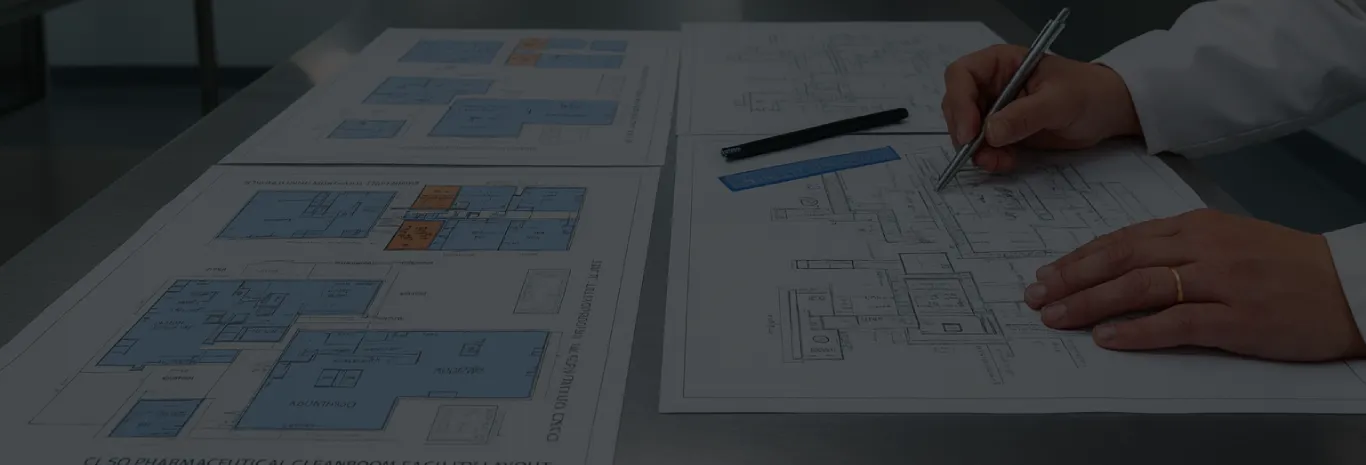
Engineering Precision Environments for Critical Manufacturing
Design ISO-classified cleanrooms and temperature-regulated cold chain systems that ensure product integrity, regulatory compliance, and operational reliability for pharmaceuticals, biologics, food processing, and precision manufacturing facilities in India.


Clean Room and Cold Chain Design Services in India
Clean room and cold chain design is a field of engineering that deals with providing controlled environments for manufacturing, storage, and transportation, and maintaining them under controlled conditions of contamination, temperature, and humidity, etc. The pharmaceutical industry in India, which ranks third in the world in terms of volume, needs ISO 5 to ISO 8 classified clean rooms under Schedule M and WHO-GMP regulations, and the cold chain gap in India, estimated to be around 10 million metric tons, with only 37 million metric tons capacity in FY24, also presents a huge investment opportunity for food and pharmaceutical industries alike.
Our cleanroom and cold chain design services in India include ISO classified cleanroom design, HVAC and air handling system design, temperature-controlled warehouse design, vaccine and biologics storage facilities, and environmental monitoring systems designed to meet the Schedule M and WHO-GMP guidelines of the Indian government and the CDSCO and FSSAI regulatory bodies. Our cleanroom and cold chain design services are required by the pharmaceutical industry, food processing industries, biotech industries, and healthcare facilities in India and abroad.
Our Approach to Cleanroom and Cold Chain Design
Our systematic design methodology integrates contamination risk assessment, thermal load analysis, and regulatory compliance engineering to deliver precision-controlled environments. This proven four-phase approach ensures comprehensive coverage of cleanroom classification requirements and temperature control specifications.
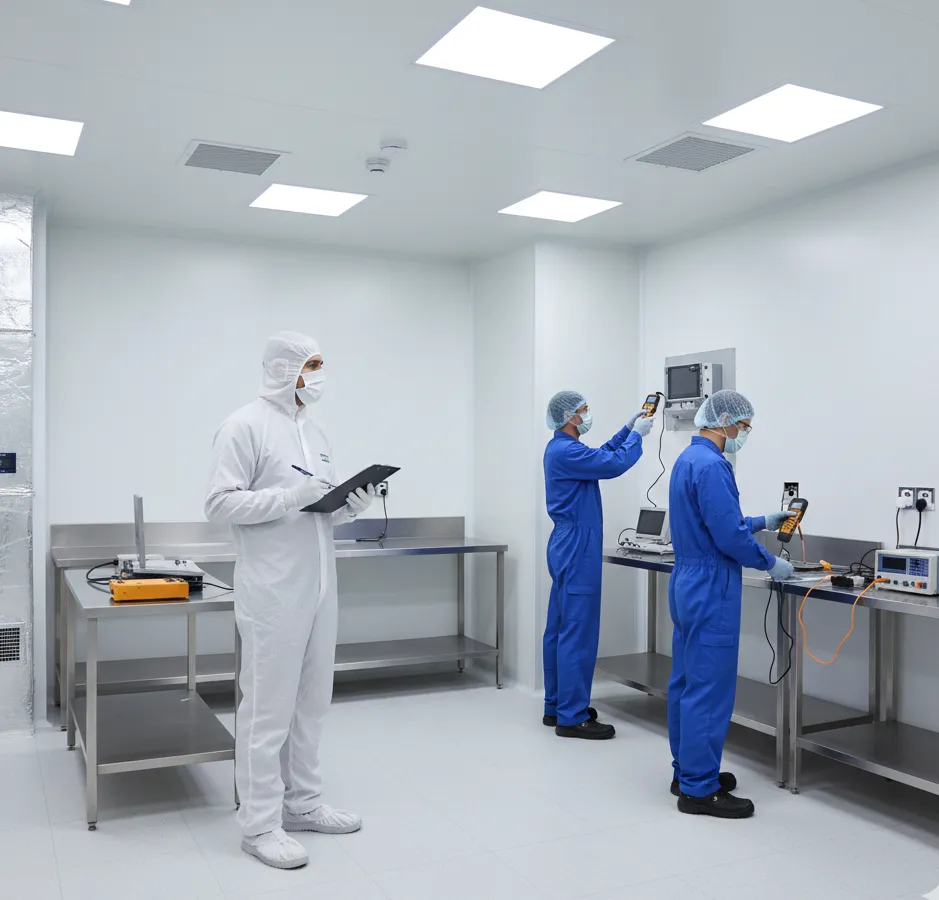

Facility Assessment & Classification Determination
Analyzing manufacturing processes, product contamination sensitivities, regulatory requirements, and operational workflows to establish appropriate ISO classifications and temperature control specifications.

Environmental System Design & Engineering
Engineering integrated HVAC systems, air filtration cascades, pressurization schemes, temperature monitoring, humidity control, and cleanroom architectural layouts meeting classification requirements.

Validation Planning & Documentation Development
Developing installation qualification protocols, operational qualification procedures, performance qualification testing plans, and comprehensive documentation supporting regulatory submissions and inspections.

Commissioning Support & Performance Verification
Providing system startup guidance, qualification testing oversight, environmental monitoring setup, personnel training, and long-term maintenance planning, ensuring sustained compliance.
Why Choose IMARC Engineering for Clean Room and Cold Chain Design Services in India?
Our integrated design approach combines contamination control engineering with thermal management expertise to deliver validated controlled environments. This comprehensive methodology ensures seamless coordination between environmental systems, product protection requirements, and regulatory compliance obligations.

Regulatory-First Design Methodology
Cleanroom and cold chain facilities in India are not simply engineering infrastructure, they are regulatory assets whose design directly determines whether a manufacturing licence is granted, whether a WHO-GMP certification inspection passes, and whether an FSSAI audit finds compliance or issues a corrective action notice. The most common and costly failure mode in Indian pharmaceutical and food processing facility projects is designing cleanrooms and cold chain systems to engineering specifications first and attempting to map them to regulatory requirements afterwards. IMARC Engineering’s design methodology begins with a comprehensive regulatory requirement mapping, identifying every Schedule M provision, WHO-GMP guideline, CDSCO licensing condition, and FSSAI regulatory requirement applicable to the facility’s product categories and target markets, before a single design parameter is established. This regulatory-first approach ensures that ISO classification selection, HVAC design parameters, temperature set points, airlock configurations, material and personnel flow layouts, and environmental monitoring system specifications are all determined by the applicable compliance framework rather than retrofitted to it after design completion.

Integrated Engineering Across Cleanroom, HVAC, Cold Chain, and EMS
Cleanroom and cold chain performance cannot be achieved by designing individual systems in isolation. A cleanroom that meets ISO classification requirements for particle count but whose HVAC system creates pressure cascade failures at doorway transitions will fail a WHO-GMP inspection. A cold chain warehouse whose refrigeration system maintains the required temperature range but whose envelope design allows thermal bridging at loading dock interfaces will fail WHO temperature mapping protocols. IMARC Engineering designs cleanrooms, HVAC systems, cold chain facilities, and environmental monitoring systems as integrated engineering systems, with each component’s design parameters specified in the context of its interface with adjacent systems. This integrated design approach eliminates the inter-system coordination failures that occur when architectural, mechanical, electrical, and instrumentation disciplines design to independent specifications, and produces a facility whose overall environmental performance is validated across all operating scenarios before construction commences.

Validation-Ready Design Documentation from Project Inception
The qualification and validation of cleanrooms and cold chain facilities including Installation Qualification, Operational Qualification, and Performance Qualification is a documentation-intensive process that requires design intent records, equipment specifications, calibration certificates, test protocols, and acceptance criteria to be available at the time of commissioning. Facilities designed without validation documentation in mind frequently encounter IQ, OQ, and PQ failures not because the facility performs inadequately, but because the documentation required to demonstrate that it performs to its design intent is incomplete, inconsistent, or absent. IMARC Engineering prepares User Requirement Specifications, Design Qualification documents, Functional Specifications, and design basis reports as integral deliverables of the design engagement, ensuring that every design decision is documented with its regulatory justification, and that the design documentation package is structured to support direct progression from design completion to IQ, OQ, and PQ execution without a documentation remediation phase.

Deep Knowledge of Indian Regulatory Inspection Standards
International cleanroom design standards such as ISO 14644, EU GMP Annex 1, and US FDA guidance documents provide the global benchmark for pharmaceutical cleanroom design, but CDSCO inspectors and state drug authority assessors evaluate facilities against the Schedule M framework, which has specific provisions that differ from international guidelines in areas including airlock configuration requirements, pressure differential specifications, surface finish standards, and utility system design. FSSAI assessors evaluate food processing facilities against the Food Safety and Standards (Licensing and Registration of Food Business) Regulations, which have specific hygienic design and temperature control requirements distinct from international food safety design standards. IMARC Engineering’s design team has direct knowledge of CDSCO and state drug authority inspection standards and FSSAI audit expectations, enabling facility designs that meet not only the letter of Schedule M and FSSAI regulations but the practical inspection standards applied by Indian regulators, including the specific areas that trigger observations and corrective action requirements in routine CDSCO GMP inspections.

Cold Chain Design Expertise Spanning Multiple Industries
Cold chain design requirements differ substantially across product categories. Vaccine storage facilities require temperature-controlled environments maintained at 2°C to 8°C with alarm and monitoring systems meeting WHO PQS standards and continuous temperature logging capable of demonstrating an unbroken cold chain for regulatory and procurement purposes. Frozen biologics and cell therapy products require ultra-low temperature storage at -20°C to -80°C with backup systems and emergency response protocols that meet the redundancy standards of regulated market customers. Pharmaceutical finished goods and API cold chain facilities require temperature-controlled storage zones designed to ICH Q1A stability testing conditions. Food processing cold chain facilities require HACCP-based temperature management systems meeting FSSAI and export market requirements. IMARC Engineering’s cold chain design capability covers all of these product categories, with design parameters, equipment specifications, monitoring system architectures, and validation protocols tailored to the specific temperature range, regulatory framework, and operational profile of each product type.

End-to-End Support from Concept Design
IMARC Engineering supports cleanroom and cold chain projects from initial concept design through detailed engineering, construction supervision, commissioning, and qualification , maintaining design intent accountability through every phase of the project. At the concept design stage, IMARC Engineering establishes the regulatory framework, ISO classification requirements, temperature zone layout, and utility system basis of design. During detailed engineering, IMARC Engineering develops full construction documentation including architectural drawings, HVAC design calculations, refrigeration system specifications, environmental monitoring system layouts, and validation documentation frameworks. During construction and commissioning, IMARC Engineering provides design clarification support, construction conformance reviews, and commissioning protocol development. At the qualification stage, IMARC Engineering supports IQ, OQ, and PQ execution, reviews test data against acceptance criteria, and prepares qualification summary reports that meet CDSCO and WHO-GMP documentation standards. This end-to-end engagement model ensures that the regulatory compliance outcome of the facility is maintained as the primary design objective throughout the project, rather than being compromised by value engineering decisions or construction expediency in later phases.
Clean Room and Cold Chain Design Services Across Key Sectors in India
IMARC Engineering delivers ISO-classified cleanroom design, cold chain facility engineering, HVAC system design, and validation documentation support across India’s most active regulated manufacturing sectors
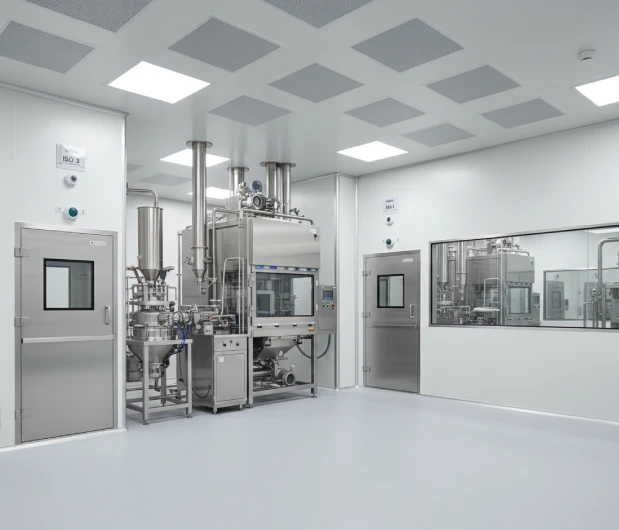
ISO 7 and ISO 8 classified cleanroom design for tablet, capsule, liquid, and semi-solid formulation manufacturing meeting Schedule M and WHO-GMP requirements. HVAC system design with unidirectional and turbulent airflow configurations, pressure cascade design for containment and cross-contamination prevention, and temperature and humidity control to ICH Q1A stability storage conditions. Environmental monitoring system design covering particle counters, differential pressure monitoring, temperature and humidity data loggers, and microbial monitoring sampling point layouts. Validation documentation including URS, DQ, IQ, OQ, and PQ protocols for cleanroom HVAC qualification.
Hygienic design cleanrooms for high-care and high-risk food processing zones meeting FSSAI licensing requirements, HACCP principles, and FSSC 22000 certification standards. Cold room and blast freezer design for chilled and frozen food storage and processing meeting FSSAI temperature control requirements and export market regulatory standards. Temperature-controlled production area design for dairy processing, ready-to-eat food manufacture, and modified atmosphere packaging operations. Environmental monitoring system design covering temperature, humidity, and microbial sampling protocols for food safety management system compliance. Cold chain logistics facility design for food distribution centres and export cold stores meeting APEDA and importing country regulatory requirements.
ISO 5 (Grade A) and ISO 6 (Grade B) classified cleanroom design for aseptic processing, fill-finish, and terminal sterilisation operations meeting EU GMP Annex 1, WHO-GMP, and Schedule M requirements for sterile product manufacture. Unidirectional airflow workstation design for aseptic filling operations, including laminar flow isolator integration and RABS design for closed aseptic processing. Pressure cascade design for Grade A through Grade D zone transitions with airlock configuration meeting CDSCO inspection standards. Complete IQ, OQ, and PQ documentation frameworks for sterile manufacturing facility qualification.
2°C to 8°C cold room and cold warehouse design for vaccine bulk storage and finished goods storage meeting WHO PQS standards and NITI Aayog cold chain infrastructure guidelines. Ultra-low temperature storage design at -20°C and -80°C for frozen vaccines, cell therapy products, and biological intermediates. Continuous temperature monitoring and alarm system design meeting WHO temperature mapping protocols and GDP documentation requirements. Backup power and redundancy system design for cold chain critical systems to ensure product integrity during power interruption events. Environmental monitoring system integration for cleanroom and cold chain areas within vaccine manufacturing facilities.
ISO 8 classified cleanroom design for nutraceutical capsule, tablet, and powder manufacturing meeting FSSAI health supplement regulations and import market GMP requirements. Temperature and humidity-controlled storage design for moisture-sensitive raw materials and finished goods. Cross-contamination prevention design for multi-product nutraceutical manufacturing facilities including dedicated equipment, material flow segregation, and cleaning validation-ready surface specifications. Environmental monitoring and documentation systems supporting FSSAI licence applications and export market GMP certification.
ISO 5 to ISO 7 classified cleanroom design for cell culture, fermentation, and downstream processing operations in biopharmaceutical manufacturing. Containment design for Biosafety Level 2 and Level 3 operations including negative pressure cleanrooms, HEPA exhaust filtration, and personnel decontamination systems. Cold chain and cryogenic storage design for biological intermediates, master and working cell banks, and finished biologic products. Integration of cleanroom HVAC design with process utility systems including WFI, clean steam, nitrogen, and compressed air to support GMP manufacturing environment requirements.
ISO 7 and ISO 8 classified cleanroom design for sterile and non-sterile medical device manufacturing meeting CDSCO Class B and C device manufacturing licence requirements and ISO 13485 quality management system standards. Particulate and microbial contamination control design for device assembly, packaging, and sterilisation preparation areas. Temperature and humidity-controlled storage design for temperature-sensitive medical devices and in-vitro diagnostic reagents. Cleanroom design documentation structured to support CDSCO manufacturing licence applications, CE marking technical files, and US FDA 510(k) submission requirements.
Frequently Asked Questions: Clean Room and Cold Chain Design Services in India
We have compiled answers to common questions investors, manufacturers, and facility developers ask about cleanroom and cold chain design. These insights address investment requirements, operational costs, regulatory compliance, validation timelines, and performance specifications.
Trusted by Industry Leaders
We partner with global enterprises and ambitious businesses across sectors to deliver operational excellence, strategic insights, and sustainable growth through integrated solutions.











Success in Their Words
Real feedback from clients across industries. Discover how our solutions delivered measurable impact and operational excellence.

I wanted to express my sincere appreciation for your efforts in handling this matter. Your dedication and commitment have been truly commendable, and it is evident that you have put in tremendous hard work and expertise into resolving the issues at hand. We are greatly interested in continuing our collaboration with you in the future, as your professionalism and reliability have made you a trusted partner. Thank you once again for your invaluable contribution. We look forward to strengthening our partnership ahead.

It has been a pleasure working with the IMARC team. The insights provided were structured, clear, and highly valuable, helping us strengthen both our technical and financial planning with confidence. We deeply appreciate the team’s professionalism, responsiveness, and attention to detail throughout the engagement. Every requirement was well understood and effectively incorporated, resulting in a comprehensive and actionable output. Overall, our experience has been excellent, and I would gladly recommend IMARC to organizations seeking a reliable research partner.

Your service is truly exceptional. Working with the IMARC team has been a seamless and professional experience. The clarity of communication, responsiveness to queries, and consistent support at every stage made the entire engagement highly efficient. The insights shared were well-structured, practical, and perfectly aligned with our requirements, helping us make informed decisions with confidence. Overall, the dedication and professionalism demonstrated by your team stand out, and I would be glad to recommend IMARC as a reliable and trustworthy research partner.

IMARC did an outstanding job in preparing our study. They were punctual, precise, and consistently responsive throughout the entire process. The team delivered all the data we required in a clear, well-organized, and highly professional format. Their strong attention to detail, combined with their ability to meet every deadline without compromising quality, truly set them apart. Overall, their reliability and commitment made them an exceptional partner for our project, and we would gladly work with them again in the future.

IMARC made the whole process incredibly easy from start to finish. Everyone I interacted with via email was polite, professional, and straightforward to deal with, always keeping their promises regarding delivery timelines and remaining consistently solutions-focused. From my very first contact, I appreciated the professionalism and support shown by the entire IMARC team. I highly recommend IMARC to anyone seeking timely, affordable, and reliable information or advice. My experience with IMARC was excellent, and I truly cannot fault any aspect of it.

I’d like to express my sincere gratitude for the excellent work you accomplished with the study. Your ability to quickly understand our requirements and deliver high-quality results under tight timelines truly reflects your expertise, exceptional work ethic, and unwavering commitment to your customer’s success. The professionalism and responsiveness you demonstrated throughout the process made a significant difference. Our entire team and company are incredibly thankful for your dedication, reliability, and support. Once again, thank you for your outstanding contribution.
Speak to Our Clean Room and Cold Chain Design Team
Whether you are in the business of pharmaceuticals, biotech, medical devices, or food processing, IMARC Engineering can provide you with the best in integrated cleanroom and cold chain solutions that meet the guidelines set by the Central Drugs Standard Control Organization, World Health Organization, and Food Safety and Standards Authority of India. Our services include ISO classified cleanroom solutions, EU GMP and WHO GMP compliance, and validation-ready cold chain solutions.