Manufacturing
October 07 2026
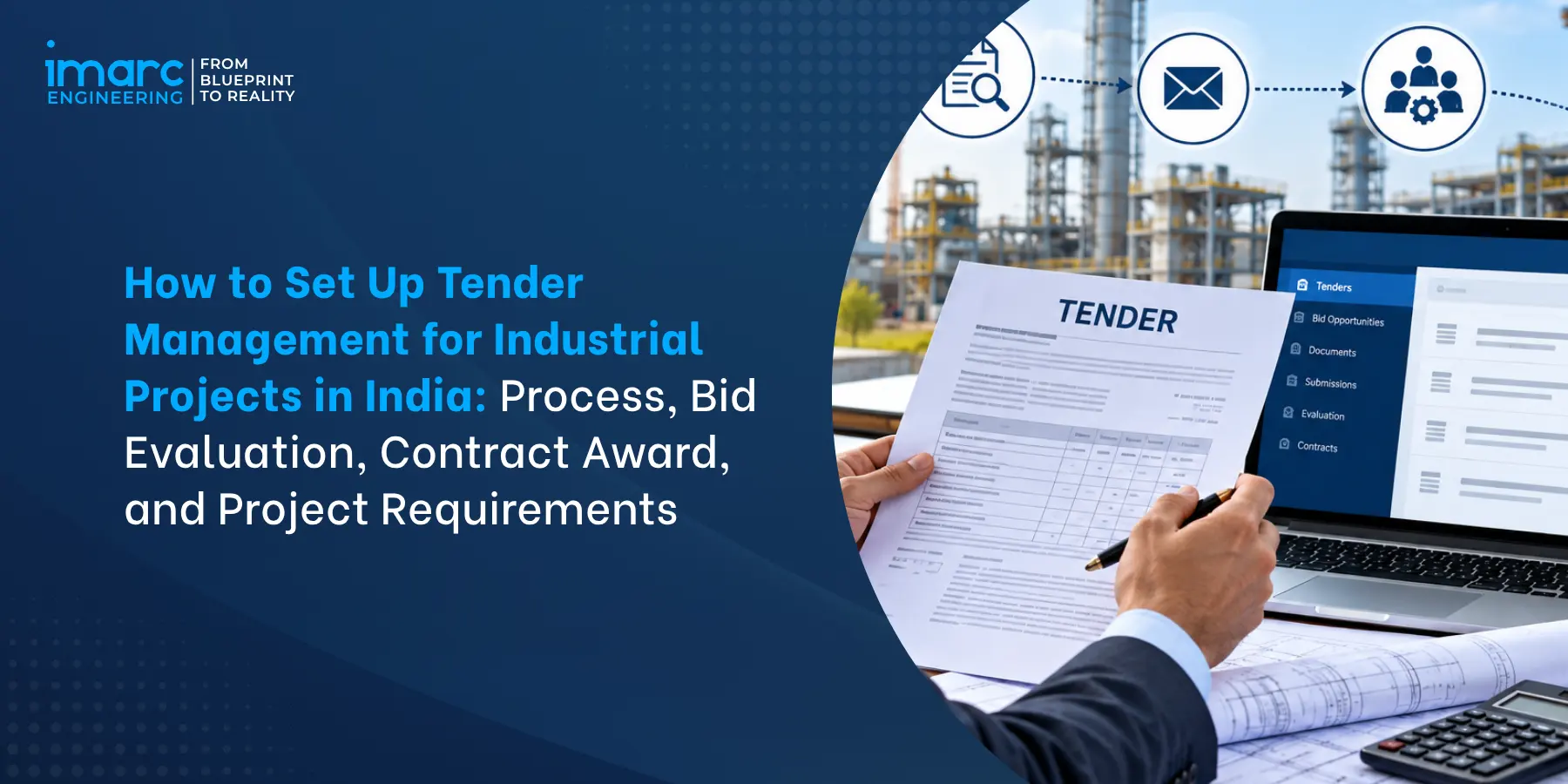
How to Set Up Tender Management for Industrial Projects in India: Process, Bid Evaluation, Contract Award, and Project Requirements
Introduction
Industrial capital projects in India are assembled from dozens of procurement packages — process equipment, utilities, electrical distribution, automation, civil works, effluent treatment and balance-of-plant and each package passes through a tender before it becomes a contract. For investors, project sponsors and manufacturers, tender management for industrial projects is the discipline that converts engineering intent into enforceable commercial commitments at a defensible price.
A tender handled as a simple request for quotations leaves scope gaps, unbalanced pricing and unallocated risk; a tender handled as a structured engineering and commercial process produces comparable bids, verified capability and contract terms that survive execution. This guide walks through the full cycle — scope and specification definition, tender package assembly, bidder prequalification, technical and commercial evaluation, bid leveling, deviation analysis, negotiation and contract award — with the technical and commercial detail a sponsor needs before releasing a single rupee of capital.
Scope of this Guide
This guide answers the sponsor's central question directly: how can manufacturers, investors and project developers manage industrial project tenders by defining project scope, preparing tender documents, prequalifying bidders, evaluating technical and commercial proposals, comparing costs and deviations, negotiating terms and selecting suitable vendors or EPC contractors? It covers tender planning, RFP and RFQ preparation, prequalification criteria, techno-commercial evaluation, bid leveling, cost benchmarking, negotiation and award, together with the governance, documentation and risk controls that hold the process together. It deliberately excludes government tender filing and GeM bidding; the focus is industrial, manufacturing and EPC procurement by private project owners.
Table of Contents
- Introduction
- Why Tender Management for Industrial Projects Matters in India in 2026
- What Tender Management for Industrial Projects Is and Why It Matters
- Package Types, Contracting Models and Capacity Planning in Tender Management for Industrial Projects
- Scope Definition, Technical Specifications and Tender Documentation for Industrial Projects
- Core Process Steps in Tender Management for Industrial Projects: From Tender Planning to Bid Submission
- Core Process Steps in Tender Management for Industrial Projects: From Bid Evaluation to Contract Award
- Evaluation Infrastructure, Governance and Package Values in Tender Management for Industrial Projects
- Regulatory, Contractual and Commercial Considerations in Industrial Tender Management
- Conclusion
1. Why Tender Management for Industrial Projects Matters in India in 2026
Four drivers explain why disciplined tender management for industrial projects has become a board-level concern for Indian project sponsors rather than a back-office procurement task.
1.1 Capital Project Cycle and Localization Drivers
India's industrial investment pipeline spans process plants, automotive component lines, electronics assembly, specialty chemicals, food processing and pharmaceutical facilities. Historically, a large share of the critical equipment inside these plants — high-pressure reactors, centrifugal and screw compressors, variable frequency drives, precision instrumentation, hydraulic power units, automated fillers and pollution-control systems — was imported. Import dependence lengthens lead times, exposes sponsors to freight and currency swings, and complicates spares and after-sales support.
Domestic manufacturing capability has matured across many of these categories, and the localization agenda — Make in India, the Production Linked Incentive schemes covering electronics, pharmaceuticals, specialty steel, solar modules, white goods and automobile components — has made local sourcing technically credible for far more packages than before. As the bidder pool widens, tender management for industrial projects shifts from price collection into structured qualification, evaluation and risk allocation. Sponsors who tender rigorously capture the localization benefit; those who do not inherit quality escapes, spares shortages and warranty disputes.
1.2 Policy, Procurement and Regulatory Framework
Several policy instruments shape how industrial tenders are framed in India. The Public Procurement Order, 2017, issued by DPIIT and amended periodically, governs local-content declaration and Class-I and Class-II supplier classification where it applies. Quality Control Orders issued under the BIS Act, 2016 restrict supply of non-conforming imported goods in specified product categories, which directly affects bidder eligibility.
GST treatment and customs duty on capital goods change the comparison between domestic and imported offers and must be normalized inside the commercial evaluation rather than left to the bidder's price sheet. The MSMED Act, 2006 imposes a 45-day payment obligation toward registered micro and small enterprises, which affects payment-term drafting. The Arbitration and Conciliation Act, 1996, as amended, governs dispute resolution clauses. This guide addresses industrial, manufacturing and EPC tendering by private project owners; it does not cover government tender filing or GeM bidding, although the same engineering discipline transfers.
1.3 Investment Ecosystem and EPC Market Structure
The supply side of Indian industrial procurement is layered: turnkey EPC contractors, discipline-wise package contractors, OEM-direct supply, Indian subsidiaries and licensees of global OEMs, and a deep cluster of fabrication and component suppliers. Vadodara and Nashik are strong in static equipment and pressure vessels; Coimbatore and Rajkot in pumps, castings and gears; Pune-Chakan and Chennai in automotive and machining capability; Sanand and Halol in electronics and auto assemblies; Ankleshwar, Dahej and Vatva in chemical process equipment and piping; Faridabad and Peenya in sheet metal and enclosures.
This structure gives sponsors genuine choice, but it also means bidder capability varies sharply between a licensed OEM and a fabricator working to drawings. Lenders and financial institutions increasingly require independent engineer certification of contract awards, and export credit agencies review contract terms for payment security. Tender strategy therefore has to be matched to the actual market for each package rather than applied uniformly.
1.4 Cost of Poor Tender Planning
Weak tender definition is expensive in ways that surface months later. Scope gaps, undefined battery limits, missing load lists, incomplete cable schedules, unstated utility terminal points and absent performance guarantees typically convert into change orders that add roughly 8 to 20 percent to awarded contract value on poorly defined packages (indicative in nature, may vary).
Ambiguous liquidated damages, missing inspection rights and silent warranty terms push disputes toward arbitration under the Arbitration and Conciliation Act, 1996, where resolution can consume years and management attention. Schedule slippage carries a financing cost at the sponsor's cost of funds, commonly in the range of 9 to 12 percent per annum (illustrative), on capital that sits idle. Against these exposures, a disciplined tender cycle — typically 8 to 16 weeks per major package and a tender-management effort of a fraction of project value — is inexpensive insurance, and it is the only stage at which the sponsor holds full commercial leverage.
2. What Tender Management for Industrial Projects Is and Why It Matters
Tender management for industrial projects is an engineering-led decision process with commercial consequences, not a purchasing formality that begins after design is finished.
2.1 What Tender Management for Industrial Projects Covers
Tender management covers everything between a defined project requirement and a signed, enforceable contract. On the engineering side it includes scope of work definition, the basic engineering package, design basis memorandum, process flow diagrams, P&IDs, equipment datasheets, material take-off, bill of quantities, technical specifications and inspection requirements. On the commercial side it includes contract form selection, price schedule design, terms and conditions, guarantees, liquidated damages and warranty structures.
On the process side it includes prequalification, bidder invitation, pre-bid clarification, two-envelope bid receipt, technical and commercial evaluation, bid leveling, deviation analysis, negotiation and award recommendation. The distinguishing feature of industrial tendering is that these three layers must stay synchronized: a technical specification without a matching commercial consequence — or a commercial clause that contradicts the specification, produces bids that cannot be compared fairly.
2.2 Tender Management Across the Project Lifecycle
Tender activity does not start after detailed engineering. Concept and feasibility work fixes the capacity and configuration that later determine package sizes. Basic engineering or FEED produces the specifications and quantities bidders price. Long-lead item tendering usually runs in parallel with detailed engineering, because transformers, HT switchgear, compressors, chillers, boilers and cranes carry delivery periods of roughly four to twelve months (indicative in nature, may vary).
Detailed design then follows the approved vendor drawings under a controlled document schedule. During execution, tender-derived obligations — inspection plans, dispatch clearances, milestone certificates, performance tests — govern progress payments. In effect, the tender document set becomes the operating rulebook for the rest of the project, which is why errors made at the tender stage are the most expensive to correct.
2.3 Package Segmentation and Contracting Models
Segmentation decides how many tenders a project needs. A single LSTK or turnkey EPC package suits a plant with complex internal interfaces and an owner without a large engineering organization, because interface risk sits with the contractor and is priced into the bid. Multiple discipline-wise packages — static equipment, rotating equipment, electrical, instrumentation, piping erection, civil, effluent treatment — usually deliver a lower total cost where the owner has engineering capability, but they transfer far more interface coordination and schedule risk back to the sponsor.
Intermediate approaches include EPCM, where a consultant manages many packages on the owner's behalf, and hybrid models where process technology is licensed separately and the rest is tendered as packages. Each model allocates risk differently, and none is universally suitable; the correct choice depends on owner capability, schedule pressure, package value and the maturity of the local bidder market for each scope.
2.4 Key Components of an Industrial Tender Package
An effective industrial tender package gives bidders a complete and consistent basis for pricing, technical compliance and delivery. Key components include:
- Scope of Work: Defines the contractor's responsibilities, package boundaries, battery limits, exclusions and interfaces with other contractors.
- Technical Specifications: States design requirements, materials, applicable codes and standards, operating conditions and performance requirements.
- Drawings and Datasheets: Provides PFDs, P&IDs, equipment datasheets, layouts, electrical drawings and other information needed for accurate pricing and design.
- BOQ/MTO: Lists quantities, units, materials and estimated requirements to establish a common commercial basis for bids.
- Commercial Terms: Covers pricing structure, taxes and duties, payment milestones, warranties, liquidated damages, securities and applicable contract conditions.
- Delivery Schedule: Defines manufacturing, inspection, dispatch, installation and commissioning milestones.
- Performance Guarantees: Specifies measurable requirements such as capacity, efficiency, utility consumption, product quality and emissions, where applicable.
- Inspection Requirements: Defines inspection stages, testing, quality documentation, hold points and third-party inspection requirements.
- Evaluation Criteria: Establishes technical, commercial and contractual criteria for bid comparison, including treatment of deviations and exclusions.
Together, these documents create a controlled basis for comparable bids and reduce scope gaps, commercial disputes, and post-award changes.
3. Package Types, Contracting Models and Capacity Planning in Tender Management for Industrial Projects
Package types, contracting models and capacity planning determine how a tender is structured before a single bidder is invited, and they set the ceiling on how good the resulting bids can be.
3.1 Package Types by Engineering Discipline
Industrial tenders fall into recognizable families. Static equipment packages cover reactors, columns, heat exchangers and pressure vessels, priced on weight and material of construction. Rotating equipment packages cover pumps, compressors, blowers and agitators, usually bid against datasheets that fix duty point, head, efficiency and seal type. Electrical packages cover transformers, panels, cabling, earthing and DG sets. Instrumentation packages cover control systems, field instruments, analysers and valves.
Utility and balance-of-plant packages cover boilers, chillers, cooling towers and compressed air. Civil and structural packages cover foundations, buildings, roads and drainage. Environmental packages cover effluent treatment, zero liquid discharge, scrubbers and stacks. Turnkey EPC packages bundle several of these under one contract. Each family has different bidder markets, evaluation criteria and price drivers, and treating them identically is a common and costly planning error.
3.2 Contracting Models and Risk Allocation
The contract form determines who carries quantity, price and performance risk. Lump sum turnkey transfers scope and quantity risk to the contractor, at a premium, and works best when the specification is complete. Item-rate or unit-rate contracts keep quantity risk with the owner and suit civil and erection work where quantities genuinely vary. Cost-plus models are used where scope is exploratory. Supply contracts with separate erection and commissioning contracts suit owners with in-house site teams.
Within any model the tender must allocate specific risks: escalation above a defined threshold, freight and currency movement, statutory tax changes, force majeure, site conditions, delay attributable to owner-supplied equipment, and performance shortfall. Risk retained by the owner does not disappear; it is simply unpriced until it materializes, and industrial project disputes are most often the product of unclear risk allocation at the tender stage.
3.3 Capacity Planning and Package Sizing
Package sizing is a capacity-planning decision as much as a commercial one. An owner with a lean project team cannot administer twenty simultaneous packages, whereas an owner with a full engineering department may find a single turnkey package an expensive way to buy coordination. A practical rule is that no package should be so large that only two credible bidders exist, and none so small that tendering and evaluation costs exceed the savings achieved.
Evaluation effort itself has a cost: a full techno-commercial evaluation with third-party review typically absorbs weeks of discipline-engineer time per package. Capacity for inspection and expediting during execution is another constraint, since every awarded package creates a stream of drawings to review, inspections to witness and milestones to certify. Package count, package value and available owner bandwidth should therefore be planned together at the strategy stage.
3.4 Bidder Pool, Cluster Selection and Sourcing Channels
Sourcing channels include direct invitation of known vendors, registered vendor databases, industry association directories in the relevant discipline, cluster referrals from comparable recent projects, and global OEM routes for proprietary technology. For engineered packages the first list is usually long and then filtered: buyers map each candidate against the package specification, fabrication capacity, prior delivery record and geographic proximity for service support.
For critical packages it is prudent to include at least one alternate vendor even when a single supplier is the practical choice, so that the tender establishes a benchmark and preserves negotiating position. For standard and repeat items, framework agreements with two or three approved vendors can shorten later tendering substantially. The quality of the initial bidder list frequently determines the quality of the entire tender outcome, because no evaluation methodology can compensate for a bidder pool containing unsuitable contractors.
4. Scope Definition, Technical Specifications and Tender Documentation for Industrial Projects
The materials of a tender are engineering deliverables, specifications and consumable lists; if these are thin or ambiguous, bids become uncomparable and contracts become change-order machines.
4.1 Basis of Design and Engineering Deliverables
Every engineered package should rest on a design basis memorandum stating capacity, feedstock or duty, ambient and site conditions, utilities available at the battery limit, applicable codes and the design margins. Supporting deliverables typically include PFDs, P&IDs, equipment datasheets, line lists, electrical load lists and single line diagrams, cable schedules, instrument index and datasheets, civil scope with geotechnical summary, and a material take-off converted into a bill of quantities with units, quantities and unit rates columns.
Deliverable lists should specify drawing sizes, language, revision codes and the review cycle — commonly Code 1 for approved, Code 2 for approved with comments and Code 3 for revise and resubmit — so that bidders price document control effort rather than assume it. Missing design basis is the single most common reason bids cannot be compared.
4.2 Material Specifications, MOC and Piping Classes
Material specification decides cost, corrosion life and supply chain. Tenders should state material of construction explicitly, carbon steel to IS 2062 or ASTM A516, stainless steel grades 304, 316L or duplex 2205, alloy steels such as IS 2002 or SA 387 for high-temperature service, lined or rubber-lined vessels for aggressive media, along with corrosion allowance, typically 1.5 to 3 mm for carbon steel process vessels (indicative in nature, may vary). Piping classes should fix nominal sizes, schedules, flange ratings, gasket and bolting types, and valve specifications.
Applicable design codes should be named rather than implied: ASME BPVC Section VIII Division 1 or IS 2825 for unfired pressure vessels, TEMA for heat exchangers, API 610 for pumps, ASME B31.3 for process piping, IBR for boiler components, IS 875 for wind and seismic loads and IS 1893 for seismic design, with electrical equipment conforming to IS 732 and IS 3043 for wiring and earthing.
4.3 Consumables, Spares and Operating Supplies
Consumables are frequently under-specified, then negotiated expensively after award. The tender should list welding consumables and their qualification requirement, gaskets with material and rating, structural fasteners with grade and coating, protective painting and coating systems with total dry film thickness, insulation with thickness and cladding material, lubricants by grade and brand allowance, and commissioning chemicals such as cleaning and passivation agents.
Spares should be split into mandatory two-year operational spares and recommended capital spares, each with a priced list rather than a lump-sum allowance. Consumable and spares lists convert into an evaluated cost during bid leveling, which is where apparently low bids are often revealed to be incomplete rather than competitive.
4.4 Performance Guarantees and Vendor Data Requirements
Performance guarantees are the buyer's protection against a technically compliant bid that fails in operation. Tender documents should require guaranteed values with defined test conditions and tolerances for capacity or throughput, specific power or steam consumption, efficiency, outlet quality, emissions, noise levels and availability. Guarantees should be tied to a measurable acceptance test at commissioning, with liquidated damages for shortfall and a defined retest procedure.
Vendor data requirements should be specified as a deliverable list with submission timelines: general arrangement drawings, foundation load data, utility and consumable lists, terminal point schedule, O&M manuals, spare parts catalogues and test certificates. Fixing these obligations in the tender avoids the common post-award negotiation in which the supplier treats drawings and manuals as an extra.
5. Core Process Steps in Tender Management for Industrial Projects: From Tender Planning to Bid Submission
The first half of the process converts an engineering concept into an issued tender document set and a controlled bid box, and these four stages determine whether later evaluation is straightforward or contested.
5.1 Tender Planning and Procurement Strategy
Tender planning produces the procurement strategy note and package matrix: package name, scope summary, estimated value, discipline, contract type, probable bidder pool, target issue date and target award date. The same exercise produces a long-lead register, a cash-flow forecast by package, and a resource-loaded tendering schedule with named evaluators. The strategy decision on single versus multiple packages, OEM-direct versus licensed local manufacture, and imported versus domestic supply is taken here, weighing landed cost, spares availability, warranty support and local-content considerations.
Long-lead items with delivery periods of roughly four to twelve months should be released for tender in parallel with detailed engineering rather than after it, because compressing procurement later is far more expensive than compressing documentation earlier. A documented strategy also protects the project later when award decisions are audited or challenged.
5.2 RFP and Tender Package Assembly
The tender package typically contains instructions to bidders, scope of work with clearly stated battery limits and exclusions, technical specifications and datasheets, drawings, bill of quantities, general and special conditions of contract, price schedule forms, milestone and delivery schedule, performance guarantee formats, bank guarantee templates, a compliance matrix and the evaluation methodology with weightings.
For imported equipment the Incoterms rule, currency, exchange-rate treatment and testing at works should be stated. The package should fix the inspection category for each item — stage inspection, third-party witness or final inspection only — and name the inspection agencies acceptable to the owner. Every document is issued under a controlled number and revision, and the tender document register becomes the single source of truth for later addenda and clarifications.
5.3 Prequalification and Bidder Shortlisting
Prequalification tests whether a bidder can technically and financially execute the package. Standard criteria include demonstrated experience in similar work — commonly three comparable packages in the last five to seven years, each not less than a stated proportion of estimated package value — audited annual turnover of roughly three to five times the package value, positive net worth, working capital adequacy, a bank solvency certificate and credit rating, certification to ISO 9001:2015 with ISO 14001 and ISO 45001 where relevant, and statutory registrations including GST, EPFO and ESIC compliance, labour licence and, where applicable, electrical contractor licence, PESO approval, IBR registration and ASME stamping capability.
Recent lost-time injury data, litigation history and past performance certificates are increasingly part of the assessment. Methods range from open invitation for standard items to restricted tendering, EOI-based shortlisting and third-party vendor audits for critical packages.
5.4 Pre-Bid Meeting, Clarifications and Bid Submission Controls
A pre-bid conference is usually held two to four weeks after tender issue, sometimes accompanied by a site visit, to address interpretation questions. Answers are issued in writing to all bidders simultaneously, without identifying the asker, as numbered addenda that form part of the tender documents. Bid submission controls protect the integrity of the process: two-envelope submission with technical and price envelopes sealed and stored separately, sequential opening of the technical envelope only, bid receipt registers with timestamps, and rejection of late submissions.
Bid security is verified for instrument type, amount, issuing bank and validity, commonly 30 to 45 days beyond the bid validity period of 90 to 120 days. Where the sponsor uses an e-procurement platform, submission is timestamped and encrypted, and access rights are released only at the scheduled opening.
6. Core Process Steps in Tender Management for Industrial Projects: From Bid Evaluation to Contract Award
The second half of the process converts sealed bids into a defensible award, and it is where technical judgement, commercial normalization and contractual discipline have to work in sequence.
6.1 Technical Bid Evaluation
Technical evaluation begins with a compliance matrix that maps every specification line item against every bid. Discipline engineers then examine equipment datasheets, material of construction, mechanical design calculations with corrosion allowance, nozzle and connection schedules, code compliance such as ASME BPVC Section VIII Division 1 or IS 2825, piping class adherence, electrical ratings and ingress protection, control philosophy, area classification per IS 5572 or IEC 60079 for hazardous zones, load and foundation data, utility consumption, and delivery schedules supported by manufacturing slot confirmation.
Each bid is classified as compliant, compliant with minor deviation, or non-compliant, and critical deviations such as capacity shortfall, unacceptable material substitution or absent code compliance disqualify the offer before price envelopes are ever opened. A weighted scoring matrix, if used, should be disclosed in the tender so that bidders understand how technical merit will be judged.
6.2 Commercial Bid Evaluation and Cost Benchmarking
Commercial evaluation normalizes price schedules into a comparable evaluated cost. Basic price, packing, freight, insurance, erection, commissioning, training and mandatory spares are added; taxes and duties are treated consistently across domestic and imported offers; payment terms are discounted to present value at the sponsor's cost of funds, commonly 10 to 12 percent per annum (indicative in nature, may vary); and schedule differences are costed as the carrying cost of delay.
Benchmarking uses internal historical bid databases, published commodity indices for steel, copper and aluminium, published wholesale price indices for escalation clauses, and a should-cost model built from raw material content, fabrication hours and standard overheads. Abnormally low bids and front-loaded payment schedules are flagged for scrutiny, since both often signal omissions or cash-flow stress rather than genuine competitiveness.
6.3 Bid Comparison, Leveling and Deviation Analysis
Bid leveling places qualified bidders side by side on an identical basis: scope gaps are priced using the bidder's own rates or a benchmark rate, missing items are added, taxes and duties are equalized, freight and insurance are included, and payment terms are normalized. The outcome is a ranked evaluated cost, not a ranking of basic prices. Deviations are classified as critical, major or minor — critical deviations disqualify, major deviations are priced and added, minor deviations are recorded and either accepted with clarification or resolved in negotiation.
A sensitivity analysis on currency, freight and duty movement of plus or minus 10 percent shows how robust the ranking is. The whole exercise concludes in a written bid comparison statement recording assumptions, exclusions, deviations, evaluated cost and the recommended award, which is the document an auditor or lender will read first.
6.4 Inspection, Testing and Quality Documentation Requirements
Inspection obligations belong in the tender, not in post-award bargaining. The package should fix the inspection category per item, the inspection and test plan with hold points, third-party inspection agency rights, and the extent of non-destructive testing — radiography, ultrasonic, dye penetrant or magnetic particle examination on designated weld joints. Pressure-retaining equipment is typically hydro-tested, and material test certificates are commonly demanded for critical services.
Factory acceptance testing should be defined with performance runs and witnessed by the owner or a nominated agency, followed by dispatch clearance against a manufacturer's dispatch clearance certificate. Closing documentation includes as-built drawings, O&M manuals, calibration certificates with traceability, and hazardous-area certification such as ATEX or IECEx where applicable.
6.5 Negotiation, Contract Award and Post-Award Controls
Negotiation should be conducted with the lowest evaluated technically qualified bidder, and should focus on scope clarification, payment milestones, delivery schedule, warranty duration, liquidated damages cap and spares pricing rather than price alone. For complex engineered packages, competitive auctioning below evaluated cost is counterproductive. Award follows through a letter of intent or letter of award, submission of a performance bank guarantee typically at 5 to 10 percent of contract value within 15 to 30 days, advance payment of up to 10 to 20 percent against an advance payment bank guarantee, and insurance cover for marine transit and erection all risks.
Post-award controls include the kick-off meeting, the vendor document schedule with approval cycles, expediting visits, monthly progress reporting, milestone payment certification against inspection release notes, and a formal change-order procedure with pre-agreed rates and approval thresholds.
7. Evaluation Infrastructure, Governance and Package Values in Tender Management for Industrial Projects
Tender management for industrial projects depends on institutional infrastructure — governance rules, platforms, cost models and benchmarking data — as much as on individual evaluator skill.
7.1 Tender Governance, Committees and Delegation of Authority
Governance determines whether evaluation is credible. A tender committee typically comprises the project head, relevant discipline leads, procurement, finance, legal and, for safety-critical scopes, HSE representation. The delegation of financial authority matrix fixes who can approve an award at each value band, with larger awards needing board or investment committee approval. Segregation of duties matters: the engineer who writes a specification should not unilaterally determine the award, and approvers should not be evaluators.
Conflict-of-interest declarations, confidentiality undertakings, non-disclosure agreements with bidders and a documented code of conduct for vendor interaction reduce both legal and reputational exposure. Every evaluation should conclude in signed minutes that record criteria applied, bids received, deviations accepted, evaluation outcome and the basis of recommendation, so that the decision can be defended months later without reconstructing history from memory.
7.2 e-Procurement Platforms, Document Control and Bid Rooms
Large sponsors use platforms such as SAP Ariba, Oracle Procurement Cloud, Zycus or Jaggaer for structured tendering, bidder registration, encrypted submission and audit trails; smaller projects frequently rely on controlled email and physical sealed envelopes with a bid receipt register. Either way, document control is the backbone: a master tender register, controlled numbering by package and revision, transmittals logged with acknowledgement, and a rule that superseded revisions are withdrawn from circulation rather than merely replaced.
Where proprietary process data is shared, a data room with access logging and signed non-disclosure agreements is standard. Electronic submission timestamps and sealed technical and price envelopes prevent the two most common integrity failures — late submission acceptance and premature price disclosure.
7.3 Evaluation Tools, Cost Models and Benchmarking Datasets
Evaluation quality improves with tooling. Weighted scoring templates should be fixed before bids arrive and applied identically, with discipline weights such as process and technical compliance, similar experience, manufacturing and shop capacity, QA and QC systems, delivery schedule credibility, HSE record, service footprint and financial strength. Should-cost models built from raw material content, machining or fabrication hours and overhead rates allow a buyer to challenge outliers.
Commodity index tracking supports escalation clauses and price reasonableness checks. Historic bid databases convert each completed tender into a benchmark for the next, which is the cheapest form of procurement intelligence available to a repeat investor. For high-value awards, an independent engineer or third-party technical reviewer adds a second opinion on both technical adequacy and commercial reasonableness.
7.4 Industrial Tender Evaluation Framework
| Evaluation Area | Key Parameters |
|---|---|
| Technical Compliance | Scope compliance, specifications, capacity, materials, codes and standards |
| Performance Guarantees | Guaranteed output, efficiency, utility consumption, reliability and product quality |
| Project Experience | Similar projects, references, execution record and sector expertise |
| Manufacturing Capability | Production capacity, facilities, quality systems and inspection capability |
| Delivery | Manufacturing schedule, lead time, commissioning plan and schedule credibility |
| Commercial Evaluation | Base price, taxes, freight, duties, spares and other applicable costs |
| Contractual Terms | Payment terms, warranty, liquidated damages, securities and liability provisions |
| HSE and Compliance | Safety record, environmental systems, statutory compliance and certifications |
| After-Sales Support | Service network, training, spares availability and technical support |
| Financial Strength | Turnover, net worth, liquidity, credit profile and financial capacity |
The evaluation should use predefined criteria and documented weightings where applicable. Scope gaps, exclusions, deviations and commercial assumptions should be normalized before ranking bids. The final bid comparison should clearly record the evaluated cost, technical position, key risks and recommended award basis.
8. Regulatory, Contractual and Commercial Considerations in Industrial Tender Management
Tender documents carry obligations that extend far beyond price: statutory approvals, environmental performance and the economics of the procurement function itself.
8.1 Statutory Approvals Embedded in Tender Scopes
Every industrial tender should clearly define the statutory approvals, licences, registrations and certifications relevant to the package, identify whether responsibility rests with the project owner, EPC contractor, equipment supplier or another party, and specify the documentation and milestone requirements for each approval.
Depending on the project type, location and process configuration, applicable requirements may include Consent to Establish and Consent to Operate from the State Pollution Control Board, Environmental Clearance where applicable, factory and building-related approvals, fire-safety approvals, boiler-related registrations, electrical approvals, PESO licences or approvals for regulated installations, and BIS conformity where applicable.
The tender should clearly allocate responsibility for obtaining, supporting and maintaining each applicable approval and link critical statutory deliverables to engineering, installation, commissioning and payment milestones. This helps reduce the risk of equipment or facilities reaching the commissioning stage without the approvals required for lawful operation.
8.2 Effluent, Hazardous Waste and Environmental Clauses
Environmental obligations must be quantified in the tender rather than referenced vaguely. Effluent treatment packages should specify design influent and effluent characteristics, treated water standards aligned with the standards notified under the Environment (Protection) Rules, 1986 Schedule I and applicable state norms, and, in sectors where it is required, zero liquid discharge commitments covering reverse osmosis, multiple effect evaporator and crystallizer performance.
Air emission limits, stack heights and continuous emission monitoring requirements should be stated for combustion and process sources. Hazardous waste handling should reference the Hazardous and Other Wastes (Management and Transboundary Movement) Rules, 2016, as amended, including authorization, storage design, the manifest system for consignment tracking and tie-up with an authorized treatment, storage and disposal facility. Performance guarantees for effluent parameters, with liquidated damages for non-compliance, are essential because environmental shortfall halts operations.
8.3 Tender Management Cost Structure and CAPEX/OPEX Composition
The cost of running a disciplined tender is modest relative to the value at stake. Tender document preparation and third-party technical review commonly cost in the range of INR 1.5 to 8 lakh per package, and comprehensive cycle costs typically fall within 0.4 to 1.2 percent of package value (indicative in nature, may vary). Bid security, usually 1 to 3 percent of estimated value, and performance bank guarantees at 5 to 10 percent with retention of 5 to 10 percent, impose financing costs on bidders that are ultimately priced back into the offer.
A representative project CAPEX composition is equipment supply at 40 to 55 percent, civil and structural works at 15 to 25 percent, erection and installation at 12 to 20 percent, utilities at 8 to 12 percent, engineering and consultancy at 3 to 6 percent, taxes and duties at 8 to 15 percent, contingency at 5 to 10 percent and pre-commissioning at 2 to 4 percent. Competitive tendering itself typically yields 5 to 15 percent savings against non-competitive procurement.
8.4 Project Economics
| Configuration | Scale Assumption | Investment (INR) (Indicative, may vary) |
|---|---|---|
| Single-package equipment tender | Project value INR 20-60 crore, one major package | Tender management effort INR 25-60 lakh |
| Multi-package brownfield expansion | Project value INR 150-400 crore, 6-12 packages | Tender management effort INR 1.5-4.0 crore |
| Greenfield plant with LSTK EPC package | Project value INR 600-1,200 crore | Tender management effort INR 5.5-14 crore |
| Mega project with parallel long-lead tendering | Project value above INR 2,000 crore, 40 or more packages | Tender management effort INR 18-35 crore |
Conclusion
Tender management for industrial projects combines procurement strategy, scope definition, bidder prequalification, technical and commercial evaluation, bid leveling, negotiation and contract award. Clear specifications reduce change orders, rigorous evaluation filters out non-compliant bids, and structured bid leveling enables fair cost comparison. Strong governance, benchmarking, contract terms and inspection controls then carry this discipline through project execution.
Three priorities decide whether a project succeeds at this stage. First, complete the engineering definition — design basis, datasheets, quantities and battery limits — before the tender is issued. Second, run a transparent, documented techno-commercial evaluation that ranks evaluated cost rather than basic price. Third, lock down contract terms, guarantees, inspection rights and change-order controls at award, so that the leverage gained during tendering is retained through delivery.
PURSUING INDUSTRIAL TENDER MANAGEMENT IN INDIA?
IMARC Engineering supports project sponsors, manufacturers and investors with capacity and feasibility planning, procurement strategy, tender package and RFP preparation, technical specification drafting, bidder prequalification, techno-commercial bid evaluation, bid leveling and cost benchmarking, contract terms and risk allocation, regulatory approval mapping and capital investment planning. The advisory covers supply, installation, EPC and LSTK packages, including basic engineering, prequalification, technical and commercial evaluation, negotiation and contract award support.
→ Schedule a free tender management scoping consultation with an IMARC specialist
Frequently Asked Questions
Tender management is the structured process of defining an industrial project's scope and specifications, preparing tender documents, prequalifying bidders, evaluating technical and commercial proposals, comparing and leveling bids, negotiating terms and awarding a contract. It is an engineering and commercial decision process, not simply collecting quotations from vendors.
Five stages: tender planning and procurement strategy; RFP or RFQ preparation with technical specifications and BOQ; prequalification and bidder invitation; technical, commercial and deviation evaluation with bid leveling; and negotiation, approval and contract award, followed by post-award document control, inspection and milestone governance.
A tender package is assembled from the basic engineering package: scope of work, design basis, P&IDs, equipment datasheets, material take-off, BOQ and technical specifications, plus commercial terms, price schedule forms, bank guarantee formats and evaluation criteria. Package boundaries and battery limits are finalized before issue to bidders.
Typically instructions to bidders, scope of work, technical specifications and datasheets, drawings, bill of quantities, general and special conditions of contract, price schedule, milestone schedule, performance guarantee formats, bank guarantee templates, compliance matrix and evaluation methodology, with clarification and deviation request formats.
An EOI screens market interest and bidder capability before a full tender; an RFQ seeks firm prices for a well-defined standard scope; an RFP invites technical and commercial proposals for complex engineered scope against owner-defined requirements, forming the basis for techno-commercial evaluation.
Prequalification tests technical and financial capability: similar project experience and completed values, reference letters, shop and fabrication capacity, key personnel, QA/QC and HSE systems, ISO 9001 and statutory registrations, audited turnover relative to package value, net worth, credit rating and litigation history.
Technical bid evaluation checks each offer against the specification: process guarantees, equipment sizing and datasheets, material of construction, codes and standards, drawings, inspection and test plans, delivery schedule, spares and service support. Bids are classified compliant, compliant with minor deviations, or non-compliant before prices are opened.
Techno-commercial evaluation combines the technical verdict with the commercial position: evaluated landed cost, taxes and duties, freight and insurance, payment terms and financing cost, schedule impact, spares, warranty, liquidated damages and risk allocation. Only technically qualified bidders proceed to commercial comparison.
Bid leveling converts offers to a common basis: scope gaps are priced, missing items added, taxes and duties treated consistently, freight and insurance included, payment terms discounted to present value, and schedule differences costed. The result is an evaluated cost ranking rather than a basic-price ranking.
Deviations are classified as critical, major or minor. Critical deviations such as capacity shortfall or unacceptable materials disqualify; major deviations are priced into the evaluated cost; minor deviations are recorded, accepted with clarification, or resolved in negotiation, with every decision documented in the compliance matrix.
Post-evaluation steps: reference and capability verification, clarification and negotiation rounds, award recommendation approved by the delegated authority, letter of intent or award, performance bank guarantee and insurance submission, contract signature, kick-off meeting, vendor document schedule release and mobilisation against agreed milestones.
Recent Post




Trusted by Industry Leaders
We partner with global enterprises and ambitious businesses across sectors to deliver operational excellence, strategic insights, and sustainable growth through integrated solutions.











Success in Their Words
Real feedback from clients across industries. Discover how our solutions delivered measurable impact and operational excellence.

I wanted to express my sincere appreciation for your efforts in handling this matter. Your dedication and commitment have been truly commendable, and it is evident that you have put in tremendous hard work and expertise into resolving the issues at hand. We are greatly interested in continuing our collaboration with you in the future, as your professionalism and reliability have made you a trusted partner. Thank you once again for your invaluable contribution. We look forward to strengthening our partnership ahead.

It has been a pleasure working with the IMARC team. The insights provided were structured, clear, and highly valuable, helping us strengthen both our technical and financial planning with confidence. We deeply appreciate the team’s professionalism, responsiveness, and attention to detail throughout the engagement. Every requirement was well understood and effectively incorporated, resulting in a comprehensive and actionable output. Overall, our experience has been excellent, and I would gladly recommend IMARC to organizations seeking a reliable research partner.

Your service is truly exceptional. Working with the IMARC team has been a seamless and professional experience. The clarity of communication, responsiveness to queries, and consistent support at every stage made the entire engagement highly efficient. The insights shared were well-structured, practical, and perfectly aligned with our requirements, helping us make informed decisions with confidence. Overall, the dedication and professionalism demonstrated by your team stand out, and I would be glad to recommend IMARC as a reliable and trustworthy research partner.

IMARC did an outstanding job in preparing our study. They were punctual, precise, and consistently responsive throughout the entire process. The team delivered all the data we required in a clear, well-organized, and highly professional format. Their strong attention to detail, combined with their ability to meet every deadline without compromising quality, truly set them apart. Overall, their reliability and commitment made them an exceptional partner for our project, and we would gladly work with them again in the future.

IMARC made the whole process incredibly easy from start to finish. Everyone I interacted with via email was polite, professional, and straightforward to deal with, always keeping their promises regarding delivery timelines and remaining consistently solutions-focused. From my very first contact, I appreciated the professionalism and support shown by the entire IMARC team. I highly recommend IMARC to anyone seeking timely, affordable, and reliable information or advice. My experience with IMARC was excellent, and I truly cannot fault any aspect of it.

I’d like to express my sincere gratitude for the excellent work you accomplished with the study. Your ability to quickly understand our requirements and deliver high-quality results under tight timelines truly reflects your expertise, exceptional work ethic, and unwavering commitment to your customer’s success. The professionalism and responsiveness you demonstrated throughout the process made a significant difference. Our entire team and company are incredibly thankful for your dedication, reliability, and support. Once again, thank you for your outstanding contribution.