Manufacturing
October 06 2026
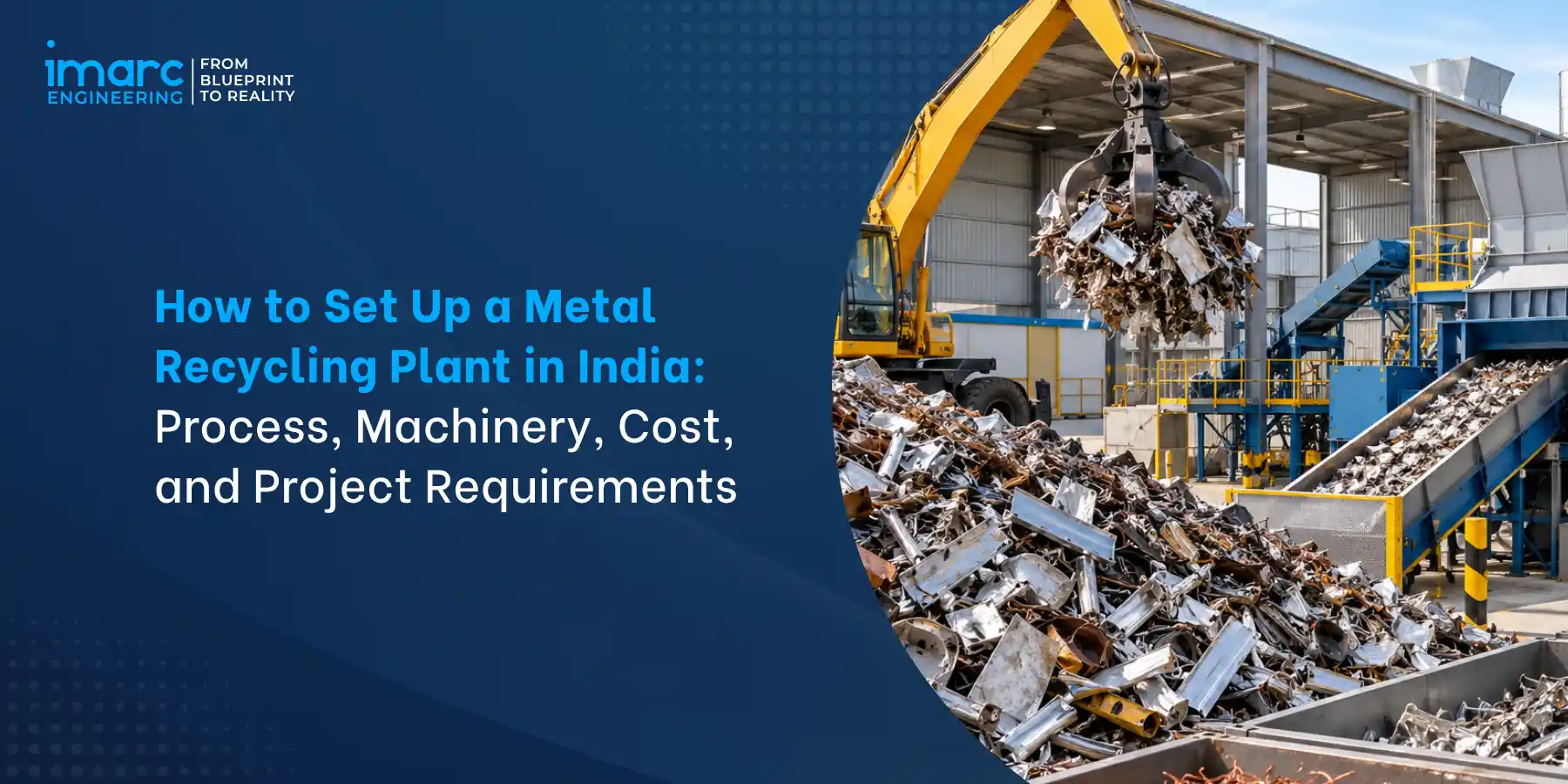
How to Set Up a Metal Recycling Plant in India: Process, Machinery, Cost, and Project Requirements
Introduction
For investors, project sponsors and manufacturing groups evaluating a metal recycling plant in India, disciplined front-end planning is what separates a bankable resource-recovery asset from an overbuilt scrap yard. Scrap metal recycling is a feedstock-led, high-volume business: purchase price, sorting yield, contamination deductions, power cost and logistics decide whether the plant earns a return, not the nameplate capacity printed in a brochure.
This engineering setup guide sets out how a scrap metal recycling plant in India is planned end to end. It covers feedstock sourcing and grading, plant sections, capacity and product-mix decisions, process chemistry, shredding and separation machinery, melting and casting where applicable, layout, utilities, effluent and dust control, licences, and project economics. It deliberately stays within ferrous and non-ferrous scrap metal recycling; e-waste, lithium-ion battery recycling and end-of-life vehicle dismantling sit under separate rules and processes and are excluded here.
All cost, capacity and consumption figures quoted are industry-typical and indicative in nature, and may vary with feedstock mix, site, state and configuration. They are planning benchmarks, not quotations.
This guide delivers an integrated planning logic linking scrap type and quality to technology, machinery, infrastructure and investment, so that a sponsor can brief engineers, lenders and regulators from a single consistent technical base.
Scope of this Guide
This guide answers the sponsor's central question directly: how can investors and recycling companies plan a metal recycling plant in India by evaluating scrap availability, metal type, processing technology, production capacity, machinery, site and infrastructure requirements, environmental compliance, project economics and execution requirements? It treats the project as an integrated resource-recovery system in which scrap type, feedstock quality, target output specification and capacity together determine sourcing strategy, sorting and separation technology, machinery configuration, storage and material handling, utilities, pollution control, plant layout, CAPEX, OPEX and production ramp-up.
Table of Contents
- Introduction
- Why Investing in a Metal Recycling Plant in India Matters in 2026
- What a Metal Recycling Plant in India is and Why It Matters
- Metal Recycling Plant in India Product Types and Capacity Planning
- Raw Materials and Chemicals for a Metal Recycling Plant in India
- Core Process Steps in a Metal Recycling Plant in India: Part 1 — Receiving, Sorting and Size Reduction
- Core Process Steps in a Metal Recycling Plant in India: Part 2 — Separation, Melting, Casting and Quality Control
- Machinery, Plant Layout and Utilities for a Metal Recycling Plant in India
- Effluent, Licences and Project Economics of a Metal Recycling Plant in India
- Conclusion
1. Why Investing in a Metal Recycling Plant in India Matters in 2026
Four structural drivers make a metal recycling plant in India a strategic rather than opportunistic investment in 2026: a feedstock and energy logic that favours secondary production, a maturing policy framework, a deepening formal investment ecosystem, and the measurable cost of planning the facility badly. Each driver is examined below, with the caveat that project-level conclusions require fresh feasibility validation.
1.1 Import Dependence and the Domestic Resource Recovery Case
India's metals economy runs on feedstock that is largely imported or informally traded. The steel sector depends on imported coking coal and, increasingly, imported ferrous scrap to supplement domestic generation, while non-ferrous fabricators rely on imported primary metal and concentrate. At the same time, large volumes of domestically generated scrap move through unorganised channels with poor segregation, high contamination and weak documentation.
A modern metal recycling plant in India addresses both sides of that gap: it upgrades domestic scrap into graded, consistently specified feedstock, and it substitutes secondary metal for primary metal where the quality is acceptable to the buyer. Secondary aluminium remelting typically consumes roughly 5 percent of the energy required for primary smelting, and secondary steelmaking bypasses mining, sintering, coking and blast-furnace stages; those energy and carbon advantages are precisely what make scrap supply security commercially valuable to steel mills, foundries and die casters.
1.2 Policy, Regulatory and Incentive Framework
The policy environment has moved from silence to active promotion. The Steel Scrap Recycling Policy 2019 issued by the Ministry of Steel sets an explicit direction toward scrap-based steelmaking and encourages the creation of organised scrapping and processing infrastructure, including the disposal of government and public sector scrap through e-auctions to registered recyclers. The National Steel Policy 2017 and the Production Linked Incentive scheme for specialty steel reinforce the demand side by expanding domestic steel capacity and quality requirements.
The Motor Vehicles (Registration and Functions of Vehicle Scrapping Facility) Rules 2021 have begun formalising a domestic scrap generation channel, even though vehicle dismantling itself is outside the scope of this guide. On the trade side, metal scrap imports are governed by DGFT policy, with pre-shipment inspection certification and radiation clearance requirements and routing through designated ports, which shapes port-linked site selection. State industrial policies add capital subsidy, stamp duty exemption, electricity duty relief and SGST reimbursement, and GST at 18 percent applies to scrap with reverse charge on purchases from unregistered suppliers. Sponsors should verify current thresholds, rates and state incentives before financial close.
1.3 Investment Ecosystem, Feedstock Cost and Working Capital
Scrap recycling is a spread business, not a margin business. Feedstock purchase typically accounts for 65 to 80 percent of operating cost in a processing or trading facility, so a two to four percent movement in the purchase-to-sale spread can swing project returns more than any equipment upgrade. Working capital is therefore the hidden capital requirement: incoming scrap inventory of 30 to 60 days, finished goods of 15 to 30 days, and receivables from mills and foundries of 30 to 60 days must all be funded alongside fixed assets.
Lenders assess recycling projects on feedstock contracts, weighbridge discipline and buyer offtake rather than on shed area. Formalisation also improves access: institutional sellers increasingly prefer registered recyclers with documented compliance, weighbridge records and statutory returns, which reduces the risk premium on both debt and equity.
1.4 The Cost of Poor Planning
Errors at the planning stage are expensive because they are structural. A shredder sized on tonnage alone rather than on infeed bulk density underperforms permanently; a yard without separate bays cross-contaminates non-ferrous loads and converts saleable copper into mixed scrap at a discount; inadequate incoming power forces diesel generation at several times the grid tariff; and a plant that installs a melting furnace without matching fume extraction and hazardous-waste facilities can face Consent to Operate conditions it cannot meet.
Brownfield re-engineering of layout, utilities and pollution control after commissioning typically adds 10 to 20 percent to original CAPEX and months of lost production (figures are indicative in nature, may vary). Radiation screening, moisture control before furnace charging, and fire separation in shredder bays are three low-cost planning decisions that prevent disproportionately large downstream losses.
2. What a Metal Recycling Plant in India Is and Why It Matters
A metal recycling plant in India is best understood as a graded-material factory: its product is specification, not tonnage. The section below defines the activity boundaries, the functional archetypes, the determinants of scale, and the physical sections that constitute the facility.
2.1 Defining a Metal Recycling Plant in India
For this guide, a metal recycling plant in India means a licensed facility that receives, weighs, inspects, sorts, size-reduces, separates and, where applicable, melts, refines and casts ferrous and non-ferrous scrap into saleable secondary raw material or metal products. Ferrous scrap covers iron and steel grades; non-ferrous scrap covers aluminium, copper, brass, zinc, lead-bearing and stainless steel streams.
The scope explicitly excludes e-waste processing, which falls under the E-Waste (Management) Rules with its own registration, collection and precious-metal recovery framework; lithium-ion and lead-acid battery recycling, which falls under battery waste rules; and end-of-life vehicle dismantling, which falls under vehicle scrapping rules. Mixing these streams into a conventional scrap yard triggers approvals the facility is not designed for, so the process flow and storage plan must keep them out.
2.2 Functional Archetypes: Yard, Processing Plant and Remelt Facility
Metal recycling facilities in India operate across three broadly distinct archetypes. The first is a collection, segregation and trading yard with minimal machinery, typically a weighbridge, sorting space, a baling press and a shear, whose economics rest on grading and logistics. The second is a mechanical processing plant that shreds, shears, screens and separates scrap into high-density graded products such as shredded ferrous, plate and structural, aluminium Zorba and copper granules, with no melting.
The third is an integrated remelt facility that adds furnaces, refining, alloying, casting and a spectrometry laboratory to produce ingots, billets and sows. Capital intensity, power demand, effluent load, fume control obligations and consent conditions step up sharply with each archetype, and the correct choice is dictated by the buyer offtake the sponsor can actually secure, not by ambition.
2.3 Scale Determinants and Indicative Capacity Bands
Scale is determined by four variables: the reliable feedstock catchment within an economic transport radius, the output specification demanded by the buyer, the bottleneck machine in the process train, and the funding available for working capital.
As a planning benchmark, a small segregation and trading yard handles 1,000 to 5,000 tonnes per annum on one to three acres; a mid-sized mechanical processing facility handles 10,000 to 30,000 tonnes per annum on four to ten acres; a large shredding-led plant handles 50,000 to 150,000 tonnes per annum on ten to twenty-five acres; and an integrated facility with melting adds 3,000 to 15,000 tonnes per annum of ingot capacity within the same estate.
All figures are indicative in nature and may vary with scrap type, land use norms and state regulations. The practical rule is that capacity should be set by the bottleneck machine at realistic utilisation, not by the sum of individual equipment nameplates.
2.4 Plant Sections
| Section | Function | Key Equipment |
|---|---|---|
| Weighbridge and Gate House | Inbound and outbound weighing, documentation, radiation screening | 60–80 MT digital weighbridge, radiation portal monitor, CCTV |
| Scrap Storage Yard | Segregated covered and open storage of ferrous and non-ferrous feedstock | Bay retaining walls, material handler, wheel loader |
| Inspection and Sorting Bay | Manual grading, instrumented identification, removal of prohibited items | Sorting tables, conveyor, handheld XRF analyser |
| Size Reduction Bay | Shredding, shearing, baling and densification of scrap | Hammer shredder, guillotine shear, baling press |
| Separation Bay | Magnetic, eddy current, density and sensor-based separation | Overband magnets, eddy current separators, XRT sorter |
| Melting and Refining Section | Charge melting, fluxing, degassing, refining and alloying | Induction furnace, rotary salt furnace, rotary degasser |
| Casting and Finishing Section | Ingot and billet casting, trimming, sawing, bundling and marking | Casting conveyor, moulds, band saw, stacker |
| Quality Control Laboratory | Chemical composition, hydrogen and mechanical checks | Optical emission spectrometer, XRF, reduced-pressure test rig |
| Utilities Block | Power distribution, compressed air, water, cooling and backup | Transformer, DG sets, screw compressors, cooling tower |
| Effluent Treatment, Dust Control and Hazardous Waste Storage | Wastewater treatment, fume and dust capture, segregated hazardous storage | ETP with clarifier, bag filter, afterburner, bunded storage pad |
3. Metal Recycling Plant in India Product Types and Capacity Planning
Product definition comes before machinery selection. The output specification a metal recycling plant in India commits to supply the target buyer determines particle size, density, chemistry tolerance and, in turn, the entire process train.
3.1 Output Formats and Product Specifications
Ferrous outputs follow internationally recognised trade grades such as heavy melting scrap 1 and 2 at an 80:20 ratio, shredded scrap, plate and structural, busheling, and turnings, differentiated by density, dimensions and residual element content. Shredded ferrous is typically baled or loose at 0.9 to 1.1 tonnes per cubic metre against 0.4 to 0.6 tonnes per cubic metre for loose unprocessed scrap, which is why shredding improves freight economics even before segregation value is added.
Non-ferrous outputs include sorted aluminium fractions such as painted extrusion, mixed low-copper aluminium and used beverage can bales; mixed non-ferrous concentrates sold for further upgrading; copper as number one and number two copper, chopped cable granules and ingot; brass and bronze ingots; and secondary aluminium alloy ingots in die-casting alloys such as ADC12, A380, LM6 and LM24, or extrusion billets in 6061 and 6063 chemistries. Zinc and stainless steel grades complete the non-ferrous basket.
3.2 Capacity Planning and Throughput Assumptions
Capacity planning must be built from the bottleneck machine and from realistic operating hours, not from theoretical nameplates. A hammer shredder rated 15 to 80 tonnes per hour depending on infeed character, running 300 days at 16 hours, gives nominal annual throughput before utilisation loss; planning at 60 to 75 percent utilisation is prudent. Manual sorting lines typically handle 3 to 8 tonnes per hour per line, eddy current separators 5 to 25 tonnes per hour per unit, and sensor-based sorters 3 to 15 tonnes per hour per unit.
Melting capacity is expressed in heats: a one to five tonne induction furnace at a 45 to 90 minute tap-to-tap cycle yields the daily liquid metal budget. Recovery assumptions matter equally: ferrous shredding typically recovers 70 to 85 percent ferrous, 3 to 8 percent non-ferrous from post-shredder treatment, with 10 to 25 percent shredder residue; aluminium remelting typically yields 88 to 95 percent metal with 2 to 5 percent oxidation loss and 3 to 8 percent dross. All figures are indicative in nature, may vary with feedstock, and must be confirmed by trial campaigns.
3.3 Product Mix and Vertical Integration Decisions
The product-mix decision is a spread decision. Selling graded scrap concentrates capital in sorting and separation and delivers faster working capital turnover with limited regulatory exposure. Adding melting captures the alloy premium and the conversion margin but introduces furnace capital, power or fuel cost, fume control, hazardous-waste obligations for dross, salt cake and bag filter dust, and a far heavier consent regime.
A middle path, common among Indian non-ferrous processors, is to sort to a high-purity concentrate such as wrought aluminium or Zorba and sell to a dedicated remelter while retaining copper and brass cable granulation in-house. Product mix should also anticipate demand for documented recycled content from automotive and appliance customers, which rewards plants that can evidence mass balance, batch traceability and consistent chemistry rather than offering the lowest price.
3.4 Location and Cluster Selection
Site selection balances feedstock proximity against buyer proximity, power tariff, land cost, effluent rules and logistics. Port-linked clusters suit imported scrap: Gujarat around Alang and Sosiya, and the Kandla and Mundra port catchments, plus Nhava Sheva and Chennai for containerised imports with pre-shipment inspection and designated port routing. Industrial clusters suit domestically generated manufacturing scrap: Ludhiana and Mandi Gobindgarh in Punjab for steel and aluminium processing scrap, Raipur and Bhilai in Chhattisgarh for induction furnace and secondary steel demand, Jamnagar and Moradabad for brass, and Delhi-NCR, Rajkot, Coimbatore, Pune and Kolkata for aluminium and copper fabrication scrap.
Within a cluster, the deciding factors are usually the industrial power tariff and reliability, road width and axle load access, whether the state mandates zero liquid discharge for metal processing, and whether the site sits inside a notified industrial estate where zoning and consent processes are simpler. Proximity to a railway siding materially improves economics for high-volume ferrous scrap.
4. Raw Materials and Chemicals for a Metal Recycling Plant in India
Feedstock is the raw material and the finished product of a metal recycling plant in India, and it is graded with the same discipline as any chemical input. Process chemistry matters mainly where melting, fluxing and alloying are involved.
4.1 Feedstock Categories and Scrap Sourcing Channels
Feedstock falls into four practical categories: manufacturing or process scrap generated as offcuts, stamping skeletons, turnings and rejected castings; demolition and municipal scrap from structures and consumer durables; institutional scrap sold by government departments, public sector undertakings, railways and defence establishments, usually through e-auctions that increasingly require buyers to be registered recyclers; and imported scrap routed through designated ports with pre-shipment inspection certification.
A viable sourcing plan normally combines two or three anchor channels, because single-channel dependence exposes the plant to price and availability shocks. Direct purchase against weighbridge slips, long-term supply agreements with fabricators, aggregator networks and toll processing arrangements are the common commercial models. Documentation quality at the point of purchase, including invoices, transport documents and supplier declarations, determines how smoothly scrap moves through statutory returns later.
4.2 Ferrous Scrap Grades and Contamination Limits
Ferrous feedstock is traded by grade definitions that specify thickness, dimensions and residual element limits. Typical acceptance criteria for heavy melting scrap include a maximum dimension suitable for the furnace or shredder feed opening, copper residuals not exceeding about 0.2 percent, tin not exceeding about 0.05 percent, moisture not exceeding about 2 percent, and freedom from sealed containers, free-flowing liquids and pressurised vessels.
Galvanised scrap introduces zinc, which affects both refractory life and fume handling; turnings carry cutting oil and moisture and are usually baled or centrifuged before melting; cast iron and rails are segregated as premium streams. Radiation screening of every incoming load is now standard practice, and any load exceeding background thresholds must move to a quarantine bay with a documented rejection protocol rather than entering the yard.
4.3 Non-Ferrous Scrap Grades and Contamination Limits
Non-ferrous grades demand tighter control because contamination destroys value quickly. Aluminium feedstock includes clean painted extrusion, mixed low-copper material, used beverage cans with paint and moisture, irony aluminium requiring magnetic removal, and turnings carrying oil and moisture that must be dried or de-coated.
Copper feedstock ranges from bare bright wire above 99 percent copper through number two copper at 94 to 96 percent to cable chops that require granulation; incoming fire-refined copper is typically specified with iron below 0.3 percent and moisture below 1 percent, while chopped cable is specified on insulation content, usually under 2 percent after granulation.
Brass grades are separated into yellow and red brass, with radiator scrap segregated because of solder. Zinc, lead and magnesium contamination is the most damaging in aluminium melting, contributing to fume generation, dross formation and out-of-specification chemistry, so sensor-based sorting is often justified by the penalty it avoids.
4.4 Process Chemicals, Fluxes and Alloying Consumables
Aluminium remelting consumes chloride-based or chloride-free salt flux, typically a sodium chloride and potassium chloride mixture with cryolite addition, dosed at roughly 0.5 to 2 percent of charge weight in crucible and reverberatory furnaces, and up to 15 to 25 percent in rotary salt furnaces processing heavily contaminated scrap and dross. Degassing uses argon or nitrogen through rotary degassers at 200 to 600 revolutions per minute; grain refinement uses aluminium-titanium-boron rod, modification uses aluminium-strontium master alloy, and chemistry adjustment uses magnesium ingot, aluminium-manganese and aluminium-silicon master alloys.
Copper and brass melting uses charcoal cover, borax or glass-based flux, phosphor copper at 10 to 15 percent phosphorus for deoxidation, and chloride-based flux for zinc-rich brasses. Induction furnace steel and cast iron melting uses lime, fluorspar, graphite or petcoke carburiser, ferro-manganese and ferro-silicon for alloying, and aluminium shot for deoxidation. Refractory consumption is significant: silica linings for iron melting, alumina-based linings for aluminium and copper, and castables for launders and ladles.
4.5 Chemical Storage, Handling and Process Safety
Chemical and fuel storage must be segregated, roofed and bunded, with secondary containment sized at 110 percent of the largest container. Petroleum and liquefied petroleum gas storage requires licensing under the Petroleum Rules and the applicable pressure vessel rules, and compressed argon, nitrogen, oxygen and acetylene manifolds require compliance with gas cylinder rules, including manifold design and earthing. Aluminium fines and dust present a combustible dust hazard and demand bonding, earthing, non-sparking tools and dedicated dust collection rather than housekeeping with compressed air. The defining process hazard in a remelt facility is molten metal contact with water or moisture, which causes violent explosions: charge moisture must be controlled below 1 to 2 percent, scrap must not be stored wet, and cooling water systems must be physically separated from furnace and casting areas with drainage that diverts away from the metal. Class D extinguishing media for magnesium, dry powder units for hydrocarbon fires, and documented personal protective equipment standards for furnace and casting crews are minimum requirements.
5. Core Process Steps in a Metal Recycling Plant in India: Part 1 — Receiving, Sorting and Size Reduction
The upstream half of the process train converts heterogeneous, undocumented scrap into classified and size-prepared material. Most of the value in a metal recycling plant in India is created or destroyed in these steps.
5.1 Scrap Receiving, Weighing, Radiation Screening and Documentation
Every load enters through a controlled gate with a stamped digital weighbridge of 60 to 80 tonnes capacity and 16 to 18 metre platform length to accommodate trailers, verified under legal metrology requirements. Documentation capture includes supplier invoice, transport document, electronic way bill, e-auction lot details where applicable, and a reverse charge declaration where the supplier is unregistered. Radiation screening is performed with a portal monitor using sodium iodide detectors, supplemented by handheld survey meters for suspect loads; any threshold exceedance triggers quarantine and a documented rejection or return process rather than entry into the yard. Incoming material is then subject to visual inspection, moisture estimation, and photographic recording for lot-level traceability. Weighing tolerances are held within about 0.5 percent, and reconciliation of supplier weight against plant weight is a commercial discipline that protects margin and prevents disputes.
5.2 Inspection, Manual Segregation and Pre-Sorting
Pre-sorting converts a mixed load into six to ten commodity streams before any machine touches it: heavy melting scrap, plate and structural, cast iron, shredded feed, aluminium, copper, brass, stainless steel and mixed non-ferrous. Sorting is carried out on conveyor lines of 1,000 to 1,200 millimetre belt width at belt speeds of 0.3 to 0.8 metres per second, with sorters working both sides and pickers recovering non-ferrous from the ferrous run. Handheld X-ray fluorescence analysers resolve ambiguities such as cast versus wrought aluminium and stainless steel grades, and inductive separators can automate stainless steel sorting where volumes justify it. Prohibited items are removed at this stage: sealed drums, pressurised cylinders, oil-filled components, capacitors, and any material with free-flowing liquid. Oversize items are set aside for shearing because feeding an oversized item into a shredder is the most common cause of catastrophic rotor damage.
5.3 Size Reduction: Shredding, Shearing, Baling and Granulation
Size reduction is where capital intensity concentrates. A hammer mill shredder with rotor diameters of 1.5 to 2.6 metres and drive motors of 750 to 3,000 kilowatts processes 15 to 80 tonnes per hour depending on infeed bulk density, with throughput falling sharply for light, bulky or high-moisture material; the shredder is fed by vibratory or apron conveyor with an integrated belt scale, and water spray at 1 to 3 cubic metres per hour controls dust and reduces explosion risk. Guillotine shears with cutting force of 500 to 1,500 tonnes handle heavy melting scrap and plate too long for shredder feed, while alligator shears serve smaller yards.
Baling presses of 1,000 to 2,500 kilonewtons produce ferrous bales at 1.5 to 2.5 tonnes per cubic metre and non-ferrous bales at 0.6 to 1.0 tonnes per cubic metre. Copper cable granulation lines of 2 to 10 tonnes per hour combine chopping with air or water separation to release insulation and yield granules above 99 percent copper content. Twin-shaft pre-shredders of low speed and high torque, up to 1,500 kilowatts, reduce bulky items ahead of the hammer mill.
5.4 Magnetic Separation, Screening and Fines Handling
Magnetic separation is the workhorse of ferrous recovery. Self-cleaning overband magnets of 800 to 2,400 millimetre belt width mounted over the discharge conveyor, in-line drum magnets with rare-earth elements, and head pulley magnets on conveyor terminals together achieve ferrous recovery above 95 percent on correctly sized feed. Vibratory screens and trommels classify material at cuts such as 10, 25, 50 and 100 millimetres, because separation efficiency across all technologies degrades below roughly 10 to 20 millimetres particle size.
Air classification removes light fluff ahead of the fines circuit, and fines are processed separately to recover the fine non-ferrous fraction rather than reporting to residue. Shredder residue, the 10 to 25 percent of shredded output that remains, must be routed to post-shredder treatment for additional non-ferrous recovery or to authorised cement co-processing, and this residual stream is now a major regulatory and cost consideration as landfill options narrow.
5.5 Feedstock Blending, Charge Preparation and Storage Discipline
The final upstream step is blending material to the specification of the next stage, whether that is a furnace charge or a buyer lot. Blending balances chemistry, particularly copper, tin, zinc, silicon, magnesium and iron, and controls bulk density and piece size so that the melting or shearing operation runs predictably. Physical separation of bays with retaining walls prevents the cross-contamination that silently converts high-grade streams into mixed scrap, and covers storage for non-ferrous and for furnace charge material controls both moisture and oxidation.
Inventory is rotated on a first-in, first-out basis with lot-level identification, and daily reconciliation of input weight against output weight produces a material recovery rate that is the single most useful operating metric in the plant. Where moisture is unavoidable, a pre-heating or drying step before furnace charging is cheaper than the explosive risk it removes.
6. Core Process Steps in a Metal Recycling Plant in India: Part 2 — Separation, Melting, Casting and Quality Control
The downstream half of the train upgrades classified material into high-purity streams and, where the facility includes melting, into specified metal products with certified chemistry.
6.1 Eddy Current and Sensor-Based Sorting
Eddy current separation is the standard method for ejecting aluminium and other non-magnetic conductors from a mixed stream. High-speed eccentric rotor separators, with rotor speeds of roughly 2,000 to 4,000 revolutions per minute and belt widths of 800 to 2,000 millimetres, handle 5 to 25 tonnes per hour per unit and typically recover above 90 percent of aluminium above 20 to 30 millimetres; fines eddy current units are used below that size, though efficiency declines with particle size.
Sensor-based sorting extends this to alloy-level discrimination: X-ray transmission and X-ray fluorescence sorters separate wrought from cast aluminium and can split Zorba into higher-value fractions, inductive sorters separate 304 from 316 stainless steel, and laser-induced breakdown spectroscopy units identify specific alloy families. Sorters process 3 to 15 tonnes per hour per unit and reach 95 to 99 percent purity on well-screened, correctly sized feed, with compressed air jet ejectors requiring clean, dry air at 6 to 8 bar.
6.2 Density Separation, Cleaning and De-Coating
Density separation resolves what magnetics and eddy currents cannot. Heavy-media or sink-float plants using a ferrosilicon or magnetite suspension apply a density cut between roughly 1.8 and 3.0 grammes per cubic centimetre to separate magnesium at 1.74 from aluminium at 2.7 and from copper and brass above 8, and modern plants of 3 to 15 tonnes per hour include media recovery circuits that keep suspension consumption low. Water-based jigs, shaking tables and dry fluidised-bed separators perform similar work on cable granules and shredder residue.
De-coating is the critical preparation step for aluminium remelting: a rotary decoating kiln operating at 350 to 550 degrees Celsius with a controlled, oxygen-limited atmosphere and 10 to 30 minutes residence time removes paint, lacquer and plastic from coated extrusion and used beverage cans, with off-gas routed to an afterburner. De-coating reduces oxidation and melt loss, improves metal yield by several percentage points, and consumes roughly 25 to 60 kilograms of fuel per tonne of scrap (indicative in nature, may vary).
6.3 Melting, Refining and Alloying
Melting technology is selected by metal and contamination profile. Copper and brass are typically melted in medium-frequency induction furnaces of 500 to 2,000 kilowatts with 0.5 to 5 tonne crucible capacities, achieving melt temperatures of 1,080 to 1,150 degrees Celsius for copper and 900 to 1,050 degrees Celsius for brass, with specific energy consumption of roughly 500 to 800 kilowatt hours per tonne.
Aluminium is poorly suited to induction melting because of its low resistivity, so gas or oil-fired crucible, reverberatory and rotary furnaces are used, with melting at 720 to 760 degrees Celsius and pouring at 700 to 740 degrees Celsius; rotary salt furnaces process heavily contaminated scrap and dross with salt flux at 15 to 25 percent of charge weight and recover 85 to 92 percent of contained metal. Refining includes flux injection, inert gas polishing, and for copper, oxidation followed by poling to control oxygen.
Alloying adds magnesium, silicon, manganese and copper master alloys to hit specification. Dross generated at 2 to 8 percent of charge is processed in a dross rotary furnace or cooled and treated, with recovered metal returned to the charge and salt cake routed to authorised disposal.
6.4 Casting, Product Finishing and Quality Control
Casting converts liquid metal into a saleable format. Secondary aluminium is cast into ingots of 5 to 23 kilogrammes on chain conveyor casting machines with coated moulds and controlled water cooling, into sows of 500 to 1,000 kilogrammes for remelt customers, or into extrusion billets of 3 to 9 inch diameter through vertical or horizontal direct-chill casting. Copper is cast into wire rod through continuous casting and rolling lines or into ingots for further processing. Finishing comprises trimming, band-sawing billets to length, bundling, strapping and marking with heat number.
Quality control centres on an optical emission spectrometer that verifies aluminium, copper, magnesium, iron, silicon, zinc, manganese, nickel, lead, tin and titanium in every heat, supported by X-ray fluorescence for incoming sorting, reduced-pressure hydrogen testing for aluminium melt quality, and microstructural examination of billet sections. Product chemistry is certified against recognised specifications such as ASTM B26, B85 and B108 for aluminium castings, EN 1706 alloy nomenclature for die-casting alloys, and the applicable Indian standard for ingots for remelting, which should be verified in its current edition for the specific alloy before committing to a supply specification.
6.5 Traceability, Documentation and Statutory Reporting
A modern metal recycling plant in India is also a documentation plant. Each production lot is linked from weighbridge entry through sorting, processing and melting to the dispatched heat or bale number, so that a material recovery rate can be computed per lot and any quality claim can be defended. Statutory reporting draws on the same records: weighbridge registers, hazardous-waste manifests for effluent treatment sludge, spent oil, bag filter dust and salt cake, annual returns to the State Pollution Control Board, and consent condition compliance data on emissions and effluent.
Buyer-side requirements increasingly mirror these records, with OEM customers seeking evidence of recycled content, responsible sourcing and audit-ready mass balance. Systems that capture this data automatically at the weighbridge, on the shredder feed scale and at the spectrometer eliminate the manual reconciliation that otherwise consumes a disproportionate share of plant management time.
7. Machinery, Plant Layout and Utilities for a Metal Recycling Plant in India
Machinery configuration follows the process train, and layout follows material flow. Utilities and pollution control are sized last but must be planned first, because retrofitting power capacity, water recycling or fume capture into a commissioned metal recycling plant in India is prohibitively disruptive.
7.1 Machinery Selection Criteria and Automation
The governing selection principle is that machines are rated on particle size and bulk density, not on tonnage alone. A plant fed largely with light end-of-life material needs a shredder with a large infeed opening and high throughput per unit of bulk density, whereas a plant fed with heavy melting scrap and plate is better served by a guillotine shear with pre-compression and a modest baling press. Wear-part economics dominates shredder operating cost, so hammer and liner cost per tonne, wear pattern, changeout time and local availability of spares are as important as motor rating.
Motors should meet current efficiency norms, conveyors should be variable-frequency driven to match downstream rates, and critical machines should be duplicated or backed by contracted standby capacity. Automation at level one to two, with programmable logic control and supervisory monitoring, gives weigh scale integration, run-hour and downtime tracking and fault diagnostics at modest cost. Spare-part lead time is a real risk for imported machines and should be contracted before commissioning.
7.2 Storage Yard Design, Plant Layout and Material Handling
Layout follows a single-direction flow: gate and weighbridge, inspection and radiation screening, storage bays, sorting, size reduction, separation, melting and casting where applicable, finished goods, and dispatch weighbridge. Yard roads need 6 to 9 metres of width for truck movement and up to 12 metres for trailer turning, with reinforced concrete hard standing of 200-to-250-millimetre thickness in heavy traffic areas, impervious flooring with a fall to collection sumps in non-ferrous and hazardous-waste storage areas, and separate storm water diversion so that contaminated yard runoff does not enter clean-water drainage.
Storage sizing is frequently underestimated: at bulk densities between 0.4 and 1.2 tonnes per cubic metre, holding 15 to 30 days of feedstock for a 20,000 tonne per annum plant requires roughly 5,000 to 12,000 square metres of usable bay area, and stack heights are typically limited to 3 to 6 metres by stability and fire access. Material handling equipment includes a material handler with grapple in the 15 to 25 tonne operating weight class, wheel loaders with 3 to 5 tonne lift and 2.5 to 4 cubic metre buckets, and hook-lift containers for residue and hazardous waste movement.
7.3 Electrical Load, Water, Fuel and Utility Requirements
Utility sizing scales steeply with process scope. A segregation and trading yard draws a connected load of roughly 150 to 400 kilowatts. A shredding-led mechanical plant draws 1,500 to 4,000 kilowatts, dominated by the shredder drive, requiring a high-tension connection at 11 or 33 kilovolts and a transformer of 1,000 to 6,300 kilovolt-amperes, with diesel generator backup of 100 to 1,500 kilovolt-amperes for critical loads. Adding melting raises the connected load to 2,000 to 6,000 kilowatts. Specific energy consumption is typically 20 to 35 kilowatt hours per tonne for shredding and mechanical processing, 500 to 800 kilowatt hours per tonne for induction melting of copper and brass, and 1.5 to 2.5 gigajoules per tonne of fuel for gas-fired aluminium remelting.
Water demand for a mechanical plant is modest, roughly 5 to 30 kilolitres per day for dust suppression, washing and cooling make-up, with 70 to 90 percent recycled through settling, oil-water separation and cooling towers operating at three to five cycles of concentration; process water should be below roughly 200 parts per million hardness to protect cooling circuits. Compressed air at 6 to 8 bars is required at 300 to 2,000 cubic feet per minute, and fire water storage of 50 to 200 cubic metres with a hydrant ring main is generally mandated by the fire authority. All figures are indicative in nature, may vary with configuration and site.
7.4 Air Pollution Control, Dust Collection and Fire Safety
Dust and fume control is engineered at three points. At shredding, a cyclone followed by a pulse-jet bag filter captures particulate from the shredder discharge and transfer points, with belt-hood ventilation and water spray controlling fugitive dust; bag filter capacities typically range from 20,000 to 150,000 cubic metres per hour depending on shredder size.
At melting, furnace off-gas requires an afterburner followed by a bag filter with activated carbon injection where organic coatings or oily scrap are charged, because secondary aluminium melting is a recognised source of polychlorinated dibenzodioxin and dibenzofuran emissions; larger units may be required to install continuous emission monitoring under Central Pollution Control Board directions, and stack heights follow the prescribed formula and State Pollution Control Board conditions. Closed process bays are ventilated at 6 to 12 air changes per hour. Fire safety is the highest-frequency operational risk in scrap processing: lithium-ion batteries, aerosols, sealed containers and hydrocarbon residues in the shredder stream ignite shredder and bale fires.
Practical controls include spark detection with water spray on the shredder infeed, thermal imaging of stored piles, fire compartmentation with fire walls every 3,000 square metres of storage, hydrant and deluge systems, foam for hydrocarbon pools, Class D media for magnesium, no water application on burning reactive metal, tractor-trailer access for fire tenders, and a trained works fire team. Compliance with the National Building Code Part 4 and state fire authority requirements, including a no-objection certificate, is mandatory.
7.5 Key Machinery
| Category | Equipment | Illustrative Scale |
|---|---|---|
| Weighing and Screening | Weighbridge and radiation portal monitor | 60–80 MT platform; sodium iodide portal detectors |
| Material Handling | Material handler with grapple, wheel loader | 15–25 t operating weight; 3–5 t bucket |
| Size Reduction | Hammer mill shredder, twin-shaft pre-shredder | 750–3,000 kW; 15–80 t/h |
| Shearing and Baling | Guillotine shear, alligator shear, baling press | 500–1,500 t force; 1,000–2,500 kN |
| Magnetic Separation | Overband magnets, drum and head pulley magnets | 800–2,400 mm belt width |
| Non-Ferrous Separation | Eddy current separators, XRT and XRF sorters, heavy media plant | 5–25 t/h; 3–15 t/h; 3–15 t/h |
| Melting and Casting | Induction furnace, rotary salt furnace, ingot caster | 0.5–8 t; 2–15 t; 5–23 kg ingots |
| Pollution Control | Cyclone and bag filter, afterburner, effluent treatment plant | 20,000–150,000 m³/h; 50–200 m³/day |
8. Effluent, Licences and Project Economics of a Metal Recycling Plant in India
A metal recycling plant in India is judged by regulators on its waste streams and by lenders on its economics. Both are shaped at the design stage, and both are difficult to correct later.
8.1 Wastewater Generation, Treatment and Discharge Standards
Wastewater arises from dust suppression runoff, cable granulation water carrying insulation and copper fines, heavy-media separation water, cooling tower blowdown, equipment and floor washing, and storm water contacting stored scrap. Treatment is normally a staged sequence: oil-water separation or grease trap for hydrocarbon removal, settling tanks or a lamella clarifier for suspended solids, coagulation and flocculation with polyelectrolyte dosing, pH correction with lime or acid dosing to hold between 6.0 and 8.5, pressure sand and activated carbon filtration, and reverse osmosis with 60 to 75 percent recovery where reuse or zero liquid discharge is required. Cooling water is recycled in a closed loop through cooling towers.
Discharge must meet the general standards prescribed under the Environment (Protection) Rules 1986 for inland surface water, which include pH 5.5 to 9.0, biochemical oxygen demand 30 milligrams per litre, chemical oxygen demand 250 milligrams per litre, total suspended solids 100 milligrams per litre, oil and grease 10 milligrams per litre, copper 3 milligrams per litre, zinc 5 milligrams per litre, lead 0.1 milligrams per litre, nickel 3 milligrams per litre and total chromium 2 milligrams per litre. Several states mandate zero liquid discharge for metal processing and non-ferrous units, and the applicable standard must be confirmed with the concerned State Pollution Control Board before design freeze.
8.2 Solid, Shredder Residue and Hazardous Waste Management
Shredder residue at 10 to 25 percent of shredder input is the largest solid stream and the most commercially awkward. It is either processed in a post-shredder separation circuit to recover additional non-ferrous metal or sent as refuse-derived fuel to cement kiln co-processing through authorised operators, with landfilling increasingly restricted.
Hazardous wastes arising from the plant typically include effluent treatment sludge bearing metals, spent oil and oil emulsion, bag filter dust, furnace flue dust, salt cake and salt slag from aluminium fluxing, spent refractory and oil-contaminated rags and filters; these fall under the Hazardous and Other Wastes (Management and Transboundary Movement) Rules 2016 with obligations for authorisation, manifest-based transport in the prescribed form, storage limited to 90 days, and annual returns to the State Pollution Control Board.
Salt cake requires a defined disposal or processing route agreed with the regulator before commissioning, because storage accumulates rapidly. Non-hazardous by-products such as polyvinyl chloride insulation from cable granulation are sold to registered plastic recyclers under the applicable plastic waste framework, and scrap wood and packaging follow ordinary recycling channels. Manifest discipline, weighbridge-linked mass balance and periodic audit are what keep these streams defensible.
8.3 Licences, Clearances, Consents and Approvals
The approval stack depends on whether the facility includes melting. All units require consent to establish and consent to operate from the State Pollution Control Board under the Water Act 1974 and the Air Act 1981, with the facility classified into the board's red, orange, green or white category determining inspection frequency and condition load; the correct classification for the proposed activity must be confirmed with the board.
Secondary metallurgical processing for ferrous and non-ferrous metals is listed in the Environmental Impact Assessment Notification 2006 schedule, and projects crossing the prescribed capacity threshold typically require prior environmental clearance processed at state level; the current threshold and amendments should be verified before site commitment. Hazardous waste authorisation is required under the 2016 rules, factory licence under the Factories Act 1948 and state factory rules, trade licence from the local body, land use conversion and building plan approval, and a fire no-objection certificate.
Fuel and gas installations require licensing under the petroleum rules and gas cylinder rules, boilers under the Indian Boiler Regulations 1950, and the weighbridge under legal metrology verification. Imported scrap requires an importer-exporter code, routing through designated ports, pre-shipment inspection certification and radiation clearance, together with compliance with the hazardous waste import provisions where applicable. Commercial registrations include GST, with reverse charge applicable on scrap purchases from unregistered suppliers, and tax collected at source obligations on scrap sales; current rates and provisions should be confirmed with the project's tax adviser.
8.4 CAPEX and OPEX Composition (Indicative by Nature, may vary)
As an indicative composition, capital expenditure on a metal recycling plant in India divides roughly as follows: land 8 to 15 percent; civil works, foundations, yards and buildings 15 to 25 percent; process machinery with erection and commissioning 35 to 50 percent; utilities including transformers, generators, compressors and cooling systems 8 to 15 percent; material handling vehicles 4 to 8 percent; effluent treatment, dust and fume control and fire systems 3 to 6 percent; engineering, consultancy and project management 3 to 6 percent; pre-operative expenses and interest during construction 3 to 6 percent; and contingency 5 to 8 percent.
Working capital is additional and substantial, covering 30 to 60 days of feedstock inventory, 15 to 30 days of finished goods and 30 to 60 days of receivables. Operating expenditure is dominated by feedstock at 65 to 80 percent of revenue for processing and trading operations; power and fuel account for 4 to 12 percent and rise to 8 to 15 percent where melting is included; labour 3 to 8 percent; consumables and wear parts 3 to 7 percent; logistics 3 to 8 percent; maintenance 2 to 5 percent; and compliance, effluent treatment and statutory costs 1 to 3 percent, before depreciation and interest. All percentages are indicative in nature and may vary with scrap type, location, tariff and configuration.
8.5 Project Economics
| Configuration | Scale Assumption | Investment (INR) (Indicative, may vary) |
|---|---|---|
| Scrap segregation and trading yard | 5,000 TPA throughput | INR 1.5–3 crore |
| Ferrous shearing, baling and shredding plant | 40,000–60,000 TPA shredded ferrous output | INR 20–40 crore |
| Non-ferrous sorting, separation and cable granulation plant | 8,000–12,000 TPA non-ferrous throughput | INR 8–18 crore |
| Integrated ferrous and non-ferrous plant with melting and casting | 40,000 TPA scrap processing plus 5,000 TPA ingots | INR 55–95 crore |
Conclusion
Planning a metal recycling plant in India is an exercise in sequencing. Feedstock availability and quality define the grade structure; the grade structure defines the product specification; the product specification defines the process train; and the process train defines capacity, machinery, layout, utilities, pollution control, capital expenditure and working capital. Projects that reverse that order, beginning with a machine purchase or a land parcel, invariably spend the construction period re-engineering what should have been decided on paper.
Three priorities drive project performance: secure reliable feedstock with clear grade and contamination specifications, size equipment and material flow around realistic throughput and utilization, and integrate environmental, safety and regulatory requirements into the design from the start. Validating these factors with project-specific data helps convert scrap-market volatility into a more predictable resource-recovery business.
PURSUING A METAL RECYCLING PLANT IN INDIA?
IMARC Engineering supports investors, project sponsors, recyclers and manufacturing groups with feedstock and scrap sourcing assessment, capacity and feasibility planning, site selection, plant layout, equipment selection, utilities planning, effluent and pollution-control design, regulatory approvals, scheme structuring and capital investment planning. The advisory covers ferrous and non-ferrous output formats, including receiving, segregation, shredding, shearing, baling, magnetic and eddy current separation, sensor-based sorting, melting, refining, casting and quality control, with project-specific infrastructure and commissioning planning.
→ Schedule a free metal recycling plant scoping consultation with an IMARC specialist
Frequently Asked Questions
Setup begins with feedstock mapping and output specification, followed by capacity sizing, site selection in a scrap-generating or port cluster, State Pollution Control Board consent to establish, plant layout, equipment procurement, erection, commissioning and ramp-up. Facilities with melting add furnace, casting, fume-control and hazardous-waste approvals.
Scrap is received, weighed, radiation-screened, inspected and manually graded, then size-reduced by shredding, shearing or baling. Magnetic, eddy current and sensor-based separation recover ferrous and non-ferrous streams. Aluminium, copper and brass scrap may be de-coated, melted, refined, alloyed and cast into ingots for foundries.
Core equipment includes weighbridges, radiation portal monitors, material handlers, hammer-mill shredders or guillotine shears, baling presses, overband and drum magnets, eddy current separators, XRF and XRT sorters, heavy-media plants, dust collection and bag filters. Remelt units add induction, rotary or reverberatory furnaces, casting machines and a spectrometry laboratory.
Ferrous scrap is iron and steel and is recovered magnetically; it is shredded, sheared and baled for steelmaking, usually without melting at the recycling plant. Non-ferrous scrap covers aluminium, copper, brass, zinc and stainless steel, which are non-magnetic and need eddy current, density or sensor-based sorting, and are often remelted.
Sorting starts with visual grading and XRF identification at the receiving bay. Overband and drum magnets pull ferrous metal, eddy current separators eject aluminium, and heavy-media, XRT, XRF and inductive sorters separate wrought from cast aluminium and stainless grades. Screening classifies material by size before and after processing.
A segregation and trading yard costs roughly INR 1.5 to 3 crore; a ferrous shredding plant of 40,000 to 60,000 TPA about INR 20 to 40 crore; a non-ferrous separation line INR 8 to 18 crore; and an integrated plant with melting INR 55 to 95 crore. Figures are indicative and vary with scale and location.
Scrap sourcing is the single largest determinant of viability because feedstock is typically 65 to 80 percent of operating cost. Plants need two or three anchor supply channels, agreed grades with contamination limits, transparent weighing and a documented quality protocol. Unreliable or contaminated supply destroys yield and destabilises working capital.
Requirements include a legal-metrology-stamped weighbridge, paved yards with drainage, machine foundations, high-tension power of roughly 1,500 to 4,000 kW for shredding and more with melting, generator backup, 5 to 30 KLD water with recycling, compressed air at 6 to 8 bar and fire water storage.
Expect consent to establish and operate from the State Pollution Control Board under the Water and Air Acts, hazardous-waste authorisation under the 2016 rules, environmental clearance where capacity thresholds apply, a fire no-objection certificate, emission and effluent controls, authorised shredder residue disposal and documented radiation screening of incoming scrap.
Profitability turns on purchase-to-sale spread, sorting yield and contamination deductions, plant utilisation, power tariff, wear-part cost per tonne and the working capital cycle. Remelt units also depend on furnace yield, dross losses, alloy premium and energy intensity. Spread and recovery sensitivity matter more than headline capacity.
Feedstock-generating and port-linked clusters perform best: Gujarat around Alang, Kandla and Mundra; Punjab around Ludhiana and Mandi Gobindgarh; Chhattisgarh around Raipur and Bhilai; and Delhi-NCR, Rajkot, Coimbatore, Pune, Kolkata and Chennai. Within each cluster, power tariff, land cost and effluent rules decide the site.
Recent Post


Trusted by Industry Leaders
We partner with global enterprises and ambitious businesses across sectors to deliver operational excellence, strategic insights, and sustainable growth through integrated solutions.











Success in Their Words
Real feedback from clients across industries. Discover how our solutions delivered measurable impact and operational excellence.

I wanted to express my sincere appreciation for your efforts in handling this matter. Your dedication and commitment have been truly commendable, and it is evident that you have put in tremendous hard work and expertise into resolving the issues at hand. We are greatly interested in continuing our collaboration with you in the future, as your professionalism and reliability have made you a trusted partner. Thank you once again for your invaluable contribution. We look forward to strengthening our partnership ahead.

It has been a pleasure working with the IMARC team. The insights provided were structured, clear, and highly valuable, helping us strengthen both our technical and financial planning with confidence. We deeply appreciate the team’s professionalism, responsiveness, and attention to detail throughout the engagement. Every requirement was well understood and effectively incorporated, resulting in a comprehensive and actionable output. Overall, our experience has been excellent, and I would gladly recommend IMARC to organizations seeking a reliable research partner.

Your service is truly exceptional. Working with the IMARC team has been a seamless and professional experience. The clarity of communication, responsiveness to queries, and consistent support at every stage made the entire engagement highly efficient. The insights shared were well-structured, practical, and perfectly aligned with our requirements, helping us make informed decisions with confidence. Overall, the dedication and professionalism demonstrated by your team stand out, and I would be glad to recommend IMARC as a reliable and trustworthy research partner.

IMARC did an outstanding job in preparing our study. They were punctual, precise, and consistently responsive throughout the entire process. The team delivered all the data we required in a clear, well-organized, and highly professional format. Their strong attention to detail, combined with their ability to meet every deadline without compromising quality, truly set them apart. Overall, their reliability and commitment made them an exceptional partner for our project, and we would gladly work with them again in the future.

IMARC made the whole process incredibly easy from start to finish. Everyone I interacted with via email was polite, professional, and straightforward to deal with, always keeping their promises regarding delivery timelines and remaining consistently solutions-focused. From my very first contact, I appreciated the professionalism and support shown by the entire IMARC team. I highly recommend IMARC to anyone seeking timely, affordable, and reliable information or advice. My experience with IMARC was excellent, and I truly cannot fault any aspect of it.

I’d like to express my sincere gratitude for the excellent work you accomplished with the study. Your ability to quickly understand our requirements and deliver high-quality results under tight timelines truly reflects your expertise, exceptional work ethic, and unwavering commitment to your customer’s success. The professionalism and responsiveness you demonstrated throughout the process made a significant difference. Our entire team and company are incredibly thankful for your dedication, reliability, and support. Once again, thank you for your outstanding contribution.