Manufacturing
October 01 2026
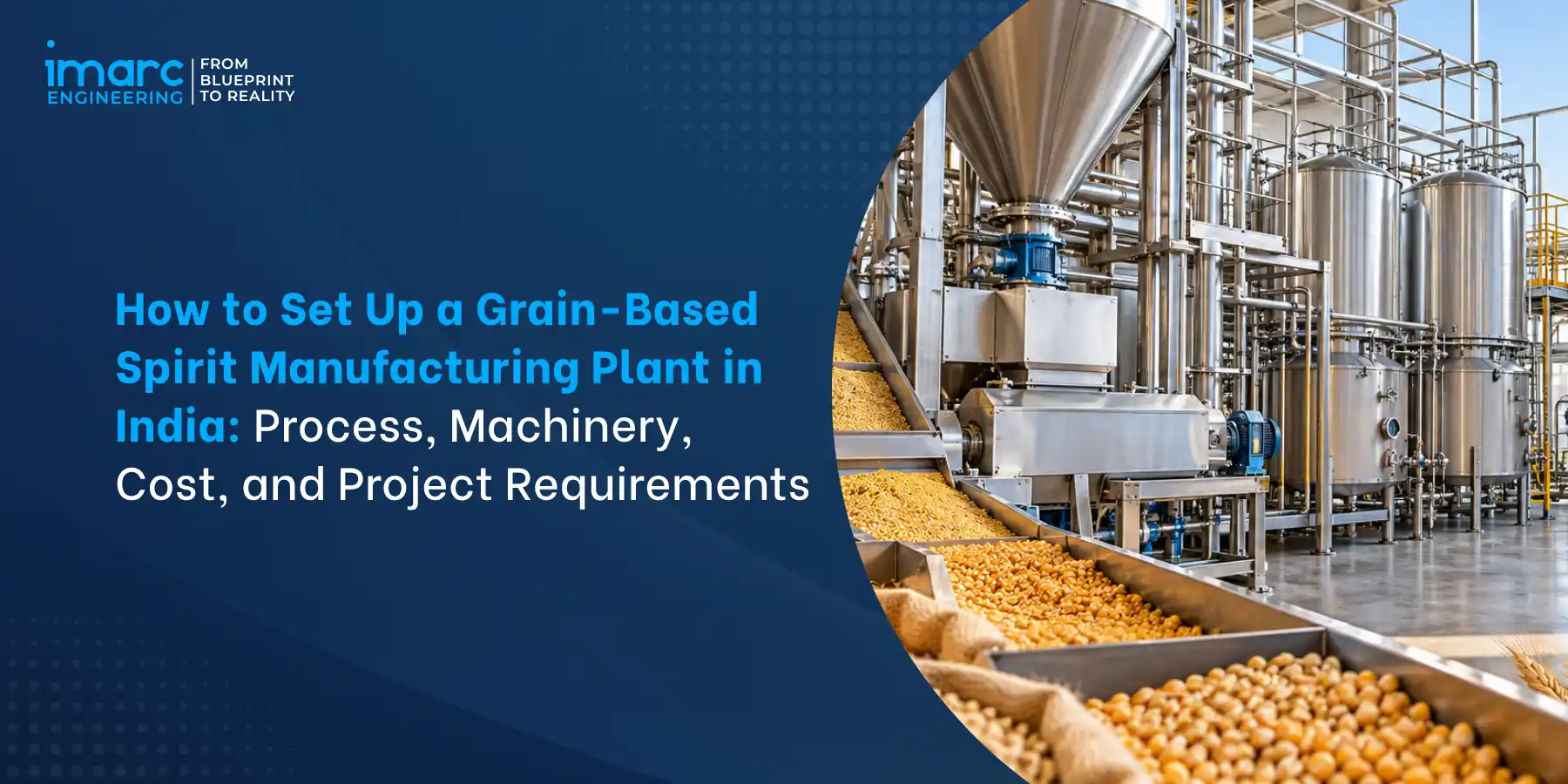
How to Set Up a Grain-Based Spirit Manufacturing Plant in India: Process, Machinery, Cost, and Project Requirements
Introduction
For investors, project sponsors, and distillery operators planning a grain-based spirit manufacturing plant in India, the first design decision is not grain or capacity - it is the intended product. Extra Neutral Alcohol (ENA) at 96 percent v/v per IS 6613:2002, and fuel ethanol are different products with different purities, different downstream users (IMFL, pharma, OMCs), different tax treatments, and different equipment configurations. Starting with the specification clarifies everything that follows.
Scope of the Guide
This guide walks through grain-based spirit project planning from product definition through feedstock selection, process design, machinery, utilities, spent wash management, environmental and safety compliance, regulatory approvals, and project economics. It is written as a project-development framework for a spirit manufacturing plant in India - not a chemistry primer and not a fuel-ethanol guide.
Table of Contents
- Introduction
- Why Grain-Based Spirit Manufacturing Matters for India in 2026
- What a Grain-Based Spirit Manufacturing Plant Can Produce in India
- Grain Feedstock and Raw Material Selection for Grain-Based Spirit Production in India
- Grain-Based Spirit Manufacturing Process from Grain Handling to Rectification in India
- Machinery Equipment and Utility Requirements for Grain-Based Distillery Plant in India
- Spent Wash Management Zero Liquid Discharge and Environmental Compliance in India
- Regulatory Approvals Safety and Project Licences for Grain-Based Distillery Plant in India
- CAPEX OPEX and Project Economics for Grain-Based Spirit Manufacturing Plant in India
- Conclusion
1. Why Grain-Based Spirit Manufacturing Matters for India in 2026
Four drivers make grain-based spirit project planning strategically important for Indian investors in 2026.
1.1 Shift from Molasses to Grain
India's distillery landscape was historically dominated by molasses-based units attached to sugar mills. However, sugar diversion to ethanol under the Ethanol Blending Programme, seasonal molasses availability, and quality consistency challenges have pushed IMFL, pharma, and industrial users toward grain-based spirit manufacturing.
Grain-based ENA offers a more consistent organoleptic profile for premium IMFL, year-round feedstock availability, and valuable DDGS co-product income. Players such as India Glycols, Associated Alcohols, and Globus Spirits have expanded grain-based distillation capacity.
1.2 Regulatory Clarity on Industrial Alcohol
The October 2024 Supreme Court nine-judge bench ruling in State of Uttar Pradesh vs Lalta Prasad Vaish clarified that state governments have constitutional authority to regulate industrial alcohol (ENA, rectified spirit, denatured spirit) under List II Entry 8. This confirms distillery licensing, movement controls, and taxation of industrial alcohol sit with State Excise Departments. From 1 November 2024, undenatured ENA supplied for alcoholic liquor for human consumption was excluded from GST, bringing it under state VAT and excise regimes.
1.3 Demand Across Three End-Use Streams
Grain-based ENA serves three distinct demand streams. First, Indian Made Foreign Liquor (IMFL) - whisky, vodka, gin, rum - uses food-grade ENA as the primary base spirit. Second, pharmaceutical, cosmetic, and personal care industries require high-purity ENA conforming to IS 6613:2002, USP, EP, or BP grades. Third, industrial users (chemicals, flavours, fragrances, solvents) draw from rectified spirit production and ENA grades. These three streams have different quality bars, different regulatory treatments, and different pricing, making product mix a strategic project decision.
1.4 Project Economics and By-Products
A grain-based distillery plant in India economically benefits from DDGS (Distillers Dried Grains with Solubles) as a valuable animal feed co-product (typically 26-32 percent protein), spent wash biogas recovery for in-plant steam, and ZLD-compliant evaporation that recovers process water. Grain-based plants are mandated to achieve Zero Liquid Discharge per CPCB directions, aligning environmental compliance with resource efficiency. By-product monetization through DDGS sales, biogas-fired boiler fuel offset, and recovered CO2 (where captured) significantly influences operating economics.
2. What a Grain-Based Spirit Manufacturing Plant Can Produce in India
Understanding what a grain-based spirit manufacturing plant can produce in India clarifies the product-first design decision that governs downstream processing, equipment selection, and project economics.
2.1 Product Portfolio and Specifications
A grain-based spirit plant can be configured to produce Extra Neutral Alcohol (ENA) at 96 percent v/v minimum at 20°C conforming to IS 6613:2002 (Neutral Spirit for Alcoholic Drinks), country liquor base, denatured spirit (via denaturant addition), and - with molecular sieve dehydration added - anhydrous ethanol. ENA grades for pharma and cosmetics may additionally meet USP, EP, or BP pharmacopoeial specifications.
| Product | Purity | Primary Standard | Typical End-Use |
|---|---|---|---|
| ENA (food grade) | 96% v/v min | IS 6613:2002 | IMFL, country liquor |
| ENA (pharma) | 96% v/v min | IS 6613 + USP/EP/BP | Pharma, cosmetics |
| Denatured Spirit | ENA + denaturant | State SDS rules | Solvents, cleaning |
| Fuel Ethanol | >99.5% anhydrous | IS 15464 | OMC blending (EBP) |
2.2 Why Product Specification Governs Everything
The intended product sets the column configuration, reflux ratios, impurity-stripping stages (heads/fusels/tails removal), condenser design, and storage classification. ENA for premium IMFL demands tighter removal of methanol, aldehydes, higher alcohols, and permanganate-reducing substances than Grade 2 rectified spirit. Fuel ethanol adds molecular sieve dehydration downstream to break the ethanol-water azeotrope at ~96 percent and achieve >99.5 percent anhydrous. Pharma-grade ENA may require additional carbon treatment. Deciding the product mix early prevents expensive retrofit.
2.3 ENA vs Rectified Spirit vs Fuel Ethanol
An ENA manufacturing plant configured for IMFL customers prioritizes organoleptic neutrality and congener removal. A rectified spirit plant for industrial customers prioritizes bulk throughput and cost. A fuel ethanol plant adds dehydration and is governed by OMC supply contracts under the Ethanol Blending Programme - a separate commercial, logistical, and regulatory ecosystem from potable spirits. These three product classes should not be conflated in project planning. A multi-product plant can be designed, but the design must accommodate the highest-grade product requirement from the outset.
3. Grain Feedstock and Raw Material Selection for Grain-Based Spirit Production in India
Understanding grain feedstock and raw material selection for grain-based spirit production in India drives plant utilization, operating cost, and process stability.
3.1 Grain Options and Starch Characteristics
Indian grain-based alcohol manufacturing commonly uses maize (preferred for its high starch content, typically 65 to 72 percent on dry basis), broken rice from parboiling and sortex mills, damaged food grains auctioned by Food Corporation of India (FCI), sorghum, bajra, and wheat. Maize gives highest alcohol yield per tonne and consistent fermentability. Broken rice is cost-effective, but starch content varies by variety. Damaged food grains offer low feedstock cost but need careful cleaning and may show quality variability batch to batch. Multi-grain flexibility built into plant design (common slurry preparation, adjustable milling, separate silos) preserves operating optionality as grain prices and availability shift.
3.2 Delivered Cost Economics
Delivered grain cost - not farmgate cost - drives distillery economics. It includes grain purchase price, freight, loading/unloading, moisture correction, and storage shrinkage. Plant location relative to grain-surplus states (Punjab, Haryana, Uttar Pradesh, Madhya Pradesh, Bihar for maize; coastal states for broken rice) directly affects landed cost. Seasonal grain price variability and FCI damaged-grain auction cycles create procurement timing opportunities. Plants with 60-90 days of grain storage can leverage price arbitrage; plants without storage are exposed to spot volatility.
3.3 Grain Receiving Storage and Cleaning
Grain receiving infrastructure includes truck weighbridge, grain tipping pit, elevators, pre-cleaner (removal of stones, straw, dust), magnetic separator (ferrous metal removal), and conveying to silos. Grain receiving and storage silos are typically concrete or galvanized steel with capacity sized for 15 to 60 days feed (project-specific). Silos include aeration, temperature monitoring, and insect control.
From silos, grain goes to grain cleaning (vibratory screens, destoner) before entering the hammer mill or roller mill for size reduction. Fine milling increases starch exposure for liquefaction but excessive fines complicate downstream separation.
4. Grain-Based Spirit Manufacturing Process from Grain Handling to Rectification in India
Understanding the spirit manufacturing process from grain handling through distillation and rectification clarifies the technology choices and equipment sizing decisions.
4.1 Slurry Liquefaction and Saccharification
Milled grain is mixed with process water in the slurry preparation tank at approximately 25 to 35 percent solids with pH adjustment. Liquefaction uses thermostable alpha-amylase enzyme at 85 to 95°C to hydrolyze starch into dextrins and oligosaccharides. The jet cooker or steam infusion heater raises slurry temperature rapidly to gelatinize starch.
Saccharification then uses glucoamylase enzyme at 60 to 65°C to break dextrins into fermentable glucose. In simultaneous saccharification and fermentation (SSF), glucoamylase is added at the start of fermentation and saccharification occurs alongside yeast activity, reducing residence time and capital cost.
4.2 Yeast Propagation and Fermentation
Yeast propagation cultures Saccharomyces cerevisiae yeast in sterile nutrient broth, scaled up through seed and propagation vessels before transfer to the main fermenter. Fermentation occurs in large stainless-steel fermenters (typically 500 to 3,000 m3) at 30 to 32°C for 36 to 72 hours depending on substrate, yeast strain, and target gravity.
Yeast converts glucose into ethanol and CO2 (approximately 51 percent ethanol by mass stoichiometrically; actual yields are lower due to yeast metabolism and side reactions). Finished beer typically contains 10 to 14 percent v/v alcohol along with yeast, unfermented sugars, grain solids, and congeners. CO2 is often scrubbed and vented, or captured for food-grade or industrial sale where economics support.
4.3 Distillation and Rectification
Distillation strips alcohol from beer and progressively purifies it through multiple columns. The beer (analyzer) column vaporizes alcohol from fermented beer; the bottoms (whole stillage) go to spent wash handling. The extractive distillation column uses water as an extractive solvent to remove head impurities (methanol, acetaldehyde, ethyl acetate) and tail impurities.
The rectification column concentrates ethanol to 95-96 percent v/v. Additional purification columns (hydro-selection, demethylizer, fusel oil decanter) strip specific congeners to meet ENA specifications. The number of columns, their diameter and height, reflux ratios, and tray count depend on the target product purity and throughput.
4.4 ENA and Rectified Spirit Finishing
Finished Extra Neutral Alcohol (ENA) at 96 percent v/v is tested for compliance with IS 6613:2002 parameters - ethanol content, non-volatile matter, acidity, aldehydes (as acetaldehyde), esters (as ethyl acetate), higher alcohols (fusel oil), methyl alcohol, furfural, and permanganate decolorization time (minimum 30 minutes).
Finished product moves to storage tanks (SS 304/316L construction) in a hazardous-area-classified tank farm. Fuel ethanol applications require an additional molecular sieve or extractive distillation stage downstream to remove the remaining water and reach >99.5 percent anhydrous ethanol, followed by denaturant addition per OMC supply specification.
5. Machinery Equipment and Utility Requirements for Grain-Based Distillery Plant in India
Understanding machinery equipment and utility requirements for grain-based distillery plant in India clarifies the equipment list that drives CAPEX and the utility planning that drives OPEX.
5.1 Grain Handling and Mash Preparation Equipment
Grain handling equipment includes truck tipping station, pre-cleaner, elevators, conveyors, silos (concrete or GI), magnetic separators, destoners, and vibratory screens. Milling uses hammer mill (coarser) or roller mill (finer) depending on process preference.
Slurry preparation includes slurry tank with agitator, pH-adjustment dosing, jet cooker or steam infusion heater, liquefaction tank, and heat recovery exchangers. Enzyme dosing systems meter alpha-amylase and glucoamylase at specified units per gram of starch. Material of construction is typically carbon steel for slurry handling and stainless-steel SS 304 or SS 316L for process vessels in contact with hot wort.
5.2 Fermentation and Distillation Equipment
Fermentation equipment includes yeast propagation vessels (seed, pre-fermenter), main fermenters with cooling coils or external heat exchangers (to maintain 30-32°C), CIP (clean-in-place) systems, and CO2 collection manifold. Grain distillery machinery for distillation includes the beer (analyzer) column, extractive distillation column, rectification column, hydro-selection column (for ENA), demethylizer, condensers, reboilers, heat exchangers, reflux drums, fusel oil decanter, and column controls.
Columns are typically stainless steel with sieve or valve trays. Height can exceed 25 to 40 meters for high-purity ENA production. Supporting equipment includes vacuum pumps, process pumps (centrifugal, positive displacement), and inline analyzers (densitometer, GC for impurities).
5.3 Storage and Hazardous Area Infrastructure
Alcohol storage tanks are vertical cylindrical SS 304 or SS 316L tanks sized for 7 to 30 days finished product inventory with pressure/vacuum relief valves, flame arresters, level transmitters, and inert nitrogen blanketing. Tank farm bunding retains 110 percent of largest tank volume. Hazardous area classification per IS/IEC 60079 designates zones (Zone 0, 1, 2) around tanks, loading bays, and fermentation vents based on explosive atmosphere probability.
All electrical equipment in classified zones must be certified flameproof (Ex d) or increased safety (Ex e) per PESO requirements. Earthing, bonding, and lightning protection are mandatory. Fire safety includes foam flooding systems, fire hydrants, deluge systems, portable extinguishers, fire pumps, and detection per NBC 2016 Part 4.
5.4 Utilities Steam Power and Water
Utility requirements depend on capacity, process technology, and spent wash management choice. Steam is generated by a boiler (biomass, coal, or biogas from spent wash biomethanation) at 10-21 bar - delivered to columns, mash heating, and evaporators. Cooling water from a cooling tower serves fermenters, condensers, and process coolers.
DM water is used for process steam. Process water comes from borewells, municipal supply, or treated recycled water (ZLD recovery). Power covers mills, pumps, agitators, and cooling tower fans - met from grid with DG backup. Compressed air serves instrumentation. Indicative utility figures depend on product, grain, capacity, and configuration - project-specific benchmarking is essential.
6. Spent Wash Management Zero Liquid Discharge and Environmental Compliance in India
Understanding spent wash management zero liquid discharge and environmental compliance in India is essential - distilleries are classified under CPCB's 17 most polluting (Red Category) industries and face mandatory ZLD plus OCEMS.
6.1 Spent Wash and Stillage Characteristics
Spent wash (also called whole stillage) is the aqueous residue from the beer column after alcohol stripping. For grain-based alcohol plant configurations, spent wash contains unfermented sugars, grain fibre, protein, dead yeast cells, and dissolved organics. BOD and COD loads are very high (grain spent wash typically lower than molasses but still in the thousands to tens of thousands of mg/L range - project-specific).
Decanters separate whole stillage into wet cake (solids) and thin stillage (liquid). The wet cake is dewatered further; the thin stillage is evaporated to syrup; wet cake plus syrup is dried to produce DDGS (Distillers Dried Grains with Solubles) animal feed.
6.2 DDGS Evaporation and By-Product Recovery
DDGS production turns a pollution liability into a saleable co-product. DDGS typically contains 26-32 percent protein and sells to the poultry, dairy cattle, and aqua feed market. Evaporation of thin stillage uses multi-effect evaporators (MEE, typically 3-5 effects) or mechanical vapour recompression (MVR) for steam efficiency.
Dryers (rotary, ring, or disc) remove the final moisture to produce DDGS at 10-12 percent moisture suitable for storage and transport. Spent wash biomethanation (anaerobic digestion) captures biogas (methane) that can fire the boiler, offsetting fossil fuel steam cost. This integrated by-product strategy underpins the economic viability of mandatory ZLD compliance.
6.3 Zero Liquid Discharge Mandate
The zero liquid discharge (ZLD) mandate for distilleries derives from CPCB directions issued in 2015 under Section 18(1)(b) of the Water Act 1974, directing that no distillery effluent shall be discharged to land or water bodies. CPCB's Charter for ZLD in Molasses-Based Distilleries established the framework that has been applied to grain-based distilleries.
Compliance requires integrated spent wash management - evaporation, biomethanation, condensate polishing, RO recovery, and incineration where needed. SPCBs verify ZLD compliance through surveillance, water balance audits, and OCEMS data.
6.4 OCEMS CTE CTO and SPCB Compliance
Online Continuous Effluent Monitoring System (OCEMS) is mandatory for distilleries as a Red Category industry under CPCB 2014 directions. OCEMS parameters typically include pH, BOD, COD, TSS, and flow - with real-time data transmission to CPCB and SPCB portals. Effluent treatment includes multi-effect evaporators, biomethanation reactors, condensate stripper, RO units, and residue management.
State Pollution Control Board (SPCB) Consent to Establish (CTE) under Water Act 1974 and Air Act 1981 is required before construction; Consent to Operate (CTO) is required before commissioning. Air emissions (boiler stack, DDGS dryer, process vents) are controlled per prescribed norms with periodic monitoring and annual Form V returns to SPCB.
7. Regulatory Approvals Safety and Project Licences for Grain-Based Distillery Plant in India
Understanding regulatory approvals safety and project licences for grain-based distillery plant in India is central to project schedule and feasibility.
7.1 State Excise Distillery Licence
Following the October 2024 Supreme Court Lalta Prasad ruling, State Excise Departments hold constitutional authority to regulate industrial alcohol production. The distillery licence is issued by the State Excise Commissioner's office under the respective state's Excise Act and Distillery Rules. Licence categories vary by state - D-2 for distillery in Himachal Pradesh, PD-2 in Uttar Pradesh, and similar in others. Associated licences include storage licence, wholesale/transport permits, and bonded warehouse approvals. Letter of Intent (LOI) is typically issued first, followed by distillery licence after commissioning. State excise officers are stationed at distilleries for duty assessment and quality checks.
7.2 Environmental Clearance CTE CTO
Environmental Clearance (EC) under EIA Notification 2006 applies to distilleries. Most distilleries fall under Category B (SEIAA appraisal) with public consultation, EIA report, and SEIAA approval - typically taking 12 to 24 months. SPCB CTE under Water Act 1974 and Air Act 1981 is required before construction, specifying ETP design, air pollution control, and ZLD plan. CTO is required before commissioning. Pollution control compliance includes periodic self-monitoring, OCEMS real-time reporting, and Form V annual returns. CTO validity is typically 5 years, subject to compliance performance.
7.3 Factory Licence and Labour Compliance
Factory licence is issued by the state Chief Inspector of Factories under the Occupational Safety, Health and Working Conditions (OSH) Code 2020 - which replaced the Factories Act 1948 effective 21 November 2025. All four Labour Codes (Code on Wages 2019, IR Code 2020, Code on Social Security 2020, OSH Code 2020) are now in force.
Labour compliance includes monthly PF and ESI contributions, appointment letters, uniform wage definitions, statutory registers, and periodic returns. Central and state rules under the Labour Codes are being finalised through 2026 (Gujarat, Karnataka, Haryana, Madhya Pradesh, Maharashtra, Arunachal Pradesh have notified final rules).
7.4 PESO Fire NOC and Hazardous Area Compliance
Ethyl alcohol is Class A petroleum (flash point below 23°C) under the Petroleum Act 1934 and Petroleum Rules 2002, administered by PESO. PESO licence covers alcohol storage design (tank specifications, bunding, distance rules), filling operations, and transport. MSIHC Rules 1989 apply where threshold quantities are exceeded, requiring notification, safety data sheets, and emergency plans.
Fire NOC is issued by the state fire department per NBC 2016 Part 4. Hazardous area classification per IS/IEC 60079 governs electrical equipment in classified zones. Explosive atmosphere management includes nitrogen inerting and emergency isolation valves.
7.5 Product Standards and Food Safety
Finished product testing to IS 6613:2002 (ENA) is performed by the plant QC laboratory with periodic third-party verification. Food-grade ENA destined for IMFL manufacture requires compliance with Food Safety and Standards Act 2006 - the IMFL manufacturer typically holds the FSSAI licence, but the ENA supplier operates under GMP conditions ensuring food-grade purity.
Pharma-grade ENA for pharmaceutical use requires compliance with Indian Pharmacopoeia (IP), USP, EP, or BP standards and WHO-GMP equivalent manufacturing conditions. GST treatment post-November 2024: undenatured ENA supplied for alcoholic liquor for human consumption is outside GST (under State VAT/Excise); industrial, pharma, and cosmetic ENA remains under GST.
8. CAPEX OPEX and Project Economics for Grain-Based Spirit Manufacturing Plant in India
Understanding CAPEX OPEX and project economics for grain-based spirit manufacturing plant in India requires product-first, capacity-indexed, and configuration-specific analysis - universal numbers are misleading.
8.1 CAPEX Drivers
Grain-based distillery CAPEX depends on plant capacity (KLPD), feedstock flexibility (single-grain vs multi-grain), process configuration (number of distillation and rectification columns), spent wash management route (biomethanation + evaporation, incineration boiler, or hybrid), DDGS drying systems, utility specifications, automation level, site conditions, land cost, and location-specific regulatory requirements.
Major CAPEX line items include grain receiving and storage, milling and slurry, fermentation, distillation and rectification, spent wash management, DDGS section, utilities, alcohol storage tank farm with hazardous area infrastructure, ETP, electrical, instrumentation, civil, piping, and site development.
8.2 OPEX Drivers
OPEX for a spirit production facility is dominated by grain cost (typically the single largest line item), followed by utilities (steam, power, water), enzymes and yeast, chemicals (process and ETP), manpower, maintenance, consumables, and overheads. By-product credits from DDGS sales and biogas-fired boiler savings offset substantial OPEX. State excise duty, licence fees, and administrative costs are state-specific.
Grain procurement strategy (spot vs contract vs FCI auction) delivered cost volatility, DDGS market pricing, and spent wash management choice all swing operating economics. Benchmarking OPEX per bulk litre of ENA against industry comparables helps evaluate project competitiveness.
8.3 Project Feasibility and Commissioning
Project feasibility for a grain-based distillery evaluates product-market fit (ENA vs RS vs mix), customer identification (IMFL majors, pharma, industrial users), grain belt proximity, water availability, power infrastructure, land suitability, environmental category, state excise regime, and competitive landscape. Project schedule from DPR approval to commissioning typically runs 24-36 months depending on EC timeline, land/approvals, and construction scope.
Commissioning includes pre-commissioning (equipment inspection, hydrotests, calibration), cold commissioning (water trials, utilities), hot commissioning (steam, process heating), and production ramp-up to stable rated capacity. Early fermentation batches may require yeast adaptation and column tuning before consistent ENA quality is achieved.
8.4 Project Risks and Mitigations
| Risk Area | Illustrative Risk | Mitigation Lever |
|---|---|---|
| Grain supply | Price spike, quality variability | Multi-grain plant, storage buffer |
| Spent wash | ZLD compliance gap | MEE + biogas + ETP integration |
| Regulatory | EC delay, state licence timeline | Early scoping, state engagement |
| Safety | Fire, explosion risk | PESO compliance, HAC per IS 60079 |
| Market | ENA price volatility | Contract customers (IMFL, pharma) |
| Utility | Power/water constraints | DG backup, DM plant, water audit |
Conclusion
Setting up a grain-based spirit plant in India in 2026 requires a product-first approach. Define the output, such as ENA, rectified spirit, or a multi-product mix, as this determines process design, equipment, utilities, quality systems, and regulatory requirements. Key considerations include grain feedstock, fermentation and distillation, steam, cooling, power and water, spent-wash management, by-product recovery, fire safety, statutory approvals, and project economics. Viability should be assessed against grain costs, DDGS revenue, water availability, and the state excise regime.
Sponsors should keep three factors in focus. Product specifications drive capital, operating, and compliance requirements. ZLD, OCEMS and spent-wash management requirements should be integrated into the plant design where applicable. Finally, state-specific excise rules, feedstock availability, utilities, and location can significantly affect project viability. All benchmarks should be validated against the project's product mix, capacity, feedstock, technology, and location.
PLANNING A GRAIN-BASED SPIRIT MANUFACTURING PLANT IN INDIA?
IMARC Engineering supports grain-based spirit and distillery projects with product and feedstock strategy, process and equipment selection, utility planning, spent-wash and DDGS management, regulatory approvals, CAPEX/OPEX benchmarking, DPR preparation, commissioning, and ramp-up advisory.
→ Schedule a free grain-based distillery project scoping consultation with an IMARC specialist
Frequently Asked Questions
A grain-based spirit manufacturing plant in India uses maize, broken rice, or damaged food grains to produce Extra Neutral Alcohol (ENA, 96% v/v per IS 6613:2002), and country liquor base through fermentation, distillation, and multi-column rectification into finished spirit products.
Grain-based spirit production in India commonly uses maize (preferred for its high starch content), broken rice from parboiling and sortex mills, damaged food grains auctioned by FCI, sorghum, bajra, and wheat. Grain selection depends on starch content, delivered cost, moisture, availability, logistics, and seasonal variability.
The spirit manufacturing process covers grain receiving and cleaning, milling, slurry preparation, liquefaction with alpha-amylase, saccharification with glucoamylase, yeast fermentation (36-72 hours), beer distillation, and multi-column rectification stripping heads/fusels/tails to produce ENA at 96 percent v/v per IS 6613:2002.
A grain-based distillery machinery list includes grain silos, grain cleaner, hammer mill, slurry tank, liquefaction and saccharification vessels, fermenters, beer column, extractive distillation column, rectification column, condensers, heat exchangers, ENA tanks, boiler, cooling tower, DM water plant, and decanters/evaporators for DDGS and spent wash handling.
Plant capacity (KLPD of ENA) directly drives grain throughput, equipment sizing (fermenters, columns), steam/power/water demand, grain silo volume, alcohol storage capacity, and spent wash evaporation. Larger KLPD plants achieve better specific utility consumption but need higher CAPEX, logistics, and tighter environmental and safety compliance infrastructure.
ENA is a highly purified neutral spirit used for applications such as alcoholic beverages and, subject to applicable specifications, pharmaceutical or cosmetic uses; rectified spirit has different purity and quality specifications depending on its intended use; fuel ethanol is anhydrous ethanol produced to the applicable specification for petrol blending.
The spirit manufacturing plant cost in India depends on KLPD capacity, feedstock flexibility (single vs multi-grain), process configuration (number of distillation columns), spent wash management (biogas, incineration boiler, evaporation, or ZLD), utility specifications, land location, state excise regime, and automation level driving CAPEX and OPEX.
Grain-based distillery setup in India requires steam (boiler), cooling water, DM water, power, compressed air; mandatory ZLD per CPCB, OCEMS for Red category; PESO storage licence under Petroleum Rules 2002; Fire NOC per NBC 2016; factory licence under OSH 2020; and State Excise distillery licence.
Recent Post
Trusted by Industry Leaders
We partner with global enterprises and ambitious businesses across sectors to deliver operational excellence, strategic insights, and sustainable growth through integrated solutions.








Success in Their Words
Real feedback from clients across industries. Discover how our solutions delivered measurable impact and operational excellence.

I wanted to express my sincere appreciation for your efforts in handling this matter. Your dedication and commitment have been truly commendable, and it is evident that you have put in tremendous hard work and expertise into resolving the issues at hand. We are greatly interested in continuing our collaboration with you in the future, as your professionalism and reliability have made you a trusted partner. Thank you once again for your invaluable contribution. We look forward to strengthening our partnership ahead.

It has been a pleasure working with the IMARC team. The insights provided were structured, clear, and highly valuable, helping us strengthen both our technical and financial planning with confidence. We deeply appreciate the team’s professionalism, responsiveness, and attention to detail throughout the engagement. Every requirement was well understood and effectively incorporated, resulting in a comprehensive and actionable output. Overall, our experience has been excellent, and I would gladly recommend IMARC to organizations seeking a reliable research partner.

Your service is truly exceptional. Working with the IMARC team has been a seamless and professional experience. The clarity of communication, responsiveness to queries, and consistent support at every stage made the entire engagement highly efficient. The insights shared were well-structured, practical, and perfectly aligned with our requirements, helping us make informed decisions with confidence. Overall, the dedication and professionalism demonstrated by your team stand out, and I would be glad to recommend IMARC as a reliable and trustworthy research partner.

IMARC did an outstanding job in preparing our study. They were punctual, precise, and consistently responsive throughout the entire process. The team delivered all the data we required in a clear, well-organized, and highly professional format. Their strong attention to detail, combined with their ability to meet every deadline without compromising quality, truly set them apart. Overall, their reliability and commitment made them an exceptional partner for our project, and we would gladly work with them again in the future.

IMARC made the whole process incredibly easy from start to finish. Everyone I interacted with via email was polite, professional, and straightforward to deal with, always keeping their promises regarding delivery timelines and remaining consistently solutions-focused. From my very first contact, I appreciated the professionalism and support shown by the entire IMARC team. I highly recommend IMARC to anyone seeking timely, affordable, and reliable information or advice. My experience with IMARC was excellent, and I truly cannot fault any aspect of it.

I’d like to express my sincere gratitude for the excellent work you accomplished with the study. Your ability to quickly understand our requirements and deliver high-quality results under tight timelines truly reflects your expertise, exceptional work ethic, and unwavering commitment to your customer’s success. The professionalism and responsiveness you demonstrated throughout the process made a significant difference. Our entire team and company are incredibly thankful for your dedication, reliability, and support. Once again, thank you for your outstanding contribution.