Manufacturing
October 01 2026
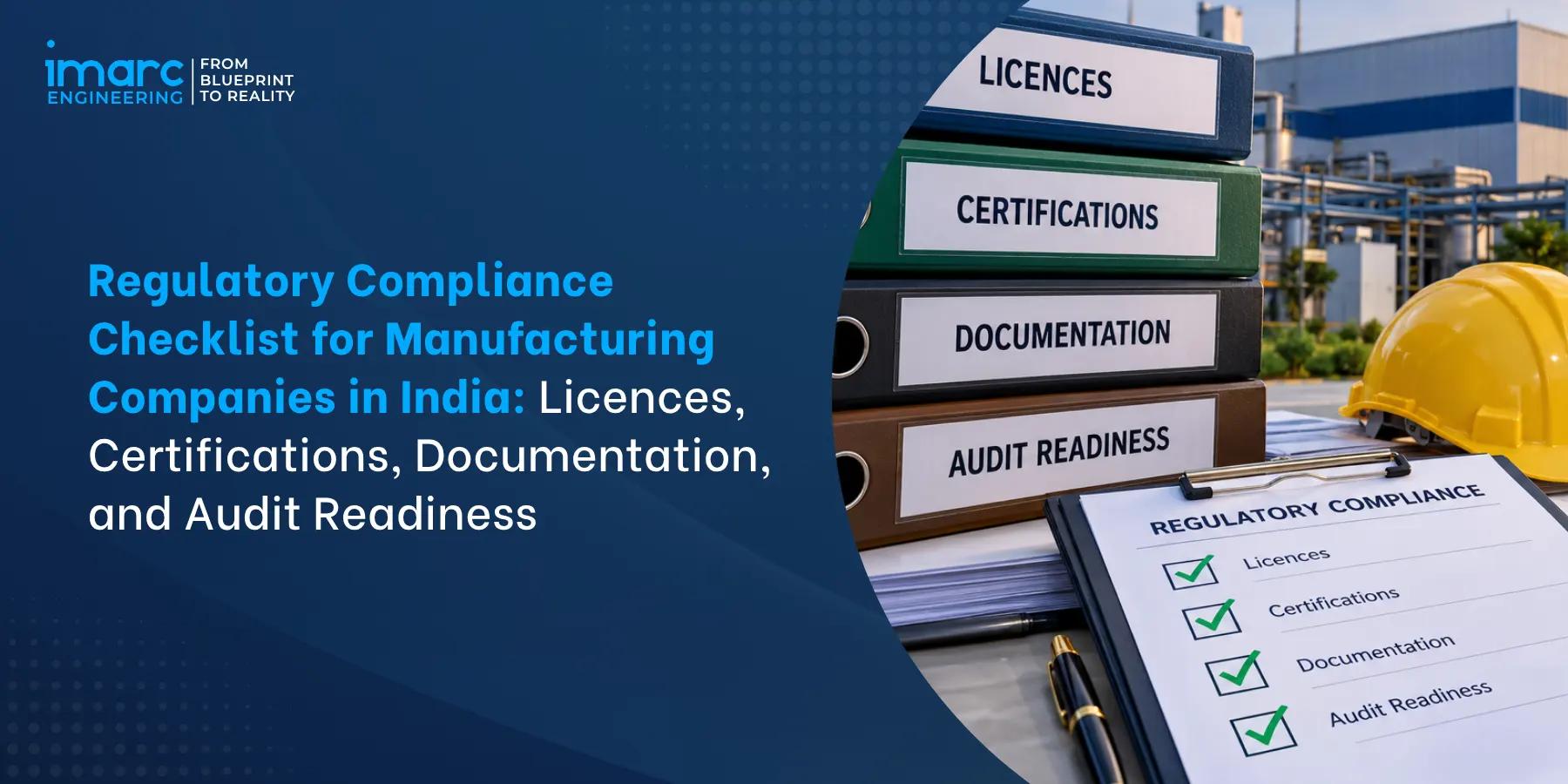
Regulatory Compliance Checklist for Manufacturing Companies in India: Licences, Certifications, Documentation, and Audit Readiness
Introduction
For manufacturers, plant heads, and compliance officers building or operating facilities in India, a practical manufacturing compliance checklist India is the operating discipline that keeps factory licences current, environmental clearances live, labour codes honoured, product certifications valid, and inspection responses defensible. India's regulatory landscape shifted meaningfully in November 2025 when all four Labour Codes came into force, replacing 29 legacy labour laws including the Factories Act 1948 - making an updated compliance framework essential for every manufacturing plant.
Scope of this Guide
This guide answers the manufacturer's core question directly. What should a compliance checklist for manufacturing company cover across licences, environmental permissions, fire and EHS, labour, product certifications, QMS documentation, equipment qualification, audits, and ongoing renewals? It walks through applicable regulatory frameworks, factory approvals, environmental compliance, fire and labour requirements, industry-specific certifications, quality documentation, equipment qualification (IQ/OQ/PQ), compliance gap assessments, inspection readiness, and renewal tracking - anchored to a lifecycle rather than one-time approach.
Table of Contents
- Introduction
- Why Manufacturing Compliance Matters for India in 2026
- What a Manufacturing Compliance Checklist is and Why It Matters in India
- Licences and Factory Approvals for Manufacturing Companies in India
- Environmental and Pollution Control Compliance for Factories in India
- Fire Safety EHS and Labour Compliance for Manufacturing Companies in India
- Product Certifications and Industry-Specific Regulatory Requirements in India
- QMS Documentation SOPs and Validation for Manufacturing Compliance in India
- Compliance Audits Gap Assessments and Inspection Readiness in India
- Conclusion
1. Why Manufacturing Compliance Matters for India in 2026
Four drivers make disciplined manufacturing compliance strategically important for plant sponsors, operations heads, and compliance officers in 2026.
1.1 Labour Code Transition
India's most significant regulatory transition took effect on 21 November 2025 when all four Labour Codes became effective law. Together they replace 29 central labour laws including the Factories Act 1948, Contract Labour Act 1970, EPF Act 1952, ESI Act 1948, and Industrial Disputes Act 1947.
Central and state rules are being finalised through 2026 (Gujarat, Karnataka, Haryana, Madhya Pradesh, Maharashtra, and Arunachal Pradesh have notified final rules). This affects every factory compliance checklist India - factory licence terminology, wage definitions, working hour flexibilities, safety committee obligations, and social security coverage.
1.2 Expanding Regulatory Perimeter
Beyond labour, the manufacturing regulatory requirements India landscape continues expanding. BIS mandatory certification now covers over 679 product categories, with recent additions including furniture, smart meters, PV solar modules, lithium-ion batteries for EV, and gas appliances. Battery Waste Management Rules 2022 and revised E-Waste Rules 2022 introduced EPR obligations. Business Responsibility and Sustainability Reporting (BRSR) applies to top 1,000 listed companies. State pollution control boards have tightened effluent norms and OCEMS requirements. Product-specific frameworks (FSSAI for food, CDSCO for pharma/medical devices, Legal Metrology for packaged goods) continue evolving.
1.3 Inspection and Enforcement
Enforcement intensity has meaningfully increased. State factory inspectors conduct scheduled and surprise inspections under OSH Code 2020 provisions. State Pollution Control Boards audit CTE/CTO compliance with real-time monitoring via OCEMS for red-category units. BIS conducts factory audits under ISI Mark surveillance.
FSSAI carries out food safety audits. CDSCO inspects pharmaceutical and medical device manufacturing sites. Labour departments verify wage payments, PF/ESI contributions, and statutory register maintenance. GST authorities audit input tax credits. Non-compliance costs include monetary penalties, licence suspension or cancellation, production stoppage, product recalls, criminal liability for occupiers, and reputational damage.
1.4 Cost of Poor Compliance
Poor compliance carries meaningful cost. Missing or expired factory licences invalidate insurance and expose occupiers to criminal liability. Environmental non-compliance triggers CPCB/SPCB directions, production suspension, and bank guarantee forfeiture. Labour Code violations attract Section-specific penalties. Product certification lapses block market access and trigger recalls. GST/EPF/ESI defaults create liability with interest and penalties. Integrated compliance discipline reduces regulatory risk and preserves operational continuity.
2. What a Manufacturing Compliance Checklist is and Why It Matters in India
Understanding what a manufacturing compliance checklist is and why it matters in India establishes the lifecycle framework for informed compliance decisions.
2.1 Compliance Checklist Definition
A manufacturing compliance checklist is a systematic lifecycle framework covering every applicable regulatory obligation across a manufacturing facility's setup, commissioning, operation, expansion, and renewal phases. It is not a one-time licence exercise - it is a living document tracking pre-establishment approvals, operational licences, periodic filings, renewal timelines, statutory registers, product certifications, quality documentation, equipment qualification, employee training, waste manifests, audit reports, and CAPA logs. Well-designed checklists distinguish always-applicable requirements from industry-specific obligations (FSSAI, CDSCO, BIS QCOs) and location-specific approvals (SPCB category, EIA applicability, PESO).
2.2 Lifecycle Phases
| Phase | Focus | Illustrative Approvals |
|---|---|---|
| Pre-establishment | Land, incorporation, SPCB CTE | Land conversion, CIN, CTE |
| Construction | Building plan, EIA, PESO | EC, building plan approval |
| Commissioning | Utility, safety, licences | CTO, factory licence, Fire NOC |
| Operation | Filings, records, audits | Statutory returns, EPR, audits |
| Expansion | Modified consents, new approvals | Amended CTE/CTO, additional EC |
| Renewal | Periodic revalidation | Licence renewals, EPR renewal |
2.3 Scope Determinants
The scope of a compliance checklist for manufacturing company depends on multiple factors. Industry sector (pharma, food, chemicals, textiles, electronics, automotive) determines industry-specific licences. Product profile decides BIS QCO applicability, FSSAI/CDSCO/Legal Metrology triggers, and export compliance.
Manufacturing process (hazardous vs non-hazardous, batch vs continuous) drives environmental category, fire load, and worker safety framework. Plant location determines SPCB jurisdiction, state labour rules, and municipal approvals. Workforce size drives PF/ESI and welfare obligations. Target market (domestic vs export) triggers additional certifications (CE, UL, FDA, EU-GMP).
3. Licences and Factory Approvals for Manufacturing Companies in India
Understanding licences and factory approvals for manufacturing companies in India covers the foundational permissions every plant must secure before commissioning and maintain through operation.
3.1 Establishment and Land Approvals
Pre-establishment approvals include company incorporation under Companies Act 2013 (Certificate of Incorporation with CIN), land conversion from agricultural to industrial (state revenue authority) where applicable, and industrial plot allotment from state industrial development corporation or approved industrial park.
Building plan approval from local municipal or industrial authority is required before construction. GST registration under CGST/SGST Act 2017 is mandatory once turnover thresholds are met. IEC (Import Export Code) is required for exports/imports. MSME Udyam registration provides classification and access to MSME benefits.
3.2 Factory Licence Under OSH Code 2020
The factory licence is the cornerstone approval for manufacturing operations. Following the OSH Code 2020 effective from 21 November 2025, factory licences are issued by state Chief Inspector of Factories offices under the OSH Code framework (which subsumes the Factories Act 1948). Applicability thresholds: 20+ workers with power or 40+ workers without power (state rules may vary).
The application requires factory plan, fire safety certificate, safety officer appointment for larger units, and worker welfare provisions. Licence is typically valid 1-5 years depending on state rules. State rules under OSH Code are being finalised through 2026.
3.3 Consent to Establish and Consent to Operate
Environmental approvals are administered by the State Pollution Control Board (SPCB) under Water (Prevention and Control of Pollution) Act 1974 and Air (Prevention and Control of Pollution) Act 1981. Consent to Establish (CTE) is required before construction begins - covering site suitability, effluent treatment plan, air pollution control equipment, and hazardous waste handling arrangement.
Consent to Operate (CTO) is required before starting production - verifying constructed pollution control equipment, monitoring systems, and compliance with prescribed standards. Industry category (Red, Orange, Green, White) determines validity period (typically 5 years for green, shorter for red category). Red category units require Online Continuous Emission Monitoring System (OCEMS) reporting to CPCB.
3.4 Environmental Clearance
Environmental Clearance (EC) under Environment (Protection) Act 1986 and EIA Notification 2006 is required for projects listed in the notification's schedule crossing capacity or investment thresholds. Category A projects (larger or more polluting) require appraisal by Ministry of Environment, Forest and Climate Change (MoEFCC) at central level.
Category B projects go to State Environment Impact Assessment Authority (SEIAA). The EIA process includes screening, scoping, public consultation, EIA report preparation, and appraisal - typically 12-24 months for greenfield industrial projects. EC is site-specific and modifications to production capacity or process require amended clearance.
4. Environmental and Pollution Control Compliance for Factories in India
Understanding environmental and pollution control compliance for factories in India covers ongoing obligations across water, air, waste, and reporting after CTE/CTO are secured.
4.1 Effluent and Emission Control
Effluent Treatment Plant (ETP) design must meet CPCB effluent norms (industry-specific standards for parameters such as BOD, COD, TSS, pH, heavy metals). Zero Liquid Discharge (ZLD) may be mandatory for water-intensive or heavily polluting industries per SPCB direction. Air emission control includes stack monitoring, ambient air quality monitoring, and specific pollutant control (SPM, SO2, NOx, VOC). Pollution control compliance requires periodic self-monitoring, third-party monitoring reports, annual returns to SPCB, and consent conditions adherence. Red category units maintain OCEMS with real-time data to CPCB portal.
4.2 Hazardous and Non-Hazardous Waste
Hazardous waste generation requires SPCB authorization under Hazardous and Other Wastes (Management and Transboundary Movement) Rules 2016. Occupier obligations include manifest system (Form 10) for waste movement, storage on impermeable surfaces, disposal at authorized Treatment, Storage, and Disposal Facility (TSDF), and annual returns (Form 4).
Environmental compliance extends to solid waste, bio-medical waste, plastic waste, and construction and demolition waste. Producers, importers, and brand owners have EPR obligations under Plastic Waste, E-Waste (2022 Rules), and Battery Waste Management Rules 2022. EPR registration with CPCB is mandatory with annual returns and targets.
4.3 Emerging Reporting Obligations
Business Responsibility and Sustainability Reporting (BRSR) is mandatory for top 1,000 listed companies under SEBI (LODR) Regulations, with BRSR Core assured reporting expanding progressively. Manufacturers increasingly face customer-driven ESG disclosures, GHG emissions inventory, water accounting, and supplier code compliance. Voluntary certifications (ISO 14001 EMS, ISO 50001 EnMS) support customer requirements and financing conditions.
5. Fire Safety EHS and Labour Compliance for Manufacturing Companies in India
Understanding fire safety EHS and labour compliance for manufacturing companies in India covers worker protection and operational safety obligations across every plant.
5.1 Fire Safety and Fire NOC
Fire NOC is issued by the state fire department under respective state fire prevention rules aligned to National Building Code (NBC) 2016 Part 4 (Fire and Life Safety). Requirements cover fire detection (smoke/heat/flame detectors), suppression (sprinklers, hydrants, extinguishers), compartmentalization, escape routes, refuge areas, emergency lighting, and public address systems - scaled to occupancy classification and fire load.
Manufacturing occupancies typically fall under Group G (industrial). Hazardous processes (flammable chemicals, dust explosion risk) trigger additional PESO requirements. Fire NOC requires drill records, extinguisher servicing, and pump testing evidence.
5.2 PESO and Hazardous Materials
Petroleum and Explosives Safety Organisation (PESO) approvals apply where hazardous chemicals are stored or used. Manufacture, Storage and Import of Hazardous Chemicals (MSIHC) Rules 1989 require notification and safety data sheets for listed chemicals. Petroleum Rules 2002 govern petroleum product storage above threshold quantities.
Explosives Rules 2008 apply to explosive materials and pyrotechnics. Gas Cylinders Rules 2016 govern cylinder handling. Compliance includes storage licence, distance rules, safety audits, emergency response plans, and worker training. On-Site Emergency Plan and Off-Site Emergency Plan are required for MAH (Major Accident Hazard) installations.
5.3 Occupational Health and Safety
Under the OSH Code 2020, occupational health and safety obligations include safety committee formation (workforce-based threshold), safety officer appointment for larger units, safe operating procedures, personal protective equipment (PPE), machine guarding, permit-to-work systems (hot work, confined space, working at height), incident investigation and reporting, and welfare facilities (canteen, drinking water, restrooms, first-aid).
Annual health check-ups are mandated for workers above prescribed age (age to be notified). Workplace safety documentation includes risk assessments, safe operating procedures, incident logs, near-miss reporting, safety training records, and welfare facility maintenance. Voluntary ISO 45001:2018 OHS management system certification supports systematic safety management.
5.4 Labour Compliance Under Four Codes
Labour compliance under the four Labour Codes covers wages (Code on Wages 2019 - uniform wage definition capping allowances at 50 percent of total pay, minimum wages, appointment letters), industrial relations (IR Code 2020 - standing orders for 300+ workers, grievance redressal, retrenchment procedures), social security (Code on Social Security 2020 - PF/ESI, gratuity, maternity benefit, gig worker coverage), and occupational safety (OSH Code 2020 - factory licence, working hour limits, contract labour thresholds). Employer obligations include monthly PF and ESI contributions, TDS on wages, statutory registers, and periodic returns.
6. Product Certifications and Industry-Specific Regulatory Requirements in India
Understanding product certifications and industry-specific regulatory requirements in India covers the sector-specific and product-specific frameworks that apply beyond general manufacturing compliance.
6.1 BIS Product Certification
The BIS certification framework under BIS Act 2016 operates through Quality Control Orders (QCOs) that make specific Indian Standards mandatory. Two main routes: ISI Mark (Scheme I) for industrial and household products with factory audit plus surveillance (licence renewable every 2 years); and Compulsory Registration Scheme (CRS, Scheme II) administered via MeitY for electronics and IT products with laboratory testing (registration valid 2 years). Over 679 products fall under mandatory BIS across multiple categories. Recent QCO additions include furniture, smart meters, photovoltaic modules, lithium-ion batteries, and gas appliances. Foreign manufacturers use FMCS route for ISI Mark.
6.2 Food, Pharma, and Medical Devices
FSSAI compliance under Food Safety and Standards Act 2006 is mandatory for all food manufacturers. Licence category depends on capacity: Basic Registration, State FSSAI Licence, or Central FSSAI Licence (larger units, imports, e-commerce). Requirements include GMP/GHP, product testing, labelling per FSS Labelling Regulations, and periodic renewal.
CDSCO compliance under Drugs and Cosmetics Act 1940 with Rules 1945 governs pharmaceutical manufacturing (schedule M GMP); Medical Devices Rules 2017 govern medical device manufacturing. Approvals include manufacturing licence, product approvals, and GMP inspection. WHO-GMP certification supports export markets.
6.3 Legal Metrology and Export
Legal Metrology Act 2009 with Packaged Commodities Rules 2011 applies to any manufacturer selling pre-packed goods. Compliance covers mandatory declarations (manufacturer name and address, net quantity, month/year of manufacture, MRP inclusive of taxes, customer care details, country of origin), and licence for packing/importing. Export compliance may require CE marking (EU), UL (US), RoHS, REACH, FDA (US food/pharma/devices), Halal/Kosher. IEC (Import Export Code) from DGFT is mandatory for cross-border shipments.
6.4 Voluntary International Standards
Beyond mandatory certifications, manufacturers frequently pursue voluntary international standards. ISO certification includes ISO 9001:2015 (QMS), ISO 14001:2015 (EMS), ISO 45001:2018 (OHS), ISO 22000 (food safety), ISO 13485 (medical devices), ISO 50001 (energy), ISO 27001 (information security), and IATF 16949 (automotive QMS). GMP certifications (WHO-GMP, US FDA, EU-GMP) apply to pharmaceuticals. These voluntary standards frequently become de facto customer requirements - large OEMs, government procurement, and export markets mandate specific certifications as supplier prerequisites.
7. QMS Documentation SOPs and Validation for Manufacturing Compliance in India
Understanding QMS documentation SOPs and validation for manufacturing compliance in India covers the internal documentation and process controls that support both regulatory audits and voluntary certifications.
7.1 Quality Management System Documentation
A Quality Management System (QMS) typically follows a hierarchical documentation structure. Quality Manual at the top defines quality policy, scope, and organizational commitment. Standard Operating Procedures (SOPs) define who does what and when for each recurring process. Work Instructions define how specific tasks are performed at operator level. Records provide evidence - batch manufacturing records, batch packaging records, calibration certificates, training records, audit reports. Master List of Documents tracks all controlled documents with version numbers and review cycles.
7.2 CAPA Change Control and Deviations
CAPA (Corrective and Preventive Action) is a core quality process. Corrective actions address existing non-conformances (product defects, process deviations, audit findings, complaints). Preventive actions address potential non-conformances identified through trend analysis or process reviews. Every CAPA follows root cause analysis, action plan, implementation, verification of effectiveness, and closure.
Change control governs planned changes to facilities, equipment, processes, materials, or documentation - with impact assessment, approval workflow, and post-change verification. Deviation logs capture unplanned departures from approved procedures. These processes are central to GMP-regulated manufacturing and increasingly applied across quality-conscious manufacturers.
7.3 Equipment Qualification and Process Validation
Equipment qualification and process validation are mandatory in GMP-regulated industries (pharma, medical devices) and increasingly applied elsewhere. Design Qualification (DQ) verifies equipment design meets user requirement specifications. Installation Qualification (IQ) verifies equipment is installed correctly per manufacturer specifications.
Operational Qualification (OQ) verifies equipment operates within specified parameters across the intended range. Performance Qualification (PQ) verifies equipment consistently performs under actual production conditions with actual product. Process validation typically requires multiple consecutive successful batches at commercial scale. Cleaning validation and analytical method validation complete the framework.
7.4 Calibration Maintenance and Training
Calibration records track periodic calibration of measurement instruments against traceable standards (typically NABL-accredited calibration laboratories). Calibration frequency depends on instrument criticality, drift history, and manufacturer recommendations - typically annual with in-process verification.
Maintenance records cover preventive maintenance schedules, breakdown maintenance, spare parts inventory, and equipment history cards. Employee training records document induction training, job-specific training, refresher training, GMP training (where applicable), safety training, and training effectiveness assessment. Every operator handling regulated processes must have documented qualification for their assigned tasks. These records are the first check auditors verify during regulatory inspections and certification audits.
8. Compliance Audits Gap Assessments and Inspection Readiness in India
Understanding compliance audits gap assessments and inspection readiness in India covers the verification, correction, and preparation processes that keep the compliance framework current.
8.1 Compliance Gap Assessment
A compliance gap assessment is a systematic review comparing the current state of licences, documentation, quality systems, safety controls, environmental compliance, and labour records against applicable regulatory requirements. Assessment covers each regulatory domain: factory licence, SPCB CTE/CTO, EC, Fire NOC, PESO, labour codes, tax registrations, product certifications, EPR, and industry-specific requirements.
Output is a gap register listing missing licences, expired registrations, incomplete records, and pending renewals - with severity classification and remediation plans. Gap assessments should precede regulatory inspections, certification audits, and expansions.
8.2 Internal Audits and Management Review
Internal audit is a systematic verification of QMS, EMS, OHSMS, or integrated management system effectiveness. Auditors verify documented procedures are followed, records are complete, non-conformances are addressed, and improvements are implemented. Internal audits are mandatory under ISO 9001, ISO 14001, ISO 45001, GMP, and most certification frameworks - typically annual or biannual.
Findings are classified as major non-conformance, minor non-conformance, observation, or improvement opportunity. Management review meetings (quarterly or half-yearly) review audit results, non-conformance trends, complaint patterns, regulatory changes, and improvement objectives - the mechanism through which top management drives systemic improvements.
8.3 Mock Audits and Inspection Readiness
Mock audit simulates a regulatory inspection or certification audit under realistic conditions - typically conducted by external consultants or trained internal teams. Objectives include validating readiness, identifying gaps before real inspections, familiarizing staff with audit interviews, and closing findings proactively.
Audit readiness covers current licence copies, organized document master files, compliance calendar with renewal tracking, up-to-date statutory registers, complete calibration and training records, closed CAPA log, and named responsible persons for each regulatory area. Regulatory inspections may be scheduled (SPCB monitoring, ISO surveillance, FSSAI/CDSCO periodic) or unannounced (incident-triggered, complaint-based).
8.4 Compliance Calendar and Ongoing Monitoring
A compliance calendar translates regulatory requirements into action items with owners and due dates. Entries include monthly filings (GST, PF, ESI, TDS), quarterly and annual returns (SPCB Form 4, factory returns), licence renewals (factory licence, CTO, Fire NOC, BIS, FSSAI, CDSCO), certification surveillance dates (ISO, GMP), calibration due dates, and internal audit schedules.
Ongoing manufacturing compliance requires digital compliance management systems, dedicated compliance officers, and regulatory update tracking (CPCB/SPCB/BIS/FSSAI/CDSCO notifications). Compliance maturity progresses from reactive to proactive to predictive.
8.5 Common Compliance Failures
| Failure Mode | Root Cause | Consequence |
|---|---|---|
| Expired factory licence | Missed renewal reminder | Production suspension |
| CTO consent expired | Poor calendar tracking | SPCB closure direction |
| Incomplete training records | Weak HR-QA linkage | Audit non-conformance |
| No CAPA closure | Poor ownership | Repeat findings |
| BIS ISI lapse | Missed surveillance audit | Market recall |
| EPR non-filing | New rule not tracked | CPCB penalty |
| PESO storage overage | No inventory monitoring | Explosive risk + fine |
8.6 Manufacturing Compliance Checklist
| Compliance Area | What All to Check (Not an Exhaustive List) |
|---|---|
| Factory & establishment | Applicable factory licence, building approvals, land-use or establishment permissions |
| Environmental | SPCB CTE/CTO, Environmental Clearance where applicable, hazardous-waste authorisation, applicable waste-management requirements |
| Fire & EHS | Fire NOC where applicable, risk assessments, emergency plans, PPE, safety procedures and incident records |
| Labour & social security returns | Applicable Labour Code requirements, EPF/ESI where applicable, appointment records, statutory registers and returns |
| Product compliance | BIS, FSSAI, CDSCO, Legal Metrology and other product-specific requirements where applicable |
| Hazardous materials | PESO approvals/licences, chemical inventories, SDS, storage controls and emergency plans where applicable |
| QMS & documentation records | Quality manual, SOPs, work instructions, document control, CAPA, change control and deviation records |
Conclusion
A practical manufacturing compliance checklist for India in 2026 covers setup and ongoing requirements, including business and tax registrations, factory licensing under the OSH Code 2020, SPCB consents, Environmental Clearance where applicable, fire and PESO approvals, labour compliance, product certifications, EPR obligations, QMS documentation, equipment and process validation, calibration, training, audits, and a compliance calendar for renewals and filings.
Three priorities matter most. First, compliance is a continuous lifecycle requiring regular filings, renewals, audits, and regulatory updates. Second, requirements vary by industry, product, process, and location. Third, accurate documentation is essential, including current SOPs, batch records, calibration certificates, CAPA records, and statutory registers.
BUILDING YOUR MANUFACTURING COMPLIANCE CHECKLIST FOR INDIA?
IMARC Engineering supports manufacturers with regulatory applicability assessments, pre-establishment approvals, factory licensing, SPCB consents, Environmental Clearance, fire and PESO approvals, labour and statutory registrations, product certifications, EPR compliance, QMS documentation, equipment qualification, process validation, calibration, training, gap assessments, internal audits, mock audits, inspection readiness, and regulatory compliance tracking.
→ Schedule a free manufacturing compliance scoping consultation with an IMARC specialist
Frequently Asked Questions
A manufacturing compliance checklist in India is a lifecycle framework covering factory licences, environmental (SPCB CTE/CTO), labour (four Labour Codes effective 21 November 2025), product certifications where applicable (BIS, FSSAI, CDSCO), QMS documentation, and audit readiness across lifecycle.
Manufacturing companies in India require SPCB Consent to Establish (CTE) and Consent to Operate (CTO), factory licence under OSH Code 2020, GST/EPF/ESI registrations, Fire NOC per NBC 2016, hazardous waste authorization, product certifications where applicable (BIS, FSSAI, CDSCO, Legal Metrology), and Labour Codes ongoing compliance.
Manufacturing plant licences and approvals in India include SPCB CTE/CTO, factory licence under OSH Code 2020, Environmental Clearance under EIA Notification 2006 (if applicable), Fire NOC per NBC 2016, PESO approval where hazardous chemicals apply, GST/EPF/ESI, BIS certification, and industry-specific licences (FSSAI, CDSCO, Legal Metrology).
Statutory compliances for manufacturing companies in India include the four Labour Codes effective 21 November 2025 (Wages, Industrial Relations, Social Security, OSH Code), PF/ESI contributions, GST filings, Income Tax TDS, statutory registers, periodic employee returns, minimum wages, working hour limits, and formal appointment letters.
Environmental and safety compliances include SPCB Consent to Establish (CTE) and Consent to Operate (CTO) under Water Act 1974 and Air Act 1981, hazardous waste authorization under 2016 Rules, EPR under E-Waste/Plastic/Battery Waste Rules, Fire NOC per NBC 2016, and PESO for hazardous chemical handling.
Manufacturing certifications depend on product and industry: BIS ISI or CRS registration under applicable QCOs (electronics, cement, steel), FSSAI licence for food, CDSCO licence for drugs/medical devices, Legal Metrology for packaged commodities, ISO 9001 (QMS), ISO 14001 (EMS), ISO 45001 (OHS), and GMP for pharma.
Manufacturing compliance documentation includes valid licences (SPCB CTE/CTO, factory licence, Fire NOC), quality manual and SOPs, batch and production records, calibration and maintenance records, employee training records, statutory registers, waste manifests, product test reports, internal audit reports, CAPA logs, and compliance calendar with renewal dates.
A manufacturing compliance gap assessment is a systematic review comparing current licences, documentation, quality systems, safety controls, and statutory records against applicable regulatory requirements (SPCB, Labour Codes, BIS, industry-specific). It identifies missing licences, expired registrations, incomplete records, and non-conformances requiring corrective action before regulatory audits.
Manufacturers prepare for regulatory audits through periodic internal audits and mock inspections, gap assessments, updated SOPs and quality manual, current licence copies, complete calibration and training records, CAPA closure, statutory register verification, waste manifest reconciliation, and management review meetings covering all applicable regulatory framework areas.
IQ (Installation Qualification), OQ (Operational Qualification), and PQ (Performance Qualification) are documented equipment qualification stages verifying equipment is installed correctly, operates within specifications, and performs consistently under production conditions. Applicable primarily to pharmaceuticals (CDSCO/GMP), medical devices, food (FSSAI), automotive, batteries, and other regulated manufacturing sectors.
Manufacturers should maintain a compliance calendar tracking licence expiry dates, renewal application timeline, periodic filing due dates (SPCB annual returns, GST/EPF/ESI monthly, statutory registers), audit schedules, and regulatory update alerts. Digital compliance management platforms and dedicated compliance officers improve tracking discipline and reduce non-compliance risk.
Regulatory requirements vary by industry: pharmaceuticals need CDSCO and GMP; food needs FSSAI licence; electronics need BIS CRS; automotive needs AIS and BIS certifications; chemicals need PESO and MSIHC compliance; textiles need BIS. All manufacturers share Labour Codes, SPCB, and factory licence under OSH Code.
Recent Post




Trusted by Industry Leaders
We partner with global enterprises and ambitious businesses across sectors to deliver operational excellence, strategic insights, and sustainable growth through integrated solutions.











Success in Their Words
Real feedback from clients across industries. Discover how our solutions delivered measurable impact and operational excellence.

I wanted to express my sincere appreciation for your efforts in handling this matter. Your dedication and commitment have been truly commendable, and it is evident that you have put in tremendous hard work and expertise into resolving the issues at hand. We are greatly interested in continuing our collaboration with you in the future, as your professionalism and reliability have made you a trusted partner. Thank you once again for your invaluable contribution. We look forward to strengthening our partnership ahead.

It has been a pleasure working with the IMARC team. The insights provided were structured, clear, and highly valuable, helping us strengthen both our technical and financial planning with confidence. We deeply appreciate the team’s professionalism, responsiveness, and attention to detail throughout the engagement. Every requirement was well understood and effectively incorporated, resulting in a comprehensive and actionable output. Overall, our experience has been excellent, and I would gladly recommend IMARC to organizations seeking a reliable research partner.

Your service is truly exceptional. Working with the IMARC team has been a seamless and professional experience. The clarity of communication, responsiveness to queries, and consistent support at every stage made the entire engagement highly efficient. The insights shared were well-structured, practical, and perfectly aligned with our requirements, helping us make informed decisions with confidence. Overall, the dedication and professionalism demonstrated by your team stand out, and I would be glad to recommend IMARC as a reliable and trustworthy research partner.

IMARC did an outstanding job in preparing our study. They were punctual, precise, and consistently responsive throughout the entire process. The team delivered all the data we required in a clear, well-organized, and highly professional format. Their strong attention to detail, combined with their ability to meet every deadline without compromising quality, truly set them apart. Overall, their reliability and commitment made them an exceptional partner for our project, and we would gladly work with them again in the future.

IMARC made the whole process incredibly easy from start to finish. Everyone I interacted with via email was polite, professional, and straightforward to deal with, always keeping their promises regarding delivery timelines and remaining consistently solutions-focused. From my very first contact, I appreciated the professionalism and support shown by the entire IMARC team. I highly recommend IMARC to anyone seeking timely, affordable, and reliable information or advice. My experience with IMARC was excellent, and I truly cannot fault any aspect of it.

I’d like to express my sincere gratitude for the excellent work you accomplished with the study. Your ability to quickly understand our requirements and deliver high-quality results under tight timelines truly reflects your expertise, exceptional work ethic, and unwavering commitment to your customer’s success. The professionalism and responsiveness you demonstrated throughout the process made a significant difference. Our entire team and company are incredibly thankful for your dedication, reliability, and support. Once again, thank you for your outstanding contribution.