Manufacturing
September 30 2026
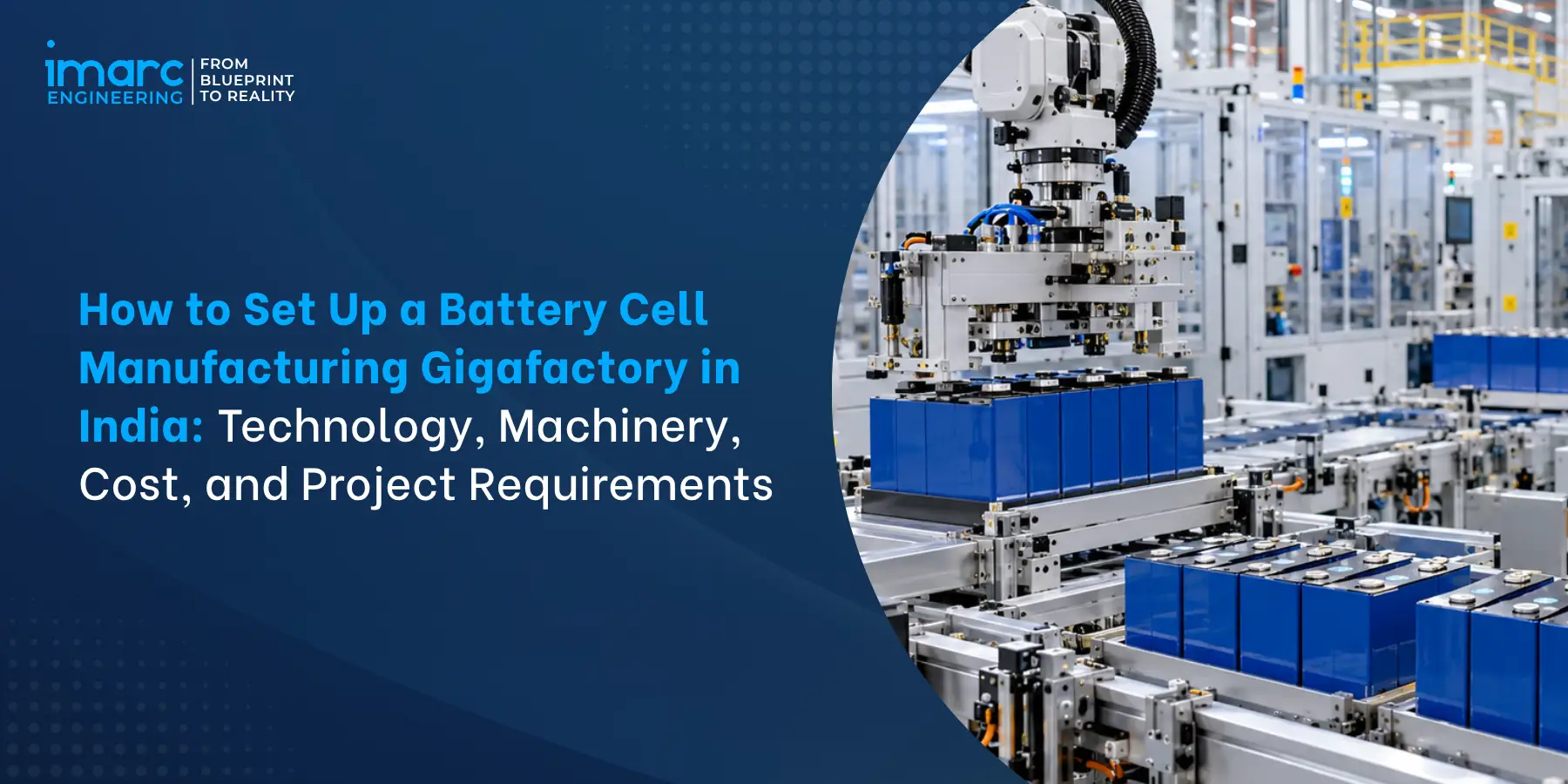
How to Set Up a Battery Cell Manufacturing Gigafactory in India: Technology, Machinery, Cost, and Project Requirements
Introduction
For investors, battery manufacturers, and project sponsors planning a battery cell manufacturing gigafactory in India in 2026, disciplined integration across cell chemistry (LFP, NMC), format (cylindrical, prismatic, pouch), GWh capacity, electrode manufacturing, cell assembly, formation and aging, dry room infrastructure, utilities, safety systems, and regulatory compliance determines commercial viability. India imports over 90 percent of lithium-ion cells today, and the PLI Advanced Chemistry Cell (ACC) Battery Storage scheme with INR 18,100 crore outlay - targeting 50 GWh - has created the policy foundation for domestic gigafactory investment.
Scope of this Guide
This guide answers the sponsor's core question directly. How should investors plan a lithium-ion cell manufacturing plant covering chemistry, format, GWh capacity, machinery, dry rooms, utilities, safety, CAPEX/OPEX, and execution? It walks through capacity planning, raw material requirements, electrode manufacturing, cell assembly and formation, dry room and utility infrastructure, safety and fire protection, PLI ACC scheme structuring, BIS/AIS compliance, and CAPEX drivers - anchored to explicit assumptions.
Table of Contents
- Introduction
- Why Battery Cell Gigafactory Investment Matters for India in 2026
- What a Battery Cell Manufacturing Gigafactory is and Why It Matters in India
- Cell Chemistry Format and GWh Capacity Planning for Battery Gigafactories in India
- Raw Materials and Components for Battery Cell Manufacturing in India
- Electrode Manufacturing Coating and Calendaring for Battery Cell Manufacturing Plants in India
- Cell Assembly Electrolyte Filling Formation and Aging for Battery Cell Manufacturing in India
- Machinery Dry Room and Utilities for Battery Cell Manufacturing Gigafactories in India
- Safety Fire Protection Licences and Project Economics for Battery Cell Manufacturing Plants in India
- Conclusion
1. Why Battery Cell Gigafactory Investment Matters for India in 2026
Four drivers make disciplined battery cell gigafactory investment strategically important for manufacturers and project sponsors in 2026.
1.1 Import Dependence and Strategic Priority
India's battery cell manufacturing in India industry remains vastly under-developed against surging demand from electric vehicles (2W, 3W, passenger vehicles, commercial), stationary energy storage (grid-scale, telecom, data centre backup), consumer electronics, and defence applications. India imports over 90 percent of lithium-ion cell requirements, primarily from China, South Korea, and Japan. This exposure creates supply-chain, currency, and geopolitical risk - making domestic cell manufacturing a strategic priority for India's energy transition and industrial competitiveness. Domestic cell production is critical for realizing India's EV targets, renewable energy integration, and self-reliance objectives.
1.2 Policy Framework - PLI ACC Scheme
India's flagship scheme for battery cell manufacturing is the Production Linked Incentive (PLI) National Programme on Advanced Chemistry Cell (ACC) Battery Storage - approved by the Ministry of Heavy Industries (MHI) in May 2021 with INR 18,100 crore outlay, targeting 50 GWh domestic ACC manufacturing. It provides performance-linked subsidy up to approximately INR 2,000 per kWh, with minimum investment threshold of INR 1,100 crore per beneficiary.
40 GWh has been awarded to four beneficiary firms - ACC Energy Storage (5 GWh), Ola Cell Technologies (20 GWh, 1 GWh installed), Reliance New Energy Battery Storage (5 GWh), and Reliance New Energy Battery Ltd (10 GWh, agreement signed 17 February 2025). 10+ non-PLI manufacturers have announced approximately 178 GWh additional cell manufacturing capacity.
1.3 Investment Ecosystem
Multiple factors support battery cell manufacturing investment in India. Domestic demand growth from EV adoption, stationary storage under National Electricity Plan, and consumer electronics. PLI ACC financial incentives reduce OPEX gaps versus imports. State-level battery-specific incentives in Gujarat, Karnataka, Maharashtra, Tamil Nadu, Andhra Pradesh, and Telangana offer land, power, capital subsidies, and stamp duty exemptions. Emerging domestic supply chain for cathode active material, anode active material, electrolyte, separator, and foils. Recycling ecosystem developing under Battery Waste Management Rules 2022 with mandatory EPR.
1.4 Cost of Poor Planning
Poor project planning carries meaningful cost. Undersized dry room infrastructure limits throughput and creates cell quality risk (moisture ingress degrades capacity and cycle life). Inadequate fire suppression creates catastrophic risk given lithium and electrolyte flammability. Insufficient BIS/AIS quality systems block market access - IS 16046 CRS is mandatory for portable cells, IS 16893 for EV traction under AIS 156 framework. Late environmental clearance delays commissioning. Poor NMP solvent recovery destroys electrode economics and creates air pollution non-compliance. Integrated discipline reduces delivery risk and preserves PLI eligibility.
2. What a Battery Cell Manufacturing Gigafactory is and Why It Matters in India
Understanding what a battery cell manufacturing gigafactory is and why it matters in India establishes the technology and infrastructure baseline for informed investment decisions.
2.1 Gigafactory Definition
A battery gigafactory in India is a large-scale integrated facility producing lithium-ion cells at gigawatt-hour (GWh) scale - typically 5 GWh to 40+ GWh annual capacity. It integrates electrode manufacturing (slurry mixing, coating, drying, calendaring, slitting), cell assembly (notching, stacking or winding, tab welding, electrolyte filling, sealing), formation and aging, testing, and grading.
Battery cell plants are moisture-sensitive, chemical-intensive, and energy-intensive facilities requiring specialized dry room infrastructure (dew point -40 to -60°C), robust safety systems, and precise process control across every stage.
2.2 Plant Sections
| Section | Function | Key Equipment |
|---|---|---|
| Slurry preparation | Mix CAM/AAM + binder + solvent | Planetary mixers, dispersion |
| Electrode coating | Coat foil with slurry | Slot-die coating machines |
| Drying/calendaring | Remove solvent, densify | In-line ovens, roll press |
| Slitting/notching | Cut electrodes to size | Slitters, die-cutters |
| Cell assembly | Stack/wind, weld, insert | Stackers, winders, welders |
| Electrolyte filling | Dry room filling and sealing | Filling, sealing machines |
| Formation/aging | Initial cycles + SEI stabilization | Formation chambers, aging racks |
| Testing/grading | Sort by capacity/voltage | Cell testers, graders, AOI |
| Utilities/dry room | HVAC, N2, chilled water | Desiccant HVAC, N2 plant, chillers |
2.3 Plant Scale Determinants
Plant scale depends on chemistry, format, capacity target, and automation level. Pilot lines (1 GWh) target INR 800-1,500 crore CAPEX. Small commercial plants (3-5 GWh) require INR 2,000-7,500 crore. Medium plants (5-10 GWh) require INR 3,000-15,000 crore. Full gigafactories (20-40 GWh) require INR 20,000-40,000+ crore. LFP chemistry is generally lower cost than NMC due to simpler cathode manufacturing and lower material cost. Automation level significantly affects CAPEX and yield. Dry room infrastructure alone can be 20-30 percent of plant CAPEX.
3. Cell Chemistry Format and GWh Capacity Planning for Battery Gigafactories in India
Understanding cell chemistry format and GWh capacity planning for battery gigafactories in India is the foundational decision that cascades through every downstream investment.
3.1 Cell Chemistry Selection
Two chemistries dominate today's cell manufacturing decisions. LFP cells (Lithium Iron Phosphate) offer inherent safety, long cycle life (3,000-6,000+ cycles), and lower cost per kWh - dominant for stationary storage and increasingly for EV (BYD, CATL, Tesla standard-range). Energy density is moderate (~150-170 Wh/kg). NMC cells (Nickel Manganese Cobalt) deliver higher energy density (~200-250 Wh/kg) with variants (NMC-622, NMC-811) - preferred for premium EV. Cobalt content creates supply-chain risk. NCA offers similar profile to NMC. LTO serves niche high-power applications. Solid-state is emerging but not yet at gigafactory scale.
3.2 Cell Format
Cell format decision follows chemistry. Cylindrical cells (18650 at 18mm × 65mm, 21700 at 21mm × 70mm, 4680 at 46mm × 80mm) suit power tools, EV (Tesla), and applications favouring standardization and thermal management via cylindrical geometry. Prismatic cells in hard aluminium cases suit EV (BYD Blade LFP, CATL) and stationary storage - offer better space utilization in pack design.
Pouch cells use flexible aluminium-laminate film - highest energy density and flexible geometry, used in premium EV, consumer electronics, and defence. Format choice drives assembly machinery (winding for cylindrical/prismatic, stacking for pouch/prismatic), packaging, and downstream pack design.
3.3 GWh Capacity Planning
Gigafactory capacity is expressed in GWh per year. Calculation basis: line throughput (electrodes coated per hour, cells assembled per minute) × operating hours × yield × energy per cell. Example: a 5 GWh/year LFP plant producing 100 Ah prismatic cells at 3.2 V (320 Wh/cell) needs approximately 15.6 million cells/year, roughly 2,000 cells/hour at 90 percent yield with 8,000 operating hours.
Multiple parallel production lines aggregate to reach GWh target. PLI ACC scheme requires minimum 5 GWh committed capacity. Capacity utilization ramp typically follows 30-50 percent in year 1, 60-80 percent in year 2, and 85-95 percent from year 3 onwards - reflecting formation optimization, yield learning, and market development.
3.4 Location and Site Selection
Gigafactory setup in India location decisions weigh multiple factors. Reliable power (50-200 MW for medium-large plants) with grid stability and renewable integration options. Water availability. Skilled workforce depth. Ecosystem proximity - EV OEM customers, energy storage integrators, component suppliers (CAM, AAM, electrolyte, separator, foil), and logistics. State industrial incentives - Gujarat, Karnataka, Maharashtra, Tamil Nadu, Andhra Pradesh, Telangana, and Odisha have battery-specific schemes. Land requirement typically 30-100 hectares for greenfield gigafactory. Environmental clearance and SPCB classification evaluated early.
4. Raw Materials and Components for Battery Cell Manufacturing in India
Understanding raw materials and components for battery cell manufacturing in India covers the active materials and components that determine cell performance and cost.
4.1 Active Materials
Two active materials are central. Cathode active material (CAM) is the highest-cost component - LFP (LiFePO4) or NMC. Domestic CAM production is emerging under PLI ACC catalyst. Anode active material (AAM) is predominantly natural or synthetic graphite; silicon-graphite composites are increasing for higher energy density. Precursor supply for CAM (nickel sulphate, cobalt sulphate, manganese sulphate, lithium salts) is import-dependent. Material purity is critical - battery-grade materials require above 99.5 percent purity with strict metal contamination limits.
4.2 Electrolyte and Separator
Electrolyte is typically LiPF6 salt in organic carbonate solvents (EC, DMC, EMC, DEC) with functional additives (VC, FEC, PS). Electrolyte is highly flammable and moisture-sensitive - requiring dry room handling and PESO-regulated storage.
Separator is a microporous polymer film (polyethylene, polypropylene, or trilayer PP/PE/PP) with ceramic coating for thermal stability - prevents electrode short circuits while allowing lithium-ion transport. Separator thickness (12-25 microns) determines cell power capability and safety. Both electrolyte and separator are largely imported today; domestic manufacturing is developing under PLI ACC ecosystem.
4.3 Current Collectors and Casing
Current collectors are metal foils - aluminum foil (12-20 microns) for cathode and copper foil (6-15 microns) for anode. Foil purity and surface finish are critical for adhesion and current distribution. Casing depends on format: aluminum can for prismatic, nickel-plated steel or aluminum can for cylindrical, aluminum-polymer laminate film for pouch. Tabs (aluminum for cathode, nickel or copper for anode) enable external electrical connection.
4.4 Consumables and Solvents
Consumables include PVDF binder (cathode) and SBR/CMC binders (anode, water-based), conductive additives (Super-P, acetylene black, carbon nanotubes), NMP solvent (cathode - requires recovery), deionized water (anode), tabs, insulation tape, and terminals. NMP recovery is critical for both economics and environmental compliance.
5. Electrode Manufacturing Coating and Calendaring for Battery Cell Manufacturing Plants in India
Understanding electrode manufacturing coating and calendaring for battery cell manufacturing plants in India covers the front-end process that determines cell performance and yield.
5.1 Slurry Preparation
Slurry mixing combines active material (CAM or AAM), binder, conductive additive, and solvent in planetary or continuous mixers. Cathode slurry uses PVDF binder in NMP solvent (recovered). Anode slurry uses SBR/CMC binder in water. Mixing parameters (speed, sequence, time) determine slurry viscosity, particle dispersion, and downstream coating quality. Solid content typically 60-75 percent for cathode, 45-55 percent for anode. Slurry must be de-aired before coating to prevent defects. Batch consistency drives coating uniformity and final cell capacity.
5.2 Coating and Drying
Coating deposits slurry onto foil current collectors via slot-die coating - the industry-standard process. Coating parameters (line speed, gap, slurry pressure, foil tension) determine coat weight uniformity (target ±2-3 percent) - directly affecting cell capacity consistency. Typical line speed is 20-80 metres/minute. After coating, in-line ovens dry the coated foil - removing NMP (cathode) or water (anode). Cathode drying operates at 80-150°C with NMP vapor captured by recovery systems - critical for economics and environmental compliance. Two-sided coating doubles active material loading per foil pass.
5.3 Calendaring and Slitting
Calendaring passes coated foils through steel rolls at controlled pressure- densifying the electrode to target porosity (25-35 percent cathode, 30-40 percent anode). It improves volumetric energy density, particle contact, and cycle life. Slitting cuts calendered rolls into narrow strips matching cell format. Blade quality and alignment determine edge quality - poor slitting creates burrs that pierce separator and cause internal shorts. Slit widths depend on cell design (typically 60-300mm).
5.4 Electrode Quality Control
Electrode quality control checkpoints include slurry viscosity/density measurement, coat weight monitoring (in-line gauging), thickness measurement, adhesion testing, and moisture measurement. Post-calendaring inspection covers density, thickness uniformity, and surface defects. Post-slitting inspection covers width, edge quality, and burr formation. Coating and electrode quality issues account for the majority of cell rejects - front-end discipline directly determines gigafactory yield economics.
6. Cell Assembly Electrolyte Filling Formation and Aging for Battery Cell Manufacturing in India
Understanding cell assembly electrolyte filling formation and aging for battery cell manufacturing in India covers the back-end processes that transform electrodes into finished cells.
6.1 Notching and Stacking or Winding
Slit electrodes are cut to final shape via notching or die-cutting - creating tab connection points. For pouch and prismatic stacked cells, individual sheets are stacked in sequence (anode - separator - cathode - separator) using precision electrode stacking machines - achieving 60-120 cycles per minute. For cylindrical and wound-prismatic cells, winding machines wind electrodes and separator into a jellyroll. Winding tension, alignment, and speed determine jelly-roll quality. Modern winders achieve 30-40 jellyrolls per minute for 18650/21700 formats.
6.2 Tab Welding and Casing
Tab welding electrically connects electrode tabs to the cell terminals via ultrasonic welding (common for aluminum-copper connections) or laser welding (for higher-power connections and precision). Weld quality directly affects cell resistance and cycle life. Post-welding, jellyrolls or stacks are inserted into cases (aluminum cans for cylindrical/prismatic, aluminum-laminate pouches for pouch cells). Insulator sleeves prevent internal shorts. Case pre-crimping (for cylindrical) or partial sealing (for prismatic and pouch) prepares cells for electrolyte filling.
6.3 Electrolyte Filling and Sealing
Electrolyte filling occurs in dry rooms (dew point -40 to -60°C) - moisture ingress destroys cell performance. Precise volumetric filling (typical 2-5 grams electrolyte per Ah) uses vacuum-assisted injection to ensure electrolyte reaches all pores. After filling, cells rest for electrolyte wetting (2-24 hours depending on chemistry and format), then final sealing: laser welding for cylindrical/prismatic cases, heat sealing for pouch cells. Sealing integrity is critical - electrolyte leakage causes performance loss and safety risk. Filled and sealed cells transition to formation.
6.4 Formation Aging and Testing
Formation is the critical initial charge/discharge cycles (2-5 cycles at low C-rate) that build the Solid Electrolyte Interphase (SEI) - a stable passive layer on the anode determining cell longevity. Formation chambers hold thousands of cells with individual charge/discharge control, temperature monitoring, and gas venting. Aging follows - 1-3 weeks at 25-45°C allowing SEI stabilization and detection of defective cells (excessive self-discharge). Cell testing measures capacity, internal resistance, and open-circuit voltage. Grading sorts of cells by performance for consistent pack assembly. Formation and aging require 3-6 weeks in-process time - a significant working capital and space consumer.
7. Machinery Dry Room and Utilities for Battery Cell Manufacturing Gigafactories in India
Understanding machinery dry room and utilities for battery cell manufacturing gigafactories in India covers the infrastructure that determines throughput, yield, and CAPEX intensity.
7.1 Key Machinery
| Category | Equipment | Illustrative Scale |
|---|---|---|
| Slurry mixing | Planetary/continuous mixers | Batch-specific capacity |
| Coating | Slot-die coating machines | 20-80 m/min line speed |
| Drying | In-line ovens, NMP recovery | Multi-zone heating |
| Calendaring | Roll press, precision rolls | 500-2,000 kN/m pressure |
| Slitting/notching | Precision slitters, die-cutters | Line-specific throughput |
| Assembly | Stackers, winders, welders | 30-120 cells/minute |
| Filling/sealing | Vacuum fillers, laser sealers | Dry room integrated |
| Formation/aging | Formation cabinets, aging racks | Thousands of channels |
| Utilities/dry room | Desiccant HVAC, N2 plant | Dew point -40 to -60°C |
7.2 Dry Room Infrastructure
Dry rooms are the defining infrastructure of cell manufacturing. Moisture control below 1 percent relative humidity (dew point -40 to -60°C) protects lithium and electrolyte from atmospheric moisture that would degrade capacity, cycle life, and safety. Design uses desiccant dehumidification (silica gel or molecular sieve wheels), HEPA-filtered air recirculation, tight envelope construction, and disciplined gowning protocols. Cell assembly, electrolyte filling, and sealing occur in dry rooms. Dry room CAPEX can be 20-30 percent of total gigafactory investment and OPEX is meaningful. Class typically ISO 7-8 alongside stringent humidity control.
7.3 Process Utilities
Gigafactory utilities are substantial. Electrical connected load 50-200 MW for medium-large plants requires dedicated substation. Nitrogen (N2) plants generate inert gas for electrolyte handling and formation. HVAC covers general facility plus dry room dehumidification. Chilled water (5-15°C) for process cooling. Compressed air for pneumatic actuation. Steam for drying ovens. Deionized water for anode slurry. NMP solvent recovery captures cathode drying vapours - critical for economics and Air Act 1981 compliance. Emergency power protects in-process cells during outages.
7.4 Plant Layout and Automation
Gigafactory layout separates electrode manufacturing (wet chemistry) from cell assembly (dry room) with logistics/warehousing supporting both. Formation and aging areas require substantial floor space given multi-week hold times. Automation levels vary from semi-automated to highly automated (80-95 percent in modern gigafactories). Material handling uses automated guided vehicles (AGV), conveyors, and robotic transfer between stations. Traceability systems (barcode, QR, RFID) track individual cells through production - essential for warranty, recall, and root-cause analysis. Land requirement 30-100 hectares for greenfield gigafactory including production, dry rooms, utilities, warehousing, and expansion.
8. Safety Fire Protection Licences and Project Economics for Battery Cell Manufacturing Plants in India
Understanding safety fire protection licences and project economics for battery cell manufacturing plants in India completes the framework for informed investment decisions.
8.1 Fire Safety and Hazard Management
Battery cell plants face elevated fire risk from lithium (reactive with moisture), flammable electrolyte solvents (DMC, EMC, EC, DEC), NMP solvent, and lithium-ion thermal runaway during formation and testing. Fire protection requires specialized systems: early detection (VESDA - very early smoke detection), suppression appropriate to lithium fires (aerosol, water mist, or dry chemical), compartmentalization to prevent propagation, electrolyte spill containment, N2 inerting in high-risk areas, and disciplined chemical storage per PESO regulations. Fire NOC per NBC 2016 requires early engagement with local fire authorities. International reference standards (NFPA 855 for stationary battery installations) inform Indian practice.
8.2 Environmental Management
Battery cell plants generate air emissions (NMP vapour, VOC), process wastewater, and hazardous waste (spent solvents, sludge, defective cells, off-spec material). Air emission control requires NMP recovery systems (>95 percent recovery target) and thermal oxidizers for uncontrolled VOC. Wastewater treatment (ETP) meets CPCB Schedule VI norms - water intensity is lower than PCB or chemical plants. Hazardous waste management follows 2016 Rules with SPCB authorization and TSDF disposal. Battery Waste Management Rules 2022 require extended producer responsibility (EPR) registration with CPCB - mandatory for producers, importers, and recyclers.
8.3 Regulatory Framework
Battery cell plants navigate multiple regulatory approvals. SPCB Consent to Establish (CTE) before construction and Consent to Operate (CTO) before production under Water Act 1974 and Air Act 1981. Hazardous waste authorization under 2016 Rules. Environmental Clearance under EIA Notification 2006 for capacity or investment thresholds. Factory licence under OSH Code 2020 (in force 21 November 2025). Fire NOC per NBC 2016. PESO licences or approvals may apply to the storage and handling of specific regulated flammable or hazardous materials, depending on the substance, quantity, storage configuration and applicable rules.
Battery Waste Management Rules 2022 EPR registration. BIS: IS 16046 (Parts 1 & 2):2018 mandatory CRS for portable lithium cells; IS 16893 (Parts 2 & 3):2018 for EV traction cells within AIS 156/AIS 038 Rev.2 framework administered by MoRTH. PLI ACC scheme compliance including MoU with MHI, quarterly reporting, and audit requirements.
8.4 Project Economics
| Configuration | Scale Assumption | Investment (INR) |
|---|---|---|
| Pilot line | 1 GWh | 800-1,500 crore |
| Small commercial plant | 3-5 GWh | 2,000-7,500 crore |
| Medium plant | 5-10 GWh | 3,000-15,000 crore |
| Gigafactory | 20-40 GWh | 20,000-40,000+ crore |
8.5 CAPEX and OPEX Composition (Indicative in Nature, may vary)
CAPEX composition for gigafactories: coating and drying equipment 15-20 percent; assembly machinery 15-20 percent; formation and aging equipment 12-18 percent; dry room infrastructure 20-30 percent; general utilities and HVAC 8-12 percent; civil/building 8-12 percent; automation and material handling 5-10 percent; engineering/commissioning 5-8 percent. OPEX drivers: raw materials (CAM, AAM, electrolyte, separator, foils) 60-75 percent, electricity 8-15 percent (highest in NMP recovery, dry room dehumidification, formation), labour 4-10 percent depending on automation, consumables 3-6 percent, other 3-5 percent.
Eligible beneficiaries under the PLI ACC scheme may receive performance-linked incentives subject to the scheme's applicable conditions, domestic value-addition requirements and other eligibility criteria. Yield discipline is decisive - each percentage point of yield loss represents meaningful economic impact given raw material cost dominance. Greenfield gigafactory development timelines vary significantly depending on GWh capacity, technology and equipment sourcing, site readiness, approvals, civil works, dry-room construction, installation, qualification and production ramp-up.
Conclusion
Setting up a battery cell gigafactory in India requires chemistry and cell-format selection, capacity planning, raw material sourcing, process and dry-room design, utilities, fire and environmental systems, regulatory approvals, and PLI ACC planning. Key processes include slurry mixing, coating, calendaring, slitting, stacking or winding, electrolyte filling, formation, aging, testing, and grading.
Three priorities are critical. First, dry-room conditions and fire safety must be designed for the selected cell chemistry and process. Second, process yield and quality control strongly influence gigafactory economics. Third, PLI ACC eligibility, domestic value addition, and project timelines should be assessed early.
PURSUING A BATTERY CELL MANUFACTURING GIGAFACTORY IN INDIA?
IMARC Engineering supports investors, battery manufacturers, and project sponsors with battery chemistry and cell-format selection, capacity planning, site selection, raw material strategy, process and plant design, dry-room and utility planning, fire protection, environmental management, regulatory compliance, PLI ACC structuring, and capital investment planning. The advisory covers cell manufacturing processes from slurry mixing and coating to formation, testing, and grading, with project-specific infrastructure and commissioning planning.
→ Schedule a free battery cell gigafactory scoping consultation with an IMARC specialist
Frequently Asked Questions
A battery cell manufacturing gigafactory in India is a large-scale facility producing lithium-ion cells at gigawatt-hour (GWh) capacity, integrating electrode manufacturing (slurry mixing, coating, calendaring, slitting), cell assembly (stacking/winding, welding, electrolyte filling, sealing), formation and aging, testing, and grading - typically at 5-40+ GWh scale.
Battery cell manufacturing gigafactory setup in India requires chemistry selection (LFP/NMC), format choice (cylindrical/prismatic/pouch), GWh capacity planning, electrode/assembly/formation process design, dry room infrastructure (dew point -40 to -60°C), specialized machinery, utilities, PLI ACC scheme structuring, BIS/AIS compliance, safety approvals, and staged 30-48 months commissioning approach.
The lithium-ion cell manufacturing process flow: electrode slurry mixing (CAM/AAM + binder + solvent), coating on foil (aluminium for cathode, copper for anode), drying, calendaring, slitting, notching, stacking or winding, tab welding, casing, electrolyte filling in dry room, sealing, formation, aging, and final characterization testing.
Battery cell manufacturing machinery includes slurry mixers, slot-die coating machines, calendaring rolls, slitting machines, notching/die-cutting equipment, stacking or winding machines, tab welders (ultrasonic/laser), can/pouch sealing units, electrolyte filling systems in a dry room, formation and aging chambers, cell testers/graders, and end-of-line automated optical inspection systems.
GWh capacity calculation depends on line throughput × operating hours × yield × cell energy density. Typical estimation: cell format, line output cells/day, saleable yield 85-95 percent, aggregating multiple production lines to reach target GWh.
Dry rooms are critical in battery cell materials and electrolyte are highly moisture-sensitive, and excessive moisture can adversely affect cell chemistry, performance, cycle life and safety. Cell assembly, electrolyte filling, and sealing require dew points from -40 to -60°C (below 1 percent humidity), typically 20-30 percent of gigafactory CAPEX.
Battery cell manufacturing plant cost depends on GWh capacity, chemistry (LFP or NMC), cell format, automation, dry room, and utilities. Illustrative CAPEX: 1 GWh pilot INR 800-1,500 crore; 5-10 GWh plants INR 3,000-15,000 crore; 20-40 GWh gigafactory INR 20,000-40,000+ crore. PLI ACC provides significant incentive support.
Battery cell plants require SPCB CTE/CTO under Water/Air Acts, hazardous waste authorization, PESO for electrolyte storage, BIS certification (IS 16046 CRS mandatory; IS 16893 for EV traction cells), Battery Waste Management Rules 2022 EPR, OSH Code 2020 factory licence, and Fire NOC per NBC 2016.
Recent Post

Trusted by Industry Leaders
We partner with global enterprises and ambitious businesses across sectors to deliver operational excellence, strategic insights, and sustainable growth through integrated solutions.












Success in Their Words
Real feedback from clients across industries. Discover how our solutions delivered measurable impact and operational excellence.

I wanted to express my sincere appreciation for your efforts in handling this matter. Your dedication and commitment have been truly commendable, and it is evident that you have put in tremendous hard work and expertise into resolving the issues at hand. We are greatly interested in continuing our collaboration with you in the future, as your professionalism and reliability have made you a trusted partner. Thank you once again for your invaluable contribution. We look forward to strengthening our partnership ahead.

It has been a pleasure working with the IMARC team. The insights provided were structured, clear, and highly valuable, helping us strengthen both our technical and financial planning with confidence. We deeply appreciate the team’s professionalism, responsiveness, and attention to detail throughout the engagement. Every requirement was well understood and effectively incorporated, resulting in a comprehensive and actionable output. Overall, our experience has been excellent, and I would gladly recommend IMARC to organizations seeking a reliable research partner.

Your service is truly exceptional. Working with the IMARC team has been a seamless and professional experience. The clarity of communication, responsiveness to queries, and consistent support at every stage made the entire engagement highly efficient. The insights shared were well-structured, practical, and perfectly aligned with our requirements, helping us make informed decisions with confidence. Overall, the dedication and professionalism demonstrated by your team stand out, and I would be glad to recommend IMARC as a reliable and trustworthy research partner.

IMARC did an outstanding job in preparing our study. They were punctual, precise, and consistently responsive throughout the entire process. The team delivered all the data we required in a clear, well-organized, and highly professional format. Their strong attention to detail, combined with their ability to meet every deadline without compromising quality, truly set them apart. Overall, their reliability and commitment made them an exceptional partner for our project, and we would gladly work with them again in the future.

IMARC made the whole process incredibly easy from start to finish. Everyone I interacted with via email was polite, professional, and straightforward to deal with, always keeping their promises regarding delivery timelines and remaining consistently solutions-focused. From my very first contact, I appreciated the professionalism and support shown by the entire IMARC team. I highly recommend IMARC to anyone seeking timely, affordable, and reliable information or advice. My experience with IMARC was excellent, and I truly cannot fault any aspect of it.

I’d like to express my sincere gratitude for the excellent work you accomplished with the study. Your ability to quickly understand our requirements and deliver high-quality results under tight timelines truly reflects your expertise, exceptional work ethic, and unwavering commitment to your customer’s success. The professionalism and responsiveness you demonstrated throughout the process made a significant difference. Our entire team and company are incredibly thankful for your dedication, reliability, and support. Once again, thank you for your outstanding contribution.