Manuafcturing
September 28 2026
How to Set Up a Cement Manufacturing Plant in India: Cost, Machinery, Licences, Process, and Project Requirements
Introduction
For investors, cement manufacturers, and project development teams planning a cement manufacturing plant in India in 2026, disciplined integration across limestone availability, capacity planning, process technology, machinery, utilities, layout, environmental compliance, and project execution determines commercial viability. India is the world's second-largest cement producer with sustained infrastructure, housing, and industrial demand. Regulatory framework has expanded through BIS certification under Cement (Quality Control) Order 2003, environmental clearance under EIA Notification 2006, and emission monitoring - now supplemented by the Carbon Credit Trading Scheme (CCTS).
Scope of the Guide
This guide answers the sponsor's question directly. How should investors plan a cement production plant in India covering raw-material availability, capacity, technology, machinery, site, licences, environmental compliance, CAPEX/OPEX, and project execution? It walks through capacity planning and limestone sourcing, site selection, raw material preparation, clinker production, cement grinding and packing, utilities and material handling, emissions control (ESP/bag filters/CEMS), regulatory compliance (BIS/EC/SPCB/OSH), and CAPEX drivers - anchored to explicit capacity and configuration assumptions.
Table of Contents
- Introduction
- Why Cement Manufacturing Plant Investment Matters for India in 2026
- What a Cement Manufacturing Plant is and Why It Matters in India
- Capacity Limestone Availability and Site Selection for Cement Manufacturing Plants in India
- Raw Materials and Clinker Production Process for Cement Manufacturing in India
- Rotary Kiln Preheater and Cement Grinding for Cement Plants in India
- Machinery Utilities and Material Handling for Cement Manufacturing Plants in India
- Emissions Control and Pollution Management for Cement Manufacturing in India
- Licences Environmental Approvals and Project Economics for Cement Manufacturing Plants in India
- Conclusion
1. Why Cement Manufacturing Plant Investment Matters for India in 2026
Four drivers make disciplined cement manufacturing plant investment a strategic opportunity for manufacturers and project sponsors in 2026.
1.1 Structural Demand Fundamentals
India's cement manufacturing in India continues to grow through sustained infrastructure investment (national highways, dedicated freight corridors, metro networks, ports and airports), housing programmes (PMAY, urban redevelopment), industrial construction (manufacturing corridors, PLI-driven factories), and commercial real estate. Rural housing and government-financed construction provide a growth floor even in slower economic cycles. Sustained demand supports both greenfield capacity addition in demand-deficit regions and brownfield capacity expansion at existing plants.
1.2 Regulatory Framework Maturation
India's cement regulatory framework has matured meaningfully. BIS certification is mandatory under Cement (Quality Control) Order 2003, requiring ISI mark on all cement bags per applicable Indian Standards - IS 269:2015 for Ordinary Portland Cement (unified across Grades 33, 43, 53), IS 1489 for Portland Pozzolana Cement (PPC), and IS 455 for Portland Slag Cement (PSC).
Environmental Clearance under EIA Notification 2006 requires Category A processing at MoEFCC/EAC for plants of 1.0 MTPA and above. Continuous emission monitoring systems (CEMS) operate 24×7 with data transmission to CPCB and SPCB. The Carbon Credit Trading Scheme (CCTS), places cement among the covered energy-intensive sectors with emissions intensity targets.
1.3 Investment Ecosystem
Multiple factors support cement plant investment in India. Limestone reserves across Rajasthan, Andhra Pradesh, Telangana, Madhya Pradesh, Chhattisgarh, Karnataka, and Tamil Nadu support long-life operations. Cement Manufacturers Association (CMA) coordinates policy engagement. Established equipment supply chain from FLSmidth, KHD, ThyssenKrupp Industrial Solutions, and Indian engineering firms. State-level industrial policies offer land, power, and tax incentives. However, greenfield cement plants remain capital-intensive - INR 200 crore for grinding units to INR 15,000+ crore for large integrated complexes - requiring disciplined project planning and staged commissioning.
1.4 Cost of Poor Planning
Poor project planning carries meaningful cost. Inadequate limestone reserves force premature closure or costly transported raw material sourcing. Undersized preheater/kiln systems cap plant throughput below nameplate. Underdesigned dust collection triggers regulatory action and fugitive emission fines. Late environmental clearance delays commissioning by 12-24 months (indicative). Poor site selection increases lifetime logistics costs on coal inbound and cement outbound. Integrated project discipline across raw materials, capacity, technology, layout, utilities, environmental compliance, and BIS certification reduces delivery risk and improves lifetime economics.
2. What a Cement Manufacturing Plant is and Why It Matters in India
Understanding what a cement manufacturing plant is and why it matters in India places it as a mineral-processing project combining mining, thermal processing, grinding, and material handling at meaningful scale.
2.1 Plant Definition
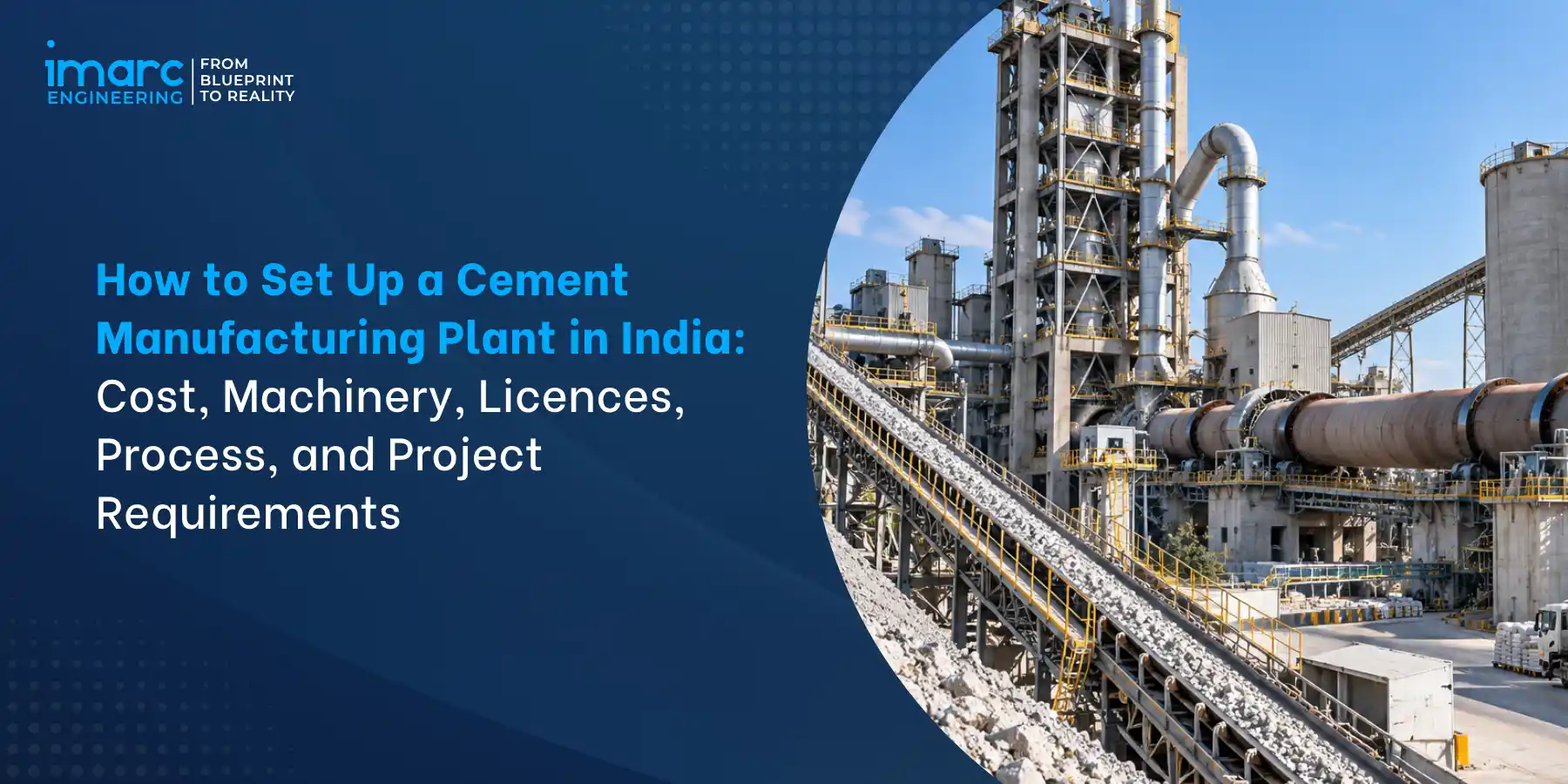
An integrated cement plant India converts limestone and additives into cement through sequential unit operations: limestone extraction (captive quarry), crushing, blending with corrective materials, grinding into raw meal, preheating, calcination and clinkering in rotary kiln, cooling, blending clinker with gypsum and supplementary cementitious materials, cement grinding, storage, and packing/bulk dispatch.
Standalone grinding units skip clinker production and grind purchased clinker with additives - lower CAPEX but dependent on clinker supply. Product mix includes OPC (33/43/53 grade per IS 269), PPC per IS 1489 (blended with fly ash), PSC per IS 455 (blended with slag), and specialty cements.
2.2 Major Plant Sections
| Section | Function | Key Equipment |
|---|---|---|
| Limestone quarry | Raw limestone extraction | Excavators, dumpers, blasting |
| Crushing | Size reduction of limestone | Primary/secondary crushers |
| Raw prep | Blending, storage, grinding | Stackers/reclaimers, raw mill |
| Pyroprocessing | Preheating, calcination, clinkering | Preheater, precalciner, kiln, cooler |
| Cement grinding | Clinker grinding with additives | Cement mill (VRM/ball mill) |
| Storage/packing | Silo storage, bagging, dispatch | Silos, packers, loaders |
| Utilities | Power, water, air, WHRS | Boiler, DG, WHRS, compressors |
| Pollution control | Dust and emissions | ESPs, bag filters, CEMS |
2.3 Plant Scale Determinants
Plant scale depends on limestone reserves, target market, and business model. Small grinding units (0.5-1.0 MTPA, INR 200-500 crore CAPEX) serve regional markets close to clinker sources or coastal ports for imported clinker. Medium integrated plants (1.0-3.0 MTPA, INR 1,500-4,000 crore) balance scale with market coverage. Large integrated plants (3.0-10.0 MTPA, INR 4,000-15,000 crore) target commercial scale for national dispatch. Very large multi-line complexes (10+ MTPA) serve pan-India distribution. Product mix, kiln count, WHRS integration, alternative fuel infrastructure, and captive power capacity drive CAPEX intensity - decisions follow limestone reserve life and market plan rather than default assumptions.
3. Capacity Limestone Availability and Site Selection for Cement Manufacturing Plants in India
Understanding capacity limestone availability and site selection for cement manufacturing plants in India is the foundation decision that cascades through the entire project.
3.1 Capacity Planning
Cement plant capacity is typically expressed as Million Tonnes Per Annum (MTPA) of cement. Planning starts with market demand assessment, matches capacity to captive limestone reserves (requiring 25-30 year mine life), and accounts for expansion phasing. Common brackets: standalone grinding units 0.5-1.5 MTPA, integrated plants 1.0-3.0 MTPA (single kiln line), large integrated 3.0-8.0 MTPA (multi-kiln), and mega-complexes above 10 MTPA. Modern single line pyroprocessing systems deliver 6,000-12,000 tonnes per day (TPD) clinker.
3.2 Limestone Reserves
Limestone constitutes 75-80 percent of cement raw material by mass. Reserve assessment covers quantity (bankable reserves for plant life), quality (CaO 45-52 percent, MgO below 5 percent, low alkali/sulphur/chloride), and mineability (overburden ratio, extractability). Mining lease under the Mines and Minerals (Development and Regulation) Act 1957 (MMDR) requires environmental and forest clearances. Typical lease is 50 years, extendable. Limestone requirement approximately 1.5 tonnes per tonne of cement. Reserve certification by qualified geologist is essential before project sanction.
3.3 Site Selection
Site selection weighs limestone proximity (transport of high-volume raw material dominates logistics), coal/petcoke availability (fuel accounts for 25-40 percent of variable cost), power access (grid connectivity plus captive generation land), rail connectivity (bulk cement dispatch efficiency), road access (last-mile distribution), water availability (process water plus dust suppression), market proximity (freight logistics on outbound cement), environmental sensitivity (avoiding eco-sensitive zones which complicate EC), and land availability (typically 200-500 hectares for integrated plants including quarry, plant, colony, buffer). India's cement belt spans Rajasthan, Gujarat, Andhra Pradesh, Telangana, Madhya Pradesh, Chhattisgarh, Karnataka, and Tamil Nadu - hosting most greenfield projects.
3.4 Product Mix Decisions
Product mix drives raw material planning and equipment configuration. OPC (Ordinary Portland Cement per IS 269) targets high-strength applications. PPC (Portland Pozzolana Cement per IS 1489) blends clinker with 15-35 percent fly ash - PPC dominates the Indian market at approximately 55 percent share, benefiting from lower clinker factor (better emissions/economics) and improved durability. PSC (Portland Slag Cement per IS 455) uses ground granulated blast-furnace slag - preferred for coastal and marine applications. Specialty cements (SRPC per IS 12330, RHPC per IS 8041) address niche high-value applications. Multi-product plants require additive storage/handling infrastructure and separate cement mill circuits or careful production planning.
4. Raw Materials and Clinker Production Process for Cement Manufacturing in India
Understanding raw materials and clinker production process for cement manufacturing in India covers the material and thermal transformation foundation.
4.1 Raw Materials
Cement raw materials fall into calcareous (limestone providing CaO), argillaceous (clay/shale providing SiO2 and Al2O3), and corrective (iron ore/laterite/bauxite providing Fe2O3, or silica sand for adjustment). Typical raw mix: limestone 75-80 percent, clay or shale 10-15 percent, iron corrective 2-4 percent. Gypsum (calcium sulphate) is added at 4-5 percent during cement grinding as set retarder. Supplementary cementitious materials (fly ash for PPC, granulated slag for PSC) are added at grinding stage. Fuels include coal (imported and domestic), petroleum coke, and alternative fuels (biomass, RDF, waste tyres) - alternative fuel substitution reduces emissions and operating cost.
4.2 Raw Material Preparation
Raw material preparation starts at the quarry with drilling, controlled blasting (per Explosives Rules 2008), loading, and transport to plant. Primary crushing (jaw or impact crushers) reduces limestone from 1.5-metre boulders to below 100 mm. Secondary crushing achieves 25-40 mm output. Crushed material passes through stacker-reclaimer systems that build large piles for pre-homogenization. Raw mill grinds limestone with clay/iron corrective to raw meal. Vertical roller mill (VRM) technology dominates over ball mills due to lower energy consumption (14-20 kWh/tonne vs 18-25 kWh/tonne).
4.3 Preheater and Precalciner
Raw meal enters the preheater tower - a series of 4-6 cyclone stages that preheat meal to 800-900°C using hot gases exiting the kiln in counter-current flow. Precalciner (a separate combustion chamber between preheater and kiln) provides 60-65 percent of thermal energy - performing calcination (CaCO3 to CaO + CO2) before material enters the kiln. Precalciners enable longer kiln life, better fuel efficiency, higher throughput, and easier alternative fuel handling. Combined preheater-precalciner systems are standard in modern cement plants.
4.4 Rotary Kiln and Clinkering
The rotary kiln is the heart of cement manufacturing - a rotating cylindrical steel shell (4-6 metres diameter, 60-90 metres length for modern precalciner kilns) lined with refractory bricks. Kiln operates at slight inclination and rotates at 2-5 rpm. Material enters at back-end from preheater at 800-900°C, progressively heats to peak burning zone temperature of approximately 1450°C where clinkering reactions occur (formation of C3S, C2S, C3A, C4AF - the strength-giving compounds). Clinker production requires precise temperature control - too low leads to under-burnt clinker; too high wastes fuel and damages refractory. Kiln exit clinker at approximately 1400°C drops to grate cooler.
5. Rotary Kiln Preheater and Cement Grinding for Cement Plants in India
Understanding rotary kiln preheater and cement grinding for cement plants in India continues from clinker production through finished cement.
5.1 Clinker Cooling
The clinker cooler serves two purposes: rapid clinker cooling and heat recovery (returning air to kiln as combustion air, and additional air to precalciner). Modern grate coolers cool clinker from 1400°C to below 100°C in minutes. Heat recovery efficiency of modern coolers exceeds 75 percent. Cooled clinker (25-50 mm nodules) transfers to storage awaiting grinding. Cooler exit gas also feeds waste heat recovery system (WHRS) where installed.
5.2 Cement Grinding
Cement grinding reduces clinker to fine cement powder (Blaine fineness 300-400 m2/kg) with gypsum and additives. Two grinding technologies dominate: ball mill (traditional, higher power 32-42 kWh/tonne cement) and vertical roller mill for cement (higher efficiency 25-32 kWh/tonne, preferred for new plants). Multi-compartment ball mills with high-efficiency separators achieve similar results. Grinding circuit configuration affects both energy consumption and product uniformity. Modern plants also use roller press pre-grinding to enhance ball mill efficiency.
5.3 Storage and Packing
Ground cement transfers via air-lift systems to cement silos (typically 3,000-15,000 tonnes each). Packing plant houses rotary bag packers (typically 8-12 spouts) producing 50 kg polypropylene bags at 1,800-3,600 bags per hour per packer. Bulk loading facilities dispatch cement in bulkers and rail wagons. BIS ISI mark is pre-printed on bag laminations. Packing plant dust collection (bag filters) is essential. Modern packing plants integrate automated weighing and truck/rail loading through SCADA-controlled systems.
5.4 Blending and Quality
For PPC production, fly ash (from thermal power plants) is added at cement grinding at 15-35 percent by mass; the fly ash must meet IS 3812 requirements. For PSC, granulated blast-furnace slag from steel plants is ground with clinker at 25-70 percent proportions per IS 455. Blending accuracy through weigh feeders determines cement uniformity.
Quality control laboratory performs continuous testing per IS 4031 physical tests (setting time, compressive strength at 3/7/28 days, soundness, fineness) and IS 4032 chemical analysis - a BIS ISI mark requires demonstrated capability to produce consistent, specification-compliant cement across batches.
6. Machinery Utilities and Material Handling for Cement Manufacturing Plants in India
Understanding machinery utilities and material handling for cement manufacturing plants in India covers the equipment and infrastructure that determine operational reliability and unit costs.
6.1 Key Machinery
| Category | Equipment | Illustrative Scale |
|---|---|---|
| Crushing | Primary/secondary crushers | 500-2,000 TPH |
| Handling | Stackers, reclaimers, conveyors | Multiple across plant |
| Raw grinding | VRM or ball mill | 150-500 TPH raw meal |
| Pyroprocessing | Preheater, kiln, cooler | 3,000-12,000 TPD clinker |
| Cement grinding | VRM/ball mill | 100-350 TPH cement |
| Storage | Cement silos | 3,000-15,000 tonnes each |
| Packing | Rotary bag packers | 1,800-3,600 bags/hour |
| Utilities | Boilers, DG, WHRS | Plant-specific sizing |
6.2 Process Utilities
Cement plant utilities are substantial. Electrical energy consumption is 100-150 kWh per tonne of cement, with typical connected load 15-40 MW for medium-large plants. Thermal energy for clinkering is 700-800 kcal/kg clinker via coal, petcoke, or alternative fuels. Water requirement covers cooling, dust suppression, and process needs. Compressed air supports pneumatic conveying and instrumentation. Waste heat recovery system (WHRS) captures preheater exit gas and cooler waste heat to generate 25-40 percent of plant electrical demand - now standard in modern plants.
6.3 Material Handling
Material handling is voluminous in cement manufacturing. A 3 MTPA plant handles approximately 4.5 million tonnes of limestone, 500,000 tonnes of clay/corrective, 150,000 tonnes of gypsum, 300,000-500,000 tonnes of coal/petcoke, and dispatches 3 million tonnes of cement annually. Belt conveyors, bucket elevators, air slides, screw conveyors, and pneumatic conveying systems move material continuously. Rail sidings connect to national railway network for coal/gypsum inbound and cement outbound. Truck loading bays handle road dispatch.
6.4 Plant Layout
Plant layout must minimize material travel distance while separating incompatible operations. Standard flow: quarry to crusher to stacker/reclaimer to raw mill to preheater/kiln to cooler to clinker storage to cement mill to cement silos to packing/dispatch. Utility corridors provide services without disrupting process areas. Control room centrally located for operations visibility.
Laboratory adjacent to process. Administrative and colony areas kept upwind and away from dust sources. Land requirement typically 200-500 hectares for integrated plants including quarry, plant, colony, and buffer zones. Layout optimization occurs at engineering stage and is difficult/expensive to correct post-construction.
7. Emissions Control and Pollution Management for Cement Manufacturing in India
Understanding emissions control and pollution management for cement manufacturing in India covers compliance-critical infrastructure and environmental performance.
7.1 Dust Collection Systems
Dust collection is the primary emissions control task at cement plants. Multiple sources generate dust: crushers, stackers/reclaimers, raw mill, preheater tower, kiln, cooler, cement mill, silos, and packing plant. Bag filters (fabric filter dust collectors with pulse-jet cleaning) are the dominant technology for new installations, achieving stack emissions below 30 mg/Nm3. Electrostatic precipitators (ESPs) remain in service on existing plants and for kiln/raw mill exit gas. Modern plants also deploy hybrid ESP-bag filter systems for kiln stack. Collected dust returns to production as raw material.
7.2 Emission Norms and Monitoring
CPCB emission standards under Environment (Protection) Rules 1986 specify limits for cement plant kiln stack particulate matter, SO2, NOx, and other parameters. Different standards apply for plants in critically polluted areas versus other locations, and separate norms for new versus existing kilns. Continuous emission monitoring system (CEMS) operates 24 hours daily with real-time data transmission to CPCB and SPCB portals.
Non-compliance triggers show-cause notices, environmental compensation, and potential closure orders. Fugitive emissions (from stacking, dispatch, and dust escape points) are governed by CPCB Guidelines for Prevention and Control of Fugitive Emissions from Cement Plants. Plant boundary air quality monitoring supplements stack monitoring.
7.3 Water and Solid Waste
Cement plants are typically zero-liquid-discharge (ZLD) operations - process water recycled, cooling water in closed circuits, and no effluent discharge to surface water bodies. Rain water harvesting and quarry pit water reuse support water balance. Solid waste is minimal - kiln bypass dust (containing alkalis/chlorides) is recycled or utilized in blended cement or construction.
Overburden from limestone quarry is dumped in designated areas with slope stabilization and progressive rehabilitation. Air pollution control device dust returns to process. Waste tyres and biomass, when used as alternative fuels, offset both fossil fuel use and waste disposal pressure.
7.4 Carbon and Sustainability
Cement production is emissions-intensive - process CO2 from limestone calcination (approximately 0.55 tonnes CO2 per tonne clinker) plus combustion CO2 from fuel. Mitigation strategies include increasing alternative fuels (biomass, RDF, waste tyres) substitution rates, deploying waste heat recovery to reduce grid power, increasing clinker substitution through PPC/PSC, and long-term investments in CCUS (carbon capture) and green cement chemistry.
The Carbon Credit Trading Scheme (CCTS) will set emissions intensity targets for cement (among other energy-intensive sectors) with tradeable credits - creating both compliance obligation and commercial opportunity for lower-emissions producers.
8. Licences Environmental Approvals and Project Economics for Cement Manufacturing Plants in India
Understanding licences environmental approvals and project economics for cement manufacturing plants in India completes the framework for informed investment decisions.
8.1 Regulatory Framework
Cement plants navigate multiple regulatory approvals. Limestone mining lease under Mines and Minerals (Development and Regulation) Act 1957 (MMDR) requires mine plan approval and mining lease grant from state government. Environmental Clearance under EIA Notification 2006 (item 3(b)): Category A for plants of 1.0 MTPA and above processed at MoEFCC through Expert Appraisal Committee (EAC) with mandatory public hearing; Category B (below 1.0 MTPA and all standalone grinding units) at State Environment Impact Assessment Authority (SEIAA). Forest Clearance required if mining/plant area includes forest land. EC validity is 10 years for the plant and 30 years for the associated mining operation.
8.2 State-Level Approvals
SPCB Consent to Establish (CTE) is required before construction and Consent to Operate (CTO) before production, under Water (Prevention and Control of Pollution) Act 1974 and Air (Prevention and Control of Pollution) Act 1981. Fire NOC per National Building Code 2016. Explosives licence for quarry blasting per Explosives Rules 2008. Petroleum storage licence from PESO if applicable for fuel storage. Boiler certification per Boilers Act (if steam raising above threshold). Legal metrology approval for cement bag weight declarations. State industrial approvals including SIA/EM-II, GST registration, pollution NOC, and local authority NOCs.
8.3 BIS Certification
BIS certification is mandatory for cement sold in India under the Cement (Quality Control) Order 2003. Applicable Indian Standards: IS 269:2015 for Ordinary Portland Cement (Grades 33, 43, 53 in unified standard), IS 8112:2013 for OPC 43 Grade (still valid separately), IS 12269:2013 for OPC 53 Grade (still valid), IS 1489 (Part 1 & 2) for Portland Pozzolana Cement, IS 455 for Portland Slag Cement, IS 8041 for Rapid Hardening Portland Cement, IS 12330 for Sulphate Resistant Portland Cement, and IS 3466 for Masonry Cement. BIS certification via Scheme 1 (ISI mark with factory audit) under BIS Act 2016. Testing per IS 4031 physical tests and IS 4032 chemical analysis. Application, plant/laboratory inspection by BIS officer, third-party testing, and licence grant complete the process.
8.4 Project Economics
| Configuration | Scale Assumption | Investment (INR) (Indicative) |
|---|---|---|
| Standalone grinding | 0.5-1.0 MTPA cement | 200-500 crore |
| Medium integrated | 1.0-3.0 MTPA cement | 1,500-4,000 crore |
| Large integrated | 3.0-10.0 MTPA cement | 4,000-15,000 crore |
| Mega complex | 10+ MTPA multi-line | 15,000+ crore |
8.5 CAPEX and OPEX Composition (Indicative in nature, may vary)
CAPEX composition for integrated cement plants: pyroprocessing 25-35 percent; grinding 15-20 percent; material handling and storage 10-15 percent; civil/building 10-15 percent; utilities and captive power 10-15 percent; pollution control 5-8 percent; engineering/commissioning 5-8 percent. OPEX drivers: fuel 25-40 percent, electricity 12-18 percent, raw materials 5-10 percent, labour/maintenance 8-15 percent, packing 3-5 percent, freight 8-15 percent. Commissioning timeline is 24-36 months (indicarive) for greenfield integrated plants; grinding units 18-24 months (indicative).
Conclusion
Setting up a cement manufacturing plant in India requires careful limestone assessment, capacity planning, site selection, raw material preparation, pyroprocessing, clinker cooling, cement grinding, storage, and packing. Key considerations include utilities, waste heat recovery, emissions control, applicable mining, environmental, BIS and factory regulations, and project commissioning.
Three priorities are critical. First, limestone reserves, quality, and mineability determine project viability. Second, environmental approvals and emissions compliance should be planned from the outset. Third, capacity, process configuration, and technology selection significantly influence plant economics and operating costs.
PURSUING A CEMENT MANUFACTURING PLANT IN INDIA?
IMARC Engineering supports investors, cement manufacturers, and project sponsors with limestone reserve assessment, capacity planning, site selection, raw material strategy, process and plant design, utilities, emissions control, and regulatory compliance. The advisory covers integrated and grinding units, key cement manufacturing processes, waste heat recovery, plant layout, applicable BIS, environmental, safety and emissions requirements, and capital investment and commissioning planning.
→ Schedule a free cement manufacturing plant scoping consultation with an IMARC specialist
Frequently Asked Questions
Cement manufacturing plant in India setup requires limestone reserves and mining lease under MMDR Act 1957, capacity planning, process design (crushing/raw preparation/clinkering/grinding), machinery selection, plant layout, utilities, environmental clearance under EIA 2006, SPCB CTE/CTO, BIS certification per IS 269/1489, and staged commissioning over 24-36 months (indicative).
Cement manufacturing process covers limestone crushing, raw material blending with additives (clay/iron ore/bauxite), grinding in raw mill to raw meal, preheating in preheater tower with precalciner, clinkering in rotary kiln at 1450°C, clinker cooling, blending with gypsum, grinding in cement mill, storage in silos, packing.
Cement manufacturing raw materials include limestone (75-80 percent), clay/shale (10-15 percent) for silica/alumina, iron ore or laterite (2-4 percent), gypsum (4-5 percent added at grinding), and supplementary cementitious materials like fly ash for PPC and slag for PSC. Fuels include coal, petcoke, or alternative fuels.
Cement plant machinery includes limestone crushers, stackers/reclaimers, raw mill (vertical roller or ball mill), preheater tower with precalciner, rotary kiln with clinker cooler, cement mill for grinding clinker with gypsum, cement silos, packing plant, material handling conveyors, dust collectors (ESP/bag filters), and captive power generation.
Cement manufacturing plant cost in India depends on capacity, integrated versus grinding-only, technology, and location. Illustrative brackets: grinding units (0.5-1.0 MTPA) INR 200-500 crore; medium integrated (1.0-3.0 MTPA) INR 1,500-4,000 crore; large integrated (3.0-10.0 MTPA) INR 4,000-15,000 crore, excluding limestone mining lease and land costs.
Higher cement plant capacity requires larger crushers, raw mills, kilns (up to 12,000 TPD single line), and grinding units. CAPEX scales linearly with capacity above 1.5 MTPA due to equipment sizing economies. Specific investment (INR/tonne capacity) decreases with scale; larger plants deliver better unit economics.
Cement plant utilities include electricity (100-150 kWh/tonne cement, typically 15-40 MW captive power for medium-large plants), thermal energy (700-800 kcal/kg clinker via coal/petcoke/alternative fuels), water for cooling and dust suppression, compressed air, rail/road connectivity for coal/gypsum/dispatch, waste heat recovery system (WHRS), and general site infrastructure.
Cement plants require limestone mining lease under MMDR Act 1957, Environmental Clearance under EIA 2006, SPCB CTE/CTO under Water/Air Acts, BIS certification under Cement Quality Control Order 2003 per IS 269/1489/455, OSH Code 2020, Fire NOC per NBC 2016.
Recent Post
Trusted by Industry Leaders
We partner with global enterprises and ambitious businesses across sectors to deliver operational excellence, strategic insights, and sustainable growth through integrated solutions.












Success in Their Words
Real feedback from clients across industries. Discover how our solutions delivered measurable impact and operational excellence.

I wanted to express my sincere appreciation for your efforts in handling this matter. Your dedication and commitment have been truly commendable, and it is evident that you have put in tremendous hard work and expertise into resolving the issues at hand. We are greatly interested in continuing our collaboration with you in the future, as your professionalism and reliability have made you a trusted partner. Thank you once again for your invaluable contribution. We look forward to strengthening our partnership ahead.

It has been a pleasure working with the IMARC team. The insights provided were structured, clear, and highly valuable, helping us strengthen both our technical and financial planning with confidence. We deeply appreciate the team’s professionalism, responsiveness, and attention to detail throughout the engagement. Every requirement was well understood and effectively incorporated, resulting in a comprehensive and actionable output. Overall, our experience has been excellent, and I would gladly recommend IMARC to organizations seeking a reliable research partner.

Your service is truly exceptional. Working with the IMARC team has been a seamless and professional experience. The clarity of communication, responsiveness to queries, and consistent support at every stage made the entire engagement highly efficient. The insights shared were well-structured, practical, and perfectly aligned with our requirements, helping us make informed decisions with confidence. Overall, the dedication and professionalism demonstrated by your team stand out, and I would be glad to recommend IMARC as a reliable and trustworthy research partner.

IMARC did an outstanding job in preparing our study. They were punctual, precise, and consistently responsive throughout the entire process. The team delivered all the data we required in a clear, well-organized, and highly professional format. Their strong attention to detail, combined with their ability to meet every deadline without compromising quality, truly set them apart. Overall, their reliability and commitment made them an exceptional partner for our project, and we would gladly work with them again in the future.

IMARC made the whole process incredibly easy from start to finish. Everyone I interacted with via email was polite, professional, and straightforward to deal with, always keeping their promises regarding delivery timelines and remaining consistently solutions-focused. From my very first contact, I appreciated the professionalism and support shown by the entire IMARC team. I highly recommend IMARC to anyone seeking timely, affordable, and reliable information or advice. My experience with IMARC was excellent, and I truly cannot fault any aspect of it.

I’d like to express my sincere gratitude for the excellent work you accomplished with the study. Your ability to quickly understand our requirements and deliver high-quality results under tight timelines truly reflects your expertise, exceptional work ethic, and unwavering commitment to your customer’s success. The professionalism and responsiveness you demonstrated throughout the process made a significant difference. Our entire team and company are incredibly thankful for your dedication, reliability, and support. Once again, thank you for your outstanding contribution.