Manufacturing
November 18 2026
How to Set Up a Mixed and Calibration Gas Manufacturing Plant in India: Gas Blending, Equipment, Investment, and DPR (2026)
Introduction
Setting up a mixed and calibration gas manufacturing plant in India requires integrating gas blending, cylinder filling, analytical testing and quality certification within a single facility. Unlike conventional industrial gas filling operations, calibration gas manufacturing requires specialised metrology capabilities to ensure accurate gas composition, measurement uncertainty evaluation and metrological traceability.
For investors and manufacturers, successful plant planning involves selecting suitable blending technologies, establishing laboratory infrastructure, managing cylinder inventories and meeting applicable safety and quality requirements. These considerations influence equipment selection, capital investment, operational efficiency and the facility's ability to supply industrial gas mixtures and certified reference gas mixtures.
Scope of this Guide
This guide answers one question: how can investors establish a mixed and calibration gas manufacturing facility in India, select suitable blending and analytical technologies, estimate investment requirements, prepare a DPR, and meet applicable quality and safety standards? It covers the manufacture and supply of gas mixtures in cylinders, including industrial blended gases, instrument calibration gases and certified reference gas mixtures, from product definition and capacity planning through blending, filling, analysis, certification, layout, utilities, approvals and project economics. Instrument calibration and adjustment services performed on a customer's equipment are an end-use application and sit outside this scope.
Table of Contents
- Introduction
- Why the Mixed and Calibration Gas Manufacturing Plant in India Matters to Investors in 2026
- What a Mixed and Calibration Gas Manufacturing Plant in India Produces and Why the Product Classes Differ
- How to Set Up a Mixed and Calibration Gas Manufacturing Plant in India: Feasibility, Capacity and Site
- Raw Materials and Blending Technologies for a Mixed and Calibration Gas Manufacturing Plant in India
- Core Process Steps in a Mixed and Calibration Gas Manufacturing Plant in India: Cylinder Preparation, Blending and Filling
- Core Process Steps in a Mixed and Calibration Gas Manufacturing Plant in India: Analysis, Certification and Quality Systems
- Machinery, Plant Layout and Utilities in a Mixed and Calibration Gas Manufacturing Plant in India
- Cost, DPR, Approvals and Project Economics for a Mixed and Calibration Gas Manufacturing Plant in India
- Conclusion
1. Why the Mixed and Calibration Gas Manufacturing Plant in India Matters to Investors in 2026
Four structural conditions make a disciplined mixed and calibration gas manufacturing plant in India a defensible industrial investment in 2026, and each one changes what a promoter should build.
1.1 Industrial Applications and Demand Structure
Demand for gas mixtures is derived from measurement obligations rather than from gas consumption. Continuous emission monitoring at thermal plants and cement kilns needs certified span and zero gases; automotive test cells need carbon monoxide, carbon dioxide, nitric oxide and hydrocarbon blends; refineries need multicomponent natural gas and liquefied petroleum gas standards; welding fabricators consume argon-carbon dioxide shielding mixtures in volume. A plant that lists only welding mixtures competes on freight and price, while one that certifies instrument gases competes on uncertainty and documentation.
1.2 Policy and Investment Framework
Industrial gas manufacture is a delicensed activity and foreign direct investment is permitted under the automatic route, so the binding constraints are technical and safety-related rather than industrial. The operating framework is the Petroleum Act, 1934 and the Gas Cylinders Rules, 2016 administered by the Petroleum and Explosives Safety Organisation, alongside state factory rules, pollution control consents and local fire requirements. State incentives may be available, but eligibility depends on district category, investment threshold and the current policy notification, and each term should be verified before it enters a financial model.
1.3 Cluster Depth and Supply-Chain Readiness
Blending clusters form where the analytical and process customer base already sits. Vadodara, Ankleshwar and Dahej serve petrochemicals and chemicals; Pune and Chennai serve automotive and engineering; Hyderabad, Ahmedabad and Baddi serve pharmaceutical; the National Capital Region and Kolkata serve environmental monitoring and steel. Cluster depth supplies bulk liquid nitrogen, argon and helium, cylinder requalification stations approved under the Gas Cylinders Rules, 2016, and laboratories able to certify the reference instruments used in the plant's own quality control.
1.4 The Cost of Poor Planning
Building a filling shed without a metrology function produces cylinders that are accurate on paper but cannot be certified, because no uncertainty budget, stability study or traceable standard underpins the certificate. Buying a blending skid before the product portfolio is fixed configures the plant for percent-level welding mixtures and leaves it unable to prepare the parts-per-million environmental standards that carry the premium. And treating cylinder inventory as a consumable rather than a depreciating asset with a testing cycle strands customer contracts when the fleet lapses.
2. What a Mixed and Calibration Gas Manufacturing Plant in India Produces and Why the Product Classes Differ
The first engineering decision at a mixed and calibration gas manufacturing plant in India is not equipment but product class, because the class fixes the preparation route, the analytical method and the certificate.
2.1 Industrial Mixed Gas, Calibration Gas and Certified Reference Mixture Defined
Industrial mixed gases are formulated for specific applications, such as welding and process operations, and are generally supplied against defined composition tolerances. Calibration gas mixtures have assigned compositions and are used to calibrate or verify analytical instruments. Certified reference gas mixtures are a more specifically characterized category, with certified values, associated measurement uncertainty, metrological traceability, and documented homogeneity and stability. Their production requires appropriate quality controls and, where applicable, competence under ISO 17034.
2.2 Product Families and End-Use Segments
Product families follow end use. Welding shielding mixtures combine argon with carbon dioxide, oxygen or helium; instrumentation gases include argon-methane for gas chromatography, hydrogen and nitrogen zero gases, and single-component span gases; environmental mixtures carry sulfur dioxide, nitric oxide, nitrogen dioxide, carbon monoxide and carbon dioxide in nitrogen at parts-per-million and parts-per-billion levels; process control mixtures support natural gas calorimetry, refinery stream analysis and biogas monitoring. Certified reference mixtures sit at the top of the range and are priced on uncertainty, not on gas volume.
2.3 Scale Determinants
Scale is fixed by cylinder throughput, product mix, analytical depth and cylinder ownership. A plant filling 20,000 cylinders a year on a single shift carries a different laboratory and a different number of balances from one filling 80,000 across two shifts, because analysis rather than filling sets the bottleneck.
The number of components per mixture, the lowest concentration required and the reactivity of those components together determine whether gravimetric preparation with one balance will suffice or whether parent-mixture dilution, passivated cylinders and dynamic dilution systems are needed (Figures are indicative in nature, may vary).
2.4 Plant Sections
| Section | Function | Key Equipment |
|---|---|---|
| Cylinder preparation | Inspection, cleaning and evacuation | Vacuum manifold, dry pump, oven |
| Blending | Sequential weighing of components | Precision balance, blending skid, manifold |
| Filling and homogenization | Pressurization and mixing | Filling manifold, booster compressor, roller rack |
| Analytical laboratory | Composition verification | GC-TCD, GC-FID, NDIR, oxygen analyzer |
| Quality and certification | Uncertainty budgets and records | LIMS, reference standards, certified weights |
| Cylinder storage and dispatch | Segregated full and empty stock | Racks, valve caps, weighbridge |
| Utilities | Power, air, vacuum, nitrogen | DG set, compressor, vacuum pump, LIN tank |
| Safety systems | Leak detection and ventilation | Gas detectors, scrubber, fire suppression |
| Effluent and waste | Scrubber liquor and spent media | Neutralization pit, waste storage |
3. How to Set Up a Mixed and Calibration Gas Manufacturing Plant in India: Feasibility, Capacity and Site
Setup proceeds from a customer list and a portfolio definition, and only then to capacity, site and approvals, because each earlier decision constrains what the later ones can deliver.
3.1 Feasibility and Product Portfolio Definition
Feasibility starts with named customers, not a capacity number. The portfolio should be defined by component, concentration range, balance gas, cylinder size and required uncertainty, because each combination sets a preparation route and an analytical method. A realistic first phase concentrates on two or three families, typically welding shielding mixtures, single-component span gases and a small multicomponent environmental set, and defers reactive and trace mixtures until passivation handling and low-level analysis are proven under routine operation.
3.2 Capacity Planning: Cylinders per Shift and Product Mix
Capacity is expressed as cylinders per shift by product family, not as tonnes of gas. Take the number of filling positions, the evacuation and filling time per cylinder, the analytical time per batch and the requalification load, then apply an availability allowance for changeovers, cleaning and cylinder waiting time. A single-shift operation with six filling positions and a two-instrument laboratory typically supports a few dozen cylinders a day across mixed families, and the laboratory rather than the manifold usually limits throughput (Figures are indicative in nature, may vary).
3.3 Site Selection and Cluster Logic
Site selection weighs hazardous-area geometry before land price. The plot needs segregated storage for oxidizers, flammable and inert stock, a filling bay with blast relief and forced ventilation, a laboratory outside the hazardous zone, tanker access for liquid nitrogen, and cylinder vehicle movement that does not cross personnel routes. Proximity to customers matters more for calibration gases than for welding mixtures, because refills are frequent, small and time critical.
Land requirements depend on the gas inventory, cylinder storage capacity, statutory separation distances, filling operations, laboratory facilities, vehicle movement and future expansion. The final area should be established through a site-specific layout and applicable safety requirements.
3.4 Approval Sequencing, Vendor Coordination and Commissioning
Approvals run in parallel with engineering: licensing under the Gas Cylinders Rules, 2016 for cylinder filling and storage, State Pollution Control Board consent to establish and operate, and local fire clearance. The facility must also comply with applicable establishment registration, factory-related approvals and occupational safety requirements under the Occupational Safety, Health and Working Conditions Code, 2020, and relevant Central or State rules.
Multi-vendor coordination is the hidden critical path, because balances, gas chromatographs, manifolds and cylinders arrive from different suppliers with different interfaces. A single coordination register with named owners, interface drawings, factory acceptance tests and a defined escalation route to the project manager keeps the schedule honest, and commissioning closes with leak testing, homogeneity trials and a documented validation batch.
4. Raw Materials and Blending Technologies for a Mixed and Calibration Gas Manufacturing Plant in India
Source gas quality and the blending method together determine the uncertainty a mixed and calibration gas manufacturing plant in India can honestly claim on a certificate.
4.1 High-Purity Source Gases and Balance Gases
Source gases are bought to defined purity grades, conventionally expressed on the nines scale, where 4.5 denotes 99.995% and 5.0 denotes 99.999%. Nitrogen, argon, helium, hydrogen, oxygen and carbon dioxide come from air separation or bulk supply; carbon monoxide, methane, propane, sulfur dioxide, nitric oxide and hydrogen sulfide come in cylinders or small tube trailers. Every source gas carries a certificate of analysis, and incoming inspection should confirm the impurities that matter for the mixtures being prepared, notably moisture, oxygen and total hydrocarbons.
4.2 Supplier Qualification and Cylinder Compatibility
Supplier qualification covers certificate authenticity, lot-to-lot consistency, lead time and the ability to supply the same lot across a customer's contract period, because a reference mixture is only useful if it can be reproduced. Cylinder compatibility is a separate engineering decision: carbon steel for inert and oxidizing service, aluminum where trace and reactive mixtures make adsorption and corrosion critical, and specialist internal treatments for hydrogen sulfide, ammonia, nitrogen dioxide and hydrogen chloride. Valve type, thread and residual-pressure protection must match both the gas and the customer's regulator.
4.3 Gravimetric, Volumetric and Dynamic Blending Compared
Gravimetric preparation, described in ISO 6142-1, fills components sequentially into an evacuated cylinder and weighs each addition on a high-capacity precision balance; it delivers the lowest uncertainty for stable mixtures and is the reference method. Static volumetric preparation, addressed in ISO 6144, proportions components by pressure in a known volume and is faster but less accurate.
Dynamic methods in the ISO 6145 series generate mixtures continuously through thermal mass flow controllers, permeation tubes or capillary dilution, and suit reactive or adsorptive components and on-site generation rather than a cylinder product. The three routes serve different purposes and are not substitutes for one another.
| Method | Preparation principle | Typical application | Key consideration |
|---|---|---|---|
| Gravimetric | Components are added and weighed individually | High-accuracy, cylinder-based calibration mixtures | Requires precision weighing and uncertainty evaluation |
| Static volumetric | Components are proportioned using a known volume and pressure | Suitable binary and multicomponent mixtures | Accuracy depends on volume, pressure and temperature measurements |
| Dynamic | Components are continuously combined using controlled flow or other generation methods | On-demand calibration gas generation and analyser testing | Requires validated flow measurements and method-specific compatibility |
4.4 Selecting a Blending Route
Blending route selection depends on the required composition accuracy, component compatibility, concentration range, production volume and intended delivery format. Gravimetric and static volumetric methods are used for cylinder-based preparation, while dynamic methods generally generate mixtures continuously for direct use or analyser testing. Production scale affects how many balances and manifolds are bought, not which method is technically valid.
5. Core Process Steps in a Mixed and Calibration Gas Manufacturing Plant in India: Cylinder Preparation, Blending and Filling
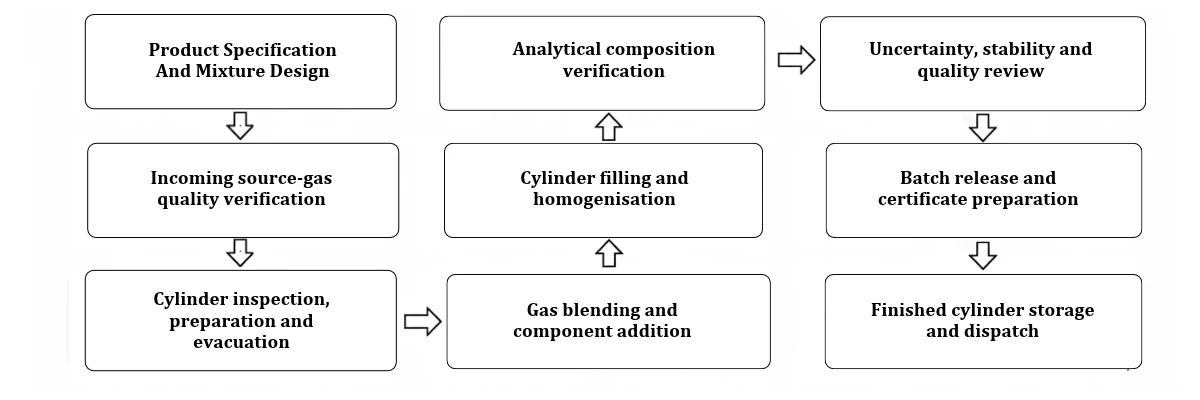
The manufacturing flow runs from cylinder preparation through sequential weighing, pressurization, and homogenization, and each stage leaves a record that the certificate depends on.
Mixed and Calibration Gas Manufacturing Process
5.1 Cylinder Preparation, Inspection and Evacuation
Cylinder preparation decides the achievable uncertainty more often than the blending does. Each cylinder is visually inspected, valve-checked, identified by a unique number and, where the service requires it, cleaned and internally treated. The cylinder is then evacuated on a manifold with a two-stage rotary-vane or dry pump, commonly to a few pascal, with heating used to drive off adsorbed moisture; trace-moisture mixtures may need prolonged evacuation or repeated fill-and-purge cycles. Tare mass, valve identity and cylinder number are recorded before any gas enters.
5.2 Gravimetric Blending in Practice
Gravimetric blending involves adding gas components to a cylinder and measuring their mass using a calibrated precision balance. The filling sequence is determined by component properties, concentration, compatibility, volatility and the preparation procedure rather than a universal highest-to-lowest concentration rule.
The measured mass of each component is converted into amount of substance using its molar mass:
Amount of substance (n) = Component mass (m) / Molar mass (M)
The mole fraction is then calculated by dividing the amount of each component by the total amount of substance in the mixture. Appropriate weighing, buoyancy and other relevant corrections are incorporated into the preparation and uncertainty calculations.
Precision balances should be selected according to cylinder capacity, component quantities and required uncertainty. Trace components may be introduced through gravimetrically prepared parent mixtures when direct addition cannot achieve the required accuracy. The final uncertainty budget should account for weighing, source gas purity, preparation and homogeneity contributions.
5.3 Filling, Pressurization and Homogenization
After the components are weighed, the cylinder is topped up with balance gas to the target pressure, commonly in the 100-200 bar range for portable cylinders, and homogenized. Homogenization is a physical requirement rather than a formality: cylinders are rolled on a roller rack, inverted, or held for a period determined by cylinder size and the density ratio of the components, and the mixing time is validated by analysing samples drawn at different intervals. Without a validated homogenization step, a gravimetric mixture can be correct in total mass and stratified at the valve end.
5.4 Reactive and Trace Mixtures: Passivation and Handling
Reactive and trace mixtures carry a different design. Hydrogen sulfide, ammonia, nitrogen dioxide, sulfur dioxide and hydrogen chloride adsorb on steel surfaces and react with residual moisture, so cylinders need internal passivation and the declared composition is set against a stability study rather than against the fill calculation.
Aluminum cylinders with treated internal surfaces, short shelf lives and lower initial pressure are common trade-offs. Schemes such as the EPA traceability protocol for continuous emission monitoring gases impose their own documentation and expiry conventions that the certificate template must accommodate.
6. Core Process Steps in a Mixed and Calibration Gas Manufacturing Plant in India: Analysis, Certification and Quality Systems
Analysis and certification convert a filled cylinder into a reference material, and the evidence trail built here is what a customer's auditor actually inspects.
6.1 Analytical Instrumentation and Test Methods
The laboratory verifies what the balance prepared. Gas chromatography with thermal conductivity detection covers permanent gases and percent-level components, flame ionization detection covers hydrocarbons, and flame photometric or sulfur chemiluminescence detection covers sulfur species at low levels. Non-dispersive infrared analysers serve carbon monoxide, carbon dioxide and sulfur dioxide, paramagnetic or electrochemical cells serve oxygen, and cavity ring-down or FTIR instruments serve trace and multicomponent work. Moisture is measured separately with a dew-point hygrometer or phosphorus pentoxide analyzer, because water is the impurity that most often invalidates a trace mixture.
6.2 Traceability, Uncertainty Budgets and Metrological Confirmation
Traceability means an unbroken chain of comparisons to national standards, documented at every link. The plant maintains working standards calibrated against reference materials from a national metrology institute or an accredited producer, and applies control charts to detect drift between calibrations. The uncertainty budget for a certificate combines preparation uncertainty, analytical uncertainty, homogeneity and stability contributions, and is stated as an expanded uncertainty at a defined coverage factor. A certificate without a stated uncertainty is a composition claim rather than a reference value.
6.3 Stability Studies, Batch Release and Shelf Life
Shelf life is established, not assumed. Stability studies hold representative cylinders of each family and re-analyze at intervals across the declared life, at defined temperatures and orientations, and the expiry on the certificate is set from the observed change with a margin. Batch release then checks the preparation record, the analytical result against specification, the uncertainty budget and the homogenization evidence before the certificate is issued. Emission monitoring customers often require both a stated expiry and a named certification protocol, so release must produce both.
6.4 Certificates, Accreditation and Out-of-Tolerance Control
Certificate acceptance is a control point in its own right: the receiving laboratory should verify producer competence, stated uncertainty, the traceability statement, expiry and the analytical method used, and record that verification. Laboratories performing testing or calibration may seek accreditation to ISO/IEC 17025:2017, and producers of certified reference materials may seek ISO 17034:2016; both are voluntary unless a customer, regulator or scheme requires them, and the scope statement rather than the logo defines what is covered.
An out-of-tolerance result triggers quarantine of the batch, root-cause analysis covering balance drift, leakage, moisture ingress and analytical bias, and a documented decision on cylinders already shipped. Performance indicators worth tracking include certificate rejection rate, out-of-tolerance frequency, calibration compliance for balances and analyzers, and cylinder requalification timeliness.
7. Machinery, Plant Layout and Utilities in a Mixed and Calibration Gas Manufacturing Plant in India
Machinery selection, hazardous-area layout and utility quality together determine whether a mixed and calibration gas manufacturing plant in India can hold its declared uncertainty in routine operation.
7.1 Blending Skids, Manifolds and Vacuum Systems
The core machinery is a gas blending and filling manifold built for the pressure and gas service: 316L stainless steel tubing, diaphragm or bellows valves, pressure regulators, non-return valves and, where required, heat-traced lines. A vacuum pump set evacuates cylinders and lines to a few pascal. Booster or diaphragm compressors move gas from a low-pressure source into cylinders where direct filling will not reach target pressure. Thermal or Coriolis mass flow controllers are needed for dynamic blending and for controlled addition of minor components.
7.2 Analytical Laboratory Layout and Equipment
The laboratory is a controlled space with dedicated ventilation, benches for balances and analytical instruments, sample and reference gas connections, and appropriate safety provisions for reactive gas handling. Depending on the product portfolio and analytical requirements, equipment may include gas chromatographs, infrared and oxygen analysers, moisture measurement instruments, cylinder sampling manifolds, and specialised equipment for reactive gases.
A dedicated weighing area with controlled temperature and humidity helps maintain measurement accuracy. Reference standards should be stored under suitable conditions and tracked through a calibration register with defined intervals and acceptance criteria. The final laboratory configuration should reflect the gas components, concentration ranges, required measurement uncertainty and applicable quality standards.
7.3 Layout, Hazardous Area Classification and Ventilation
Layout separates incompatible inventories. Oxidizers are stored away from flammable gases, full cylinders are segregated from empty, and the filling bay is arranged so cylinder movement never passes through the laboratory or office area. Hazardous-area classification should be determined through an assessment of potential gas release sources, release characteristics, ventilation and the applicable electrical safety standards.
Electrical equipment should be selected according to the resulting area classification and gas group. Mechanical ventilation, low-level extraction for heavier-than-air gases and gas detection interlocked to alarm and shutdown are engineered with the layout, not after it.
7.4 Utilities: Power, Air, Vacuum and Nitrogen
Utilities are modest in size but unforgiving in quality. A mid-size blending plant draws an indicative 150-400 kVA connected load with standby generation for the laboratory and life-safety systems; instrument air at 6-8 bar, oil-free and dried; vacuum for evacuation and sampling; liquid nitrogen storage with a vaporizer for purging and cooling; and cooling water for compressors. Ventilation, gas detection and fire suppression should sit on emergency power, since they protect the inventory rather than the process (Figures are indicative in nature, may vary).
7.5 Key Machinery
| Category | Equipment | Function | Selection considerations |
|---|---|---|---|
| Cylinder evacuation | Vacuum manifold and dry pump set | Evacuates cylinders before filling | Vacuum level and simultaneous positions |
| Gravimetric blending | Precision balance and filling skid | Measures component additions by mass | Capacity, readability and required uncertainty |
| Gas compression | Diaphragm or booster compressor | Transfers gas into cylinders at the required pressure | Gas compatibility and discharge pressure |
| Dynamic blending | Thermal or Coriolis mass flow controllers | Controls component flow during continuous blending | Flow range and measurement accuracy |
| Composition analysis | GC-TCD, GC-FID and NDIR analysers | Determines gas composition | Components and concentration ranges |
| Moisture measurement | Dew-point hygrometer | Measures moisture in gas mixtures | Required moisture detection range |
| Safety systems | Gas detectors and scrubber package | Detects gas leaks and treats designated exhaust streams | Gas properties and safety assessment |
8. Cost, DPR, Approvals and Project Economics for a Mixed and Calibration Gas Manufacturing Plant in India
Cost, documentation and approvals are one integrated work package, because the DPR that ignores the approval register produces a capital estimate nobody will finance.
8.1 CAPEX and OPEX Composition
Capital splits indicatively into blending and filling machinery, cylinders and valves, the analytical laboratory, civil works including the filling bay and storage yard, and utilities and safety systems; cylinders and analytical instruments together often exceed the cost of the manifold itself. Operating cost is dominated by source gas, then cylinder maintenance and requalification, labor, power, analytical consumables and transport, with cylinder asset replacement a real but frequently omitted line.
8.2 Detailed Project Report Contents
A Detailed Project Report (DPR) evaluates the technical feasibility, investment requirements and financial viability of a mixed and calibration gas manufacturing facility. It should cover the following areas:
| DPR Component | Key Assessment Areas |
|---|---|
| Market Assessment | Target industries, customer demand, competition and market opportunities |
| Product Portfolio | Gas components, concentration ranges, balance gases and uncertainty requirements |
| Technical Feasibility | Blending technologies, analytical methods, cylinder compatibility and quality controls |
| Production Capacity | Cylinder throughput, product mix, filling positions and laboratory capacity |
| Machinery and Equipment | Blending systems, manifolds, balances, compressors, analytical instruments and cylinder fleet |
| Raw Material Assessment | Source gas requirements, purity specifications, supplier availability, procurement costs and supply-chain reliability |
| Plant Layout | Cylinder storage, blending and filling areas, analytical laboratory, utilities, safety zones, material movement and future expansion |
| CAPEX and OPEX | Machinery, civil works, utilities, source gases, labour, maintenance and operating expenses |
| Working Capital | Gas inventory, cylinder fleet, receivables and operating requirements |
| Quality and Certification | ISO standards, traceability, uncertainty budgets, stability studies and accreditation strategy |
| Regulatory Approvals | PESO licensing, factory approvals, fire clearance and pollution control consents |
| Financial Projections | Revenue, profitability, cash flow, break-even, NPV, IRR and DSCR |
| Risk Assessment | Gas contamination, leakage, stability failures, supply interruptions and customer concentration |
| Implementation Schedule | Engineering, approvals, procurement, construction, installation and commissioning |
The DPR should use vendor quotations, customer requirements, site assessments and documented technical assumptions to establish a realistic project implementation and financial plan.
8.3 Regulatory Approvals and Quality Standards
Cylinder filling, possession and storage require licensing under the Gas Cylinders Rules, 2016, and Rule 43 of those rules establishes the licensing requirement subject to the rules' specific exemptions. Cylinders must be approved types with approved valves and are subject to periodic inspection and testing. Cryogenic storage vessels fall under the Static and Mobile Pressure Vessels (Unfired) Rules, 2016.
Relevant standards include ISO 6142-1:2015 and ISO 6142-2:2024 for gravimetric preparation of calibration gas mixtures; ISO 6143:2025 for comparison methods used to determine and verify mixture composition; ISO 6144:2003 for static volumetric preparation; and applicable parts of the ISO 6145 series for dynamic preparation. ISO 6141:2015 addresses certificate content.
ISO/IEC 17025:2017 applies to testing and calibration laboratory competence, while ISO 17034:2016 covers the competence of reference material producers. Their applicability depends on the facility's activities, product claims and accreditation objectives. Factory, fire, pollution control and local permissions depend on gas inventory and site configuration and should be confirmed for the specific project.
8.4 Risks, Revenue Model and Financial Feasibility
Revenue may come from cylinder sales and refills, custom gas mixtures, cylinder rental or deposits, and recurring supply contracts. Profitability depends on product mix, raw gas costs, cylinder utilisation, analytical requirements, production capacity and customer contracts.
Financial viability is influenced by capacity utilisation, product pricing, laboratory operating costs, cylinder fleet management and customer demand. The relative importance of these factors varies according to the product portfolio, manufacturing scale and operating model.
Principal risks include gas contamination, out-of-tolerance batches, reactive-mixture stability failures, cylinder requalification backlogs, helium and specialty gas supply interruptions, and customer concentration within a single industrial cluster.
8.5 Project Economics
The total investment for a mixed and calibration gas manufacturing plant depends on production capacity, product portfolio, analytical requirements, cylinder inventory and site infrastructure. Project costs should be established through vendor quotations, engineering estimates and site-specific assessments.
The major CAPEX components include:
- Land and Civil Works: Filling bays, laboratory, cylinder storage areas and supporting buildings.
- Plant and Machinery: Blending manifolds, precision balances, compressors, analytical instruments and cylinder fleet.
- Utilities and Installation: Electrical systems, compressed air, vacuum systems, nitrogen supply, ventilation and safety equipment.
- Engineering and Pre-operative Expenses: Feasibility studies, DPR preparation, engineering, regulatory approvals, installation and commissioning.
- Contingency: Provision for unforeseen infrastructure, equipment and implementation expenses.
Working capital should also account for source gas inventory, cylinder maintenance, operating expenses and customer receivables. Final investment estimates should be prepared using actual equipment specifications and supplier quotations.
Conclusion
A successful mixed and calibration gas facility in India must align product requirements, analytical capabilities and cylinder management from the outset. These factors determine blending technology, laboratory equipment, quality controls, and capital investment. Integrating preparation, testing, and certification into the initial design also allows future product expansion without major infrastructure changes.
The key priorities are defining the product portfolio and uncertainty requirements before equipment selection, establishing metrology and certification capabilities alongside construction, and aligning regulatory approvals with the project schedule. Early planning for Gas Cylinders Rules, 2016 licensing, factory approvals, pollution control consents and fire clearances helps prevent commissioning delays and supports commercial readiness.
PURSUING A MIXED AND CALIBRATION GAS PLANT IN INDIA?
IMARC Engineering supports industrial gas manufacturers and project sponsors throughout the project development lifecycle, from initial feasibility assessment to plant commissioning. Its services include feasibility studies, plant layout and process flow planning, equipment selection, utilities planning, regulatory advisory, and CAPEX/OPEX assessment.
→ Schedule a mixed and calibration gas scoping consultation with an IMARC Engineering specialist
Frequently Asked Questions
Setting up a calibration gas manufacturing plant involves defining the product portfolio, selecting suitable blending technologies, planning laboratory and filling infrastructure, and securing regulatory approvals. The facility must also establish quality control procedures, validate gas mixture composition, and ensure traceability before commercial production.
Mixed gas refers to any combination of gases blended for a specific industrial application. Calibration gas is a precisely formulated mixture with a defined composition and uncertainty, used to calibrate and verify analytical instruments. Certified reference gas mixtures also include documented metrological traceability.
Gravimetric gas blending is a preparation technique in which individual gas components are added to a cylinder and measured by mass. The measured quantities are used to determine the final composition. This method supports accurate preparation and traceability of calibration gas mixtures.
A calibration gas manufacturing facility requires gas blending and filling systems, cylinder evacuation manifolds, precision weighing equipment, compressors, flow controllers, and homogenization systems. Laboratory infrastructure includes gas chromatographs, gas analysers, moisture measurement instruments, certified reference standards, and cylinder sampling equipment.
The investment required depends on production capacity, product portfolio, blending technology, laboratory infrastructure, cylinder inventory, and regulatory requirements. Major cost components include land, civil construction, machinery, analytical instruments, utilities, engineering, and working capital.
Gas blending and cylinder filling facilities must obtain applicable approvals and licences under the Gas Cylinders Rules, 2016. Requirements depend on gas properties, storage arrangements, and cylinder inventory. Facilities handling cryogenic storage must also comply with the applicable static and mobile pressure vessel regulations.
Calibration gas manufacturing involves relevant ISO 6142, ISO 6143, ISO 6145, and ISO 6141 standards covering preparation, composition determination, dynamic blending, and certification. ISO/IEC 17025 and ISO 17034 are also relevant for testing laboratory accreditation and reference material production.
Standard calibration mixtures provide specified gas compositions for routine instrument calibration. Certified reference gas mixtures offer additional metrological assurance through documented uncertainty, traceability, homogeneity, and stability assessments. These characteristics support reliable measurements and compliance with quality assurance and audit requirements.
Land requirements depend on production capacity, gas inventory, storage configuration, and safety clearances. The facility layout should accommodate segregated gas storage, blending and filling operations, laboratory infrastructure, utilities, vehicle movement, and appropriate safety arrangements.
A detailed project report should cover product selection, market assessment, production capacity, blending technology, machinery, laboratory requirements, and facility layout. It should also evaluate regulatory approvals, project costs, operating expenses, working capital, quality systems, financial projections, and project viability.
Recent Post



Trusted by Industry Leaders
We partner with global enterprises and ambitious businesses across sectors to deliver operational excellence, strategic insights, and sustainable growth through integrated solutions.











Success in Their Words
Real feedback from clients across industries. Discover how our solutions delivered measurable impact and operational excellence.

I wanted to express my sincere appreciation for your efforts in handling this matter. Your dedication and commitment have been truly commendable, and it is evident that you have put in tremendous hard work and expertise into resolving the issues at hand. We are greatly interested in continuing our collaboration with you in the future, as your professionalism and reliability have made you a trusted partner. Thank you once again for your invaluable contribution. We look forward to strengthening our partnership ahead.

It has been a pleasure working with the IMARC team. The insights provided were structured, clear, and highly valuable, helping us strengthen both our technical and financial planning with confidence. We deeply appreciate the team’s professionalism, responsiveness, and attention to detail throughout the engagement. Every requirement was well understood and effectively incorporated, resulting in a comprehensive and actionable output. Overall, our experience has been excellent, and I would gladly recommend IMARC to organizations seeking a reliable research partner.

Your service is truly exceptional. Working with the IMARC team has been a seamless and professional experience. The clarity of communication, responsiveness to queries, and consistent support at every stage made the entire engagement highly efficient. The insights shared were well-structured, practical, and perfectly aligned with our requirements, helping us make informed decisions with confidence. Overall, the dedication and professionalism demonstrated by your team stand out, and I would be glad to recommend IMARC as a reliable and trustworthy research partner.

IMARC did an outstanding job in preparing our study. They were punctual, precise, and consistently responsive throughout the entire process. The team delivered all the data we required in a clear, well-organized, and highly professional format. Their strong attention to detail, combined with their ability to meet every deadline without compromising quality, truly set them apart. Overall, their reliability and commitment made them an exceptional partner for our project, and we would gladly work with them again in the future.

IMARC made the whole process incredibly easy from start to finish. Everyone I interacted with via email was polite, professional, and straightforward to deal with, always keeping their promises regarding delivery timelines and remaining consistently solutions-focused. From my very first contact, I appreciated the professionalism and support shown by the entire IMARC team. I highly recommend IMARC to anyone seeking timely, affordable, and reliable information or advice. My experience with IMARC was excellent, and I truly cannot fault any aspect of it.

I’d like to express my sincere gratitude for the excellent work you accomplished with the study. Your ability to quickly understand our requirements and deliver high-quality results under tight timelines truly reflects your expertise, exceptional work ethic, and unwavering commitment to your customer’s success. The professionalism and responsiveness you demonstrated throughout the process made a significant difference. Our entire team and company are incredibly thankful for your dedication, reliability, and support. Once again, thank you for your outstanding contribution.