Manufacturing
November 13 2026
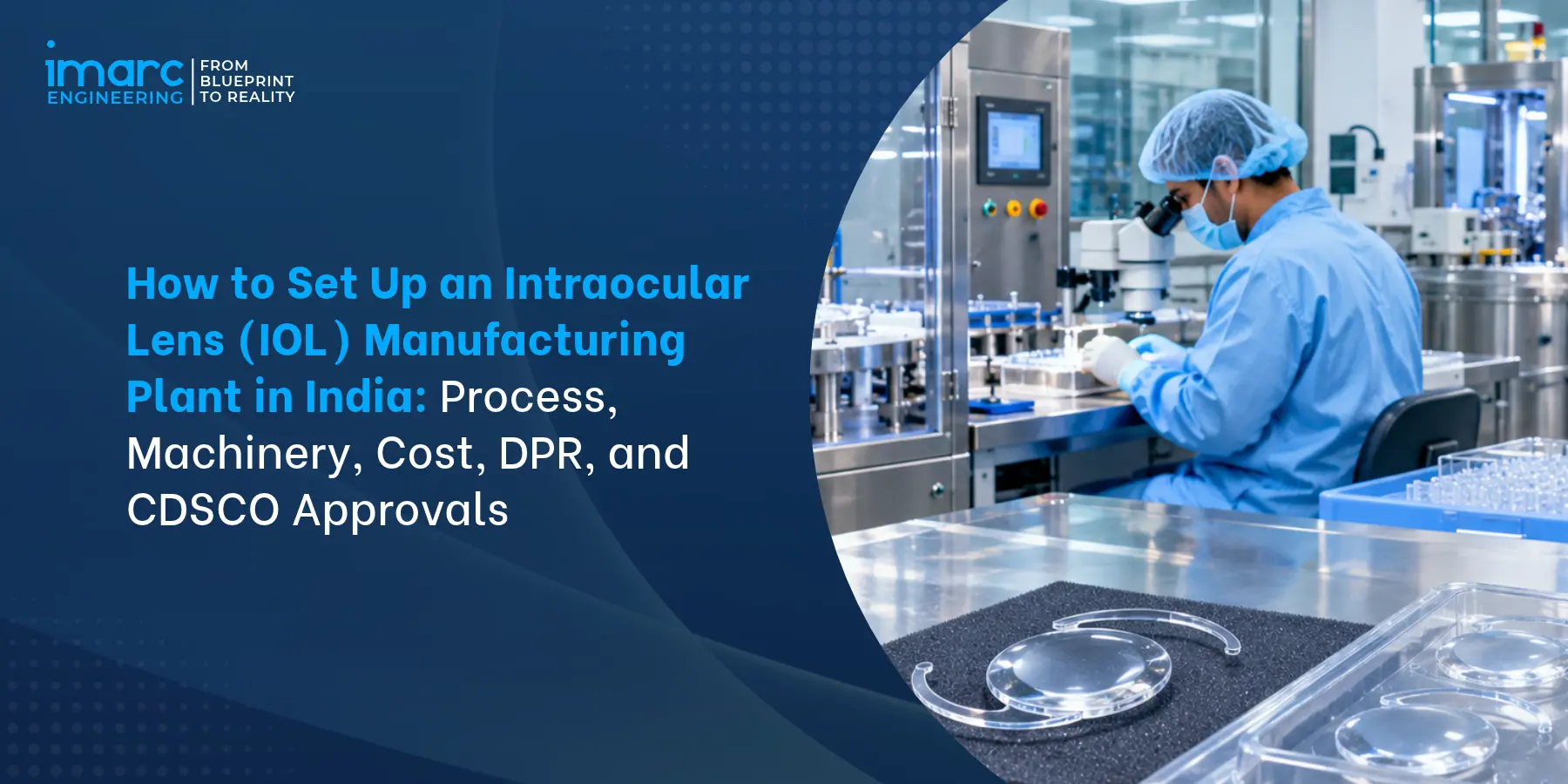
How to Set Up an Intraocular Lens (IOL) Manufacturing Plant in India: Process, Machinery, Cost, DPR, and CDSCO Approvals (2026)
Introduction
For medical device manufacturers, ophthalmic product companies and industrial investors, an intraocular lens manufacturing plant in India is a precision-optics and regulated-implant project, not a general medical device factory. The lens stays in the eye for life, so surface finish, polymer purity and sterility decide approval and commercial success.
The most expensive mistakes happen early: choosing a lens material before confirming machining capability, building a cleanroom before fixing the process route, or filing for a licence on an unconfirmed device classification. This guide shows how to sequence these decisions and prepare a DPR for a defined production capacity.
IOL projects also carry a long pre-revenue period. Machining trials, process validation, sterilisation studies and shelf-life data take many months, and surgeons adopt a new lens brand cautiously. Funding plans and launch strategy should allow for both.
Scope of this Guide
This guide answers one question: how can investors establish an IOL manufacturing unit in India while evaluating manufacturing technology, precision equipment, regulatory compliance, capital investment and financial feasibility?
It separates full lens manufacturing, from polymer to sterile lens, from limited-scope operations such as finishing, packaging or relabelling imported lenses. It covers lens types, process, machinery, cleanrooms, testing, cost, the DPR, CDSCO approvals, financial risks and a setup checklist. Cost guidance is a framework, not benchmarks.
Table of Contents
- Introduction
- Intraocular Lens Manufacturing in India: Market Demand, Policy Support and Investment Case
- Types of Intraocular Lenses: Materials, Optical Designs and Their Impact on Plant Design
- How to Set Up an Intraocular Lens Manufacturing Unit in India: Step-by-Step Approach
- Intraocular Lens Manufacturing Process: From Lens Blank to Sterile Packaged Lens
- Machinery Required for IOL Manufacturing: Lathes, CNC Mills, Polishing and Metrology
- Cleanroom Requirements, Plant Layout and Utilities for an IOL Manufacturing Plant
- IOL Quality Testing and Validation: Optical, Mechanical, Biocompatibility and Sterility
- Intraocular Lens Manufacturing Plant Cost in India: CAPEX, OPEX and Working Capital
- Preparing a DPR for an Intraocular Lens Manufacturing Plant: Capacity, Costs and Projections
- CDSCO Approvals, Licensing Pathway and Quality Standards for IOL Manufacturing
- Financial Feasibility and Key Project Risks for an IOL Manufacturing Plant
- IOL Manufacturing Plant Setup and DPR Checklist for Investors
- How IMARC Engineering Supports Intraocular Lens Manufacturing Projects in India
- Conclusion
1. Intraocular Lens Manufacturing in India: Market Demand, Policy Support and Investment Case
Four conditions shape the investment case for an intraocular lens manufacturing unit in India, and each affects the plant configuration worth funding.
1.1 Market Applications and Demand Channels
Cataract surgery is among the highest-volume surgical procedures in India, driven by an ageing population and expanding eye-care networks. Modern cataract surgery normally implants an intraocular lens, so demand follows surgical volumes rather than discretionary spending.
Demand flows through three channels: government and charitable eye programmes that buy large volumes at low prices, eye hospital chains that negotiate on volume, and private surgeons who increasingly ask for premium optics. Each channel rewards a different product and price position.
1.2 Project Opportunities by Lens Segment and Customer Type
The opportunity depends on the segment targeted. Volume monofocals, toric lenses and premium multifocal or extended-depth designs differ in technical difficulty, competition and pricing, so the feasibility study should map current domestic and imported supply for each segment, using credible data, before fixing the product range.
Fix the target customer before the lens portfolio. A plant built for high-volume hydrophilic monofocals for eye programmes needs a different design, cost structure and sales effort from one aimed at premium hydrophobic lenses for private hospitals.
1.3 Policy Support and Medical Device Clusters
Central support for medical device manufacturing includes the Production Linked Incentive (PLI) Scheme for medical devices, which was extended up to FY 2035-36 on 10 November 2026, with fresh applications invited under revised guidelines. Applicants should verify the current eligible product categories, investment conditions and application requirements before including any incentive in the project model.
Under the Promotion of Medical Device Parks scheme, parks were approved in Uttar Pradesh (YEIDA), Madhya Pradesh (Ujjain), Tamil Nadu (Oragadam, Kancheepuram) and Himachal Pradesh (Nalagarh). State-led options include AMTZ in Visakhapatnam and the Telangana medical devices park.
Scheme windows, eligibility and park readiness change over time, so confirm current status with the Department of Pharmaceuticals and the relevant state agency before modelling any incentive. Treat incentives as upside, not as the basis of viability. A plant that only works with a subsidy is fragile, because disbursement timing and conditions can change during a long project.
1.4 Key Investment Considerations and Common Early Mistakes
Three failures recur. Lens designs are frozen before machining trials, so surface quality and yield fall short. Cleanrooms are specified before the process route, forcing HVAC rework. Licence applications are filed before the classification, quality system and test evidence are ready, adding months of queries.
A fourth failure is under-budgeting working capital. Many powers and models create slow-moving stock, and hospital customers often take extended credit, so cash needs run well ahead of sales.
2. Types of Intraocular Lenses: Materials, Optical Designs and Their Impact on Plant Design
Lens type drives the whole plant, because each material and optical design needs a different machining, cleaning and sterilisation route.
2.1 Lens Materials: Hydrophobic Acrylic, Hydrophilic Acrylic and PMMA
Hydrophobic acrylic IOLs are foldable and widely associated with lower rates of posterior capsule opacification. Many hydrophobic acrylics are soft at room temperature, so manufacturers often cool them before lathing; the actual machining temperature depends on the polymer and its glass transition temperature.
Hydrophilic acrylic IOLs are usually HEMA-based copolymers, typically machined dry and hydrated afterwards under a validated process. PMMA intraocular lenses are rigid, generally machined at room temperature and low in cost, but need a larger incision, so demand is shifting to foldable designs.
| Material | Typical form | Typical machining approach | Common sterilisation methods | Market position |
|---|---|---|---|---|
| Hydrophobic acrylic | Foldable; one-piece or three-piece | Often lathed after cooling | Commonly ethylene oxide | Mid-range to premium |
| Hydrophilic acrylic | Foldable; usually one-piece | Usually lathed dry, then hydrated | Often moist heat, packed hydrated | Volume and mid-range |
| PMMA | Rigid; usually one-piece | Generally lathed at room temperature | Commonly ethylene oxide | Entry-level, declining share |
These are common approaches, not universal rules. Machining conditions, any hydration step and the sterilisation method must be set for each material and design, and validated for the specific product.
2.2 Optical Designs: Monofocal, Toric, Multifocal and Extended Depth of Focus
Monofocal lenses correct distance vision with a spherical or aspheric optic. Toric lenses add cylinder power and axis marks to correct astigmatism. Multifocal and extended-depth-of-focus lenses use diffractive or refractive zones to extend the range of clear vision.
Premium designs demand much tighter machining and metrology. Diffractive steps are only micrometres high, and toric lenses need precise axis alignment, so most entrants start with aspheric monofocals and add premium designs once process capability is proven.
2.3 One-Piece and Three-Piece IOL Designs
One-piece lenses machine the optic and haptics from a single blank, which suits acrylic materials and preloaded injectors. Three-piece lenses attach separate haptics, typically PMMA or polypropylene, to the optic, adding assembly steps and inspection points. Optic and haptic design governs centration and stability.
3. How to Set Up an Intraocular Lens Manufacturing Unit in India: Step-by-Step Approach
IOL manufacturing plant setup in India runs through five stages, and each contains decisions that are expensive to reverse.
3.1 Feasibility Study and Lens Portfolio Definition
Start with an intraocular lens manufacturing feasibility study that tests demand, channel pricing, competition and regulatory timelines. Then fix the product portfolio: materials, designs, power range and launch volumes. Every later decision, from machinery to cleanroom class, follows from this definition.
3.2 Full Manufacturing Versus Limited-Scope Operations
Three scopes are common. Finishing, packaging or relabelling imported lenses needs the least capital but offers little control over design or cost. Manufacturing from purchased blanks removes polymer chemistry risk but ties margins to the blank supplier.
Fully integrated production, from monomer casting to sterile lens, adds curing, extraction and chemical safety obligations, but gives the most cost control and design freedom. Many entrants start with purchased blanks and move to in-house casting once volumes justify it.
Regulatory responsibility follows the activity. Under the Drugs and Cosmetics Act, manufacture includes finishing, packing and labelling, so limited-scope operations may still need a manufacturing licence, alongside an import licence for the lenses they bring in. The table summarises each scope.
| Scope | What the plant does | Licensing route | Key regulatory responsibilities |
|---|---|---|---|
| Full manufacturing | Casts polymer and makes finished sterile lenses | Manufacturing licence (Form MD-7 application, Form MD-9 licence) | The whole device: design, materials, processes, sterilisation validation, quality system and post-market surveillance |
| Purchased-blank manufacturing | Machines finished lenses from bought blanks | Manufacturing licence (Form MD-7 application, Form MD-9 licence) | Same as full manufacturing for the finished lens, plus supplier qualification, incoming inspection and change control for blanks |
| Limited-scope imported-lens operations | Finishes, packs, labels or sterilises lenses made elsewhere | Import licence (Form MD-14 application, Form MD-15 licence) for the imported lenses; manufacturing licence (Form MD-7 application, Form MD-9 licence) for steps that count as manufacture | Importer duties for the imported product and manufacturer duties for each process performed, including label claims and post-market surveillance under its name |
3.3 Technology Selection: Lathe Cutting Versus Cast Moulding
Choose the forming route by material and volume. Lathe cutting from blanks gives design flexibility and suits most new plants. Cast moulding of finished lenses can lower unit cost at high volumes, but needs precision mould tooling and offers less flexibility. Confirm the route through machining trials.
3.4 Site Selection Criteria for an IOL Manufacturing Plant
Choose a site with stable power, vibration-free ground, low dust exposure, access to sterilisation and testing services, and a pool of trainable technicians. Avoid locations near heavy road, rail or press-shop vibration, which cannot be engineered away cheaply once lathes are installed.
3.5 Project Execution Sequence: From Machining Trials to Commissioning
Execution follows a fixed order: machining trials, detailed engineering, long-lead equipment orders, cleanroom construction, equipment qualification, process validation, licence application, sterilisation and shelf-life studies, and plant commissioning. Regulatory and validation work should run in parallel with engineering, not after it.
4. Intraocular Lens Manufacturing Process: From Lens Blank to Sterile Packaged Lens
The intraocular lens manufacturing process combines polymer chemistry, ultra-precision machining and medical device quality control. The steps below describe full manufacturing; blank-based plants start at lathe cutting.
4.1 Lens Blank Preparation
In integrated plants, filtered and degassed monomer mixes with crosslinkers, initiators and UV absorbers are cast into rods or sheets and cured under nitrogen on a controlled temperature profile. Residual monomer is then removed by extraction and checked by chromatography.
Blanks are cut into buttons, conditioned to relieve stress and tested lot by lot for machinability. Curing defects such as bubbles, voids or uneven stress later appear as machining failures or optical haze, so cure control is a yield lever, not just a chemistry step.
4.2 Precision Lathe Cutting of the Optic
Ultra-precision diamond-turning lathes cut the anterior and posterior optic surfaces that set lens power and asphericity. Cutting temperature depends on the material: many hydrophobic acrylics are cut cooled, while hydrophilic acrylic and PMMA are often cut at or near room temperature, as qualified for each polymer. Thermal stability, vibration isolation and tool condition control surface form and finish.
Cutting programmes, feed rates and tool geometry are material-specific. A documented process window, with first-article checks after each tool change, keeps power consistent from lens to lens.
4.3 CNC Machining of Haptics and Edges
For one-piece lenses, CNC micro-milling cuts the haptics and optic edge from the turned blank. Three-piece lenses have holes drilled in the optic to hold separate haptics. A sharp, well-finished posterior edge helps limit posterior capsule opacification, so edge profile is a defined control point.
4.4 Lens Polishing, Cleaning and Hydration
Tumble polishing with fine media removes tool marks and smooths non-optical edges under controlled time and temperature. Ultrasonic cleaning, using purified water and any solvents qualified for the lens material, then removes particles and residues. Hydrophilic lenses go through a validated hydration step and are checked for water content and power shift.
Polishing must remove marks without distorting the optic, so batch size, media wear and fluid condition are monitored. Cleaning validation must show that no polishing or solvent residue remains.
4.5 Lens Inspection, Packaging and Sterilisation
Every lens is inspected individually under magnification, or by automated vision, for scratches, voids, haze and edge defects, and tested for power and image quality. Accepted lenses are packed in validated sterile barrier systems and sterilised by a method selected and validated for the specific material, design and packaging. Ethylene oxide and moist heat are both used.
| Process step | Purpose | Key control |
|---|---|---|
| Blank preparation | Produce stress-free optical polymer | Cure profile, residual monomer |
| Lathe cutting | Form optic surfaces and power | Surface form, roughness, power |
| Haptic and edge machining | Form haptics and square edge | Dimensions, edge profile |
| Polishing and cleaning | Remove tool marks and residues | Surface quality, cleanliness |
| Hydration (hydrophilic only) | Reach final water content | Water content, power shift |
| Inspection and testing | Verify every lens | Cosmetic defects, power, MTF |
| Packaging and sterilisation | Deliver a sterile implant | Seal integrity, sterility assurance, residuals |
5. Machinery Required for IOL Manufacturing: Lathes, CNC Mills, Polishing and Metrology
IOL manufacturing machinery accounts for a large share of capital and most technical risk, so selection should be driven by proven performance on the buyer's own lens design.
5.1 Precision Lathes and CNC Machines
Ultra-precision diamond-turning lathes are the core asset. Specify them on form accuracy, surface roughness, thermal stability and spindle performance, with cooling capability where the chosen material needs it. CNC micro-mills handle haptics and edges. Most of this equipment is imported, with long lead times.
Make acceptance trials on your own lens design part of the purchase contract, and tie vendor commitments to surface quality, installation, operator training, tooling support and local service response.
5.2 Moulding Equipment Where Applicable
Cast moulding of finished lenses or optics needs precision mould tooling, dosing and curing equipment and mould inspection. It suits high, stable volumes of a narrow design range and is rarely the first choice for a new plant.
5.3 Polishing and Cleaning Equipment
Tumble polishers with controlled media and fluid, multi-stage ultrasonic cleaning lines, purified-water systems and drying equipment complete the finishing line. Hydrophilic lines also need hydration and equilibration tanks.
5.4 Inspection and Optical Metrology
Optical metrology equipment measures lens power, modulation transfer function (MTF) and resolution to ISO 11979-2. Interferometers or surface profilers check optic form, and microscopes, profile projectors or vision systems handle cosmetic and dimensional inspection. Mechanical testers cover the haptic tests in ISO 11979-3.
| Machinery | Function | Selection criteria |
|---|---|---|
| Curing ovens (integrated plants) | Polymerise monomer into rods or sheets | Temperature uniformity, nitrogen purge, profile control |
| Ultra-precision diamond lathes | Cut optic surfaces | Form accuracy, surface finish, thermal stability, cooling option |
| CNC micro-mills | Cut haptics and edges | Positioning accuracy, fixturing, edge quality |
| Tumble polishers | Remove tool marks | Repeatability, media and fluid control |
| Ultrasonic cleaning lines | Remove particles and residues | Number of stages, water quality, validation support |
| Optical benches | Measure power, MTF and resolution | ISO 11979-2 methods, range of designs covered |
| Interferometers and profilers | Check surface form | Resolution, measurement speed |
| Microscopes and vision systems | Cosmetic and dimensional inspection | Magnification, repeatability, automation |
| Mechanical testers | Haptic compression and fatigue tests | ISO 11979-3 methods |
| Pouch or blister sealers | Seal sterile barrier packs | Validated sealing parameters |
Where ethylene oxide is used, sterilisation is often contracted to a validated external facility, so transport and scheduling belong in the lead-time plan.
6. Cleanroom Requirements, Plant Layout and Utilities for an IOL Manufacturing Plant
Medical device cleanroom manufacturing for IOLs should be specified by process step and contamination risk, not by a single blanket class.
6.1 Cleanroom Classification for IOL Manufacturing Areas
Cleanroom classifications should be determined through a documented contamination-control risk assessment, considering the lens material, manufacturing process, cleaning requirements, product exposure and sterile-barrier packaging operations. The selected ISO 14644-1 classification, environmental monitoring and qualification requirements should be justified for each production area.
6.2 HVAC and Contamination Control
HVAC must hold stable temperature and humidity for machining accuracy and material stability, with pressure cascades between zones, gowning airlocks and pass boxes. India's monsoon humidity and dust loads raise HVAC duty, so dehumidification and filtration need generous margins.
Routine monitoring of particles, pressure differentials, temperature and humidity, plus periodic requalification, keeps the cleanroom within its validated state.
6.3 Plant Layout and Personnel and Material Flow
Layout should flow in one direction from stores through casting, machining, cleaning, inspection and packaging to quarantine and dispatch, with separate routes for personnel, materials and waste. Lathes need vibration-isolated foundations, and monomer and solvent areas need segregation and ventilation.
6.4 Utilities and Chemical Safety
Key utilities are stable power with UPS for lathes and metrology, DG backup, purified water, oil-free compressed air, nitrogen for casting and redundant HVAC chillers. Utility loads depend on capacity and process route, so size them from equipment data rather than generic benchmarks.
Monomers and solvents need cool, flameproof, ventilated storage with spill containment, and staff should be trained on methacrylate sensitisation risks. Workplace safety obligations follow the Occupational Safety, Health and Working Conditions Code, 2020 and the applicable state rules.
7. IOL Quality Testing and Validation: Optical, Mechanical, Biocompatibility and Sterility
Testing and validation turn machined lenses into documented, sterile and traceable implants that regulators and surgeons will accept.
7.1 Optical Performance Testing
Optical testing measures dioptric power, image quality (MTF) and spectral transmittance using ISO 11979-2 methods, with power tolerances that widen at higher powers. Every lens is also inspected for cosmetic defects, with defect catalogues and inspector requalification keeping judgments consistent.
7.2 Dimensional and Mechanical Inspection
Dimensional checks cover optic and overall diameter, thickness, haptic angle and edge profile. ISO 11979-3 mechanical tests include haptic compression force, axial displacement, optic decentration and tilt, and dynamic fatigue. Destructive tests consume lenses, so sampling plans belong in the yield model.
7.3 Material Evaluation and Biocompatibility Testing
Material evaluation covers refractive index, water content for hydrophilic grades, residual monomer and extractables, and glistenings for acrylics. Biocompatibility testing follows ISO 10993-1 and ISO 11979-5 at accredited laboratories, and should start early because some studies take months.
7.4 Sterilisation Validation and Shelf Life
Sterilisation must be validated for each product family, covering lens material, design, packaging and load configuration. Ethylene oxide is validated to ISO 11135 and moist heat to ISO 17665, typically to a sterility assurance level of 10^-6, with routine monitoring and revalidation after significant changes.
Where ethylene oxide is used, residues of ethylene oxide and ethylene chlorohydrin must meet ISO 10993-7 limits. The sterile barrier system is validated to ISO 11607-1 for materials and design and ISO 11607-2 for forming, sealing and assembly, including seal strength and package integrity.
Shelf life and transport stability are demonstrated to ISO 11979-6 through real-time or accelerated ageing that covers optical and mechanical properties, sterility maintenance and package integrity. The labelled expiry must be supported by data on the final sterilised product in its commercial packaging.
7.5 Process Validation, Risk Management and Traceability
Process validation (IQ, OQ, PQ) covers casting, machining, cleaning, packaging and sterilisation. ISO 14971 risk management links hazards to controls, and lot traceability ties each lens to its polymer batch, machine run, operator, sterilisation cycle and test data.
| Test or validation | Standard | Purpose |
|---|---|---|
| Dioptric power, MTF, spectral transmittance | ISO 11979-2 | Optical performance |
| Haptic compression, decentration, tilt, fatigue | ISO 11979-3 | Mechanical performance |
| Biocompatibility | ISO 10993-1, ISO 11979-5 | Biological safety |
| EtO residuals | ISO 10993-7 | Patient safety after EtO sterilisation |
| Sterilisation validation | ISO 11135 (EtO), ISO 17665 (moist heat) | Sterility assurance |
| Packaging integrity | ISO 11607 | Sterile barrier performance (ISO 11607-1 and 11607-2) |
| Shelf life and transport stability | ISO 11979-6 | Supports the labelled shelf life |
| Cleanroom classification | ISO 14644-1 | Environmental control |
8. Intraocular Lens Manufacturing Plant Cost in India: CAPEX, OPEX and Working Capital
Intraocular lens manufacturing plant cost depends on scope, materials, designs, capacity and automation, so it should be built from quotations rather than generic benchmarks. The framework below shows what to include.
8.1 CAPEX Components of an IOL Manufacturing Plant
Capital cost covers land or lease, building and civil works, cleanrooms and HVAC, machinery, metrology and QC laboratory equipment, utilities, installation and qualification, engineering and project management, validation and regulatory work, pre-operative expenses and contingency.
8.2 OPEX Components and Recurring Cost Drivers
Operating cost covers lens blanks or monomers, haptic material, diamond tooling, polishing media, packaging, sterilisation, labour, utilities, testing, maintenance, calibration, quality assurance and regulatory upkeep. Tooling wear and testing consumables are often underestimated.
8.3 Working Capital Requirements for an IOL Plant
Working capital covers raw material and packaging inventory, work in progress during validation and sterilisation release, finished stock across many powers, and receivables from hospitals and distributors that often take extended credit.
| Cost head | What it includes | Main cost driver |
|---|---|---|
| Building and cleanrooms | Civil works, cleanroom panels, HVAC, environmental monitoring | Cleanroom area and class |
| Machinery | Lathes, mills, polishers, cleaning lines, curing ovens | Capacity, materials and designs |
| QC and metrology | Optical benches, interferometers, mechanical testers | Product range; in-house or outsourced testing |
| Utilities | Power, UPS, DG, purified water, compressed air, nitrogen | Capacity and process route |
| Validation and regulatory | IQ, OQ, PQ; sterilisation, biocompatibility and shelf-life studies; licensing | Number of models and materials |
| Engineering and project management | Design, procurement and construction supervision | Project complexity |
| Contingency | Allowance for scope and price changes | Design maturity |
| Working capital | Inventory, receivables and pre-revenue costs | SKU range and customer credit terms |
9. Preparing a DPR for an Intraocular Lens Manufacturing Plant: Capacity, Costs and Projections
An IOL manufacturing project report, or intraocular lens plant DPR, should tie every cost and revenue line to verifiable technical assumptions. The table below sets out what a bankable DPR should cover.
| DPR component | What to cover |
|---|---|
| Product portfolio | Lens designs, materials and intended production volumes |
| Technical feasibility | Manufacturing route, precision requirements and technology availability |
| Production capacity | Annual saleable units, equipment throughput, rejection rates and utilisation |
| Machinery and infrastructure | Equipment specifications, cleanroom requirements and utility loads |
| Regulatory strategy | Confirmed CDSCO classification, licence pathway, testing and validation plan |
| CAPEX | Machinery, cleanrooms, QC laboratory, installation, engineering and contingency |
| OPEX | Lens materials, labour, utilities, packaging, testing, maintenance and quality assurance |
| Working capital | Raw material inventory, receivables, production cycle and operating cash |
| Financial projections | Revenue, cash flow, DSCR, NPV, IRR, break-even and sensitivity analysis |
| Implementation schedule | Design, procurement, construction, qualification, regulatory review and commissioning |
9.1 Calculating CAPEX and OPEX
CAPEX estimation is built bottom-up from quotations for each cost head, plus contingency. OPEX planning works per saleable lens: material and tooling cost adjusted for cumulative yield, plus labour, utilities, testing, sterilisation and overheads spread over saleable output.
9.2 Capacity, Yield and Ramp-Up
State capacity as saleable lenses per year at a defined yield and utilisation, not as machine count. Calculate the throughput of each stage, including casting, lathing, haptic machining, polishing, cleaning, inspection, packaging and sterilisation lead time, from equipment data, staffing and shifts. The slowest stage in the specific project sets installed capacity.
Model a realistic ramp-up, with lower utilisation and yields in the first year, plus the pre-revenue period of validation and regulatory work. These periods usually decide whether debt service holds.
The tables below show the method with hypothetical figures only. They are not benchmarks for any real plant; actual rates must come from machining trials, vendor data and the project's own shift plan.
| Stage (hypothetical) | Assumed throughput | Annual capacity at 4,500 operating hours |
|---|---|---|
| Lathing | 4 lathes x 6 optics per hour | 108,000 lenses |
| Haptic and edge milling | 3 mills x 9 lenses per hour | 121,500 lenses |
| Polishing and cleaning | 30 lenses per hour | 135,000 lenses |
| Inspection and optical testing | 5 stations x 5 lenses per hour | 112,500 lenses |
| Packaging and sealing | 40 lenses per hour | 180,000 lenses |
In this example, lathing is the slowest stage, so it sets installed capacity. In another project, inspection, polishing or sterilisation lead time could be the constraint.
| Calculation step (hypothetical) | Assumption | Result |
|---|---|---|
| Operating hours | 2 shifts x 7.5 productive hours x 300 days | 4,500 hours per year |
| Installed capacity | Set by the slowest stage (lathing) | 108,000 lenses per year |
| Utilisation | 75% of installed capacity | 81,000 lenses started |
| Stage yields | Lathing 92%, milling 97%, polishing and cleaning 96%, inspection 90% | Cumulative yield of about 77.1% |
| Annual saleable output | 81,000 x 77.1% | About 62,450 saleable lenses |
9.3 Financial Projections: DSCR, NPV, IRR and Break-Even
Projections should show revenue by product and channel, operating cash flow, DSCR, NPV, IRR and break-even, with sensitivity tests on yield, selling price, utilisation and approval timing. Lenders rely on these outputs for project financing decisions.
10. CDSCO Approvals, Licensing Pathway and Quality Standards for IOL Manufacturing
CDSCO approval for IOL manufacturing is the main regulatory gate. IOLs were among the first medical devices brought under regulation in India and are now governed by the Medical Devices Rules, 2017.
10.1 Device Classification of IOLs under the Medical Devices Rules, 2017
CDSCO lists intraocular lenses as Class C, moderate-to-high risk, devices under the Medical Devices Rules, 2017. Confirm the entry for each lens model in CDSCO's current classification list before filing, as the lists are revised from time to time.
10.2 Manufacturing Licence Pathway
As a Class C device, an IOL needs a manufacturing licence from the Central Licensing Authority at CDSCO. The manufacturer applies online on Form MD-7 with device and plant master files, and the licence is issued on Form MD-9 after document review and site inspection.
A company without its own plant can instead apply for a loan licence, on Form MD-8 with the licence issued on Form MD-10, to manufacture at another manufacturer's licensed premises. The loan licensee remains responsible for the device it places on the market.
| Pathway | Application | Licence | When it applies |
|---|---|---|---|
| Manufacturing licence | Form MD-7 | Form MD-9 | Manufacture at the company's own licensed premises |
| Loan licence | Form MD-8 | Form MD-10 | Manufacture at another manufacturer's licensed premises |
| Test licence | Form MD-12 | Form MD-13 | Small quantities for testing, evaluation or demonstration before the manufacturing licence |
A test licence may be needed to make units for testing or evaluation before the manufacturing licence. Check current forms, fees and portal procedures with CDSCO at the time of filing.
10.3 Quality Management System and ISO Standards
Build the quality system on ISO 13485, which aligns with the quality management requirements of the Medical Devices Rules. ISO 14971 governs risk management, and the ISO 11979 series sets IOL-specific requirements.
| Standard | Scope | Where it applies |
|---|---|---|
| ISO 13485 | Quality management system | Whole plant, including design control |
| ISO 14971 | Risk management | Design, process and post-market activities |
| ISO 11979-2 | Optical properties and test methods | Power, MTF, transmittance |
| ISO 11979-3 | Mechanical properties and test methods | Haptic and optic mechanics |
| ISO 11979-4 | Labelling and information | Labels and instructions for use |
| ISO 11979-5 | Biocompatibility | Material safety |
| ISO 11979-6 | Shelf life and transport stability | Packaging and expiry dating |
| ISO 11979-7 and 11979-9 | Clinical investigations; multifocal IOLs | New designs and premium lenses |
| ISO 11979-8 | Fundamental requirements | Overall IOL requirements |
| ISO 10993, 11135, 17665, 11607, 14644-1, 15223-1 | Biocompatibility, sterilisation, packaging, cleanrooms, label symbols | Supporting processes |
10.4 Other Approvals: Pollution Control, Factory, Fire and PESO Clearances
Other approvals typically include State Pollution Control Board consents, factory plan approval and licence under the OSH Code where thresholds are met, fire safety approval, hazardous waste authorisation for solvent and monomer waste, and PESO licensing if solvent storage exceeds exemption limits.
11. Financial Feasibility and Key Project Risks for an IOL Manufacturing Plant
Profitability depends less on headline capacity than on how many good lenses the plant sells, at what price and in what mix.
11.1 Yield and Rejection Rates
Yield is the biggest single lever. Each stage, from casting to inspection, removes lenses, and cumulative yield sets the real cost per saleable lens. Model rejection by stage and test downside cases.
11.2 Product Mix, Pricing and Utilisation
Premium designs earn higher prices but need tighter tolerances and longer validation. Volume monofocals sell into price-sensitive tenders and eye programmes. Utilisation determines how fixed costs spread across output, so sales channels should be secured before capacity is added.
11.3 Cash Flow and Key Risks
Key risks include delayed licensing, slow surgeon adoption, yield shortfalls, dependence on imported blanks and machines, tender price pressure and working capital strain from long credit periods. Mitigation includes phased capacity, supplier qualification and conservative ramp-up assumptions.
11.4 Sensitivity Analysis for Base, Downside and Upside Cases
Run sensitivities on yield, average selling price, product mix, utilisation, approval timing, imported input costs and exchange rates. Base, downside and upside cases show lenders how DSCR responds.
12. IOL Manufacturing Plant Setup and DPR Checklist for Investors
Use this checklist before committing capital and again before commissioning.
| Stage | Checklist item |
|---|---|
| Pre-investment | Target channels and lens portfolio defined; feasibility study complete |
| Pre-investment | Manufacturing scope chosen: finishing, blank-based or fully integrated |
| Pre-investment | Device classification and licence pathway confirmed with CDSCO |
| Technical | Machining trials completed on target lens designs and materials |
| Technical | Cleanroom classes set by risk assessment; layout and flows approved |
| Technical | Machinery specified with acceptance trials and service terms |
| Financial | DPR with yield-adjusted capacity, CAPEX, OPEX, working capital and sensitivities |
| Regulatory | ISO 13485 quality system, risk file and device documentation prepared |
| Commissioning | IQ, OQ and PQ complete for equipment, cleanrooms and processes |
| Commissioning | Biocompatibility, sterilisation, packaging and shelf-life studies complete |
| Commissioning | Manufacturing licence and other approvals in hand before commercial release |
13. How IMARC Engineering Supports Intraocular Lens Manufacturing Projects in India
IMARC Engineering supports IOL projects with feasibility studies, DPR preparation, plant layout and cleanroom planning, equipment selection and sourcing, regulatory approval support and project management through to commissioning.
The scope of each engagement is defined with the client, whether the project is a finishing operation, a blank-based plant or a fully integrated intraocular lens production facility.
Conclusion
A bankable intraocular lens manufacturing plant in India aligns lens portfolio, machining capability, cleanroom design and regulatory evidence before capital is committed. Investors who fix the product and route first, prove yields through trials and build the DPR on rejection-adjusted capacity avoid the costliest failures.
A phased strategy often balances risk and return: start with a defined monofocal range, prove yield and regulatory compliance, build surgeon trust, then add toric and premium designs as capability and cash flow allow.
PURSUING AN INTRAOCULAR LENS MANUFACTURING PLANT IN INDIA?
Setting up an intraocular lens manufacturing plant in India means getting the lens portfolio, machining route, cleanroom design and CDSCO licensing pathway right before capital is committed. IMARC Engineering helps medical device manufacturers, ophthalmic product companies and investors make those decisions with confidence.
Our support covers IOL feasibility studies and DPRs, product and capacity definition, plant layout and cleanroom planning, equipment selection and sourcing, regulatory and quality-system support, and project management through qualification and commissioning, whether you plan a finishing unit, a blank-based plant or a fully integrated facility.
→ Schedule a free intraocular lens manufacturing scoping consultation with an IMARC specialist
Frequently Asked Questions
Define the target market and lens portfolio, choose the manufacturing scope, run machining trials, prepare a DPR, select a site, design the cleanroom, order machinery, build an ISO 13485 quality system, apply to CDSCO for a manufacturing licence, then qualify, validate and commission the plant.
Polymer is cast into blanks, or blanks are purchased, then diamond-lathed into optic surfaces, with haptics milled or attached. Lenses are polished, cleaned, hydrated if hydrophilic, individually inspected and tested, packed in validated sterile packaging and sterilised before lot release.
Core equipment includes ultra-precision diamond lathes, CNC micro-mills, tumble polishers, ultrasonic cleaning lines, optical benches, interferometers, inspection microscopes or vision systems, mechanical testers and pouch sealers. Integrated plants add curing ovens. Where ethylene oxide is used, sterilisation is often contracted out.
Cost depends on manufacturing scope, materials, designs, capacity and automation. CAPEX covers building, cleanrooms, machinery, metrology, utilities, validation, engineering and contingency, and should be built from vendor quotations for the specific project rather than generic benchmarks.
Lens materials are hydrophobic acrylic, hydrophilic HEMA-based acrylic or PMMA, bought as blanks or cast from monomers with crosslinkers, initiators, UV absorbers and optional blue-light filters. Haptics may use PMMA or polypropylene. Consumables include diamond tools, polishing media, solvents, purified water and packaging.
Cleanroom classes should follow a risk assessment. A common approach uses ISO Class 8 for machining and ISO Class 7 for final cleaning, inspection and packaging, with ISO Class 5 unidirectional airflow at critical steps, plus pressure cascades, gowning airlocks and controlled temperature and humidity.
Tests include individual cosmetic inspection, dioptric power, MTF and spectral transmittance (ISO 11979-2), dimensional and mechanical tests (ISO 11979-3), material and biocompatibility testing (ISO 10993, ISO 11979-5), sterilisation validation, EtO residuals and shelf-life studies (ISO 11979-6).
CDSCO lists IOLs as Class C devices under the Medical Devices Rules, 2017. Manufacturers apply to the Central Licensing Authority on Form MD-7 for a licence issued on Form MD-9; a loan licence (Form MD-8, licence Form MD-10) covers manufacturing at another licensed site. Confirm current procedures before filing.
ISO 13485 (quality management), ISO 14971 (risk management) and the ISO 11979 series (IOL-specific requirements) are central. Supporting standards include ISO 10993, ISO 11135, ISO 17665, ISO 11607, ISO 14644-1 and ISO 15223-1.
A DPR defines the product portfolio, technical feasibility, yield-adjusted capacity, machinery and infrastructure, regulatory strategy, CAPEX, OPEX, working capital, financial projections (DSCR, NPV, IRR, break-even) and an implementation schedule, supported by sensitivity analysis.
CAPEX is built bottom-up from quotations for each cost head plus contingency. OPEX is calculated per saleable lens: material and tooling cost adjusted for cumulative yield, plus labour, utilities, testing, sterilisation and overheads spread over saleable output.
Profitability depends on cumulative yield, throughput at the slowest stage, product mix, selling price by channel, utilisation, approval timing, imported input costs and working capital. Yield and utilisation usually matter most, because they set the real cost per saleable lens.
Recent Post
Trusted by Industry Leaders
We partner with global enterprises and ambitious businesses across sectors to deliver operational excellence, strategic insights, and sustainable growth through integrated solutions.











Success in Their Words
Real feedback from clients across industries. Discover how our solutions delivered measurable impact and operational excellence.

I wanted to express my sincere appreciation for your efforts in handling this matter. Your dedication and commitment have been truly commendable, and it is evident that you have put in tremendous hard work and expertise into resolving the issues at hand. We are greatly interested in continuing our collaboration with you in the future, as your professionalism and reliability have made you a trusted partner. Thank you once again for your invaluable contribution. We look forward to strengthening our partnership ahead.

It has been a pleasure working with the IMARC team. The insights provided were structured, clear, and highly valuable, helping us strengthen both our technical and financial planning with confidence. We deeply appreciate the team’s professionalism, responsiveness, and attention to detail throughout the engagement. Every requirement was well understood and effectively incorporated, resulting in a comprehensive and actionable output. Overall, our experience has been excellent, and I would gladly recommend IMARC to organizations seeking a reliable research partner.

Your service is truly exceptional. Working with the IMARC team has been a seamless and professional experience. The clarity of communication, responsiveness to queries, and consistent support at every stage made the entire engagement highly efficient. The insights shared were well-structured, practical, and perfectly aligned with our requirements, helping us make informed decisions with confidence. Overall, the dedication and professionalism demonstrated by your team stand out, and I would be glad to recommend IMARC as a reliable and trustworthy research partner.

IMARC did an outstanding job in preparing our study. They were punctual, precise, and consistently responsive throughout the entire process. The team delivered all the data we required in a clear, well-organized, and highly professional format. Their strong attention to detail, combined with their ability to meet every deadline without compromising quality, truly set them apart. Overall, their reliability and commitment made them an exceptional partner for our project, and we would gladly work with them again in the future.

IMARC made the whole process incredibly easy from start to finish. Everyone I interacted with via email was polite, professional, and straightforward to deal with, always keeping their promises regarding delivery timelines and remaining consistently solutions-focused. From my very first contact, I appreciated the professionalism and support shown by the entire IMARC team. I highly recommend IMARC to anyone seeking timely, affordable, and reliable information or advice. My experience with IMARC was excellent, and I truly cannot fault any aspect of it.

I’d like to express my sincere gratitude for the excellent work you accomplished with the study. Your ability to quickly understand our requirements and deliver high-quality results under tight timelines truly reflects your expertise, exceptional work ethic, and unwavering commitment to your customer’s success. The professionalism and responsiveness you demonstrated throughout the process made a significant difference. Our entire team and company are incredibly thankful for your dedication, reliability, and support. Once again, thank you for your outstanding contribution.