Manufacturing
November 17 2026
How to Set Up an Aluminium Window Manufacturing Plant in India: Fabrication Process, Machinery, Investment, and DPR
Introduction
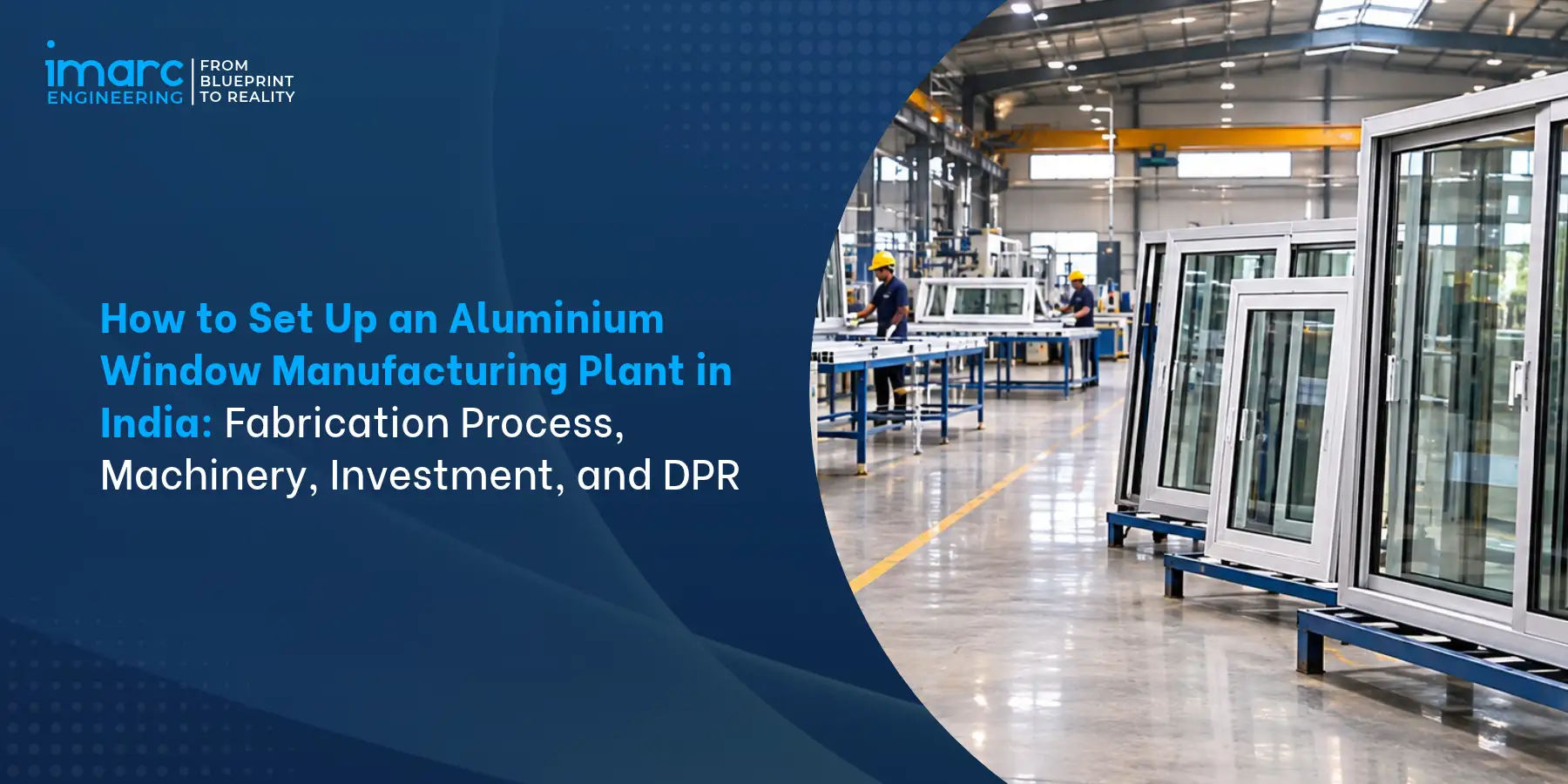
Setting up an aluminium window manufacturing plant in India involves fabricating and assembling window systems using purchased extruded aluminium profiles, rather than undertaking upstream aluminium extrusion or smelting. Demand for aluminium windows is supported by residential construction, commercial real estate, institutional infrastructure, and the growing preference for durable, low-maintenance window systems.
For investors and manufacturers, understanding the fabrication process, machinery requirements, investment costs, and regulatory considerations is essential for planning a commercially viable manufacturing facility.
Scope of this Guide
This guide walks through aluminium window manufacturing plant setup from product selection and fabrication process through machinery and raw materials, plant layout, regulatory compliance, quality testing, CAPEX/OPEX, working capital, DPR preparation with illustrative capacity, and project risks - calibrated to the BIS and regulatory framework in force in November 2026. Upstream aluminium extrusion manufacturing, aluminium smelting, and architectural glass manufacturing are separate businesses covered elsewhere.
Table of Contents
- Introduction
- Why Aluminium Window Manufacturing Plant Setup in India Matters for Investors in 2026
- Types of Aluminium Windows and Product Selection for a Manufacturing Plant in India
- Aluminium Window Manufacturing Process and Raw Materials for a Fabrication Plant in India
- Machinery, Equipment and Production Automation for an Aluminium Window Manufacturing Plant in India
- Land, Plant Layout, Utilities and Capacity Planning for an Aluminium Window Manufacturing Plant in India
- Regulatory Framework, Quality Control and Performance Testing for Aluminium Window Manufacturing in India
- CAPEX, OPEX, Working Capital and Financial Feasibility for an Aluminium Window Manufacturing Plant in India
- DPR Preparation, Project Risks and EPCM Support for an Aluminium Window Manufacturing Plant in India
- Conclusion
1. Why Aluminium Window Manufacturing Plant Setup in India Matters for Investors in 2026
Four drivers make disciplined aluminium window fabrication investment strategically important in India in 2026.
1.1 Construction Demand Across Segments
Residential housing, premium apartments, commercial office towers, IT parks, hospitals, educational institutions and hospitality projects are driving demand for aluminium doors and windows, and for the output of each aluminium doors and windows manufacturing plant that serves them. Aluminium competes with uPVC and, in some segments, steel and timber, and wins on durability, low maintenance, slim sightlines and suitability for large glazed openings.
1.2 Material and System Evolution
Product evolution from basic sliding windows to thermal-break systems, double-glazed insulated glass units, high-performance acoustic systems, and large-format casement windows has broadened the addressable market. Architectural specifications now routinely demand air permeability, water tightness, and wind-load resistance performance - raising the bar for fabrication discipline and quality control.
1.3 MSME-Friendly Entry
Aluminium window fabrication is a fabrication-and-assembly business with moderate CAPEX relative to upstream metals manufacturing. Many plants qualify as micro, small, or medium enterprises under the MSME Development Act 2006 (as amended) and can access MSME benefits such as priority-sector lending, credit guarantee cover under CGTMSE and state industrial policy incentives. The earlier Credit Linked Capital Subsidy Scheme (CLCSS) was discontinued after 2019-20, so current schemes should be verified before any subsidy is included in the financial model.
1.4 Supply-Install Revenue Lever
The business can scale from fabrication-only revenue (selling manufactured window units to contractors), to supply-and-installation revenue (supplying with on-site installation), and to project-based manufacturing against construction contracts with custom profiles and specifications. For an aluminium window fabrication business in India, each revenue mode has a distinct margin, working capital and risk profile, so the DPR should segment them clearly.
2. Types of Aluminium Windows and Product Selection for a Manufacturing Plant in India
Product selection is the first decision in aluminium window production line planning. Window type, profile system, glazing specification, and finish define machinery, workflow, and target customer segment.
2.1 Window Types
Common window types in Indian construction are sliding windows (horizontal track, two or more sashes - the highest volume segment), casement windows (side-hinged, outward or inward opening with multi-point locking), fixed windows (non-opening architectural panels), tilt-and-turn windows (dual-mode European-style for premium segments), louvred windows (ventilation applications), and bay/bow windows (projected configurations). Each type has distinct profile set, hardware list, and fabrication workflow.
2.2 Thermal Break and Standard Profiles
Non-insulated (standard) aluminium profiles, often multi-chamber extrusions, suit most Indian climatic zones. Thermal-break profiles (with polyamide insulating strips between inner and outer aluminium shells) offer reduced heat transfer - preferred for air-conditioned premium residential, commercial, and cold-climate projects. Thermal-break profiles are usually supplied pre-assembled by the extruder or system house, so the fabricator mainly needs compatible corner cleats, tooling and process discipline; inserting and rolling the polyamide strips in-house would need specialised machinery. Thermal-break systems open premium segments.
2.3 Glazing Specification
Glazing options include single glazing with float glass (IS 14900), toughened safety glass and laminated safety glass where additional safety or security performance is required. Double-glazed units (DGU), also known as insulated glass units (IGU), incorporate an air- or gas-filled cavity to improve thermal and acoustic performance.
Applicable Indian Standards should be verified according to the glass type and intended application, including relevant provisions of IS 2553 for safety glass and IS 16231 for the use of glass in buildings. Glazing selection influences aluminium profile rebate depth, hardware load capacity, sealing requirements and glass-handling equipment on the fabrication floor.
2.4 Surface Finish
Aluminium window profiles are typically supplied as pre-finished - powder coated (electrostatic polyester coating cured in oven) or anodised (electrochemical anodic oxide coating per IS 1868). Powder coated aluminium profiles are widely used in residential and commercial projects, while anodised profiles are often chosen for a metallic finish. For coastal or industrial sites, either finish can be suitable when specified to an appropriate coating class or thickness. Most fabrication plants purchase pre-finished profiles rather than finishing in-house - keeping scope on fabrication and assembly.
3. Aluminium Window Manufacturing Process and Raw Materials for a Fabrication Plant in India
The aluminium window manufacturing process is a fabrication-and-assembly workflow. Purchased aluminium profiles are cut, machined, joined, glazed, sealed, inspected, and packaged for dispatch or installation.
3.1 Profile Cutting and Machining
Profiles are received as 6-metre extrusions (powder coated or anodised), inspected on arrival, and cut to size using a double-head mitre saw (45-degree mitre cuts for crimped corners and 90-degree cuts for screwed butt joints). CNC profile machining centres perform drilling, routing, and milling for hardware cut-outs, drainage slots, locking-point mortices, and ventilation openings. End milling machines prepare the profile ends for corner joining.
3.2 Corner Joining and Frame Assembly
Corner joining uses crimping, in which a corner crimping machine presses the mitred profiles onto corner cleats (often bonded with corner adhesive), or screwing, in which profiles are fixed with screws through butt joints or into cleats. The method follows the profile system supplier's instructions. Assembled frames and sashes are checked for squareness and dimensional accuracy. Hardware installation covers hinges, locks, friction stays, multi-point locking gear, handles, rollers (for sliding), and friction brakes.
3.3 Glazing and Sealing
Glazing covers measurement, cutting (where glass is cut in-house) or receipt of pre-cut panels, insertion into the glazing rebate with glazing wedges and setting blocks, fitting of glazing beads, and installation of EPDM gaskets or silicone sealants. Weather-tightness depends on gasket specification, continuous bead, and corner sealing discipline. For DGU/IGU units, the sealed assembly is treated as a unit - handled with vacuum lifters to avoid edge damage and breakage.
3.4 Raw Materials and Components
| Material / Component | Primary Reference |
|---|---|
| Finished aluminium framed windows | IS 1948:2024 |
| Aluminium profiles (extrusions) | IS 733 (sections) and IS 1285 (tubes and hollow sections), as applicable |
| Anodised finish on profiles | IS 1868 |
| Powder-coated finish on profiles | Coating specification of the profile supplier or system house |
| Float glass | IS 14900 |
| Toughened and laminated safety glass | Applicable provisions of IS 2553, depending on glass type and intended application |
| EPDM gaskets, weather seals | Vendor-specified compound grade |
| Silicone sealants | Weather-sealing or structural grade, as the system requires |
| Hardware (locks, hinges, rollers) | System-compatible hardware with manufacturer test data |
| Thermal-break polyamide strips | Usually supplied within pre-assembled profiles |
| Packaging (edge protectors, film) | Supply-chain standard |
4. Machinery, Equipment and Production Automation for an Aluminium Window Manufacturing Plant in India
An integrated aluminium window manufacturing machinery suite covers cutting, machining, corner joining, assembly, glazing handling, and inspection. Automation level scales with target production volume and product mix.
4.1 Core Fabrication Equipment
Core fabrication equipment includes a double-head mitre saw (fixed or movable head for cutting profiles at 45 and 90 degrees), CNC profile machining centres (3-axis or 4-axis for complex profile systems), end milling machines, copy routers, corner crimping machines (hydraulic-assisted, single-corner or four-corner simultaneous for higher throughput), punching machines for hardware preparation, drilling machines, and glazing-bead saws. Semi-automatic configurations use operator-attended single-station equipment; automated configurations use integrated production lines with conveyors between stations.
4.2 Assembly and Glazing Equipment
Assembly stations include workbenches with squaring frames, hardware installation jigs, tapping and screw-driving tools, and compressed-air lines. Glass handling uses manual vacuum lifters, overhead vacuum manipulators for larger panels, and dedicated glazing tables. Glazing bead application uses pneumatic guns. Silicone sealant dispensing uses cartridge or bulk pneumatic applicators. Weather-seal insertion is typically manual with supporting tooling.
4.3 Quality and Testing Equipment
In-house quality equipment covers dimensional-check jigs for frame and sash squareness, calibrated measuring instruments, hardware functional check fixtures, and visual inspection stations. For dedicated performance testing, air permeability and water tightness test chambers (where supplied against premium project specifications) represent additional CAPEX. Most plants outsource third-party performance testing to accredited laboratories for air, water, and wind-load tests on representative window samples.
4.4 Semi-Automatic vs Automated Configurations
An aluminium window assembly plant can run in semi-automatic mode with single-station equipment and operator intervention (suitable for lower volume and higher product-mix variety, with lower CAPEX), or automated mode with integrated cutting-machining-crimping lines and material-handling automation (higher volume with narrower product-mix variety, higher CAPEX and higher consistent throughput). Most MSME-scale plants start semi-automatic and progressively automate as order volume stabilises.
5. Land, Plant Layout, Utilities and Capacity Planning for an Aluminium Window Manufacturing Plant in India
Facility layout, utilities, and capacity planning for an aluminium window factory setup are matched to target production volume, product mix, and material-flow discipline.
5.1 Land and Facility
Land requirement varies with scale and layout. Small-scale MSME units can operate from leased industrial sheds of a few thousand square feet with fabrication in one bay and finished-goods storage in another. Mid-scale units need larger covered areas for the fabrication floor, glass storage, finished goods and dispatch, sized from the layout and capacity plan. Shed clear height accommodates 6-metre-length profile handling. Ground-floor access with level loading is preferred for forklift and trolley operation.
5.2 Plant Layout and Material Flow
Material flow proceeds from profile unloading and vertical storage racks (6-metre bar storage), to cutting station, to machining and corner joining, to assembly station, to glazing and hardware installation, to final inspection, to packaging, to finished-goods storage, and to dispatch. Glass is stored upright in dedicated racks and brought to the glazing station only when needed. Hardware kits are picked from a central store per order. Linear or U-shape layout minimises cross-flow and handling.
5.3 Utilities
Utilities include single-phase and three-phase electrical supply sized for the machinery load (the connected load depends on the machinery list and automation level), compressed air at 6-8 bar for pneumatic tools and clamping, DG backup for critical loads, process water for cleaning, lighting at fabrication-grade lux levels, exhaust ventilation for aluminium dust from machining operations, and suitable dust extraction systems at saws and routers. Noise control enclosures around saws reduce workplace exposure.
5.4 Capacity Planning
Production capacity is defined in number of windows per shift, square-metre area of windows per day, or profile linear metres processed per day. The output of an aluminium window manufacturing unit depends on product mix and automation, so it should be calculated from station-level cycle times rather than assumed. Capacity planning accounts for product-mix variation (sliding, casement, fixed have different takt times), labour productivity, machine utilisation, and material-flow balancing. DPR sizing follows a disciplined bottom-up calculation per station rather than a top-down nameplate assumption.
6. Regulatory Framework, Quality Control and Performance Testing for Aluminium Window Manufacturing in India
The regulatory stack for an aluminium window fabrication plant in India combines factory, fire, environmental, and product-quality references - lighter than process industries but still specification-driven.
6.1 Factory and Labour Compliance
Factory registration and licensing requirements should be assessed under the applicable occupational safety and factory regulations, including the Occupational Safety, Health and Working Conditions Code, 2020, and relevant Central or State rules. Applicability depends on workforce size, use of power, manufacturing activities and the prevailing regulatory framework.
Worker safety provisions cover cutting-machine guarding, glass handling PPE, dust extraction at saws and routers, noise control, and first-aid. EPFO and ESIC obligations under the Code on Social Security 2020 and Code on Wages 2019 compliance apply where their thresholds are met. Udyam registration is voluntary but needed to claim MSME benefits.
6.2 Environmental and Fire Compliance
The environmental classification of an aluminium window fabrication plant depends on its manufacturing activities and applicable State Pollution Control Board requirements. Facilities limited to cutting, machining and assembling pre-finished profiles may qualify for a lower-pollution category, while operations involving powder coating, anodising or other surface treatments may require additional environmental permissions. The applicable category and requirements for Consent to Establish and Consent to Operate should be confirmed with the relevant State Pollution Control Board.
Adding in-house powder coating or anodising may change the facility's environmental classification and introduce additional consent or authorisation requirements, depending on the processes and applicable State Pollution Control Board regulations.
6.3 Product and Material Standards
The finished product standard is IS 1948:2024, Aluminium Framed Doors, Windows and Sliders (first revision), which replaced IS 1948:1961 and IS 1949:1961. Manufacturers should verify the current notification status and applicability of any Quality Control Order covering aluminium framed doors and windows under IS 1948:2024. Mandatory BIS certification requirements, implementation dates and exemptions, if applicable, should be confirmed against the latest official notifications before commercial production.
Profile references include IS 733 (wrought aluminium alloy bars, rods and sections), IS 1285 (extruded round tubes and hollow sections) and IS 1868 (anodic coatings). The Ministry of Mines withdrew the Aluminium and Aluminium Alloys (Quality Control) Order, 2023 on 13 November 2025 (S.O. 5173(E)), so BIS certification is no longer mandatory for purchased profiles under that order. Fabricators should still specify profiles conforming to these standards and check for any new Quality Control Order before procurement. Glass references include IS 14900 (float glass), IS 2553 Part 1 (safety glass) and IS 16231 (use of glass in buildings). Project tender specifications frequently invoke these standards.
6.4 Performance Testing
Window performance testing against project tender specifications covers air permeability, water tightness, wind-load resistance, and structural performance - typically to the standard method invoked by the architect or consultant (IS 1948:2024 and other BIS methods, or international methods such as ASTM E283 for air leakage, ASTM E331 for water penetration and ASTM E330 for structural performance). Test samples are prepared from production to representative dimensions and tested at accredited third-party laboratories. Routine in-house quality inspection covers dimensional accuracy, corner joint strength, gasket continuity, hardware functional smoothness, and visual finish quality.
7. CAPEX, OPEX, Working Capital and Financial Feasibility for an Aluminium Window Manufacturing Plant in India
Understanding aluminium window manufacturing plant cost needs discipline. Universal per-window or per-unit figures mislead - every plant is engineered to product mix, automation level, scale, and location.
7.1 CAPEX Drivers
Primary CAPEX drivers are fabrication machinery (double-head mitre saw, CNC machining centre, end milling, corner crimping, punching, drilling, glazing-bead saw), assembly station tooling, glass handling equipment (vacuum lifters), quality and measurement equipment, land or leasehold improvement, factory shed civil work and flooring, electrical infrastructure, compressed-air system, dust extraction, fire protection, storage racks, material-handling (forklift, trolleys), office and testing area, licensing fees, and a contingency set by design maturity and project risk. Automation level is the largest single swing.
7.2 OPEX Components
Primary OPEX components are raw materials (aluminium profiles - the dominant line, glass, hardware, EPDM, silicone, thermal-break strips - together usually the largest share of OPEX), skilled and semi-skilled labour (operators, assemblers, glazing specialists, QC inspectors, supervisors), electrical energy, DG fuel for outages, consumables (saw blades, drill bits, abrasives), maintenance and spares, packaging, freight (fabricators often absorb inbound and outbound), warranty provisions, insurance, and compliance. Aluminium price volatility (LME-linked) is the dominant OPEX-risk variable.
7.3 Working Capital
Aluminium window fabrication is working-capital sensitive. Profile inventory (6-metre bars across the product system), work-in-progress during cutting, machining, and assembly, finished-goods inventory for project dispatch, and receivables from construction contractors (often extended, and milestone-linked for project work) stretch cash. Supply-and-installation revenue extends the cycle further through on-site installation and retention release. DPR projections must model working-capital days carefully.
7.4 Financial Feasibility
Financial feasibility combines CAPEX amortised over equipment life, OPEX with aluminium and glass price assumptions, revenue segmented into fabrication-only, supply-and-installation, and project-based manufacturing streams, working capital, and standard investment metrics (NPV, IRR, payback, DSCR) as lenders require. Project feasibility sensitivity spans aluminium price, capacity utilisation (ramp-up discipline), realised price per square metre, wastage rate, and receivable days. Base-downside-upside banding supports lender appraisal.
8. DPR Preparation, Project Risks and EPCM Support for an Aluminium Window Manufacturing Plant in India
A disciplined aluminium window plant DPR integrates technical, market, financial, and implementation planning into a document that supports investment and lender appraisal.
8.1 DPR Component Framework
| DPR Component | What to Cover |
|---|---|
| Executive summary | Facility, location, product mix, investment objective |
| Market and demand | Residential, commercial, institutional, project demand |
| Product portfolio | Sliding, casement, fixed, thermal-break, DGU as selected |
| Technical feasibility | Fabrication process, profile system, glazing, automation |
| Production capacity | Windows/shift, dimensions, machine utilisation, labour |
| Raw material assessment | Profiles, glass, hardware, gaskets, supplier availability |
| Machinery and equipment | Cutting, machining, joining, glazing, handling, QC |
| Plant layout | Storage, cutting, machining, assembly, glazing, dispatch |
| Quality assurance | IS 1948:2024 conformity, incoming material checks, in-process and final inspection, third-party performance testing, QMS documentation |
| Regulatory assessment | SPCB category and consents, factory licence under the OSH Code, fire approval, BIS certification if the QCO applies, GST and Udyam |
| CAPEX and OPEX | Civil, machinery, utilities, installation; materials, labour |
| Working capital | Inventory, WIP, receivables, project payment cycles |
| Financial projections | Revenue, margin, cash flow, NPV, IRR, DSCR, break-even |
| Implementation schedule | Site readiness, procurement, installation, trials |
| Risk assessment | Raw material, order variability, wastage, quality, delays |
8.2 Illustrative Project Example
As an illustration, consider a mid-scale unit set up in a leased industrial shed, producing sliding, casement and fixed windows in standard and thermal-break profile systems. It would use semi-automatic machinery (double-head saw, CNC machining centre, four-corner crimper, assembly stations, vacuum lifters and QC equipment), size annual output to the local project pipeline and run a quality system to ISO 9001. Its CAPEX varies with automation level, scale, product mix and location, so it should be derived from vendor quotes and a bottom-up BoQ in the DPR, not from per-window benchmarks.
8.3 Common Project Risks
Primary risks include aluminium price volatility (LME-linked, margin-compressing when extruder pass-through lags), order variability from construction cycles, profile wastage from poor cutting-plan optimisation, glass breakage during handling and glazing, hardware compatibility issues across multiple OEM brands, fabrication tolerance deviations that create installation problems at site, production bottlenecks from unbalanced station capacities, delayed receivables from contractors, and quality claims on air/water performance. Mitigation includes cutting-plan software, trained operators, supplier qualification, CAR and product-liability insurance, and performance-bank-guarantee discipline on contract orders.
8.4 EPCM Support and Setup Checklist
EPCM support covers the full project lifecycle, from feasibility and a DPR with vendor-quote CAPEX through FEED, approvals, construction and installation supervision, trial production and performance acceptance. Use the checklist below before committing capital and again before commercial production.
| Stage | Checklist Item |
|---|---|
| Planning and feasibility |
|
| Engineering and procurement |
|
| Approvals and incentives |
|
| Installation and commissioning |
|
Conclusion
An effective aluminium window manufacturing plant in India in 2026 starts with the right window types and profile system, a disciplined fabrication workflow from cutting through corner joining, glazing and sealing, and machinery matched to volume and product mix. It then needs compliance with IS 1948:2024 and the relevant profile and glass standards, the applicable factory, fire and environmental requirements, and a DPR built on vendor quotes, working-capital modelling and performance testing at accredited laboratories.
Three reminders for project sponsors. First, aluminium window fabrication is not aluminium extrusion. Scope stays on fabrication from purchased pre-finished profiles - extrusion, smelting, and architectural glass manufacturing are separate businesses. Second, revenue segmentation discipline matters. Fabrication-only sales, supply-and-installation, and project-based manufacturing have different margin, working capital, and risk profiles - the DPR should model each stream explicitly. Third, aluminium price volatility (LME-linked) and receivable cycles from construction contractors are the dominant commercial risks. Monthly aluminium-price pass-through clauses in large contracts and disciplined credit control are essential.
PLANNING AN ALUMINIUM WINDOW MANUFACTURING PLANT IN INDIA?
IMARC Engineering supports investors and manufacturers with product selection, fabrication process design, machinery and automation planning, plant layout, utility planning, regulatory coordination, and quality compliance. The team also assists with DPR preparation, covering project feasibility, production capacity, machinery requirements, CAPEX and OPEX, working capital, financial projections, and risk assessment, alongside EPCM support and implementation planning from project development to commissioning.
→ Schedule a free aluminium window plant scoping consultation with an IMARC specialist
Frequently Asked Questions
Aluminium window manufacturing plant setup requires product and profile selection, DPR with vendor-quote CAPEX, land or industrial shed, FEED and layout, machinery procurement, SPCB categorisation (with consents only if required), a factory licence under the OSH Code 2020 where the threshold is met, fire approvals as applicable, BIS certification to IS 1948:2024 if the Quality Control Order applies, optional Udyam registration, and trial production with performance testing against tender specifications.
Aluminium window manufacturing process covers profile cutting on a double-head mitre saw, CNC machining for hardware cut-outs, corner crimping or screwing, frame assembly, hardware installation, glazing with EPDM gaskets, silicone sealing, final inspection, and packaging for dispatch or on-site installation.
Aluminium window fabrication machinery includes a double-head mitre saw for profile cutting, CNC profile machining centre for hardware cut-outs, end milling, corner crimping machine, punching and drilling equipment, glazing-bead saw, assembly stations, vacuum glass lifters, pneumatic tools, and dimensional-check jigs for quality inspection.
Aluminium window manufacturing investment depends on automation level (semi-automatic or fully automated line), production capacity, product mix, and location. Generic per-window figures are misleading, so CAPEX should be estimated in the DPR from vendor quotations for the specific scope and scale.
Primary raw materials are pre-finished aluminium profiles (IS 733 and IS 1285, with anodised finishes to IS 1868), glass (IS 14900 float glass and IS 2553 Part 1 safety glass, as applicable), EPDM gaskets, silicone sealants, hardware (hinges, locks, rollers, handles), and thermal-break polyamide strips where applicable.
Small-scale MSME units can operate from leased industrial sheds of a few thousand square feet. Mid-scale units need larger covered areas, sized from the layout and capacity plan, across fabrication, glass storage, finished goods, and dispatch with clear height suitable for 6-metre profile handling and level ground-floor access.
Aluminium extrusion manufacturing converts aluminium billets into profiles through heated dies a separate upstream business requiring presses, dies, and heat treatment. Window fabrication purchases pre-finished profiles and performs cutting, machining, corner joining, glazing, and assembly into finished window units a downstream fabrication-and-assembly business.
Common types are sliding windows (horizontal track, highest volume segment), casement windows (side-hinged), fixed windows (non-opening), tilt-and-turn windows (dual-mode premium), louvred windows (ventilation), and bay/bow windows. Thermal-break and Double Glazed Unit variants extend most types into premium and climate-controlled segments.
Production capacity is defined in windows per shift, square-metre area per day, or profile linear metres processed. Capacity planning uses station-level takt time, product-mix weighting, labour productivity, machine utilisation, and material-flow balancing calculated bottom-up per station rather than top-down nameplate.
Operating costs are dominated by raw materials (aluminium profiles, glass and hardware, usually the largest share of OPEX), skilled and semi-skilled labour, electrical energy, consumables, maintenance, packaging, freight, warranty provisions, insurance, and compliance. Aluminium price volatility, linked to LME prices, is the main OPEX risk.
Recent Post
Trusted by Industry Leaders
We partner with global enterprises and ambitious businesses across sectors to deliver operational excellence, strategic insights, and sustainable growth through integrated solutions.












Success in Their Words
Real feedback from clients across industries. Discover how our solutions delivered measurable impact and operational excellence.

I wanted to express my sincere appreciation for your efforts in handling this matter. Your dedication and commitment have been truly commendable, and it is evident that you have put in tremendous hard work and expertise into resolving the issues at hand. We are greatly interested in continuing our collaboration with you in the future, as your professionalism and reliability have made you a trusted partner. Thank you once again for your invaluable contribution. We look forward to strengthening our partnership ahead.

It has been a pleasure working with the IMARC team. The insights provided were structured, clear, and highly valuable, helping us strengthen both our technical and financial planning with confidence. We deeply appreciate the team’s professionalism, responsiveness, and attention to detail throughout the engagement. Every requirement was well understood and effectively incorporated, resulting in a comprehensive and actionable output. Overall, our experience has been excellent, and I would gladly recommend IMARC to organizations seeking a reliable research partner.

Your service is truly exceptional. Working with the IMARC team has been a seamless and professional experience. The clarity of communication, responsiveness to queries, and consistent support at every stage made the entire engagement highly efficient. The insights shared were well-structured, practical, and perfectly aligned with our requirements, helping us make informed decisions with confidence. Overall, the dedication and professionalism demonstrated by your team stand out, and I would be glad to recommend IMARC as a reliable and trustworthy research partner.

IMARC did an outstanding job in preparing our study. They were punctual, precise, and consistently responsive throughout the entire process. The team delivered all the data we required in a clear, well-organized, and highly professional format. Their strong attention to detail, combined with their ability to meet every deadline without compromising quality, truly set them apart. Overall, their reliability and commitment made them an exceptional partner for our project, and we would gladly work with them again in the future.

IMARC made the whole process incredibly easy from start to finish. Everyone I interacted with via email was polite, professional, and straightforward to deal with, always keeping their promises regarding delivery timelines and remaining consistently solutions-focused. From my very first contact, I appreciated the professionalism and support shown by the entire IMARC team. I highly recommend IMARC to anyone seeking timely, affordable, and reliable information or advice. My experience with IMARC was excellent, and I truly cannot fault any aspect of it.

I’d like to express my sincere gratitude for the excellent work you accomplished with the study. Your ability to quickly understand our requirements and deliver high-quality results under tight timelines truly reflects your expertise, exceptional work ethic, and unwavering commitment to your customer’s success. The professionalism and responsiveness you demonstrated throughout the process made a significant difference. Our entire team and company are incredibly thankful for your dedication, reliability, and support. Once again, thank you for your outstanding contribution.