Manufacturing
September 08 2026
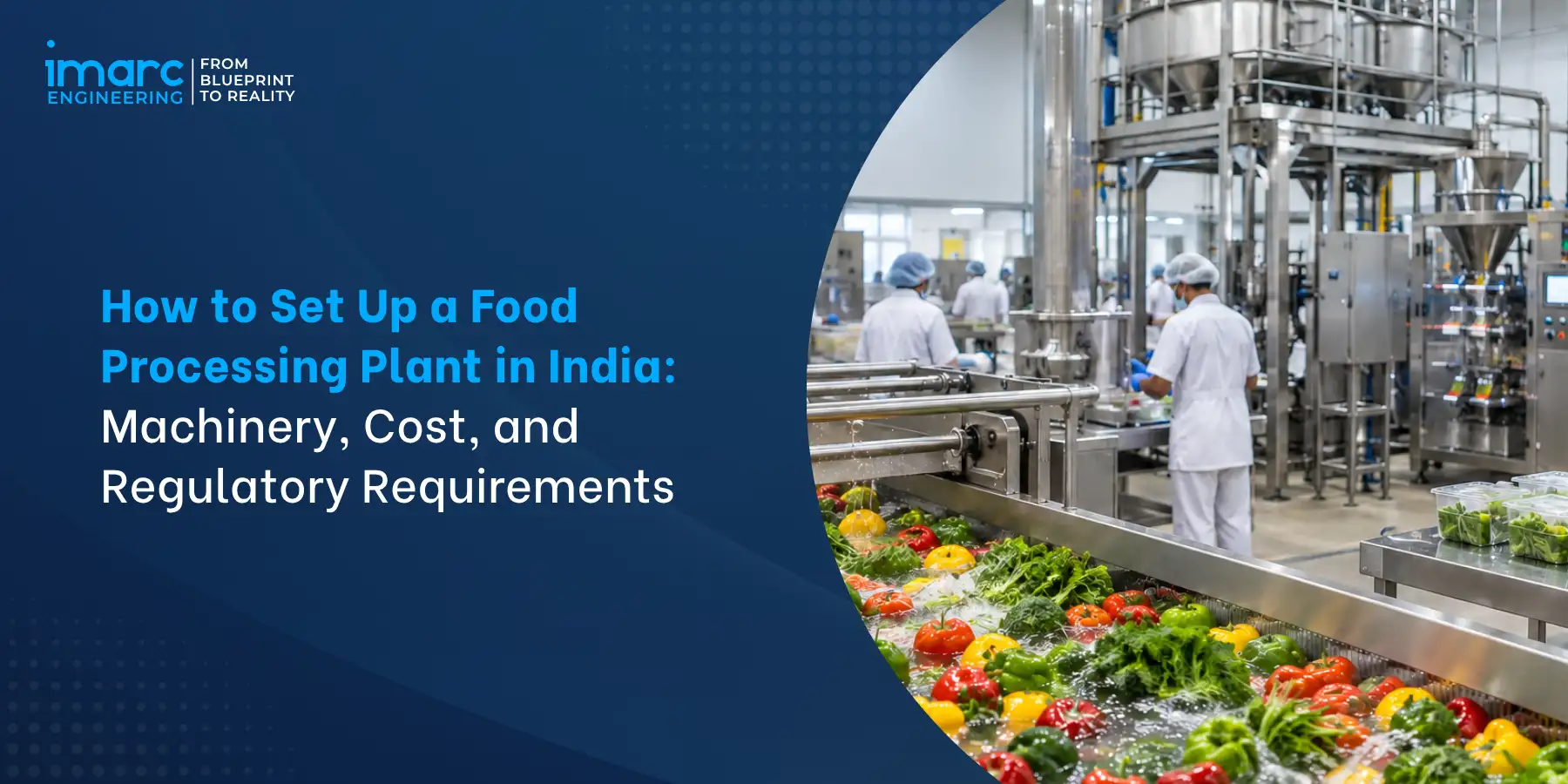
How to Set Up a Food Processing Plant in India: Machinery, Cost, and Regulatory Requirements
Introduction
For manufacturers, investors, and project developers evaluating a food processing plant in India in 2026, disciplined integration across product-market assessment, raw material strategy, hygienic facility design, food safety framework, and regulatory compliance determines commercial viability. India's food processing sector is one of the largest employment generators supported by revised FSSAI licensing framework (April 2026), Pradhan Mantri Kisan SAMPADA Yojana (PMKSY), Production Linked Incentive Scheme (PLISFPI), and PMFME schemes. Well-planned facilities integrate FSSAI compliance and hygienic design from project inception rather than retrofit corrections.
Scope of this Guide
This guide answers the sponsor's question directly. How can manufacturers and investors plan and set up a commercially viable food manufacturing plant in India based on product type, raw-material availability, production capacity, process technology, machinery, food-safety requirements, regulatory approvals, and project economics? It walks through product selection, raw material assessment, machinery selection matched to product category, hygienic facility design per HACCP and GMP, utility planning including cold chain, food safety framework, revised 2026 FSSAI licensing thresholds, and investment brackets anchored to explicit product category and capacity assumptions.
Table of Contents
- Introduction
- Why Food Processing Matters for India in 2026
- What a Food Processing Plant Is and Why It Matters in India
- Product Selection and Raw Material Assessment for Food Processing Plants in India
- Process Technology Machinery and Equipment for Food Processing Plants in India
- Hygienic Facility Design and Plant Layout for Food Processing Plants in India
- Utilities Storage and Cold Chain Infrastructure for Food Processing Plants in India
- Food Safety Quality Control and Testing for Food Processing Plants in India
- FSSAI Licensing Regulatory Approvals and Project Economics for Food Processing Plants in India
- Conclusion
1. Why Food Processing Matters for India in 2026
Four drivers make disciplined food processing plant setup a strategic priority for Indian manufacturers and investors in 2026.
1.1 Large Consumer Market and Growth
India's food processing sector serves the world's largest consumer market with sustained demand growth across dairy, fruit and vegetable processing, bakery, meat and poultry, marine products, snacks, beverages, ready-to-eat, ready-to-cook, and packaged food categories. Food manufacturing plant in India supports growing modern retail, e-commerce, and food service channels alongside traditional distribution.
Rising urbanisation, dual-income households, and convenience preferences drive processed food demand. Well-executed plants deliver competitive advantages across regional and national markets with export opportunities to Middle East, Africa, Southeast Asia, and other destinations.
1.2 Policy Support and Scheme Framework
Indian policy framework supports food processing manufacturing including Pradhan Mantri Kisan SAMPADA Yojana (PMKSY) as Central Sector Scheme with INR 4,600 crore allocation covering Integrated Cold Chain, Creation/Expansion of Food Processing/Preservation Capacities (Unit Scheme), and Food Irradiation Units.
Production Linked Incentive Scheme for Food Processing Industry (PLISFPI) with INR 10,900 crore corpus for 2021-22 to 2026-27 covering Ready-to-Eat/Ready-to-Cook, Marine Products, Fruits and Vegetables, and Mozzarella Cheese categories. PM Formalization of Micro Food Enterprises (PMFME) with INR 10,000 crore for micro units. Ministry of Food Processing Industries (MoFPI) administers these schemes with dedicated investor support portals.
1.3 Raw Material Availability
India is among the largest producers globally of milk, pulses, spices, fruits, vegetables, and marine products creating raw material availability advantages. Agricultural raw materials sourced from state-specific agri-clusters support raw material cost, freshness, and traceability advantages. However, seasonality, post-harvest losses (estimated at 5-15 percent for perishables), and supply consistency create sourcing challenges that plant design must address through storage, preservation, and processing capacity planning. Feedstock-proximate plant location minimises logistics cost and preserves raw material quality.
1.4 Regulatory Framework Clarity
Food Safety and Standards Authority of India (FSSAI) framework under Food Safety and Standards Act 2006 provides regulatory clarity for commercial food processing operations. Revised licensing framework effective 1 April 2026 (through FSS Licensing Amendment Regulations 2026) increased Central Licence threshold to INR 50 crore turnover with State Licence for INR 1.5-50 crore and Basic Registration for smaller units (with turnover less than INR 1.5 crore). Perpetual licence validity with risk-based inspections reduces compliance burden while maintaining food safety oversight.
2. What a Food Processing Plant Is and Why It Matters in India
Understanding what a food processing plant is and why it matters in India begins with defining commercial-scale food production. Food plants are integrated hygienic-manufacturing facilities rather than upgraded kitchens.
2.1 Definition and Scope
A commercial food processing plant setup in India is an integrated manufacturing facility designed and licensed to produce processed food products for commercial sale under FSSAI licence per Food Safety and Standards Act 2006 and applicable regulations. Commercial plants combine hygienic manufacturing environments matched to product category, quality management aligned with HACCP and GMP principles, validated processes, calibrated testing infrastructure, appropriate preservation systems (thermal processing, refrigeration, freezing, drying, packaging), traceability systems, and documented compliance. Food processing plants differ fundamentally from artisanal or home-based food production through regulatory-controlled facility design, batch traceability, and mandatory quality controls.
2.2 Plant Components
| Component | Function | Illustrative Elements |
|---|---|---|
| Raw Material Zone | Reception, storage, quality check | Weighbridge, storage bays, refrigeration |
| Processing Area | Product-specific processing | Cleaning, sorting, size reduction, cooking |
| Packaging Line | Filling, sealing, labelling | Filling machines, sealers, coders |
| Cold Storage | Chilled/frozen product storage | Cold rooms, blast freezers |
| Utilities | Steam, water, power, refrigeration | Boiler, chillers, cooling tower |
| Quality Lab | In-process and product testing | Analytical instruments, microbiology |
| Sanitation | Cleaning and hygiene | CIP system, chemical storage |
| Warehouse | Finished goods dispatch | Temperature-controlled zones |
2.3 Product Categories and Plant Design Impact
Product category significantly affects plant design and required infrastructure. Dairy plants require milk chilling, pasteurisation, homogenisation, and cold chain infrastructure. Fruit and vegetable processing require washing, sorting, thermal processing, and packaging (aseptic or retort). Bakery plants require flour storage, mixing, proofing, baking ovens, and packaging.
Meat processing requires chilling, deboning, cutting, and freezing with strict biosecurity. Beverage plants require water treatment, mixing, filling, and pasteurisation. Ready-to-eat plants require multiple processes with retort or aseptic packaging. Plant design decisions should follow target product category rather than universal assumptions.
3. Product Selection and Raw Material Assessment for Food Processing Plants in India
Understanding product selection and raw material assessment for food processing plants in India establishes the strategic foundation. Product and raw material decisions cascade across all engineering and cost decisions.
3.1 Product Selection Framework
- Product selection should follow market opportunity assessment, competitive landscape, and operational feasibility
- Food processing plant feasibility covers demand analysis, unit economics, capital availability, and regulatory pathway
- Product-market fit: target consumer segment, distribution channel, pricing, and brand positioning
- Shelf-life requirements affecting preservation, packaging, and cold chain decisions
- Product specifications: nutritional, sensory, physical, microbiological parameters
- Regulatory category under FSS Regulations affecting licence and compliance requirements
- PLI Scheme category eligibility (Ready-to-Eat, Marine, Fruits & Vegetables, Mozzarella Cheese)
3.2 Product Category Examples and Complexity
| Category | Examples | Complexity Indicator |
|---|---|---|
| Bakery & Confectionery | Biscuits, breads, cakes, chocolates | Moderate |
| Dairy Products | Milk, curd, cheese, ghee, milk powder | High (cold chain) |
| Fruits & Vegetables | Juices, purees, pickles, sauces | Moderate to High |
| Grain Milling | Flour, rice, pulses, ready-to-cook mixes | Low to Moderate |
| Meat & Poultry | Frozen meat, ready-to-cook, processed | High (biosecurity) |
| Marine Products | Frozen, chilled, ready-to-eat seafood | High (cold chain) |
| Beverages | Juices, soft drinks, water | Moderate |
| Snacks & Ready-to-Eat | Chips, extruded snacks, RTE meals | Moderate to High |
3.3 Raw Material Assessment
- Raw material availability within economical logistics radius supporting cost-competitive sourcing
- Raw material sourcing arrangements with farmer groups, mandis, aggregators, or direct contracts
- Seasonality assessment covering peak and lean seasons with corresponding storage/processing capacity planning
- Quality specifications and sampling protocols matched to product requirements
- Post-harvest loss considerations affecting sourcing radius and cold chain need
- Price stability and multi-source contracts reducing supply and price risk
3.4 Production Capacity Planning
Production capacity selection depends on raw material availability, target market demand, seasonality, and investment appetite. Capacity brackets range from small (500-2,000 kg/day) suited to specialty and regional products, medium (2,000-10,000 kg/day) for regional-scale operations, to large (10,000+ kg/day) for national/export scale. Capacity utilisation above 60-70 percent supports fixed cost recovery. Product-market fit and offtake commitments should be established before final capacity decisions. Over-capacity increases fixed cost burden; under-capacity limits growth flexibility.
4. Process Technology Machinery and Equipment for Food Processing Plants in India
Understanding process technology machinery and equipment for food processing plants in India covers the largest single capital investment category. Food processing plant machinery selection should match product category, capacity, automation level, and hygienic design requirements.
4.1 Manufacturing Process and Flow
- Manufacturing process development from raw material to finished product with defined critical control points
- Process flow diagram showing sequential unit operations and material transfer
- Material balance establishing raw material to finished product conversion factors and process losses
- Process parameters: temperature, time, pressure, moisture, pH per product requirements
- Standard operating procedures (SOPs) for each unit operation supporting consistency
4.2 Machinery Categories
- Raw material handling: weighbridges, conveyors, elevators, silos
- Cleaning and sorting: washers, sieves, magnetic separators, optical sorters
- Size reduction: cutters, dicers, mills, homogenisers
- Mixing and blending: mixers, kneaders, agitators, emulsifiers
- Thermal processing: cookers, ovens, retorts, pasteurisers, sterilisers
- Cooling and freezing blast freezers, plate freezers, IQF systems
- Drying: spray dryers, tray dryers, fluidised bed, freeze dryers
- Extrusion: single or twin-screw extruders for snacks and cereals
4.3 Packaging Equipment
- Packaging equipment selection depends on product format, shelf life, and distribution requirements
- Form-fill-seal (FFS) machines for flexible pouches
- Bottle filling and capping for liquids and beverages
- Tetra-pak aseptic filling for extended shelf-life liquid products
- Retort pouches for shelf-stable ready-to-eat products
- Modified atmosphere packaging (MAP) for extended freshness
- Carton erecting, filling, sealing for secondary packaging
- Coding and marking (best-before, batch code, barcode) per Legal Metrology Rules
4.4 Machinery Sources
Sources for food processing machinery range from domestic manufacturers (competitive cost, local support, faster delivery) to European (Krones, Bosch, GEA, Tetra Pak, Buhler) and Asian suppliers. Product category affects source preference - dairy and beverage equipment commonly sourced from European suppliers for premium applications while bakery, grain milling, and general processing equipment available from domestic and Asian sources.
Machinery selection should follow food-contact material specifications (typically SS 304 or SS 316L for direct contact), CIP-compatibility, and validation documentation supporting FSSAI compliance. Total machinery investment typically 40-55 percent of plant CAPEX.
5. Hygienic Facility Design and Plant Layout for Food Processing Plants in India
Understanding hygienic facility design and plant layout for food processing plants in India covers the physical infrastructure framework. Design decisions establish the operational hygiene baseline that cannot be easily retrofitted.
5.1 Hygienic Zoning
- Hygienic plant design with zoning by contamination risk (high-care, low-care, general)
- Segregated zones for raw material, processing, packaging, and finished goods
- Cascading air pressure from clean to less-clean zones preventing cross-contamination
- Temperature and humidity control per product requirements (typically 15-22°C production areas)
- Wall, floor, and ceiling materials supporting cleaning (typically epoxy floors, stainless steel/FRP walls)
- Coving between walls and floors preventing dirt accumulation
- Adequate lighting (typically 300-500 lux general, 500-750 lux inspection areas)
5.2 Material and Personnel Flow
| Flow Type | Design Principle | Key Elements |
|---|---|---|
| Material flow | Unidirectional, no backtracking | Raw material → process → packaging → dispatch |
| Personnel flow | Segregated from material flow | Dedicated entry/exit, gowning areas |
| Waste flow | Separate from clean flow | Dedicated collection and disposal route |
| Air flow | Clean to less-clean cascading | HVAC design with pressure differentials |
5.3 Factory Layout Design
Factory layout should support material flow from raw material warehouse through processing to finished goods dispatch. Adjacencies matched to process sequence. Utility area segregated from production. Quality laboratory positioned to support in-process testing. Personnel amenities (canteen, changing rooms, toilets) segregated from production. Loading dock design supporting temperature-controlled dispatch where applicable. Provision for future expansion in initial site planning. Layout finalisation should precede equipment procurement to avoid costly modifications.
5.4 Sanitation Design
- Sanitation and hygiene design integrated into facility with adequate wash-down provisions and drainage
- CIP system (Clean-in-Place) for tanks, piping, and equipment reducing manual cleaning and downtime
- Floor drains at appropriate spacing with anti-microbial trap covers
- Boot wash, hand wash, and gowning stations at zone transitions
- Pest control infrastructure including bird netting, insect screens, rodent bait stations
- Waste collection and disposal per Solid Waste Management Rules 2016
6. Utilities Storage and Cold Chain Infrastructure for Food Processing Plants in India
Understanding utilities storage and cold chain infrastructure for food processing plants in India covers the enabling systems affecting product quality and shelf life. Utility investment typically 15-20 percent of plant CAPEX with additional cold chain investment for perishable products.
6.1 Process Utilities
- Process water meeting FSSAI Regulation potable water specifications for direct-contact use
- Steam requirement from industrial boiler for cooking, sterilization, and utility applications
- HVAC system with HEPA filtration for high-care zones and temperature control per product needs
- Compressed air (oil-free, food-grade) for pneumatic controls and packaging line operation
- Power supply typically 100-1,000 kVA depending on capacity with backup DG
- Water treatment for boiler feed, process, and utility with softeners, RO, DM units
6.2 Refrigeration and Cold Chain
- Refrigeration system sized for product cooling, storage, and freezing requirements
- Cold storage with temperature zones (chilled 0-4°C, frozen -18°C or lower, deep-frozen -25°C)
- Cold chain integration through refrigerated trucks, cold storage warehouses, and last-mile distribution
- Blast freezers for rapid product freezing preserving quality
- Individual Quick Freezing (IQF) systems for particulate products
- Refrigerant selection per Ozone Layer Depletion norms
- PMKSY Integrated Cold Chain sub-scheme provides capital subsidy support
6.3 Storage Infrastructure
- Raw material storage with appropriate conditions per material characteristics (ambient, chilled, or frozen)
- Finished goods storage with temperature control matching product shelf-life requirements
- Racking systems supporting FIFO/FEFO inventory management
- Storage capacity typically 15-30 days consumption with buffer for demand variability
- Chemical and packaging material storage segregated from food contact areas
- Waste storage in dedicated area with regular disposal
6.4 Effluent and Waste Management
Effluent treatment plant (ETP) sized per plant discharge with primary, secondary, and tertiary treatment achieving SPCB discharge norms. Dairy, meat, and beverage plants typically generate high-BOD effluent requiring biological treatment (activated sludge, MBR). Wastewater treatment including in-plant recycling for non-contact use reducing fresh water demand. Waste management covering solid waste (organic waste for composting/biogas, packaging waste for recycling), and hazardous waste per applicable rules. Zero Liquid Discharge (ZLD) increasingly required for water-scarce regions.
7. Food Safety Quality Control and Testing for Food Processing Plants in India
Understanding food safety quality control and testing for food processing plants in India covers the operational discipline for regulatory compliance and consumer safety. Food safety is not overlay but integrated into every plant function.
7.1 Food Safety Management Framework
- Food safety program under FSS Act 2006 with FSSAI Schedule 4 requirements for hygiene and safety
- HACCP (Hazard Analysis and Critical Control Points) system identifying and controlling food safety hazards
- GMP (Good Manufacturing Practices) covering premises, equipment, personnel, sanitation, and documentation
- ISO 22000 Food Safety Management System (voluntary but recommended for export)
- FSSC 22000 or BRC certification for export-oriented plants
- Halal, Kosher, Organic certifications for specific market segments where applicable
7.2 Quality Control Infrastructure
- Food quality control through in-house laboratory or NABL-accredited external laboratory arrangements
- Food testing laboratory with physical, chemical, and microbiological testing capability per product requirements
- Analytical instruments (HPLC, GC, spectrophotometer) per testing scope
- Microbiological facility with autoclave, incubators, laminar flow, media preparation
- Sensory evaluation panel for organoleptic quality assessment
- Testing per FSS (Contaminants, Toxins and Residues) Regulations 2011 and product-specific standards
7.3 Traceability and Documentation
Traceability systems supporting batch tracking from raw material to finished product enabling recall management. Documentation covering raw material COAs, in-process records, finished product test reports, cleaning records, and pest control records. FSSAI Schedule 4 requires daily production and raw material utilisation records with FIFO/FEFO stock rotation. Digital traceability through ERP integration supports faster recall response and regulatory reporting. Trained sanitation and hygiene teams execute cleaning protocols with validation.
8. FSSAI Licensing Regulatory Approvals and Project Economics for Food Processing Plants in India
Understanding FSSAI licensing and regulatory approvals for food processing plants in India alongside investment capital cost and commercial viability for food processing plants in India completes the project development framework.
8.1 FSSAI Licensing Framework (Revised 2026)
| Category | Annual Turnover | Authority |
|---|---|---|
| Basic Registration | Up to INR 1.5 crore | State FSSAI |
| State Licence | INR 1.5 crore to INR 50 crore | State FSSAI |
| Central Licence | Above INR 50 crore or specified | Central FSSAI |
Food Safety and Standards (Licensing and Registration of Food Businesses) Amendment Regulations 2026 notified 10 March 2026 with FSSAI Order dated 13 March 2026 revised turnover thresholds effective 1 April 2026. Central Licence remains mandatory regardless of turnover for specified categories including dairy processing (except petty milkmen), meat processing, packaged drinking water, infant food, fishery products, health supplements, nutraceuticals, importers, exporters, e-commerce operators, and multi-state operators. Perpetual validity with risk-based inspections. 30 days prior notice required for business closure.
8.2 Other Regulatory Approvals
The approvals applicable to a food processing plant vary by product category, process, capacity, location, workforce, utilities, environmental impact and storage arrangements. The following is an indicative framework and should not be treated as a universal approval checklist.
| Approval | Authority | Framework |
|---|---|---|
| IEM Part A/B (via NSWS) | DPIIT | IDRA 1951 |
| CTE and CTO | State Pollution Control Board | Water Act 1974, Air Act 1981 |
| Factory Licence | State Directorate of Factories | OSH Code 2020 (21 Nov 2025) |
| Fire NOC | State Fire Services | NBC 2016 Part 4 |
| Legal Metrology Registration | State Legal Metrology | Legal Metrology Act 2009 |
8.3 Capital Investment by Plant Scale
| Plant Category | Capacity Assumption | Total Investment (INR) |
|---|---|---|
| Small | 500-2,000 kg/day, minimal cold chain | 50 lakh to 3 crore |
| Medium | 2,000-10,000 kg/day, moderate automation | 3-15 crore |
| Large | 10,000+ kg/day, cold storage, quality lab | 15-100 crore |
8.4 CAPEX/OPEX and Project Commissioning
- CAPEX and OPEX composition vary by product category
- Machinery and equipment: 40-55 percent of CAPEX
- Civil works and building: 15-25 percent
- Utilities and cold chain: 15-25 percent (higher for perishable products)
- Raw material cost: typically, 40-60 percent of variable operating cost
- Project commissioning covers mechanical completion, utility commissioning, trial runs, FSSAI inspection, and commercial production launch typically 12-18 months from investment decision
- Well-planned food processing plants typically achieve EBITDA margins 10-20 percent
Conclusion
Setting up a food processing plant in India involves product-market and raw material assessment, product-specific machinery and hygienic facility design, plant layout, utilities and cold-chain planning, food safety systems, FSSAI licensing, environmental and factory approvals, CAPEX assessment, eligible government schemes, and integrated commissioning. Project timelines and costs vary by product, capacity, technology, and site.
Three key reminders for food processing plant sponsors: product category should drive the entire project design, since processing methods, machinery, hygiene controls, storage, cold-chain requirements, and regulatory obligations can vary significantly between products. Hygiene and food safety should be designed into the facility from the beginning, with appropriate zoning, material and personnel flow, sanitation systems, utilities, and contamination controls rather than being addressed through costly modifications after commissioning.
Finally, regulatory and licensing requirements should always be assessed against the latest applicable FSSAI framework, along with environmental, factory, fire, and other site-specific approvals, rather than relying on outdated thresholds or generic approval checklists. Clear assumptions around product, capacity, technology, and location help sponsors develop more realistic project costs, timelines, and implementation plans.
PURSUING FOOD PROCESSING PLANT SETUP?
IMARC Engineering's food processing plant advisory team supports manufacturers, investors, and project developers with product-market and raw material assessment across dairy, fruits and vegetables, bakery, grains, meat and poultry, marine products, beverages, snacks, and ready-to-eat products. Services cover machinery selection, hygienic facility and plant layout design, utilities and cold-chain planning, food safety systems including HACCP and GMP, capacity and investment assessment, regulatory approvals, government scheme advisory, and integrated commissioning for compliant commercial production.
→ Schedule a free food processing plant scoping consultation with an IMARC specialist
Frequently Asked Questions
Setting up a food processing plant in India involves product selection, raw material assessment, capacity planning, process/machinery selection, hygienic facility design, utility planning, FSSAI licence per revised 2026 turnover threshold, SPCB CTE/CTO, factory licence under OSH Code 2020, Fire NOC, and commissioning across 12-18 months.
Food processing plant cost in India varies significantly with product category, capacity, and automation. Small units (500-2,000 kg/day) require INR 50 lakh to 3 crore; medium plants INR 3-15 crore; large plants with cold storage and quality infrastructure INR 15-100 crore excluding land and building.
Food processing plant machinery varies by product category. Common categories include raw material handling, cleaning/sorting, size reduction, mixing/blending, cooking/processing, cooling, packaging, and material handling. Specific machinery depends on product (grain milling, dairy processing, fruit and vegetable processing, meat processing, bakery, beverages) with different equipment configurations.
Location selection depends on raw material proximity (minimising freight and preserving freshness), infrastructure (power, water, logistics), Mega Food Park designation under PMKSY, and market access. Capacity depends on raw material availability, seasonality, target market demand, and investment appetite. Cold chain requirements affect coastal/inland decisions.
Food processing plant utilities include process water (potable/food-grade), steam (from industrial boiler), refrigeration/cold storage systems, HVAC for hygienic zones, compressed air (oil-free food grade), effluent treatment plant, and power (typical 100-1,000 kVA depending on capacity). CIP system for equipment cleaning is essential for food safety.
Food processing plants require FSSAI license for food manufacturing per revised 2026 turnover thresholds (Basic Registration INR 1.5 crore, State Licence INR 1.5-50 crore, Central Licence above INR 50 crore), SPCB CTE/CTO, factory licence under OSH Code 2020, and Fire NOC per NBC 2016.
Food processing plant layout should follow unidirectional material flow from raw material reception through processing to finished goods dispatch preventing cross-contamination. Hygienic zoning segregating high-care and low-care areas per HACCP principles. Personnel flow separate from material flow with dedicated changing/gowning areas. Sanitation design per GMP.
Commercial viability depends on raw material availability and price stability, capacity utilisation above 60-70 percent, product-market fit with target pricing, cold chain reliability for perishables, distribution network, FSSAI compliance, brand positioning, and PLI/PMKSY scheme participation where eligible. Well-planned plants typically achieve EBITDA 10-20 percent.
Recent Post
Trusted by Industry Leaders
We partner with global enterprises and ambitious businesses across sectors to deliver operational excellence, strategic insights, and sustainable growth through integrated solutions.











Success in Their Words
Real feedback from clients across industries. Discover how our solutions delivered measurable impact and operational excellence.

I wanted to express my sincere appreciation for your efforts in handling this matter. Your dedication and commitment have been truly commendable, and it is evident that you have put in tremendous hard work and expertise into resolving the issues at hand. We are greatly interested in continuing our collaboration with you in the future, as your professionalism and reliability have made you a trusted partner. Thank you once again for your invaluable contribution. We look forward to strengthening our partnership ahead.

It has been a pleasure working with the IMARC team. The insights provided were structured, clear, and highly valuable, helping us strengthen both our technical and financial planning with confidence. We deeply appreciate the team’s professionalism, responsiveness, and attention to detail throughout the engagement. Every requirement was well understood and effectively incorporated, resulting in a comprehensive and actionable output. Overall, our experience has been excellent, and I would gladly recommend IMARC to organizations seeking a reliable research partner.

Your service is truly exceptional. Working with the IMARC team has been a seamless and professional experience. The clarity of communication, responsiveness to queries, and consistent support at every stage made the entire engagement highly efficient. The insights shared were well-structured, practical, and perfectly aligned with our requirements, helping us make informed decisions with confidence. Overall, the dedication and professionalism demonstrated by your team stand out, and I would be glad to recommend IMARC as a reliable and trustworthy research partner.

IMARC did an outstanding job in preparing our study. They were punctual, precise, and consistently responsive throughout the entire process. The team delivered all the data we required in a clear, well-organized, and highly professional format. Their strong attention to detail, combined with their ability to meet every deadline without compromising quality, truly set them apart. Overall, their reliability and commitment made them an exceptional partner for our project, and we would gladly work with them again in the future.

IMARC made the whole process incredibly easy from start to finish. Everyone I interacted with via email was polite, professional, and straightforward to deal with, always keeping their promises regarding delivery timelines and remaining consistently solutions-focused. From my very first contact, I appreciated the professionalism and support shown by the entire IMARC team. I highly recommend IMARC to anyone seeking timely, affordable, and reliable information or advice. My experience with IMARC was excellent, and I truly cannot fault any aspect of it.

I’d like to express my sincere gratitude for the excellent work you accomplished with the study. Your ability to quickly understand our requirements and deliver high-quality results under tight timelines truly reflects your expertise, exceptional work ethic, and unwavering commitment to your customer’s success. The professionalism and responsiveness you demonstrated throughout the process made a significant difference. Our entire team and company are incredibly thankful for your dedication, reliability, and support. Once again, thank you for your outstanding contribution.