Manufacturing
October 22 2026
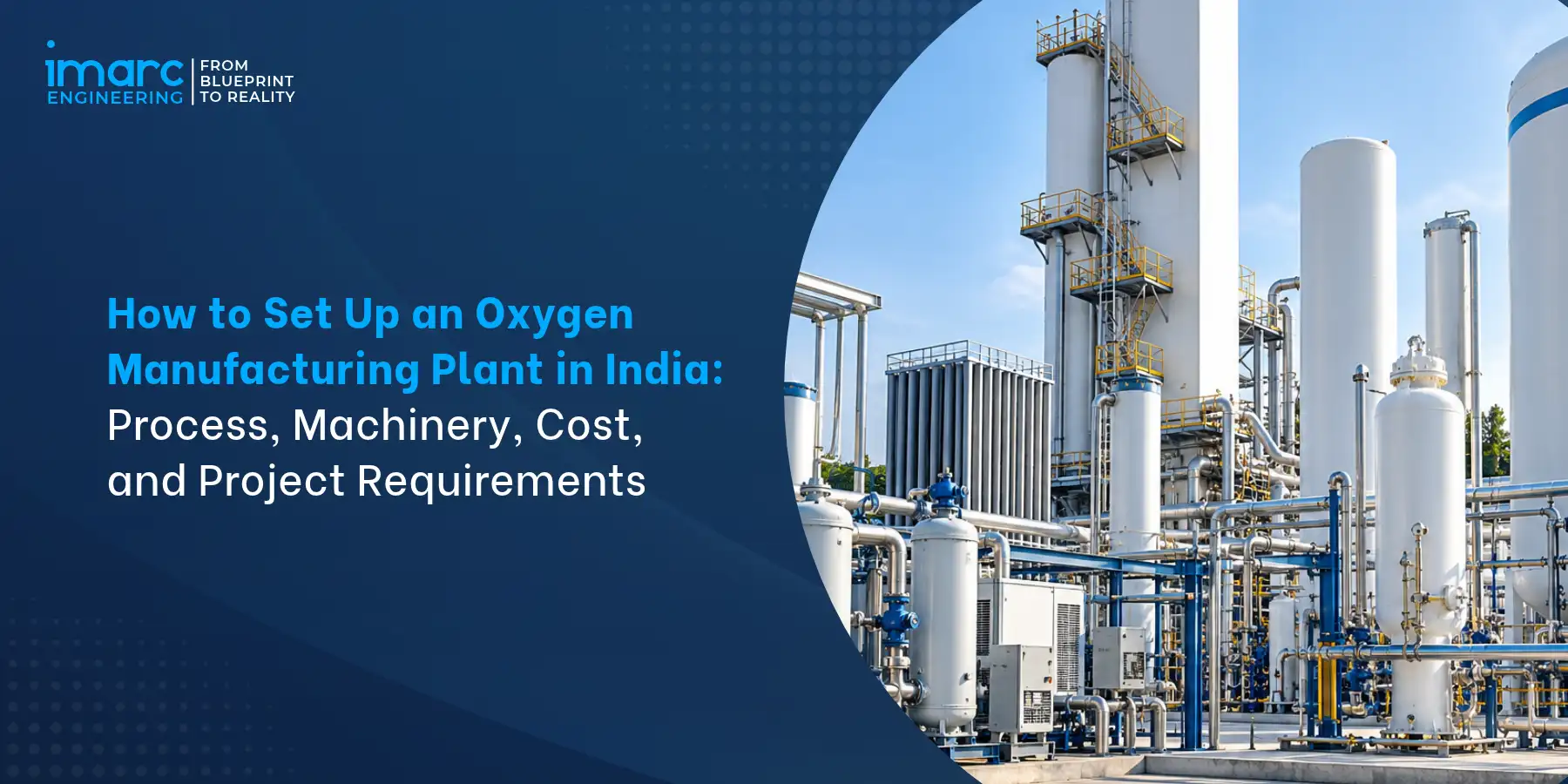
How to Set Up an Oxygen Manufacturing Plant in India: Process, Machinery, Cost, and Project Requirements
Introduction
Dependable, locally produced oxygen sits underneath almost every industrial value chain in India: steel and ferroalloys, non-ferrous smelting, glass, cement, chemicals, wastewater treatment, aquaculture and hospital care. Historically, merchant supply came from a small number of large cryogenic air separation units anchored to steel plants and refinery complexes, with cylinders trucked long distances to everyone else. The pandemic changed the technology envelope. Hundreds of pressure swing adsorption units were installed at district hospitals and industrial estates, and a domestic supply chain for sieve vessels, oil-free compressors and filling manifolds matured alongside them.
For investors, project sponsors and manufacturers, an oxygen manufacturing plant setup in India is a feedstock, power and licensing problem long before it is a sales problem. Air is free, but compressing and separating it is not; purity determines which customers you can legally serve; and PESO layout requirements determine whether your plot plan survives inspection. This guide sets out the engineering and commercial architecture of a bankable facility: separation chemistry, machinery specification, capacity logic, utilities, effluent and safety, the licence stack, and CAPEX and OPEX composition, so that capital is committed against verified assumptions rather than vendor brochures.
Scope of this Guide
This guide answers one question: how can investors plan and establish an oxygen manufacturing plant in India, from technology selection and feasibility assessment to regulatory approvals and commissioning? It compares PSA, VPSA and cryogenic routes on purity, scale and life-cycle cost, and distinguishes industrial oxygen production from medical oxygen manufacture and cylinder filling. Machinery, utility loads, land areas, licence requirements and investment ranges are presented as indicative planning figures to be replaced by vendor quotations, site data and air-balance modeling during the detailed project report stage.
Table of Contents
- Introduction
- Why Oxygen Manufacturing Plant Setup in India Matters for Investors in 2026
- What an Oxygen Manufacturing Plant Setup in India is and Why it Matters
- How to Set Up an Oxygen Manufacturing Plant in India
- Oxygen Production Technologies and Capacity Planning
- Raw Materials, Air Feed and Consumables
- Oxygen Manufacturing Process: Air Compression and Separation
- Oxygen Cylinder Filling, Purity and Quality Control
- Oxygen Plant Machinery, Utilities and Layout
- Environmental Compliance, Licences and Project Economics
- Conclusion
1. Why Oxygen Manufacturing Plant Setup in India Matters for Investors in 2026
Four structural conditions make a disciplined oxygen manufacturing plant setup in India commercially relevant in 2026, and each one changes the technical configuration an investor should fund.
1.1 Demand from Steel, Healthcare and Process Industry
Oxygen demand is anchored by steelmaking, where basic oxygen furnaces, electric arc furnace lances and blast furnace enrichment consume the bulk of merchant tonnage, followed by ferroalloys, copper and zinc smelting, glass melting, cement kiln enrichment, caprolactam and ethylene oxide chemistry, ozonation for water treatment and aquaculture. Healthcare is the second pillar, and piped medical gas systems are now standard in new hospital construction. Because these segments load differently - steel runs continuously at high volume, hospitals draw small volumes at very high reliability, fabrication shops draw intermittently - a plant sized for one rarely serves another well.
1.2 Policy Framework and Localization
Public investment in PSA oxygen generation capacity at district hospitals since 2021, together with the Make-in-India push across medical devices and industrial gases, has built a domestic base for sieve vessels, oxygen boosters, filling manifolds and cylinder hardware. State industrial policies may provide incentives for eligible manufacturing and gas-related projects, but eligibility for land allotment, power concessions, capital subsidies or other benefits varies by state, project category and applicable scheme. Current state notifications should be verified before including incentives in the project financial model.
1.3 Investment Ecosystem and Cylinder Logistics
Merchant oxygen economics are driven by cylinder logistics as much as by generation. A 47-litre water-capacity cylinder filled to around 150 kgf/cm² contains roughly 7 Nm³ of oxygen under standard reference conditions. The actual quantity depends on filling pressure, temperature and cylinder specifications. Cylinder-pool requirements should therefore be calculated from the actual filling configuration and dispatch schedule. Investors who model the plant but not the cylinder pool systematically understate working capital. Bulk liquid supply into vacuum-insulated tanks is the alternative for large consumers, requiring a liquefier or a purchased liquid oxygen arrangement.
1.4 The Cost of Poor Planning
Three errors recur. Sizing a plant on nameplate flow without derating for Indian ambient temperature and humidity, which can cut delivered output substantially in peak summer, is the first. Installing a PSA oxygen plant without first establishing the applicable medical-gas specification, regulatory pathway, quality controls and testing requirements is the second. Oxygen 93% is recognised separately in the Indian Pharmacopoeia, so the applicable product specification and licensing pathway must be established before supplying medical oxygen. Omitting PESO separation distances, bunding, flame arrestors and filling hall ventilation from the plot plan is the third, and it is the most expensive because it surfaces during inspection, after civil works are complete.
2. What an Oxygen Manufacturing Plant Setup in India is and Why It Matters
An oxygen manufacturing plant setup in India is defined by the separation technology it deploys, the purity it can certify, and the boundary of what it dispatches.
2.1 Definition and Facility Boundary
An oxygen generation plant takes ambient air as its only process raw material, removes water, carbon dioxide and hydrocarbons, separates oxygen from nitrogen and argon, and delivers product as compressed gas in cylinders, as liquid in vacuum-insulated tanks, or as low-pressure gas through a pipeline. The facility boundary matters commercially: a generation-only plant selling into a pipeline carries a different licence set and margin structure from an integrated plant that also fills cylinders, and a medical oxygen plant carries a drug manufacturing licence on top of the industrial consents.
2.2 Industrial versus Medical Oxygen Production Plant
Industrial oxygen specifications depend on the application and customer requirements. Medical oxygen is regulated as a medicinal gas, but the applicable specification depends on the product and regulatory pathway. The Indian Pharmacopoeia includes both Oxygen and Oxygen 93 Per Cent. Oxygen 93% produced by molecular-sieve technology is specifically recognised in the Drugs Rules, including a Schedule K provision for qualifying captive production. Commercial medical-oxygen production and supply should therefore be assessed against the applicable Drugs Rules, pharmacopoeial specification and State Drug Control requirements.
2.3 Scale Determinants
Scale is determined by contracted offtake, required purity, product phase, load factor, separation technology, power availability and site conditions. PSA and VPSA are commonly used for smaller and medium-scale gaseous oxygen applications, while cryogenic ASUs become increasingly suitable where high-purity gaseous or liquid products and larger continuous demand justify the higher capital complexity. Capacity should be established through a project-specific process and life-cycle cost assessment.
2.4 Plant Sections
| Section | Function | Key Equipment |
|---|---|---|
| Air intake and compression | Filters and compresses ambient air | Intake filter house, oil-free screw compressor |
| Air prepurification | Removes water, CO2, hydrocarbons | Refrigerated dryer, 13X sieve beds |
| Separation | Splits oxygen from nitrogen and argon | LiLSX adsorber vessels or distillation column |
| Oxygen buffer storage | Evens out demand and stabilizes purity | 20-100 m3 surge tank at 15-25 bar |
| Liquid oxygen storage | Backup supply and bulk dispatch | 5-50 kL vacuum-insulated tank, vaporizer |
| Cylinder filling | Charges cylinders to 150 kgf/cm2 | Filling manifold, booster, weigh platform |
| Quality laboratory | Verifies purity, moisture, CO and CO2 | Paramagnetic analyser, GC, dew point meter |
| Utilities block | Supplies power, cooling, instrument air | Transformer, cooling tower, air receiver |
| Effluent and oily water | Treats blowdown and compressor condensate | Oil-water separator, ETP, settling pit |
| Fire and safety systems | Oxygen fire and overpressure protection | Flame arrestors, deluge, gas detectors |
3. How to Set Up an Oxygen Manufacturing Plant in India
Setting up an oxygen manufacturing plant in India requires careful planning of production capacity, separation technology, power requirements, storage infrastructure and regulatory compliance. The process also differs depending on whether the facility will supply industrial oxygen, medical oxygen, compressed gas, or liquid oxygen. The following steps outline the main stages of project development.
Step 1: Assess Market Demand and Secure Offtake
Identify potential customers across healthcare, steel, metal processing, glass manufacturing, chemicals and other industries. Estimate their oxygen requirements based on volume, purity, delivery pressure and consumption patterns. Evaluate whether customers require cylinder supply, bulk liquid oxygen or pipeline delivery. Reliable offtake agreements help determine the appropriate plant capacity and commercial model.
Step 2: Conduct a Feasibility Study and Prepare a DPR
Assess the project's technical and commercial viability through a detailed project report (DPR). Evaluate expected demand, production capacity, technology options, electricity costs, logistics, working capital and revenue assumptions. The feasibility study should compare operating costs and performance under actual site conditions rather than relying solely on equipment nameplate ratings.
Step 3: Select the Oxygen Production Technology
Choose between pressure swing adsorption (PSA), vacuum pressure swing adsorption (VPSA) and cryogenic air separation based on the required oxygen purity, production volume, product phase and operating profile. PSA and VPSA are commonly considered for gaseous oxygen applications, while cryogenic systems can support high-purity gaseous oxygen and liquid oxygen production. The final choice should follow a project-specific life-cycle cost assessment.
Step 4: Select the Site and Develop the Plant Layout
Evaluate industrial locations based on proximity to customers, reliable power supply, road connectivity, water availability where required and access to maintenance services. Develop the layout for air compression, prepurification, oxygen separation, storage, cylinder filling and dispatch. Allow space for utilities, cylinder handling, liquid oxygen storage where applicable, emergency access and future expansion. Safety distances and site arrangements should be checked against applicable PESO and fire-safety requirements before construction.
Step 5: Specify Machinery and Utility Systems
Select compressors, filters, dryers, adsorber vessels or cryogenic equipment, oxygen boosters, storage systems, filling manifolds and quality-control instruments. Size electrical distribution, cooling systems, instrument air and backup arrangements according to the selected process and operating schedule. Equipment specifications should define required output, oxygen purity, operating conditions, energy performance, safety features and acceptance-test criteria.
Step 6: Identify Applicable Licences and Regulatory Approvals
Prepare an approval matrix based on the plant configuration, product type and storage arrangements. Applicable requirements may include PESO approvals under the Gas Cylinders Rules, 2016 or SMPV(U) Rules, 2016, environmental permissions, fire-safety and electrical approvals, and factory-related compliance under the applicable occupational-safety framework and state rules. Medical oxygen projects must separately assess the applicable Indian Pharmacopoeia specifications, Drugs Rules and State Drug Control requirements.
Step 7: Install Equipment and Commission the Plant
Complete civil works, utility connections and safety infrastructure before installing the production and filling systems. Commission the equipment according to vendor procedures and verify oxygen output, purity, pressure, energy consumption and operating stability. Validate oxygen-service cleanliness, instrumentation, emergency shutdown systems and applicable quality-control procedures before commercial operation.
Step 8: Establish Quality Control and Commercial Operations
Implement routine product testing, maintenance schedules, operating procedures and batch or cylinder traceability. Establish cylinder inspection and filling controls where compressed gas is supplied, or storage and delivery procedures where bulk liquid oxygen is handled. Monitor plant utilisation, electricity consumption, maintenance costs, delivery performance, and customer demand to improve operating efficiency and profitability.
4. Oxygen Production Technologies and Capacity Planning
Technology and capacity decisions in an oxygen manufacturing plant setup in India must be taken together, because the purity target fixes the separation route and the route fixes the machinery, utilities and licence stack.
4.1 PSA Oxygen Plant: Pressure Swing Adsorption
A pressure swing adsorption (PSA) oxygen plant separates oxygen from air by selectively adsorbing nitrogen in molecular-sieve beds. The adsorption pressure, regeneration cycle, product pressure and achievable oxygen purity depend on the adsorbent, system configuration and vendor design. PSA systems are commonly used for gaseous oxygen applications where modularity and operational flexibility are important. Actual output, oxygen recovery, specific energy consumption and adsorbent life should be established through vendor guarantees based on the required product specification and site operating conditions.
4.2 VPSA and Oxygen Generation Plant Scale-Up
Vacuum pressure swing adsorption (VPSA) uses adsorption and vacuum-assisted regeneration to separate oxygen from air. The operating pressure, regeneration conditions, achievable purity and specific energy consumption depend on the selected equipment and process design. VPSA may offer energy advantages for suitable bulk gaseous-oxygen applications, but performance should be evaluated against the required output, purity, product pressure, operating profile and site conditions.
The economically suitable capacity and specific energy consumption are project-specific. During equipment selection, compare vendor-guaranteed performance, blower and vacuum-pump efficiency, maintenance requirements, turndown capability and expected availability. Confirm these parameters before finalising the technical specification.
4.3 Cryogenic Oxygen Plant: Air Separation by Distillation
A cryogenic air separation unit cools and separates purified air through heat exchange and distillation. The process configuration, operating pressures, column conditions and achievable oxygen purity depend on the plant design and required product specification. Depending on the configuration, a cryogenic unit can supply gaseous oxygen, liquid oxygen and other products such as nitrogen or argon. Cryogenic systems generally involve greater process complexity and capital requirements than adsorption systems, but may be suitable where demand, purity, product phase and utilisation justify the investment. Final capacity and economic suitability should be established through process design, vendor quotations and a project-specific life-cycle cost assessment.
4.4 Comparing PSA, VPSA and Cryogenic Technologies
The selection of PSA, VPSA or cryogenic technology depends on oxygen purity, production capacity, product form, energy consumption, and project economics. Each technology offers different advantages, and the appropriate configuration should be determined through a project-specific feasibility study.
| Parameter | PSA | VPSA | Cryogenic |
|---|---|---|---|
| Technology | Pressure swing adsorption | Vacuum pressure swing adsorption | Cryogenic air separation |
| Production method | Adsorption with pressure regeneration | Adsorption with vacuum-assisted regeneration | Low-temperature distillation |
| Oxygen purity | Typically around 90–95%, depending on design | Typically around 90–95%, depending on design | High-purity oxygen, depending on specification |
| Product form | Primarily gaseous | Primarily gaseous | Gaseous and/or liquid |
| Capacity suitability | Small to medium applications | Medium to larger gaseous applications | Larger-scale and liquid-oxygen applications |
| Investment | Often lower initial complexity | Depends on capacity and configuration | Generally higher capital complexity |
| Key considerations | Purity, product pressure, compressor energy | Vacuum equipment, energy efficiency, product pressure | Capital investment, energy use, liquid-product logistics |
The final technology selection should compare vendor-guaranteed oxygen output, product purity, specific electricity consumption, capital expenditure, operating costs, maintenance requirements and plant utilization under actual site conditions.
4.5 Oxygen Plant Capacity Planning and Location
Capacity planning begins with a twelve-month load curve, not an average. A plant supplying hospitals needs day-of-week and seasonal modeling plus liquid backup; a plant supplying a steelworks needs a take-or-pay contract sized to furnace campaigns. Location should be assessed against offtake concentration, transport economics, road access, power reliability, water availability, safety requirements and, for cryogenic facilities, cooling-water and liquid-product logistics. Cylinder and bulk-gas transport economics should be evaluated using the actual customer network and delivery model.
5. Raw Materials, Air Feed and Consumables
Feedstock characterization and consumable specification determine delivered capacity and purity far more than equipment branding does in any oxygen manufacturing plant setup in India.
5.1 Air as the Feedstock
Ambient air is the sole process raw material: approximately 78.1% nitrogen, 20.95% oxygen, 0.93% argon and 0.04% carbon dioxide by volume, with water vapor varying widely across Indian seasons. Because plant capacity is fixed by the mass of air that can be compressed and separated, site temperature, relative humidity, altitude and local pollutant load directly set delivered output. Every performance guarantee should be quoted at a stated inlet condition and corrected to site conditions in the DPR; a guarantee quoted at 20 degrees C and 60% relative humidity is not a guarantee for a coastal or inland hot site.
5.2 Molecular Sieves and Adsorbent Specification
Adsorption plants use molecular-sieve adsorbents selected according to the process configuration, feed conditions and required oxygen purity. Adsorbent quantity, particle specification, moisture-control requirements, cycle life and replacement frequency should be established from the selected technology and vendor guarantees.
5.3 Cryogenic Consumables and Prepurification Media
A cryogenic plant uses a reversing heat exchanger or a molecular sieve prepurifier charged with 13X and activated alumina to strip water and carbon dioxide below 1 ppm ahead of the cold box. Where argon recovery is specified, a hydrogenation or adsorption stage removes oxygen from the crude argon stream. Instrument-quality air is required for valve actuation across both technologies. Perlite for cold box insulation, adsorbent top-up and regeneration heater elements belong in the operating budget, not in contingency.
5.4 Consumables, Lubricants and Spares
Lubricants, seals and other components used in oxygen service must be suitable for the applicable oxygen concentration, pressure, temperature and equipment design. Specify approved materials and lubricants in accordance with the relevant oxygen-service standards, equipment manufacturer's requirements and documented risk assessment. Where oil-free or non-lubricated equipment is required, define this requirement in the technical specification and verify it during procurement and commissioning.
5.5 Oxygen Compatibility and Gas Cylinder Safety
Oxygen systems require materials, components, lubricants, and cleaning procedures suitable for oxygen service at the applicable pressure and temperature. Equipment and piping exposed to oxygen must be thoroughly cleaned of oil, grease and other combustible contaminants before commissioning, with material selection and oxygen-service design based on the applicable engineering standards and operating conditions. High-pressure sections may require specific materials and velocity controls. Oxygen systems should be inspected and certified for cleanliness and service compatibility before commissioning.
6. Oxygen Manufacturing Process: Air Compression and Separation
The production flow runs from intake filtration to separated oxygen through four controlled stages, each with parameters that must be fixed in the equipment specification.
6.1 Air Intake, Filtration and Compression
Ambient air enters the oxygen production system through intake filtration equipment designed to remove dust and other contaminants. Depending on the selected PSA, VPSA or cryogenic technology, air is compressed or supplied through an appropriate blower and compression arrangement before undergoing the required cooling, drying and purification stages.
Compression and air-handling equipment are major contributors to oxygen-plant electricity consumption. Equipment selection should therefore consider airflow, operating pressure, specific energy consumption, ambient conditions, turndown capability and maintenance requirements. Aftercooling and filtration systems should be specified according to the selected process and downstream equipment requirements.
6.2 Drying and Carbon Dioxide Removal
In adsorption systems, upstream drying and adsorbent beds remove moisture and carbon dioxide to the levels required by the selected process. Cryogenic systems require much deeper moisture and carbon-dioxide removal before the cold box to prevent freezing and operational problems. Dryer and prepurifier performance should be specified against vendor and process requirements. Prepurifier switching valves and regeneration heaters carry the highest cycle counts in the plant and should be specified with stroke-time and cycle-life guarantees, not just pressure ratings.
6.3 The Adsorption Cycle in a PSA Oxygen Plant
Oxygen recovery and purity are interdependent in adsorption systems. Increasing product purity can reduce oxygen recovery and increase specific energy consumption, while cycle configuration, adsorbent, feed conditions and purge strategy also influence performance. These parameters should be established through vendor guarantees and performance testing.
6.4 Distillation in a Cryogenic Oxygen Plant
Purified, cooled air liquefies in a plate-fin exchanger and enters a double column: the high-pressure column at 5-6 bar knocks down bulk nitrogen, and the low-pressure column at 1.2-1.5 bar produces oxygen at the sump and nitrogen at the top. An argon side column removes argon, whose boiling point of -186 degrees C lies between oxygen at -183 degrees C and nitrogen at -196 degrees C. Oxygen is drawn as gas at 1.2-1.5 bar or as liquid from the sump, with purity set by column reflux ratio.
6.5 Oxygen Compression, Storage Tanks and Vaporization
Gas and liquid oxygen storage and product-boosting systems should be sized according to production capacity, customer pressure requirements, backup philosophy, storage duration and applicable pressure-vessel and safety requirements.
7. Oxygen Cylinder Filling, Purity and Quality Control
Finishing and verification turn separated gas into a saleable, documented product that customers and inspectors will accept.
7.1 Oxygen Cylinder Filling Plant Design and Operation
Cylinders are inspected for identification, valve condition, test status and physical integrity before filling. Filling systems should use staged pressure control and appropriate temperature and final-pressure checks. Manifold capacity, filling time and cylinder throughput should be established from cylinder size, filling pressure, equipment configuration and operating schedule. The filling area should incorporate appropriate ventilation, oxygen-enrichment detection, emergency shutdown and segregation of filled and empty cylinders.
7.2 Medical Oxygen Plant Setup: Purity and Pharmacopoeial Compliance
Medical oxygen must comply with the applicable Indian Pharmacopoeia specification and regulatory requirements for the product being manufactured. The Indian Pharmacopoeia includes Oxygen as well as Oxygen 93 Per Cent. Oxygen 93% produced by molecular-sieve technology has a specific regulatory pathway, including provisions under Schedule K for qualifying captive production. Commercial production and supply should be assessed against the applicable Drugs Rules, product specification and State Drug Control requirements.
7.3 Oxygen Pipeline Distribution and Bulk Liquid Supply
Large consumers may receive oxygen through dedicated pipelines or pressure-reduction systems designed around the customer's required pressure, flow and continuity requirements. Medical-gas pipeline systems are subject to applicable healthcare-facility standards and commissioning tests. Hospital installations fall under medical gas pipeline system requirements and need zone valves, alarm panels and terminal unit verification before handover.
7.4 Testing, Inspection and Quality Standards
Routine testing covers oxygen purity by paramagnetic or electrochemical analyser, trace carbon monoxide and carbon dioxide by gas chromatography or dedicated cells, moisture by dew point or capacitance hygrometer, and an odour check per batch. Cylinders require periodic inspection and testing in accordance with the applicable Gas Cylinders Rules, 2016, cylinder specifications and PESO requirements. Filling records should maintain cylinder identification and traceability to the relevant filling batch.
8. Oxygen Plant Machinery, Utilities and Layout
Machinery, controlled areas and utilities account for the majority of capital and effectively all of the technical risk in an oxygen manufacturing plant setup in India.
8.1 Oxygen Manufacturing Machinery: Selection Drivers
Specify compressors on specific power at site ambient rather than at standard reference conditions; specify adsorber vessels on sieve volume, cycle time and switching valve cycle life; specify oxygen boosters on non-lubricated construction with a stated seal and piston ring life; and specify filling manifolds on simultaneous fill capability and pressure ramp rate. Vendor guarantees should be tied to delivered Nm3/h at a stated purity and inlet condition, with an agreed performance test protocol. Oxygen-cleanliness certification belongs in the supply contract, not in the commissioning punch list.
8.2 Cylinder Handling and Filling Automation
Oxygen cylinder filling facilities may use manual, semi-automated or automated handling and filling systems depending on production capacity, cylinder specifications, labour availability and operational requirements. Automation options include cylinder conveyors, automated valve operation, cylinder identification systems, and digital filling records.
Filling systems should incorporate appropriate pressure and temperature controls, cylinder inspection procedures, product traceability, and safety interlocks. Filling areas should also provide suitable ventilation, oxygen-enrichment monitoring, emergency shutdown arrangements, and fire-safety measures based on the applicable risk assessment and PESO requirements.
The level of automation should be determined through a project-specific assessment of cylinder throughput, filling accuracy, operational safety, labour requirements, and investment costs.
8.3 Utilities: Power Consumption, Water and Gases
Power consumption varies significantly with technology, oxygen purity, product pressure, ambient conditions, plant utilisation and auxiliary systems. The DPR should develop a project-specific power balance from vendor guarantees and operating conditions. Cooling water, instrument air and other utilities should likewise be sized from the selected equipment and operating schedule.
8.4 Layout and Material Handling
Layout follows process direction: intake filter and compressor house on the upwind side, prepurification and separation vessels in a bounded process area, filling hall set back from the site boundary, cylinder yard with separate full and empty zones, and substation, cooling tower and liquid oxygen tank against the plot edge.
PESO separation distances, fire access roads and truck turning radii are fixed constraints that cannot be retrofitted. Land requirements depend on process configuration, production capacity, cylinder storage, liquid-oxygen storage, safety distances, utility blocks, road access, fire access and future expansion. The site area should therefore be established through the project layout and applicable PESO and fire-safety requirements.
8.5 Key Machinery
| Category | Equipment | Sizing Basis |
|---|---|---|
| Air compression | Air compressor or blower system suitable for the selected oxygen production technology | Required airflow, discharge pressure, site ambient conditions, specific power, equipment configuration and redundancy |
| Air prepurification | Dryer, filters and prepurification equipment | Feed-air moisture and contaminant levels, downstream process requirements and regeneration design |
| Separation, adsorption | PSA or VPSA adsorber vessels and associated equipment | Required oxygen output and purity, recovery, cycle configuration, operating profile and vendor guarantees |
| Separation, cryogenic | Cryogenic air separation unit, including distillation columns where applicable | Required gaseous and liquid product volumes, purity, co-products, utilisation and process configuration |
| Oxygen boosting | Oxygen booster or compressor suitable for oxygen service | Required discharge pressure, flow, materials compatibility, cleanliness and duty cycle |
| Liquefaction and storage | Liquefaction equipment, vacuum-insulated storage and vaporiser, where applicable | Liquid oxygen demand, storage duration, delivery schedule, backup requirements and applicable safety rules |
| Cylinder filling | Filling manifold, booster and associated handling equipment | Cylinder specifications, permitted filling pressure, required throughput and operating shifts |
| Purity analysis | Oxygen analyser and other required quality-control instruments | Product specification, measurement range, accuracy, calibration and applicable testing requirements |
9. Environmental Compliance, Licences and Project Economics
Effluent, residues and approvals determine whether an otherwise sound oxygen manufacturing plant setup in India is ever allowed to run at design capacity.
9.1 Effluent, Blowdown and Emissions
An oxygen plant generally has limited wastewater process compared with many manufacturing industries. Potential water streams include cooling-tower blowdown, compressor condensate and water-treatment reject. Treatment and discharge requirements depend on the source and characteristics of each stream, the discharge route and the conditions imposed by the applicable SPCB consent.
Where Schedule VI general standards apply, the applicable parameter limits should be checked against the current Environment (Protection) Rules and any more stringent site-specific conditions. The air-separation process itself does not normally generate a process emission stack; however, emissions from DG sets, boilers or other auxiliary combustion equipment, where installed, remain subject to applicable requirements.
9.2 Spent Adsorbent and Hazardous Waste
Spent molecular sieve, activated alumina, perlite, used compressor oil, oily sludge, filter materials and other residues should be characterised and classified under the applicable waste-management requirements. Where a waste stream is classified as hazardous, the facility must obtain the applicable authorisation and follow the prescribed storage, manifesting and authorised disposal or recovery route. Hazardous waste is stored in a covered, bunded, labelled yard within the permitted retention period.
9.3 PESO Licensing, Gas Cylinder Rules and Other Approvals
The approvals required for an oxygen manufacturing plant depend on its production process, product type, storage capacity, cylinder-filling activities, and location. PESO requirements should be assessed under the Gas Cylinders Rules, 2016 for applicable cylinder-related activities and the Static and Mobile Pressure Vessels (Unfired) Rules, 2016 for pressure-vessel installations within their scope. The precise licence, approval, and inspection requirements should be confirmed against the current rules and the proposed facility configuration.
Environmental permissions should be determined using the applicable CPCB classification, relevant state pollution control board requirements, and the plant's actual pollution potential. Factory-related compliance should be assessed under the Occupational Safety, Health and Working Conditions Code, 2020 and applicable state rules in force. Fire-safety, electrical and other local approvals may also apply.
Medical oxygen projects require a separate assessment of the applicable Indian Pharmacopoeia specification, Drugs Rules and State Drug Control requirements. Oxygen 93 Per Cent and conventional Oxygen have distinct product specifications and regulatory provisions. The approval matrix should therefore be finalised with the relevant authorities before construction and commercial operation.
9.4 CAPEX and OPEX Composition
CAPEX is driven by separation equipment, compressors, oxygen boosting, storage and filling systems, civil works, electrical infrastructure, utilities, safety systems, land and pre-operative costs. OPEX is primarily influenced by electricity, maintenance, labour, consumables, cylinder logistics, testing, and compliance. The project financial model should be developed from vendor quotations, site-specific infrastructure requirements, operating assumptions, and customer contracts.
9.5 Project Economics
| Cost component | Key cost drivers |
|---|---|
| Separation equipment | PSA, VPSA or cryogenic technology, required output, purity and product phase |
| Compression and oxygen boosting | Flow rate, operating pressure, equipment configuration and redundancy |
| Storage and filling | Cylinder-filling requirements, gas or liquid storage, backup capacity and dispatch model |
| Civil works and site development | Land, soil conditions, foundations, buildings, access roads and safety distances |
| Utilities and electrical systems | Connected load, power infrastructure, cooling requirements and backup arrangements |
| Safety and regulatory compliance | Applicable PESO requirements, fire protection, inspections and other approvals |
| Installation and commissioning | Equipment erection, piping, instrumentation, testing and performance validation |
| Working capital and logistics | Cylinder inventory, transport, maintenance, consumables, staffing and customer payment terms |
Conclusion
A bankable oxygen manufacturing plant in India is a power-price and offtake business wrapped around a separation plant. The raw material is free and universally available, which makes the project look simple, and that is precisely where investors get hurt: the plant that reaches financial close comfortably is the one whose capacity was sized on a measured load curve at site ambient conditions, whose purity target was matched to the customers it is licensed to serve, and whose plot plan was drawn around PESO separation distances before the first column was poured.
The three priorities are unambiguous. First, select the technology against a life-cycle cost comparison at the actual purity, phase and load factor required, not against quoted equipment price. Second, treat PESO approval, SPCB consent and, where relevant, the State Drug Controller licence as critical-path activities that run in parallel with engineering rather than after it. Third, fund the cylinder pool and logistics as part of the project, because a plant that can produce oxygen but cannot deliver it earns nothing. Everything else - automation level, building finish, equipment brand - is negotiable. These three are not.
PURSUING AN OXYGEN MANUFACTURING PLANT SETUP IN INDIA?
IMARC Engineering supports investors, project sponsors and manufacturers with capacity and feasibility planning, technology selection, site selection, plant layout, equipment specification, utilities and piping design, effluent and safety engineering, PESO and drug licensing advisory, scheme structuring and capital investment planning. The advisory covers PSA, VPSA and cryogenic oxygen plants, including air compression, prepurification, separation, oxygen boosting, cylinder filling and cold box installation, with project-specific infrastructure and commissioning planning.
→ Schedule a free oxygen plant scoping consultation with an IMARC specialist
Frequently Asked Questions
Start by assessing oxygen demand, purity, capacity and delivery requirements. Select PSA, VPSA or cryogenic technology and prepare a detailed project report (DPR) covering machinery, layout, utilities and costs. Obtain applicable PESO, environmental, factory and fire approvals, plus medical oxygen licences where required. Complete installation, testing, quality validation and commissioning.
PSA plants use pressure swing adsorption to produce gaseous oxygen, typically for smaller applications. VPSA plants use vacuum-assisted regeneration and may offer energy advantages for larger gaseous-oxygen requirements. Cryogenic plants use low-temperature distillation to produce high-purity gaseous or liquid oxygen. Selection depends on capacity, purity, energy consumption and project economics.
The cost varies significantly with oxygen production technology, capacity, purity, product phase, storage and filling requirements, land, utilities, safety systems and site development. A reliable project cost should be developed from vendor quotations, site-specific engineering and the required regulatory and infrastructure scope rather than a universal cost benchmark.
Oxygen production machinery depends on the technology used. PSA and VPSA plants require air compressors or blowers, filters, dryers and adsorption vessels. Cryogenic plants use compressors, heat exchangers and distillation columns. Additional equipment may include oxygen boosters, storage tanks, cylinder filling manifolds, vaporizers and purity analysers, depending on plant requirements.
Applicable approvals may include PESO licensing under the Gas Cylinders Rules, 2016 for cylinder filling and possession, SMPV(U) requirements for applicable pressure-vessel storage, applicable SPCB requirements, factory-related approvals under the Occupational Safety, Health and Working Conditions Code, 2020 and state rules, fire-safety and electrical approvals, and legal-metrology requirements where applicable. Medical-oxygen projects should additionally assess the applicable Drugs Rules and State Drug Control requirements. The final approval list depends on the plant configuration, product, storage arrangements and state.
Electricity consumption varies with separation technology, oxygen purity, product pressure, ambient conditions, plant utilisation and auxiliary equipment. PSA, VPSA and cryogenic systems should be compared using vendor-specific specific-energy guarantees under the actual site conditions and operating profile.
Industrial oxygen is produced to the purity and quality specification required by the intended industrial application. Medical oxygen is subject to the applicable Indian Pharmacopoeia specification and drug-regulatory requirements. The Indian Pharmacopoeia includes both Oxygen and Oxygen 93 Per Cent, with specific regulatory provisions applying to qualifying captive Oxygen 93% production. Commercial medical-oxygen production should therefore be assessed against the applicable Drugs Rules and State Drug Control requirements.
Oxygen-plant profitability depends on electricity cost, plant utilisation, oxygen purity and product form, customer pricing, cylinder or bulk-liquid logistics, maintenance, financing and the stability of the offtake contract. A project-specific financial model should test utilisation, power costs, selling prices, logistics costs, working capital and sensitivity to changes in customer demand.
Land requirements depend on technology, production capacity, cylinder or liquid-oxygen storage, PESO safety distances, utilities, access roads, fire-safety requirements and future expansion. Site area should be established through the project layout and applicable safety requirements.
They build the air and energy balance, test PSA, VPSA and cryogenic options on life-cycle cost, size capacity at site ambient conditions, specify compressors, sieve vessels and filling headers, design layout to PESO separation distances, plan utilities and safety systems, sequence PESO, SPCB and drug licensing, structure CAPEX and OPEX, and manage procurement, construction and commissioning under EPCM delivery.
Recent Post
Trusted by Industry Leaders
We partner with global enterprises and ambitious businesses across sectors to deliver operational excellence, strategic insights, and sustainable growth through integrated solutions.





Success in Their Words
Real feedback from clients across industries. Discover how our solutions delivered measurable impact and operational excellence.

I wanted to express my sincere appreciation for your efforts in handling this matter. Your dedication and commitment have been truly commendable, and it is evident that you have put in tremendous hard work and expertise into resolving the issues at hand. We are greatly interested in continuing our collaboration with you in the future, as your professionalism and reliability have made you a trusted partner. Thank you once again for your invaluable contribution. We look forward to strengthening our partnership ahead.
It has been a pleasure working with the IMARC team. The insights provided were structured, clear, and highly valuable, helping us strengthen both our technical and financial planning with confidence. We deeply appreciate the team’s professionalism, responsiveness, and attention to detail throughout the engagement. Every requirement was well understood and effectively incorporated, resulting in a comprehensive and actionable output. Overall, our experience has been excellent, and I would gladly recommend IMARC to organizations seeking a reliable research partner.

Your service is truly exceptional. Working with the IMARC team has been a seamless and professional experience. The clarity of communication, responsiveness to queries, and consistent support at every stage made the entire engagement highly efficient. The insights shared were well-structured, practical, and perfectly aligned with our requirements, helping us make informed decisions with confidence. Overall, the dedication and professionalism demonstrated by your team stand out, and I would be glad to recommend IMARC as a reliable and trustworthy research partner.

IMARC did an outstanding job in preparing our study. They were punctual, precise, and consistently responsive throughout the entire process. The team delivered all the data we required in a clear, well-organized, and highly professional format. Their strong attention to detail, combined with their ability to meet every deadline without compromising quality, truly set them apart. Overall, their reliability and commitment made them an exceptional partner for our project, and we would gladly work with them again in the future.

IMARC made the whole process incredibly easy from start to finish. Everyone I interacted with via email was polite, professional, and straightforward to deal with, always keeping their promises regarding delivery timelines and remaining consistently solutions-focused. From my very first contact, I appreciated the professionalism and support shown by the entire IMARC team. I highly recommend IMARC to anyone seeking timely, affordable, and reliable information or advice. My experience with IMARC was excellent, and I truly cannot fault any aspect of it.

I’d like to express my sincere gratitude for the excellent work you accomplished with the study. Your ability to quickly understand our requirements and deliver high-quality results under tight timelines truly reflects your expertise, exceptional work ethic, and unwavering commitment to your customer’s success. The professionalism and responsiveness you demonstrated throughout the process made a significant difference. Our entire team and company are incredibly thankful for your dedication, reliability, and support. Once again, thank you for your outstanding contribution.