Manufacturing
October 21 2026
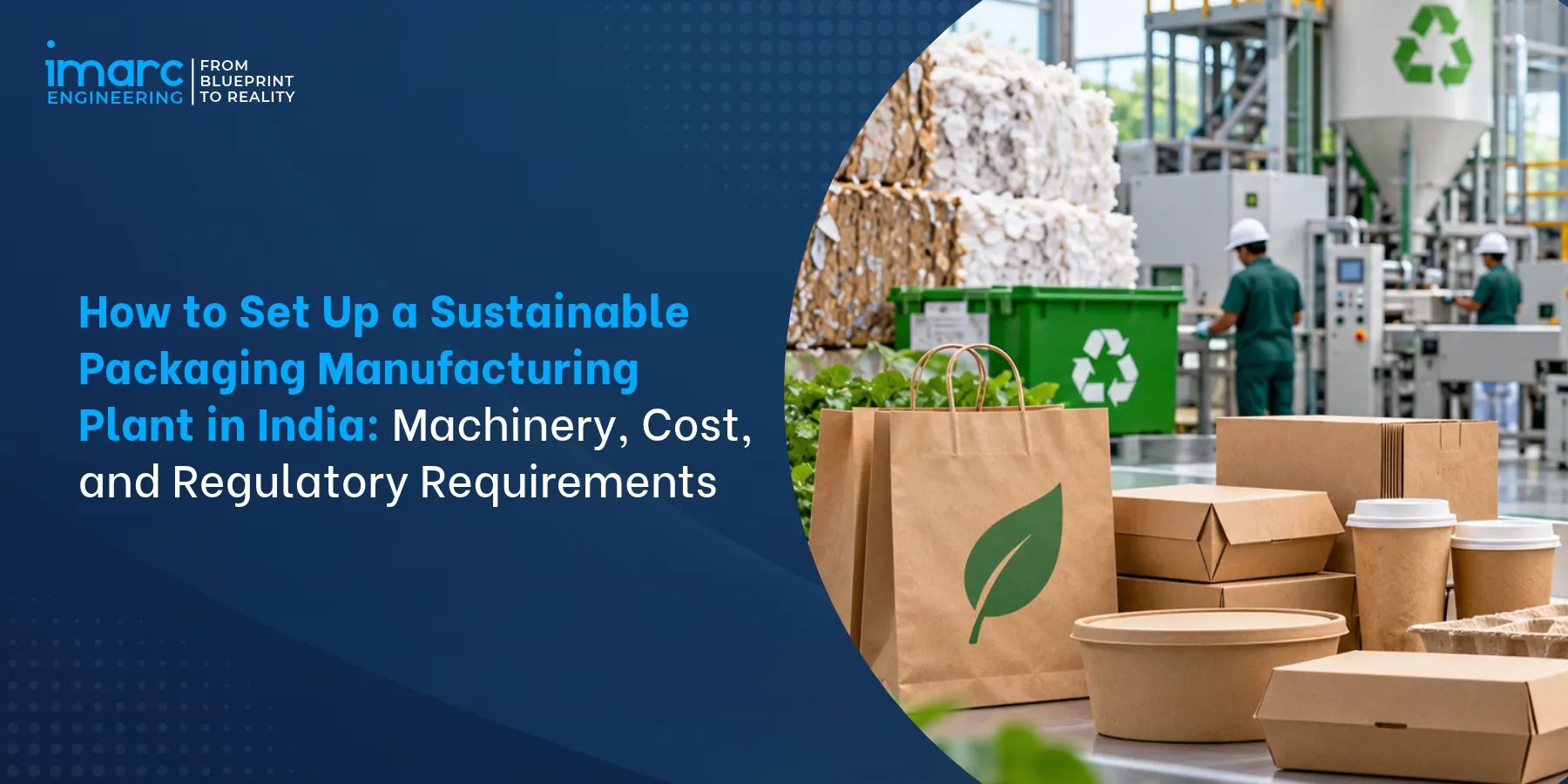
How to Set Up a Sustainable Packaging Manufacturing Plant in India: Machinery, Cost, and Regulatory Requirements
Introduction
For investors and manufacturers planning a sustainable packaging manufacturing plant in India in 2026, the opportunity rests on the structural shift away from single-use plastics and the compliance pull from the evolving Extended Producer Responsibility (EPR) framework for packaging. Corrugated boxes, molded fiber packaging, and recyclable paperboard cartons together form a defined investment space with proven production technology, established raw material supply, and visible demand from e-commerce, FMCG, pharmaceutical, and export channels.
Scope of this Guide
This guide walks through sustainable packaging manufacturing plant setup from product selection and raw materials through machinery, utilities, regulatory approvals, CAPEX/OPEX, and the full project lifecycle - calibrated to the policy framework in force in October 2026 and anchored to project-specific assumptions rather than universal claims. Recyclable, biodegradable, and compostable are distinct categories with different standards; the guide uses each term precisely.
Table of Contents
- Introduction
- Why Sustainable Packaging Manufacturing Plant in India Matters for Investors in 2026
- Sustainable Packaging Product Categories for a Manufacturing Plant in India
- Raw Materials and Sourcing for Sustainable Packaging Manufacturing in India
- Machinery and Production Line Configuration for Sustainable Packaging Manufacturing in India
- Plant Layout Utilities and Infrastructure for a Packaging Plant in India
- Regulatory Approvals and BIS Standards for Packaging Manufacturing in India
- CAPEX OPEX and Profitability Framework for Sustainable Packaging Plant Setup in India
- DPR Project Lifecycle and Commissioning for a Packaging Manufacturing Plant in India
- Conclusion
1. Why Sustainable Packaging Manufacturing Plant in India Matters for Investors in 2026
Four drivers make disciplined sustainable packaging investment strategically important in India in 2026.
1.1 EPR Compliance and Regulatory Pull
India's packaging EPR framework is evolving, with regulatory provisions covering packaging materials and specified obligated entities. Project developers should verify the applicable EPR requirements, commencement status and registration obligations for the relevant packaging category before relying on them in project planning. Combined with the Plastic Waste Management Rules 2016 (as amended through 2022, 2024, and 2026), the regulatory landscape pushes FMCG, e-commerce, pharmaceutical, and consumer-goods brands toward recyclable paper-based alternatives. This creates a structural demand pull for eco-friendly packaging manufacturing plant capacity across the value chain.
1.2 E-commerce and FMCG Demand
India's e-commerce sector drives direct demand for corrugated boxes and protective packaging; FMCG and pharmaceutical brands drive demand for paperboard cartons. Replacement of plastic multilayer packaging with paper-based recyclable alternatives is a defined conversion in cosmetics, food, and personal care. Export markets (EU, UK, Japan, US) with their own packaging-waste frameworks reinforce the direction. The addressable market supports investment across tiers - from regional corrugators to large multi-plant paperboard converters.
1.3 Raw Material Availability and Supply Base
India has an established kraft paper and recycled paperboard supply base - with domestic mills in Andhra Pradesh, Gujarat, Maharashtra, Tamil Nadu, Uttar Pradesh, and Himachal Pradesh. Molded pulp uses waste paper, bagasse (sugarcane residue), and bamboo as feedstock. Domestic raw material availability reduces import dependence and currency risk compared with specialty polymer alternatives. For investors evaluating multiple sustainable packaging routes, the recycled paperboard and molded pulp route has the lowest raw material supply risk.
1.4 Policy Support and Incentives
Central and state-level incentives may be available for eligible packaging manufacturing projects, depending on the applicable scheme, project location, enterprise classification, technology and investment conditions. Investors should verify current scheme availability and eligibility before including any financial assistance in the project model.
2. Sustainable Packaging Product Categories for a Manufacturing Plant in India
Product selection shapes machinery, raw materials, capacity, and economics. Three categories dominate the sustainable packaging business in India today - plus two niche routes with growing demand.
2.1 Corrugated Boxes
Corrugated box manufacturing plant output serves e-commerce, FMCG transit packaging, pharmaceutical outer cartons, and industrial applications. Products include 3-ply (single-wall), 5-ply (double-wall), and 7-ply (triple-wall) boxes in a wide range of dimensions. Standards include IS 2771 (Series) for corrugated fibreboard boxes. The segment is well-established in India with mature machinery supply, strong raw material base (kraft paper mills), and distributed demand - making it the most common entry point for new investors.
2.2 Molded Fiber Packaging
Molded fiber packaging manufacturing produces three-dimensional packaging - egg trays, fruit trays, electronics protective inserts, bottle holders, and food-service containers - from recycled paper or agricultural residues (bagasse, bamboo). The products are recyclable, biodegradable under appropriate conditions, and functional for cushioning applications.
Food-contact molded-fiber products must meet applicable food-contact requirements, including the Food Safety and Standards (Packaging) Regulations, 2018, as amended, where applicable. The route attracts investors replacing expanded polystyrene (EPS) in electronics protective packaging and plastic egg trays in retail.
2.3 Recyclable Paperboard Cartons
Paperboard cartons serve pharmaceutical blister packs, cosmetics, food, and premium consumer goods. Boards include Solid Bleached Sulfate (SBS), Solid Bleached Board (SBB), Folding Box Board (FBB), and recycled fibre boards. Converting involves printing, die-cutting, creasing, gluing, and folding. The route requires more sophisticated printing capability than corrugated and typically serves brand-sensitive customers at premium realisation. Standards covered include IS 1060 (Series) methods for test of paper and allied products.
2.4 Kraft Paper Bags and Honeycomb Packaging
Kraft paper bags (replacing plastic retail bags) and honeycomb paper packaging (for dunnage, protective inserts, pallet-level cushioning) are smaller but growing segments. Kraft paper bag machinery is modest CAPEX and well-suited for MSME investors. Honeycomb packaging requires specialist machinery and typically targets industrial OEM customers. Both routes benefit from the broader shift away from plastic alternatives but have narrower addressable markets than corrugated or paperboard.
2.5 Terminology Discipline
Recyclable, biodegradable, and compostable are not interchangeable. Recyclable packaging manufacturing produces output that can be collected and reprocessed (paperboard, corrugated, kraft, PET). Biodegradable means the material breaks down under biological action in defined conditions - but not necessarily in landfill or marine environments. Compostable requires certified decomposition under industrial composting conditions per IS 17088 or international standards such as ASTM D6400 and EN 13432. Investor positioning and label claims should match the independently certifiable category.
3. Raw Materials and Sourcing for Sustainable Packaging Manufacturing in India
Raw material selection and sourcing anchor the economics of any biodegradable packaging manufacturing facility. Each product category uses its own feedstock set.
3.1 Kraft Paper and Testliner for Corrugated
Corrugated manufacturing uses kraft paper (for linerboards) and testliner (recycled fibre liner) at defined grammages (typically 120-300 GSM). The fluting medium (semi-chemical or recycled fluting paper) sits between the liners. Domestic kraft and testliner supply comes from JK Paper, ITC Paperboards, Century Paper, West Coast Paper, Khanna Paper, Shree Krishna Paper and other mills across the country. Specification covers burst factor, ring crush test (RCT), and cobb value - standardised test methods under IS 1060 series apply.
3.2 Paperboard Grades
Paperboard packaging manufacturing uses Solid Bleached Sulfate (SBS) and Solid Bleached Board (SBB) for premium applications, Folding Box Board (FBB) for pharmaceutical and cosmetics cartons, Coated Unbleached Kraft (CUK) for heavier food packaging, and recycled fibre boards for commodity cartons. Grammage typically 230-450 GSM depending on application. Food-contact grades must comply with FSSAI (Food Safety and Standards Authority of India) packaging regulations - FSS (Packaging) Regulations 2018 for direct food contact use.
3.3 Pulp for Molded Fiber
Molded fiber plants use mixed wastepaper (recycled newspaper, office paper, corrugated cuttings), bagasse pulp (sugarcane residue), bamboo pulp, or wood pulp depending on target product and food-contact requirement. Recycled wastepaper can be used in molded-fiber applications, but suitability for food-contact products depends on the material source, processing, contaminants, additives and applicable food-contact requirements. Bagasse, bamboo and other virgin or agricultural-fibre sources may also be used depending on the product and applicable requirements. Pulping chemicals include dispersants and sometimes starch binders. Water quality for pulp preparation is specified - demineralised or softened water prevents mineral deposits in moulds.
3.4 Adhesives Inks and Auxiliaries
Starch-based adhesives (corn, tapioca) are the primary bonding chemistry for corrugated manufacturing. For paperboard cartons, water-based or hot-melt adhesives are used in box gluing stations. Printing inks for food-contact applications must be food-safe grade (no mineral oil migration, low VOC) per FSSAI requirements. Water-based flexographic inks and UV-cured inks are preferred for sustainable packaging positioning. Release agents, waxes, and barrier coatings may apply for specific functional requirements.
3.5 Raw Material Summary
| Product | Primary Raw Material | Grammage / Grade |
|---|---|---|
| Corrugated boxes | Kraft paper + testliner + fluting | 120-300 GSM |
| Paperboard cartons | SBS, SBB, FBB, CUK, recycled board | 230-450 GSM |
| Molded fiber | Waste paper, bagasse, bamboo pulp | Pulp slurry |
| Kraft bags | Kraft paper | 60-120 GSM |
| Honeycomb packaging | Kraft core paper + liner | 140-220 GSM core |
4. Machinery and Production Line Configuration for Sustainable Packaging Manufacturing in India
The right packaging machinery in India selection depends on product category, capacity, and automation level. Each route has its own line architecture.
4.1 Corrugated Box Line
A corrugated plant centres on the corrugation machine - either a semi-automatic unit (single-face corrugator plus board-maker, suited for small/medium plants at 60-100 metres/minute) or an automatic corrugator line (3-ply or 5-ply inline production at 150-300 metres/minute for medium to large plants). Downstream converting includes rotary or flatbed slotting and die-cutting, printing (flexographic 2-6 colour), stitching or gluing, strapping, and bundling. Automated feeders, servo-driven cut-offs, and inline flexo printers are the current premium configuration. CAPEX scales substantially with speed and automation.
4.2 Molded Fiber Packaging Line
Molded pulp machinery includes a pulp preparation section (hydrapulper, refiners, chests), a vacuum-forming machine (reciprocating or rotary forming for different shapes), transfer stations, drying systems (hot-air tunnels or infrared), hot-press stations (for premium smooth finish products such as electronics inserts), trimming/cutting, and packaging. Rotary forming machines deliver higher throughput for standardised products (egg trays, cup carriers); reciprocating machines offer flexibility for varied shapes (electronics inserts, specialty products). Food-contact grade production adds pulp purification stages and food-safe binder dosing.
4.3 Paperboard Converting Line
Paperboard converting for folding cartons starts with sheet feeding or roll-to-sheet cutting, then offset or flexographic printing (typically 4-6 colour process plus special colours), coating (aqueous or UV), die-cutting machine (rotary or platen), creasing/scoring, folder-gluer, and bundling. For pharmaceutical cartons, additional stations include braille embossing, inline inspection cameras, and track-and-trace serialisation. Printing quality defines customer segment - commodity cartons use flexo at modest cost; premium cosmetics and pharma require offset with careful colour management.
4.4 Automation and Quality Systems
Modern plants deploy PLC/SCADA control, automatic feeders and stackers, vision inspection for print quality and die-cut accuracy, in-process GSM and strength testing, and MES/ERP integration for order tracking and material usage. Entry-level plants rely on manual quality checks and simple controls; mid-range to premium plants use inline inspection and automated reject systems. Automation level is matched to customer quality expectation - FMCG and pharma customers increasingly audit quality systems before awarding business.
5. Plant Layout Utilities and Infrastructure for a Packaging Plant in India
A well-sized plant on an appropriate site is central to packaging plant setup. Three decisions - site, utilities, layout - are made together.
5.1 Land and Building
Land requirement varies significantly with product type, production capacity, machinery configuration, raw-material and finished-goods storage, utilities, parking and future expansion plans. Corrugated, molded-fiber and paperboard plants should therefore be sized based on the specific process and capacity rather than a universal acreage benchmark.
Molded-fiber facilities may require additional space for pulp preparation, drying and effluent treatment, while paperboard converting plants have different equipment and storage requirements. Site selection should consider proximity to raw materials and customers, labour availability, utility reliability, logistics and applicable industrial-estate policies.
5.2 Power Water and Steam
Power, water and thermal-energy requirements depend on product type, production capacity, machinery configuration, drying technology and operating schedule. Corrugated and paperboard converting generally have different utility profiles from molded-fiber production, particularly where pulp preparation and drying are involved. Project-specific utility balances should be developed during engineering. Water requirement is low for corrugated and paperboard converting (process water for starch adhesive and cleaning) but substantial for molded fiber (pulp preparation uses significant freshwater, much of which can be recirculated with blowdown). Steam or thermal energy from biomass boilers or gas-fired dryers serves drying operations in molded fiber plants and some converting operations.
5.3 Plant Layout Principles
The plant layout flows from raw material intake (paper reels in a dedicated warehouse) to production (corrugator-converter line in a straight flow) to packaging to finished goods warehouse to dispatch. Material handling uses forklifts, pallet trucks, and overhead cranes for paper reels. Printing areas require controlled temperature and humidity (40-55 percent RH typical) for registration stability. Fire protection per NBC 2016 Part 4 is critical - paper and finished product fire load is high. Compliance clearances under OSH Code 2020 cover worker safety around moving machinery.
5.4 Effluent and Waste Management
Corrugated and paperboard converting generate minimal effluent (cleaning water from printing stations, mostly starch-based from corrugator). Molded fiber plants generate pulping effluent that requires biological treatment before discharge or recirculation. Solid waste - paper trim, defective product, dust from dust extraction - is high-value scrap sold back to paper mills for repulping. Dust extraction with cyclones and bag filters captures airborne fibres and protects worker health. Compliance with Water Act 1974 and Air Act 1981 pollution control norms applies through SPCB Consent to Operate.
6. Regulatory Approvals and BIS Standards for Packaging Manufacturing in India
The compliance stack for packaging manufacturing regulations covers environmental consent, factory operation, product standards, food-contact safety, and EPR obligations.
6.1 Pollution Control and Factory Licensing
State Pollution Control Board (SPCB) pollution control approvals - Consent to Establish (CTE) and Consent to Operate (CTO) - are required under the Water (Prevention and Control of Pollution) Act 1974 and Air (Prevention and Control of Pollution) Act 1981. Corrugated and paperboard converting plants typically fall under Green or Orange category. Molded fiber plants with effluent generation are usually Orange category. Factory licence under the Occupational Safety Health and Working Conditions Code 2020 (effective 21 November 2025, replacing the Factories Act 1948) is obtained from the state Chief Inspector of Factories. Fire NOC per NBC 2016 Part 4 is critical given high combustible fire load.
6.2 BIS Product Standards
Applicable Indian Standards vary by packaging product and application. For corrugated fibreboard boxes, IS 2771 (Part 1):2022, as amended, is applicable. Other paper and paperboard products should be assessed against the relevant current Indian Standards and applicable product-specific requirements. These standards cover specification, test methods, and marking requirements. ISI certification is not mandatory for most packaging categories unless specific Quality Control Orders apply - but BIS-aligned product testing is often required by institutional buyers and export customers.
6.3 Food-Contact and FSSAI Compliance
Packaging intended for direct food contact must comply with the FSS (Packaging) Regulations 2018 under the Food Safety and Standards Authority of India (FSSAI). The regulations specify permitted materials, migration limits, and prohibited substances for food-contact packaging. Molded pulp food trays, paperboard food cartons, and kraft paper bags for food use fall under this scope. Food-contact packaging must meet the applicable material, safety, migration and other requirements under the FSSAI packaging framework. Any FSSAI licensing or registration requirement should be assessed based on whether the business itself falls within the definition of a Food Business Operator. Non-food packaging is outside FSSAI scope - but customer-side food-industry audits may still require food-safe-grade material certification.
6.4 EPR for Packaging and PWM Rules
The packaging EPR framework includes obligations for specified Producers, Importers and Brand Owners, depending on the packaging material and applicable regulatory provisions. Registration, recycling, reuse and reporting requirements should be verified against the latest applicable rules and CPCB requirements for the specific packaging category. Plastic packaging remains under the Plastic Waste Management Rules 2016 (as amended through 2022, 2024, and 2026) with its own CPCB EPR framework, including applicable registration, recycling, recycled content and reporting requirements.
Packaging manufacturers can fall within the Producer category under the EPR framework, subject to the applicable coverage and exemptions. Brand owners and other obligated entities may also have separate EPR responsibilities.
6.5 Other Approvals
Supporting approvals include Udyam Registration, where applicable for MSME classification and benefits, GST registration, IEC (Import Export Code) for raw material imports or finished-goods exports, Legal Metrology Act 2009 and Legal Metrology (Packaged Commodities) Rules 2011 compliance for printed declarations on packaging, Hazardous and Other Wastes Rules 2016 for ink and solvent scrap management, and electricity connection with the state DISCOM for industrial power.
7. CAPEX OPEX and Profitability Framework for Sustainable Packaging Plant Setup in India
Understanding packaging plant setup cost requires discipline. Universal CAPEX and ROI numbers mislead; each project is sized to its product mix, scale, and automation level.
7.1 CAPEX Components
Primary CAPEX drivers are the production lines (corrugator, converter, molded fiber forming line, paperboard converting line) with their speed and automation level, printing capability (number of colour units, offset vs flexo), auxiliary equipment (dust extraction, compressed air, chillers, boilers for molded fiber drying), building and civil works, utilities build (power distribution, water, effluent treatment where applicable), warehouse racking and material handling, QC laboratory, land acquisition or lease premium, licensing fees, EPC margin, and contingency. Production lines typically dominate hard CAPEX.
7.2 OPEX Components
Primary OPEX components are raw materials (paper and board typically dominate cost - kraft paper and testliner for corrugated, SBS/FBB for cartons, waste paper/bagasse for molded fiber), inks and adhesives, electricity and thermal energy, water, labour (operators, QC, maintenance, warehouse, management), consumables (die-cutting rules, printing plates, forming moulds, bag filter media), maintenance and spares, scrap/giveaway, logistics (packaging is high-volume low-density cargo), insurance and administrative overheads. Raw material cost moves with pulp and kraft paper market cycles - a watchable variable.
7.3 Profitability Levers
| Lever | Impact on Unit Economics |
|---|---|
| Raw material (kraft/board) procurement | Dominant - secure term pricing |
| Capacity utilisation | High - absorbs fixed overhead |
| Scrap and giveaway rate | Moderate - lower scrap and giveaway improve material yield and margins |
| Product mix (commodity vs premium) | High - premium cartons carry better margin |
| Channel (project tender vs retail vs private label) | Moderate - stability vs margin trade-off |
| Freight and delivery distance | Freight and delivery radius - influences the economically serviceable market |
7.4 Risk and Sensitivity
Key risks include raw material price volatility (pulp and kraft paper indices), customer concentration (over-dependence on a single FMCG or e-commerce buyer), demand cyclicality (festive and seasonal), freight cost inflation, and regulatory tightening on specific grades. Mitigation includes term pricing agreements with paper mills, customer diversification across sectors, forward planning for seasonal peaks, and specification agility to adapt to EPR and recycled-content changes. Sensitivity analysis on raw material cost, capacity utilisation, and realised price is central to the business case.
8. DPR Project Lifecycle and Commissioning for a Packaging Manufacturing Plant in India
A disciplined DPR and packaging plant commissioning plan convert a concept into an operating facility.
8.1 Feasibility and DPR
A DPR for packaging plant covers promoter and company profile, market and demand study (customer segments, geographic radius, product mix), technology and machinery selection, process flow with mass and energy balance, raw material plan, plant layout, utilities, CAPEX and OPEX, financial projections with sensitivity, implementation schedule, risk register, compliance stack covering SPCB CTE/CTO, Factory Licence under OSH Code 2020, Fire NOC, FSSAI where applicable, EPR awareness and alignment, and vendor shortlist. A well-prepared DPR supports bank sanction and government incentive application linkage.
8.2 Project Lifecycle
A typical greenfield sustainable packaging plant runs pre-feasibility and market scoping, feasibility and DPR, parallel regulatory applications (SPCB CTE, factory layout approval, Fire NOC, Udyam registration, FSSAI where applicable), FEED and detailed engineering, equipment ordering with vendor negotiation, civil construction, equipment installation, utility commissioning, trial production, BIS-aligned product testing, customer sample approval, and commercial launch. The overall implementation timeline is project-specific and depends on site readiness, approvals, engineering, equipment lead times, civil works, installation, commissioning and customer qualification.
8.3 Commissioning and Customer Qualification
Commissioning covers mechanical checks, utility verification, dry runs, trial production on target raw material, print and die-cut quality validation, strength testing per IS specifications, and operator training. For food-contact products, additional FSSAI-aligned testing confirms migration limits. First-article inspection, PPAP (production part approval process) for automotive-grade packaging, and buyer-specific qualification lots are coordinated during ramp-up. Customer qualification and commercial ramp-up timelines vary by product, customer requirements, validation procedures and plant performance. The ramp-up period should therefore be established in the project implementation plan rather than treated as a universal benchmark.
8.4 Project Timeline Summary (Illustrative, Project Dependent)
The durations below are illustrative planning ranges and may vary significantly with project scope, site conditions, approvals, procurement and customer qualification requirements.
| Phase | Indicative Duration |
|---|---|
| Pre-feasibility and market scoping | 4-8 weeks |
| DPR and bank sanction | 8-12 weeks |
| FEED, procurement, civil, installation | 6-12 months |
| Trial production and BIS testing | 6-10 weeks |
| Customer qualification and ramp-up | 3-6 months |
Conclusion
An effective sustainable packaging plant in India combines product selection based on secured demand, reliable raw material sourcing, capacity-matched machinery, efficient plant layout and utilities, BIS and FSSAI-aligned quality systems, applicable regulatory approvals, EPR awareness, financial modelling with sensitivity analysis, and a project schedule covering feasibility, engineering, approvals, construction, commissioning and commercial ramp-up.
Three priorities matter most. First, select the product route that matches market demand, as corrugated, molded fiber and paperboard require different machinery, materials and customers. Second, secure competitive raw material pricing before commissioning. Third, ensure recyclable, biodegradable and compostable claims are accurate and independently supportable to avoid regulatory and reputational risks.
PLANNING A SUSTAINABLE PACKAGING MANUFACTURING PLANT IN INDIA?
IMARC Engineering supports investors in sustainable packaging manufacturing with product selection, market and demand analysis, raw material sourcing, machinery specification, plant layout and utilities, QC laboratory setup, and regulatory compliance. Services cover corrugated boxes, molded fiber, paperboard cartons, kraft bags and honeycomb packaging, along with BIS-aligned testing, FSSAI packaging requirements, SPCB approvals, factory and fire requirements, EPR awareness, eligible incentives, DPR and financial analysis, FEED, detailed engineering, EPC/EPCM contracting, construction supervision, trial production, customer qualification and capacity ramp-up.
→ Schedule a packaging plant scoping consultation with an IMARC specialist
Frequently Asked Questions
A sustainable packaging manufacturing plant in India requires product selection (corrugated, molded fiber, paperboard), demand study, raw material sourcing, machinery, utilities, QC lab, SPCB CTE/CTO, Factory Licence under OSH Code 2020, Fire NOC, FSSAI for food-contact, and EPR awareness under the 2024 Rules.
Sustainable packaging machinery varies by product. Corrugated plants need corrugator, flexo printer, slotter, die-cutter, and gluer. Molded fiber plants need pulper, vacuum-forming machine, dryer, and hot-press. Paperboard converting needs offset or flexo printer, die-cutting machine, folder-gluer, and inline inspection stations.
Packaging plant setup cost depends on product (corrugated, molded fiber, paperboard), capacity, machinery speed and automation, printing capability, utilities, and site conditions. Universal CAPEX figures mislead - costing requires defined product mix, scale and automation configuration before benchmarking becomes meaningful.
Sustainable packaging products include corrugated boxes (3/5/7-ply) for e-commerce and transit, molded fiber (egg trays, electronics inserts, food trays), paperboard cartons (pharma, cosmetics, food), kraft paper bags (retail), and honeycomb packaging (dunnage, protective inserts). Each route has distinct machinery and customer segments.
Eco-friendly packaging raw materials include kraft paper and testliner (corrugated), SBS/SBB/FBB/recycled board (cartons), waste paper or bagasse/bamboo pulp (molded fiber), starch-based or hot-melt adhesives, water-based or UV-cured food-safe inks, and water. Sourcing from established Indian paper mills reduces import dependence.
Depending on the project and its activities, packaging manufacturing may require SPCB Consent to Establish and Consent to Operate, factory-related approvals, fire-safety approvals, Legal Metrology compliance, GST registration, Udyam Registration where applicable, and IEC for relevant import or export activities. Packaging intended for food contact must also comply with applicable FSSAI packaging requirements. FSSAI licensing or registration applies where the business itself falls within the scope of a Food Business Operator.
Land and infrastructure requirements depend on packaging type, plant capacity, machinery configuration, warehouse space, utilities, material handling and future expansion. Corrugated, molded fiber and paperboard plants have different layout requirements. A project-specific plant layout and capacity assessment should determine the land requirement.
Sustainable packaging business in India profitability depends on raw material procurement, capacity utilisation, scrap discipline, product mix (premium paperboard vs commodity corrugated), channel strategy, transportation costs, economically serviceable markets, and customer stability. EPR compliance pull supports structural demand - outcomes vary with execution.
ROI drivers include raw material cost, capacity utilisation, material yield, product mix, realised selling prices, channel strategy, logistics costs, operating expenses, financing terms and applicable compliance requirements. Sensitivity analysis can be used to assess the effect of changes in key assumptions.
Packaging plant consultants in India provide product and market scoping, machinery selection, plant layout and utilities engineering, DPR preparation, regulatory stack mapping covering SPCB, Factory Licence, Fire NOC, FSSAI, EPR awareness, and project management from FEED and detailed engineering through procurement, construction, commissioning and operational handover.
Recent Post
Trusted by Industry Leaders
We partner with global enterprises and ambitious businesses across sectors to deliver operational excellence, strategic insights, and sustainable growth through integrated solutions.







Success in Their Words
Real feedback from clients across industries. Discover how our solutions delivered measurable impact and operational excellence.

I wanted to express my sincere appreciation for your efforts in handling this matter. Your dedication and commitment have been truly commendable, and it is evident that you have put in tremendous hard work and expertise into resolving the issues at hand. We are greatly interested in continuing our collaboration with you in the future, as your professionalism and reliability have made you a trusted partner. Thank you once again for your invaluable contribution. We look forward to strengthening our partnership ahead.

It has been a pleasure working with the IMARC team. The insights provided were structured, clear, and highly valuable, helping us strengthen both our technical and financial planning with confidence. We deeply appreciate the team’s professionalism, responsiveness, and attention to detail throughout the engagement. Every requirement was well understood and effectively incorporated, resulting in a comprehensive and actionable output. Overall, our experience has been excellent, and I would gladly recommend IMARC to organizations seeking a reliable research partner.
Your service is truly exceptional. Working with the IMARC team has been a seamless and professional experience. The clarity of communication, responsiveness to queries, and consistent support at every stage made the entire engagement highly efficient. The insights shared were well-structured, practical, and perfectly aligned with our requirements, helping us make informed decisions with confidence. Overall, the dedication and professionalism demonstrated by your team stand out, and I would be glad to recommend IMARC as a reliable and trustworthy research partner.

IMARC did an outstanding job in preparing our study. They were punctual, precise, and consistently responsive throughout the entire process. The team delivered all the data we required in a clear, well-organized, and highly professional format. Their strong attention to detail, combined with their ability to meet every deadline without compromising quality, truly set them apart. Overall, their reliability and commitment made them an exceptional partner for our project, and we would gladly work with them again in the future.

IMARC made the whole process incredibly easy from start to finish. Everyone I interacted with via email was polite, professional, and straightforward to deal with, always keeping their promises regarding delivery timelines and remaining consistently solutions-focused. From my very first contact, I appreciated the professionalism and support shown by the entire IMARC team. I highly recommend IMARC to anyone seeking timely, affordable, and reliable information or advice. My experience with IMARC was excellent, and I truly cannot fault any aspect of it.

I’d like to express my sincere gratitude for the excellent work you accomplished with the study. Your ability to quickly understand our requirements and deliver high-quality results under tight timelines truly reflects your expertise, exceptional work ethic, and unwavering commitment to your customer’s success. The professionalism and responsiveness you demonstrated throughout the process made a significant difference. Our entire team and company are incredibly thankful for your dedication, reliability, and support. Once again, thank you for your outstanding contribution.