Manufacturing
October 23 2026
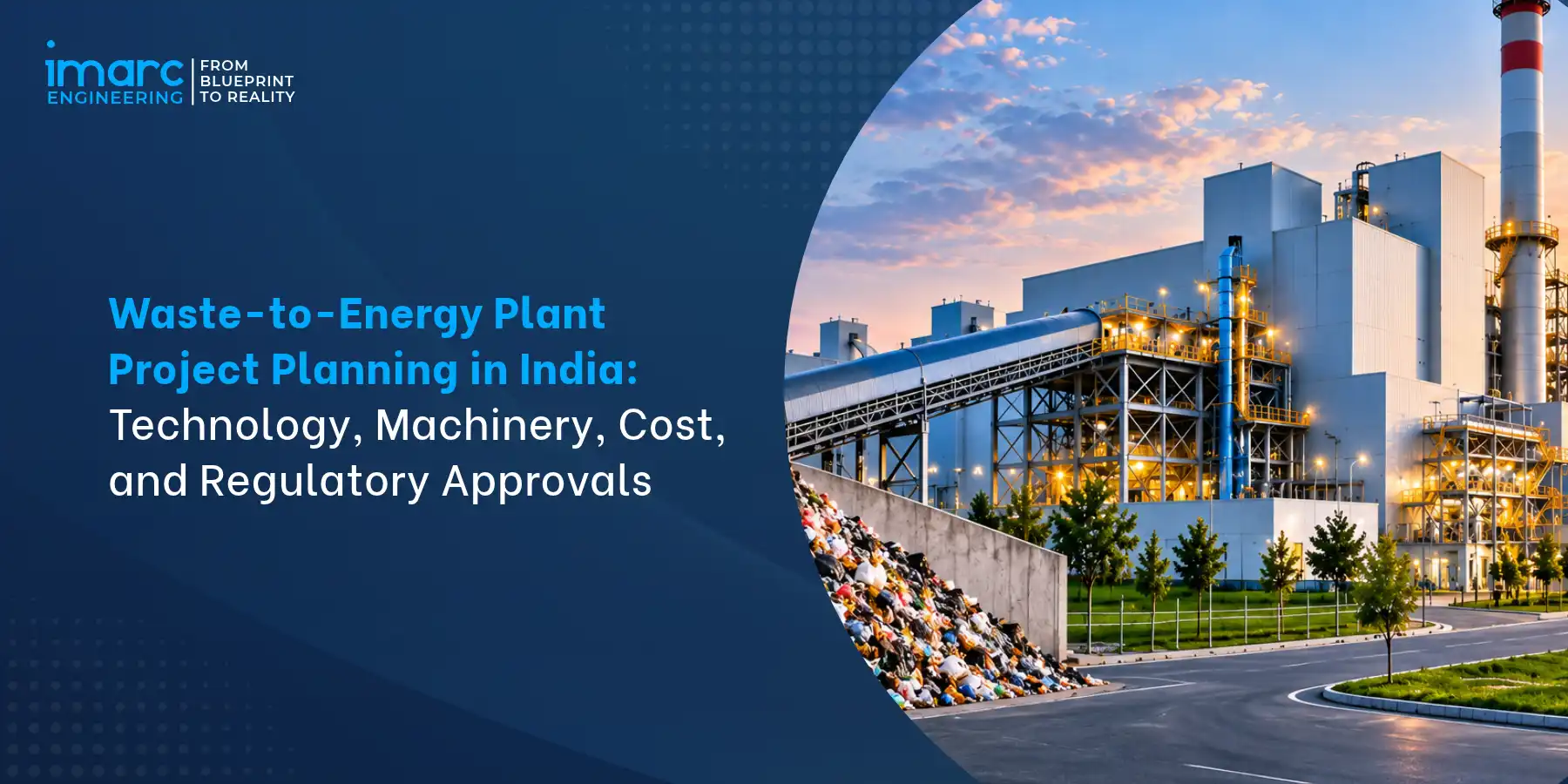
Waste-to-Energy Plant Project Planning in India: Technology, Machinery, Cost, and Regulatory Approvals
Introduction
For investors and project developers evaluating waste-to-energy plant project planning in India in 2026, the opportunity rests on a tightening regulatory push for Zero Waste to Landfill combined with structural pressure on urban waste management. The Solid Waste Management Rules 2026 (notified by MoEFCC under the Environment (Protection) Act 1986, effective 1 April 2026) and the CPCB's August 2025 Guidelines on MSW Incineration-Based WtE Plants have sharpened both the demand pull and the compliance floor. Technology, feedstock, and offtake decisions made before capital commitment determine whether the project is bankable.
Scope of the Guide
This guide walks through waste-to-energy project planning for thermal plants (incineration, RDF combustion, and gasification) in India - from waste characterization and technology selection through machinery, site, approvals, CAPEX/OPEX, DPR, and EPCM execution - calibrated to the policy framework in force in October 2026 and anchored to project-specific assumptions rather than universal claims.
Practical Waste-to-Energy Project Planning Workflow
A waste-to-energy project should progress through linked stages, with feedstock, technical, commercial and regulatory decisions developed together.
- Feedstock Assessment: Characterise waste quantity, composition, moisture, calorific value, seasonal variation and collection reliability. Establish the ULB's committed waste quantity and applicable tipping-fee framework.
- Feasibility Assessment: Evaluate technology options, plant capacity, site requirements, utilities, grid connectivity, offtake arrangements, CAPEX, OPEX and project economics.
- DPR Preparation: Develop the process design, mass and energy balances, equipment list, plant layout, CAPEX/OPEX estimates, financial model, implementation schedule, risk register and compliance roadmap.
- Approvals and Commercial Structuring: Progress applicable Environmental Clearance, SPCB consents, SWM-related approvals, land and utility approvals, PPA and tipping-fee arrangements. Where dependencies permit, these activities can proceed in parallel.
- Engineering and Procurement: Finalise FEED and detailed engineering, equipment specifications, vendor packages, procurement strategy, civil works and grid-interconnection requirements.
- Construction and Commissioning: Execute civil and mechanical works, install electrical and pollution-control systems, complete testing and commissioning, conduct trial operations and verify plant performance before commercial operation.
Table of Contents
- Introduction
- Practical Waste-to-Energy Project Planning Workflow
- Why Waste-to-Energy Plant Project Planning in India Matters for Investors in 2026
- Waste Characterization and Feedstock Assessment for Waste-to-Energy Plant Planning in India
- Waste-to-Energy Technology Selection and Comparison for Projects in India
- Machinery and Equipment for a Waste-to-Energy Plant in India
- Site Selection Plant Layout and Capacity Determination for Waste-to-Energy Plants in India
- Regulatory and Environmental Approvals for Waste-to-Energy Projects in India
- CAPEX OPEX and Revenue Framework for Waste-to-Energy Plant Project Planning in India
- DPR Preparation Risks and EPCM Execution for Waste-to-Energy Projects in India
- Conclusion
1. Why Waste-to-Energy Plant Project Planning in India Matters for Investors in 2026
Four drivers make disciplined thermal WtE investment strategically important in India in 2026.
1.1 SWM Rules 2026 and Landfill Restrictions
The Solid Waste Management Rules 2026 shift the national framework from collect-and-dump to a circular economy with Zero Waste to Landfill as the stated aim. Landfills are restricted to non-recyclable, inert waste. Legacy dumpsites must be cleared through time-bound biomining and bioremediation. Non-recyclable waste with a calorific value of 1,500 kcal/kg or above is subject to energy-recovery requirements under the SWM Rules 2026. This strengthens the policy case for energy-recovery and RDF capacity where suitable high-calorific non-recyclable waste is available.
1.2 Cement Co-Processing and RDF Market
The SWM Rules 2026 introduce fuel-substitution requirements for specified industrial units using solid fuel, including requirements relating to segregated combustible fractions and RDF. This creates an additional potential offtake route for suitable RDF, subject to feedstock quality, applicable requirements and project location.
This creates a parallel offtake channel for RDF beyond captive power generation. Projects can be designed as RDF-production facilities feeding cement kilns, as combined RDF-plus-power plants, or as integrated MSW-to-power facilities. The right design depends on offtake visibility, cement industry proximity, and tipping fee negotiation with Urban Local Bodies (ULBs).
1.3 Policy and Financial Support
MNRE has previously provided Central Financial Assistance (CFA) under its Waste-to-Energy Programme. However, Phase I covered FY 2021-22 to FY 2025-26, and new applications closed on 31 December 2025 until further notice. The 2021-26 guidelines also excluded MSW-to-power projects from CFA. Developers should therefore verify the applicable MNRE scheme and project eligibility before including any government incentive in the financial model.
1.4 Compliance Floor and Technology Advancement
CPCB issued draft Guidelines on MSW Incineration-Based Waste-to-Energy Plants in August 2025 and subsequently worked on revisions following the introduction of the SWM Rules 2026. Project design should therefore be based on the applicable statutory requirements and the latest CPCB and SPCB directions rather than treating the August 2025 draft as a final regulatory standard.
Air pollution control systems should be selected and sized to meet the applicable emission limits and site-specific compliance requirements. The compliance floor rewards investors who design to the latest standard from day one and penalises those planning marginal retrofits. Waste-to-energy technology India has matured over the past decade - with multiple operating reference plants in Delhi, Jabalpur, Bengaluru, Hyderabad, and Pune providing reliable benchmarks.
2. Waste Characterization and Feedstock Assessment for Waste-to-Energy Plant Planning in India
The project begins with waste characterization - the single most important input to every downstream decision. Feedstock defines technology, capacity, emission control sizing, and project economics.
2.1 Waste Composition Analysis
A representative waste composition study over multiple seasons establishes the share of combustibles (paper, plastics, textiles, wood), compostable organics, inerts (grit, construction debris, glass), recyclables (metals, high-value plastics), and hazardous or special-care fractions. Indian urban MSW typically shows high moisture content, significant inert fraction, and seasonal variability. A single-sample characterization misleads - monsoon moisture and festive season composition change feedstock quality enough to affect plant operations.
2.2 Calorific Value Assessment
Calorific value is a critical factor in selecting waste-to-energy technology and determining plant capacity. Indian mixed municipal solid waste (MSW) can have relatively low and variable calorific value due to moisture, organic matter and inert materials. Refuse-Derived Fuel (RDF) quality also depends on waste segregation, composition and pre-processing methods. The actual lower heating value should therefore be established through representative, multi-season testing before technology selection and capacity finalisation.
The calorific value of RDF varies according to its combustible content, moisture levels and processing quality. Waste streams should be assessed against the applicable energy-recovery provisions of the Solid Waste Management Rules 2026, including the relevant calorific-value criteria. Pre-processing activities such as sorting, shredding and drying can improve feedstock consistency, reduce moisture and increase the calorific value of the processed material. Where technically and economically justified, controlled drying systems may also be considered to improve feedstock suitability for thermal waste-to-energy applications.
2.3 Feedstock Volume and Reliability
Volume commitment from the ULB over the plant's economic life (typically 20-25 years) is a precondition for bankability. The commitment should cover minimum daily tonnage, quality floor, and tipping fee escalation. Variability in waste arrival (daily, weekly, seasonal) sets receiving pit capacity. The ULB's own collection reliability, segregation performance under SWM 2026 rules, and backup disposal arrangement for down-time events all affect operating assumptions.
2.4 Typical Intake Composition
Waste composition varies significantly by city, collection system, source segregation, season and sampling methodology. A project-specific multi-season characterization study should establish the combustible, organic, inert, recyclable and special-care fractions before technology and capacity are selected.
3. Waste-to-Energy Technology Selection and Comparison for Projects in India
The right waste-to-energy technology India choice depends on feedstock, scale, offtake, and investor risk appetite. Four thermal routes merit evaluation.
3.1 Mass Burn Incineration
Mass burn incineration technology combusts mixed MSW (with limited pre-processing) in a moving-grate furnace. It is the most mature technology globally, with multiple decades of operating reference. Advantages include handling of heterogeneous feed, lower pre-processing CAPEX, and proven emission control. Drawbacks include relatively larger furnace size per tonne processed and sensitivity to very low calorific waste. Mass-burn technology can be suitable for large municipal projects with relatively heterogeneous feedstock and reliable waste collection, subject to project-specific feedstock, technology, environmental and commercial assessments.
3.2 RDF Combustion
RDF combustion uses pre-processed Refuse Derived Fuel (segregated, shredded, dried, pelletised where applicable) in a dedicated boiler - typically moving-grate or fluidised-bed. Higher and more uniform calorific value enables smaller furnace and boiler size per MW output, better emission control, and cleaner combustion. The trade-off is CAPEX for the RDF production line (shredders, trommels, magnetic and eddy-current separators, ballistic separators, dryers) and the operational discipline to maintain feed quality. For medium-scale projects or where RDF has a parallel cement kiln offtake, this route offers flexibility.
3.3 Gasification
Gasification partially oxidises carbon-rich waste at high temperature with limited oxygen to produce syngas (CO + H2 + CH4 + inerts). The syngas can fire a boiler, run a gas engine, or feed downstream chemistry. Potential advantages include syngas flexibility and, depending on feedstock and process configuration, potentially favourable emissions performance. However, gasification requires consistent feedstock quality and appropriate syngas cleaning and has fewer long-term municipal MSW references than conventional mass-burn systems.
Drawbacks are higher CAPEX, more demanding feedstock quality, and fewer long-run commercial reference plants on MSW compared with mass burn. For well-segregated feedstocks and specialist waste streams, gasification deserves evaluation; for mixed MSW at large scale, it carries higher execution risk.
3.4 Pyrolysis and Emerging Routes
Pyrolysis thermally decomposes waste in the absence of oxygen, producing bio-oil, char, and syngas. Commercial deployment at municipal scale remains limited in India. Plasma gasification is a further emerging route. Both are at the technology-maturity frontier and are better suited to pilot or specialist waste applications than to a flagship municipal project where proven operation matters more than theoretical efficiency.
3.5 Technology Comparison
| Technology | Feedstock Fit | Maturity | Typical Scale |
|---|---|---|---|
| Mass burn incineration | Mixed MSW, variable quality | Mature | Medium–Large |
| RDF combustion | Processed RDF, uniform quality | Mature | Medium to large |
| Gasification | Segregated, higher CV feed | Commercial for selected streams | Varies by project |
| Pyrolysis / plasma | Niche or pilot | Emerging for MSW | Small to pilot |
4. Machinery and Equipment for a Waste-to-Energy Plant in India
The waste-to-energy plant machinery envelope spans waste reception through flue gas treatment and ash handling. Scale and technology determine specification; the functional blocks are common.
4.1 Waste Reception and Pre-Processing
Waste trucks tip into a receiving hall with weighbridge. The pit stores several days of feedstock buffer. A mobile grab crane handles feed from pit to pre-processing or directly to furnace. Pre-processing equipment includes primary shredders, trommels for size separation, overband magnets for ferrous metal recovery, eddy-current separators for non-ferrous, ballistic separators for lights-vs-heavies, and (for RDF production) secondary shredders and pelletisers. Hot-air drying installations raise effective calorific value where moisture is high.
4.2 Combustion System
The heart of the plant is the combustion system - a moving-grate furnace, a fluidised-bed combustor, or a rotary kiln depending on technology choice. The combustion system should be designed and operated to meet the applicable temperature, residence-time, turbulence and emission requirements under the prevailing regulatory framework and applicable CPCB requirements. The boiler (water-tube waste-heat boiler) raises steam at specified pressure and temperature feeding the power generation island.
4.3 Power Generation Island
Steam feeds a condensing or extraction-condensing steam turbine coupled to a synchronous generator. Power output depends on feedstock quantity and calorific value, plant configuration, conversion efficiency and parasitic consumption. Project-specific mass and energy balances should be used to determine expected net generation. Auxiliary systems include condenser, cooling tower (wet or air-cooled depending on water availability), demineralised water plant, feedwater heaters, and chemical dosing. The turbine island is a conventional thermal power sub-system - vendor supply and maintenance are well-established in India.
4.4 Air Pollution Control
Air pollution control systems for thermal waste-to-energy plants may include selective non-catalytic reduction (SNCR) or selective catalytic reduction (SCR) for NOx, scrubbers or sorbent injection for acid gases, bag filters for particulate matter, and activated carbon injection for mercury and dioxins/furans.
The plant must be designed to meet applicable notified emission standards, including relevant concentration limits, averaging periods, sampling methods and reference conditions. Requirements for online continuous emission monitoring and periodic stack testing should be verified against applicable CPCB/SPCB directions and project-specific consent conditions.
4.5 Ash Handling and Auxiliary Systems
Bottom ash and slag discharge from the furnace must meet CPCB targets - total organic carbon below 3 percent or loss on ignition below 5 percent of dry weight - and are typically used in construction material or disposed in an engineered landfill. Fly ash and other residues must be characterised and managed according to their applicable regulatory classification, with hazardous residues requiring appropriate treatment and secure disposal. Ash handling systems include conveyors, silos, and stabilisation units. Auxiliary systems cover plant DCS/SCADA, instrumentation, electrical switchgear, fire protection, and administrative facilities.
5. Site Selection Plant Layout and Capacity Determination for Waste-to-Energy Plants in India
A well-sized plant on the right site is the backbone of waste-to-energy plant design. Three decisions - site, layout, capacity - are made together, not in sequence.
5.1 Site Selection Criteria
Site selection weighs proximity to the waste source (ULB collection points), buffer distance from residential and ecologically sensitive areas, access for waste-haul trucks and ash disposal vehicles, water availability for cooling and process needs, grid connectivity for power evacuation, land availability sufficient for the plant, green belt, ash handling, utilities, access, buffers and potential expansion, as determined by project-specific planning. The SWM Rules 2026 require a buffer zone around solid-waste processing and disposal facilities exceeding five tonnes per day of installed capacity. The buffer is maintained within the facility area, with its requirements determined on a case-by-case basis by the local body in consultation with the State Pollution Control Board. Stack height should be established through applicable requirements and site-specific air-dispersion modelling.
5.2 Plant Capacity Determination
Waste-to-energy plant capacity should be determined through an assessment of committed waste availability, feedstock composition and calorific value, selected technology, expected operating availability, grid evacuation capacity and project economics. Mass and energy balances should establish the relationship between waste throughput and expected net power generation. Larger facilities require corresponding long-term feedstock commitments, supporting infrastructure and grid connectivity.
5.3 Plant Layout
The plant layout flows from truck entry through weighbridge, tipping hall, waste pit, pre-processing area, furnace-boiler island, turbine hall, air pollution control building, stack, ash handling yard, cooling system, DM water plant, electrical switchyard, and administrative block. Traffic separation (waste trucks, ash trucks, personnel vehicles) is a safety requirement. Fire-fighting and emergency access per NBC 2016 Part 4 and OSH Code 2020 are integrated at layout stage - retrofit is costly and sometimes impossible on constrained sites.
5.4 Grid Interconnection
Power evacuation agreement with the state DISCOM, substation sizing, and transmission line construction run as parallel critical-path activities with plant engineering. For waste to energy projects, PPA tenure and tariff depend on the applicable State regulatory framework, procurement structure and project-specific agreement. Delays in grid interconnection commonly extend plant commissioning past mechanical readiness - the resulting idle plant eats into project returns. Early engagement with DISCOM and state transmission utility is advised.
6. Regulatory and Environmental Approvals for Waste-to-Energy Projects in India
The compliance stack for waste-to-energy regulatory approvals is extensive. Approvals are sequenced across the project lifecycle; missing any one blocks commissioning.
6.1 Environmental Clearance
Prior Environmental Clearance is required for projects falling within the applicable categories of the EIA Notification 2006. The applicable category and appraisal authority should be confirmed based on the specific project scope, facility type and EIA Schedule. The process covers Terms of Reference issuance, Environmental Impact Assessment covering baseline air/water/soil/socio-economic conditions and predicted impacts, public hearing in the project area, Expert Appraisal Committee review, and final EC with conditions.
Dispersion modelling supports the stack height decision. For complex projects, the EC process can be a significant critical-path activity, and its duration should be assessed project-by-project based on the scope, appraisal pathway, studies and statutory process.
6.2 SPCB Consent to Establish and Operate
State Pollution Control Board (SPCB) Consent to Establish (CTE) and Consent to Operate (CTO) are required under the Water (Prevention and Control of Pollution) Act 1974 and Air (Prevention and Control of Pollution) Act 1981. The applicable emission standards cover parameters including particulate matter, HCl, SO₂, CO, NOx, HF and dioxins/furans, with parameter-specific averaging or sampling periods and reference conditions. The applicable OCEMS requirements should be confirmed against the latest CPCB/SPCB directions for the facility. OCEMS deployment, effluent discharge standards, solid waste management, and conditions on operation. SPCB consent is renewed periodically through the plant life.
6.3 Solid Waste Management Rules Compliance
The project must register and operate under the Solid Waste Management Rules 2026 (effective 1 April 2026, under the Environment (Protection) Act 1986) - which replace the SWM Rules 2016. Registration on the centralised online waste tracking portal, compliance with the four-stream source segregation framework, landfill restriction to non-recyclable inert waste only, and biomining of legacy dumpsites are the new rules' main themes. CPCB's draft/revised technical guidance provides additional technical considerations for MSW incineration-based WtE projects, alongside the applicable statutory requirements.
6.4 Other Statutory Approvals
Applicable registration, licensing and occupational-safety requirements under the Occupational Safety, Health and Working Conditions Code 2020 and relevant State rules must be assessed for the facility. Fire NOC per NBC 2016 Part 4 covers plant-wide fire detection, suppression, and emergency response. Hazardous Waste Management Rules 2016 compliance covers fly ash stabilisation and disposal.
Explosives Rules 2008 and PESO approvals apply where storage of fuel oil above threshold quantities is involved. GST registration, Udyam (where applicable), electricity connection with the state DISCOM, and PPA execution complete the stack.
7. CAPEX OPEX and Revenue Framework for Waste-to-Energy Plant Project Planning in India
Understanding waste-to-energy plant cost in India needs discipline. Universal CAPEX and ROI figures mislead; each project is sized to its feedstock, scale, and offtake structure.
7.1 CAPEX Components
Primary CAPEX drivers are plant capacity (TPD and MW), technology choice (mass burn vs RDF vs gasification), pre-processing scope, boiler and turbine island, air pollution control package (SNCR/SCR, scrubbers, bag filter, activated carbon system), ash handling, OCEMS and controls, civil and structural works, land, electrical switchyard and grid interconnection, water system, administrative facilities, EPC margin, and project contingency. The combustion-boiler-turbine island and air pollution control package together typically dominate hard CAPEX.
7.2 OPEX Components
Major OPEX components include waste reception and handling, labour, auxiliary power consumption, water and wastewater treatment, combustion and air-pollution-control consumables such as lime, reagents and activated carbon, routine maintenance and major overhauls, ash handling and disposal, OCEMS operation and calibration, insurance, laboratory and environmental monitoring, administration, transportation where applicable, and equipment replacement. The relative cost of each component depends on plant technology, feedstock quality, operating regime, contractual structure and site conditions.
7.3 Revenue Structure
Indian WtE projects typically have three revenue streams - tipping fees from the ULB per tonne of waste accepted, electricity sale to the state DISCOM under a long-term PPA, and secondary revenue from recovered materials (metals from pre-processing, bottom ash to construction uses where quality permits). Carbon credits and RDF sales to cement plants are emerging additions. Tipping fees can be a major determinant of project economics, particularly where electricity tariffs alone do not support project viability.
7.4 Project Economics Profile
| Economic Lever | Impact on Project IRR |
|---|---|
| Tipping-fee arrangements | Contracted fee, payment security and escalation |
| Electricity tariff and PPA | Contracted tariff, tenure and payment terms |
| Feedstock quality | Calorific value, moisture, contamination and consistency |
| Plant availability (uptime) | Technology-specific uptime and maintenance assumptions |
| Auxiliary power consumption | Difference between gross and net electricity generation |
| Pollution control and ash disposal | Reagent, monitoring and residue-management costs |
8. DPR Preparation Risks and EPCM Execution for Waste-to-Energy Projects in India
A disciplined waste-to-energy DPR and EPCM execution plan convert concept into bankable project and bankable project into operating plant.
8.1 DPR Contents
The Detailed Project Report consolidates waste characterization study, demand and supply assessment, technology selection rationale, process flow diagram with mass and energy balance, equipment list, plant layout, utility estimation, land plan, CAPEX and OPEX, revenue projections, financial model with sensitivity, implementation schedule, risk register, compliance stack, PPA and tipping fee framework, and EPCM structure.
For waste-to-energy projects, the DPR must also explicitly cover the applicable SWM Rules 2026 requirements, CPCB emission-compliance strategy, and any applicable government incentive or state-level support.
8.2 Major Risks
WtE project risks fall into five categories - feedstock risk (ULB waste supply volume and quality variability), technology execution risk (first-of-its-kind applications, unproven vendors, commissioning delays), revenue risk (tipping fee disputes, delayed PPA, DISCOM payment cycles), regulatory risk (changing emission standards, EC conditions, SWM Rules amendments), and social risk (community opposition to siting, public hearing delays). Each risk needs a named owner in the DPR with a specific mitigation plan - a risk register that lumps all five together provides little comfort to lenders or sponsors.
8.3 EPCM Execution
EPCM is one execution model available for WtE projects. Depending on project scope and risk allocation, sponsors may also use lump-sum EPC or hybrid EPC/EPCM structures. The EPCM contractor handles detailed engineering, procurement co-ordination, construction supervision, and commissioning oversight on the sponsor's behalf - without taking lump-sum turnkey risk.
For complex multi-technology scope, this structure preserves cost transparency and flexibility to change scope during execution. Alternative lump-sum EPC transfers execution risk to the contractor at a cost premium. Mixed structures - EPC for boiler island, EPCM for balance of plant - are also common.
8.4 Project Timeline
Project duration is highly site- and scope-specific. Environmental clearance, land and utility readiness, contracting, equipment lead times, construction complexity and commissioning requirements should be modelled in an integrated project schedule. Key approvals, commercial agreements, engineering and procurement can proceed in parallel where dependencies permit.
Conclusion
Effective waste-to-energy project planning in India requires reliable ULB feedstock, suitable technology, compliant plant design, site and grid planning, regulatory approvals, a viable revenue model, a robust DPR, risk management, and coordinated EPCM execution.
Three priorities matter most: secure long-term feedstock and tipping-fee commitments, design for applicable CPCB and SWM requirements from the outset, and run key approvals, procurement and commercial negotiations in parallel to maintain the project schedule.
PLANNING A WASTE-TO-ENERGY PROJECT IN INDIA?
IMARC Engineering supports waste-to-energy projects across waste characterization, technology selection, equipment specification, site selection, plant layout and capacity sizing, grid integration, regulatory approvals, DPR preparation, financial modelling, risk assessment, EPCM execution and commissioning. Its advisory scope covers technologies such as mass burn, RDF combustion and gasification, along with pollution control, utilities and project implementation planning.
→ Schedule a waste-to-energy project scoping consultation with an IMARC specialist
Frequently Asked Questions
Waste-to-energy plant project planning in India covers waste characterization, ULB feedstock commitment, technology selection, machinery and layout, site selection with buffer and green belt, PPA and tipping fee structuring, regulatory approvals under SWM Rules 2026 and EIA 2006, DPR, and EPCM execution.
Waste-to-energy technology India selection depends on feedstock. Mass burn can suit large municipal projects with heterogeneous feedstock. RDF combustion is suited to consistent, pre-processed feedstock, while gasification generally requires tighter feedstock control. Technology selection should be based on feedstock characteristics, scale, emissions requirements, commercial structure and technology maturity.
Waste-to-energy plant cost in India depends on technology (mass burn, RDF, gasification), capacity (TPD and MW output), air pollution control package, site conditions, and grid interconnection. Universal CAPEX figures mislead - costing requires defined feedstock, technology, and compliance scope before any benchmark becomes meaningful.
Waste-to-energy plant machinery includes tipping hall and pit, mobile grab crane, pre-processing (shredders, trommels, magnetic/eddy-current/ballistic separators), moving-grate or fluidised-bed furnace, waste-heat boiler, steam turbine and generator, air pollution control (SNCR/SCR, scrubbers, bag filter, activated carbon), ash handling, OCEMS, and DCS/SCADA.
Waste-to-energy plant capacity is determined by committed waste quantity, feedstock calorific value and composition, selected technology, expected availability, grid requirements and project economics. Capacity should be established through project-specific waste characterization and feasibility analysis.
Depending on project scope and applicable legislation, WtE projects may require Environmental Clearance under the EIA Notification 2006, SPCB consents under the Water and Air Acts, compliance with the SWM Rules 2026, applicable OSH Code requirements, fire-safety approvals, waste-management authorisations and power-sector agreements.
WtE project profitability depends on tipping fees from the ULB, PPA tariff and tenure (typically 20-25 years), feedstock calorific value and reliability, plant availability (85-90 percent target), auxiliary power consumption, APC reagent and ash disposal cost, and secondary revenue from metals and RDF offtake.
A waste-to-energy DPR covers waste characterization, demand assessment, technology selection, process flow with mass and energy balance, equipment list, plant layout, utilities, CAPEX/OPEX, financial model with sensitivity, implementation schedule, risk register, compliance stack covering SWM Rules 2026 and CPCB emission norms, and PPA/tipping fee framework.
Major risks include unreliable or variable feedstock, technology and commissioning risk, delays in Environmental Clearance or other approvals, grid-interconnection delays, uncertainty around tipping fees and PPA arrangements, emissions and environmental-compliance risk, construction and equipment-delivery delays, ash-management requirements, and community or siting issues. Each major risk should have a defined owner, mitigation measure and contingency in the project risk register.
Waste-to-energy project consultants provide waste characterization, technology selection, machinery specification, compliance roadmap under CPCB and SWM Rules 2026, DPR preparation, EPCM execution covering engineering, procurement coordination, construction supervision, and commissioning oversight, PPA and tipping fee structuring, and risk management across the project development and execution lifecycle.
Recent Post
Trusted by Industry Leaders
We partner with global enterprises and ambitious businesses across sectors to deliver operational excellence, strategic insights, and sustainable growth through integrated solutions.


Success in Their Words
Real feedback from clients across industries. Discover how our solutions delivered measurable impact and operational excellence.

I wanted to express my sincere appreciation for your efforts in handling this matter. Your dedication and commitment have been truly commendable, and it is evident that you have put in tremendous hard work and expertise into resolving the issues at hand. We are greatly interested in continuing our collaboration with you in the future, as your professionalism and reliability have made you a trusted partner. Thank you once again for your invaluable contribution. We look forward to strengthening our partnership ahead.
It has been a pleasure working with the IMARC team. The insights provided were structured, clear, and highly valuable, helping us strengthen both our technical and financial planning with confidence. We deeply appreciate the team’s professionalism, responsiveness, and attention to detail throughout the engagement. Every requirement was well understood and effectively incorporated, resulting in a comprehensive and actionable output. Overall, our experience has been excellent, and I would gladly recommend IMARC to organizations seeking a reliable research partner.
Your service is truly exceptional. Working with the IMARC team has been a seamless and professional experience. The clarity of communication, responsiveness to queries, and consistent support at every stage made the entire engagement highly efficient. The insights shared were well-structured, practical, and perfectly aligned with our requirements, helping us make informed decisions with confidence. Overall, the dedication and professionalism demonstrated by your team stand out, and I would be glad to recommend IMARC as a reliable and trustworthy research partner.

IMARC did an outstanding job in preparing our study. They were punctual, precise, and consistently responsive throughout the entire process. The team delivered all the data we required in a clear, well-organized, and highly professional format. Their strong attention to detail, combined with their ability to meet every deadline without compromising quality, truly set them apart. Overall, their reliability and commitment made them an exceptional partner for our project, and we would gladly work with them again in the future.
IMARC made the whole process incredibly easy from start to finish. Everyone I interacted with via email was polite, professional, and straightforward to deal with, always keeping their promises regarding delivery timelines and remaining consistently solutions-focused. From my very first contact, I appreciated the professionalism and support shown by the entire IMARC team. I highly recommend IMARC to anyone seeking timely, affordable, and reliable information or advice. My experience with IMARC was excellent, and I truly cannot fault any aspect of it.

I’d like to express my sincere gratitude for the excellent work you accomplished with the study. Your ability to quickly understand our requirements and deliver high-quality results under tight timelines truly reflects your expertise, exceptional work ethic, and unwavering commitment to your customer’s success. The professionalism and responsiveness you demonstrated throughout the process made a significant difference. Our entire team and company are incredibly thankful for your dedication, reliability, and support. Once again, thank you for your outstanding contribution.