Manufacturing
August 17 2026
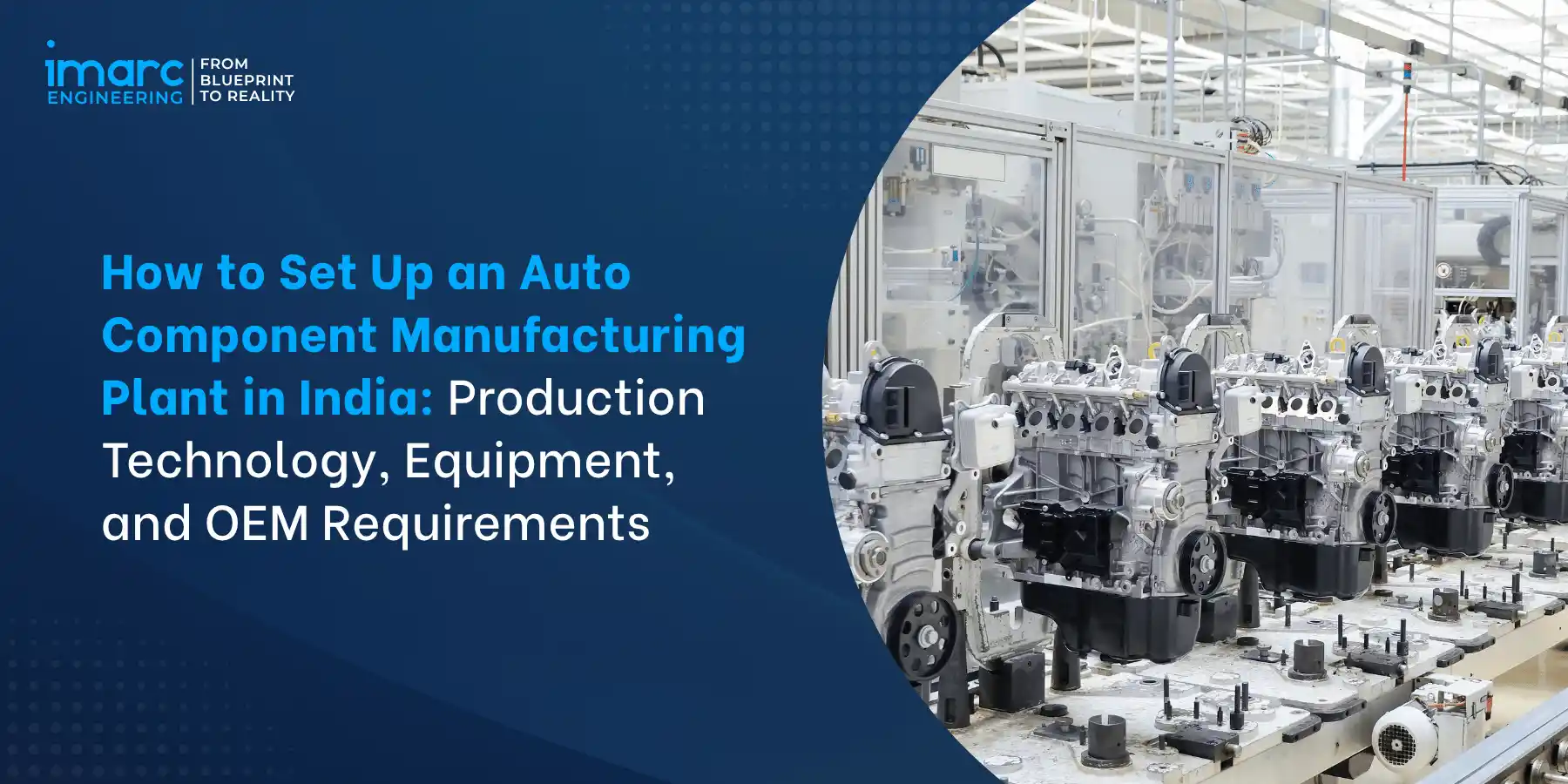
How to Set Up an Auto Component Manufacturing Plant in India: Production Technology, Equipment, and OEM Requirements
Introduction
For any investor or manufacturer entering India's automotive value chain in 2026, planning an auto component manufacturing plant in India requires disciplined evaluation across product selection, OEM demand, production technology, plant capacity, equipment, quality systems, and regulatory approvals.
Automotive components span a wide spectrum from engine and drivetrain parts to electricals, plastics, castings, forgings, precision machined parts, and EV-specific subsystems, each demanding different processes, machinery, testing, and facility requirements.
Scope of this Guide
This guide answers the sponsor's project question directly. How can manufacturers plan and establish a facility by selecting the right production technology and equipment while meeting OEM requirements, quality expectations, and project feasibility? It walks through market opportunity, setup roadmap, product and OEM demand assessment, process and technology selection, capacity and cluster site selection, equipment planning, automotive OEM requirements and quality standards, and the practices that distinguish technically and commercially viable auto component plant development from generic, one-size-fits-all planning.
Table of Contents
- Introduction
- Why Auto Component Manufacturing Matters in India
- How to Set Up an Auto Component Manufacturing Plant in India
- Auto Component Product Selection and OEM Demand Assessment in India
- Auto Component Manufacturing Process and Technology Selection in India
- Capacity Planning and Automotive Cluster Site Selection in India
- Auto Component Manufacturing Equipment and Production Line Design in India
- OEM Quality Requirements and Automotive Quality Standards in India
- Common Mistakes and Best Practices
- Conclusion
1. Why Auto Component Manufacturing Matters in India
Four drivers make auto component manufacturing a strategic opportunity for Indian investors in 2026.
1.1 Industry Scale and Economic Contribution
Indian auto component industry turnover approached INR 6 lakh crore in FY24 per Automotive Component Manufacturers Association (ACMA) data, contributing approximately 2.3 percent to national GDP.
The sector supports both domestic OEM production including Maruti Suzuki, Tata Motors, Mahindra, Hyundai, Toyota, Bajaj, TVS, and Hero, plus growing exports to Europe, North America, and Asia. Progressive Tier-1 and Tier-2 supplier ecosystems around major clusters support new entrant integration. Industry scale provides opportunity for specialised suppliers targeting specific component categories.
1.2 PLI Scheme and Policy Support
The PLI Scheme for Automobile and Auto Components, with a INR 25,938 crore outlay, supports Advanced Automotive Technology (AAT) products and deep localisation. PM E-DRIVE supports EV adoption and upgrades automotive testing agencies, while PLI-ACC supports domestic advanced-cell battery manufacturing relevant to the EV supply chain.
The NATRIP ecosystem, including NATRAX, iCAT, and GARC, provides automotive testing and R&D infrastructure. These measures can improve project economics and market opportunities, but viability still depends on OEM demand, technology, scale, localisation, and execution.
1.3 EV Transition and New Component Demand
Electric vehicle transition progressively creates new component categories including battery packs, motors, controllers, chargers, and thermal management systems while restructuring traditional powertrain component demand. Existing suppliers face progressive product portfolio transition while new entrants may target EV-specific components from inception.
Auto component manufacturing process selection and technology choices increasingly must consider both ICE and EV component compatibility. Strategic positioning for EV transition distinguishes forward-looking suppliers from those risking obsolescence.
1.4 Export Opportunity
Indian auto component exports grow progressively supported by cost competitiveness, quality maturity, and increasing OEM confidence. Europe, North America, and Southeast Asia represent primary export markets. Component categories from castings and forgings to precision engineered parts and electronics find export markets.
Export-oriented OEM suppliers may need IATF 16949 certification and customer-specific requirements such as VDA standards, depending on the component, buyer, and target market. Export markets can diversify revenue and customer exposure, although margins depend on product category, logistics, certification, and customer contracts.
2. How to Set Up an Auto Component Manufacturing Plant in India
Understanding how to set up an auto component manufacturing plant helps sponsors sequence project decisions correctly. Well-planned setup integrates market assessment, feasibility, technology and equipment selection, engineering, approvals, construction, and commissioning into coherent execution.
2.1 The Setup Roadmap
| Stage | Activities | Indicative Timeline |
|---|---|---|
| Product and Market Assessment | Component selection, OEM demand analysis, competitive study | 2-4 months |
| Feasibility and DPR | Techno-commercial evaluation, financial modelling | 2-4 months |
| Technology and Partner Selection | Process route, equipment vendors, licensor tie-ups | 3-6 months (parallel) |
| Site Selection and Approvals | Cluster evaluation, land, environmental clearance | 4-9 months |
| Detailed Engineering | Process design, plant layout, equipment specifications | 3-6 months |
| Procurement and Construction | Equipment sourcing, civil works, installation | 8-16 months |
| Commissioning and Ramp-Up | Line qualification, PPAP submission, OEM approval | 3-6 months |
Project timelines vary by component category, process complexity, approval requirements, equipment lead times, and OEM qualification cycles.
2.2 Capex, Opex and Financial Modelling for Auto Component Plants in India
Capex, opex and financial modelling for auto component plants scale substantially with component category, technology, and volume. Small facilities producing single components at low-to-medium volumes typically require INR 5-25 crore capex. Medium facilities producing multi-component or medium volume typically require INR 25-150 crore.
Large Tier-1 supplier facilities typically require INR 150-500 crore. Mega integrated suppliers with multiple lines typically require INR 500-2,000 crore. Auto component plant cost in India excludes land, working capital, and pre-operative expenses.
2.3 Manufacturing Model Selection
Manufacturing model choice affects both capital intensity and market positioning. Tier-3 suppliers typically manufacture sub-components for Tier-2 companies, while Tier-2 suppliers provide defined components or sub-assemblies to Tier-1 manufacturers. Tier-1 suppliers generally serve OEMs directly and may take responsibility for complete components, assemblies, or system integration.
Other models include contract manufacturing for automotive companies and system supply for complete subsystems such as braking systems, electrical harnesses, or other integrated components. Selecting the appropriate manufacturing model should reflect the promoter’s technical capability, available capital, target customers, and long-term strategic objectives.
3. Auto Component Product Selection and OEM Demand Assessment in India
Auto component product selection and OEM demand assessment in India establish the commercial foundation determining which segments the facility will serve. Product choice defines downstream engineering, equipment, capital, and quality requirements.
3.1 Component Categories
- Engine components: pistons, cylinder heads, crankshafts, camshafts, valves
- Drivetrain: transmission gears, propeller shafts, differentials, clutch assemblies
- Steering systems: steering columns, tie rods, ball joints, power steering pumps
- Suspension and braking: shock absorbers, springs, brake pads, callipers, discs
- Body and chassis: stampings, panels, frames, bumpers
- Electrical and electronics: harnesses, sensors, ECUs, starter motors, alternators
- Lighting: headlamps, tail lamps, indicators, interior lighting
- Interiors: seats, dashboards, door trims, floor mats, headliners
- EV-specific: motors, motor controllers, battery packs, on-board chargers, thermal management
3.2 OEM Demand Assessment
OEM demand assessment covers current OEM sourcing patterns, near-term platform launches, localisation targets, existing supplier landscape, and price and quality benchmarks. Direct engagement with OEM sourcing teams during feasibility stage supports realistic demand and pricing assumptions.
Platform-specific sourcing rather than generic component demand provides tangible commercial visibility. Understanding OEM platform lifecycles helps avoid investing in capacity for programmes approaching end-of-life. Documented OEM engagement supports both feasibility credibility and downstream commercial development.
3.3 Tier Positioning
Tier positioning affects commercial complexity, margin profile, and capital intensity. Tier-1 direct-to-OEM supply commonly requires IATF 16949 certification, APQP/PPAP discipline, customer-specific quality systems, and higher investment to meet stringent quality, testing, traceability, and delivery requirements.
Tier-2 suppliers typically provide defined components or sub-assemblies to Tier-1 manufacturers, while Tier-3 suppliers operate at the sub-component or material level with comparatively narrower manufacturing scope. The aftermarket serves replacement demand and may involve different customer, quality, volume, and margin requirements.
Selecting the appropriate tier should reflect the promoter’s manufacturing capability, investment capacity, quality-system maturity, and target customer base.
3.4 EV Versus ICE Product Strategy
Electric vehicle transition creates strategic choice between ICE-focused, EV-focused, or dual-capability facility. ICE component demand continues through medium-term supporting sustained investment while progressively transitioning. EV-specific components including motors, controllers, and battery-related components represent growth segments.
Dual-capability manufacturing supporting both ICE and EV components suits several component categories including electricals, plastics, and precision machined parts. Strategic positioning during initial facility design prevents costly retrofit as market composition evolves.
4. Auto Component Manufacturing Process and Technology Selection in India
Auto component manufacturing process and technology selection depends primarily on component material, geometry, and volume requirements. Process choice determines equipment, quality systems, and facility infrastructure that subsequent decisions build upon.
4.1 Manufacturing Process Categories
| Process Family | Typical Applications |
|---|---|
| Metal forming (stamping, forging, casting) | Body panels, engine blocks, crankshafts, brackets |
| Machining (turning, milling, grinding) | Precision engine and drivetrain components |
| Fabrication (welding, brazing) | Frames, exhaust systems, brackets |
| Heat treatment | Hardening, tempering for gears, shafts, springs |
| Surface treatment (plating, coating, painting) | Corrosion protection, aesthetics |
| Powder metallurgy | Sintered components, bushings, gears |
| Plastic processing (injection, blow moulding) | Interior trim, bumpers, ducts |
| Rubber processing | Seals, bushings, hoses, wiper blades |
| Electronics assembly (SMT, PCB) | ECUs, sensors, controllers, harness modules |
| Assembly (manual, semi-auto, automated) | Sub-assemblies and finished components |
4.2 Technology Level Selection
Technology level scales with volume, quality requirements, and OEM expectations. Manual and low-automation processes suit low-volume, high-mix production with lower capital intensity. Semi-automated processes with operator-assisted stations suit medium volumes balancing flexibility and productivity.
Fully automated production lines suit high-volume standardised products supporting stringent quality consistency. OEM and Tier-1 customers increasingly value digital traceability, real-time production monitoring, automated quality controls, and predictive maintenance capabilities, particularly for high-volume and critical components.
4.3 Automation and Industry 4.0 Considerations
Automation intensity considerations include labour cost economics, quality consistency requirements, safety of hazardous operations, cycle time targets, and volume stability. Robotic welding, painting, and assembly progressively common in Indian auto plants. Machine vision inspection replacing manual visual inspection.
Automated Guided Vehicles (AGV) for material handling. Manufacturing Execution System (MES) providing production monitoring and traceability. Cyber-physical systems supporting Industry 4.0 maturity progression. Technology roadmap aligned with OEM expectations distinguishes strategic manufacturers from those responding reactively.
4.4 Material and Process Traceability
Material and process traceability represents fundamental automotive requirement. Batch-level traceability for materials, sub-components, and finished components. Manufacturing parameter recording supporting future analysis.
Serialisation for safety-critical components. Bar code and RFID tracking supporting shop-floor discipline. IATF 16949 and customer-specific requirements may require defined traceability controls, particularly for safety-critical, regulatory, or special-characteristic components. Structured traceability supports both quality management and recall response capability that ad-hoc systems cannot achieve at scale.
5. Capacity Planning and Automotive Cluster Site Selection in India
Capacity planning and automotive cluster site selection determine access to OEM customers, supplier networks, skilled workforce, and logistics infrastructure. Cluster proximity to major OEMs typically provides commercial and operational advantages that isolated locations cannot match.
5.1 Major Indian Automotive Clusters
- NCR (Gurgaon, Manesar, Neemrana): Maruti Suzuki, Honda, Hero MotoCorp anchor OEMs
- Chennai and Tamil Nadu belt: Hyundai, Renault-Nissan, Ashok Leyland, TVS
- Pune, Chakan, Aurangabad (Maharashtra): Tata Motors, Mahindra, Bajaj Auto, Bharat Forge
- Sanand, Halol (Gujarat): Tata Motors, Suzuki
- Bangalore, Hosur (Karnataka): Toyota, Volvo, TVS Motor
- Jamshedpur (Jharkhand): Tata Motors heavy commercial vehicles
- Pantnagar, Rudrapur (Uttarakhand): Ashok Leyland, Bajaj Auto
- Emerging clusters: Andhra Pradesh (Kia), Telangana
5.2 Cluster Selection Factors
Cluster selection considers OEM customer proximity minimising logistics cost and enabling just-in-time delivery, existing supplier ecosystem supporting Tier-2 sourcing, skilled workforce availability across relevant disciplines, State industrial policy and incentives, land availability and cost, utility infrastructure including power reliability, logistics connectivity across road, rail, and port, and existing testing infrastructure.
Multi-OEM clusters can reduce dependence on a single customer and improve access to a broader supplier and workforce ecosystem. Cluster maturity supports both immediate operations and long-term capability development.
5.3 Site Selection Criteria
- Industrial-park or SEZ location supporting regulatory clarity and infrastructure
- Land availability with expansion potential for future capacity addition
- Power infrastructure supporting production loads with reliable supply
- Water availability for utilities, cooling, and where process demands
- Road connectivity for inbound raw material and outbound finished product
- Skilled workforce availability including technicians, engineers, and operators
- Proximity to OEM customer plants supporting just-in-time delivery
- Environmental clearance feasibility given siting characteristics
- Local State industrial policy and incentives
5.4 Capacity Planning Considerations
Capacity planning combines OEM Requests for Quotation (RFQ) demand, addressable market share targets, competitive positioning, and expansion phasing. Phased capacity addition can help manufacturers align investment with demand ramp-up and reduce the risk of underutilisation from installing full capacity too early.
OEM RFQ and sourcing processes often require suppliers to demonstrate available or planned production capacity, making pre-award capacity planning important. A reasonable capacity buffer can provide flexibility for volume variation, programme ramp-up, and future business opportunities. Matching plant capacity to committed OEM demand, with appropriate headroom for growth, supports more sustainable project economics.
6. Auto Component Manufacturing Equipment and Production Line Design in India
Auto component manufacturing equipment and production line design translate process design into operational infrastructure. Equipment selection matched to component, volume, and quality targets outperforms generic procurement approaches.
6.1 Metal Forming and Machining Equipment
- Mechanical and hydraulic stamping presses (100-2,000 tonnes typical)
- Forging presses (mechanical, hydraulic, screw press) with induction heating
- Casting equipment (die casting, sand casting, investment casting) with core-making
- CNC turning centres (2-axis to multi-axis) with bar feeders
- CNC machining centres (3-axis to 5-axis) with pallet changers
- CNC grinding machines (surface, cylindrical, centreless)
- Honing, lapping, and superfinishing equipment for precision surfaces
- Broaching machines for keyways and internal profiles
- Gear cutting equipment (hobbing, shaping, shaving) for drivetrain components
6.2 Heat Treatment and Surface Treatment
- Continuous and batch heat treatment furnaces (hardening, tempering, annealing)
- Induction hardening equipment for selective surface hardening
- Carburising and nitriding equipment for surface enrichment
- Electroplating lines (zinc, chromium, nickel) with effluent treatment
- Powder coating and paint booths with waste solvent management
- Anodising lines for aluminium components
- Phosphating pre-treatment lines
- E-coat (electrophoretic deposition) systems for corrosion protection
6.3 Testing and Measurement Infrastructure
- Coordinate Measuring Machines (CMM) for dimensional inspection
- Vision measurement systems for high-throughput inspection
- Surface roughness testers and profilometers
- Hardness testers (Rockwell, Brinell, Vickers, micro-hardness)
- Metallography equipment for microstructural analysis
- Spectrometers for material composition verification
- Universal Testing Machines for tensile, compression, and bend testing
- Endurance test rigs and automotive component testing equipment matched to component category
- Environmental chambers (temperature, humidity, salt spray)
- Vibration and shock test benches
6.4 Production Line Layout Principles
Production line layout supports material flow efficiency, quality, and worker safety. Cellular manufacturing arrangement for related component families supporting lean flow. U-shape or straight-line configurations depending on component progression. Kanban systems supporting just-in-time material replenishment.
Poka-yoke (mistake-proofing) integration preventing quality defects. Andon systems supporting immediate quality response. 5S workplace organisation across production zones. Layout planned during design phase outperforms retrofit modifications during operations.
7. OEM Quality Requirements and Automotive Quality Standards in India
OEM quality requirements and automotive quality standards define the compliance framework distinguishing certified suppliers from those unable to serve OEM markets. Quality system maturity progressively becomes prerequisite for OEM engagement.
7.1 IATF 16949 and Automotive Quality Framework
IATF 16949:2016 covering Quality Management Systems requirements for automotive production and relevant service parts organisations represents baseline certification for OEM Tier-1 supply. Sector-specific requirements build on ISO 9001:2015 foundation. Certification typically requires 12-18 months preparation covering documentation, implementation, internal audit maturity, and third-party certification audit.
Complementary certifications include ISO 14001 (environmental) and ISO 45001 (occupational health and safety). Automotive supplier requirements progressively expect these certifications as tender qualification criteria.
7.2 AIAG Core Tools and Process Discipline
Automotive Industry Action Group (AIAG) core tools provide the operational discipline within IATF 16949. Advanced Product Quality Planning (APQP) structuring product development through defined phases. Production Part Approval Process (PPAP) documenting supplier submission and OEM approval typically covering 18 elements at Level 3. Failure Mode and Effects Analysis (FMEA) using AIAG-VDA harmonised methodology.
Measurement System Analysis (MSA) validating measurement capability. Statistical Process Control (SPC) monitoring process capability. Control Plan documenting process controls. Discipline across core tools distinguishes systematic Tier-1 suppliers from those unable to sustain OEM engagement.
7.3 Regulatory Approvals and Compliance for Auto Component Manufacturing in India
Regulatory approvals and compliance for auto component manufacturing in India cover both plant establishment and component-specific requirements. Component-specific approvals under Motor Vehicles Act 1988 as amended by Motor Vehicles (Amendment) Act 2019 and Central Motor Vehicles Rules (CMVR) 1989.
Type Approval under CMVR Rule 126 required for safety-critical components. Conformity of Production (CoP) under CMVR Rule 126A ensuring production consistency. Automotive Industry Standards (AIS) issued by Automotive Research Association of India (ARAI) covering specific component categories.
7.4 OEM-Specific Quality Standards
Individual OEMs also impose company-specific requirements supplementing IATF 16949. Maruti Suzuki supplier quality expectations aligned with Toyota Production System. Tata Motors Supplier Quality Assurance framework. AIAG Continuous Quality Improvement (CQI) standards including CQI-9 (heat treatment), CQI-11 (plating), CQI-12 (coating), CQI-15 (welding), and CQI-27 (casting). Multi-OEM supply demands attention to varying OEM-specific requirements.
8. Common Mistakes and Best Practices
8.1 Weak OEM Demand Validation
Facilities constructed on assumed OEM demand without documented RFQ engagement often face utilisation challenges.
Best practice: direct OEM sourcing team engagement during feasibility; documented Letters of Intent supporting bankability; platform-specific rather than generic component demand; awareness of OEM platform lifecycles preventing entry at end-of-life; multi-OEM engagement reducing single-customer dependency; realistic price and volume assumptions grounded in OEM benchmarks.
8.2 Under-Investment in Testing Infrastructure
Testing infrastructure inadequate for OEM PPAP submission produces certification delays and business loss.
Best practice: testing capability including CMM, universal testing machines, hardness testers, and metallography sized for target component certification; environmental chambers and endurance testing matched to component category; third-party testing partnerships with ARAI, iCAT, or GARC for Type Approval requirements; investment in measurement systems supporting MSA compliance.
8.3 Cluster Selection Without OEM Proximity Analysis
Site selection ignoring OEM proximity produces logistics disadvantages and reduced just-in-time capability.
Best practice: cluster selection anchored on target OEM customer proximity; multi-OEM cluster preference reducing single-customer dependency; supplier ecosystem availability supporting Tier-2 sourcing; skilled workforce availability across required disciplines; State industrial policy alignment supporting incentive optimisation; logistics infrastructure supporting inbound and outbound flows.
8.4 Insufficient IATF 16949 Preparation
Facilities attempting OEM supply without IATF 16949 certification face qualification barriers even with technical capability.
Best practice: IATF 16949 certification planned during feasibility with realistic 12-18 month preparation timeline; APQP-PPAP capability development in parallel with facility construction; internal audit maturity supporting third-party audit success; documentation systems from inception rather than retrofit; consultant support where internal capability limited.
8.5 Underestimating Working Capital Requirements
Working capital under-provision producing operational stress even for technically successful facilities.
Best practice: working capital sized for raw material inventory, work-in-progress, and receivables cycles typically 90-180 days total; OEM payment terms typically 60-90 days requiring receivables financing; structured banking relationships supporting inventory and receivables financing; contingency provisions for OEM payment delays; disciplined cash flow management preventing operational stress.
Conclusion
Planning an auto component manufacturing plant combines market assessment, OEM demand validation, feasibility, technology selection, capacity planning, cluster-based site selection, quality-system planning, regulatory approvals, and testing infrastructure. Strong OEM demand, EV growth, exports, and government support are creating opportunities across selected automotive component categories. However, project viability remains highly dependent on component selection, confirmed OEM demand, technology, location, quality-system readiness, and execution capability.
Successful projects require manufacturers to validate customer demand early, align production technology and capacity with component requirements, plan automotive quality systems from the outset, and select locations that provide strong access to OEMs, suppliers, skilled labour, and infrastructure.
PLANNING YOUR AUTO COMPONENT MANUFACTURING PLANT?
IMARC Engineering supports investors and manufacturers with auto-component plant feasibility studies, OEM and market assessment, technology and process selection, capacity planning, automotive-cluster site selection, plant layout and detailed engineering, equipment specification, CAPEX/OPEX modelling, testing and quality-system planning, procurement support, installation, and commissioning. Our engineering-led approach helps align product strategy, OEM requirements, manufacturing technology, and plant investment decisions before execution begins.
→ Schedule a free auto component plant scoping consultation with an IMARC specialist
Frequently Asked Questions
Auto component plant development typically includes product assessment, feasibility and DPR, technology selection, site selection and approvals, detailed engineering, procurement and construction, and commissioning with PPAP submission. Depending on project scope, facilities generally take 18-36 months to reach stable commercial production.
Automotive components are manufactured using metal forming, machining, fabrication, heat treatment, surface treatment, plastic and rubber processing, electronics assembly, and final assembly operations. Process selection depends on the component's material, geometry, production volume, quality requirements, and intended automotive application.
Core equipment includes stamping presses, forging and casting systems, CNC machines, grinding equipment, heat treatment furnaces, coating lines, injection moulding machines, welding stations, and electronics assembly lines. Quality infrastructure typically includes CMMs, spectrometers, hardness testers, and endurance testing equipment.
Project costs vary by component type and production capacity. Small facilities typically require INR 5-25 crore, medium plants INR 25-150 crore, large Tier-1 facilities INR 150-500 crore, and integrated operations up to INR 2,000 crore, excluding land and working capital.
Technology selection depends on component material, geometry, production volume, quality requirements, OEM expectations, automation needs, capital availability, and workforce capability. Aligning manufacturing technology with customer requirements and long-term production goals supports productivity, quality, and competitive positioning.
Requirements vary by OEM, component category, and supplier tier. Manufacturers may need IATF 16949 and other relevant certifications, along with AIAG core tools such as APQP, PPAP, FMEA, MSA, SPC, and Control Plans. OEMs may also specify customer-specific quality requirements and CQI standards for applicable special processes.
Location selection considers proximity to automotive clusters and OEMs, supplier ecosystems, skilled workforce availability, infrastructure, utilities, logistics, state incentives, environmental approvals, and future expansion. Multi-OEM manufacturing clusters generally provide greater commercial resilience than dependence on a single customer.
Project feasibility depends on confirmed OEM demand, appropriate technology selection, strategic location, quality certification capability, testing infrastructure, capital availability, working capital planning, and experienced management. Structured project development improves commercial viability and reduces execution risks.
Recent Post


Trusted by Industry Leaders
We partner with global enterprises and ambitious businesses across sectors to deliver operational excellence, strategic insights, and sustainable growth through integrated solutions.












Success in Their Words
Real feedback from clients across industries. Discover how our solutions delivered measurable impact and operational excellence.

I wanted to express my sincere appreciation for your efforts in handling this matter. Your dedication and commitment have been truly commendable, and it is evident that you have put in tremendous hard work and expertise into resolving the issues at hand. We are greatly interested in continuing our collaboration with you in the future, as your professionalism and reliability have made you a trusted partner. Thank you once again for your invaluable contribution. We look forward to strengthening our partnership ahead.

It has been a pleasure working with the IMARC team. The insights provided were structured, clear, and highly valuable, helping us strengthen both our technical and financial planning with confidence. We deeply appreciate the team’s professionalism, responsiveness, and attention to detail throughout the engagement. Every requirement was well understood and effectively incorporated, resulting in a comprehensive and actionable output. Overall, our experience has been excellent, and I would gladly recommend IMARC to organizations seeking a reliable research partner.

Your service is truly exceptional. Working with the IMARC team has been a seamless and professional experience. The clarity of communication, responsiveness to queries, and consistent support at every stage made the entire engagement highly efficient. The insights shared were well-structured, practical, and perfectly aligned with our requirements, helping us make informed decisions with confidence. Overall, the dedication and professionalism demonstrated by your team stand out, and I would be glad to recommend IMARC as a reliable and trustworthy research partner.

IMARC did an outstanding job in preparing our study. They were punctual, precise, and consistently responsive throughout the entire process. The team delivered all the data we required in a clear, well-organized, and highly professional format. Their strong attention to detail, combined with their ability to meet every deadline without compromising quality, truly set them apart. Overall, their reliability and commitment made them an exceptional partner for our project, and we would gladly work with them again in the future.

IMARC made the whole process incredibly easy from start to finish. Everyone I interacted with via email was polite, professional, and straightforward to deal with, always keeping their promises regarding delivery timelines and remaining consistently solutions-focused. From my very first contact, I appreciated the professionalism and support shown by the entire IMARC team. I highly recommend IMARC to anyone seeking timely, affordable, and reliable information or advice. My experience with IMARC was excellent, and I truly cannot fault any aspect of it.

I’d like to express my sincere gratitude for the excellent work you accomplished with the study. Your ability to quickly understand our requirements and deliver high-quality results under tight timelines truly reflects your expertise, exceptional work ethic, and unwavering commitment to your customer’s success. The professionalism and responsiveness you demonstrated throughout the process made a significant difference. Our entire team and company are incredibly thankful for your dedication, reliability, and support. Once again, thank you for your outstanding contribution.