Manufacturing
August 19 2026
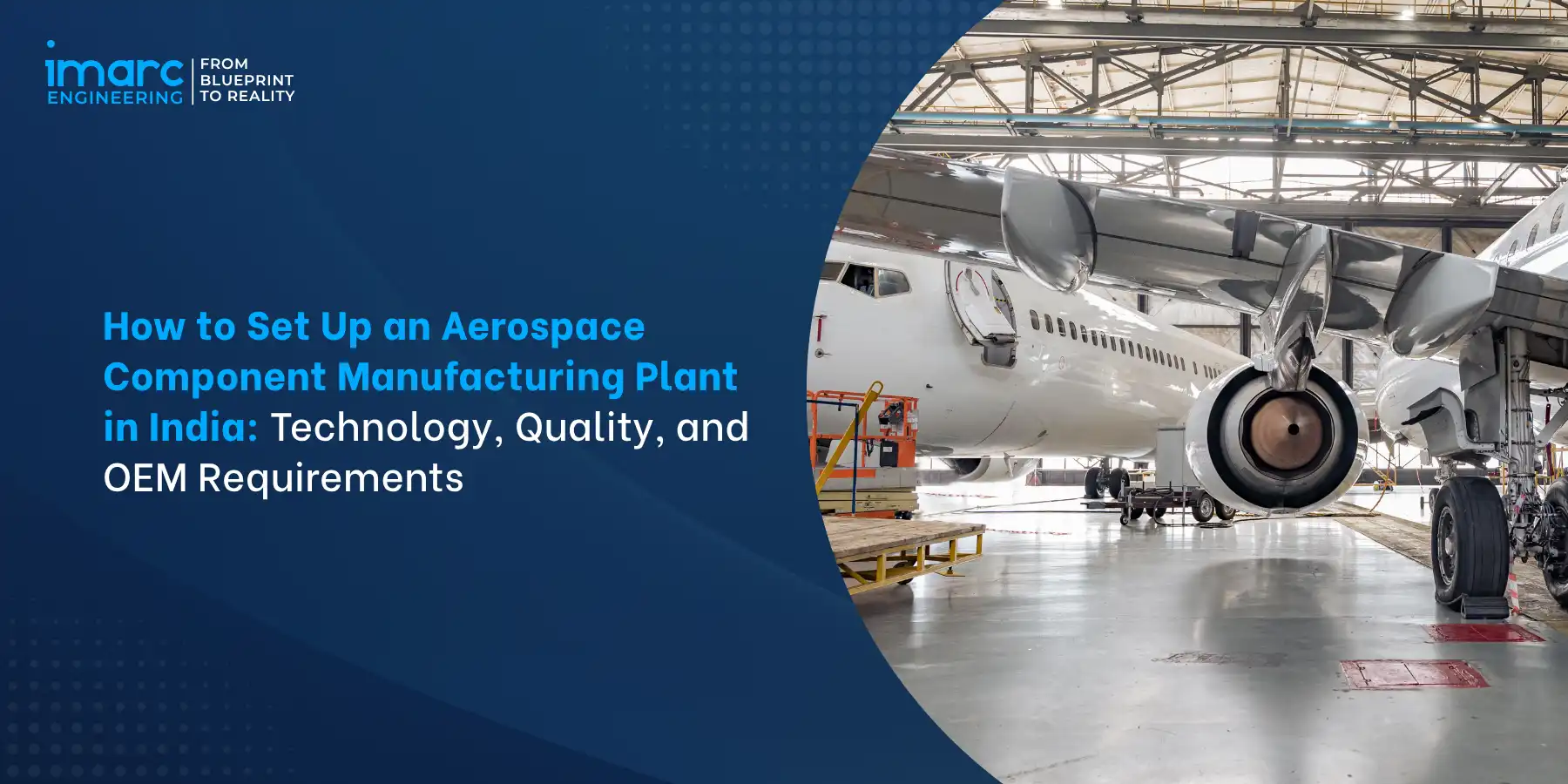
How to Set Up an Aerospace Component Manufacturing Plant in India: Technology, Quality, and OEM Requirements
Introduction
For investors and manufacturers evaluating India's aerospace value chain in 2026, planning an aerospace component manufacturing plant in India requires disciplined evaluation across product selection, OEM demand, production technology, quality systems, special process capability, testing infrastructure, and regulatory approvals.
Aerospace components span aerostructures, engine components, landing gear, precision machined parts, composite structures, and sheet metal parts, each demanding different processes, machinery, materials, testing, and quality frameworks.
Scope of this Guide
This guide answers the sponsor's project question directly. How can manufacturers establish a facility by selecting appropriate production technology, developing robust quality systems, and meeting OEM and aerospace supply-chain requirements? It walks through market opportunity, setup roadmap, product and OEM assessment, technology and equipment selection, aerospace manufacturing quality systems anchored on AS9100D certification, and the practices distinguishing well-planned aerospace component plant setup from ad-hoc entry approaches.
Table of Contents
- Introduction
- Why Aerospace Component Manufacturing Matters in India
- How to Set Up an Aerospace Component Manufacturing Plant in India
- Aerospace Product Selection and OEM Demand Assessment in India
- Aerospace Manufacturing Technology and Process Selection in India
- Aerospace Manufacturing Equipment and Production Line Design in India
- Quality Systems and AS9100 Certification for Aerospace Manufacturers in India
- Regulatory Approvals and Compliance for Aerospace Manufacturing in India
- Common Mistakes and Best Practices
- Conclusion
1. Why Aerospace Component Manufacturing Matters in India
Four drivers make aerospace component manufacturing a strategic opportunity for Indian investors and industrial groups in 2026.
1.1 Global OEM Sourcing from India
Global aerospace OEMs including Boeing, Airbus, GE Aerospace, Pratt & Whitney, Safran, Rolls-Royce, and Collins Aerospace progressively expand India sourcing across aerostructures, engine components, and systems. India annual aerospace and defence exports have grown substantially over recent years supporting Tier-1 and Tier-2 supplier development.
Domestic suppliers including HAL, Bharat Forge Aerospace, TAL Manufacturing Solutions (Tata Group), Dynamatic Technologies, Aequs, Rossell Techsys, Mahindra Aerospace, and BEL supply major global OEMs. Aerospace manufacturing in India progressively deepens beyond commodity supply to complex assemblies and engineered systems.
1.2 Defence Aerospace Demand
Defence aerospace demand from Indian Air Force, Navy, and Army aviation modernisation supports both platform manufacturing and component supply. Defence Acquisition Procedure (DAP) 2020 emphasises indigenisation with Buy Indian and Make in India categories favouring domestic manufacturing. iDEX (Innovations for Defence Excellence) supports startup and MSME defence engagement.
SRIJAN portal supports MoD indigenisation opportunities. Defence PSU HAL plus private sector participants including Tata Advanced Systems, L&T Defence, Kalyani Rafael, and Bharat Electronics anchor the defence aerospace supplier ecosystem.
1.3 Policy Support
Defence corridors in Uttar Pradesh and Tamil Nadu supporting defence aerospace ecosystem development. Foreign Direct Investment liberalisation across aerospace segments supporting technology partnerships.
iDEX and Technology Development Fund supporting R&D. State-level aerospace policies across Karnataka, Telangana, Tamil Nadu, and Maharashtra supplement Central support. Policy framework supports both civil and defence aerospace supplier development.
1.4 Cost Competitiveness and Engineering Depth
India offers cost competitiveness in aerospace manufacturing across labour, engineering, and manufacturing operations versus mature aerospace clusters. Engineering depth across Bengaluru, Hyderabad, and other clusters supports both manufacturing and adjacent design services.
Established supplier ecosystems around Bengaluru, Belagavi (Aequs SEZ), Hyderabad, Nashik, Pune, and Coimbatore support new entrant integration. Progressive quality maturity supports increasing complexity assignments from global OEMs supporting long-term supplier relationships and value-added positioning.
2. How to Set Up an Aerospace Component Manufacturing Plant in India
Understanding how to set up an aerospace component manufacturing plant in India helps sponsors sequence project decisions correctly. Setup integrates market assessment, feasibility, technology selection, engineering, construction, AS9100 certification, and OEM qualification into coherent execution across multi-year timelines.
2.1 The Setup Roadmap
| Stage | Activities | Typical Duration |
|---|---|---|
| Product and OEM Assessment | Component category selection, OEM engagement, RFQ pipeline | 3-6 months |
| Feasibility and DPR | Techno-commercial evaluation, financial modelling | 2-4 months |
| Technology and Partner Selection | Process route, equipment vendors, tech partners | 3-6 months (parallel) |
| Site Selection and Approvals | Cluster evaluation, environmental clearance | 4-9 months |
| Detailed Engineering | Process design, plant layout, equipment specifications | 3-6 months |
| Procurement and Construction | Equipment sourcing, civil works, installation | 10-18 months |
| AS9100 Certification and OEM Qualification | Quality system, Nadcap, OEM audits, FAI submission | 12-24 months |
Actual timelines vary substantially depending on component category, facility scope, regulatory triggers, equipment lead times, certification readiness, special-process requirements, and OEM qualification procedures.
2.2 Capex Opex and Financial Modelling for Aerospace Plants in India
CAPEX and OPEX for aerospace manufacturing projects vary substantially based on component category, material, production volume, process route, equipment configuration, special-process requirements, testing infrastructure, automation, and OEM qualification requirements. A precision-machining facility can therefore have a very different investment profile from a composite aerostructure, engine-component, or vertically integrated aerospace manufacturing facility.
Project-specific feasibility, equipment planning, CAPEX/OPEX modelling, and working-capital assessment are therefore required to determine realistic investment requirements. Extended qualification and production ramp-up cycles should also be incorporated into the financial model.
2.3 Manufacturing Model Selection
Manufacturing model selection affects both capital intensity and market positioning. Tier-3 sub-component supply serving tier-2 or tier-1 manufacturers with defined scope at lower investment. Tier-2 supply to Tier-1 assemblers with sub-assemblies at moderate complexity.
Tier-1 direct-to-OEM supply typically requires a mature aerospace quality management system, commonly including AS9100 certification, together with customer-specific approvals and Nadcap accreditation for applicable special processes where required by the OEM or programme.
3. Aerospace Product Selection and OEM Demand Assessment in India
Aerospace product selection and OEM demand assessment in India establishes the commercial foundation. Component choice defines downstream engineering, equipment, quality, certification, and capital requirements. Aerospace component manufacturing is not a single standardised production model.
3.1 Aerospace Component Categories
- Aerostructures: fuselage sections, wings, empennage, doors, engine nacelles
- Engine components: blades, discs, cases, combustors, turbine parts
- Landing gear components: struts, axles, wheels, brakes, actuators
- Interiors: seats, panels, galleys, lavatories, in-flight entertainment
- Avionics and electronics: cockpit displays, flight control computers, sensors
- Hydraulic and pneumatic systems: pumps, valves, actuators
- Fuel systems: tanks, pumps, distribution components
- Precision machined components: brackets, fittings, structural elements
- Sheet metal parts: skins, panels, ribs, formers
- Composite structures: floor panels, radomes, spoilers, control surfaces
- Fasteners and hardware: bolts, rivets, brackets, hardware
3.2 OEM Demand Assessment
OEM demand assessment covers current OEM sourcing patterns, near-term platform launches, indigenisation targets, existing supplier landscape, and technology-driven sourcing decisions. Direct engagement with OEM supply chain teams during feasibility supports realistic assumptions. Platform-specific sourcing rather than generic component demand provides tangible commercial visibility.
Awareness of aircraft programme lifecycles (Boeing 737, Airbus A320 family, A350, engine platforms) prevents entry at programme maturity. Documented OEM engagement including Letters of Intent supports both feasibility credibility and downstream commercial development.
3.3 Civil Versus Defence Positioning
Civil aerospace supply demands adherence to global OEM quality frameworks anchored on AS9100D, Nadcap accreditation, and OEM-specific approvals. Defence aerospace supply additionally requires DGAQA quality assurance and CEMILAC certification support where military airworthiness applies.
Dual-use capability serving both civil and defence markets supports revenue diversification but demands broader compliance capability. Positioning matched to promoter capability, market access, and strategic ambition supports realistic development. Some component categories including precision machined parts suit dual-use while others typically specialise.
3.4 Component Complexity and Value Ladder
Aerospace component complexity ranges from simple hardware to complex integrated assemblies affecting value capture and competitive dynamics. Entry-level positioning in commodity parts, fasteners, or basic machined components. Mid-level positioning in complex precision machined parts, sheet metal assemblies, or basic composites.
High-value positioning in engine components, complex aerostructure sub-assemblies, or system-integrated assemblies. Progressive value ladder movement supports both revenue growth and competitive moats. Ladder progression typically demands multi-year capability development that opportunistic entry cannot achieve.
4. Aerospace Manufacturing Technology and Process Selection in India
Aerospace manufacturing technology and process selection in India depend on component material, geometry, tolerance, and volume requirements. Aerospace component manufacturing process choice determines equipment, quality systems, special process capability, and facility infrastructure that subsequent decisions build upon. Downstream capacity planning and site selection for aerospace plants in India must align with the chosen process route.
4.1 Manufacturing Process Categories
| Process Family | Typical Applications |
|---|---|
| Precision CNC machining (3-axis to 5-axis) | Structural components, brackets, engine parts |
| Sheet metal forming and deep drawing | Skins, panels, ribs, formers |
| Composite lay-up (hand and automated fibre placement) | Aerostructures, panels, control surfaces |
| Autoclave curing for composites | Composite panels, floor beams |
| Superplastic forming and diffusion bonding | Titanium aerostructures, complex geometries |
| Additive manufacturing (DMLS, EBM) | Complex geometries, weight-reduced parts |
| Investment casting | Turbine blades, complex geometry parts |
| Forging (closed die, ring rolling) | Engine discs, structural forgings |
| Special processes (heat treatment, plating, coating) | Surface protection, material properties |
| Assembly (riveting, bonding, welding) | Aerostructures, sub-assemblies |
4.2 Technology Level and Automation
Technology level scales with volume, complexity, and OEM expectations. Manual and low-automation processes suit low-volume high-complexity work with specialist workforce. Semi-automated processes suit medium volumes with operator-assisted stations. Automated fibre placement, robotic drilling, and automated inspection increasingly common for aerostructures.
Additive manufacturing progressively adopted for complex geometries and weight-critical parts. Industry 4.0 features including real-time monitoring, digital twins, and predictive maintenance meet OEM expectations. Technology roadmap aligned with OEM expectations supports competitive positioning.
4.3 Special Processes and Nadcap Discipline
Special processes in aerospace manufacturing demand specialised discipline given inability to fully verify results through inspection. Categories including heat treatment, welding, non-destructive testing (NDT), chemical processing (plating, anodising, coating), coatings, composites, and materials testing may require Nadcap accreditation through the Performance Review Institute (PRI), depending on the applicable OEM, programme, customer, and process requirements.
Nadcap audits verify process control, equipment calibration, workforce qualification, and documentation systems. Special processes represent significant capital investment and long qualification timelines that facility planning must accommodate from initial design.
4.4 Material Traceability and Configuration Control
Aerospace traceability requirements exceed typical manufacturing standards due to the safety-critical nature of aerospace components. Full material traceability may extend from mill certification through processing to the finished component, supported by batch-level and, where required, serial-level tracking. Configuration control across engineering changes also requires rigorous documentation.
Manufacturing parameters should be recorded to support quality verification, investigation, and future analysis. Long-term retention of manufacturing, inspection, material, and configuration records may be required, with retention periods determined by applicable customer, programme, regulatory, and contractual requirements. Digital traceability systems can support audit readiness, record retrieval, and recall capability. Strong traceability discipline supports regulatory compliance and OEM confidence at aerospace manufacturing scale.
5. Aerospace Manufacturing Equipment and Production Line Design in India
Aerospace manufacturing equipment and production line design in India translate process design into operational infrastructure. Equipment selection matched to component, tolerance, and volume targets outperforms generic procurement approaches. Coherent aerospace plant design during engineering stage supports both operational excellence and audit readiness.
5.1 Machining and Metal Processing Equipment
- 5-axis CNC machining centres for complex geometry aerospace parts
- 3-axis and 4-axis CNC turning and milling for structural components
- CNC grinding machines for precision finishing
- Wire and sinker EDM for complex geometry cutting
- Sheet metal forming presses and hydraulic press brakes
- Superplastic forming and diffusion bonding equipment
- Deep drawing and stretch forming for aerostructure skins
- Ring rolling and forging equipment for structural parts
- Additive manufacturing systems (DMLS, EBM, LPBF) for complex geometries
5.2 Composites and Special Process Equipment
- Autoclaves for composite curing (typically 2-5 metre diameter)
- Automated Fibre Placement (AFP) and Automated Tape Laying (ATL) systems
- Composite lay-up tables and clean room environments
- Ultrasonic knife trimming and waterjet cutting for composites
- Heat treatment furnaces (vacuum, atmosphere, salt bath)
- Electroplating and anodising lines with effluent treatment
- Paint booths with controlled environment
- Aerospace welding equipment (TIG, EBW, laser, friction stir)
5.3 Testing, Inspection, and Measurement
- Coordinate Measuring Machines (CMM) sized for aerospace parts
- Laser trackers for large aerostructure measurement
- Vision measurement and structured light scanning systems
- Non-destructive testing equipment (ultrasonic, X-ray, eddy current, penetrant, magnetic particle) for aerospace component testing
- Metallography and material testing equipment
- Environmental test chambers (temperature, humidity, altitude)
- Vibration and shock test benches
- Hardness testers and surface roughness measurement
5.4 Tooling, Fixtures, and Production Line Design
Aerospace tooling and fixtures can represent a significant part of project investment, particularly for aerostructures, composite components, complex assemblies, and programme-specific production lines. Tooling includes machining fixtures, drilling jigs, assembly jigs, composite lay-up moulds, and inspection fixtures. Production line layout supports material flow, quality inspection points, and configuration control.
Cellular manufacturing arrangement for related component families. Clean areas for critical assembly and composites. Segregated raw material, work-in-progress, and finished goods zones. First Article Inspection (FAI) capability integrated with production flow supporting AS9102 documentation.
6. Quality Systems and AS9100 Certification for Aerospace Manufacturers in India
Quality systems and AS9100 certification for aerospace manufacturers in India define compliance framework distinguishing certified suppliers from those unable to serve aerospace OEMs. Quality system maturity is prerequisite for aerospace engagement rather than optional differentiator.
6.1 AS9100D Quality Management System
AS9100 Revision D (AS9100D:2016) sets Quality Management System requirements for organisations supplying the aviation, space, and defence sectors. It builds on the ISO 9001:2015 framework with aerospace-specific requirements covering areas such as product safety, counterfeit-parts prevention, human factors, operational risk, and configuration management.
The certification timeline varies depending on the organisation's existing quality-system maturity, facility scope, process complexity, documentation readiness, implementation status, internal-audit preparedness, and certification-body audit process. Certification planning should therefore begin early in facility development and be aligned with customer and supplier-qualification requirements.
Complementary management-system certifications may include ISO 14001 for environmental management and ISO 45001 for occupational health and safety, depending on organisational and customer requirements.
6.2 Nadcap Special Process Accreditation
Nadcap (National Aerospace and Defense Contractors Accreditation Program) administered by Performance Review Institute (PRI) provides special process accreditation across categories including heat treatment, welding, non-destructive testing, chemical processing (plating, anodising), coatings, composites, materials testing laboratories, and non-conventional machining.
Major OEMs including Boeing, Airbus, GE Aerospace, and Rolls-Royce require Nadcap accreditation for special process supply. Accreditation demands rigorous process control, equipment calibration, workforce qualification, and documentation. Nadcap preparation and accreditation timelines vary by process category, existing process maturity, audit readiness, corrective-action requirements, and customer expectations, and should therefore be incorporated into the project schedule from an early stage.
6.3 First Article Inspection and Process Discipline
First Article Inspection (FAI) per AS9102 documents complete verification of first production article against engineering drawings and specifications. FAI required for new parts, changed parts, and re-qualification triggers. AS9145 aerospace Advanced Product Quality Planning provides structured product development framework. AS9103 Variation Management of Key Characteristics defines critical dimension control.
Configuration control across engineering changes with documented change management. Non-conforming product control with segregation and disposition documentation. Discipline across quality tools distinguishes systematic aerospace suppliers from those unable to sustain OEM engagement.
6.4 OEM-Specific Requirements
Individual OEMs may impose company-specific requirements that supplement AS9100D. Aerospace supplier qualification may include OEM-specific quality manuals, supplier requirements, process approvals, documentation standards, and programme-specific requirements, depending on the customer and scope of supply.
OEM qualification and audits may assess production capability, quality-system implementation, process controls, traceability, delivery performance, and other supplier requirements. Multi-OEM supply therefore requires manufacturers to manage different customer-specific requirements. Supplier qualification timelines vary by OEM, programme, component complexity, supplier readiness, audit requirements, First Article Inspection, special-process approvals, and customer-specific qualification procedures. These timelines should be incorporated into commercial ramp-up and working-capital planning.
7. Regulatory Approvals and Compliance for Aerospace Manufacturing in India
Regulatory approvals and compliance for aerospace manufacturing in India span aviation-specific approvals, plant establishment, and defence-specific requirements where applicable. Compliance planning during feasibility prevents project delays.
7.1 Aviation-Specific Approvals
India's civil aviation regulatory framework is governed by the Bharatiya Vayuyan Adhiniyam, 2024, with the Directorate General of Civil Aviation (DGCA) under the Ministry of Civil Aviation administering applicable civil aviation regulations.
DGCA CAR-21 establishes requirements relating to certification and production organisation approvals for applicable civil aviation products, parts, and appliances. Whether an aerospace component manufacturing facility requires specific DGCA approval depends on the products being manufactured, its certification responsibility, supply-chain role, and applicable aviation requirements.
For defence aerospace manufacturing, DGAQA quality-assurance requirements and CEMILAC airworthiness certification may apply depending on the component, platform, programme, and supplier's scope of responsibility. These aviation-specific requirements should therefore be assessed during project planning alongside general manufacturing and plant-level approvals.
7.2 Manufacturing Plant Approvals
| Approval | Authority | Trigger |
|---|---|---|
| Environmental Clearance | MoEFCC or SEIAA per EIA 2006 | Category A or B project scale |
| Consent to Establish | State Pollution Control Board | Pre-construction |
| Consent to Operate | State Pollution Control Board | Pre-commissioning |
| Factory Licence | State Directorate of Factories | Under OSH Code 2020 |
| Fire NOC | State Fire Services | Per NBC 2016 Part 4 |
| PESO Licence | PESO under Explosives Act 1884 | Paint, solvent storage where applicable |
| DGCA CAR 21 Approval | Directorate General of Civil Aviation | Civil aviation manufacturing |
| DGAQA Registration | Directorate General of Aeronautical Quality Assurance | Defence aerospace manufacturing |
7.3 Defence Manufacturing Framework
Defence aerospace manufacturing operates under additional frameworks. Defence Acquisition Procedure (DAP) 2020 governs defence procurement with Buy Indian, Buy Indian-IDDM (Indigenously Designed Developed and Manufactured), Make, and Strategic Partnership categories favouring domestic manufacturing.
Industrial licensing under Industries (Development and Regulation) Act 1951 with revised delegation to DPIIT (Department for Promotion of Industry and Internal Trade) for defence sectors. Foreign Direct Investment framework permits automatic route up to 74 percent for defence with higher through government route. iDEX (Innovations for Defence Excellence) and Technology Development Fund support defence R&D and manufacturing engagement.
7.4 Export Control and Material Compliance
Aerospace manufacturing may be subject to export-control and material-compliance requirements depending on the product, technology, materials, customer, and destination market. India's Foreign Trade Policy and the Directorate General of Foreign Trade (DGFT) framework include the Special Chemicals, Organisms, Materials, Equipment and Technologies (SCOMET) list covering specified dual-use items and technologies.
Depending on the product, materials, customer requirements, and destination market, manufacturers may also need to address chemical and material compliance requirements, including applicable EU REACH obligations, customer restricted-substance requirements, and responsible-minerals or conflict-minerals reporting.
Environmental, health, and safety requirements should also be evaluated based on the manufacturing processes and materials used at the facility. Planning applicable export-control and material-compliance requirements during project development can support regulatory readiness and market access.
8. Common Mistakes and Best Practices
8.1 Under-Estimating Qualification Timelines
Facilities under-estimating AS9100D certification, Nadcap accreditation, and OEM qualification timelines face commercial launch delays and cash flow stress.
Best practice: qualification planning during feasibility with project-specific timelines for each certification and approval track; parallel qualification workstreams across AS9100, applicable Nadcap processes, and OEM approvals; consultant support where internal capability is limited; workforce hiring aligned with qualification requirements; and working capital sized for extended qualification cycles.
8.2 Weak OEM Demand Validation
Facilities constructed on assumed aerospace demand without documented OEM engagement often face utilisation shortfalls.
Best practice: direct OEM supply chain engagement during feasibility; documented Letters of Intent or RFQ pipeline supporting bankability; platform-specific rather than generic component demand; awareness of aircraft programme lifecycles preventing entry at maturity; multi-OEM engagement reducing single-customer dependency; realistic price assumptions grounded in OEM benchmarks.
8.3 Special Process Under-Investment
Special processes representing significant capability under-invested during initial design face Nadcap accreditation limits and commercial vulnerability.
Best practice: special process capability planning during feasibility with dedicated infrastructure; Nadcap-ready design across heat treatment, welding, NDT, chemical processing, coatings, and composites areas; specialised workforce planning; equipment calibration and control systems; documentation systems from inception; ongoing surveillance audit preparation supporting sustained accreditation.
8.4 Inadequate Testing and Traceability Infrastructure
Testing and traceability infrastructure inadequate for aerospace requirements produces certification delays and audit failures.
Best practice: CMM, laser tracker, and NDT equipment sized for target component category; environmental testing capability matched to component category; digital traceability systems from inception supporting long-term retention; material certification management systems; configuration control tools supporting engineering change management; investment in measurement systems supporting AS9102 First Article Inspection.
8.5 Underestimating Working Capital
Working capital under-provision producing operational stress even for technically capable facilities.
Best practice: Working capital should account for extended aerospace manufacturing cycles, including material inventory, work-in-progress across long production and qualification cycles, and customer receivables. Financial planning should also provide contingency for OEM qualification delays and adequate financing to support inventory and receivables through qualification and production ramp-up. Disciplined cash-flow planning supports operational stability as the facility progresses toward commercial-scale production.
Conclusion
Planning an aerospace component manufacturing plant in India in 2026 requires civil and defence market assessment, OEM demand validation, technology and special-process selection, capacity planning, AS9100D certification, relevant Nadcap accreditation, testing and traceability infrastructure, and applicable regulatory approvals. Growing OEM sourcing, defence indigenisation, policy support, and export opportunities strengthen the sector's investment potential.
Three closing reminders for aerospace manufacturing sponsors. First, validate OEM demand and platform-specific requirements before committing capacity. Second, plan AS9100D certification and relevant Nadcap accreditation from project inception. Third, account for extended qualification cycles, inventory requirements, work-in-progress, and receivables when assessing working capital and project economics.
PLANNING YOUR AEROSPACE COMPONENT MANUFACTURING PLANT?
IMARC Engineering's aerospace component manufacturing plant and project development advisory team supports investors, sponsors, and aerospace manufacturing leaders across market opportunity assessment covering civil and defence aerospace segments, product selection and OEM demand assessment with direct engagement, feasibility studies and Detailed Project Report (DPR) preparation, technology selection, regulatory approvals coordination, capex and opex financial modelling, working capital planning for extended aerospace cycles, and disciplined project governance for aerospace component manufacturing plant development across India.
→ Schedule a free aerospace plant scoping consultation with an IMARC specialist
Frequently Asked Questions
Setup follows seven stages: product and OEM assessment (3-6 months), feasibility and DPR (2-4 months), technology selection (3-6 months parallel), site selection and approvals (4-9 months), detailed engineering (3-6 months), procurement and construction (10-18 months), followed by AS9100 certification and OEM qualification, with timelines varying by project and customer requirements.
Aerospace components manufactured in India include aerostructures (fuselage sections, wings, empennage), engine components (blades, discs, cases, combustors), landing gear parts, interiors, avionics, hydraulics, precision machined components, sheet metal parts, composite structures, forgings, castings, and fasteners for civil and defence aviation.
Aerospace manufacturing technology includes precision 5-axis CNC machining, sheet metal forming, composite lay-up with automated fibre placement (AFP), autoclave curing, superplastic forming, diffusion bonding, metal additive manufacturing including DMLS and EBM, investment casting, forging, heat treatment, and surface treatment special processes.
Aerospace manufacturing equipment includes 5-axis CNC machining centres, sheet metal presses, autoclaves for composites, AFP or hand lay-up systems, heat treatment furnaces, plating and coating lines, welding stations, additive manufacturing systems, CMM, laser trackers, NDT equipment, and assembly jigs and fixtures.
The investment varies substantially by component type, production capacity, material, process technology, automation, special-process capability, inspection and testing infrastructure, tooling, and OEM qualification requirements. A precision-machining facility can have a very different CAPEX profile from a composite aerostructure, engine-component, or vertically integrated aerospace facility. Project-specific feasibility, equipment planning, and CAPEX/OPEX modelling are therefore required before determining the investment.
Aerospace manufacturing standards centre on AS9100D:2016 quality management system certification, Nadcap accreditation for special processes covering heat treatment, welding, non-destructive testing, chemical processing, coatings, and composites, AS9102 First Article Inspection, ISO 14001 environmental, ISO 45001 OH&S, and customer-specific quality requirements.
Aerospace OEM requirements include AS9100D certification, Nadcap accreditation for special processes, customer-specific approvals such as Boeing D6-82479 or Airbus supplier requirements, AS9145 APQP framework, AS9102 First Article Inspection, full material and process traceability, on-time delivery discipline, and financial stability with long-term commitment.
Feasibility depends on documented OEM demand or Letters of Intent, technology matched to component category, capacity aligned with committed business, capital availability across capex and long qualification cycles, AS9100 and Nadcap capability development, workforce access, and cluster proximity supporting supplier ecosystem access.
Recent Post



Trusted by Industry Leaders
We partner with global enterprises and ambitious businesses across sectors to deliver operational excellence, strategic insights, and sustainable growth through integrated solutions.












Success in Their Words
Real feedback from clients across industries. Discover how our solutions delivered measurable impact and operational excellence.

I wanted to express my sincere appreciation for your efforts in handling this matter. Your dedication and commitment have been truly commendable, and it is evident that you have put in tremendous hard work and expertise into resolving the issues at hand. We are greatly interested in continuing our collaboration with you in the future, as your professionalism and reliability have made you a trusted partner. Thank you once again for your invaluable contribution. We look forward to strengthening our partnership ahead.

It has been a pleasure working with the IMARC team. The insights provided were structured, clear, and highly valuable, helping us strengthen both our technical and financial planning with confidence. We deeply appreciate the team’s professionalism, responsiveness, and attention to detail throughout the engagement. Every requirement was well understood and effectively incorporated, resulting in a comprehensive and actionable output. Overall, our experience has been excellent, and I would gladly recommend IMARC to organizations seeking a reliable research partner.

Your service is truly exceptional. Working with the IMARC team has been a seamless and professional experience. The clarity of communication, responsiveness to queries, and consistent support at every stage made the entire engagement highly efficient. The insights shared were well-structured, practical, and perfectly aligned with our requirements, helping us make informed decisions with confidence. Overall, the dedication and professionalism demonstrated by your team stand out, and I would be glad to recommend IMARC as a reliable and trustworthy research partner.

IMARC did an outstanding job in preparing our study. They were punctual, precise, and consistently responsive throughout the entire process. The team delivered all the data we required in a clear, well-organized, and highly professional format. Their strong attention to detail, combined with their ability to meet every deadline without compromising quality, truly set them apart. Overall, their reliability and commitment made them an exceptional partner for our project, and we would gladly work with them again in the future.

IMARC made the whole process incredibly easy from start to finish. Everyone I interacted with via email was polite, professional, and straightforward to deal with, always keeping their promises regarding delivery timelines and remaining consistently solutions-focused. From my very first contact, I appreciated the professionalism and support shown by the entire IMARC team. I highly recommend IMARC to anyone seeking timely, affordable, and reliable information or advice. My experience with IMARC was excellent, and I truly cannot fault any aspect of it.

I’d like to express my sincere gratitude for the excellent work you accomplished with the study. Your ability to quickly understand our requirements and deliver high-quality results under tight timelines truly reflects your expertise, exceptional work ethic, and unwavering commitment to your customer’s success. The professionalism and responsiveness you demonstrated throughout the process made a significant difference. Our entire team and company are incredibly thankful for your dedication, reliability, and support. Once again, thank you for your outstanding contribution.