Manufacturing
May 08 2026
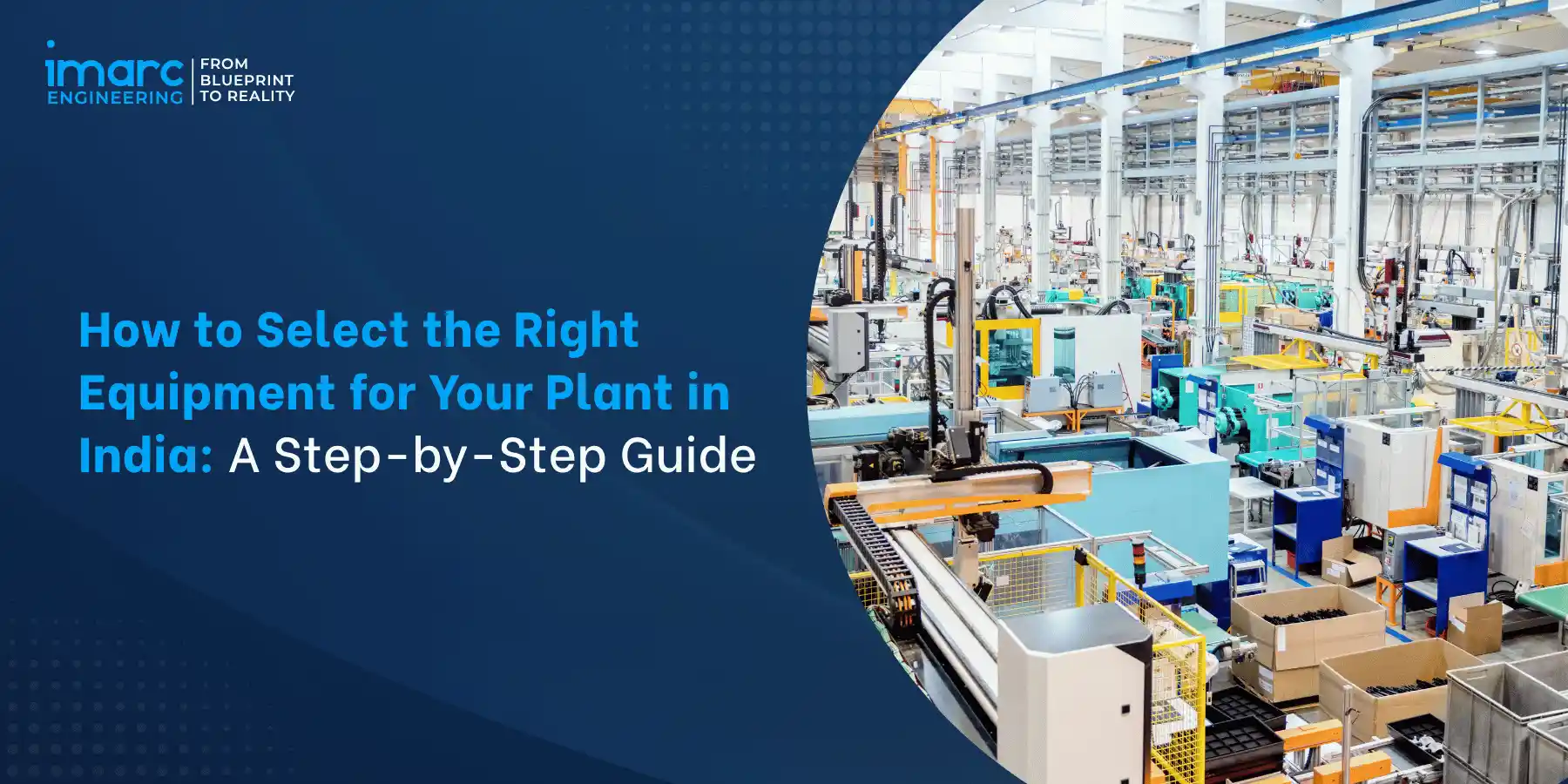
How to Select the Right Equipment for Your Plant in India: A Step-by-Step Guide
A Practical Framework for Plant Equipment Selection in India- Across Sectors, CAPEX Stages, and Industry 4.0 Capabilities
Introduction
Few decisions during the build phase of a manufacturing project carry as much long-term consequence as plant equipment selection in India. The equipment you commission today will shape your unit cost, product quality, energy bill, regulatory compliance posture, and digital readiness for the next 10–20 years. Get it right, and the plant runs near best-in-class on every metric for the asset’s life. Get it wrong, and you absorb avoidable cost, downtime, and competitive friction long after the original CapEx is sunk.
The 2026 stakes are higher than at any point in India’s industrial history. Indian electronics production reached approximately USD 101 billion in FY 2022-23 and is targeted to reach USD 300 billion by FY 2025-26. The Production Linked Incentive (PLI) framework now spans 14 sectors with a total outlay of INR 1.97 lakh crore, with committed investments above INR 2.16 lakh crore as of December 2025. Against this backdrop, well-structured industrial equipment selection is one of the highest-leverage activities a manufacturer can perform, far more consequential than most engineering, commercial, or HR decisions taken in the same period.
This guide is a structured, sector-aware framework for manufacturing equipment selection in India. Drawing on IMARC Engineering’s experience in feasibility studies, plant design, equipment specification, vendor identification, and turnkey commissioning, it provides practical insights for industrial projects across pharmaceuticals, EV batteries, specialty chemicals, food processing, semiconductors, and electronics manufacturing. The guide covers a six-phase equipment selection framework, key evaluation factors, sector-specific machinery requirements, CapEx optimization strategies, Industry 4.0 readiness, energy-efficient equipment planning, vendor evaluation methods, checklists, common mistakes, and FAQs for Indian manufacturing plant setup projects.
Key Insight: Across hundreds of manufacturing project engagements, the single most reliable predictor of long-term plant performance is the discipline applied to equipment selection. Manufacturers who treat it as a structured, multi-criteria, multi-stage decision routinely achieve their cost, quality, and timeline targets. Those who default to incumbent-vendor preference or single-criterion (cost or speed) decisions pay a measurable performance penalty for the asset’s life. This guide distils the methodology that consistently produces the first outcome rather than the second.
Table of Contents
- Introduction
- Why Plant Equipment Selection Is Strategic in 2026 India
- The Six-Phase Equipment Selection Framework
- Factors to Consider When Buying Plant Machinery
- Sector-Specific Equipment Selection- EV Batteries, Pharma, Chemicals, Food Processing, Semiconductors, Electronics
- CAPEX Planning and How to Reduce CAPEX in Manufacturing Projects
- Industry 4.0 and Energy-Efficient Equipment in 2026
- Vendor Selection and Procurement Process
- Manufacturing Plant Equipment Checklist
- Common Mistakes and How to Avoid Them
- Conclusion
1. Why Plant Equipment Selection Is Strategic in 2026 India
In a slower era, equipment selection was largely a procurement exercise. In 2026 India, it is unambiguously a strategic decision, for five reinforcing reasons documented in policy, industry, and operational evidence.
1.1 Equipment Defines 60-80% of the Plant’s Lifetime Performance
Across most manufacturing categories, equipment choice determines the bulk of the plant’s long-run unit cost, quality consistency, throughput, and downtime risk. Building, utilities, IT, and management can compensate at the margin, but they cannot rescue under-specified or wrongly-selected core production equipment. Disciplined industrial equipment selection is therefore the strategic anchor of plant design, not a downstream procurement decision. The company that gets manufacturing equipment in India right at the design stage rarely needs to revisit it; the company that gets it wrong spends years compensating with operational workarounds.
1.2 PLI and DVA Conditions Reshape the Specification
The Production Linked Incentive scheme (INR 1.97 lakh crore outlay, 14 sectors) and the Domestic Value Addition (DVA) requirements that accompany sector-specific schemes have a direct bearing on industrial machinery selection. DVA in electronics manufacturing rose from approximately 30% to around 70% by April 2025 (per IBEF, citing industry analysis), with projections to reach 90% by FY27, a structural shift that affects the choice between imported and Indian-manufactured equipment, and between off-the-shelf and locally engineered production lines. PLI eligibility, qualifying capacity thresholds, and DVA timelines must therefore be embedded into the equipment specification from Day 1, not retrofitted later.
1.3 Industry 4.0 Is Now a Boardroom Priority
Indian manufacturers are increasingly adopting Industry 4.0 manufacturing in India, IIoT-enabled equipment, MES integration, predictive-maintenance analytics, digital twins, and shop-floor automation. The decision today is rarely whether to adopt these capabilities, but when, how, and at what depth. Equipment that is not Industry 4.0-ready becomes obsolete faster than it depreciates, typically before 60% of its accounting life is consumed.
1.4 Energy Costs and Sustainability Are Material to Project Economics
Energy is one of the largest operating costs for most Indian manufacturers, and energy efficient industrial equipment can shift unit economics by 5–15% over the equipment’s life. ESG scrutiny by lenders, customers, and global supply-chain partners has further raised the importance of energy-efficient specification, particularly for export-oriented projects subject to EU CBAM and similar regimes.
1.5 Capital Cost Discipline Has Tightened
Indian cost of capital remains structurally higher than in developed markets. Combined with the FY26 / FY27 budget signals on PLI realisation patterns, the project IRR sensitivity to equipment-CapEx variations is acute. A 10% over-spec on equipment CapEx routinely consumes 2–3 percentage points of project IRR, material enough to flip a project from clearly investable to borderline.
2. The Six-Phase Equipment Selection Framework
Disciplined plant equipment selection in India unfolds across six sequential phases. Treat them as gates, completing each before moving to the next consistently produces stronger outcomes than a parallel-track or ‘figure it out as we go’ approach.
| Phase | Objective | Key Deliverable |
|---|---|---|
| 1. Strategic intent and capacity definition | Define product mix, capacity targets, growth scenarios, regulatory regime | Process flow diagram, Year-1 / Year-3 / Year-5 capacity plan |
| 2. Process design and unit-operation list | Decompose the production process into discrete unit operations with throughput targets | Detailed PFD, mass / energy balance, equipment list with size and duty |
| 3. Specification and shortlisting | Develop full technical specifications, identify long-list of capable vendors | URS / FRS documents, vendor long-list (typically 8–12 vendors per major item) |
| 4. Vendor evaluation and selection | Run technical and commercial evaluation against weighted criteria | Technical and commercial scorecards, recommended vendor selection |
| 5. Negotiation, ordering, and FAT | Finalise commercial terms, factory-acceptance test (FAT), purchase order | Signed contract, FAT report, payment milestone schedule |
| 6. Installation, SAT, and ramp-up | Commission, perform site-acceptance test (SAT), ramp to qualifying production | SAT report, qualified production data, handover documentation |
3. Factors to Consider When Buying Plant Machinery
The classic mistake in equipment selection is over-weighting price and under-weighting everything else. The disciplined alternative is a multi-factor evaluation against eleven dimensions, the same dimensions that should anchor any industrial equipment procurement guide India worth following. The matrix below summarises each factor and what to test for in vendor proposals and FAT documentation.
| S.No. | Factor | What to Evaluate |
|---|---|---|
| 1 | Process fit and unit-operation match | Whether the equipment is engineered for your specific feedstock, product, and operating envelope |
| 2 | Capacity, throughput, and turn-down ratio | Year-1 nameplate vs Year-3 / Year-5 demand; ability to operate efficiently at 40–110% of design rate |
| 3 | Quality and consistency | Output specification, batch-to-batch variation, in-process monitoring, contamination control |
| 4 | Energy efficiency | kWh / unit, heat-recovery options, motor efficiency class, idle-mode power draw |
| 5 | Industry 4.0 readiness | OPC-UA / MQTT support, IIoT sensors, MES integration, predictive-maintenance analytics, cybersecurity |
| 6 | Maintenance and spares ecosystem | MTBF, MTTR, in-country spares stocking, service network response time |
| 7 | Regulatory compliance | GMP, FDA, BIS, FSSAI, MeitY, ISO, ATEX, sector-specific certifications |
| 8 | Safety | PPE compatibility, intrinsic-safety design, emergency-stop logic, operator-protection features |
| 9 | Vendor strength | Financial stability, manufacturing depth, India service presence, reference installations |
| 10 | Total cost of ownership (TCO) | CapEx + 10-year energy + spares + maintenance + downtime + decommissioning |
| 11 | DVA / PLI eligibility | Domestic manufacturing component, qualifying vendor list, alignment with sector PLI / ECMS rules |
3.1 Why TCO Beats CapEx as the Primary Lens
The single most common cost-side mistake is selecting on CapEx alone. A disciplined TCO model, CapEx + cumulative energy + planned and unplanned maintenance + downtime cost + decommissioning, should be the primary basis for vendor comparison, with CapEx treated as one input rather than the headline number.
3.2 The Trade-Off Triangles
Three trade-offs recur across nearly every equipment-selection decision and should be made explicit rather than implicit:
- CapEx vs OpEx- owned, custom-engineered equipment vs leased / utility-as-a-service / contract-manufacturing alternatives
- Imported vs Indian-made- global benchmark performance vs DVA / PLI eligibility, faster spares response, and lower lifecycle service cost
- Standard vs custom- faster commissioning and proven performance vs higher process fit and competitive differentiation
4. Sector-Specific Equipment Selection- EV Batteries, Pharma, Chemicals, Food Processing, Semiconductors, Electronics
Equipment selection rules vary materially by sector. The six high-value sectors below, chosen for their 2026 strategic priority and PLI / ECMS / Semicon India significance, each have a distinct selection logic worth internalising.
4.1 EV Battery Manufacturing
EV battery manufacturing, particularly under the Advanced Chemistry Cell PLI scheme (INR 18,100 crore outlay), requires equipment engineered to extremely tight cleanliness, humidity, and electrical-isolation specifications. Indian automotive sector context is large. Critical equipment includes electrode coating and calendaring lines, cell assembly automation, formation and aging chambers, dry rooms with sub-1% RH control, and battery management system (BMS) testers. Selection priorities: industrial automation in India of the cell-line is essentially mandatory; humidity-control infrastructure must be specified before the building shell is finalised; cell-line throughput must be matched to module-and-pack assembly downstream; and Indian-content thresholds in the PLI specification need to be embedded in the equipment list rather than retrofitted.
4.2 Pharmaceuticals
Pharmaceutical equipment selection, particularly for plants targeting USFDA, EU EMA, or WHO-prequalified production, is dominated by GMP, validation, and material-of-construction requirements. Critical equipment categories include reactors and crystallisers, fluid-bed processors, tablet presses, blister-and-bottle packaging lines, freeze dryers (lyophilisers), filling lines, and analytical / QC infrastructure. Selection priorities: pharma-grade stainless-steel certification (typically 316L), cleanability and CIP / SIP capability, electronic batch records integration, 21 CFR Part 11 compliance, and proven validation track record. The pharma PLI (INR 15,000 crore outlay) and bulk drugs PLI (INR 6,940 crore) make pre-existing GMP-compliant Indian capacity a meaningful structural advantage; many global vendors now have full GMP manufacturing depth in Hyderabad, Pune, and Ahmedabad clusters.
4.3 Specialty Chemicals
Specialty chemicals plants, typically anchored in Gujarat (Dahej, Vapi, Ankleshwar) and Maharashtra clusters, depend on hazardous-area-rated, corrosion-resistant equipment. Critical equipment includes glass-lined and high-alloy reactors, distillation columns, evaporators, dryers (vacuum, fluid-bed, tray), centrifuges, and ETP (effluent treatment plant) infrastructure. Selection priorities: ATEX / IECEx hazardous-area certification, materials-of-construction selection (Hastelloy, Monel, glass-lined steel) matched to chemical compatibility, secondary-containment design, and the ability of the ETP infrastructure to handle multi-product effluent streams. Indian chemical equipment manufacturing is well-developed; global benchmarking should still be done, but local options are typically credible for most categories.
4.4 Food Processing
Food processing equipment selection is governed by FSSAI standards, hygienic-design principles (e.g., 3-A, EHEDG), and increasingly by export-market certification (HACCP, BRC, IFS, SQF). Under the food processing PLI (INR 10,900 crore outlay), capacity build-out has been meaningful across dairy, ready-to-eat meals, marine products, fruits and vegetables, and processed snacks. Critical equipment categories include processing lines (mixing, cooking, pasteurising, sterilising, drying), filling and packaging machinery, refrigeration and cold chain, and CIP / SIP systems. Selection priorities: food-grade materials of construction, allergen-cross-contamination prevention, energy efficiency (food processing is energy-intensive), water-use efficiency, and waste / by-product handling capability.
4.5 Semiconductors
Semiconductor equipment selection is the most technologically demanding category in Indian manufacturing today. The India Semiconductor Mission framework has supported five major projects with combined investments approaching INR 1.52 lakh crore, including Tata Electronics’ ~INR 91,000 crore fab in Dholera, Gujarat, and Micron Technology’s ~USD 2.75 billion (INR 22,516 crore) ATMP facility. Critical equipment categories include lithography systems, deposition tools (CVD, PVD, ALD), etching systems, ion implanters, wafer-handling robotics, and cleanroom infrastructure (Class 1 to Class 1000 zones). Selection priorities: vendor relationships with global semiconductor equipment suppliers (ASML, Applied Materials, Lam Research, Tokyo Electron); cleanroom design integrated with equipment specification from Day 1; ultrapure-water and specialty-gas infrastructure; and industrial automation in India of wafer handling at near-100% levels.
4.6 Electronics Manufacturing (ESDM)
Electronics manufacturing equipment selection has become a core 2026 priority. Indian electronics production is targeted to reach USD 300 billion by FY 2025-26, and the Electronics Components Manufacturing Scheme (ECMS) approved 17 projects with INR 7,172 crore investment and expected production worth INR 65,111 crore on 17 November 2025. Critical equipment categories include surface-mount technology (SMT) lines, automated optical inspection (AOI) and X-ray inspection, reflow and wave-soldering, conformal coating, automated test equipment (ATE), and assembly automation. Selection priorities: throughput matching to anchor-customer demand profiles, component-level traceability (essential for ECMS DVA reporting), ESD-protected design throughout, and Industry 4.0-ready data integration to enable customer-facing manufacturing analytics.
4.7 Sector-Wise Equipment Snapshot
| Sector | Lead Equipment Categories | Top Selection Priority | Verified Policy Anchor |
|---|---|---|---|
| EV batteries | Cell coating, formation, dry-rooms, BMS testers | Cleanliness, automation, DVA | ACC PLI INR 18,100 cr |
| Pharmaceuticals | Reactors, lyophilisers, packaging, QC labs | GMP, validation track record | Pharma PLI INR 15,000 cr; Bulk Drugs PLI INR 6,940 cr |
| Specialty chemicals | Reactors, distillation, dryers, ETP | Materials of construction, hazardous-area rating | Specialty chemicals not under PLI; export incentives apply |
| Food processing | Cookers, fillers, refrigeration, CIP / SIP | Hygienic design, FSSAI / HACCP | Food Processing PLI INR 10,900 cr |
| Semiconductors | Litho, deposition, etch, cleanroom | Cleanroom integration, vendor relationships | Semicon India ~INR 1.52 lakh cr |
| Electronics (ESDM) | SMT, AOI, ATE, assembly automation | Throughput matching, component traceability | ECMS 17 projects, INR 7,172 cr |
5. CAPEX Planning and How to Reduce CAPEX in Manufacturing Projects
Disciplined CAPEX planning in India starts long before the equipment list is final. Five practical levers consistently reduce CAPEX in manufacturing projects without compromising performance and answer the perennial question of how to reduce CAPEX in manufacturing projects responsibly. Effective CAPEX planning in India requires applying these levers deliberately, in sequence, during the project’s design phase rather than retrofitting them under cost pressure later. Treated this way, the exercise is essentially manufacturing project cost optimization, balancing CapEx, lifecycle cost, and incentive capture in a single decision frame.
5.1 Lever 1- Right-Size Capacity
The single largest source of avoidable CapEx is over-sizing. The discipline is to specify equipment for honest Year-3 demand (with explicit upgrade path to Year-5), not for an aspirational Year-5 number. Over-sizing typically adds 15–25% to upfront equipment CapEx and produces low-utilisation operating economics in the early years, exactly when project IRR is most sensitive. A right-sized initial spec, backed by a documented expansion path, is almost always the better choice.
5.2 Lever 2- Modular and Skid-Mounted Design
Modular and skid-mounted equipment compresses commissioning timelines by 30–50% in many sectors and reduces civil and erection cost by 10–20%. The trade-off is some sub-optimisation on the integrated layout, but for most projects, the time-to-revenue benefit and reduced site-CapEx outweigh the layout penalty. Pharma, specialty chemicals, food processing, and certain electronics applications particularly benefit from modular design.
5.3 Lever 3- Strategic Mix of Imported and Indian-Made Equipment
Indian-made equipment is now world-class in many categories like chemical reactors, packaging machinery, food-processing lines, basic SMT, and select EMS automation. Specifying Indian-made for non-process-critical, well-developed categories typically saves 25–40% on CapEx, with comparable performance and significantly faster spares response. Imported equipment remains the right choice for the most technology-intensive, performance-critical categories (semiconductor lithography, advanced battery cell coating, high-end pharma fillers). The ratio of imported-to-Indian content is itself a deliberate decision; project-specific benchmarking is the right basis.
5.4 Lever 4- Capture Subsidies and PLI Eligibility
PLI capital subsidy effectively offsets a portion of qualifying CapEx in priority categories. State-level capital subsidies, stamp-duty waivers, power-tariff rebates, and SGST reimbursement further reduce effective CapEx. Designing the equipment list with these incentives in mind from Day 1 typically captures 8–15% of effective CapEx that would otherwise be left on the table. The key is to design eligibility-in rather than retrofit.
5.5 Lever 5- OpEx-Convert Non-Core Categories
Non-core categories like utilities (solar PPA, compressed air, steam), warehousing, IT (SaaS), warehousing automation, certain robotics applications, can often be shifted from CapEx to OpEx through utility-as-a-service, lease, or robotics-as-a-service contracts. This typically reduces upfront CapEx significantly on a typical mid-size manufacturing project, freeing capital for the strategic core or for working capital. The discipline is to OpEx-convert deliberately, not opportunistically, non-core categories where the CapEx savings exceed the OpEx premium over the asset’s life.
5.6 The CapEx Reduction Stacking Effect
Used together, these five levers can reduce effective CapEx significantly on a typical mid-size Indian manufacturing project, a material improvement that often turns a borderline project into a clearly-investable one. The discipline is to apply the levers deliberately during Phase 2–3 of the framework (process design and specification), not to retrofit them under cost pressure later.
6. Industry 4.0 and Energy-Efficient Equipment in 2026
The shift to Industry 4.0 manufacturing in India has moved from buzzword to baseline expectation, and the broader push toward smart manufacturing India and digital manufacturing India agendas now flows directly into how plants specify capital assets. New Industry 4.0 equipment specifications routinely include connected-machine capability, sensor integration, MES-readiness, and predictive-maintenance hooks, even at MSME scale. At the same time, energy efficient industrial equipment has become a financial requirement as much as a sustainability one, given Indian industrial power tariffs and the tightening regulatory environment around carbon and energy.
6.1 What Industry 4.0 Means at Equipment-Selection Stage
At equipment-selection stage, Industry 4.0 manufacturing in India readiness, and the wider use of IIoT in manufacturing, translates into specific, checkable requirements rather than abstract digitalisation aspirations:
- PLC and SCADA architecture compatible with the plant's control philosophy and standard protocols (OPC-UA, Modbus, EtherCAT, Profinet)
- MES-ready: machine-level data exposed for production monitoring, OEE calculation, downtime classification, and quality-event capture
- ERP integration capability- production confirmations, materials consumption, batch records flowing back automatically
- IoT sensor compatibility- temperature, vibration, current, pressure, energy consumption, for predictive maintenance
- Cybersecurity posture- segregated OT networks, role-based access, audit logging, secure remote access for OEM support
- Software upgrade pathway- equipment that allows firmware and PLC software updates without proprietary lock-in
6.2 The Right Level of Automation
Not every plant needs the same level of automation. The decision should be driven by product complexity, demand volatility, labour-cost economics, quality criticality, and traceability requirements. The pace of industrial automation in India, and of factory automation India programmes more broadly, has been a defining feature of the 2024-25 capacity-build cycle and shows no signs of slowing in 2026, but the right level for any specific plant depends on its profile. The matrix below summarises a practical way of thinking about automation level.
| Plant Profile | Typical Automation Level | Rationale |
|---|---|---|
| Regulated, high traceability (pharma, medical devices) | High to very high | Compliance, traceability, batch-record integrity |
| High-volume, stable demand (FMCG, cement, steel) | High | Unit-cost leadership, throughput, energy efficiency |
| High-mix, variable-demand (specialty engineering, mid-volume EMS) | Medium-high (flexible automation) | Changeover speed and flexibility outweigh full automation |
| Low-volume, high-customisation (custom machine tools, project goods) | Medium | Skilled operators add more value than full automation |
| Hazardous-process / safety-critical (chemicals, oil & gas) | Very high- specifically for safety and shutdown | Safety integrity drives automation, not throughput |
| Early-stage / pilot / R&D production | Low to medium | Capital flexibility and reconfigurability outweigh automation |
6.3 Energy Efficiency- The TCO Lever
Energy is one of the largest controllable cost categories in most industrial plants. Three practical disciplines move the needle:
- Specify equipment by specific energy consumption (SEC), not just nameplate rating: kWh per unit output (per tonne, per cycle, per kg of product) is the metric that determines lifetime cost. Vendors will quote nameplate kW; the buyer must convert to SEC at design-load conditions.
- Use BEE star ratings where applicable: The Bureau of Energy Efficiency star-labelling programme covers a growing range of industrial and commercial equipment. BEE-certified higher-rated equipment typically pays back the price premium within 2-4 years through tariff savings.
- Design for variable load- install VFDs and right-sized motors: Many industrial motors are oversized relative to actual load and run inefficiently at part load. Variable frequency drives, properly sized IE3 / IE4 motors, and load-matched compressors typically deliver 10-25% energy savings against legacy specifications.
6.4 Sustainability and Compliance Backdrop
Several converging requirements are pushing energy and sustainability higher in the equipment-selection conversation: tightening Bureau of Energy Efficiency norms, BIS standards, sector-specific environmental clearances (CTE / CTO), and for export-oriented manufacturers, overseas requirements like the EU Carbon Border Adjustment Mechanism. For plants targeting export markets, equipment choices that ignore carbon intensity now create real revenue risk later. For plants serving the Indian domestic market, the same discipline simply protects margin against rising power tariffs and tightening regulation.
7. Vendor Selection and Procurement Process
Vendor selection is where equipment quality, after-sales support, and project delivery actually get locked in. A robust industrial equipment procurement guide India breaks vendor selection into four discrete sub-steps, each filtering out specific failure modes.
7.1 Step 1- Vendor Long-Listing
For each major equipment category, build a long list of 6-10 credible vendors and plant machinery suppliers India using a triangulation of sources: industry directories, sector trade associations, trade exhibitions and shows, peer references, OEM and distributor networks, and specialist consulting firms. Resist the temptation to long-list only the largest names, strong mid-tier OEMs often deliver better value, faster lead times, and more attentive after-sales support.
7.2 Step 2- Pre-Qualification (PQ)
Filter the long list to a shortlist of 3-5 vendors using a structured pre-qualification questionnaire. Typical PQ filters include:
- Company financial stability (audited financials, credit rating where available, banker references)
- Track record- number of installations of the requested equipment type, in India and globally, in the same sector
- Manufacturing-base capability- own manufacturing vs. trading / re-badging arrangement
- After-sales infrastructure in India- service depots, trained engineers, spares stocking levels
- Relevant certifications- ISO 9001, sector-specific (CE, UL, ATEX, USFDA-listed, etc.)
- Customer references- at least 3 verifiable references in your sector
7.3 Step 3- RFP and Technical-Commercial Evaluation
Issue a structured Request for Proposal to the shortlisted vendors covering technical requirements, commercial terms (price, payment milestones, delivery, warranty), after-sales support (response time, AMC structure, spares availability), and risk allocation (performance guarantees, liquidated damages, IP, exit). Evaluate on a weighted scorecard. The single discipline that distinguishes mature evaluation from amateur is: evaluate technical proposals first and commercial proposals second, in a two-envelope process. This prevents commercial considerations from biasing technical assessment.
7.4 Step 4- Site Visit, References, Final Negotiation
Visit installations of the same equipment type and capacity at existing customers, preferably 2-3 sites in your sector. Speak to the plant team, not just the procurement contact. Verify uptime, OEE, FAT-to-SAT slippage, and after-sales response time directly. Then conduct final commercial negotiation against benchmark data, vendor first quotes typically embed 10-25% in commercial cushion that disciplined buyers can negotiate out by adjusting payment terms, FAT scope, warranty / AMC bundling, and spares-package commitments.
7.5 Domestic vs. International Vendor Selection
The choice between domestic and international vendors should be category-by-category, not vendor-by-vendor. The matrix below summarises the typical trade-off pattern across common equipment categories.
| Equipment Category | Typical Best Choice | Reason |
|---|---|---|
| General-purpose machine tools, conveyors, bulk handling | Domestic OEM | Cost, lead time, service depth |
| Process equipment (reactors, heat exchangers, pumps for non-critical service) | Domestic OEM | Mature Indian capability |
| Precision CNC, advanced machining centres | International OEM (often) | Technology depth, accuracy, productivity |
| Pharma sterile processing, formulation lines | International OEM (typically) | GMP compliance, validation track record |
| Semiconductor lithography, deposition, etch | International OEM | Technology lock-in; no Indian alternative at scale |
| EV battery cell manufacturing equipment | International primarily; growing domestic | Technology depth; Indian capability emerging |
| Packaging lines (basic and intermediate) | Domestic or regional OEM | Cost-effective, well-supported, fast |
| High-speed packaging, special applications | International OEM | Speed, accuracy, flexibility |
| Utilities (DG sets, transformers, chillers, boilers) | Domestic OEM | Cost, service, well-understood category |
| Specialty / hazardous-area equipment, high-spec instruments | International OEM (typically) | Certification, reliability, technology depth |
7.6 Contracting and Onboarding
The purchase contract is where everything earlier in the process either gets locked in or quietly negotiated away. Critical clauses: technical specification reference (annexed to contract), FAT and SAT acceptance criteria with measurable KPIs, delivery and commissioning schedule with liquidated damages, performance guarantees with measurable triggers and remedies, warranty period and terms, post-warranty AMC framework, spares availability commitment, training plan, and termination/ exit provisions. The plant team should be involved in contract review, not only procurement and legal, they will live with the contract for the asset life.
8. Manufacturing Plant Equipment Checklist
A consolidated manufacturing plant equipment checklist brings together the framework, factors, and sector-specific considerations into a single working document. The checklist below covers the core categories any well-structured plant setup equipment guide should address, adapt to the specific sector and product mix, but use it as the minimum coverage baseline. A useful manufacturing plant equipment checklist also serves as a board-level review document, ensuring that industrial machinery selection has been considered systematically rather than item-by-item.
8.1 The Core Equipment Categories
| S.No. | Category | Typical Sub-Items |
|---|---|---|
| 1 | Core production equipment | Reactors, presses, lines, filling, packaging, assembly automation |
| 2 | Material handling | Conveyors, AGVs / AMRs, palletisers, robotic arms, ASRS, forklifts |
| 3 | Utilities | Power (transformers, DG sets, solar), water (RO, DM, ultrapure), steam (boilers), compressed air, chillers, HVAC |
| 4 | Cleanroom and environmental control | HEPA / ULPA filtration, AHUs, BMS, gowning rooms |
| 5 | Effluent and waste treatment | ETP, STP, hazardous waste handling, scrap-and-by-product recovery |
| 6 | QA / QC laboratory | Analytical instruments, calibration equipment, sample-preparation, environmental chambers |
| 7 | Industry 4.0 / IT infrastructure | PLC, SCADA, MES, ERP integration, IIoT sensors, cybersecurity |
| 8 | Safety and security | Fire detection / suppression, emergency exits, PPE, CCTV, access control |
| 9 | Maintenance and tooling | Maintenance workshop, calibration lab, spares store, tooling for changeovers |
| 10 | Office and ancillary | Admin block, training rooms, canteen, change rooms, security |
8.2 Phase-Wise Documentation Checklist
Across the six phases of the framework, the documentation that should be produced and signed off, and that the project committee should require, is summarised below.
- Phase 1: Strategic intent document, capacity plan, regulatory matrix, master process flow diagram
- Phase 2: Detailed PFD, mass / energy balance, equipment list with size and duty, layout option drawings
- Phase 3: URS / FRS for each major equipment, vendor long-list, RFP package, evaluation matrix template
- Phase 4: Technical and commercial scorecards, vendor recommendations memo, project committee approval
- Phase 5: Signed contract, FAT plan, payment milestone schedule, FAT report
- Phase 6: Installation logs, SAT plan, SAT report, ramp-up data, handover documentation, training records
9. Common Mistakes and How to Avoid Them
Across hundreds of equipment-selection engagements, the same six mistakes recur. They are easy to identify in retrospect, and equally easy to avoid in advance with disciplined planning.
Mistake 1: Selecting on CapEx alone
The most expensive mistake is using CapEx as the primary selection criterion. Lower CapEx with higher energy use, lower MTBF, and a thinner spares ecosystem typically produces materially worse 10-year TCO. Use TCO as the primary comparison basis.
Mistake 2: Over-sizing for aspirational demand
Specifying for Year-5 aspirational demand instead of honest Year-3 demand routinely adds 15–25% to upfront CapEx and produces low-utilisation early-year economics. Right-size for Year-3, with documented expansion path.
Mistake 3: Treating Industry 4.0 as a retrofit
Industry 4.0 capabilities cost meaningfully more to retrofit than to specify. The five-layer stack should be embedded in URS / FRS from Phase 2, not added later when MES integration becomes a project priority.
Mistake 4: Under-investing in vendor due diligence
Skipping reference visits, FAT / SAT discipline, and financial-stability review of vendors leads to commissioning delays, performance shortfalls, and contractual disputes. A structured four-step process is non-negotiable.
Mistake 5: Ignoring DVA / PLI eligibility in early specification
Designing the equipment list without DVA / PLI conditions baked in produces 8–15% efficiency loss when these eligibility constraints are retrofitted later. Embed them in Phase 2.
Mistake 6: Compressing FAT and SAT
Treating FAT and SAT as paperwork rather than rigorous gates is one of the most common ramp-up disasters. Build pass / fail criteria into contracts, with payment milestones and contractual remedies tied to acceptance.
Conclusion
Selection of equipment for plants in India by 2026 is one of the most impactful decisions during the construction stage of projects. All the decisions made throughout early stages including the strategic purpose, process design, specification, and vendor selection make up a large part of what will determine the cost structure, quality, and competitive advantage of an organization over its lifetime. Plant equipment selection in India should therefore be viewed not simply as a procurement activity but rather as a capability over 10-20 years’ worth of asset life cycle.
The application of a well-defined approach based on a multi-phase methodology, detailed evaluation criteria, domain-specific factors such as those applicable to electric vehicle batteries, pharmaceuticals, specialty chemicals, food manufacturing, semiconductors, and electronics, and careful Capital Expenditure (CapEx) management results in predictability and scalability.
For new ventures under PLI, expansion initiatives driven by a China+1 approach, or a turnaround strategy for poorly performing assets, a systematic selection of equipment will ensure that investments generate sustainable value.
Planning a New Manufacturing Plant in India?
Talk to IMARC Engineering’s experts for equipment selection, plant setup, feasibility studies, and turnkey execution support.
Frequently Asked Questions
Electrode coating and calendaring lines, cell assembly automation, formation and aging chambers, dry-rooms with sub-1% RH control, and BMS testers. Cleanliness, automation depth, and DVA-compliant content under the ACC PLI scheme (INR 18,100 crore outlay) are the priority specification dimensions.
Pharma equipment selection is dominated by GMP, validation, and regulatory compliance. Key categories include reactors and crystallisers, fluid-bed processors, tablet presses, lyophilisers, filling lines, and analytical / QC infrastructure. Pharma-grade stainless steel certification, CIP / SIP capability, electronic batch records integration, and 21 CFR Part 11 compliance are non-negotiable specification dimensions.
The India Semiconductor Mission framework supports five major projects with combined investments of ~INR 1.52 lakh crore. Major players including Tata Electronics and Micron Technology have set the equipment-vendor template, typically anchored on global semiconductor OEMs (ASML, Applied Materials, Lam Research, Tokyo Electron) with cleanroom design integrated from Day 1. Newer entrants should follow this established equipment-vendor pattern.
The Electronics Components Manufacturing Scheme (ECMS), with 17 projects approved on 17 November 2025 totalling INR 7,172 crore investment and INR 65,111 crore expected production (PIB), is the new structural scheme for component manufacturers, particularly bare PCBs, display modules, camera modules, and passive components. Companies in these categories should design their equipment list to qualify under ECMS DVA conditions from Day 1.
Using the five-lever framework, right-sizing, modular design, strategic imported / Indian mix, subsidy capture, and OpEx-conversion of non-core categories, together can reduce effective CapEx by 25–35% on a typical mid-size Indian manufacturing project, without compromising performance. The discipline is to apply the levers deliberately during Phase 2–3 rather than retrofitting under cost pressure later.
Most major industrial states, Gujarat, Maharashtra, Tamil Nadu, Karnataka, Telangana, Uttar Pradesh, Andhra Pradesh, offer capital subsidies (typically 10–25% of qualifying investment), stamp-duty waivers, power-tariff rebates, SGST reimbursement, and industrial-plot allocations. Combined with central PLI eligibility, these can offset 15–30% of effective equipment CapEx in qualifying categories.
Build a 10-year TCO model covering CapEx (equipment + installation + commissioning), energy (kWh / unit × tariff × output × years, with escalation), spares and consumables, planned and unplanned maintenance, downtime cost (production lost × margin), and decommissioning. Discount to NPV at the company’s cost of capital. The lowest 10-year TCO option is usually the right answer; CapEx alone rarely is.
IMARC Engineering provides end-to-end manufacturing plant consulting in India, working as plant setup consultants India teams rely on, and as factory setup consultants India programmes call for. Our manufacturing project consulting India mandates cover strategic intent and capacity planning, process design, equipment specification (URS / FRS), vendor identification and qualification, RFP and evaluation support, FAT / SAT planning, CapEx and OpEx structuring, and turnkey plant setup India delivery from concept to commissioning. As equipment selection consultants, our multi-disciplinary teams combine sector expertise (pharma, EV battery, chemicals, food processing, semiconductors, electronics), engineering depth, vendor-network intelligence, and on-ground project execution capability.
IMARC supports plant engineering and equipment selection across pharmaceuticals, EV batteries and EV manufacturing, specialty chemicals, food processing, semiconductors, electronics manufacturing services, white goods, textiles, and other manufacturing sectors. Sector-specific case credentials can be shared under NDA during project scoping.
Yes. IMARC supports both project-phase advisory (feasibility, plant engineering, equipment selection, vendor identification, commissioning) and operations-phase advisory (performance management, energy optimisation, debottlenecking, capacity expansion, Industry 4.0 retrofit). The same multi-disciplinary teams that support project delivery can extend into post-commissioning support to ensure long-run plant performance against the original investment thesis.
Recent Post

Trusted by Industry Leaders
We partner with global enterprises and ambitious businesses across sectors to deliver operational excellence, strategic insights, and sustainable growth through integrated solutions.












Success in Their Words
Real feedback from clients across industries. Discover how our solutions delivered measurable impact and operational excellence.

I wanted to express my sincere appreciation for your efforts in handling this matter. Your dedication and commitment have been truly commendable, and it is evident that you have put in tremendous hard work and expertise into resolving the issues at hand. We are greatly interested in continuing our collaboration with you in the future, as your professionalism and reliability have made you a trusted partner. Thank you once again for your invaluable contribution. We look forward to strengthening our partnership ahead.

It has been a pleasure working with the IMARC team. The insights provided were structured, clear, and highly valuable, helping us strengthen both our technical and financial planning with confidence. We deeply appreciate the team’s professionalism, responsiveness, and attention to detail throughout the engagement. Every requirement was well understood and effectively incorporated, resulting in a comprehensive and actionable output. Overall, our experience has been excellent, and I would gladly recommend IMARC to organizations seeking a reliable research partner.

Your service is truly exceptional. Working with the IMARC team has been a seamless and professional experience. The clarity of communication, responsiveness to queries, and consistent support at every stage made the entire engagement highly efficient. The insights shared were well-structured, practical, and perfectly aligned with our requirements, helping us make informed decisions with confidence. Overall, the dedication and professionalism demonstrated by your team stand out, and I would be glad to recommend IMARC as a reliable and trustworthy research partner.

IMARC did an outstanding job in preparing our study. They were punctual, precise, and consistently responsive throughout the entire process. The team delivered all the data we required in a clear, well-organized, and highly professional format. Their strong attention to detail, combined with their ability to meet every deadline without compromising quality, truly set them apart. Overall, their reliability and commitment made them an exceptional partner for our project, and we would gladly work with them again in the future.

IMARC made the whole process incredibly easy from start to finish. Everyone I interacted with via email was polite, professional, and straightforward to deal with, always keeping their promises regarding delivery timelines and remaining consistently solutions-focused. From my very first contact, I appreciated the professionalism and support shown by the entire IMARC team. I highly recommend IMARC to anyone seeking timely, affordable, and reliable information or advice. My experience with IMARC was excellent, and I truly cannot fault any aspect of it.

I’d like to express my sincere gratitude for the excellent work you accomplished with the study. Your ability to quickly understand our requirements and deliver high-quality results under tight timelines truly reflects your expertise, exceptional work ethic, and unwavering commitment to your customer’s success. The professionalism and responsiveness you demonstrated throughout the process made a significant difference. Our entire team and company are incredibly thankful for your dedication, reliability, and support. Once again, thank you for your outstanding contribution.