Manufacturing
November 20 2026
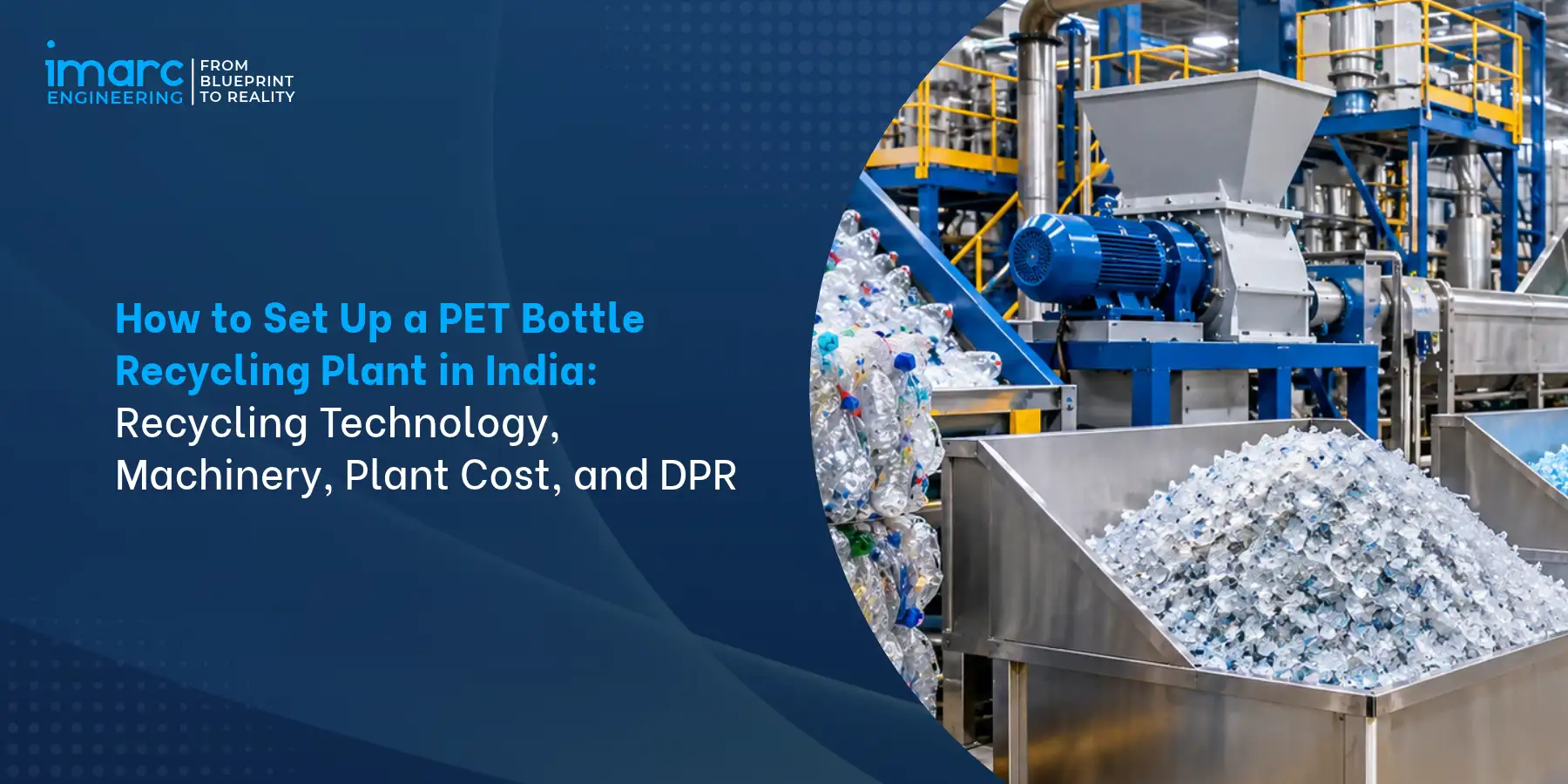
How to Set Up a PET Bottle Recycling Plant in India: Recycling Technology, Machinery, Plant Cost, and DPR
Introduction
The Plastic Waste Management Rules, 2016, as amended, require producers, importers and brand owners to meet category-wise recycled-plastic content obligations for plastic packaging. For Category I rigid plastic packaging, the prescribed recycled-content targets are 40% in FY 2026–27, 50% in FY 2027–28 and 60% from FY 2028–29 onwards.
These obligations are subject to statutory exemptions where recycled content is not permitted under applicable laws, regulations or mandatory standards. The 2026 amendment also provides a limited carry-forward facility for certain unfulfilled food-contact recycled-content obligations from FY 2025–26. The applicability of these provisions should be assessed for each obligated entity and packaging application.
Registered plastic waste processors can generate processing certificates against eligible quantities, creating a potential revenue stream. However, certificate eligibility and revenue depend on registration, verified processing, documentation, and actual transactions under the EPR framework.
This guide covers the eight-step setup route, recycling technology, machinery, sourcing, layout, material balance, regulatory approvals, plant cost and DPR content. Ranges are planning indications to be replaced by vendor quotations, bale trials and site data.
Scope of this Guide
Investors evaluating a PET bottle recycling plant in India should assess six things together: the production model (washed flakes, rPET pellets or food-grade resin), bale supply and contamination levels, wash-line and extrusion technology, infrastructure (land, power, water, effluent), regulatory registrations including EPR and pollution-control consents, and a yield-based financial model. This guide treats them in that logic and separates the three plant types throughout. Generic plastic recycling is excluded. All investment figures are indicative.
Table of Contents
- Introduction
- Why a PET Bottle Recycling Plant in India Matters for Investors in 2026
- What Is a PET Bottle Recycling Plant in India and How Do the Three Plant Types Differ
- How to Set Up a PET Bottle Recycling Plant in India: Eight-Step Roadmap
- PET Bottle Recycling Process and Technology Selection for a PET Bottle Recycling Plant in India
- Raw Material Sourcing, Bale Quality and Consumables for a PET Bottle Recycling Plant in India
- Regulatory Approvals, EPR Compliance and Quality Control for a PET Bottle Recycling Plant in India
- Land, Layout, Utilities, Capacity and Machinery for a PET Bottle Recycling Plant in India
- Plant Cost, DPR and Financial Feasibility of a PET Bottle Recycling Plant in India
- Conclusion
1. Why a PET Bottle Recycling Plant in India Matters for Investors in 2026
Four conditions shape the investment case for a PET bottle recycling plant in India in 2026, and each affects which configuration is worth funding.
1.1 EPR and Recycled-Content Demand
Producers, importers and brand owners are subject to Extended Producer Responsibility under the Plastic Waste Management Rules, 2016, as amended. Plastic waste processors, including PET recyclers, must obtain registration from the concerned State Pollution Control Board or Pollution Control Committee through the centralised CPCB EPR portal. Following the required facility audit and validation, registered processors can issue plastic-waste-processing certificates against eligible quantities.
For Category I rigid plastic packaging, the recycled-content target is 40% in FY 2026–27. The corresponding targets rise to 50% in FY 2027–28 and 60% from FY 2028–29 onwards, subject to the statutory exemptions and carry-forward provisions under the amended rules.
Financial projections should not assume a fixed EPR certificate price or guaranteed certificate revenue. The model should account for eligible processing volumes, registration conditions, verification requirements and prevailing transaction arrangements.
1.2 Virgin PET Substitution and the Food-Grade Gap
Virgin PET is generally produced through the polycondensation of purified terephthalic acid and monoethylene glycol. Recycled PET can substitute virgin material in applications such as polyester fibre, strapping, sheet and certain packaging products, provided it meets the buyer's quality and performance specifications.
Food-contact applications require additional decontamination, testing and regulatory authorisation. The choice between conventional rPET and food-contact rPET therefore affects the technology, quality-control system, investment requirement and market-access pathway.
1.3 Policy Framework and Cluster Ecosystem
PET recycling facilities are generally evaluated in relation to post-consumer bottle availability, waste aggregation networks, downstream buyers, logistics costs and access to industrial infrastructure. Potential locations should be assessed based on the availability and quality of PET bottle bales, proximity to fibre and packaging converters, land-use permissibility, power reliability, water availability and wastewater-treatment arrangements.
State industrial policies may provide capital subsidies, stamp duty concessions or power-related incentives, but eligibility depends on the applicable policy, project location, investment category and notified conditions. Incentives should be included in the financial model only after eligibility is confirmed.
1.4 The Cost of Poor Planning
Bales are contracted on price alone, so PVC, colored bottles and dirt arrive above what the wash line was designed for. A pelletizing extruder is installed behind flake whose moisture and viscosity were never tested. Effluent treatment is sized after the layout is frozen, leaving no room for a clarifier or filter press. Each is an early decision that is cheap to fix on paper and expensive on site.
2. What Is a PET Bottle Recycling Plant in India and How Do the Three Plant Types Differ
A PET bottle recycling plant converts post-consumer bottles into washed flakes and, depending on configuration, pellets or food-contact resin. Its boundary defines cost and regulatory scope.
2.1 Definition and Facility Boundary
The plant receives baled post-consumer PET bottles and removes caps, labels, adhesives, other polymers, metals, dirt and residual liquids through sorting, size reduction, washing and drying. The output is clean PET flake. Some facilities stop there; others add melt processing. Where the boundary is drawn fixes the equipment list, utility load, laboratory scope and licence conditions, so it belongs in the feasibility report rather than a later revision.
2.2 Washing Plant, Pelletizing Plant and Food-Grade Plant Compared
A PET bottle washing plant produces washed flakes and generally has the simplest process configuration. A flake extrusion and pelletizing facility adds drying, melt processing, filtration and pelletizing to produce rPET pellets for applications such as fibre, strapping and sheet. A food-contact rPET facility requires additional decontamination and quality-control systems.
FSSAI's May 2025 guidelines recognise four routes for producing recycled PET as a food-contact material: super-clean, melt-in, paste-in and chemical recycling. The selected process must include at least one validated decontamination step capable of reducing contaminants to levels suitable for food contact.
The technology and manufacturing process must receive the applicable FSSAI technology and facility authorisation for the relevant facility. Testing, process validation, traceability and quality-assurance requirements depend on the selected route and applicable guidelines. Solid-state polycondensation (SSP) may form part of a super-clean process, but it is not a universal requirement for every approved recycling route.
Understanding the Three PET Recycling Production Models
A PET bottle recycling project can be developed around three different production models. A washing plant converts post-consumer bottles into washed PET flakes for sale to downstream manufacturers. A pelletizing facility adds extrusion, melt filtration and pelletizing to convert suitable flakes into recycled PET pellets. A food-contact bottle-to-bottle facility requires an additional validated decontamination process and compliance with applicable food-contact requirements. Each configuration differs in machinery, product specifications, quality-control requirements, investment and regulatory considerations. Investors should select the model based on feedstock quality, downstream demand and the intended end use of the recycled material.
2.3 Scale Determinants
Scale is set by bale supply radius, contamination level, target flake specification, operating hours, wash-line availability and the downstream market's volume appetite. Capacity should be stated as saleable tonnes at a defined yield and utilization, not as nameplate input alone. Water recirculation capacity and effluent treatment infrastructure can also constrain the achievable throughput of wet-processing lines. These requirements should be evaluated alongside equipment capacity and feedstock availability.
2.4 Plant Sections
| Section | Function | Key Equipment |
|---|---|---|
| Bale reception and storage | Weigh, inspect, store bales | Weighbridge, covered yard, forklifts |
| Debaling and pre-sorting | Open bales, remove gross contaminants | Debaler, trommel, sorting belt |
| Label and cap removal | Strip labels and closures | Label remover, air separator |
| Wet size reduction | Granulate bottles to flakes | Wet granulator, 8-14 mm screen |
| Hot and friction washing | Remove glue, dirt, residues | Hot wash reactor, friction washer |
| Sink-float separation | Separate PET from polyolefins | Float-sink tanks, rinse tanks |
| Drying and flake sorting | Dewater, dry, remove defects | Centrifuge, thermal dryer, optical sorter |
| Extrusion/SSP (optional) | Pellet and upgrade viscosity | Vacuum extruder, melt filter, SSP reactor |
| Utilities and laboratory | Power, steam, air, testing | Transformer, boiler, IV tester |
| Effluent treatment | Treat and recycle wash water | Screens, DAF, clarifier, filter press |
3. How to Set Up a PET Bottle Recycling Plant in India: Eight-Step Roadmap
Setting up a PET bottle recycling plant in India follows eight linked steps, grouped below; later sections explain each technical element once.
3.1 Step 1 and Step 2 – Feasibility Study and Plant Configuration
Begin with a market and project feasibility study comparing bale procurement costs, expected flake or pellet realisation, downstream offtake demand and capital requirements. Test representative bale lots through vendor wash trials to establish actual material yield and product quality. Any potential income from EPR processing certificates should be evaluated separately as conditional upside, based on registration, eligible processing quantities, verification and actual market transactions.
Then select the configuration: washed flakes, flakes plus pelletizing, or food-grade. Many sponsors phase the project, commissioning a wash line first and reserving space and utilities for extrusion.
3.2 Step 3 and Step 4 – Raw Material Availability and Industrial Location
Evaluate raw material availability through supplier mapping, multi-month supply commitments and bale audits before any land is committed (Section 5). Locate the plant using the same data: distance to bale aggregators and flake buyers, industrial-zone permissibility for plastic recycling, truck access, power feeder reliability, water source and a permitted effluent route. Land-use and zoning confirmation precedes purchase or lease signing.
3.3 Step 5 and Step 6 – Recycling Technology, Machinery, Layout and Utilities
Finalize technology by running the sponsor's own bales through shortlisted vendors' test lines, then write performance guarantees on PVC level, moisture, flake size and yield. Plan the layout and utilities around a one-way flow from bale yard to finished goods, with effluent treatment and fire protection integrated at the design stage (Section 7). Machinery orders follow, not precede, the approved layout.
3.4 Step 7 and Step 8 – Regulatory Approvals and Commissioning
Obtain the applicable pollution-control consent to establish before undertaking construction or installation activities that require prior consent. Secure the required factory, building, fire, electrical and other site-specific approvals. A PET recycling unit operating as a plastic waste processor must obtain registration from the concerned SPCB/PCC through the centralised CPCB EPR portal. The facility must meet the applicable audit and validation requirements before issuing processing certificates. Consent to operate must be obtained before commencing operations.
Food-contact rPET facilities must also complete the applicable FSSAI technology and facility authorisation requirements before supplying material for food-contact applications. Commissioning should include mechanical and electrical checks, water and utility trials, process testing with representative feedstock and performance verification against agreed throughput, yield and product-quality parameters.
4. PET Bottle Recycling Process and Technology Selection for a PET Bottle Recycling Plant in India
The PET bottle recycling process runs from baled bottles to flakes and, optionally, pellets or food-grade resin, with each stage removing a defined contaminant class.
4.1 Bale Opening, Sorting and Label Removal
A debaler opens the incoming bales and feeds the material onto a sorting belt, where manual or automated systems remove bulk contaminants. Trommels can remove loose dirt and undersized material, while label-removal equipment strips shrink sleeves and other labels. Optical sorting systems using near-infrared and colour cameras can identify and separate selected polymers, colours and non-PET materials.
PVC is a particularly important contaminant because it can thermally degrade during PET melt processing and release hydrochloric acid, which accelerates polymer degradation. Upstream sorting should therefore control PVC contamination to the limits agreed with the downstream processor or buyer. Sorting performance should be verified through feedstock trials and quality testing.
4.2 Wet Granulation, Hot Washing, Sink-Float and Drying
Bottles are typically wet-granulated into flakes, with the target size selected according to the washing and downstream processing equipment. Hot washing uses controlled alkaline and detergent solutions to remove adhesives, dirt, oils and surface residues. The chemical concentration, temperature and residence time depend on the bottle condition, adhesive type and wash-line design. Friction washing provides additional mechanical cleaning.
Sink-float tanks use density differences to separate PET from lighter polyolefins such as PP and HDPE, which generally float while PET sinks. PVC and other dense contaminants may remain in the sinking fraction and therefore require effective upstream sorting or additional separation methods. The flakes are subsequently rinsed, dewatered, and dried, followed by inspection or optical sorting to remove residual contaminants and colour defects.
4.3 Extrusion, Melt Filtration and Pelletizing
For rPET pellet production, washed flakes are dried before melt processing. Crystallisation may also be required to prevent flakes from agglomerating during drying, depending on the equipment and process route. The dried material is fed into a suitably configured extruder, where it is melted and passed through a melt-filtration system to remove residual solid contaminants. Extrusion temperature, screw configuration, vacuum conditions and filter rating should be selected according to feedstock quality, throughput and the required pellet specifications.
PET is sensitive to moisture during melt processing, as hydrolysis can reduce molecular weight and intrinsic viscosity. The drying system should therefore achieve the moisture level specified by the extruder supplier and downstream product requirements. The filtered melt is then converted into pellets using a suitable pelletizing system.
4.4 Food-Grade Technology and Production Line Selection
Food-contact rPET production requires a validated recycling process with an effective decontamination step. FSSAI's May 2025 guidelines recognise super-clean, melt-in, paste-in and chemical recycling routes. The selected route must be suitable for the feedstock and intended food-contact application, and the recycling process must receive the applicable FSSAI technology and facility authorisation.
Process validation and testing requirements depend on the technology used. These may include challenge testing, extraction testing and migration testing, as applicable. FSSAI's guidelines also specify relevant PET quality and safety requirements, including conformity with IS 12252, applicable migration standards and sensory evaluation. Testing must be undertaken through laboratories meeting the prescribed NABL/ILAC accreditation requirements.
The facility must maintain feedstock traceability, process-control records, quality-assurance documentation and records of the authorised technology. Any change in the process, operating parameters or input feed that affects validated decontamination performance should be assessed against the applicable validation requirements.
SSP may be used in certain super-clean recycling configurations to improve intrinsic viscosity and support decontamination. However, it is not mandatory for every food-grade rPET production line. Machinery selection should follow the approved process design and its validation requirements rather than assuming that all food-grade facilities require an SSP reactor.
5. Raw Material Sourcing, Bale Quality and Consumables for a PET Bottle Recycling Plant in India
Feedstock quality, not machine speed, decides yield and flake grade, so sourcing is engineered like a process input.
5.1 PET Bottle Collection Infrastructure
Post-consumer PET bottles reach recyclers through informal waste collectors, scrap aggregators, material recovery facilities, urban local body collection systems and institutional collection channels such as commercial establishments and event venues. Bottlers and packaging manufacturers may also generate production rejects and other pre-consumer PET scrap, but these materials should be identified and accounted for separately from post-consumer feedstock.
A recycling plant should map its suppliers, verify the origin and composition of the material and assess the availability of suitable quantities throughout the year. Procurement contracts should specify feedstock quality, contamination limits, delivery schedules, rejection conditions and traceability requirements. Food-contact rPET projects require particular attention to the source and eligibility of incoming post-consumer food-packaging material.
5.2 Bale Specification and Contamination Control
A written bale specification should cover bottle proportion, clear versus colored fractions, PVC and PETG bottles, closure and label content, moisture, residual liquids, dirt and non-bottle PET. Incoming bales are inspected, sampled and graded at the weighbridge, with rejection and price-adjustment clauses. Visual audits are supported by periodic wash-trial yield checks per supplier. Colored and opaque bottles lower flake value and are a key variable in the margin model.
5.3 Procurement Structure and Price Exposure
Bale cost is the dominant operating input, and bale prices respond to virgin PET prices, seasonal collection patterns and informal-sector demand. Supply contracts should be staged across suppliers, with minimum volume and quality terms, and cost pass-through to offtake pricing where buyers allow. A registered PET recycler may generate plastic-waste-processing certificates against eligible quantities processed and verified under the EPR framework.
Any revenue from these certificates should be modelled separately and should depend on registration status, installed capacity, audit and validation, eligible processing volumes and actual certificate transactions. It should not be treated as a guaranteed offset against feedstock costs.
5.4 Chemicals, Consumables and Safe Storage
Consumables include caustic soda flakes or lye, non-ionic or anionic surfactants, defoamers, flocculants and coagulants for effluent treatment, screens and granulator knives, filter elements and packaging bags. Caustic needs corrosion-resistant bunded storage, eyewash and splash protection under the applicable factory safety rules. Hot-wash dosing is automated so concentration and temperature are controlled, since over-dosing raises effluent load and under-dosing leaves glue on flakes.
6. Regulatory Approvals, EPR Compliance and Quality Control for a PET Bottle Recycling Plant in India
Applicability of each requirement depends on the state, plant classification, product use and the approval process, so the list below is a screening framework to confirm for the specific project.
6.1 EPR Registration and CPCB Recycler Registration
PET bottle recyclers operating as plastic waste processors must obtain registration from the concerned State Pollution Control Board or Pollution Control Committee through the centralised CPCB EPR portal under the Plastic Waste Management Rules, 2016, as amended. The application requires information on the entity, plant location, processing capacity, machinery, process flow, pollution-control systems, waste generation and disposal arrangements.
Applicants must provide the applicable pollution-control consents and supporting documents required for registration. The concerned SPCB/PCC examines the application and undertakes the prescribed audit and validation of the facility. Registration as a plastic waste processor enables an eligible facility to participate in the EPR system and use the centralised portal for applicable reporting and certificate-related activities. It does not itself constitute a processing certificate or establish an automatic entitlement to generate certificates for the plant's entire production.
Processing certificates may be generated only against eligible plastic waste quantities that have been processed and verified in accordance with the applicable rules, CPCB guidelines and portal requirements. Certificate generation is therefore conditional on the facility's registration status, approved processing capacity, material category, verified processing records and other applicable conditions.
6.2 SPCB Consents and Other Approvals
PET recycling projects generally require consent to establish and consent to operate from the relevant State Pollution Control Board under the applicable water and air pollution-control laws, subject to the unit's classification and state-specific requirements.
Other approvals may include land-use and building-plan approval, factory registration or licence, fire clearance, electrical safety approval, groundwater abstraction permission, GST registration and Udyam registration, where applicable. The four Labour Codes came into effect on 21 November 2025, and the applicable labour, occupational safety and social-security requirements should be assessed for the establishment.
A standalone mechanical PET recycling facility is not separately identified as an activity in the Schedule to the EIA Notification, 2006. However, the need for prior environmental clearance should be assessed where the project includes other scheduled activities, an integrated industrial development or other components that trigger the notification. The relevant SPCB/PCC should also confirm the applicable industrial category and consent conditions for the proposed process and location.
6.3 Wastewater Treatment and Residue Management
PET bottle washing generates wastewater containing suspended solids, dirt, adhesives, detergents, alkaline chemicals and other residues. The effluent-treatment system should be designed after characterising the wash-water streams and estimating average and peak wastewater generation. Depending on the wastewater quality and applicable discharge or reuse conditions, treatment may include screening, equalisation, pH correction, coagulation-flocculation, dissolved-air flotation, clarification, biological treatment and polishing.
A filter press or another suitable dewatering system may be required for treatment sludge. Water recirculation can reduce freshwater demand, but the design must account for contaminant build-up and the need for controlled wastewater discharge or disposal. Zero liquid discharge should be included only where required by the applicable regulatory conditions or selected as a project-specific design objective. Sludge, rejected labels, closures and other process residues must be characterised and sent to authorised disposal or recovery channels, as applicable.
6.4 Quality Control and Testing for Recycled PET
The laboratory should monitor flake and pellet quality according to the intended application and buyer specifications. Relevant parameters may include moisture, bulk density, particle-size distribution, fines, colour, PVC and polyolefin contamination, ash content, metal contamination and intrinsic viscosity.
Pellet lines may require additional testing for moisture, acetaldehyde and other product-specific parameters. Food-contact rPET requires more extensive validation and testing. Depending on the approved recycling route, applicable requirements may include challenge testing, extraction testing and migration testing, conformity with IS 12252, and sensory evaluation under ISO 13302 or an equivalent method. Testing must be conducted in laboratories meeting the prescribed NABL/ILAC accreditation requirements.
Food-contact rPET manufacturers must maintain feedstock traceability, process-validation records, quality-assurance data and the applicable FSSAI technology and facility authorisation. The FSSAI guidelines also prescribe documentation and marking requirements for food-contact materials made from recycled PET.
Separately, the Plastic Waste Management (Amendment) Rules, 2026 amended Rule 11(2) to require recycled plastic packaging and commodities to conform to IS 14534:2023 and carry the prescribed recycled-content label and marking. Packaging intended for food-contact applications must also comply with the applicable FSSAI marking and labelling requirements.
These are related but distinct requirements: IS 14534:2023 addresses recycled plastic packaging and marking, while FSSAI's guidelines govern the acceptance, safety, authorisation and labelling of food-contact rPET.
7. Land, Layout, Utilities, Capacity and Machinery for a PET Bottle Recycling Plant in India
Figures in this section refer to one illustrative flake line of 2 tonnes per hour input and are indicative planning values.
7.1 Land, Plant Layout and Infrastructure
Land and building requirements for a PET recycling plant depend on the processing configuration, line capacity, bale-storage period, finished-goods inventory, equipment footprint, utilities and effluent-treatment facilities. A 2 TPH washing line should be planned around the required bale-storage buffer, sorting and washing areas, dry processing zone, finished-flake storage, laboratory, utilities, ETP and vehicle movement.
The layout should provide separate areas for incoming waste, accepted feedstock, rejected material and finished products. It should also account for fire access, drainage, maintenance clearances, worker movement and future expansion. Land area and covered building requirements should be established through a preliminary equipment layout and material-storage calculation rather than a generic acreage assumption.
7.2 Utilities: Power, Water, Heat and Air
Utility requirements should be calculated from the selected equipment list and process design. The connected electrical load must include the debaler, conveyors, sorting systems, granulator, washing equipment, pumps, centrifuges, dryers, optical sorters, extruders, compressors and ETP. Actual demand will depend on the operating schedule and equipment loading. Freshwater consumption should be estimated from wash-line requirements, rinsing stages, cooling, cleaning and the proposed water-recirculation system.
Process heating may use steam, thermic fluid or another suitable arrangement, depending on the equipment selected. Compressed air should meet the pressure, flow and quality requirements of optical sorting and pneumatic equipment. Backup power should be sized according to the critical operating loads, including essential pollution-control systems. Final utility requirements should be confirmed through vendor data, equipment guarantees and a project-specific load study.
7.3 Production Capacity and Material Balance
Annual input capacity should be calculated using rated throughput, scheduled operating hours, operating days and expected utilisation. For example, a 2 TPH line operating for 20 hours a day over 300 days has a theoretical annual input capacity of 12,000 tonnes at full rated throughput. Actual processed input will be lower when downtime, maintenance, feedstock shortages or other operating constraints reduce utilisation.
A material-balance calculation should then convert actual input into saleable output. Consider a hypothetical plant operating at 80% utilisation. Its annual processed input would be 9,600 tonnes (12,000 tonnes × 80%). If representative bale trials establish a hypothetical saleable flake yield of 75%, annual saleable output would be 7,200 tonnes (9,600 tonnes × 75%). The remaining 2,400 tonnes would represent caps, labels, dirt, moisture, non-PET materials, sorting rejects and other process losses.
These figures are illustrative assumptions, not industry-standard yield or utilisation benchmarks. Actual output must be established through representative bale sampling, vendor wash trials and a project-specific material balance. Pellet output should be calculated separately after accounting for extrusion, filtration and other downstream process losses.
| Material balance item | Hypothetical quantity |
|---|---|
| Rated annual input capacity | 12,000 tonnes |
| Assumed utilisation | 80% |
| Actual annual input | 9,600 tonnes |
| Assumed saleable flake yield | 75% |
| Annual saleable flake output | 7,200 tonnes |
| Rejects and process losses | 2,400 tonnes |
The 75% yield is an illustrative assumption for demonstrating the calculation. It must not be presented as a typical or guaranteed PET recycling yield.
7.4 Key Machinery
| Category | Equipment | Illustrative Scale |
|---|---|---|
| Bale handling | Debaler, belt conveyors | 2 TPH input line |
| Sorting | Trommel, NIR and colour optical sorter | 2-3 sorting stages |
| Size reduction | Wet granulator, 8-14 mm screen | Rated 2-3 TPH |
| Washing | Hot wash reactor, friction washers | Hot-wash temperature, chemical concentration and residence time to be determined through feedstock trials and vendor process design; 80–90°C is an illustrative operating range. |
| Separation and drying | Float-sink tanks, centrifuge, thermal dryer | Drying performance based on the required saleable flake moisture specification; additional drying may be required before downstream extrusion. |
| Flake sorting | Flake optical sorter, metal detector | Rated capacity matched to actual flake output after washing |
| Pelletizing (optional) | Crystalliser, extruder, melt filter, pelletizer | Capacity matched to validated flake flow and required pellet quality |
| Effluent treatment | Screening, equalisation, treatment system, sludge dewatering equipment | Designed for estimated wastewater flow, peak load, pollutant characteristics and applicable consent conditions |
8. Plant Cost, DPR and Financial Feasibility of a PET Bottle Recycling Plant in India
Plant cost depends on the model, bale quality, wash-water design and site, so costs below are one illustrative project, not a market benchmark.
8.1 PET Bottle Recycling Plant Cost in India: CAPEX and OPEX Drivers
Plant investment depends on the selected recycling configuration, input capacity, feedstock quality, equipment specifications, site conditions and environmental infrastructure. A washed-flake facility requires bale handling, sorting, granulation, washing, separation, drying and effluent treatment systems. Adding pelletizing requires further drying, extrusion, melt filtration and pelletizing equipment.
Food-contact rPET production may require additional decontamination technology, process validation, laboratory facilities, testing and FSSAI authorisation. Major CAPEX components include land, civil works, machinery, utilities, fire protection, pollution-control systems, engineering and pre-operative expenses.
OPEX is influenced by bale procurement, electricity, water, process chemicals, labour, maintenance, effluent treatment, residue disposal and logistics. Imported equipment may also expose the project to exchange-rate and customs-related costs.
8.2 Detailed Project Report for a PET Bottle Recycling Plant
A DPR for a PET recycling plant documents the market and offtake analysis, selected configuration, bale sourcing plan, process flow and material balance, machinery list with specifications, layout, utilities, effluent design, approvals roadmap including EPR, CAPEX, OPEX, working capital, implementation schedule and risk register. The financial model should show DSCR, NPV, IRR, break-even, and sensitivities on yield, bale price, flake price and utilization.
8.3 Challenges and Financial Feasibility
Profitability depends on the spread between feedstock procurement costs and realised flake or pellet selling prices, along with processing yield, capacity utilisation, product quality and operating expenses. Eligible plastic waste processors may generate processing certificates for verified quantities under the EPR framework.
However, any income from certificate transactions is conditional on registration, processing eligibility, verification, applicable portal requirements and actual market transactions. It should be treated as potential additional revenue rather than a guaranteed source of project income.
Other challenges include bale-price volatility, competition for quality feedstock, PVC and coloured-bottle contamination, water availability, effluent-treatment costs and buyer concentration. The financial model should test downside scenarios involving lower yields, higher procurement costs, weaker selling prices, lower utilisation and delays in certificate-related revenue before investment approval.
8.4 Project Economics
The following table presents the main cost heads and estimating basis for a proposed 2 TPH PET bottle-to-flake project. It is a project-cost estimation framework, not a market benchmark. Actual costs should be established through site-specific land and civil estimates, machinery quotations, utility calculations, ETP design, installation estimates and applicable taxes.
| Cost head | Basis for project estimate |
|---|---|
| Land and site development | Location-specific land cost, site preparation and access infrastructure |
| Civil works and buildings | Process shed, bale storage, finished-goods storage, laboratory and utility buildings |
| Plant and machinery | Debaling, sorting, granulation, washing, separation and drying for the 2 TPH bottle-to-flake configuration. Pelletizing equipment, if proposed, should be estimated separately as an additional project scope. |
| Utilities and installation | Electrical systems, process heating, compressed air, water systems and equipment erection |
| Effluent treatment and environmental systems | ETP, water recirculation, sludge handling and air-pollution controls, where applicable |
| Fire and safety systems | Fire detection, protection, emergency access and occupational safety provisions |
| Engineering and pre-operative costs | DPR, detailed engineering, approvals, trials, training and commissioning |
| Contingency | Based on project risk, estimate maturity and procurement conditions |
| Working capital | Feedstock inventory, consumables, payroll, utilities and receivables |
The final project cost should also identify whether GST, import duties, financing costs, interest during construction, land registration charges, initial working capital and future expansion provisions are included or excluded. A bankable estimate should be supported by vendor quotations, a defined equipment scope, site-specific civil estimates and a detailed implementation schedule.
Conclusion
Establishing a PET bottle recycling plant in India requires alignment between feedstock quality, product specifications, recycling technology and regulatory requirements. The selected production model, whether washed PET flakes, rPET pellets or food-contact rPET, determines the machinery, process design, quality-control systems and investment requirements. Reliable bale sourcing, representative wash trials and a suitable material balance are essential for estimating saleable output and operating costs.
Before committing capital, investors should validate downstream demand, secure feedstock arrangements and finalise the plant configuration based on technical and financial feasibility. Plastic waste processor registration, pollution-control approvals, wastewater treatment and applicable FSSAI requirements for food-contact rPET should be incorporated into the project schedule. A detailed DPR supported by vendor quotations, realistic operating assumptions and sensitivity analysis provides the basis for investment and implementation decisions.
PURSUING A PET BOTTLE RECYCLING PLANT IN INDIA?
IMARC Engineering supports investors, project sponsors and recycling entrepreneurs with feasibility studies, location analysis and site selection, plant layout and process flow design, equipment selection, utilities planning, waste management system planning, regulatory approval and licensing, and CapEx and OpEx planning support. The advisory covers washed PET flake, rPET pellet and food-contact rPET facilities, including sorting, washing, drying, extrusion and decontamination requirements, with project-specific engineering and commissioning assistance.
→ Schedule a PET bottle recycling plant scoping consultation with an IMARC specialist
Frequently Asked Questions
Start with a feasibility study and select a configuration: washed flakes, pellets or food-grade. Secure bale supply, choose a permitted industrial site, finalize technology through wash trials, plan layout and utilities, obtain consents and EPR registration, then install and commission against guaranteed yield and flake quality.
Cost depends on processing capacity, plant configuration, location, machinery specifications and environmental infrastructure. A washed-flake plant generally requires less equipment than a pelletizing or food-contact rPET facility. Prepare the estimate using vendor quotations, civil-cost estimates, utility designs, ETP costs and working-capital requirements.
A PET washing line typically includes a debaler, trommel, label remover, optical sorters, wet granulator, hot-wash reactor, friction washers, float-sink tanks, centrifuge, thermal dryer and effluent-treatment system. Pelletizing adds suitable drying, extrusion, melt filtration and pelletizing equipment. Food-contact rPET production requires a validated and FSSAI-authorised decontamination process. The machinery configuration depends on the approved technology route; SSP may be required in certain configurations but is not universal.
Baled bottles are opened, sorted and de-labelled, wet-granulated, hot-washed in caustic, separated in float-sink tanks, dewatered and dried, then sorted as flakes. For pellets, flakes are dried, melted in a vacuum extruder, melt-filtered and pelletized. Food-grade resin adds validated decontamination.
Land, power and water requirements depend on line capacity, equipment configuration, bale-storage needs, operating hours and water-recirculation design. A 2 TPH plant should be sized through an equipment layout, utility load study and wastewater assessment rather than relying on generic acreage or consumption figures.
A washing plant produces washed PET flakes. A pelletizing plant adds drying, extrusion, melt filtration and pelletizing to produce recycled PET pellets. A food-contact rPET plant requires an FSSAI-authorised recycling process with a validated decontamination step, along with applicable testing, traceability and quality-assurance systems. The selected route may involve super-clean, melt-in, paste-in or chemical recycling. SSP is used in certain process configurations but is not mandatory for every food-grade facility.
Typical requirements include SPCB/PCC consent to establish and operate, plastic waste processor registration through the CPCB EPR portal, factory and building approvals, fire clearance and electrical safety approval. Groundwater permission and hazardous-waste authorisation may also apply. Food-contact rPET requires applicable FSSAI technology and facility authorisation.
Annual input is calculated using hourly throughput, operating hours, operating days and expected utilisation. Saleable flake output is calculated using a validated yield based on feedstock quality and process losses. Yield depends on bottle composition, caps, labels, PVC, dirt, moisture, sorting efficiency and washing performance.
Profitability depends on feedstock cost, product selling price, processing yield, capacity utilisation and operating expenses. CAPEX includes land, civil works, machinery, utilities and pollution-control systems. OPEX includes bales, power, water, chemicals, labour, maintenance and residue disposal. Treat EPR certificate revenue as conditional, not guaranteed.
A DPR should include market and offtake analysis, feedstock sourcing, configuration selection, process flow, material balance, machinery specifications, layout, utilities, ETP design, regulatory approvals, EPR registration, CAPEX, OPEX, working capital, implementation schedule and risk assessment. Financial outputs should include DSCR, NPV, IRR, break-even and sensitivity analysis.
Recent Post
Trusted by Industry Leaders
We partner with global enterprises and ambitious businesses across sectors to deliver operational excellence, strategic insights, and sustainable growth through integrated solutions.



Success in Their Words
Real feedback from clients across industries. Discover how our solutions delivered measurable impact and operational excellence.

I wanted to express my sincere appreciation for your efforts in handling this matter. Your dedication and commitment have been truly commendable, and it is evident that you have put in tremendous hard work and expertise into resolving the issues at hand. We are greatly interested in continuing our collaboration with you in the future, as your professionalism and reliability have made you a trusted partner. Thank you once again for your invaluable contribution. We look forward to strengthening our partnership ahead.
It has been a pleasure working with the IMARC team. The insights provided were structured, clear, and highly valuable, helping us strengthen both our technical and financial planning with confidence. We deeply appreciate the team’s professionalism, responsiveness, and attention to detail throughout the engagement. Every requirement was well understood and effectively incorporated, resulting in a comprehensive and actionable output. Overall, our experience has been excellent, and I would gladly recommend IMARC to organizations seeking a reliable research partner.
Your service is truly exceptional. Working with the IMARC team has been a seamless and professional experience. The clarity of communication, responsiveness to queries, and consistent support at every stage made the entire engagement highly efficient. The insights shared were well-structured, practical, and perfectly aligned with our requirements, helping us make informed decisions with confidence. Overall, the dedication and professionalism demonstrated by your team stand out, and I would be glad to recommend IMARC as a reliable and trustworthy research partner.

IMARC did an outstanding job in preparing our study. They were punctual, precise, and consistently responsive throughout the entire process. The team delivered all the data we required in a clear, well-organized, and highly professional format. Their strong attention to detail, combined with their ability to meet every deadline without compromising quality, truly set them apart. Overall, their reliability and commitment made them an exceptional partner for our project, and we would gladly work with them again in the future.
IMARC made the whole process incredibly easy from start to finish. Everyone I interacted with via email was polite, professional, and straightforward to deal with, always keeping their promises regarding delivery timelines and remaining consistently solutions-focused. From my very first contact, I appreciated the professionalism and support shown by the entire IMARC team. I highly recommend IMARC to anyone seeking timely, affordable, and reliable information or advice. My experience with IMARC was excellent, and I truly cannot fault any aspect of it.

I’d like to express my sincere gratitude for the excellent work you accomplished with the study. Your ability to quickly understand our requirements and deliver high-quality results under tight timelines truly reflects your expertise, exceptional work ethic, and unwavering commitment to your customer’s success. The professionalism and responsiveness you demonstrated throughout the process made a significant difference. Our entire team and company are incredibly thankful for your dedication, reliability, and support. Once again, thank you for your outstanding contribution.