Manufacturing
November 20 2026
How to Set Up a Tractor Manufacturing Plant in India: Assembly Line Design, Powertrain Integration, and DPR (2026)
Introduction
For investors, project sponsors and agricultural-machinery manufacturers, a tractor manufacturing plant in India is a heavy-engineering assembly and supply-chain project. In most tractors the engine, transmission and rear axle housings bolt together to form the structural backbone, but the commercial challenge lies in integrating a tier-1 supplier base, holding assembly takt time, and passing product testing before dispatch. Mechanisation of Indian agriculture keeps domestic tractor production strategically relevant, and demand is seasonal, tied to monsoon outcomes, crop cycles and rural credit.
Disciplined planning matters because the costliest errors arise early: choosing integrated manufacturing when an assembly model would reach market sooner, fixing a horsepower segment before testing the supplier ecosystem, or building a paint shop and test track on an unconfirmed approval route. This guide covers manufacturing models, the production process, machinery, plant layout, capacity planning, cost heads, DPR contents, approvals, testing and profitability drivers. Cost and capacity values should come from vendor quotations and site data for the specific project.
Scope of this Guide
This guide answers one question: what technical, operational, financial and regulatory requirements should investors evaluate before establishing a tractor manufacturing facility in India? It separates integrated manufacturing (in-house machining of gearbox, axle and hydraulic housings, with fabrication and engine capability) from SKD/CKD assembly and from assembly-focused plants that buy engines, transmissions and axles from qualified suppliers. The scope covers assembly line design, powertrain integration, quality testing, utilities, approvals and a dedicated DPR section. Requirements differ by project, jurisdiction and product category, so each regulatory point must be confirmed for the specific project.
Table of Contents
- Introduction
- Tractor Manufacturing Plant in India: Market Context, Manufacturing Models and Policy Framework
- Plant Scope, Sections and Setup Roadmap
- Tractor Manufacturing Process and Production Systems
- Raw Materials, Components and Supplier Development
- Land, Plant Layout and Production Capacity Planning
- Tractor Manufacturing Machinery, Equipment and Utilities
- Regulatory Approvals, Tractor Testing and Quality Control
- Tractor Manufacturing Plant Cost, DPR and Financial Feasibility
- Conclusion
1. Tractor Manufacturing Plant in India: Market Context, Manufacturing Models and Policy Framework
Four conditions shape the investment case for a tractor manufacturing plant in India, and each affects the plant configuration worth funding.
1.1 Agricultural Mechanisation and Domestic Manufacturing
Tractors are the primary power source for tillage, haulage, sowing and threshing, and they underpin farm mechanisation. India has an established domestic manufacturing base serving both internal demand and exports, so a new entrant competes against incumbents with scale, dealer networks and localised supply chains. Demand moves with monsoon quality, minimum support prices, rural credit availability and farm income, so a plant should be sized for cyclical swings and not peak years. This guide deliberately avoids market-size statistics that cannot be tied to a named source; sponsors should obtain current figures from industry bodies such as the Tractor and Mechanization Association (TMA) and validate them in the DPR.
1.2 Integrated Manufacturing Versus SKD/CKD Assembly
Integrated manufacturing means the plant machines gearbox casings, rear axle housings, hydraulic lift housings and gears, fabricates sheet metal and often produces or co-develops engines. SKD (semi-knocked-down) assembly imports or buys partly built sub-assemblies; CKD (completely knocked-down) assembly imports full kits of components for assembly and painting locally. Assembly-focused plants buy engines, transmissions, axles and hydraulics from qualified suppliers and concentrate on integration, painting and testing. Machinery needs, investment, localisation levels and margin structure differ sharply between these models, which is why scope must be fixed before anything is ordered.
1.3 Policy and Incentive Framework
Support depends on location and category. State industrial policies commonly offer capital subsidy, SGST reimbursement, stamp duty relief and power tariff concessions, while central schemes and customs provisions for capital goods may apply. Eligibility is tied to entity form, investment thresholds and commencement dates, so verify current notifications before including any incentive in the financial model. Incentives should be treated as upside rather than the basis of viability.
1.4 The Cost of Poor Planning
Recurring failures include freezing the horsepower portfolio before confirming the supplier base, building excess machining capacity that sits idle at low volumes, sizing the paint shop for peak output that the market does not absorb, and under-budgeting working capital, since dealer credit and seasonal inventory build tie up cash well before sales. Warranty exposure from early field failures is a further hidden cost for new entrants.
2. Plant Scope, Sections and Setup Roadmap
A tractor plant is defined by how much of the chain from raw casting to tested vehicle it actually performs.
2.1 What a Tractor Manufacturing Plant Is
A tractor manufacturing plant converts engines, transmissions, axles, hydraulics, sheet metal, tyres and electricals into a tested, painted agricultural tractor in defined horsepower classes. It is typically organised as a sequence of shops: machining (if integrated), fabrication and welding, paint, sub-assembly, final assembly, testing and dispatch.
2.2 Types of Plants and Production Scope
Three scopes exist: assembly-only (purchased powertrain); assembly with in-house fabrication, painting and some machining; and fully integrated manufacturing including gearbox and axle machining and possibly engine production. Component-based manufacturing, where the plant makes only gearboxes, axles or hydraulic units for other tractor makers, is a distinct business with different customers and risk. Many entrants begin with an assembly-plus-paint model and expand backward into machining once volumes justify tooling and validation.
2.3 Scale Determinants
Scale follows target horsepower segment, product variants, takt time, shifts per day and the supplier base's ability to deliver in sequence. Capacity should be expressed as saleable tractors per year at a defined utilisation, not as line speed alone. Seasonality means output is often built ahead of peak demand periods, so storage yard and finished-goods financing matter.
2.4 Plant Sections
The table maps each section to its function and principal equipment.
| Section | Function | Key Equipment |
|---|---|---|
| Machining Shop | Gearbox, axle, hydraulic housing machining | CNC machining centres, VMCs, gear hobbers |
| Fabrication and Welding | Front supports, sub-frames, fenders, hood, platform | Press brakes, laser cutters, MIG/robotic welding |
| Paint Shop | Pretreatment, primer, topcoat | Dip or spray pretreatment, powder or liquid booths, ovens |
| Sub-Assembly | Engine, transmission, axle, front axle units | Assembly benches, torque tools, balancers |
| Final Assembly Line | Powertrain marriage, wheels, electricals | Overhead conveyors, AGVs, hoists, nutrunners |
| Testing Area | Engine, hydraulic, brake, functional tests | Dynamometer, hydraulic test rig, test track |
| Stores and Warehouse | Component receipt, kitting, storage | Racking, forklifts, kitting trolleys |
| Dispatch Yard | Finished tractor storage and loading | Yard, ramps, loading equipment |
| Utilities | Power, air, water, fuel | HT supply, DG sets, air compressors, water treatment |
| Effluent Treatment | Pretreatment and wash effluent | ETP with neutralisation and sludge handling |
3. Tractor Manufacturing Process and Production Systems
The tractor manufacturing process is a sequence of fabrication, machining, painting, assembly and testing steps, and its first decision is which of those steps are done in-house.
3.1 Component Manufacture or Procurement
Many facilities do not make the engine, gearbox, axles and castings in-house. They procure major assemblies from qualified suppliers and focus on integration, assembly and final testing. Integrated plants machine cast-iron gearbox and axle housings, hardened gears and shafts, and may assemble engines from machined blocks and heads. The in-house versus bought-out choice should follow volume, tooling cost, supplier capability and the strategic value of controlling the powertrain.
3.2 Fabrication, Welding and Sheet Metal
As most tractors use frameless construction, with the powertrain housings forming the chassis, fabrication covers front axle supports, sub-frames, fenders, hoods and platforms. These parts are cut by laser or plasma, formed on press brakes or presses, and joined by MIG welding. Robotic welding cells improve joint consistency on high-volume structures, while lower-volume plants rely on welding fixtures and trained welders. Sheet-metal stamping needs press lines and dies with significant tooling investment, which is often outsourced at modest volumes. Weld quality is controlled by procedure qualification and visual and dimensional inspection.
3.3 Machining and Powertrain Preparation
Gearbox and rear-axle housings are machined on CNC machining centres with fixtures that hold bore position and face flatness. Gears are cut on hobbing and shaping machines, heat treated by carburising or induction hardening, and finished by grinding or honing for noise control. Where machining is outsourced, incoming inspection on coordinate measuring machines becomes the plant's quality gate.
3.4 Painting, Assembly and Production Systems
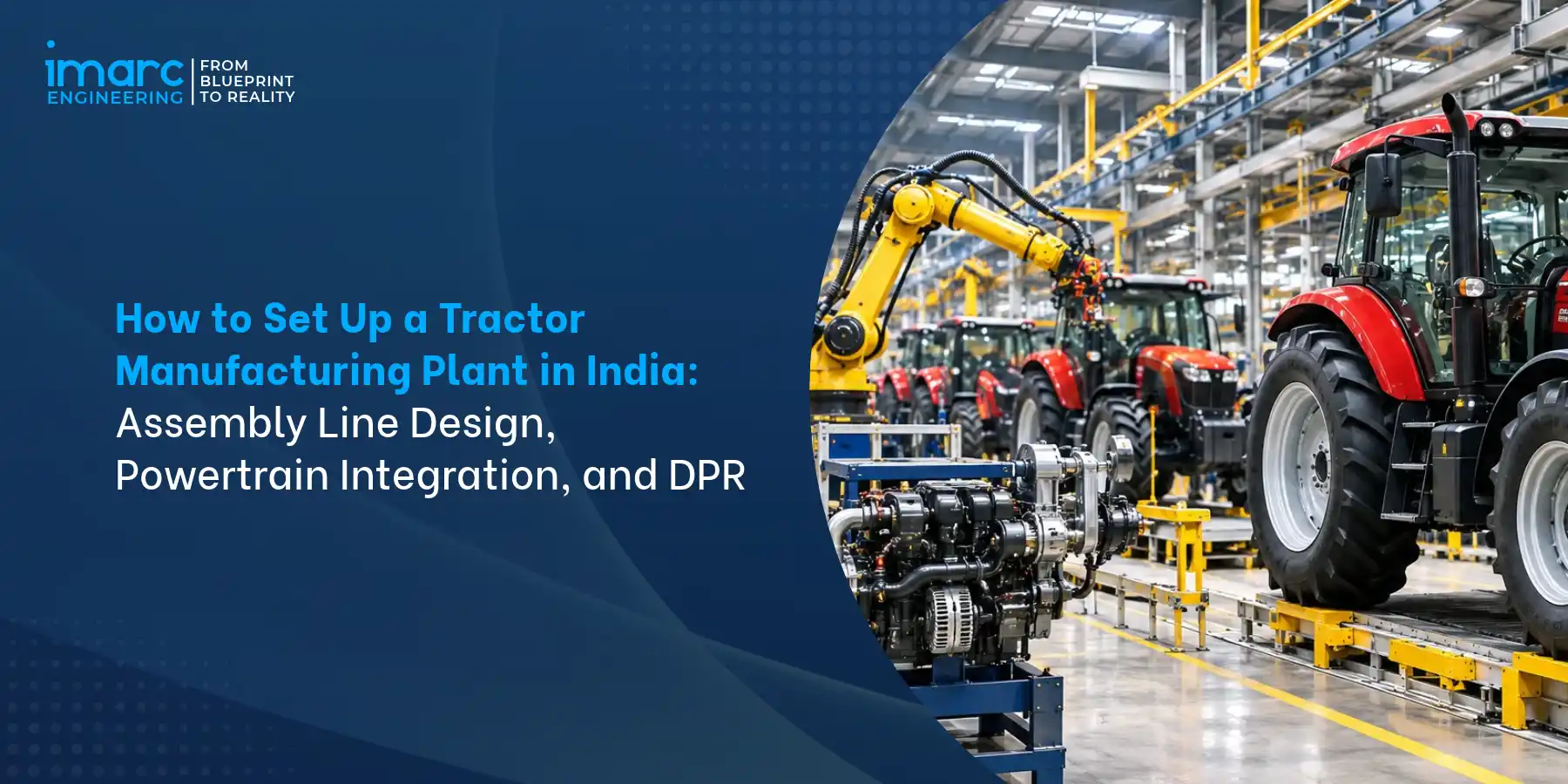
Fabricated parts pass through pretreatment, primer and topcoat in spray booths with curing ovens, with ventilation designed for solvent loads and operator safety. Final assembly typically uses a conveyor line where the chassis or transmission-axle assembly moves through stations that fit engine, hydraulics, wheels, cabin or canopy, electricals and fluids. Conventional paced lines suit stable variant mixes, while flexible cells and AGV-based assembly handle more variants. Torque-controlled nutrunners with traceability, automated fluid filling and error-proofing improve repeatability, and automation should be added where it reduces variability rather than for its own sake.
3.5 End-to-End Tractor Manufacturing Process Flow
Process flow: Component Procurement/Manufacturing → Fabrication and Machining → Painting and Sub-Assembly → Final Assembly → Testing → Dispatch.
The table below expands each stage. The sequence and the steps performed in-house vary by plant model: an assembly-only plant buys in most components and starts at sub-assembly, while an integrated plant also fabricates and machines major parts.
| Stage | Main Activities | By Plant Model |
|---|---|---|
| Component procurement or manufacture | Engines, transmissions, axles, hydraulics and electricals bought in or made in-house | Assembly-only: bought out; integrated: partly in-house |
| Fabrication and machining | Front supports, sub-frames and sheet metal fabricated; housings and gears machined | Machining in integrated plants only |
| Painting and sub-assembly | Pretreatment, primer and topcoat; engine, transmission and axle sub-assemblies | Painting where in scope; sub-assembly in all models |
| Final assembly | Powertrain marriage, hydraulics, wheels, electricals and fluid filling | All models |
| Testing | End-of-line engine, PTO, transmission, hydraulic, brake, steering, electrical and leak tests | All models |
| Dispatch | Pre-delivery inspection, finished-goods yard storage and loading | All models |
4. Raw Materials, Components and Supplier Development
Component quality and supplier reliability set warranty cost and line stability, so sourcing strategy is a plant-design decision.
4.1 Steel, Castings and Forgings
Structural steel plate and sections are used for front supports, sub-frames and other fabrications, while grey and ductile iron castings form housings for transmission, axle, clutch and hydraulics. Forgings and alloy steel bar stock become gears, shafts and crankshafts. Casting quality (porosity, dimensional stability) is a frequent cause of machining rejection, so foundry qualification and incoming inspection are important.
4.2 Engines, Transmissions and Axles
Diesel engines in the relevant horsepower class are normally procured or co-developed, with emission-stage compliance driven by the engine supplier's certification. Transmissions combine clutch, gearbox, rear axle and differential, with PTO and hydraulic lift options. Front axles, brakes and steering units are procured as modules. Supplier agreements should specify specification control, change notification and spares support.
4.3 Hydraulics, Tyres, Electricals and Cabin Systems
Hydraulic pumps, valves and lift cylinders, tyres and wheel rims, wiring harnesses, instrument clusters, lights, batteries and seats are standard bought-out items. Cabin or canopy structures are either fabricated or purchased, depending on product tier. Harness and instrument compatibility must be validated across variants to avoid late integration failures.
4.4 Vendor Development and Localisation
A new entrant should map critical-to-quality parts, qualify at least two sources for high-risk items, set incoming inspection plans and agree on sequence delivery for large assemblies. Localisation strategy should reflect available vendor capability near the plant, because supplier distance affects inventory and logistics cost. Supplier capacity must match peak-season output, not average demand.
5. Land, Plant Layout and Production Capacity Planning
Land and layout decisions fix material flow, safety and expansion options, and are expensive to change once buildings are up.
5.1 Land Requirement
Land need depends on the manufacturing model and capacity: assembly-only plants need far less area than integrated plants with machining and foundry-adjacent operations. The plot must also accommodate a test track, finished-goods yard, effluent treatment, green belt and expansion. Land requirement should be derived from the shop-wise layout and not taken from a generic benchmark.
5.2 Layout, Material Flow and Safety
Layout should follow a one-way flow from receipt through sub-assembly, painting, final assembly, testing and dispatch, minimising handling distance and cross-traffic. Paint-shop ventilation, fire separation of solvent and paint storage, segregated pedestrian routes, inspection stations, and utilities close to heavy consumers should be planned at design stage. Fire-fighting and egress follow applicable codes such as the National Building Code and state factory rules, confirmed for the specific site.
5.3 Capacity and Takt Time
Capacity is built backward: annual target divided by working days and shifts gives daily output, and available time divided by daily output gives takt time. Line balancing assigns work content to stations so no station exceeds takt. Utilisation is limited by the slowest resource, which is commonly paint, testing or a single machining operation, so bottlenecks should be identified early. Ideal capacity depends on the target segment, supplier readiness and market access, and a phased approach with room to expand often limits risk.
Illustrative calculation (assumptions only): A plant targeting 6,000 tractors annually over 250 working days must produce 24 tractors per day. Assuming one shift with 420 scheduled production minutes after planned breaks, the takt time is 17.5 minutes per tractor (420 ÷ 24).
The calculation excludes additional losses from equipment breakdowns, changeovers, rework and production interruptions. These losses should be considered separately when determining effective line capacity and station cycle-time targets. The final production plan should also account for first-pass yield and equipment availability.
| Parameter | Assumption | Result |
|---|---|---|
| Annual production target | 6,000 tractors per year | Assumption |
| Working days | 250 days per year | Assumption |
| Daily output | 6,000 ÷ 250 | 24 tractors per day |
| Net production time | 420 minutes per day (one shift, after breaks) | Assumption |
| Takt time | 420 ÷ 24 | 17.5 minutes per tractor |
| Availability and production losses | Breakdowns, changeovers, rework | Applied separately; design cycle time below takt |
5.4 Production Planning and Supplier Capacity
Demand seasonality means production planning must reconcile level loading with peak sales. Sequenced supplier delivery, buffer stock for long-lead parts and a clear schedule for engine and transmission supply keep the line fed. Supplier capacity audits should confirm that critical vendors can ramp when the plant does.
6. Tractor Manufacturing Machinery, Equipment and Utilities
Machinery and utilities account for the largest share of capital, and the list differs materially between assembly-only and integrated plants.
6.1 Machinery by Manufacturing Model
An assembly-only facility needs assembly conveyors, torque tools, fluid filling, painting (if in scope), testing rigs and material handling. An integrated facility adds CNC machining centres, gear cutting and grinding, heat treatment, fabrication and press equipment, plus extensive inspection and metrology. This distinction is the main driver of the capital gap between the two models.
6.2 Welding, Paint and Material Handling
Fabrication uses laser or plasma cutting, press brakes, MIG welding stations and fixtures, with robotic cells where volume justifies them. The paint line comprises pretreatment, spray booths, flash-off and curing ovens and, for solvent systems, abatement as required by consent conditions. Handling uses overhead conveyors or skillet lines, EOT cranes, forklifts and AGVs for sub-assembly movement.
6.3 Utilities
Typical needs include HT power supply with DG backup, compressed air at roughly 6–8 bar, process and wash water, fuel for ovens and diesel for engine filling, and effluent treatment. Demand depends on process scope, so utility sizing should rest on the equipment connected load and a realistic diversity factor, since connected load is not maximum demand. Utility requirements are indicative and must be validated against equipment specifications and project-specific operating conditions.
6.4 Key Machinery
The table lists principal equipment categories and whether each is needed in an assembly-only plant, an integrated plant or both.
| Category | Equipment | Assembly-Only vs Integrated |
|---|---|---|
| Machining | CNC machining centres, VMC/HMC | Integrated plants only |
| Gear Manufacturing | Hobbing, shaping, grinding machines, heat treatment | Integrated plants only |
| Fabrication | Laser cutter, press brakes, MIG welding | Both, unless fabrication is outsourced |
| Painting | Pretreatment, spray booths, curing ovens | Both, where painting is in scope |
| Assembly | Conveyor, nutrunners, fluid fillers | Both |
| Testing | Dynamometer, hydraulic rig, brake tester | Both |
| Material Handling | EOT cranes, forklifts, AGVs | Both; heavier handling in integrated plants |
| Metrology | CMM, gauges, torque calibration | Both; larger laboratory for integrated plants |
7. Regulatory Approvals, Tractor Testing and Quality Control
Compliance and testing decide when the first tractor can legally be sold, so they run in parallel with engineering.
7.1 Factory, Environmental and Safety Approvals
Typical requirements include factory licence and plan approval under the Occupational Safety, Health and Working Conditions Code, 2020 (in force from 21 November 2025, replacing the Factories Act, 1948), State Pollution Control Board Consent to Establish and Operate under the Water and Air Acts, hazardous waste authorisation for paint sludge and spent solvent, fire no-objection, and, only if the plant installs a steam boiler covered by the Act, registration under the Boilers Act, 2025 (in force from 1 May 2025); air receivers and other pressure vessels follow the applicable safety rules.
Environmental Clearance (EC) applicability depends on whether any activity falls within the scheduled activities of the EIA Notification, 2006 and its subsequent amendments, so the actual manufacturing scope should be assessed, including any in-house foundry or other operations that may be scheduled activities. Applicability varies by state, plant classification and approval process.
7.2 Product Testing and Type Approval
Agricultural tractors are subject to applicable type-approval and emission requirements under the Central Motor Vehicles Rules, 1989, and relevant Ministry of Road Transport and Highways (MoRTH) notifications. Type approval should be obtained through an authorised testing agency, as applicable to the tractor category.
Tractor emission standards, including TREM IIIA, TREM IV and any subsequently notified stages, depend on engine power classification and the applicable implementation schedule. MoRTH issued draft amendments in February 2026 proposing changes to emission-stage requirements and timelines. These proposals should not be treated as legally effective unless confirmed through a final Gazette notification.
Manufacturers should verify the latest notified emission standards, engine power thresholds and type-approval requirements with MoRTH and the relevant testing agency before finalizing engine specifications and launching production.
Requirements are not identical for every product. Agricultural tractors, commercial or haulage variants and other vehicle categories can follow different homologation, registration and testing pathways, and test reports from CFMTTI or other designated institutes are commonly required for farm-mechanisation subsidy eligibility. Verify the latest applicable requirements with the relevant authority before launch.
7.3 Regulatory Requirements Overview
The table summarises the approval stack (confirm applicability for the specific project).
| Requirement | Authority/Basis | Purpose |
|---|---|---|
| Factory licence and plan approval | State factories inspectorate, OSH Code 2020 | Layout, safety, occupancy |
| Consent to Establish/Operate | State Pollution Control Board | Air, water, waste compliance |
| Hazardous waste authorisation | SPCB, HOWM Rules 2016 | Paint sludge, solvents |
| Fire no-objection | State fire authority | Fire safety |
| Boiler and pressure vessels | Boilers Act 2025 (in force 1 May 2025), only if a steam boiler is installed; pressure-vessel rules | Steam and pressure equipment safety |
| Tractor type approval | CMVR Rule 126; notified test agencies (e.g. CFMTTI Budni, ARAI, ICAT) | Model approval before sale |
| Engine emission compliance | CMVR Rule 115A and applicable MoRTH notifications. Confirm the currently notified TREM stage, engine power classification and implementation schedule for the relevant tractor model | Engine and tractor certification |
7.4 Quality Control and End-of-Line Testing
Quality control in tractor manufacturing covers incoming component inspection, in-process welding and torque checks, dimensional verification and end-of-line testing. Before dispatch, each tractor should undergo applicable engine performance, PTO, transmission, hydraulic, braking, steering, electrical, leak, noise and vibration checks, followed by a final visual inspection and test-track evaluation where required.
Inspection and test results should be traceable to the tractor's serial number, component batches and assembly records. A documented quality management system, such as ISO 9001, supports process consistency and corrective action. Separately, the tractor model must meet applicable CMVR type-approval and emission-compliance requirements before commercial sale.
8. Tractor Manufacturing Plant Cost, DPR and Financial Feasibility
Cost, DPR content and operating risks determine whether the plant is financeable and whether it stays profitable through demand cycles.
8.1 Cost Heads and Operating Challenges
Cost heads comprise land, buildings, machinery and tooling, utilities, testing facilities, technology or design licensing, pre-operative expense and working capital. Operating challenges include supplier dependence, tooling investment, component quality, seasonality, inventory financing, warranty exposure and production efficiency. Cost depends heavily on scope, so an assembly-only plant and an integrated plant cannot be compared on a single benchmark, and no universal investment figure is given here.
Major challenges in establishing a tractor factory: supplier reliability for engines, transmissions and castings determines line stability; tooling for fabrication, pressing and machining is a large upfront cost that pays back only at volume; product type approval and emission-stage transitions can delay launch or force engine changes; seasonal demand tied to monsoon and crop cycles creates uneven output and inventory build-up; and warranty risk from early field failures can erode margins before the brand is established.
8.2 DPR for a Tractor Manufacturing Plant
A DPR should cover the parameters below.
| DPR Parameter | What to Cover |
|---|---|
| Product and market | Product portfolio, horsepower segments and target market |
| Manufacturing scope | Manufacturing versus assembly scope |
| Capacity | Proposed capacity in tractors per year |
| Technology and machinery | Technology selection and machinery specifications |
| Supply chain | Supplier development and localisation strategy |
| Site and infrastructure | Land, building, utilities and plant layout |
| Operations | Material flow, line balancing and manpower planning |
| Costs | CAPEX, OPEX, working capital and inventory assumptions |
| Regulatory | Regulatory approvals and product testing requirements |
| Unit economics | Unit production cost and selling price assumptions |
| Financial indicators | IRR, NPV, DSCR and break-even |
| Schedule and risk | Project schedule, risk assessment and sensitivity analysis |
Project duration depends on scope, approvals, equipment lead times and commissioning, so it should be modelled in an integrated schedule.
8.3 Financial Feasibility and Profitability
Profitability should be analysed in two steps. Contribution per tractor is the selling price less variable costs per tractor (bill of materials, variable conversion cost, warranty provision and outbound logistics). Operating profit is the total contribution less fixed manufacturing, administrative and selling costs.
Contribution per tractor = Selling price − Variable cost per tractor
Operating profit = (Contribution per tractor × Annual volume) − Fixed manufacturing, administrative and selling costs
Break-even volume = Fixed costs ÷ Contribution per tractor
Key drivers are procurement cost, capacity utilisation, product mix, dealer credit, warranty provisions and seasonal cash flow. Sensitivity runs on volume, input cost and price show how resilient returns are to a weak monsoon year.
8.4 Project Economics
The table sets out the main cost heads for an assembly-focused plant with in-house fabrication and painting, and what drives each estimate. Values should come from vendor quotations and site data in the project DPR.
| Cost Head | Scope | What Drives the Estimate |
|---|---|---|
| Land and Civil Works | Assembly, paint, fabrication, test track | Plot size from the layout, building spans, crane loads and civil specification |
| Plant and Machinery | Assembly line, paint, welding, test rigs | Plant scope, automation level and vendor quotations |
| Utilities and Installation | Power, air, water, ETP, erection | Connected load, paint-shop demand and ETP capacity |
| Engineering and Pre-Operative | Design, approvals, trials, training | Approval route, trial runs and manpower training |
| Contingency | Allowance for scope and price risk | Estimate maturity and project risk |
| Working Capital | Inventory, WIP and dealer credit | Seasonal stock build and dealer credit terms |
Operating costs should be modelled head by head, as below, using project-specific quotations and norms rather than generic percentages.
| OPEX Head | What It Covers | Basis for Estimate |
|---|---|---|
| Bought-out components | Engines, transmissions, axles, hydraulics, tyres, electricals, sheet metal | Supplier quotations and bill of materials by variant |
| Labour | Line, sub-assembly, quality and indirect staff | Manpower plan from line balancing and wage rates |
| Utilities | Power, oven fuel, compressed air, water | Connected load, operating hours and tariffs |
| Consumables | Paint, fluids, welding wire, gases, tooling inserts | Consumption norms per tractor |
| Maintenance | Preventive and breakdown maintenance, spares | Equipment manufacturer recommendations |
| Warranty | Field repair and replacement claims | Warranty terms and expected claim rates agreed with suppliers |
| Logistics | Inbound component freight and outbound tractor delivery | Supplier and dealer locations, freight quotations |
Working Capital and Financing Costs:
Working capital requirements should be calculated separately from operating expenditure. These include raw material and component inventory, work-in-progress, finished tractor inventory and dealer receivables, net of applicable supplier credit. Interest on working-capital borrowings should be reflected separately as a financing expense in the financial model to avoid double-counting.
8.5 How IMARC Engineering Supports Tractor Manufacturing Plant Setup
IMARC Engineering supports tractor manufacturing projects from feasibility through commissioning. Its scope covers feasibility studies and DPR preparation, site selection, plant layout and assembly-line design, machinery sourcing and technical specifications, CAPEX and OPEX planning, regulatory approval support, technical due diligence and turnkey project management. Each engagement is scoped to the plant model, whether assembly-focused or integrated.
Conclusion
A bankable tractor manufacturing plant in India starts with the choice of manufacturing model: assembly-led with a bought-out powertrain, or integrated with in-house machining. That choice sets machinery, investment, margin structure and risk, and many entrants begin with an assembly-led plant in a defined horsepower segment, integrating backward once volumes justify the tooling.
Supplier readiness, regulatory compliance and DPR-based financial planning then decide outcomes. Investors should qualify suppliers for peak-season output, run CMVR type approval and emission compliance in parallel with engineering, and build the DPR on realistic utilisation, contribution per tractor and working-capital needs before capital is committed.
PURSUING A TRACTOR MANUFACTURING PLANT IN INDIA?
IMARC Engineering supports investors, project sponsors and agricultural-machinery manufacturers with capacity and feasibility planning, site selection, plant layout, equipment selection, utilities planning, waste management planning, regulatory approvals, CAPEX and OPEX planning, technical due diligence and turnkey project management. The advisory covers assembly-focused and integrated tractor plants, including fabrication, painting, powertrain integration, final assembly and end-of-line testing, with project-specific infrastructure and commissioning planning.
→ Schedule a free tractor manufacturing plant scoping consultation with an IMARC specialist
Frequently Asked Questions
Define the target horsepower segment and model (integrated, assembly-only or CKD/SKD), prepare a feasibility study and DPR, select a site, qualify suppliers for engines, transmissions and axles, design the layout and line, obtain factory and pollution consents, arrange product testing, then install and commission.
Fabrication and welding produce front supports, sub-frames and sheet metal, machining prepares gearbox and axle housings if in scope, parts are pretreated and painted, then sub-assemblies (engine, transmission, axles) are integrated on the final assembly line, filled with fluids and put through end-of-line testing before dispatch.
Assembly plants need conveyors, torque-controlled nutrunners, fluid fillers, paint equipment, handling systems and test rigs. Integrated plants add CNC machining centres, gear cutting and grinding, heat treatment, press and welding equipment, and coordinate measuring machines. Exact needs depend on scope and capacity.
Cost depends mainly on scope and capacity. An assembly-focused plant needs far less capital than an integrated plant with machining and engine capability. Any figure must come from a project-specific DPR; the main cost heads and what drives each are set out in this guide.
Integrated manufacturing machines and often fabricates major components in-house, while CKD assembly imports complete component kits and assembles and paints them locally, with SKD using partly built sub-assemblies. CKD needs much less machinery and capital but offers lower localisation, design control and margin.
Land depends on model and capacity. Assembly-only plants need less area than integrated plants with machining shops. The plot must also fit the paint shop, test track, yard, effluent treatment, green belt and expansion, so derive it from the shop-wise layout rather than a fixed rule.
Major components are the engine, transmission with gearbox and rear axle, front axle, hydraulic system, steering and brakes, front support, sub-frames and sheet metal, tyres and wheels, electrical harness and instruments, and cabin or canopy. Castings, forgings and steel feed the machined parts.
Design starts from annual target and working time to derive takt time, then allocates work to balanced stations with conveyors or AGVs, sub-assembly feeders, torque-controlled tools, fluid filling and error-proofing. Layout follows one-way material flow with buffer areas, inspection points and room for variants and expansion.
No single capacity is ideal. It depends on target segment, supplier readiness, demand seasonality, and funding. Many entrants phase capacity, starting with a modest single-shift line and expanding after proving quality and market acceptance, while sizing utilities and layout for growth.
Typical approvals include factory licence and plan approval under the OSH Code 2020, State Pollution Control Board consents, hazardous waste authorisation, fire clearance and utility sanctions, plus CMVR type approval and TREM emission compliance for each tractor model. Applicability varies by state, plant classification and product category, so confirm requirements for the specific project.
Recent Post
Trusted by Industry Leaders
We partner with global enterprises and ambitious businesses across sectors to deliver operational excellence, strategic insights, and sustainable growth through integrated solutions.







Success in Their Words
Real feedback from clients across industries. Discover how our solutions delivered measurable impact and operational excellence.

I wanted to express my sincere appreciation for your efforts in handling this matter. Your dedication and commitment have been truly commendable, and it is evident that you have put in tremendous hard work and expertise into resolving the issues at hand. We are greatly interested in continuing our collaboration with you in the future, as your professionalism and reliability have made you a trusted partner. Thank you once again for your invaluable contribution. We look forward to strengthening our partnership ahead.

It has been a pleasure working with the IMARC team. The insights provided were structured, clear, and highly valuable, helping us strengthen both our technical and financial planning with confidence. We deeply appreciate the team’s professionalism, responsiveness, and attention to detail throughout the engagement. Every requirement was well understood and effectively incorporated, resulting in a comprehensive and actionable output. Overall, our experience has been excellent, and I would gladly recommend IMARC to organizations seeking a reliable research partner.

Your service is truly exceptional. Working with the IMARC team has been a seamless and professional experience. The clarity of communication, responsiveness to queries, and consistent support at every stage made the entire engagement highly efficient. The insights shared were well-structured, practical, and perfectly aligned with our requirements, helping us make informed decisions with confidence. Overall, the dedication and professionalism demonstrated by your team stand out, and I would be glad to recommend IMARC as a reliable and trustworthy research partner.

IMARC did an outstanding job in preparing our study. They were punctual, precise, and consistently responsive throughout the entire process. The team delivered all the data we required in a clear, well-organized, and highly professional format. Their strong attention to detail, combined with their ability to meet every deadline without compromising quality, truly set them apart. Overall, their reliability and commitment made them an exceptional partner for our project, and we would gladly work with them again in the future.

IMARC made the whole process incredibly easy from start to finish. Everyone I interacted with via email was polite, professional, and straightforward to deal with, always keeping their promises regarding delivery timelines and remaining consistently solutions-focused. From my very first contact, I appreciated the professionalism and support shown by the entire IMARC team. I highly recommend IMARC to anyone seeking timely, affordable, and reliable information or advice. My experience with IMARC was excellent, and I truly cannot fault any aspect of it.

I’d like to express my sincere gratitude for the excellent work you accomplished with the study. Your ability to quickly understand our requirements and deliver high-quality results under tight timelines truly reflects your expertise, exceptional work ethic, and unwavering commitment to your customer’s success. The professionalism and responsiveness you demonstrated throughout the process made a significant difference. Our entire team and company are incredibly thankful for your dedication, reliability, and support. Once again, thank you for your outstanding contribution.