Manufacturing
November 19 2026
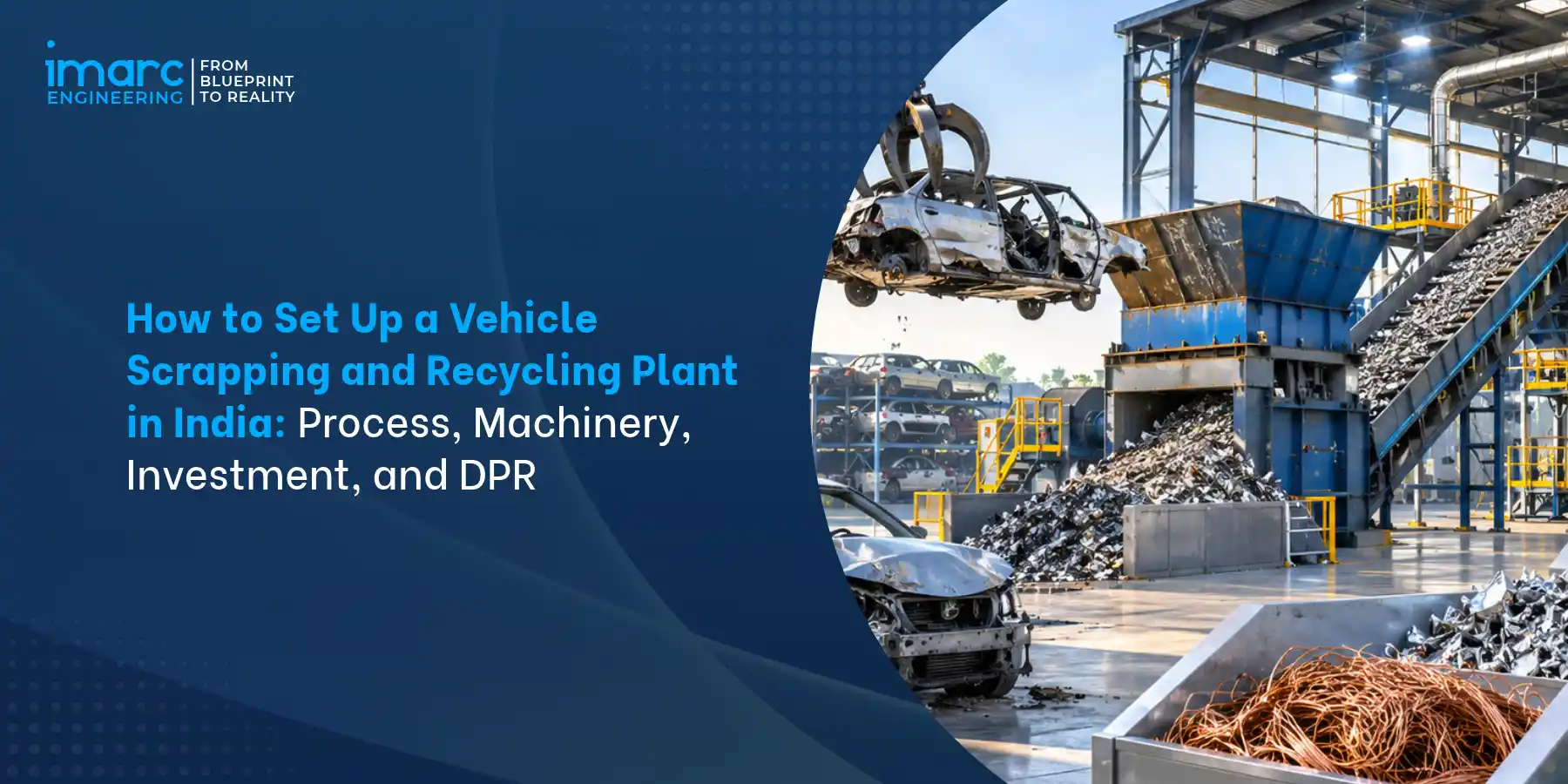
How to Set Up a Vehicle Scrapping and Recycling Plant in India: Process, Machinery, Investment, and DPR
Introduction
India's vehicle scrapping sector offers opportunities for investors, fleet operators and industrial recyclers under the Vehicle Scrappage Policy and the regulatory framework established by the Motor Vehicles (Registration and Functions of Vehicle Scrapping Facility) Rules, 2021, notified by the Ministry of Road Transport and Highways (MoRTH).
The Environment Protection (End-of-Life Vehicles) Rules, 2025, add a separate environmental compliance framework for the sector. Registered Vehicle Scrapping Facilities (RVSFs) provide an authorised route for end-of-life vehicle depollution, dismantling and material recovery, distinct from informal scrap yards and standalone downstream recycling operations.
Scope of this Guide
This guide examines the key requirements for setting up a vehicle scrapping and recycling plant in India, covering RVSF registration, vehicle categories, depollution and dismantling, machinery, end-of-life vehicle procurement, land and plant layout, environmental compliance, project costs and DPR preparation. It considers the MoRTH RVSF Rules, 2021, the Environment Protection (End-of-Life Vehicles) Rules, 2025, CPCB guidelines and applicable waste-management regulations. Automated Testing Stations, informal scrap yards and standalone downstream shredding facilities are treated as separate business activities.
Table of Contents
- Introduction
- Why Vehicle Scrapping Plant Setup in India Matters for Investors in 2026
- Registered Vehicle Scrapping Facility RVSF and Types of Vehicle Scrapping Plants in India
- How to Set Up a Vehicle Scrapping Plant in India and the Scrapping Process
- Machinery Equipment and End-of-Life Vehicle Procurement for a Scrapping Plant in India
- Land Plant Layout and Infrastructure Requirements for an RVSF in India
- RVSF Registration Regulatory Approvals and Environmental Compliance in India
- Vehicle Scrapping Plant Cost CAPEX OPEX and Financial Feasibility in India
- DPR Preparation Project Risks and EPCM Support for a Vehicle Scrapping Plant in India
- Conclusion
1. Why Vehicle Scrapping Plant Setup in India Matters for Investors in 2026
Four drivers make disciplined RVSF investment strategically important in India in 2026.
1.1 Policy-Enabled Vehicle Pipeline
India's Vehicle Scrappage Policy creates a framework for phasing out older and unfit vehicles through fitness-based assessment and authorised scrapping facilities. Registration certificates for specified government-owned vehicles are not renewed after 15 years. Commercial vehicles are subject to fitness testing, while private vehicles generally require registration renewal after 15 years.
Vehicles declared unfit, deregistered or otherwise classified as end-of-life under the applicable rules can enter the authorised scrapping channel. This creates potential demand for RVSFs, although actual vehicle availability depends on fitness outcomes, owner decisions, fleet replacement cycles and local procurement conditions.
1.2 Formalisation of a Large Informal Market
The RVSF framework provides a formal channel for end-of-life vehicle collection, depollution, dismantling and material recovery. Under the MoRTH rules, a Certificate of Deposit (CoD) is issued when an RVSF accepts a vehicle for scrapping, while the Certificate of Vehicle Scrapping (CVS) is issued after the prescribed treatment and final disposal process.
The CoD may support incentives on a replacement vehicle, including motor vehicle tax concessions, subject to the applicable state or UT policy. The notified concessions provide for reductions of up to 25% for non-transport vehicles and up to 15% for transport vehicles, where implemented by the relevant state or UT.
1.3 Material Recovery and Circular Economy
A scrapped vehicle yields recoverable ferrous metal (steel body, chassis), non-ferrous metal (copper from wiring and motors, aluminium from castings, lead from batteries), plastics, glass, rubber, textiles, and residual oils. Organised material recovery with traceability supports downstream steel mills, non-ferrous smelters, and recyclers under India's circular-economy direction and lowers dependence on raw-material imports.
1.4 EV Scrappage and Battery Recycling
End-of-life electric vehicles introduce additional requirements for battery removal, safe handling, storage, transportation and traceability. Waste batteries must be managed under the Battery Waste Management Rules, 2022, and transferred to appropriately registered battery recyclers or other authorised entities. RVSFs should plan dedicated handling procedures and segregated storage for damaged and intact battery packs, with battery recycling treated as a separate regulated activity.
2. Registered Vehicle Scrapping Facility RVSF and Types of Vehicle Scrapping Plants in India
A registered vehicle scrapping facility is a formally authorised plant for end-of-life vehicle depollution, dismantling, and segregation under the Motor Vehicles (Registration and Functions of Vehicles Scrapping Facility) Rules 2021. It is not an Automated Testing Station (ATS, which conducts fitness tests), a scrap-metal yard, or a downstream shredder.
2.1 RVSF Role in the Formal Ecosystem
An RVSF receives eligible end-of-life vehicles from registered owners, fleet operators, government entities and authorised auctions. It verifies ownership and vehicle records, including stolen-vehicle checks, and records the vehicle details before processing. The facility then removes fuel, oils, coolants, refrigerants, batteries and other hazardous components before dismantling and segregating reusable parts and material streams.
The RVSF issues a Certificate of Deposit (CoD) when it accepts the vehicle and a Certificate of Vehicle Scrapping (CVS) after completing the prescribed treatment and scrapping process. It must also maintain records, transfer recovered materials to appropriate registered or authorised downstream entities and meet applicable environmental reporting requirements.
2.2 RVSF vs ATS vs Scrap Yard vs Shredder
| Facility type | Primary role |
|---|---|
| RVSF | Vehicle receipt, depollution, dismantling, segregation and scrapping under the MoRTH RVSF Rules, 2021 |
| Automated Testing Station (ATS) | Fitness testing of vehicles for continued registration |
| Informal scrap yard | Informal vehicle or scrap handling without RVSF registration or authority to issue statutory CoD/CVS |
| Downstream shredder or recycler | Processes segregated vehicle scrap into material fractions for further recycling or recovery |
| Steel mill or metal smelter | Processes recovered ferrous or non-ferrous scrap into secondary metal |
2.3 Vehicle Categories Handled
RVSFs may specialise by vehicle category two-wheelers, three-wheelers, passenger cars, light commercial vehicles (LCV), heavy commercial vehicles (HCV, trucks and buses), or combinations. Each category has different lifting equipment, dismantling bay size, fluid recovery volumes, and material yield profiles. Dedicated EV pathways are increasingly added to handle the growing end-of-life battery-electric fleet.
2.4 Dismantling vs Integrated Shredding
An RVSF may focus on depollution, dismantling and material segregation without installing an in-house industrial shredder. In this model, recovered materials and vehicle hulks are transferred to appropriate registered recyclers, refurbishers or co-processors. An integrated facility may add shredding and material-separation equipment to process scrap further.
The choice depends on vehicle throughput, land availability, downstream agreements, investment capacity and the intended level of material recovery. Shredding is not a universal prerequisite for RVSF registration.
3. How to Set Up a Vehicle Scrapping Plant in India and the Scrapping Process
A disciplined vehicle recycling plant setup moves from feasibility through site selection, regulatory planning, machinery procurement, and operational readiness with the scrapping process itself as the operating core.
3.1 Setup Workflow
A typical greenfield RVSF project begins with a pre-feasibility assessment, vehicle catchment study and Detailed Project Report (DPR) covering throughput, material recovery and project economics. The promoter must then secure a suitable site, prepare the facility layout and obtain applicable land-use and building approvals.
Two separate registrations must be planned. First, the applicant must obtain RVSF registration from the designated State or Union Territory Registration Authority under the Motor Vehicles (Registration and Functions of Vehicle Scrapping Facility) Rules, 2021. This registration governs the facility's authority to operate as an RVSF under the motor vehicle framework, including prescribed infrastructure, equipment, vehicle processing and VAHAN-related functions.
Second, under the Environment Protection (End-of-Life Vehicles) Rules, 2025, the RVSF must apply for registration with the concerned State Pollution Control Board (SPCB) or Pollution Control Committee (PCC), using Form 5 through the centralised online portal. This registration covers environmental management, material accounting, downstream transfers and quarterly reporting. The two registrations serve different purposes and neither should be treated as a substitute for the other.
The project schedule should also identify applicable Consent to Establish and Consent to Operate requirements, hazardous-waste authorisation, factory and fire approvals, and other site-specific permissions. Construction, machinery installation, VAHAN connectivity, downstream recycler agreements, trial operations and commissioning should follow the relevant approval sequence.
3.2 Vehicle Receipt and Depollution
The scrapping process begins with vehicle receipt, ownership verification, registration and chassis-number checks, stolen-vehicle verification and photographic documentation. Depollution involves removing fuel, engine and transmission oils, brake fluid, coolant, refrigerant and batteries before dismantling. Fluids and gases should be recovered using suitable equipment and stored separately in closed, labelled and leak-proof containers.
Reusable fuel should be segregated from fuel requiring waste management. Recovered refrigerants must not be released into the atmosphere and should be managed according to their composition and applicable regulations. Batteries and other hazardous components must be transferred to appropriate registered or authorised handlers.
3.3 Dismantling and Component Segregation
After depollution, the vehicle is moved to a dismantling bay for the removal of reusable components, tyres, wheels, glass, interiors and other material streams. Components such as engines, gearboxes, alternators and radiators may be inspected and segregated for reuse where permitted.
Waste tyres should be transferred to registered recyclers or retreaders under the applicable waste-tyre framework. Batteries, electronic components and other regulated waste streams must be separately identified and channelled to entities authorised under their respective waste-management rules.
3.4 Material Recovery and Dispatch
Following dismantling, the remaining vehicle structure is cut or flattened, and ferrous and non-ferrous materials are segregated using suitable cutting, magnetic separation and manual sorting methods. Plastics, glass, rubber and other recoverable fractions should be separately collected where feasible. Recovered materials must be weighed, recorded and transferred to registered recyclers, refurbishers or co-processors, as applicable. Non-recyclable materials and unusable hazardous waste must be sent to the appropriate authorised treatment or disposal facility in accordance with the applicable waste-management rules.
4. Machinery Equipment and End-of-Life Vehicle Procurement for a Scrapping Plant in India
An integrated vehicle recycling machinery suite scales with target throughput, vehicle categories, and chosen recycling depth. Vehicle procurement strategy determines facility utilisation.
4.1 Core Machinery for an RVSF
| Equipment | Function |
|---|---|
| Vehicle lifts | Raise vehicles for inspection and dismantling |
| Fluid extraction systems | Recover oils, fuel and coolant |
| Refrigerant recovery units | Safely recover vehicle refrigerants |
| Battery handling equipment | Remove and transport batteries |
| Hydraulic cutters and shears | Cut vehicle structures |
| Balers or presses | Compact recovered materials |
| Forklifts and handling trolleys | Move components and scrap |
| Weighbridge | Measure vehicle and recovered material weights |
| VAHAN-integrated system | Support statutory records and certificates |
| Optional industrial shredder | Further process dismantled vehicle scrap |
Equipment selection must also address process safety. Fuel depollution should take place in a designated, adequately ventilated area with suitable spill containment, ignition-source control and appropriately rated electrical equipment where required by the risk assessment. Refrigerant recovery should use compatible recovery machines and dedicated cylinders, with refrigerants identified, recovered and stored without atmospheric release. Hot-work areas should have controlled access, suitable fire protection, spark containment and a permit-to-work procedure. Vehicles and components should be confirmed free of residual fuel, flammable vapours and other relevant hazards before cutting or heating.
Electric and hybrid vehicles require a separate high-voltage isolation and battery-removal procedure. The facility should provide insulated tools, suitable personal protective equipment, lockout and isolation arrangements, battery lifting equipment, segregated storage and an emergency response plan. Damaged or suspect lithium-ion battery packs should be isolated and handled under a site-specific fire and thermal-runaway risk assessment. Equipment specifications, ventilation, detection, containment and emergency provisions should be finalised through the facility's process and safety studies.
4.2 Optional Shredder and Downstream Equipment
An industrial shredder is optional, not mandatory for an RVSF. Facilities focused on depollution, dismantling and segregation may operate without in-house shredders, transferring processed vehicle hulks and segregated materials to appropriate downstream facilities in accordance with applicable regulatory requirements.
Larger integrated facilities adding shredding capability require a hammer mill or dual-shaft shredder, downstream eddy-current separators for non-ferrous recovery, magnetic separators, and air classifiers, all of which raise CAPEX significantly and require larger land footprint and higher connected load.
4.3 End-of-Life Vehicle Procurement
End-of-life vehicle procurement determines plant utilisation and operating economics. Potential sources include government and public-sector auctions, fleet operators, transport undertakings, individual vehicle owners, designated collection centres and insurance-related salvage channels. Each vehicle must meet the applicable end-of-life eligibility criteria and be supported by valid ownership, auction or transfer documentation.
Procurement procedures should include vehicle-record verification, stolen-vehicle checks, condition assessment and a documented purchase process. The DPR should model vehicle availability, acquisition prices, logistics costs and seasonal or regional supply variations.
4.4 Documentation at Intake
At intake, the RVSF should verify the original registration certificate, identity and authority of the person handing over the vehicle, ownership or auction documents, chassis and vehicle identification details, and relevant registration records. It must also verify the vehicle against stolen-vehicle records and retain the required documentation.
After accepting the vehicle, the RVSF issues a digitally signed Certificate of Deposit (CoD) through VAHAN. Following depollution, dismantling and completion of the prescribed scrapping process, it issues the Certificate of Vehicle Scrapping (CVS) and facilitates the required update to the vehicle registration records.
5. Land Plant Layout and Infrastructure Requirements for an RVSF in India
The layout and infrastructure requirements for a vehicle scrapping facility in India depend on the MoRTH RVSF Rules, applicable CPCB guidelines, environmental compliance requirements and the proposed plant's operational material flow.
5.1 Land Requirement
Land requirement should be determined through a site-specific layout based on the proposed vehicle categories, annual and daily throughput, operating shifts, vehicle dimensions and the intended level of dismantling or downstream processing. The land plan should account for inbound vehicle parking, inspection and depollution bays, dismantling bays, internal circulation and turning space, component and material storage, hazardous-waste storage, battery segregation, weighbridge, dispatch areas, utilities, fire access and statutory setbacks.
Heavy commercial vehicles may require larger bays, wider circulation routes and greater parking space than passenger vehicles. Integrated shredding and material separation will add further space and infrastructure requirements. The DPR should establish the land area from a scaled layout and applicable statutory conditions rather than relying on a generic acreage estimate.
5.2 Plant Layout and Material Flow
Material flow proceeds from vehicle intake and verification to inbound parking, to depollution bay (bunded with impervious flooring and fluid containment), to dismantling bay (overhead cover, lifting equipment, drainage separated from storm water), to component wash and storage, to metal and plastic segregation storage, to weighbridge, and to dispatch.
Hazardous fluids should be stored in designated, labelled and appropriately contained areas pending collection by authorised handlers. Lead-acid and lithium-ion batteries require separate storage and handling arrangements. EV battery storage should include segregation of damaged or suspect packs, suitable ventilation, access control, fire-risk mitigation and emergency-response provisions based on a site-specific safety assessment and applicable fire-authority requirements.
5.3 Utilities and Site Infrastructure
Utilities include single-phase and three-phase electrical supply sized for lifts, hydraulic equipment, and lighting, DG backup, compressed air for pneumatic tools, process water for component washing, oil-water separator for washdown effluent, storm-water drainage with oil interceptor, dust suppression where applicable, and lighting for extended-hour operation.
Fire protection should be designed in accordance with applicable state fire-service requirements, the National Building Code of India and a site-specific fire-risk assessment. The design should address fuel and oil storage, hot-work activities, electrical equipment and lithium-ion battery handling, including suitable detection, isolation, emergency access and response procedures.
5.4 CPCB SOP and MoRTH Facility Standards
CPCB's March 2023 Guidelines for Environmentally Sound Facilities for Handling and Scrapping of End-of-Life Vehicles set out requirements and recommendations for vehicle collection, storage, depollution, dismantling, material segregation and waste management. These include impervious flooring and suitable drainage, certified depollution equipment, designated storage for recovered materials and hazardous waste, worker-safety measures, and effluent-management arrangements.
The MoRTH RVSF Rules, 2021 additionally require suitable infrastructure, approved layouts, equipment, VAHAN connectivity and secure digital record-keeping. Applicable state-level conditions should also be incorporated into the facility design.
6. RVSF Registration Regulatory Approvals and Environmental Compliance in India
The regulatory stack for RVSF registration India combines MoRTH vehicle-scrapping rules, CPCB and SPCB environmental approvals, state transport authority registration, labour compliance, and hazardous and specialised waste rules.
6.1 MoRTH RVSF Registration
An RVSF must comply with two distinct registration frameworks. Under the Motor Vehicles (Registration and Functions of Vehicle Scrapping Facility) Rules, 2021, it must obtain registration from the designated State or Union Territory Registration Authority. This registration establishes its status and authority to operate as a vehicle scrapping facility under the motor vehicle framework. It covers the prescribed facility, infrastructure, equipment, vehicle processing and related operational requirements.
Separately, Rule 10 of the Environment Protection (End-of-Life Vehicles) Rules, 2025 requires the RVSF to apply to the concerned State Pollution Control Board or Pollution Control Committee in Form 5 for environmental registration. The application includes details such as the facility's identity, contact information, applicable consent validity, hazardous-waste authorisation and operating capacity. This registration supports environmental oversight, waste-material accounting and reporting under the 2025 Rules. The RVSF must maintain records of vehicles received, steel recovered, other material streams generated and materials transferred to registered recyclers, refurbishers or authorised treatment and disposal facilities.
The 2025 Rules also establish an EPR certificate mechanism. After processing an end-of-life vehicle, the RVSF records the recovered steel and other material streams on the centralised online portal. The Central Pollution Control Board (CPCB) issues the EPR certificate to the RVSF based on the weight of steel scrap generated, subject to accounting for the recycling or refurbishment of other vehicle materials and environmentally sound disposal of non-recoverable and hazardous materials. Producers can purchase these certificates through the portal to meet their vehicle-scrapping EPR obligations. Certificates are valid for five years.
RVSFs must submit quarterly returns in Form 3 through the centralised portal to the State Board. These returns report the number and weight of vehicles received and processed, steel scrap generated, and category-wise materials recycled, refurbished, transferred or sent for authorised treatment and disposal. The prescribed filing deadline is the 30th day of the month following the relevant quarter. Producers have separate obligations: they register with CPCB in Form 4, declare their current-year EPR obligations by 30 April and submit annual returns for the previous financial year by 30 June.
6.2 Pollution Control Approvals
RVSFs should obtain applicable Consent to Establish and Consent to Operate from the State Pollution Control Board or Pollution Control Committee under the Water (Prevention and Control of Pollution) Act, 1974 and Air (Prevention and Control of Pollution) Act, 1981, subject to the relevant state requirements and facility classification. Waste streams must be managed under their respective regulations.
Waste tyres and used oil are covered by separate Extended Producer Responsibility provisions under the Hazardous and Other Wastes (Management and Transboundary Movement) Rules, 2016, as amended. Waste tyres are governed by Schedule IX, introduced through the 2022 Amendment Rules. This framework applies to specified tyre producers, waste-tyre recyclers and retreaders, which must register on the CPCB waste-tyre EPR portal and comply with the applicable recycling or retreading certificate requirements.
Used oil is governed separately by Schedule X, introduced through the 2023 Second Amendment Rules. Its EPR framework covers specified base-oil and lubrication-oil producers, used-oil importers, collection agents and recyclers. An RVSF should segregate these waste streams and transfer them to appropriately registered or authorised entities, while assessing its own registration obligations if it undertakes a regulated activity such as recycling or collection.
6.3 Battery and E-Waste Compliance
Waste batteries recovered from vehicles, including lead-acid and lithium-ion batteries, must be handled under the Battery Waste Management Rules, 2022 and transferred to appropriately registered battery recyclers or other authorised entities.
Vehicle electronic components should be assessed against the scope and Schedule I of the E-Waste (Management) Rules, 2022. Components classified as e-waste must be channelled to registered e-waste recyclers. An RVSF that undertakes battery or e-waste recycling itself must separately assess the registration and compliance requirements applicable to that activity.
6.4 Cross-Cutting Approvals
Other approvals and registrations depend on the RVSF's scale, workforce, equipment and site configuration. Establishments meeting the applicable thresholds must comply with registration, licensing and workplace-safety requirements under the Occupational Safety, Health and Working Conditions Code, 2020 and relevant rules. Fire approvals should be obtained under the applicable state fire-service legislation and building requirements.
PESO licensing under the Petroleum Rules, 2002 should be assessed where stored recovered fuel qualifies as petroleum and exceeds the applicable licensing limits. Electrical inspector approvals, EPFO and ESIC registrations, GST, Udyam and local industrial or municipal permissions should be evaluated according to their respective applicability criteria. These requirements should be confirmed with the relevant authorities before construction and commissioning.
7. Vehicle Scrapping Plant Cost CAPEX OPEX and Financial Feasibility in India
Estimating the cost of setting up a vehicle scrapping plant in India requires a project-specific assessment of vehicle categories, processing capacity, technology selection, land requirements and regulatory compliance. Universal per-vehicle or per-tonne CAPEX figures mislead - every plant is engineered to vehicle category mix, throughput, recycling depth, and whether shredding is in-house.
7.1 CAPEX Drivers
Primary CAPEX drivers are land acquisition or development, covered depollution and dismantling bays with impervious bunded flooring, vehicle lifts and hydraulic equipment, fluid recovery and refrigerant equipment, battery handling infrastructure, cutters and dismantling tools, weighbridge, computerised record system linked to VAHAN, fire protection, storm-water and effluent management, boundary wall and security, electrical supply with DG backup, dispatch area, office and administration, EPC margin, and contingency margin.
The project estimate should also account for engineering and project-management costs, pre-operative expenses, commissioning, taxes and an appropriate contingency based on design maturity, vendor quotations, procurement conditions and execution risks. Integrated shredding and material-separation systems should be estimated separately because they can materially increase equipment, land, utility and infrastructure requirements.
7.2 OPEX Components
Primary OPEX components are vehicle procurement cost (typically dominant), labour (skilled dismantlers, operators, supervisors, security, administration), electrical energy, consumables (saw blades, cutting discs, PPE), authorised disposal fees for hazardous streams, outbound logistics to downstream recyclers, maintenance and spares, insurance, compliance (CPCB/SPCB reporting, VAHAN system maintenance), and finance costs on working capital. Vehicle procurement price volatility is the dominant OPEX-risk variable.
7.3 Revenue Streams
| Revenue stream | Basis for estimation |
|---|---|
| Ferrous scrap | Recoverable steel quantity and prevailing regional scrap prices |
| Non-ferrous scrap | Copper, aluminium and other recoverable metals, priced by grade and market benchmarks |
| Lead-acid batteries | Net recovery or transfer value based on battery condition, applicable reuse restrictions, and commercial arrangements with appropriately registered or authorised entities. |
| Lithium-ion batteries | Net realisable value based on chemistry, state of health, residual capacity, damage status, transport and handling requirements, testing costs, and recycler or recovery charges. The net value may be positive, negligible or negative. |
| Reusable components | Inspection, testing, resale demand and applicable legal requirements |
| Waste tyres | Recovery or transfer arrangements with registered recyclers or retreaders |
| Plastics, glass and rubber | Recoverable quantity, material quality and downstream buyer terms |
| Service fees | Applicable charges, if offered and commercially agreed |
The DPR should not assume that recovered EV batteries always generate positive revenue. Damaged, degraded or difficult-to-transport packs may involve testing, specialised handling, storage, insurance and recycling charges that exceed their recoverable material value. Battery-related cash flows should therefore be based on documented recycler quotations and the condition and chemistry of the batteries expected to be received.
7.4 Financial Feasibility
Financial feasibility should assess project CAPEX, operating expenditure, vehicle procurement costs, material recovery, revenue, working capital and financing requirements. The financial model should include projected cash flows, NPV, project and equity IRR, payback period, DSCR and break-even analysis, using clearly stated assumptions.
Sensitivity analysis should test changes in vehicle acquisition prices, ferrous and non-ferrous scrap prices, throughput, material recovery rates, labour costs, downstream processing charges and working-capital requirements. Base, downside and upside scenarios should be used to assess financial resilience and debt-servicing capacity.
Illustrative Financial Model Assumptions for an RVSF
The following assumptions demonstrate how a DPR can connect vehicle procurement, material recovery, revenue and financing inputs. They are illustrative planning inputs for a passenger-car dismantling facility, not industry benchmarks or standard market prices. Actual assumptions should be supported by catchment studies, sample dismantling, supplier quotations and buyer or recycler offers.
| Parameter | Illustrative assumption | Basis for validation |
|---|---|---|
| Vehicle category | Passenger cars | Proposed operating scope |
| Average incoming vehicle weight | 1,000 kg | Sample vehicle and weighbridge data |
| Annual vehicle throughput | 1,000 vehicles | Catchment and procurement assessment |
| Average vehicle acquisition cost | INR 35,000 per vehicle | Auction data, supplier quotations and vehicle condition |
| Saleable material output | 837.5 kg per vehicle | Illustrative material recovery calculation in Section 8.2 |
| Ferrous scrap selling price | INR 35/kg | Local scrap-buyer quotations by grade |
| Non-ferrous scrap selling price | INR 280/kg | Weighted indicative price across segregated grades |
| Tyre/rubber selling price | INR 15/kg | Registered recycler or retreader quotation |
| Glass selling price | INR 2/kg | Local buyer quotation and quality |
| Plastics selling price | INR 12/kg | Polymer-wise buyer quotations |
| Reusable component realisation | INR 250/kg equivalent | Inspection, testing and actual resale value |
| Vehicle acquisition expenditure | INR 3.50 crore/year | 1,000 vehicles × INR 35,000 |
| Other variable operating costs | INR 7,000 per vehicle | Illustrative allowance for collection, transport, labour, consumables, depollution and disposal |
| Fixed operating costs | To be established from staffing, utilities, maintenance, insurance and administration | Bottom-up annual operating budget |
| Working capital | Two months of forecast cash operating expenditure, as an initial modelling assumption | Monthly procurement and collection cycle |
| Debt-equity ratio | 60:40, illustrative only | Promoter contribution and lender assessment |
| Interest rate | 11% per annum, illustrative only | Indicative lender terms |
| Loan tenure | Seven years, illustrative only | Lender sanction and repayment structure |
| Project cost | To be established from land, civil works, machinery, utilities, safety systems, engineering and contingency | Vendor quotations and project estimates |
The model should calculate revenue separately for each recovered material stream. It should also account for vehicle acquisition, inbound logistics, depollution, dismantling, labour, utilities, consumables, waste handling, downstream transport, maintenance, insurance and administration. Debt servicing, depreciation, taxes and working-capital movements should be modelled separately.
The DPR should test downside scenarios involving lower throughput, higher vehicle acquisition prices, lower material recovery, weaker scrap prices, higher disposal charges and delayed buyer payments. No financing or profitability conclusion should be drawn from the illustrative assumptions alone.
8. DPR Preparation Project Risks and EPCM Support for a Vehicle Scrapping Plant in India
A disciplined vehicle scrapping plant DPR integrates technical, market, regulatory, and financial planning into a document supporting investment and lender appraisal.
8.1 DPR Component Framework
| DPR Component | What to Cover |
|---|---|
| Project scope | Vehicle categories, annual throughput, dismantling-only or integrated |
| Catchment assessment | ELV availability in the proposed catchment |
| Procurement strategy | Auctions, fleet contracts, walk-in, insurance salvage |
| Capacity planning | Vehicles per day/year, bay utilisation, labour |
| Technology selection | Dismantling vs integrated shredding; recycling depth |
| Material recovery | Expected yield by category under conservative assumption |
| Site and layout | Land, parking buffer, bay layout, segregated storage |
| Machinery and infrastructure | Lifts, fluid recovery, cutters, weighbridge, VAHAN system |
| Regulatory and compliance | MoRTH RVSF, SPCB, Factory Licence, Fire NOC, hazardous waste |
| CAPEX, OPEX, working capital | Vendor-quote based; procurement-cycle modelling |
| Financial projections | Revenue, cash flow, NPV, IRR, DSCR, break-even, sensitivity |
| Implementation schedule | Design, approvals, construction, trial, commercial |
| Risk assessment | Supply, prices, regulation, compliance, operational safety |
8.2 Material Recovery Calculation
Material recovery should be estimated separately for each vehicle category using representative vehicle weights, dismantling trials and downstream buyer specifications. The following example illustrates a mass-balance calculation for a conventional passenger car with an assumed incoming weight of 1,000 kg. The fractions and recovery rates are illustrative only and should not be treated as standard recovery benchmarks.
Illustrative material composition and recovery
For this illustrative mass balance, material categories are assumed to be mutually exclusive. Reusable components are allocated separately from ferrous and non-ferrous scrap, and their weight is not counted again in other recovered material streams. The assumed composition and recovery rates must be validated through representative vehicle dismantling trials before being used in a project financial model.
| Material stream | Assumed share of vehicle weight | Input weight | Recovery rate | Saleable output |
|---|---|---|---|---|
| Ferrous metals | 65% | 650 kg | 95% | 617.5 kg |
| Non-ferrous metals | 8% | 80 kg | 90% | 72 kg |
| Tyres and rubber | 4% | 40 kg | 90% | 36 kg |
| Glass | 3% | 30 kg | 80% | 24 kg |
| Plastics | 8% | 80 kg | 60% | 48 kg |
| Reusable components | 5% | 50 kg | 80% | 40 kg |
| Fluids, battery and residual materials | 7% | 70 kg | Not assumed saleable | 0 kg |
| Total | 100% | 1,000 kg | 837.5 kg |
Under these assumptions, the facility obtains 837.5 kg of saleable material from a 1,000 kg vehicle. The remaining 162.5 kg comprises recovery losses, contamination, non-saleable residuals and materials requiring separate treatment or disposal. The calculation assumes that reusable components are segregated separately and are not counted again as metal scrap.
Illustrative material sales calculation
| Saleable material | Output per vehicle | Assumed selling price | Indicative sales value |
|---|---|---|---|
| Ferrous scrap | 617.5 kg | INR 35/kg | INR 21,612.50 |
| Non-ferrous scrap | 72 kg | INR 280/kg | INR 20,160 |
| Tyres and rubber | 36 kg | INR 15/kg | INR 540 |
| Glass | 24 kg | INR 2/kg | INR 48 |
| Plastics | 48 kg | INR 12/kg | INR 576 |
| Reusable components | 40 kg | INR 250/kg equivalent | INR 10,000 |
| Total | 837.5 kg | INR 52,936.50 |
The indicative material sales value is approximately INR 52,937 per vehicle under these assumptions. This is gross material realisation, not profit. It excludes vehicle acquisition, collection and transport, labour, depollution, utilities, consumables, authorised waste disposal, maintenance, insurance, administration, depreciation, interest and taxes.
An RVSF DPR should validate material fractions through sample dismantling and weighbridge records. Selling prices should be based on actual buyer quotations and material grades. Lithium-ion batteries from EVs should be evaluated separately because their net realisable value depends on chemistry, condition, residual capacity, testing, handling, transport and recycling charges. Battery proceeds should not be assumed to be positive in the base case without supporting commercial evidence.
8.3 Project Risks
Key project risks include inconsistent end-of-life vehicle supply, procurement price volatility, variations in material recovery, hazardous component handling, regulatory changes, workplace safety incidents, downstream recycler availability and delayed payments. Older or damaged vehicles may contain specific hazardous components requiring additional handling controls. Mitigation measures should include diversified procurement channels, documented depollution procedures, trained workers, multiple downstream recycler agreements, suitable insurance and regular monitoring of operating and financial performance.
8.4 EPCM Support and Planning Checklist
EPCM support for an RVSF project can cover feasibility assessment, DPR preparation, vendor-based CAPEX estimation, FEED, plant layout, machinery procurement, construction supervision and commissioning. Regulatory coordination should include MoRTH RVSF registration, registration under the Environment Protection (End-of-Life Vehicles) Rules, 2025, applicable SPCB consents, hazardous-waste authorisation and other site-specific approvals.
Project execution should also address VAHAN connectivity, downstream recycler agreements, machinery installation, trial dismantling, operating procedures and workforce training. Before commissioning, sponsors should verify land and approvals, equipment readiness, vehicle procurement arrangements, downstream tie-ups, digital record systems and compliance documentation.
Conclusion
A successful vehicle scrapping and recycling plant in India requires compliance with the MoRTH RVSF Rules 2021, efficient depollution and dismantling processes, suitable machinery, compliant plant infrastructure, statutory approvals and a commercially viable DPR. Key considerations include VAHAN integration, SPCB consents, waste management compliance, vendor-based CAPEX, realistic material recovery estimates and a phased implementation plan.
Project sponsors should consider three priorities:
- Regulatory compliance: RVSF registration, VAHAN integration, Certificate of Vehicle Scrapping and CPCB SOP compliance are central to operations.
- Appropriate plant configuration: Dismantling-focused facilities with downstream recycler tie-ups can offer a lower-CAPEX entry point without requiring an industrial shredder.
- EV battery management: Plan for safe lithium-ion battery removal, segregated storage and transfer to registered recyclers under the Battery Waste Management Rules, 2022.
PLANNING A VEHICLE SCRAPPING AND RECYCLING PLANT IN INDIA?
IMARC Engineering supports investors, automobile manufacturers, fleet operators and industrial project developers planning vehicle scrapping and recycling facilities in India through project feasibility studies, market assessment, Detailed Project Report (DPR) preparation, location analysis and site selection, plant layout and process flow design, machinery and equipment selection, utilities planning, regulatory approval and licensing, and CAPEX and OPEX assessment. The advisory covers vehicle dismantling, depollution, material segregation, metal recovery and end-of-life vehicle processing, including infrastructure planning, equipment requirements, operational considerations and project implementation support.
→ Schedule a vehicle scrapping plant scoping consultation with an IMARC specialist
Frequently Asked Questions
Setting up an RVSF requires a project feasibility assessment, suitable land, machinery, a DPR and registration under the MoRTH RVSF Rules, 2021. Separate registration under the Environment Protection (End-of-Life Vehicles) Rules, 2025, applicable SPCB consents, safety approvals and downstream recycler arrangements are also required.
A registered vehicle scrapping facility (RVSF) is an authorised plant under the Motor Vehicles (Registration and Functions of Vehicles Scrapping Facility) Rules 2021 for end-of-life vehicle depollution, dismantling, segregation, and issuance of Certificate of Vehicle Scrapping (CVS) and Certificate of Deposit (CoD).
Requirements may include MoRTH RVSF registration, separate SPCB/PCC registration under the 2025 ELV Rules, applicable pollution-control consents and hazardous-waste authorisation. Factory, fire, electrical and PESO approvals depend on the facility's workforce, equipment, storage arrangements and applicable state requirements.
Vehicle recycling plant investment depends on vehicle category mix, planned throughput, dismantling-only versus integrated-with-shredder configuration, land cost, machinery automation level, and location-specific utility and compliance cost. Universal per-vehicle figures mislead - project-specific vendor-quote-based estimation in a DPR drives any meaningful CAPEX benchmark.
There is no single land-area requirement suitable for every RVSF. The plot size should be calculated from vehicle throughput, vehicle categories, parking buffer, depollution and dismantling bays, internal circulation, material and hazardous-waste storage, utilities, fire access and applicable statutory setbacks. Integrated shredding facilities require additional space. A scaled plant layout should establish the land requirement.
Vehicle scrapping refers to the authorised end-of-life process covering depollution, dismantling, and segregation at an RVSF. Vehicle recycling is the broader value chain where scrapped material (ferrous, non-ferrous, plastics, batteries) is converted back into usable raw material by downstream mills, smelters, and recyclers.
End-of-life vehicles are sourced through government PSU and defence vehicle auctions, direct contracts with fleet operators (taxi, logistics, bus), individual vehicle owners via walk-in and app platforms, insurance-written-off salvage, and automotive dealer trade-ins - with disciplined inbound logistics stabilising facility throughput.
The Environment Protection (End-of-Life Vehicles) Rules, 2025 require vehicle producers to register with CPCB, declare EPR obligations and meet scrapping targets through EPR certificates. RVSFs must register separately with SPCBs/PCCs, record material recovery and file quarterly returns.
CPCB issues certificates based on recovered steel and compliance with material management requirements. Producers purchase these certificates through the centralised portal. Waste tyres, used oil and batteries are covered under their respective EPR frameworks.
A vehicle scrapping plant DPR covers project scope, catchment and procurement strategy, capacity and technology selection, material recovery, site and layout, machinery, regulatory compliance, CAPEX/OPEX/working capital, financial projections with NPV/IRR/DSCR and sensitivity, implementation schedule, and risk assessment - anchored to vendor quotes and bottom-up estimation.
Automotive scrap recycling business profitability depends on vehicle procurement price, scrap metal prices (ferrous and non-ferrous), throughput against planned capacity, labour cost, downstream recycler tariffs, compliance overhead, and working capital cycle. DPR sensitivity across these variables under base-downside-upside bands drives lender-appraisable projections.
Recent Post
Trusted by Industry Leaders
We partner with global enterprises and ambitious businesses across sectors to deliver operational excellence, strategic insights, and sustainable growth through integrated solutions.









Success in Their Words
Real feedback from clients across industries. Discover how our solutions delivered measurable impact and operational excellence.

I wanted to express my sincere appreciation for your efforts in handling this matter. Your dedication and commitment have been truly commendable, and it is evident that you have put in tremendous hard work and expertise into resolving the issues at hand. We are greatly interested in continuing our collaboration with you in the future, as your professionalism and reliability have made you a trusted partner. Thank you once again for your invaluable contribution. We look forward to strengthening our partnership ahead.

It has been a pleasure working with the IMARC team. The insights provided were structured, clear, and highly valuable, helping us strengthen both our technical and financial planning with confidence. We deeply appreciate the team’s professionalism, responsiveness, and attention to detail throughout the engagement. Every requirement was well understood and effectively incorporated, resulting in a comprehensive and actionable output. Overall, our experience has been excellent, and I would gladly recommend IMARC to organizations seeking a reliable research partner.

Your service is truly exceptional. Working with the IMARC team has been a seamless and professional experience. The clarity of communication, responsiveness to queries, and consistent support at every stage made the entire engagement highly efficient. The insights shared were well-structured, practical, and perfectly aligned with our requirements, helping us make informed decisions with confidence. Overall, the dedication and professionalism demonstrated by your team stand out, and I would be glad to recommend IMARC as a reliable and trustworthy research partner.

IMARC did an outstanding job in preparing our study. They were punctual, precise, and consistently responsive throughout the entire process. The team delivered all the data we required in a clear, well-organized, and highly professional format. Their strong attention to detail, combined with their ability to meet every deadline without compromising quality, truly set them apart. Overall, their reliability and commitment made them an exceptional partner for our project, and we would gladly work with them again in the future.

IMARC made the whole process incredibly easy from start to finish. Everyone I interacted with via email was polite, professional, and straightforward to deal with, always keeping their promises regarding delivery timelines and remaining consistently solutions-focused. From my very first contact, I appreciated the professionalism and support shown by the entire IMARC team. I highly recommend IMARC to anyone seeking timely, affordable, and reliable information or advice. My experience with IMARC was excellent, and I truly cannot fault any aspect of it.

I’d like to express my sincere gratitude for the excellent work you accomplished with the study. Your ability to quickly understand our requirements and deliver high-quality results under tight timelines truly reflects your expertise, exceptional work ethic, and unwavering commitment to your customer’s success. The professionalism and responsiveness you demonstrated throughout the process made a significant difference. Our entire team and company are incredibly thankful for your dedication, reliability, and support. Once again, thank you for your outstanding contribution.