Manufacturing
July 27 2026
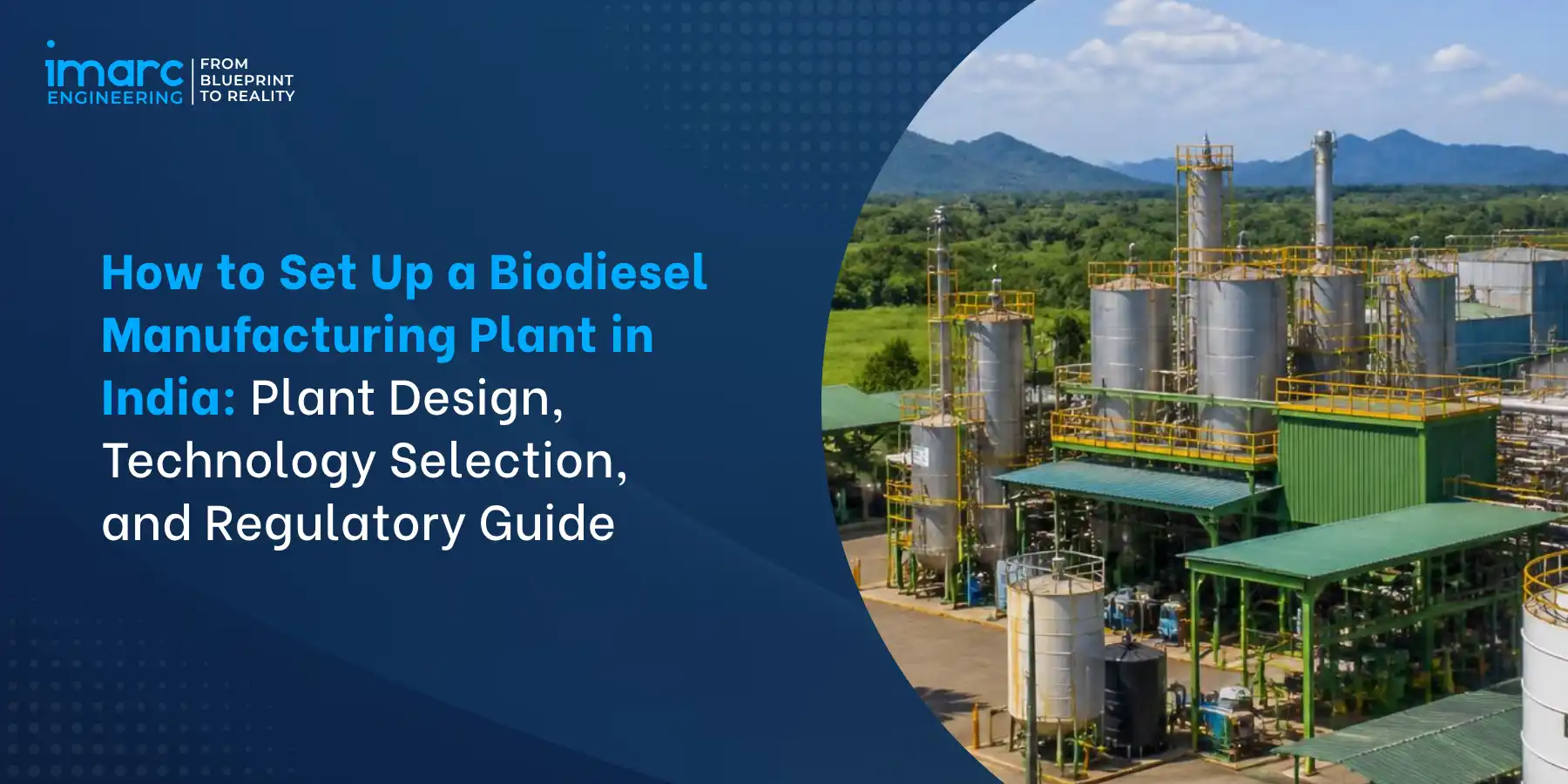
How to Set Up a Biodiesel Manufacturing Plant in India: Plant Design, Technology Selection, and Regulatory Guide
Introduction
For any biofuel investor or infrastructure developer planning a biodiesel manufacturing plant in India in 2026, the project extends materially beyond selecting production equipment. Successful facilities integrate feedstock evaluation, technology selection, process design, plant layout, utility and infrastructure planning, environmental compliance, safety systems, storage facilities, and expansion provisioning into a coherent development programme.
India's National Policy on Biofuels 2018 framework, Biodiesel Blending Programme, growing diesel-substitute demand, and expanding feedstock ecosystem collectively create an attractive but engineering-intensive sector opportunity.
Scope of this Guide
This guide answers the sponsor's set-up question directly. How should investors evaluate production technologies, design plant layout, plan supporting infrastructure, and obtain the required biodiesel regulatory approvals to develop an efficient, compliant, and scalable biodiesel manufacturing plant in India? It walks through the sector context, structured biodiesel project planning, plant design, technology selection, feedstock strategy, infrastructure, regulatory pathway, and the practices that separate structured biodiesel plant setup from projects that stall on feedstock economics, compliance failures, or technology mismatches.
Table of Contents
- Introduction
- Why Biodiesel Manufacturing in India Matters in 2026
- How to Set Up a Biodiesel Manufacturing Plant in India
- Biodiesel Plant Design and Layout in India
- Biodiesel Technology Selection for Indian Manufacturers
- Biodiesel Plant Feedstock and Supply Chain in India
- Biodiesel Infrastructure and Utilities Planning in India
- Biodiesel Regulatory Approvals and Licensing in India
- Common Mistakes and Best Practices
- Conclusion
1. Why Biodiesel Manufacturing in India Matters in 2026
Four structural drivers make biodiesel an attractive sector opportunity for Indian investors in 2026.
1.1 National Policy on Biofuels and Blending Programme
The National Policy on Biofuels 2018 (amended in 2022) administered by the Ministry of Petroleum and Natural Gas (MoPNG) provides the parent framework for biofuels including biodiesel. The Biodiesel Blending Programme with an indicative B5 target (5 percent blend) creates structured domestic demand.
Oil marketing companies (Indian Oil Corporation, Hindustan Petroleum, Bharat Petroleum) provide anchor offtake through structured procurement programmes. Policy support materially reduces early-mover investment risk for structured entrants.
1.2 Feedstock Ecosystem and Diversification
India offers substantial feedstock endowment for biodiesel production. Non-edible oil feedstock including jatropha, karanja (pongamia), mahua, neem, castor, and rubber seed provide bulk options aligned with food security policy.
Used cooking oil (UCO) through structured collection programmes including the FSSAI Repurpose Used Cooking Oil (RUCO) initiative provides growing supply. Animal fats (tallow), rice bran oil, and imported palm stearin or palm fatty acid distillate (PFAD) supplement domestic feedstock. Feedstock diversification supports both project viability and sustainability positioning.
1.3 Environmental and Energy Security Benefits
Biodiesel as a biofuel manufacturing plant output category delivers material environmental benefits versus fossil diesel including lifecycle greenhouse gas reduction, reduced sulphur oxide emissions, and biodegradability.
India's fossil diesel import dependence exceeds 80 percent making biofuel substitution an energy security priority. National energy transition commitments including Panchamrit at COP26 support biofuel scale-up. Sustainable biodiesel production aligned with certification frameworks (ISCC, RSB) additionally supports export potential to premium markets.
1.4 Rural Employment and Circular Economy
Biodiesel value chains create rural employment through feedstock cultivation (particularly for non-edible oilseeds), collection networks, and processing. Waste-based feedstocks (UCO, animal fats) support circular economy outcomes preventing environmental pollution.
Glycerol byproduct (approximately 10 percent of output) provides additional revenue stream through pharmaceutical, cosmetics, and industrial applications. Structured facilities capture value across the full biodiesel and byproduct portfolio.
2. How to Set Up a Biodiesel Manufacturing Plant in India
Understanding how to set up a biodiesel manufacturing plant in India helps sponsors sequence engineering and commercial decisions correctly. Structured biodiesel project planning integrates feasibility, technology selection, engineering, statutory approvals, and construction into a coherent programme.
2.1 The Six-Stage Development Roadmap
| Stage | Activities | Typical Duration |
|---|---|---|
| Feasibility and DPR | Market study, feedstock, technology, financial | 3-6 months |
| Site and Technology Selection | Land, layout, process pathway, licensing | 3-6 months |
| Detailed Engineering | Process design, MEP, civil, utilities, safety | 6-12 months |
| Regulatory Approvals | EC, CTE, CTO, PESO, BIS, MoPNG | 6-18 months |
| Construction and Commissioning | Civil, installation, testing, ramp-up | 12-24 months |
| Commercial Operations | Feedstock supply, production, offtake | Ongoing |
2.2 Feasibility Study and DPR
Feasibility assessment covers market analysis (blending programme uptake, industrial demand, export potential), feedstock strategy (types, availability, cost, quality), technology pathway selection, site selection with infrastructure evaluation, regulatory pathway with timelines, and financial modelling.
The Detailed Project Report (DPR) consolidates findings supporting board approval, debt financing, and regulatory submissions. DPR components include market and feedstock analysis, technology selection, site and infrastructure, engineering summary, statutory approvals, capex-opex projections, risk register, and financial modelling. Well-structured DPRs typically take 3-5 months to develop.
2.3 Biodiesel Plant Capex and Financial Modelling in India
Structured biodiesel plant capex and financial modelling in India covers capex profile, feedstock cost sensitivity (typically 60-75 percent of production cost), biodiesel pricing linked to fossil diesel, glycerol byproduct revenue, utility costs, and multi-scenario IRR analysis.
Investment ranges depend on scale: small biodiesel plants (1,000-10,000 TPA) typically require INR 2-15 crore capex; medium plants (10,000-50,000 TPA) typically require INR 15-100 crore; large plants (50,000-200,000 TPA) typically require INR 100-500 crore. Integrated multi-feedstock plants can exceed INR 200-1,000 crore. Structured working capital sizing (typically 8-15 percent of annual revenue) supports feedstock procurement cycles.
3. Biodiesel Plant Design and Layout in India
Biodiesel plant design and layout in India translates technology selection and site characteristics into constructible facility configuration. Effective biodiesel plant design integrates process, mechanical, electrical, instrumentation, civil, and utility engineering in coordinated packages.
3.1 Standard Plant Sections
| Section | Function | Key Equipment |
|---|---|---|
| Feedstock Receiving and Storage | Oil unloading, storage, pre-treatment | Tanks, unloading pumps, filters |
| Reaction Section | Transesterification | Reactors, agitators, methanol dosing |
| Separation Section | Biodiesel-glycerol separation | Settlers, centrifuges |
| Washing and Drying | Impurity removal, water removal | Wash tanks, dryers |
| Distillation (optional) | High-purity biodiesel | Distillation columns, condensers |
| Methanol Recovery | Excess methanol recycle | Distillation, condensers |
| Glycerol Recovery | Byproduct processing | Settlers, evaporators, refining |
| Product Storage and Dispatch | Finished biodiesel | Storage tanks, loading systems |
3.2 Layout Design Principles
Effective layout design follows structured material flow from feedstock receiving through reaction, separation, refining, storage, and dispatch. Segregation between process areas prevents cross-contamination and supports safety. Utility corridors provide organised access for piping and cables. Fire safety separation distances between storage tanks and process equipment per Oil Industry Safety Directorate (OISD) standards prevent cascading incidents. Structured layouts typically require 5-15 acres for medium-scale plants including storage, utility, and administrative areas.
3.3 Storage Facilities
Storage design covers feedstock (oil storage tanks sized for typical 15-30 days supply), methanol storage (Class A flammable liquid with structured containment per PESO requirements), catalyst storage (KOH or NaOH), glycerol storage, and finished biodiesel storage. Tank farm layouts follow OISD guidelines with bund walls, spacing per petroleum rules, fire hydrant coverage, and structured drainage. Structured storage design during initial engineering prevents post-commissioning modifications that are materially expensive.
3.4 Safety System Integration
Biodiesel plants involve methanol (highly flammable, toxic), high-temperature operations, and pressurised systems requiring integrated safety design. Hazard and Operability (HAZOP) studies at basic engineering stage identify risks. Layer of Protection Analysis (LOPA) evaluates safety layer adequacy. Safety Instrumented Systems (SIS) per IEC 61511 provide automated protection. Fire safety per NBC 2016 and OISD standards covers hydrant network, sprinklers, foam systems for flammable liquid areas, and gaseous suppression where applicable. Structured process safety integration during design prevents post-commissioning safety retrofits.
4. Biodiesel Technology Selection for Indian Manufacturers
Biodiesel technology selection for Indian manufacturers matches feedstock characteristics, capex-opex trade-offs, and product quality targets. The biodiesel manufacturing process centres on transesterification but pathway variants substantially affect economics and operability.
4.1 Transesterification Process Pathways
| Technology | Best For | Key Characteristics |
|---|---|---|
| Alkali-catalysed transesterification | Low FFA feedstocks | KOH or NaOH catalyst, mature, low cost |
| Acid-catalysed transesterification | High FFA feedstocks | Sulphuric acid, slower reaction |
| Two-step (acid then alkali) | Mixed or high-FFA feedstock | Handles UCO, animal fats effectively |
| Enzymatic transesterification | Sensitive feedstocks | Lipase enzyme, emerging, higher opex |
| Supercritical methanol | Advanced applications | No catalyst, high pressure, high capex |
4.2 Transesterification Process Design
Structured transesterification process design for biodiesel in India covers reactor selection (batch versus continuous), reaction conditions (temperature typically 55-65 degrees Celsius for alkali process, methanol-to-oil molar ratio typically 6:1 to 9:1), catalyst dosing (0.5-1.5 percent by weight of oil for KOH), residence time optimisation, and separation efficiency. Continuous processes suit large-scale plants above 30,000 TPA capacity while batch processes suit smaller and multi-feedstock operations. Two-step processes for high-FFA feedstock materially expand the feedstock envelope.
4.3 Batch versus Continuous Processing
Batch processing offers operational flexibility for varied feedstocks and campaign-based production but requires higher labour and lower automation. Continuous processing delivers superior economics for uniform feedstock and dedicated capacity but requires higher capex and consistent feedstock supply.
Hybrid configurations with continuous processing for primary feedstocks and batch capability for supplementary feedstocks provide operational flexibility. Structured selection considers feedstock reliability, plant scale, and operational sophistication.
4.4 Product Quality and BIS Certification
Biodiesel product must meet IS 15607:2005 (Biodiesel B100 Fatty Acid Methyl Esters specification) for domestic supply and ASTM D6751 or EN 14214 for international markets. Key quality parameters include acid value, water content, methanol content, glycerin content, cetane number, and cold flow properties. BIS certification supports oil marketing company procurement and buyer confidence. Structured product quality assurance from process design through commissioning ensures certification readiness.
5. Biodiesel Plant Feedstock and Supply Chain in India
Biodiesel plant feedstock and supply chain in India is often the single most consequential decision affecting plant viability. Feedstock choice determines technology pathway, capex profile, ongoing operating cost, and sustainability credentials.
5.1 Feedstock Options and Characteristics
- Jatropha oil: dedicated cultivation, non-food, moderate FFA content
- Karanja (pongamia) oil: non-food, tree-based, moderate availability
- Mahua oil: seasonal, tree-based, traditional collection networks
- Neem oil: byproduct of insecticide industry, limited volumes
- Castor oil: cultivated crop, higher-value uses compete
- Rubber seed oil: byproduct of rubber industry, growing supply
- Used cooking oil (UCO): FSSAI RUCO programme, expanding collection
- Animal fats (tallow): abattoir byproduct, high-FFA typically
- Palm stearin and PFAD: imports, lower cost, sustainability considerations
- Rice bran oil (limited): food-competing use limits availability
5.2 UCO Collection and RUCO Programme
Used cooking oil (UCO) has emerged as a strategically important feedstock through the FSSAI Repurpose Used Cooking Oil (RUCO) initiative. UCO collection networks operate through registered aggregators serving hotels, restaurants, food processors, and institutional kitchens.
Structured collection agreements with aggregator networks provide reliable feedstock supply. UCO handling requires acid pretreatment for high FFA content and adequate filtration for particulates. Structured UCO supply typically supports 30-50 percent of feedstock mix in mature Indian biodiesel operations.
5.3 Non-Edible Oil Cultivation and Sourcing
Non-edible oil feedstock sourcing follows structured supply chain design. Contract farming arrangements for jatropha, karanja, and castor secure cultivated supply. Aggregator networks collecting tree-based oilseeds (mahua, neem) support decentralised sourcing. Long-term supply agreements with structured pricing mechanisms materially reduce operating risk versus spot procurement.
National Mission on Edible Oils and complementary rural development schemes support feedstock supply chain development. Structured feedstock strategies typically diversify across 3-5 feedstock types reducing single-source risk.
5.4 Feedstock Economics and Sustainability
Feedstock cost typically represents 60-75 percent of biodiesel production cost making supply chain economics central to project viability. Long-term contracts with structured pricing formulae linking to fossil diesel or vegetable oil indices manage price volatility.
Sustainability certification through International Sustainability and Carbon Certification (ISCC) or Roundtable on Sustainable Biomaterials (RSB) increasingly supports premium buyer engagement particularly for export markets. Structured sustainability compliance from feedstock origin materially outperforms retrofit certification approaches.
6. Biodiesel Infrastructure and Utilities Planning in India
Biodiesel infrastructure and utilities planning in India covers the supporting infrastructure that biodiesel operations require. Structured planning during basic engineering prevents post-commissioning retrofits and supports operational reliability.
6.1 Utility Requirements
- Power supply: typically HT connection at 11kV or 22kV based on connected load
- Steam: high-pressure steam for reaction heating and distillation
- Cooling water: circulation system for reactor cooling and condensers
- Nitrogen: inerting for methanol handling and product blanketing
- Compressed air: instrument air and utility air networks
- Water: process water, DM water where required, potable water, fire water
- Fuel: natural gas, LPG, or biomass for boiler operation
6.2 Environmental Management Infrastructure
Environmental management infrastructure supports compliance with State Pollution Control Board consents. Effluent Treatment Plants (ETP) handle wash water and cleaning effluents typically with pH neutralisation, oil separation, biological treatment, and tertiary polishing. Air pollution control including scrubbers for methanol vapour and dust collection for handling operations.
Storage tank vent controls prevent VOC emissions. Hazardous waste storage per Rule 6 of Hazardous and Other Wastes Rules 2016 covers spent catalyst, filter media, and process residues. Structured environmental management from design stage prevents both compliance failures and expensive retrofits.
6.3 Fire and Safety Infrastructure
Fire and safety infrastructure follows OISD standards and NBC 2016 Part 4 requirements. Fire water reservoir typically sized for 4 hours firefighting reserve. Fire hydrant network covering all process, storage, and utility areas. Deluge or foam systems for methanol and biodiesel storage tank protection.
Fire alarm systems with smoke, heat, and flame detection appropriate to specific hazards. Gas detection systems for methanol vapour. Emergency response equipment and structured evacuation plans. Structured fire safety design during basic engineering is materially cheaper than post-commissioning modifications.
6.4 Digital Systems and Process Control
Modern biodiesel plants operate on Distributed Control Systems (DCS) with advanced process control for optimisation. Enterprise integration through Manufacturing Execution Systems (MES) supports production visibility.
Predictive maintenance using IoT sensors reduces unplanned downtime. Cybersecurity per IEC 62443 protects operational technology. Structured digital architecture during initial design materially outperforms post-commissioning retrofit for both cost and operational effectiveness.
7. Biodiesel Regulatory Approvals and Licensing in India
Biodiesel regulatory approvals and licensing in India span central and state agencies covering environmental, petroleum safety, product certification, and operational dimensions. Structured approval sequencing at project outset materially compresses total timelines.
7.1 The Statutory Approvals Framework
| Approval | Authority | Purpose |
|---|---|---|
| Environmental Clearance | MoEFCC / SEIAA (per EIA 2006) | Pre-construction approval |
| Consent to Establish (CTE) | State Pollution Control Board | Pre-construction consent |
| Consent to Operate (CTO) | State Pollution Control Board | Pre-commissioning consent |
| MoPNG Biofuel Category Approval | Ministry of Petroleum and Natural Gas | Sector classification |
| PESO License | PESO under Explosives Act 1884 | Methanol and petroleum storage |
| BIS License (IS 15607) | Bureau of Indian Standards | Product certification |
| Factory License | State Directorate of Factories | OSH Code 2020 compliance |
| Fire NOC | State Fire Services | Fire safety compliance |
7.2 Environmental Clearance and SPCB Consents
Environmental Clearance under EIA Notification 2006 is prerequisite for construction. State Pollution Control Board Consent to Establish (CTE) under Water Act 1974 and Air Act 1981 is required before construction. Consent to Operate (CTO) must be obtained before commissioning.
Application preparation covers project description, waste stream characterisation, treatment design, monitoring proposals, and compliance commitments. Structured pre-application engagement with SPCB during design stage prevents post-submission modifications.
7.3 PESO License and Factory License
PESO License for methanol storage is prerequisite given methanol's Class A flammable liquid classification. Application covers storage design, safety systems, and operational protocols. Factory License under the Occupational Safety, Health and Working Conditions Code 2020 in force from 21 November 2025 covers workplace safety, worker welfare, and operational compliance. Structured application with complete documentation prevents processing delays that can extend total licensing timelines by 3-6 months.
7.4 BIS Product Certification and MoPNG Approval
BIS certification under IS 15607 (Biodiesel B100 Fatty Acid Methyl Esters) is prerequisite for domestic biodiesel supply through oil marketing companies. Certification requires demonstrated product quality through structured testing at BIS-approved laboratories.
MoPNG biofuel category approval supports procurement eligibility under the Biodiesel Blending Programme. Structured product qualification workflow parallel with plant commissioning prevents post-commissioning delays to commercial supply.
8. Common Mistakes and Best Practices
8.1 Underestimating Feedstock Supply Chain
Projects selecting technology before validating feedstock supply chain routinely face operating cost surprises.
Best practice: long-term feedstock contracts secured before construction commitment; multiple feedstock sources reducing single-source risk; sustainability certification prerequisites documented from origin; feedstock cost sensitivity integrated into financial modelling.
8.2 Weak Technology-Feedstock Matching
Alkali-catalysed processes deployed for high-FFA feedstocks routinely produce yield shortfalls.
Best practice: technology selection matched to actual feedstock characteristics; two-step processes for mixed or high-FFA feedstock; process flexibility for feedstock variability; pilot studies validating technology-feedstock compatibility before large capex commitment.
8.3 Deferred Regulatory Engagement
Approvals treated as post-engineering formalities produce commissioning delays. Best practice: parallel initiation of Environmental Clearance, CTE, PESO, and BIS applications with detailed engineering; pre-consultation with regulatory authorities during feasibility; structured documentation preparation matching approval requirements; regulatory advisory engagement at project outset.
8.4 Under-Investment in Safety Design
Methanol handling safety systems retrofit after commissioning produce material cost overruns.
Best practice: HAZOP and LOPA during basic engineering; SIS design per IEC 61511; fire safety per OISD and NBC 2016 integrated during design; safety training and Standard Operating Procedures developed alongside commissioning.
8.5 Inadequate Working Capital
Biodiesel operations require substantial working capital for feedstock procurement and inventory.
Best practice: working capital sized at 8-15 percent of annual revenue; structured lines of credit before ramp-up; supplier and customer term negotiation supporting cash cycle; conservative early-stage revenue projections.
Conclusion
Setting up a biodiesel manufacturing plant in India in 2026 is a multidisciplinary project spanning feedstock, technology, engineering, environmental compliance, safety, and commercial arrangements. India's National Policy on Biofuels 2018 framework, Biodiesel Blending Programme, growing feedstock ecosystem, and structured demand from oil marketing companies collectively create an attractive development window for structured entrants.
Successful biodiesel projects depend on secure feedstock sourcing, technology selection aligned with feedstock characteristics, and integrated project advisory that combines engineering, regulatory, commercial, and financial expertise.
PLANNING YOUR BIODIESEL MANUFACTURING PROJECT?
IMARC Engineering's end-to-end biodiesel manufacturing plant project development advisory team supports investors, manufacturers, and biofuel developers across market and feedstock feasibility, technology pathway evaluation and licensing, DPR preparation, engineering design, regulatory approvals, and MoPNG biofuel category approvals, EPC or EPCM contractor evaluation, construction supervision, commissioning coordination, and commercial operations ramp-up for alkali-catalysed, acid-catalysed, two-step, and specialised biodiesel projects across small, medium, and large-scale developments in India.
→ Schedule a free biodiesel plant project scoping consultation with an IMARC specialist
Frequently Asked Questions
A biodiesel manufacturing plant is an industrial facility that produces biodiesel (Fatty Acid Methyl Esters or FAME) from vegetable oils, animal fats, or used cooking oil through the transesterification process. Facilities range from small, dedicated operations to large integrated plants with multiple feedstock capabilities and glycerol refining.
Small biodiesel plants (1,000-10,000 tonnes per annum) typically require INR 2-15 crore capex. Medium plants (10,000-50,000 TPA) typically require INR 15-100 crore. Large plants (50,000-200,000 TPA) typically require INR 100-500 crore. Integrated multi-feedstock plants can exceed INR 200-1,000 crore. Actual costs vary with technology, feedstock, and site conditions.
The transesterification process converts triglycerides in vegetable oils or animal fats into Fatty Acid Methyl Esters (biodiesel) and glycerol through reaction with methanol in the presence of alkali or acid catalyst. Alkali-catalysed processes suit low-FFA feedstocks; acid or two-step processes handle high-FFA feedstocks like UCO.
Common feedstocks include non-edible oil feedstock (jatropha, karanja, mahua, neem, castor, rubber seed), used cooking oil (UCO) through the FSSAI RUCO programme, animal fats (tallow), and imported palm stearin or PFAD. Non-food feedstocks are policy-preferred aligned with National Policy on Biofuels 2018.
Key approvals include Environmental Clearance under EIA 2006, State Pollution Control Board Consent to Establish (CTE) and Consent to Operate (CTO), PESO License for methanol storage, BIS certification under IS 15607, MoPNG biofuel category approval, Factory License under OSH Code 2020, Fire NOC, and building permissions.
Total project timeline typically extends 24-42 months from feasibility to commercial operations. Feasibility and DPR: 3-6 months. Design and engineering: 6-12 months. Approvals: 6-18 months (parallel). Construction: 12-24 months. Commissioning: 3-6 months. Structured parallel execution compresses total elapsed time.
Options include alkali-catalysed transesterification (mature, low cost, for low-FFA feedstocks), acid-catalysed transesterification (for high-FFA feedstocks), two-step processes (acid pretreatment followed by alkali reaction, for mixed feedstock), enzymatic transesterification (emerging), and supercritical methanol (advanced). Selection matches feedstock characteristics and commercial objectives.
IS 15607:2005 (Biodiesel B100 Fatty Acid Methyl Esters) specifies quality requirements including acid value, water content, methanol content, glycerin content, cetane number, and cold flow properties. BIS certification is prerequisite for domestic biodiesel supply through oil marketing companies. International standards ASTM D6751 and EN 14214 apply for export markets.
Glycerol is produced at approximately 10 percent of biodiesel output. Refined glycerol (99+ percent purity) supplies pharmaceutical, cosmetics, and food industries at premium pricing. Technical grade glycerol supplies industrial applications. Crude glycerol supplies feed and lower-value uses. Structured glycerol refining typically supports 5-15 percent additional revenue contribution to biodiesel operations.
Recent Post

Trusted by Industry Leaders
We partner with global enterprises and ambitious businesses across sectors to deliver operational excellence, strategic insights, and sustainable growth through integrated solutions.











Success in Their Words
Real feedback from clients across industries. Discover how our solutions delivered measurable impact and operational excellence.

I wanted to express my sincere appreciation for your efforts in handling this matter. Your dedication and commitment have been truly commendable, and it is evident that you have put in tremendous hard work and expertise into resolving the issues at hand. We are greatly interested in continuing our collaboration with you in the future, as your professionalism and reliability have made you a trusted partner. Thank you once again for your invaluable contribution. We look forward to strengthening our partnership ahead.

It has been a pleasure working with the IMARC team. The insights provided were structured, clear, and highly valuable, helping us strengthen both our technical and financial planning with confidence. We deeply appreciate the team’s professionalism, responsiveness, and attention to detail throughout the engagement. Every requirement was well understood and effectively incorporated, resulting in a comprehensive and actionable output. Overall, our experience has been excellent, and I would gladly recommend IMARC to organizations seeking a reliable research partner.

Your service is truly exceptional. Working with the IMARC team has been a seamless and professional experience. The clarity of communication, responsiveness to queries, and consistent support at every stage made the entire engagement highly efficient. The insights shared were well-structured, practical, and perfectly aligned with our requirements, helping us make informed decisions with confidence. Overall, the dedication and professionalism demonstrated by your team stand out, and I would be glad to recommend IMARC as a reliable and trustworthy research partner.

IMARC did an outstanding job in preparing our study. They were punctual, precise, and consistently responsive throughout the entire process. The team delivered all the data we required in a clear, well-organized, and highly professional format. Their strong attention to detail, combined with their ability to meet every deadline without compromising quality, truly set them apart. Overall, their reliability and commitment made them an exceptional partner for our project, and we would gladly work with them again in the future.

IMARC made the whole process incredibly easy from start to finish. Everyone I interacted with via email was polite, professional, and straightforward to deal with, always keeping their promises regarding delivery timelines and remaining consistently solutions-focused. From my very first contact, I appreciated the professionalism and support shown by the entire IMARC team. I highly recommend IMARC to anyone seeking timely, affordable, and reliable information or advice. My experience with IMARC was excellent, and I truly cannot fault any aspect of it.

I’d like to express my sincere gratitude for the excellent work you accomplished with the study. Your ability to quickly understand our requirements and deliver high-quality results under tight timelines truly reflects your expertise, exceptional work ethic, and unwavering commitment to your customer’s success. The professionalism and responsiveness you demonstrated throughout the process made a significant difference. Our entire team and company are incredibly thankful for your dedication, reliability, and support. Once again, thank you for your outstanding contribution.