Delhi's Petrol Vehicle Phase-Out Policy Highlights Growing Demand for EV Manufacturing in India
July 08, 2026
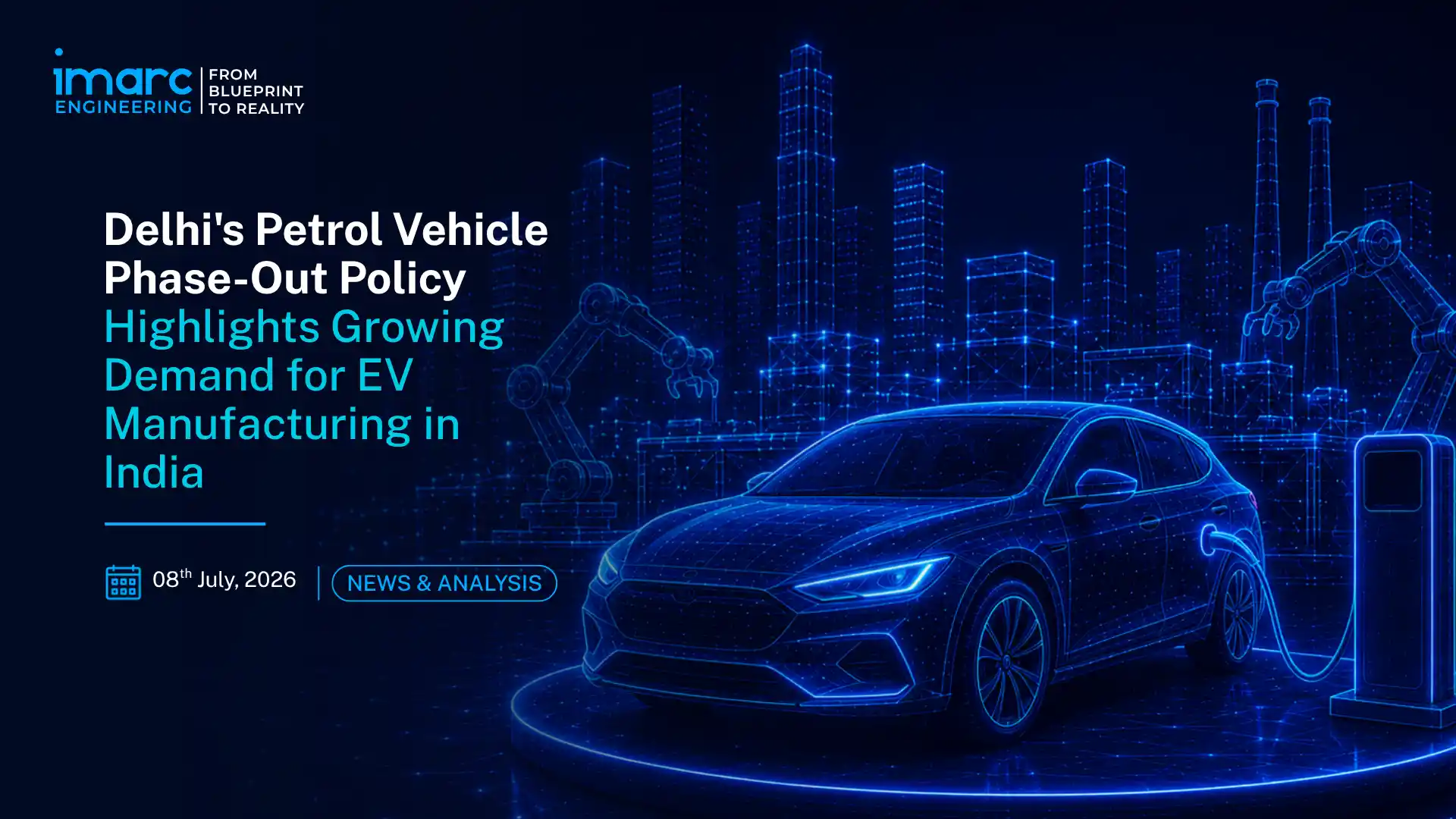
In July 2026, Delhi Chief Minister Rekha Gupta notified the Delhi EV Policy 2.0 in the Gazette, marking the formal beginning of one of India's most significant electric mobility mandates. The policy comes into effect immediately and runs through March 31, 2030. Its headline measure is a phased ban on new petrol and CNG vehicle registrations.
From January 1, 2027, no new petrol or CNG three-wheelers can be registered in the National Capital Territory. From April 1, 2028, no new petrol two-wheelers can be registered either. Delhi becomes the first major Indian city to set a firm legislative deadline for ending new petrol two-wheeler registrations.
The implications stretch well beyond Delhi's roads. For India's EV manufacturing in India ecosystem, manufacturers, battery producers, component suppliers, and charging infrastructure developers, this is a policy-backed demand guarantee that removes the guesswork from long-term capacity investment decisions.
What Delhi's EV Policy 2.0 Actually Does
The policy is backed by a budget of INR 7,000 crore, with some sources citing the broader programme at INR 15,000 crore including implementation costs. The immediate measure is a tiered purchase incentive for electric two-wheelers priced below INR 2.25 lakh ex-showroom. In Year 1, buyers receive INR 10,000 per kWh of battery capacity, capped at INR 30,000.
This steps down to INR 20,000 in Year 2 and INR 10,000 in Year 3. Scrappage incentives are layered on top, INR 10,000 for replacing a BS-IV or older petrol two-wheeler with an electric model. For four-wheelers, buyers replacing old BS-IV petrol cars with battery electric vehicles receive a scrappage incentive of INR 1 lakh, available for the first one lakh participants. All incentives are delivered through Direct Benefit Transfer.
The road tax and registration exemption is expanded. EVs priced up to INR 30 lakh receive 100% exemption. EVs above that threshold attract standard charges, a change from the earlier blanket exemption for all EVs. Three-wheelers get INR 50,000 in direct purchase subsidies. N1 category electric goods carriers receive INR 1 lakh. The charging infrastructure commitment is substantial: 30,000 active charging points across the city over four years, with land already identified and work set to commence soon.
What the policy does not do is equally important. It does not ban the use of existing petrol or CNG vehicles. A petrol bike already registered and on Delhi's roads today can continue to be used for its entire legally permitted operational life. The ban is prospective: it applies to fresh registrations only. This protects existing vehicle owners while ensuring that the new vehicle market is systematically redirected toward electric.
Why This Creates an EV Manufacturing Investment Signal
Delhi has over 11 million registered two-wheelers. It is one of India's largest single-city markets for new two-wheeler purchases. When registration of petrol two-wheelers ends in April 2028, every new two-wheeler buyer in Delhi, whether buying their first vehicle or replacing an old one, will choose an electric model. That is not a projected market shift. It is a mandated one.
For EV manufacturers, this creates a floor under Delhi demand that compounds with the national trajectory. India sold 1.4 million electric two-wheelers in FY2026. FY2027 is likely to be higher, accelerated by petrol price increases following the Iran-US conflict that pushed pump prices in Delhi to INR 97.77 per litre in May 2026.
Delhi's registration ban, coming on top of this price-driven demand shift, will further concentrate consumer preference for electric models through 2027 and 2028. TVS, Bajaj, Ather, Ola Electric, Hero MotoCorp, Honda and among others, all of which manufacture electric two-wheelers, are the direct commercial beneficiaries of this policy environment.
For the broader automotive manufacturing sector in India, Delhi's policy is a leading indicator of what other states will likely follow. Delhi has historically set urban mobility policy benchmarks, CNG bus conversion in the early 2000s, the odd-even traffic scheme, BS-VI fuel adoption, that other Indian cities have replicated.
If other major states introduce similar policies over the coming years, the national transition toward electric two-wheelers could accelerate significantly. Planning manufacturing capacity and battery manufacturing in India at that scale now is the rational response.
The Supply Chain and Manufacturing Expansion It Demands
India's EV industry is already scaling to meet growing demand, but Delhi's mandate is expected to accelerate manufacturing investment decisions that might otherwise have been phased over several years. Production capacity, battery cell supply, motor and controller manufacturing, wiring harnesses, and charger hardware must all be expanded.
Ola Electric's Gigafactory in Krishnagiri, Tamil Nadu, producing 4680-format NMC cells under the PLI-ACC scheme, has begun scaling cell output. Amara Raja's Mahbubnagar gigafactory is targeting its first 1 GWh phase by Q2-Q3 FY27.
Tata's Agratas battery facility in Sanand, Gujarat is progressing through construction. These battery manufacturing investments were planned before Delhi's mandate was confirmed, but the mandate strengthens their business case by making the demand trajectory more predictable and more legally anchored.
The charging infrastructure side is equally critical. Delhi's commitment to 30,000 charging points complements the 4,874 chargers approved under the PM E-DRIVE scheme's INR 503.86 crore tranche in May 2026. The Unified Bharat eCharge platform, India's interoperability framework for EV charging, is under development with BHEL as nodal agency.
Haryana's June 2026 Building Code amendment, mandating EV charging infrastructure in all new residential and commercial buildings, adds a further layer of charging infrastructure rollout that serves Delhi's surrounding NCR geography. The EV supply chain from cell to charger is being built simultaneously, and Delhi's mandate provides the demand anchor that justifies the pace of that investment.
Delhi notified its EV Policy 2.0 today. From April 2028, every new two-wheeler registration in India's capital must be electric. That is not a target, it is law. The EV manufacturing capacity to meet it needs to be on the ground before then.
IMARC Engineering's Perspective
Delhi's EV Policy 2.0 creates exactly the kind of durable, long-horizon demand signal that justifies large-scale investment in EV manufacturing infrastructure. When a city of 35 million people mandates that every new two-wheeler registered from April 2028 must be electric, the manufacturing capacity, battery production, and charging infrastructure are no longer driven solely by market projections, they are increasingly supported by long-term policy commitments.
At IMARC Engineering, we support EV manufacturers, battery producers, and EV component suppliers with greenfield and brownfield industrial manufacturing projects, from DPR preparation and site selection to EPCM project execution and commissioning.
As manufacturers scale production to serve Delhi's phase-out timeline and the national demand trajectory it reflects, the quality of manufacturing plant design, utility infrastructure, and regulatory compliance planning determines whether they are ready to ship on time. That is the engineering challenge IMARC Engineering is built to solve.
Latest News
-
IEX Subsidiary Applies for Coal Exchange Registration Under India’s New Coal Exchange Rules 2026
September 30, 2026
-
India Pushes Domestic Shipping Container Manufacturing with INR 10,000 Crore Assistance Scheme
September 25, 2026
-
India’s Growing GCC Sector Brings Greenfield Setup and Regulatory Compliance into Focus
September 24, 2026
-
Uttar Pradesh Approves INR 200+ Crore Ethanol Plant at Chhata Sugar Mill in Mathura
September 23, 2026
-
Escorts Kubota Breaks Ground on INR 2,000 Crore Greenfield Manufacturing Plant in Uttar Pradesh
September 22, 2026
Trusted by Industry Leaders
We partner with global enterprises and ambitious businesses across sectors to deliver operational excellence, strategic insights, and sustainable growth through integrated solutions.











Success in Their Words
Real feedback from clients across industries. Discover how our solutions delivered measurable impact and operational excellence.

I wanted to express my sincere appreciation for your efforts in handling this matter. Your dedication and commitment have been truly commendable, and it is evident that you have put in tremendous hard work and expertise into resolving the issues at hand. We are greatly interested in continuing our collaboration with you in the future, as your professionalism and reliability have made you a trusted partner. Thank you once again for your invaluable contribution. We look forward to strengthening our partnership ahead.

It has been a pleasure working with the IMARC team. The insights provided were structured, clear, and highly valuable, helping us strengthen both our technical and financial planning with confidence. We deeply appreciate the team’s professionalism, responsiveness, and attention to detail throughout the engagement. Every requirement was well understood and effectively incorporated, resulting in a comprehensive and actionable output. Overall, our experience has been excellent, and I would gladly recommend IMARC to organizations seeking a reliable research partner.

Your service is truly exceptional. Working with the IMARC team has been a seamless and professional experience. The clarity of communication, responsiveness to queries, and consistent support at every stage made the entire engagement highly efficient. The insights shared were well-structured, practical, and perfectly aligned with our requirements, helping us make informed decisions with confidence. Overall, the dedication and professionalism demonstrated by your team stand out, and I would be glad to recommend IMARC as a reliable and trustworthy research partner.

IMARC did an outstanding job in preparing our study. They were punctual, precise, and consistently responsive throughout the entire process. The team delivered all the data we required in a clear, well-organized, and highly professional format. Their strong attention to detail, combined with their ability to meet every deadline without compromising quality, truly set them apart. Overall, their reliability and commitment made them an exceptional partner for our project, and we would gladly work with them again in the future.

IMARC made the whole process incredibly easy from start to finish. Everyone I interacted with via email was polite, professional, and straightforward to deal with, always keeping their promises regarding delivery timelines and remaining consistently solutions-focused. From my very first contact, I appreciated the professionalism and support shown by the entire IMARC team. I highly recommend IMARC to anyone seeking timely, affordable, and reliable information or advice. My experience with IMARC was excellent, and I truly cannot fault any aspect of it.

I’d like to express my sincere gratitude for the excellent work you accomplished with the study. Your ability to quickly understand our requirements and deliver high-quality results under tight timelines truly reflects your expertise, exceptional work ethic, and unwavering commitment to your customer’s success. The professionalism and responsiveness you demonstrated throughout the process made a significant difference. Our entire team and company are incredibly thankful for your dedication, reliability, and support. Once again, thank you for your outstanding contribution.
Ready to Experience the IMARC Advantage?
Whether you're planning a new facility, expanding operations, optimizing performance, or facing complex challenges—IMARC Engineering brings the expertise, experience, and commitment needed for success.