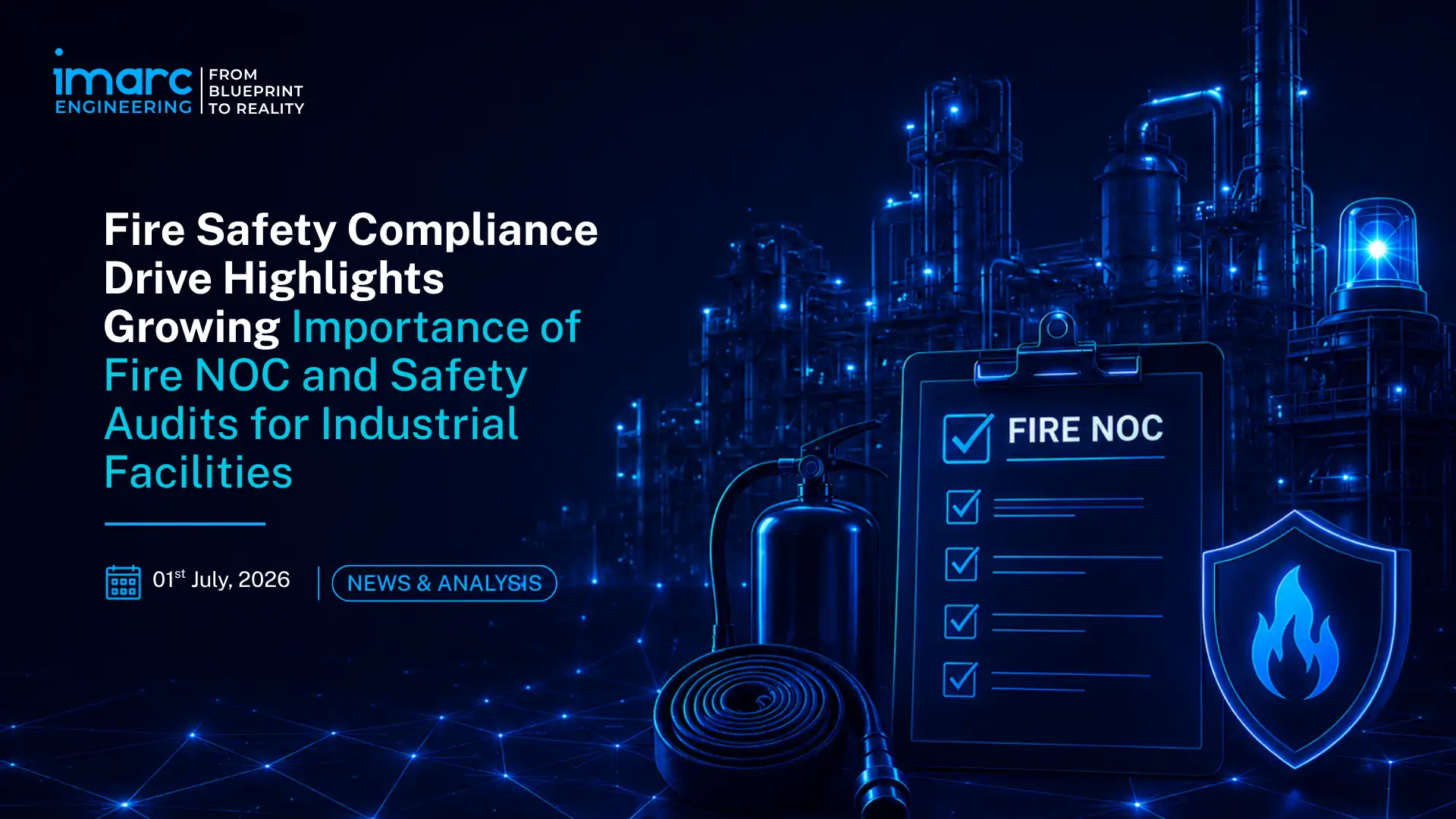
Fire Safety Compliance Drive Highlights Growing Importance of Fire NOC and Safety Audits for Industrial Facilities
July 01, 2026
Four weeks ago, a fire at a Delhi bed-and-breakfast establishment exposed a building operating without mandatory fire clearance and with far more rooms than its approved capacity allowed. A few weeks before that, a fire at a Muzaffarpur hospital exposed how vulnerable patients become when fire safety systems fail.
These incidents follow a familiar pattern. Each major fire tragedy in India over the past three decades, Uphaar Cinema in 1997, the Surat coaching centre fire in 2019, the Rajkot gaming zone fire in 2024, the Arpora nightclub fire in Goa in 2025, and a commercial building fire tragedy in Lucknow, shares one root cause. There was a lapse in fire safety compliance.
In many cases, the establishment had not obtained a valid Fire NOC. In others, fire safety equipment was installed but not maintained or working. India's regulators are now responding with sharper enforcement, and that response has direct consequences for industrial facilities across the country.
Why Industrial Facilities Face the Highest Scrutiny
A Fire NOC, or fire safety certificate, is an official approval issued by the local fire department. It confirms that a building has the necessary fire protection systems, including fire extinguishers, hydrants, sprinklers, alarms, and clear evacuation routes. For industrial facility safety, the bar is even higher than for commercial buildings.
Factories that use chemicals, store flammable materials, or run heavy machinery need a more detailed fire risk assessment. Chemical plants and warehouses storing flammable substances often require blast-proof walls and explosion suppression systems as part of their fire clearance requirements. This is not a generic checklist. It is hazard-specific engineering that must match the actual risk profile of the facility.
India's fire safety regulations in India are governed by multiple layers. The National Building Code sets baseline standards. State-specific laws, the Delhi Fire Service Act, the Maharashtra Fire Prevention and Life Safety Measures Act, the Tamil Nadu Fire and Rescue Services Act, among others, add their own requirements. The Factories Act, 1948, and state Fire Services Acts both apply to industrial buildings.
For sectors like pharmaceuticals, Schedule M under the Drugs and Cosmetics Act adds another compliance layer. For food facilities, FSSAI requirements apply too. Few facility owners can navigate this layered framework without specialist engineering support.
What Has Changed in 2026: Stricter Rules, Digital Oversight
Fire safety approvals and Fire NOC compliance in India have become more technology-driven and harder to bypass in 2026. Commercial and industrial buildings are now required to maintain digital logs of fire safety systems, inspections, and maintenance activities. These digital records make it much easier for authorities to audit compliance and spot gaps before a fire happens, not after.
Buildings are also being classified by risk level. High-risk structures, large industrial units, chemical plants, data centres, and warehouses, face stricter fire safety certification requirements than low-risk office buildings. This risk-based approach means industrial facilities can expect more frequent and more detailed inspections than before.
A revised National Building Code, NBC 2025, has been introduced with updated provisions for construction and infrastructure safety. There is also discussion of a broader shift toward a National Building Standard, which would give individual states more control over enforcement while maintaining harmonised baseline rules. Whatever the final shape of this framework, the direction is consistent: more inspections, more documentation, and less tolerance for gaps.
The Enforcement Gap That Regulators Are Now Trying to Close
Despite stronger rules on paper, India's fire safety governance has long suffered from weak enforcement. A recent government review highlighted several recurring problems. Many fire departments face shortages of trained staff, equipment, and modern firefighting technology.
Inspections have often been reactive, triggered by an incident, rather than preventive. Many facility owners treat fire safety compliance as a one-time formality to get the NOC, rather than an ongoing responsibility.
The review recommended several reforms: moving toward harmonised national fire safety standards, strengthening inspections through technology-enabled monitoring and third-party audits, and mandating periodic fire safety audits and mock drills for high-risk buildings including hospitals, hotels, and industrial facilities.
This signals that regulatory compliance for industrial facilities is moving from a one-time approval model to a continuous compliance model, where the facility must demonstrate ongoing readiness, not just a certificate issued years earlier.
What This Means for Industrial Facility Owners
For manufacturers and industrial developers, the practical implications are significant. First, a Fire NOC is not a one-time achievement. Most certificates need renewal every one to three years, with hospitals and high-hazard industries often requiring annual renewal. Renewal applications should be filed 60 days before expiry. Delayed renewals attract daily penalties in many states.
Second, a fire safety audit is becoming a standard expectation, not an optional extra. Many authorities now recommend professional fire audits even where the law does not explicitly mandate one. An audit identifies gaps before an inspector does, giving facility owners time to fix problems rather than face a deficiency notice or closure order.
Third, the consequences of non-compliance have become more severe. Operating without a valid Fire NOC can lead to fines, business closure, and legal action under negligence provisions of the law. Insurance claims for fire damage are frequently rejected if the facility lacked a valid Fire NOC at the time of the incident. For industrial facilities carrying significant equipment and inventory value, this insurance risk alone makes fire NOC compliance a financial necessity, not just a legal one.
Fourth, fire safety planning works best when it is built into a facility's design from the start. Retrofitting fire suppression systems, evacuation routes, and detection networks into an operating plant is far more expensive and disruptive than designing them in from the beginning. Suppression technology also needs to match the specific hazard; a chemical storage area needs a different system than a server room or a cleanroom.
For new manufacturing plants and industrial expansions, Fire NOC compliance is also a critical project approval milestone that directly affects construction completion, occupancy permissions, commissioning schedules, and the timely commencement of commercial operations.
A Compliance Culture, Not Just a Certificate
The consistent lesson from India's fire tragedies, old and recent, is that fire safety compliance fails most often not because rules do not exist, but because they are not followed continuously. A government review released this month called for owners and occupiers of establishments to move away from treating fire safety as a mere formality and start recognising it as an indispensable responsibility.
For industrial facilities, this means three things in practice. Keep digital compliance logs current and ready for inspection. Conduct periodic fire safety audits, even when not legally required, to stay ahead of regulatory changes. And treat every facility expansion or modification as a trigger to review fire safety certification status, not just a trigger for production planning.
As enforcement tightens across India in response to recent incidents, the facilities best positioned to avoid disruption are the ones that built a real compliance culture, not just a certificate on the wall.
Every major fire tragedy in India shares one cause: a lapse in compliance that was preventable. As regulators tighten enforcement in 2026, industrial facilities that treat fire safety as ongoing engineering discipline, not a one-time certificate, will be the ones that keep running.
IMARC Engineering's Perspective
At IMARC Engineering, we treat fire safety design as a core engineering discipline, not a paperwork formality added at the end of a project. Our fire safety and security system design practice covers detection networks, suppression technology matched to specific hazard types, evacuation route engineering, and complete documentation aligned with NBC 2025 Part 4, applicable NFPA codes, and state-specific Fire Services Act requirements.
For industrial clients, this means clean agent systems for cleanrooms and electronics, foam systems for flammable liquid storage, and gas suppression for server rooms, each specified to the hazard it protects, not a generic standard applied uniformly. We integrate fire safety planning into the DPR, detailed engineering, regulatory approval strategy, and project execution roadmap so Fire NOC compliance becomes an integral part of project development rather than a post-construction approval exercise.
As enforcement tightens across India following recent fire tragedies, the facilities that planned for compliance from Day 1 will be the ones that keep operating without disruption.
Latest News
-
India Pushes Domestic Shipping Container Manufacturing with INR 10,000 Crore Assistance Scheme
September 25, 2026
-
India’s Growing GCC Sector Brings Greenfield Setup and Regulatory Compliance into Focus
September 24, 2026
-
Uttar Pradesh Approves INR 200+ Crore Ethanol Plant at Chhata Sugar Mill in Mathura
September 23, 2026
-
Escorts Kubota Breaks Ground on INR 2,000 Crore Greenfield Manufacturing Plant in Uttar Pradesh
September 22, 2026
-
SEMICON India 2026 Highlights Expansion of India’s Semiconductor Manufacturing Ecosystem
September 21, 2026
Trusted by Industry Leaders
We partner with global enterprises and ambitious businesses across sectors to deliver operational excellence, strategic insights, and sustainable growth through integrated solutions.










Success in Their Words
Real feedback from clients across industries. Discover how our solutions delivered measurable impact and operational excellence.

I wanted to express my sincere appreciation for your efforts in handling this matter. Your dedication and commitment have been truly commendable, and it is evident that you have put in tremendous hard work and expertise into resolving the issues at hand. We are greatly interested in continuing our collaboration with you in the future, as your professionalism and reliability have made you a trusted partner. Thank you once again for your invaluable contribution. We look forward to strengthening our partnership ahead.

It has been a pleasure working with the IMARC team. The insights provided were structured, clear, and highly valuable, helping us strengthen both our technical and financial planning with confidence. We deeply appreciate the team’s professionalism, responsiveness, and attention to detail throughout the engagement. Every requirement was well understood and effectively incorporated, resulting in a comprehensive and actionable output. Overall, our experience has been excellent, and I would gladly recommend IMARC to organizations seeking a reliable research partner.

Your service is truly exceptional. Working with the IMARC team has been a seamless and professional experience. The clarity of communication, responsiveness to queries, and consistent support at every stage made the entire engagement highly efficient. The insights shared were well-structured, practical, and perfectly aligned with our requirements, helping us make informed decisions with confidence. Overall, the dedication and professionalism demonstrated by your team stand out, and I would be glad to recommend IMARC as a reliable and trustworthy research partner.

IMARC did an outstanding job in preparing our study. They were punctual, precise, and consistently responsive throughout the entire process. The team delivered all the data we required in a clear, well-organized, and highly professional format. Their strong attention to detail, combined with their ability to meet every deadline without compromising quality, truly set them apart. Overall, their reliability and commitment made them an exceptional partner for our project, and we would gladly work with them again in the future.

IMARC made the whole process incredibly easy from start to finish. Everyone I interacted with via email was polite, professional, and straightforward to deal with, always keeping their promises regarding delivery timelines and remaining consistently solutions-focused. From my very first contact, I appreciated the professionalism and support shown by the entire IMARC team. I highly recommend IMARC to anyone seeking timely, affordable, and reliable information or advice. My experience with IMARC was excellent, and I truly cannot fault any aspect of it.

I’d like to express my sincere gratitude for the excellent work you accomplished with the study. Your ability to quickly understand our requirements and deliver high-quality results under tight timelines truly reflects your expertise, exceptional work ethic, and unwavering commitment to your customer’s success. The professionalism and responsiveness you demonstrated throughout the process made a significant difference. Our entire team and company are incredibly thankful for your dedication, reliability, and support. Once again, thank you for your outstanding contribution.
Ready to Experience the IMARC Advantage?
Whether you're planning a new facility, expanding operations, optimizing performance, or facing complex challenges—IMARC Engineering brings the expertise, experience, and commitment needed for success.