Maharashtra's INR 20,000 Crore Greenfield Shipbuilding Cluster Signals Major Boost for India's Maritime Manufacturing
July 06, 2026
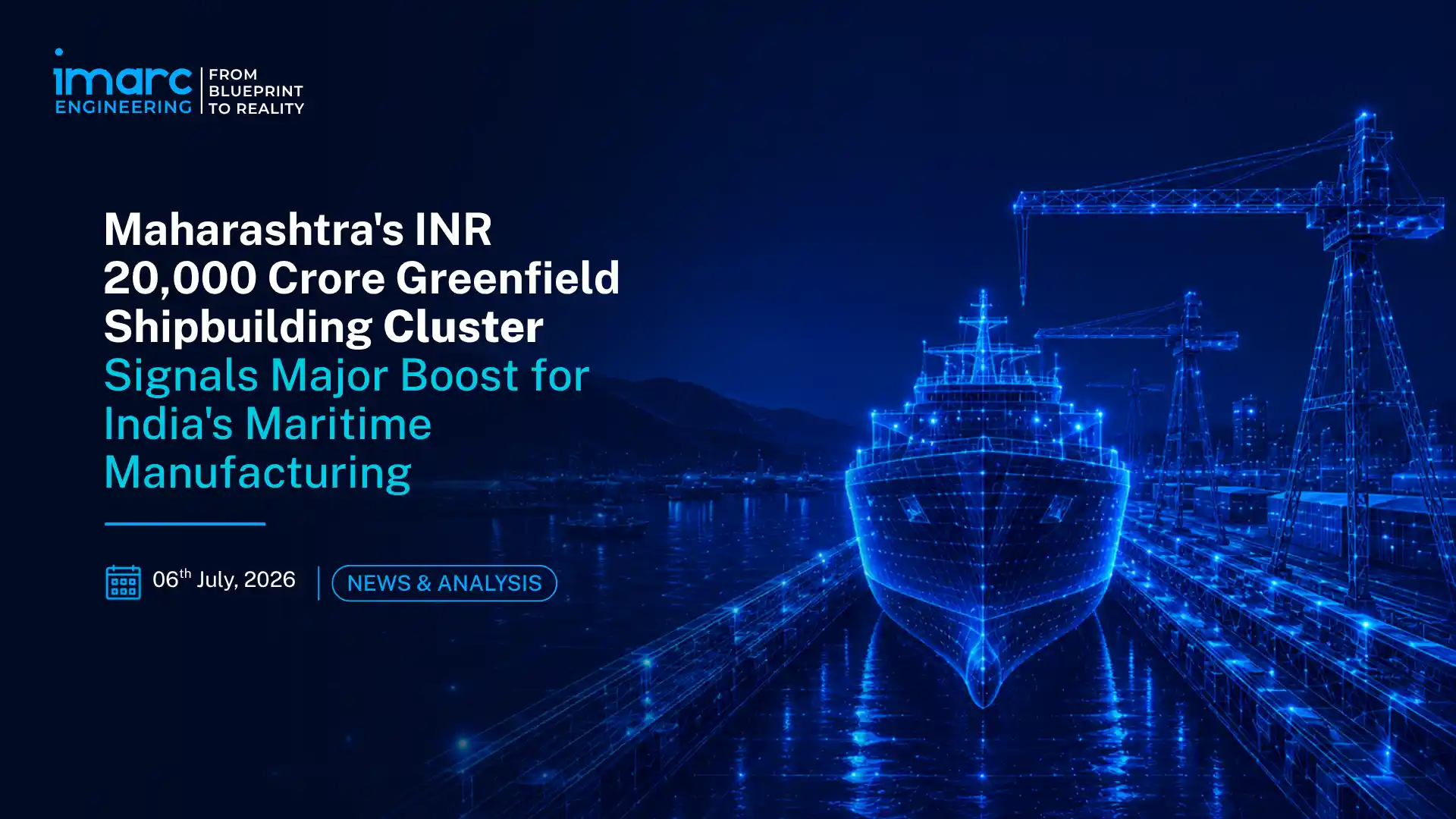
In June 2026, Maharashtra identified Dighi in Raigad district as the site for a proposed INR 20,000 crore greenfield shipbuilding cluster. The project is planned across 2,550 acres of the Dighi Port Industrial Area. Mazagon Dock Shipbuilders Limited (MDL), India's premier defence shipbuilder and a Navratna public sector enterprise, is expected to anchor the cluster.
Mumbai Port Authority and the Maharashtra government have formed an equal special purpose vehicle to set up the project. This is one of the largest single-site maritime manufacturing investments announced in India in recent years. It is also the clearest statement yet of India's intent to move from a country that buys ships to a country that builds them at global scale.
The Dighi Site: Why This Location Was Selected
Dighi was selected over two other shortlisted sites, Nandgaon and Vijaydurg, following a techno-economic feasibility study that assessed site suitability and project structure. The site has strong advantages.
The Dighi Port Industrial Area in Raigad spans more than 6,000 acres and offers multimodal road and rail connectivity. The port area already has basic infrastructure. It is located on Maharashtra's 877-kilometre coastline, with natural access to deep-water approaches. The proximity to Mumbai, India's primary maritime and financial hub, makes it attractive for attracting skilled workers, marine engineers, and international shipping clients.
Maharashtra accounts for approximately 40% of the nearly 15,000 acres of land identified across five coastal states for proposed shipbuilding clusters nationally. Dighi is the state's highest-priority cluster site. The Dighi greenfield industrial project complements planned clusters in Nandgaon and Vijaydurg, which the Maharashtra Maritime Board has designated as part of a strategy to develop six marine shipyard clusters along the state's coast.
What the Cluster Will Contain
The Dighi cluster is designed as a fully integrated maritime manufacturing in India ecosystem, not just a single shipyard.
The facility will include shipyards for vessel construction, repair facilities for commercial and naval maintenance, marine equipment manufacturing units for propulsion, navigation, and safety systems, and the full supporting infrastructure including power, water, waste management, road access, and worker accommodation, needed to operate at industrial scale.
This integrated approach is key to the cluster's commercial logic: a shipbuilding cluster that has access to local marine equipment suppliers, repair berths, and training infrastructure can compete on cost, turnaround time, and service quality in ways that a standalone shipyard cannot.
MDL's role as anchor shipyard brings critical assets to the project. MDL has built destroyers, submarines, frigates, and corvettes for the Indian Navy. Its experience in complex vessel fabrication, steel processing for marine-grade requirements, and quality systems aligned to naval classification standards will provide the technical baseline from which the commercial shipbuilding capabilities at Dighi can be developed.
MDL's presence also signals government commitment to the project, which is likely to attract private marine equipment manufacturers and international joint venture partners to the cluster over time.
The Policy Framework Behind the Project
The Dighi cluster does not stand alone, it sits within a strong and recently reinforced policy architecture for the shipbuilding industry in India.
Maharashtra introduced its Shipbuilding, Ship Repair, and Ship Recycling Policy in 2025. The policy offers a 15% capital subsidy for shipbuilding investments, research and development incentives of up to INR 25 crore, and concessional land leases for private players entering the sector. These incentives directly improve project economics for the marine equipment manufacturers, component suppliers, and ship repair operators who will populate the Dighi cluster around MDL's anchor facility.
At the national level, the Centre's Shipbuilding Development Scheme provides financial support for shipyard modernisation and new shipyard development. India's Maritime Amrit Kaal Vision 2047 sets the ambition of becoming one of the top five global shipbuilding nations, targeting a 5% share of global shipbuilding output by 2030 (up from less than 1% today).
The INR 25,000 crore Maritime Development Fund and the INR 25,000 crore ship financing facility announced in Union Budget 2025-26 provide the capital market infrastructure that projects like Dighi need to attract investment at scale.
India's Maritime Manufacturing Gap and Why It Must Close
India's shipbuilding industry has historically punched well below its geographic weight. Despite having one of the world's longest coastlines. Indian shipping companies own or operate over 1,600 vessels, but the vast majority are built in South Korea, Japan, or China.
This import dependency has direct economic consequences. India's shipping and trade dependence on foreign vessels means that INR leaves the country every time a new vessel is procured. It also means that India lacks the industrial depth, in steel fabrication, propulsion engineering, electronics for navigation, and precision machining for marine components, that a mature shipbuilding ecosystem would create domestically.
The Dighi cluster addresses this directly. At full development, a cluster of this size can support direct employment in the tens of thousands and indirect employment across the full maritime supply chain. Steel fabricators, paint suppliers, electrical and electronics manufacturers, logistics operators, and training institutions all grow around a functioning shipbuilding hub.
Global demand is also shifting in ways that favour new entrants. The green shipping transition, driven by IMO regulations requiring reduced emissions from commercial vessels, is creating demand for LNG-powered and hydrogen-ready vessels, dual-fuel engines, and energy efficiency retrofits.
India's shipbuilding industry has an opportunity to position itself in green vessels from the start, rather than inheriting the legacy production architecture of established shipbuilding nations. The Dighi cluster, designed from scratch in 2026 with this market context in view, can embed green vessel production capabilities that older facilities in South Korea or China must now retrofit.
India has a 7,500-kilometre coastline and less than 1% of global shipbuilding output. Dighi is where that arithmetic begins to change.
IMARC Engineering's Perspective
A greenfield shipbuilding cluster at this scale is not one project, it is a collection of specialised industrial facilities: drydocks, fabrication halls, steel processing yards, paint facilities, outfitting wharves, marine equipment plants, and utility infrastructure, all of which need to be designed and built in an integrated sequence. At IMARC Engineering, we see clusters like Dighi as representing exactly the kind of complex, phased industrial infrastructure development where our EPCM consulting adds the most value.
Site master planning that accounts for sequential construction without disrupting earlier phases, utility infrastructure that serves the whole cluster, civil engineering for heavy marine loads and coastal soil conditions, environmental compliance for coastal industrial activity, and project management across multiple contractors, these are the engineering challenges that define whether an INR 20,000 crore greenfield industrial project delivers on schedule or accumulates delays.
For India's shipbuilding industry to realise its export ambitions, the infrastructure quality of facilities like Dighi must match the quality expectations of global ship owners and classification societies. That starts at the design and feasibility stage, and it is the space IMARC Engineering occupies.
Latest News
-
IEX Subsidiary Applies for Coal Exchange Registration Under India’s New Coal Exchange Rules 2026
September 30, 2026
-
India Pushes Domestic Shipping Container Manufacturing with INR 10,000 Crore Assistance Scheme
September 25, 2026
-
India’s Growing GCC Sector Brings Greenfield Setup and Regulatory Compliance into Focus
September 24, 2026
-
Uttar Pradesh Approves INR 200+ Crore Ethanol Plant at Chhata Sugar Mill in Mathura
September 23, 2026
-
Escorts Kubota Breaks Ground on INR 2,000 Crore Greenfield Manufacturing Plant in Uttar Pradesh
September 22, 2026
Trusted by Industry Leaders
We partner with global enterprises and ambitious businesses across sectors to deliver operational excellence, strategic insights, and sustainable growth through integrated solutions.










Success in Their Words
Real feedback from clients across industries. Discover how our solutions delivered measurable impact and operational excellence.

I wanted to express my sincere appreciation for your efforts in handling this matter. Your dedication and commitment have been truly commendable, and it is evident that you have put in tremendous hard work and expertise into resolving the issues at hand. We are greatly interested in continuing our collaboration with you in the future, as your professionalism and reliability have made you a trusted partner. Thank you once again for your invaluable contribution. We look forward to strengthening our partnership ahead.

It has been a pleasure working with the IMARC team. The insights provided were structured, clear, and highly valuable, helping us strengthen both our technical and financial planning with confidence. We deeply appreciate the team’s professionalism, responsiveness, and attention to detail throughout the engagement. Every requirement was well understood and effectively incorporated, resulting in a comprehensive and actionable output. Overall, our experience has been excellent, and I would gladly recommend IMARC to organizations seeking a reliable research partner.

Your service is truly exceptional. Working with the IMARC team has been a seamless and professional experience. The clarity of communication, responsiveness to queries, and consistent support at every stage made the entire engagement highly efficient. The insights shared were well-structured, practical, and perfectly aligned with our requirements, helping us make informed decisions with confidence. Overall, the dedication and professionalism demonstrated by your team stand out, and I would be glad to recommend IMARC as a reliable and trustworthy research partner.

IMARC did an outstanding job in preparing our study. They were punctual, precise, and consistently responsive throughout the entire process. The team delivered all the data we required in a clear, well-organized, and highly professional format. Their strong attention to detail, combined with their ability to meet every deadline without compromising quality, truly set them apart. Overall, their reliability and commitment made them an exceptional partner for our project, and we would gladly work with them again in the future.

IMARC made the whole process incredibly easy from start to finish. Everyone I interacted with via email was polite, professional, and straightforward to deal with, always keeping their promises regarding delivery timelines and remaining consistently solutions-focused. From my very first contact, I appreciated the professionalism and support shown by the entire IMARC team. I highly recommend IMARC to anyone seeking timely, affordable, and reliable information or advice. My experience with IMARC was excellent, and I truly cannot fault any aspect of it.

I’d like to express my sincere gratitude for the excellent work you accomplished with the study. Your ability to quickly understand our requirements and deliver high-quality results under tight timelines truly reflects your expertise, exceptional work ethic, and unwavering commitment to your customer’s success. The professionalism and responsiveness you demonstrated throughout the process made a significant difference. Our entire team and company are incredibly thankful for your dedication, reliability, and support. Once again, thank you for your outstanding contribution.
Ready to Experience the IMARC Advantage?
Whether you're planning a new facility, expanding operations, optimizing performance, or facing complex challenges—IMARC Engineering brings the expertise, experience, and commitment needed for success.