Manufacturing
August 21 2026
Sodium-Ion Battery Manufacturing in India: Technology, Supply Chain, and Production Scale-Up
Introduction
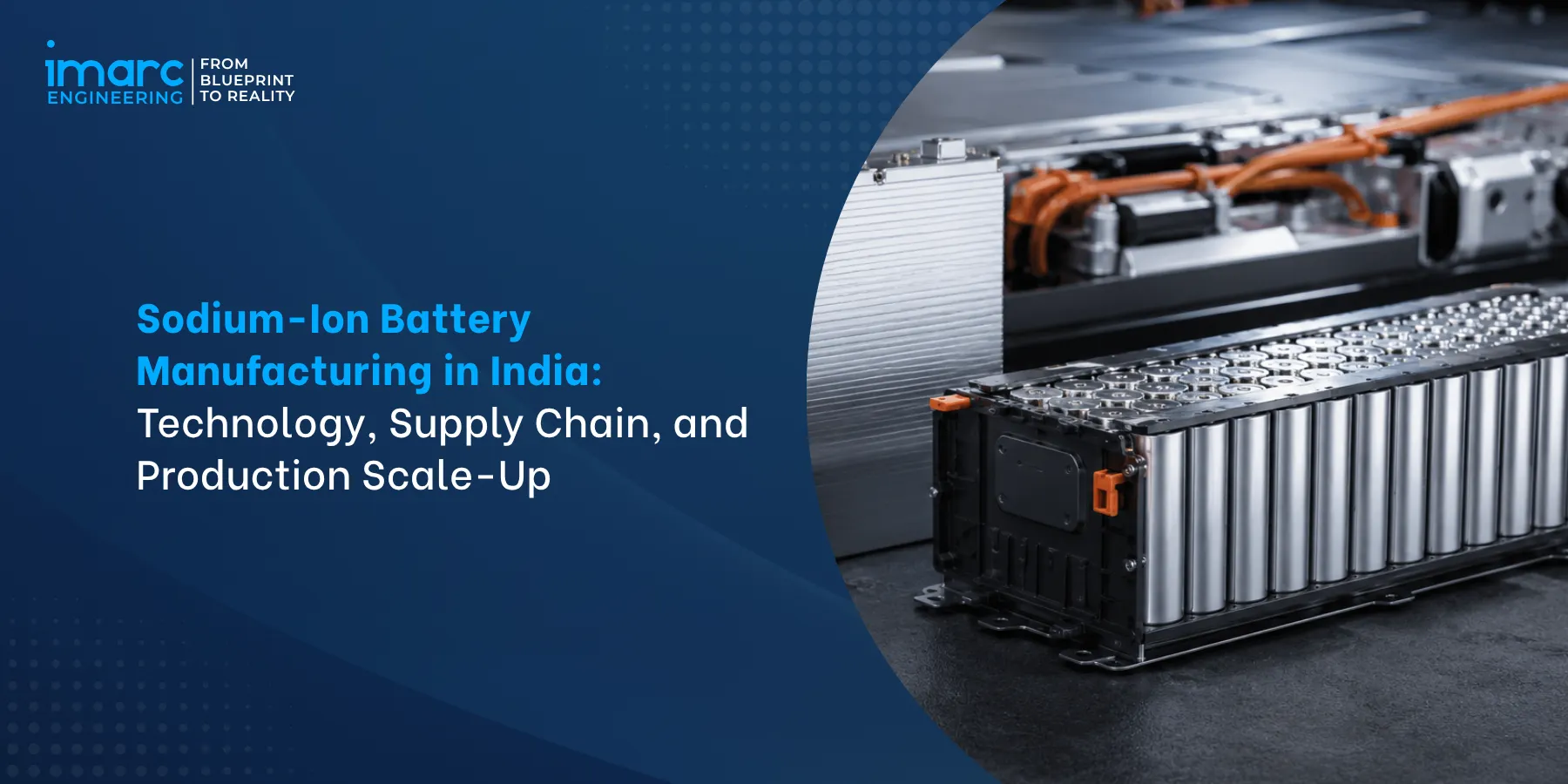
For battery manufacturers, technology sponsors, and energy storage investors evaluating India's evolving cell manufacturing landscape in 2026, sodium-ion battery manufacturing in India represents a distinct opportunity alongside established lithium-ion production. Sodium-ion chemistry offers advantages including sodium abundance, aluminium current collectors on both electrodes, better thermal safety, and hard carbon anode sourcing potentially from biomass.
However, moving from laboratory technology readiness through pilot production to commercial-scale manufacturing requires disciplined evaluation across cell chemistry, material supply chain, process capability, equipment, yield, quality, and target application economics.
Scope of this Guide
This guide answers the sponsor's project question directly. How can manufacturers develop and scale sodium-ion battery technology in India by selecting the right cell technology, building localised material supply chains, and planning production capacity, equipment, infrastructure, and commercial scale-up? It walks through chemistry selection, raw materials, manufacturing process, equipment, differences from lithium-ion manufacturing, pilot-to-commercial transition, and the practices distinguishing well-planned sodium-ion battery scale-up from opportunistic entry.
Table of Contents
- Introduction
- Why Sodium-Ion Battery Manufacturing Matters in India
- Sodium-Ion Battery Chemistry and Technology Selection for Manufacturers in India
- Sodium-Ion Battery Raw Materials and Supply Chain Localisation in India
- Sodium-Ion Battery Manufacturing Process and Cell Production Stages in India
- Sodium-Ion Battery Manufacturing Equipment and Production Line Design in India
- Lithium-Ion Versus Sodium-Ion Battery Manufacturing Differences for Indian Manufacturers
- Pilot Production to Commercial Scale-Up for Sodium-Ion Batteries in India
- Capex Opex and Feasibility for Sodium-Ion Battery Projects in India
- Conclusion
1. Why Sodium-Ion Battery Manufacturing Matters in India
Four drivers make sodium-ion battery manufacturing a strategic opportunity for Indian investors and cell manufacturers in 2026.
1.1 Material Abundance and Supply Chain Resilience
Sodium is substantially more abundant and geographically widespread than lithium, giving sodium-ion chemistry a potential raw-material and supply-chain advantage. India currently remains dependent on imported lithium and lithium-based battery materials, while sodium precursors and biomass feedstocks for hard carbon offer greater potential for domestic sourcing.
Sodium-based chemistry reduces this supply chain vulnerability by using abundant materials including sodium carbonate, sodium chloride derivatives, and hard carbon sourceable from biomass residues available domestically. Material abundance provides both cost and strategic autonomy advantages that lithium-dependent supply chains cannot achieve for the Indian market.
1.2 Cost Structure and Cell Economics
Sodium-ion cells use aluminium current collectors on both electrodes eliminating the copper current collector required for lithium-ion anodes. Cathode active materials for many sodium-ion chemistries do not require cobalt or nickel avoiding critical mineral cost exposure. Hard carbon anode sourcing from biomass presents domestic supply potential.
Sodium-ion technology has the potential to become cost-competitive in applications where lower-cost and more abundant raw materials can offset its generally lower energy density. However, actual competitiveness with LFP depends on chemistry, material costs, production yield, manufacturing scale, capacity utilisation, and supply-chain maturity.
1.3 Policy Support and PLI ACC Alignment
The Production Linked Incentive (PLI) Scheme for Advanced Chemistry Cell (ACC) Battery Storage, administered by the Ministry of Heavy Industries with an outlay of INR 18,100 crore and a target of 50 GWh of domestic ACC manufacturing capacity, is technology-agnostic. This creates a potential policy pathway for qualifying sodium-ion technologies, subject to the scheme's applicable technical, performance, investment, domestic-value-addition, and bidding requirements.
Battery Waste Management Rules 2022 as amended cover end-of-life management. Central policy alignment supports sodium-ion battery manufacturing investment within the broader ACC ecosystem rather than requiring chemistry-specific policy carve-outs.
1.4 Applications Fit and Market Development
Potential sodium-ion applications include stationary energy storage, telecom backup and other applications where cost, safety, cycle life, temperature performance, or supply-chain resilience may be prioritised over maximum gravimetric energy density. Selected mobility applications, including two- and three-wheelers, may also emerge where the chemistry's performance and economics meet OEM requirements.
India's renewable energy expansion supported by MNRE programmes creates baseline stationary demand. Cost-sensitive mobility segments where LFP economics are pressured support sodium-ion opportunity. Application fit rather than universal lithium-ion replacement drives the commercial thesis for sodium-ion investment.
2. Sodium-Ion Battery Chemistry and Technology Selection for Manufacturers in India
Sodium-ion battery chemistry and technology selection for manufacturers in India establishes the foundation for all downstream decisions. Chemistry choice affects material supply chain, equipment selection, cell performance profile, and target application fit.
2.1 Cathode Chemistry Options
| Cathode Family | Characteristics |
|---|---|
| Layered Oxides (e.g., NaMnO2, NaNiMnCo-based) | High capacity; moisture-sensitive processing |
| Polyanionic (e.g., NVP Na3V2(PO4)3, NFPP) | Strong cycle-life and thermal characteristics; performance and material economics vary by composition. |
| Prussian Blue Analogues (PBA) | Low cost; abundant precursors; capacity trade-offs |
| Sulphates and Fluorophosphates | Emerging chemistries with specific performance profiles |
2.2 Anode Selection and Hard Carbon Focus
Hard carbon is one of the leading anode-material choices for sodium-ion cells because conventional graphite does not readily accommodate sodium ions under typical carbonate-electrolyte conditions. Hard carbon can accommodate sodium through mechanisms influenced by its pore structure, disorder, precursor chemistry, and processing conditions, making material selection and optimisation important to cell performance.
Precursor selection and pyrolysis conditions affect final electrochemical performance. Soft carbon and titanium-based alternatives serve specific application niches. Hard carbon precursor and processing selection significantly affects both cell performance and material cost economics.
2.3 Electrolyte and Separator
Sodium-ion electrolyte formulations use sodium salts including sodium hexafluorophosphate (NaPF6), sodium perchlorate (NaClO4), and sodium bis (fluorosulfonyl)imide (NaFSI) dissolved in organic solvents (ethylene carbonate, propylene carbonate, dimethyl carbonate) with additives supporting solid electrolyte interphase (SEI) formation.
Separator materials largely follow lithium-ion practice with polypropylene, polyethylene, and ceramic-coated options. Electrolyte formulation optimisation supporting cell performance and safety represents an active development area with proprietary formulations differentiating manufacturers.
2.4 Cell Format and Chemistry-Format Matching
Cell format selection follows lithium-ion practice with cylindrical (18650, 21700, 26650, 32140), prismatic, and pouch options. Format selection matched to target application supports commercial economics. Cylindrical formats suit high-volume standardised production with mature equipment ecosystem. Prismatic formats suit high capacity stationery and vehicle applications.
Pouch formats suit application-specific customisation. Chemistry-format matching supports both performance targets and manufacturing efficiency; some chemistries perform better in specific formats due to thermal and mechanical considerations.
3. Sodium-Ion Battery Raw Materials and Supply Chain Localisation in India
Sodium-ion battery raw materials and supply chain localisation in India represents both the strategic advantage and near-term constraint for commercial-scale manufacturing. The sodium-ion battery supply chain offers substantial domestic sourcing potential, but supplier ecosystem depth remains progressive.
3.1 Sodium Source Materials
Sodium precursors for cathode active material synthesis include sodium carbonate (Na2CO3), sodium hydroxide (NaOH), sodium chloride (NaCl), and sodium bicarbonate depending on target chemistry. India has substantial soda ash (sodium carbonate) manufacturing capacity from established chemical producers.
Sodium chloride availability is essentially unlimited from coastal salt operations. Sodium precursor supply is largely domestic-ready with limited import dependence, providing supply chain foundation that lithium chemistry cannot match without lithium mining or refining domestic capacity.
3.2 Cathode Active Material Supply
Sodium-ion cathode materials require specialised manufacturing beyond precursor supply. Layered oxide cathodes require controlled synthesis with precise stoichiometry, particle size distribution, and crystalline structure. Polyanionic compounds including Na3V2(PO4)3 (NVP) demand vanadium sourcing and specific synthesis protocols.
Prussian Blue Analogues require iron and manganese-based synthesis with controlled cyanide chemistry. Domestic cathode active material production currently limited with several R&D initiatives progressing towards commercial capacity. Import supplements domestic supply pending capacity build-out.
3.3 Hard Carbon Anode Ecosystem
Hard carbon manufacturing in India represents a strategic opportunity given biomass availability including coconut shell, rice husk, and sugarcane bagasse. India's substantial agricultural residue base supports biomass precursor sourcing at scale. Synthesis process typically involves precursor selection, high-temperature carbonisation under a controlled atmosphere, followed by appropriate post-treatment and material qualification.
Precursor selection and pyrolysis parameters significantly affect final electrochemical performance. Domestic hard carbon supply currently at pilot scale with several manufacturers developing commercial capacity supporting sodium-ion cell manufacturers.
3.4 Electrolyte and Ancillary Materials
Electrolyte manufacturing including sodium salt synthesis and formulation currently largely import-dependent for specialty salts including NaFSI. Sodium hexafluorophosphate (NaPF6) production supported by fluorine chemistry infrastructure. Solvent supply through chemical industry base. Separator supply through polymer film manufacturers.
Aluminium current collectors readily available domestically from established aluminium foil producers. Binder materials and conductive additives largely import-supplied. Progressive localisation across all ancillary categories supports supply chain resilience that early-stage cell manufacturers cannot manage on isolated basis.
4. Sodium-Ion Battery Manufacturing Process and Cell Production Stages in India
Sodium-ion battery manufacturing process and cell production stages in India closely parallels lithium-ion cell manufacturing enabling substantial equipment and process knowledge transfer. Key differences occur in slurry preparation, electrolyte handling, and formation protocols.
4.1 Cell Production Stage Sequence
| Stage | Function |
|---|---|
| Cathode slurry preparation | Mixing active material, binder, conductive additive, solvent |
| Cathode coating on aluminium foil | Doctor blade or slot-die coating both sides |
| Cathode drying and calendering | Solvent removal; density optimisation via calendering |
| Anode slurry preparation | Hard carbon, binder, conductive additive, aqueous or organic solvent |
| Anode coating on aluminium foil | Coating both sides; sodium-ion uses aluminium not copper |
| Anode drying and calendering | Solvent removal; density optimisation |
| Electrode slitting | Cutting to required width for cell format |
| Cell assembly (winding or stacking) | Format-specific assembly with separator |
| Tab welding and can insertion | Cell can or pouch integration |
| Electrolyte filling in dry room | Controlled atmosphere with humidity below 1 percent RH |
| Formation and aging | Initial charge-discharge cycles; SEI stabilisation |
| Cell testing and grading | Capacity, impedance, self-discharge verification |
4.2 Slurry Preparation Specifics
Slurry preparation for sodium-ion cathodes requires attention to moisture-sensitivity of layered oxide chemistries. Cathode slurry typically uses PVDF (polyvinylidene fluoride) binder in NMP (N-methyl-2-pyrrolidone) solvent following lithium-ion practice. Anode slurry using hard carbon supports aqueous binder systems (CMC-SBR) reducing organic solvent use versus lithium-ion NMC anodes.
Precise mixing energy, sequence, and duration significantly affect final electrode performance. Slurry quality control including viscosity, solid content, and particle dispersion supports coating consistency across production runs.
4.3 Coating, Calendering, and Slitting
Coating processes follow lithium-ion practice with slot-die coating for high-volume production. Coating uniformity across web width and length affects cell capacity variance. Drying protocols must remove residual moisture to specifications given sodium-ion moisture sensitivity.
Calendering compresses each electrode to the target thickness, porosity, and density established for the selected chemistry and cell design. Slitting to precise width supporting cell assembly. Web handling minimising particle contamination critical throughout electrode preparation.
4.4 Cell Assembly and Formation
Cell assembly follows format-specific practice with cylindrical cells using winding machines, prismatic cells using either winding or stacking, and pouch cells using stacking. Assembly typically occurs in controlled environment with dust and humidity control. Electrolyte filling occurs in dry room with humidity typically below 1 percent RH (approximately -40 degrees Celsius dew point) preventing electrolyte degradation. Formation cycles at defined charge rates support solid electrolyte interphase (SEI) formation critical to cell cycle life. Formation protocols specific to sodium-ion chemistry differ from lithium-ion patterns.
5. Sodium-Ion Battery Manufacturing Equipment and Production Line Design in India
Sodium-ion battery manufacturing equipment and production line design in India substantially overlaps with lithium-ion production infrastructure. This overlap supports both cost efficiency and workforce leverage for manufacturers extending from lithium-ion to sodium-ion.
5.1 Core Electrode Preparation Equipment
- Planetary mixers and continuous mixers for slurry preparation
- Slot-die coaters or comma coaters for double-sided electrode coating
- Multi-zone drying ovens with atmosphere control
- Calenders (roll-to-roll) with precise thickness control
- Slitting machines with automatic tension control
- Vacuum ovens for final electrode drying
- Quality inspection systems including thickness gauging and defect detection
5.2 Cell Assembly Equipment
- Winding machines for cylindrical and prismatic cell sodium-ion cell assembly
- Stacking machines for pouch and prismatic cells
- Tab welders (ultrasonic, laser)
- Cell can insertion and beading equipment for cylindrical formats
- Pouch cell sealing equipment (heat, ultrasonic)
- Electrolyte filling machines with vacuum-assisted infiltration
- Cell degassing and final sealing equipment
5.3 Formation, Aging, and Testing
- Formation cyclers for controlled initial charge-discharge cycles supporting sodium-ion battery testing
- Aging chambers with temperature control
- Cell test equipment for capacity, impedance, and self-discharge measurement
- Grading and sorting systems for cell classification
- Environmental test chambers for cell qualification
- Transport qualification equipment supporting UN 38.3 testing, including vibration, shock and other applicable transport tests for sodium-ion cells and batteries.
5.4 Dry Room and Facility Infrastructure
Plant infrastructure for sodium-ion battery manufacturing in India requires controlled environmental conditions to support moisture-sensitive cell assembly and electrolyte-handling operations. Cleanliness and humidity-control requirements should be determined by the selected cell chemistry, electrolyte system, manufacturing process, equipment specifications, and product-quality requirements rather than applying a universal cleanroom classification or dew-point threshold.
Facility infrastructure may include dry rooms and dehumidification systems, HVAC, compressed-air distribution for pneumatic equipment, chilled-water systems for process and equipment cooling, electrical distribution, process exhaust, fire protection, and nitrogen or argon supply where required for specific operations.
Dry-room, environmental-control, and utility infrastructure can represent a significant part of project CAPEX and directly influence process stability, product quality, and production yield. These systems should therefore be sized against the selected chemistry, production capacity, equipment configuration, and manufacturing specifications.
6. Lithium-Ion Versus Sodium-Ion Battery Manufacturing Differences for Indian Manufacturers
Lithium-ion versus sodium-ion battery manufacturing differences for Indian manufacturers matter for existing lithium-ion producers evaluating sodium-ion extension. The differences are targeted rather than fundamental supporting substantial infrastructure reuse.
6.1 Material and Component Differences
| Component | Lithium-Ion | Sodium-Ion |
|---|---|---|
| Cation carrier | Lithium (Li+) | Sodium (Na+) |
| Cathode active material | LFP, NMC, NCA, LMO | Layered oxides, NVP, PBA, others |
| Anode active material | Graphite, silicon composites | Hard carbon (primary) |
| Anode current collector | Copper | Aluminium |
| Cathode current collector | Aluminium | Aluminium |
| Electrolyte salt | LiPF6, LiFSI | NaPF6, NaFSI, NaClO4 |
| Cell voltage (nominal) | 3.2-3.7 V typical | 3.0-3.3 V typical |
| Energy density (typical) | 120-260 Wh/kg | 100-160 Wh/kg |
6.2 Manufacturing Process Overlaps and Reuse
Manufacturing process overlaps enable substantial equipment and workforce reuse. Slurry mixing, coating, calendering, slitting, cell assembly (winding, stacking, tab welding), and testing processes largely identical. Dry room infrastructure adaptable across chemistries. Formation and aging equipment configurable across chemistries.
A significant portion of lithium-ion electrode preparation, cell assembly, formation, and testing infrastructure may be adaptable for sodium-ion production. However, the actual reuse potential must be assessed equipment by equipment against the selected sodium-ion chemistry, electrode formulation, cell format, process window, contamination-control requirements, and production specification.
6.3 Chemistry-Specific Adjustments Required
Chemistry-specific adjustments include slurry formulation optimisation for cathode moisture sensitivity, anode slurry rheology for hard carbon versus graphite, electrolyte handling protocols for sodium salt properties, formation protocols optimised for SEI formation on hard carbon, and testing protocols for sodium-ion cycle characteristics.
Anode current collector change from copper to aluminium enables cost reduction but requires supplier and process qualification. Adjustments are targeted rather than fundamental supporting adaptation from lithium-ion base with reasonable engineering effort.
6.4 Standards and Testing Framework
The standards and regulatory framework for sodium-ion batteries is still evolving and depends on the intended application, market, cell or battery configuration, and transport requirements. Manufacturers should therefore map applicable Indian and international safety, performance, transport, and end-use requirements during product and facility planning rather than assuming that every lithium-ion standard automatically applies to sodium-ion technology.
International dangerous-goods frameworks now include specific provisions for sodium-ion batteries, while standards bodies continue to develop and update requirements relevant to emerging battery chemistries. For Indian projects, applicable BIS standards, automotive requirements where relevant, transport testing, and customer-specific qualification requirements should be verified for the intended product and application before commercial production.
7. Pilot Production to Commercial Scale-Up for Sodium-Ion Batteries in India
Pilot production to commercial scale-up for sodium-ion batteries in India represents the critical transition from technology demonstration to commercial viability. Distinguishing laboratory technology readiness from manufacturing readiness and commercial readiness matters for realistic project planning.
7.1 Technology Readiness Levels
| Readiness Stage | Focus |
|---|---|
| Laboratory (TRL 3-5) | Cell chemistry validation in small format cells |
| Pilot production (TRL 6-7) | Cell-format production at 10-500 MWh per year scale |
| Manufacturing demonstration (TRL 8) | Yield and quality demonstration at commercial format |
| Commercial production (TRL 9) | Sustained production at target capacity with commercial economics |
7.2 Yield and Quality Development
Sodium-ion battery pilot production typically achieves initial yields around 60-80 percent versus mature lithium-ion facilities at 95-plus percent. Yield development through pilot stage supports both commercial economics and process learning. Common yield loss mechanisms include electrode coating defects, cell assembly misalignment, electrolyte filling variability, formation excursions, and cell testing rejections.
Statistical Process Control (SPC), root cause analysis, and continuous improvement discipline during pilot support subsequent commercial yield targets. Yield trajectory during pilot indicates commercial readiness more reliably than laboratory performance.
7.3 Scale-Up Capacity Planning
Scale-up capacity planning progresses through defined stages matching demand development. Pilot capacity typically 10-500 MWh per year supporting product development and initial customer qualification. Demonstration capacity typically 500 MWh to 2 GWh per year supporting production learning and initial commercial deployment.
Commercial capacity typically 2-10 GWh per year supporting sustained commercial operations. Giga-scale capacity above 10 GWh per year supporting mass market applications. Progressive capacity addition matched to demand development and process maturity outperforms accelerated scale-up risking yield and quality issues.
7.4 Customer Qualification and Target Applications
Sodium-ion battery commercial production requires customer qualification across target application segments. Stationary storage system integrators evaluate sodium-ion for grid support and behind-the-meter applications. Electric two-wheeler and three-wheeler OEMs evaluate for cost-sensitive mobility. Telecom operators evaluate for tower backup.
Customer qualification timelines vary by application, product maturity, testing requirements, OEM or system-integrator specifications, and the amount of field validation required. Documented customer qualification during pilot production supports subsequent commercial ramp-up that generic application claims cannot achieve.
8. Capex Opex and Feasibility for Sodium-Ion Battery Projects in India
Capex opex and feasibility for sodium-ion battery projects in India scales substantially with target capacity and vertical integration scope. Financial framework matched to realistic technology readiness supports credible investment planning.
8.1 What Determines Sodium-Ion Plant CAPEX?
Sodium-ion battery manufacturing CAPEX depends on the target annual production capacity, selected cell chemistry and format, automation level, equipment sourcing strategy, dry-room and environmental-control requirements, formation and testing capacity, utility infrastructure, and the degree of vertical integration.
A cell-manufacturing facility sourcing qualified cathode, hard-carbon anode, electrolyte, separator, and other materials will have a materially different investment profile from an integrated project that also produces cathode active material, hard carbon, or other battery components in-house.
For early-stage project planning, CAPEX should therefore be developed from the selected process route, equipment list, line capacity, utility load, building and dry-room requirements, localisation strategy, testing infrastructure, implementation schedule, and contingency assumptions rather than applying a generic cost-per-GWh or facility-size benchmark.
8.2 Opex Structure and Cell Economics
Operating costs for sodium-ion cell manufacturing include cathode active material, hard-carbon anode material, electrolyte, separator, current collectors, binders, conductive additives, packaging materials, and other production consumables. Their relative contribution to cell cost varies according to the selected chemistry, cell format, material specifications, sourcing strategy, and production scale.
Other operating costs include electricity for electrode drying, environmental control and dry-room operation, formation and testing; manpower across production, quality, maintenance, and support functions; process chemicals and consumables; equipment maintenance; and costs associated with scrap and yield losses.
Commercial cell economics depend not only on the potential cost advantage of sodium-based raw materials but also on material qualification and sourcing costs, purchasing scale, production yield, line utilisation, energy consumption, manufacturing maturity, and supply-chain localisation. As production scales, improvements in these factors can progressively reduce unit manufacturing costs.
8.3 Feasibility Determinants
- Technology readiness of chosen cathode chemistry through pilot demonstration
- Supply chain readiness across cathode active material, hard carbon anode, and electrolyte
- Target application demand supporting commercial economics
- Potential eligibility and alignment with applicable PLI ACC requirements
- Plant infrastructure and yield capability during pilot supporting commercial extrapolation
- Capital availability for pilot-to-commercial scale-up over 3-5 year horizon
- Workforce capability across cell manufacturing, quality, and support functions
- Regulatory compliance across Battery Waste Management Rules 2022, AIS-156 where EV applies, and applicable standards
Conclusion
Advancing sodium-ion battery manufacturing in India requires cathode and hard-carbon anode development, electrolyte and cell-format selection, adapted manufacturing processes, dry-room infrastructure, pilot-scale validation, progressive scale-up, and customer qualification. PLI ACC support and evolving standards strengthen the investment case.
Three closing reminders: First, distinguish laboratory, pilot, and commercial readiness. Second, develop domestic cathode and hard-carbon supply chains early. Third, target applications such as stationary storage, telecom backup, and cost-sensitive mobility rather than treating sodium-ion as a universal lithium-ion replacement.
PLANNING SODIUM-ION BATTERY MANUFACTURING?
IMARC Engineering supports sodium-ion battery manufacturing projects across feasibility assessment, technology and equipment evaluation, material-supply-chain planning, plant layout and process engineering, utility and dry-room planning, CAPEX/OPEX assessment, regulatory planning, vendor selection, pilot-to-commercial scale-up, and project execution.
→ Schedule a free sodium-ion battery manufacturing scoping consultation with an IMARC specialist
Frequently Asked Questions
Sodium-ion cell manufacturing produces rechargeable cells using sodium (Na) ions as the charge carrier instead of lithium. Cells combine sodium-based cathodes, hard carbon anodes, sodium salt electrolytes, and aluminium current collectors on both electrodes through processes similar to lithium-ion cell production.
Yes, sodium-ion cell manufacturing shares nearly identical process steps and equipment with lithium-ion including coating, calendaring, winding or stacking, filling, formation, and testing. Adaptation typically requires modifications to slurry preparation, electrolyte handling, and formation parameters rather than fundamental production line redesign.
Sodium-ion battery manufacturing in India involves cathode and anode slurry preparation, coating on aluminium current collectors, calendering, slitting, cell assembly (cylindrical, prismatic, or pouch format), electrolyte filling in dry room, formation, aging, and testing.
Sodium-ion battery materials include cathode active material (layered oxides, polyanionic compounds like NVP, or Prussian Blue Analogues), hard carbon anode often derived from biomass, sodium salt electrolyte (NaPF6, NaFSI), separator film, aluminium current collectors, binders, conductive additives, and cell housing materials.
Sodium-ion battery manufacturing equipment includes slurry mixers, coating machines, drying ovens, calenders, slitters, cell assembly lines (winding or stacking machines), tab welders, dry room infrastructure, electrolyte filling stations, formation and aging equipment, and comprehensive cell testing and grading systems for quality validation.
Key differences include aluminium current collectors on both electrodes (versus copper for lithium anode), different active materials (sodium-based cathodes and hard carbon anodes), different electrolyte chemistry, and different formation protocols. Process equipment largely overlaps enabling significant capital reuse for lithium-ion manufacturers extending into sodium-ion.
Sodium-ion battery scale-up challenges include hard carbon anode supply chain development, cathode active material supply (layered oxides, polyanionic compounds, Prussian Blue Analogues), electrolyte formulation optimisation, achieving lithium-ion parity yields, target application definition, and cost competitiveness during transition from pilot to commercial production.
Feasibility depends on technology readiness of chosen chemistry, supply chain readiness for cathode active material and hard carbon anode, target application demand supporting commercial economics, alignment with PLI ACC scheme benefits, plant infrastructure and yield capability, and capital availability for pilot-to-commercial scale-up.
Recent Post
Trusted by Industry Leaders
We partner with global enterprises and ambitious businesses across sectors to deliver operational excellence, strategic insights, and sustainable growth through integrated solutions.










Success in Their Words
Real feedback from clients across industries. Discover how our solutions delivered measurable impact and operational excellence.

I wanted to express my sincere appreciation for your efforts in handling this matter. Your dedication and commitment have been truly commendable, and it is evident that you have put in tremendous hard work and expertise into resolving the issues at hand. We are greatly interested in continuing our collaboration with you in the future, as your professionalism and reliability have made you a trusted partner. Thank you once again for your invaluable contribution. We look forward to strengthening our partnership ahead.

It has been a pleasure working with the IMARC team. The insights provided were structured, clear, and highly valuable, helping us strengthen both our technical and financial planning with confidence. We deeply appreciate the team’s professionalism, responsiveness, and attention to detail throughout the engagement. Every requirement was well understood and effectively incorporated, resulting in a comprehensive and actionable output. Overall, our experience has been excellent, and I would gladly recommend IMARC to organizations seeking a reliable research partner.

Your service is truly exceptional. Working with the IMARC team has been a seamless and professional experience. The clarity of communication, responsiveness to queries, and consistent support at every stage made the entire engagement highly efficient. The insights shared were well-structured, practical, and perfectly aligned with our requirements, helping us make informed decisions with confidence. Overall, the dedication and professionalism demonstrated by your team stand out, and I would be glad to recommend IMARC as a reliable and trustworthy research partner.

IMARC did an outstanding job in preparing our study. They were punctual, precise, and consistently responsive throughout the entire process. The team delivered all the data we required in a clear, well-organized, and highly professional format. Their strong attention to detail, combined with their ability to meet every deadline without compromising quality, truly set them apart. Overall, their reliability and commitment made them an exceptional partner for our project, and we would gladly work with them again in the future.

IMARC made the whole process incredibly easy from start to finish. Everyone I interacted with via email was polite, professional, and straightforward to deal with, always keeping their promises regarding delivery timelines and remaining consistently solutions-focused. From my very first contact, I appreciated the professionalism and support shown by the entire IMARC team. I highly recommend IMARC to anyone seeking timely, affordable, and reliable information or advice. My experience with IMARC was excellent, and I truly cannot fault any aspect of it.

I’d like to express my sincere gratitude for the excellent work you accomplished with the study. Your ability to quickly understand our requirements and deliver high-quality results under tight timelines truly reflects your expertise, exceptional work ethic, and unwavering commitment to your customer’s success. The professionalism and responsiveness you demonstrated throughout the process made a significant difference. Our entire team and company are incredibly thankful for your dedication, reliability, and support. Once again, thank you for your outstanding contribution.