Manufacturing
October 13 2026
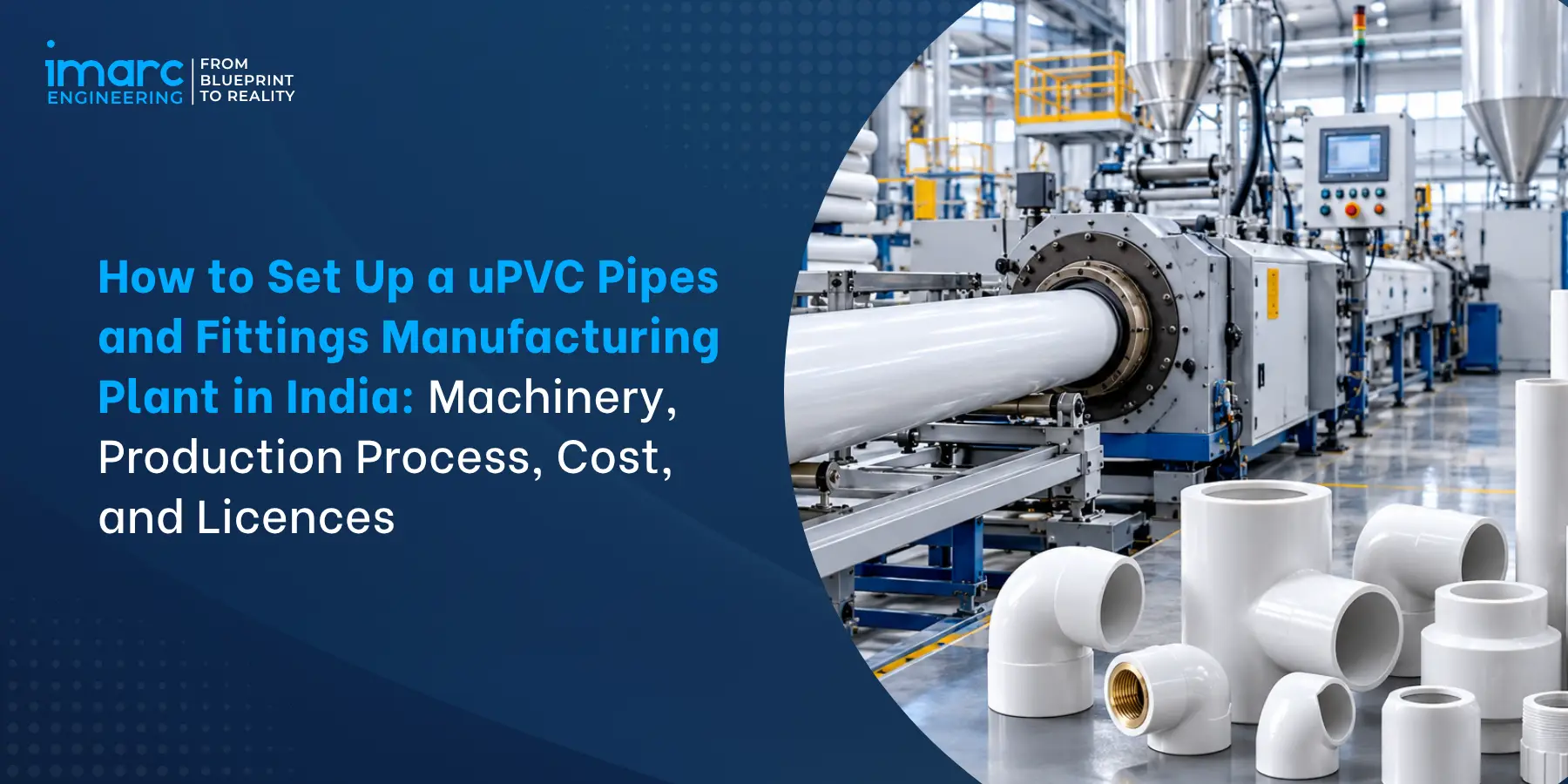
How to Set Up a uPVC Pipes and Fittings Manufacturing Plant in India: Machinery, Production Process, Cost, and Licences
Introduction
For investors and manufacturers planning a uPVC pipe manufacturing plant in India in 2026, the project combines product category decisions (water supply, SWR drainage, agriculture, borewell), production capacity, extrusion line selection, injection moulding for fittings, utilities, quality systems, applicable BIS certification. uPVC pipes for potable water supply are governed by IS 4985:2021 and pipes for soil and waste discharge inside and outside buildings by IS 13592:2013 - with injection-moulded PVC fittings covered by the IS 7834 series.
Scope of this Guide
This guide walks through uPVC pipes and fittings manufacturing from the production process and raw materials through machinery, utilities, quality control, regulatory approvals, CAPEX/OPEX, and the full project lifecycle - calibrated to the policy framework operating in 2026 and anchored to project-specific assumptions rather than universal claims.
Table of Contents
- Introduction
- Why uPVC Pipes and Fittings Manufacturing Matters for India in 2026
- uPVC Pipe Manufacturing Process from Dry Blending to Socketing in India
- Raw Materials and Compound Formulation for uPVC Pipe Manufacturing in India
- Machinery and Production Line Configuration for uPVC Pipe Manufacturing Plant in India
- Pipe Extrusion Versus Fittings Injection Moulding for uPVC Manufacturing in India
- Utilities Plant Layout and Quality Control for uPVC Pipe Manufacturing in India
- BIS Standards Licences and Regulatory Approvals for uPVC Pipe Manufacturing in India
- CAPEX OPEX and Project Lifecycle for uPVC Pipe Manufacturing Plant in India
- Conclusion
1. Why uPVC Pipes and Fittings Manufacturing Matters for India in 2026
Four drivers make disciplined uPVC pipe project investment strategically important for India in 2026.
1.1 Infrastructure and Housing Demand
India's water-infrastructure programmes - Jal Jeevan Mission (functional household tap connections), AMRUT 2.0 (urban water supply), Smart Cities Mission, and state-level irrigation and drainage projects - have driven sustained demand for uPVC pipes and fittings manufacturing. Residential and commercial construction, agriculture, and industrial applications add further pull.
Replacement of ageing GI and cement pipe systems is a steady long-term source of demand. The addressable market supports investment in dedicated manufacturing capacity across tiers from small regional players to large multi-plant national brands.
1.2 Material Advantage
Unplasticized polyvinyl chloride (uPVC) offers corrosion resistance, chemical inertness, long service life (typically 50 years in cold water applications), low internal friction, light weight, and competitive economics. Compared with galvanised iron, cast iron, or concrete pipes, uPVC installs faster, requires less maintenance, and does not leach iron into potable water - anchoring sustained demand across water supply, drainage, agriculture, and borewell segments.
1.3 BIS Certification and Product Standards
The applicable BIS requirements depend on the product, standard, and current regulatory or procurement requirements. uPVC pipes for potable water supply are covered by IS 4985:2021, while IS 13592:2013, the IS 7834 series, and the IS 10124 series cover other pipe and fitting applications. Where BIS certification or the ISI Mark is required by a Quality Control Order, tender, customer specification, or procurement condition, manufacturers must establish the required conformity assessment and testing capability. The applicable requirement should be verified for each product before investment and production planning.
1.4 Government Push and Make-in-India
Policy support for domestic manufacturing - including MSME Champions Scheme components for technology upgradation and state industrial policies in Gujarat, Maharashtra, Tamil Nadu, Karnataka, Rajasthan, UP, MP, and Telangana offering capital subsidies and power tariff rebates - improves uPVC pipe plant setup project IRR. Udyam registration opens access to MSME schemes for eligible units, while BIS certification and anti-dumping measures on PVC resin from select origins support domestic capacity.
2. uPVC Pipe Manufacturing Process from Dry Blending to Socketing in India
Understanding the uPVC pipe manufacturing process clarifies the sequence from raw material intake through finished pipe dispatch.
2.1 Dry Blending
The process begins with dry blending of PVC resin and additives in a high-speed mixer. PVC resin (suspension grade, K-value typically 65-67 for pressure pipes), heat stabilizers, processing aids, lubricants, impact modifiers, fillers (calcium carbonate), and pigments are metered to recipe and mixed. Frictional heat raises the blend temperature to a controlled level appropriate for the formulation, supporting uniform additive distribution and absorption of certain liquid ingredients into the PVC resin. The hot blend is subsequently transferred to a cooling mixer to reduce its temperature before storage or extrusion, helping prevent agglomeration and premature processing problems.
The hot blend is transferred to a cooling mixer that brings it down to 40-50 degrees C before storage - preventing agglomeration and premature degradation. The dry blend quality determines downstream extrusion stability and pipe quality.
2.2 Twin-Screw Extrusion
The dry blend is fed to a twin-screw extruder (conical or parallel) sized to the target pipe diameter and output. Material is conveyed, compressed, melted, and homogenised through heated barrel zones (typically 160-200 degrees C profile) and metered through an annular pipe die. The molten pipe emerges from the die at target diameter plus allowance for sizing shrinkage.
Twin-screw design is standard for rigid PVC because the counter-rotating screws deliver positive conveying, controlled residence time, and precise temperature profile - critical for a heat-sensitive polymer. Screw speed, barrel temperatures, and die temperatures are tuned to each product.
2.3 Vacuum Calibration and Cooling
The extruded pipe enters a vacuum calibration tank where it is pulled against a sizing sleeve by vacuum, setting outer diameter and wall thickness while the pipe cools and solidifies. Water sprays and immersion cool the pipe through subsequent tanks to room temperature. A haul-off unit (caterpillar or belt) with speed matched to extrusion rate pulls the pipe through calibration and cooling - any mismatch between extrusion and haul-off changes wall thickness and ovality.
2.4 Cutting Socketing and Packaging
Cooled pipe is cut to standard lengths (typically 3 or 6 metres) by a planetary or orbital cutter that moves with the pipe to maintain line speed. For socket-and-spigot jointed pipes, one end is passed through a socketing (belling) machine that heats the pipe end, forms the socket over a mandrel, and cools it in place. Chamfering, printing of IS mark and specification, visual inspection, dimensional check, and bundling complete the production flow. Fittings produced by injection moulding feed into the same packaging and dispatch flow.
3. Raw Materials and Compound Formulation for uPVC Pipe Manufacturing in India
Understanding uPVC pipe manufacturing raw material inputs is central to specification, cost, and quality control. Each additive has a defined function.
3.1 PVC Resin
PVC resin is the primary raw material used in uPVC pipe manufacturing. Suspension-grade polyvinyl chloride is commonly used, with resin K-value selected according to the intended application, processing requirements, and applicable BIS product standards. The resin is supplied as a free-flowing white powder, and its properties influence extrusion performance, mechanical strength, and finished-pipe quality.
In India, PVC resin is sourced from domestic manufacturers, including Reliance Industries, Chemplast Sanmar, and DCM Shriram, as well as international suppliers from the Middle East, Southeast Asia, and the United States. Since PVC resin typically accounts for a significant share of raw material costs, supplier selection, procurement strategy, price fluctuations, and inventory management play an important role in determining plant operating costs and profitability.
3.2 Stabilizers Lubricants and Processing Aids
Heat stabilizers protect PVC from thermal degradation during processing. Heat stabilizers of choice have shifted to calcium-zinc (Ca-Zn) systems from traditional lead-based systems - lead stabilizers are being phased out globally for health and environmental reasons, with calcium-zinc now standard for potable-water-contact applications. Lubricants (internal and external, usually stearate-based) control melt flow and prevent metal-polymer adhesion in the extruder.
Processing aids (acrylic polymers) promote fusion of the resin and improve surface finish. Impact modifiers (chlorinated polyethylene, methyl methacrylate-butadiene-styrene, or acrylic) raise the pipe's resistance to impact and transportation damage.
3.3 Fillers and Pigments
Calcium carbonate is commonly used as a filler in uPVC formulations to influence cost, stiffness, and processing characteristics. Its type and loading are formulation-specific and must be selected to achieve the required properties of the finished product. Excessive filler can adversely affect mechanical and pressure performance, so the formulation should be validated against the applicable product standard and testing requirements.
Pigments (titanium dioxide for white/cream pipes, carbon black for grey/black pipes, iron oxides for other shades) provide colour and UV stability. Each additive is checked at incoming inspection against supplier Certificate of Analysis.
3.4 Formulation Summary
The following ranges are illustrative formulation benchmarks for preliminary project assessment only. They are not prescribed BIS formulations and should not be used as a compliance recipe. Actual formulation depends on the product, pressure/class requirements, raw materials, additives, processing equipment, and applicable product standard.
| Component | Role | Typical Range (% of compound) (Indicative in Nature) |
|---|---|---|
| PVC resin (K-67) | Base polymer | 60-80 |
| Calcium carbonate | Filler, stiffness | 5-20 |
| Heat stabilizer (Ca-Zn) | Thermal protection | 2-4 |
| Lubricants (int + ext) | Melt flow, release | 1-2 |
| Processing aid | Fusion, finish | 1-2 |
| Impact modifier | Toughness | 0-6 |
| Pigment (TiO2 / others) | Colour, UV | 0.5-2 |
4. Machinery and Production Line Configuration for uPVC Pipe Manufacturing Plant in India
Understanding uPVC pipe manufacturing machinery links target capacity, pipe diameter range, and automation level to line specification.
4.1 Mixing Section
The mixing section pairs a high-speed mixer (typically 500-1000 kg per batch) with a cooling mixer sized to match. Batch cycle time is around 8-12 minutes. The mixer feeds a hot blend hopper, from which the cooling mixer discharges to day silos or directly to extruder hoppers. Automatic weighing systems for each additive support recipe-controlled dosing - critical when multiple pipe grades (water, drainage, agriculture) are produced on alternating shifts. Material transfer uses vacuum conveying or screw conveyors to minimise dust and spillage.
4.2 Extrusion Line
The core of the plant is the pipe extrusion line. A twin-screw extruder (conical or parallel) sized to output and pipe diameter is the primary machine - small lines run 150-300 kg per hour, mid-range lines 400-700 kg per hour, and large lines 800-1500 kg per hour or more for large-diameter pipes. The extruder is matched with a pipe die, vacuum calibration tank, cooling tanks (spray and immersion), haul-off unit, cutting machine with chamfering, and socketing/belling machine. Each component is sized to the maximum pipe diameter and output - mismatched sizing creates bottlenecks or wasted capacity. Modern lines run under PLC control with recipe management and data logging.
4.3 Injection Moulding for Fittings
Where the plant also produces fittings, injection moulding machines (typically 150-800 tonne clamp force depending on fitting size) handle elbows, tees, bends, caps, reducers, couplings, and other injection-moulded shapes. Multi-cavity moulds reduce unit cost - a single mould may produce 4, 8, or 16 pieces per cycle for small fittings. The moulds themselves are a significant capital item and are typically ordered from specialised mould makers. Fittings cycle times run 20-60 seconds depending on size and wall thickness.
4.4 Line Capacity Options
| Line Category | Output | Pipe Diameter Range | Suitability |
|---|---|---|---|
| Small/entry | 150-300 kg/hr | 20-110 mm | Regional, agriculture, borewell |
| Mid-range | 400-700 kg/hr | 20-315 mm | Water supply, SWR, growing brands |
| Large/high-output | 800-1500+ kg/hr | Up to 630 mm | National brands, infrastructure projects |
5. Pipe Extrusion Versus Fittings Injection Moulding for uPVC Manufacturing in India
Many investors ask whether a facility should produce only pipes, only fittings, or both. The answer depends on market, scale, and capital availability - and uPVC pipes and fittings manufacturing uses two technically different manufacturing routes.
5.1 Pipe Extrusion
Pipe extrusion is a continuous process - compound melts through a twin-screw extruder, exits an annular die, is calibrated to size, cooled, cut to length, and finished. Economics favour long production runs of a single size per shift to minimise changeover time. Extrusion machinery is heavy capital with high throughput - a single mid-range line can produce several thousand tonnes per year. Pipe grades include IS 4985 water supply pipes (pressure classes), IS 13592 SWR drainage, IS 14735 sewerage, IS 15328 well casing, and agricultural pipes.
5.2 Fittings Injection Moulding
Fittings injection moulding is a discrete-cycle process - compound is injected into closed moulds, cooled, and ejected as finished parts. uPVC fittings manufacturing plant economics favour multi-cavity moulds for high-volume small fittings and single-cavity moulds for large or complex fittings. Fittings cover elbows, tees, bends, couplings, reducers, end caps, flanges, and specialty pieces. Standards include IS 7834 series for injection-moulded PVC fittings for pressure applications (several parts covering different fitting types) and IS 10124 for fabricated PVC fittings for potable water supply.
5.3 Combined vs Dedicated Facilities
A combined pipe-plus-fittings facility serves distributors and project customers with a complete range from one supplier - a commercial advantage in retail and project channels. The combined facility shares warehouse, QC laboratory, and utilities across both product streams. Dedicated pipe-only facilities achieve lower per-metre cost on long runs for project supply. Dedicated fittings facilities serve as backward integration for distributors. The right choice depends on target market mix and capital available.
5.4 Scrap and Recycling
Clean process scrap such as startup material, sprues, trim, and rejected pieces may be segregated, ground, and reused where permitted by the applicable product specification and quality-control system. Regrind levels should be established through product-specific validation rather than a universal percentage, particularly for pressure-rated or potable-water applications. Contaminated or unusable waste should be classified and managed under the applicable plastic-waste, hazardous-waste, and pollution-control requirements.
6. Utilities Plant Layout and Quality Control for uPVC Pipe Manufacturing in India
Understanding utilities and plant layout avoids retrofit cost, and quality control under BIS standards is the condition for ISI certification and market access.
6.1 Power Water Compressed Air and Cooling
The largest utility load is electrical power - extruder drive, heater bands, haul-off, cutter, mixer, cooling pumps, chillers, and auxiliaries. Specific energy for uPVC pipe extrusion typically runs 0.35-0.50 kWh per kg of pipe produced.
Water for calibration vacuum, pipe cooling, and chiller circuits is drawn from borewell, municipal supply, or treated effluent reuse - typically with soft water loop and periodic blowdown. Compressed air supports pneumatic actuators, cutting mechanisms and other equipment requiring pneumatic operation. Vacuum calibration tanks use dedicated vacuum pumps or suitable vacuum-generation systems to maintain the required sizing conditions. Cooling-water circulation, vacuum generation and compressed-air demand should be calculated separately during utility planning.
6.2 Plant Layout
The plant layout flows from raw material intake (resin and additive storage), to mixing section, to extrusion hall (long and narrow for straight-line pipe production), to post-extrusion finishing (socketing, printing, bundling), to warehouse (racked storage for pipes by diameter and class) and dispatch. Fittings moulding occupies a separate bay with its own raw material feed, moulding machines, cooling, and QC. Utility rooms (compressor, chiller, cooling tower, electrical panels) are located to minimise piping runs. QC laboratory is centrally located for sample access from both pipe and fittings production.
6.3 Quality Control Testing
Finished-pipe testing should follow the requirements and test methods specified in the applicable BIS product standard. Depending on the product and specification, testing may include dimensions, hydrostatic characteristics, Vicat softening temperature, reversion, impact resistance, density, and other specified physical or chemical properties. Manufacturers should prepare the QC test plan against the exact standard and product scope rather than applying one generic test list to all uPVC pipes.
Fittings should be tested against the requirements of the applicable fitting standard, which may include dimensional, visual, mechanical, pressure, joint-performance, or other specified tests depending on the product and standard. In-process checks include outer diameter and wall thickness measurement every 30-60 minutes, visual check for defects, and sample retention for traceability. BIS surveillance and conformity assessment activities are conducted in accordance with the applicable certification scheme, licence requirements, and product standard.
6.4 Hygiene and Potable Water Compliance
Pipes intended for potable water supply must meet the applicable requirements of IS 4985:2021, including specified requirements relating to the effect of the pipe on water and applicable material or chemical controls. Formulation and stabilizer selection should be validated against the applicable standard and any separate regulatory requirements governing substances such as lead. Testing should follow the specific requirements and methods prescribed for the product and certification scope.
7. BIS Standards Licences and Regulatory Approvals for uPVC Pipe Manufacturing in India
Understanding the full regulatory stack and BIS standards for a uPVC pipe manufacturing licence India avoids approval delays and market access rejection.
7.1 Applicable BIS Standards
Relevant BIS standards for uPVC pipes and fittings in India are IS 4985:2021 for unplasticized PVC pipes for potable water supply (pressure classes based on PN rating), IS 13592:2013 for unplasticized PVC pipes for soil and waste discharge systems inside buildings, IS 14735 for injection-moulded PVC fittings for soil and waste discharge systems, and IS 12818 for PVC-U screen and casing pipes for bore/tubewells, IS 7834 (Series Parts 1 to 8) for injection-moulded PVC fittings for pressure applications, and IS 10124 (Series) for fabricated PVC fittings for potable water supplies.
Each standard specifies raw material requirements, dimensions, physical and mechanical properties, test methods, and marking. Certification requirements should be checked against the latest applicable Quality Control Orders, BIS certification scheme, product standard, and relevant procurement specifications before project planning.
7.2 BIS ISI Certification
ISI certification may also be specified by municipal bodies, water utilities, government tenders, large project contractors, or individual customers. Manufacturers should verify the applicable Quality Control Order, tender specification, or customer requirement for each product before treating certification as mandatory. Where separate licences are required for different standards or factory locations, the scope should be confirmed with BIS before application.
For major procurement channels (municipal corporations, water utilities, government tenders, large project contractors) and preferred retail positioning, ISI certification is a practical requirement. The licence is issued per factory per IS standard - a factory producing both IS 4985 and IS 13592 pipes needs two licences. Application is through the BIS Manakonline portal.
7.3 Pollution Control and Factory Licensing
State Pollution Control Board (SPCB) Consent to Establish (CTE) and Consent to Operate (CTO) are required under the Water (Prevention and Control of Pollution) Act 1974 and the Air (Prevention and Control of Pollution) Act 1981. uPVC pipe manufacturing is typically a green or orange category industry depending on scale - no process effluent is generated beyond cooling water (which is recirculated with blowdown), and air emissions are limited to extruder-area ventilation.
Factory Licence under the Occupational Safety Health and Working Conditions Code 2020, which became effective 21 November 2025 and has replaced the Factories Act 1948, is obtained from the state Chief Inspector of Factories. Fire NOC per NBC 2016 Part 4 covers plant-wide fire detection, suppression, and emergency response.
7.4 Other Approvals
In addition to BIS certification and factory-level approvals, setting up a uPVC pipes and fittings manufacturing plant in India may involve Udyam registration for eligible MSMEs, GST registration, and an Importer Exporter Code (IEC) for importing PVC resin or exporting finished products. Compliance with the Legal Metrology Act, 2009, and the Legal Metrology (Packaged Commodities) Rules, 2011, may also apply to products sold in regulated retail packaging.
Manufacturers should assess their obligations under the Plastic Waste Management Rules, 2016, as amended, including Extended Producer Responsibility (EPR) registration where applicable. Manufacturing waste must be classified and managed under relevant environmental regulations, including the Hazardous and Other Wastes (Management and Transboundary Movement) Rules, 2016, where applicable.
Industrial electricity connections and related approvals must be obtained from the appropriate state distribution utility. Eligible manufacturers may also explore MSME and state industrial incentives. However, scheme availability, eligibility criteria, and application requirements should be verified before including financial assistance in project cost estimates.
8. CAPEX OPEX and Project Lifecycle for uPVC Pipe Manufacturing Plant in India
Understanding uPVC pipe manufacturing plant cost needs discipline. Universal CAPEX numbers divorced from capacity, product mix, and automation level mislead.
8.1 CAPEX Drivers
Primary CAPEX drivers are the extrusion lines (number, output, pipe diameter range, automation), injection moulding machines and fittings moulds (where applicable), mixing section (high-speed and cooling mixers, batch size), building and civil works (production hall, warehouse, QC lab, offices), utilities (power distribution, chilled water plant, compressors, cooling towers), raw material storage (silos for resin, warehouse for additives), QC laboratory equipment including hydrostatic test rigs, warehouse racking and material handling, land acquisition or lease premium, licensing fees including BIS ISI application cost, EPC margin, and project contingency. Extrusion lines plus moulds typically dominate hard CAPEX, with fittings moulds representing a significant and often underestimated capital line item.
8.2 OPEX Drivers
Primary OPEX components are PVC resin and additives (typically dominating direct cost - resin prices move with crude oil, petrochemical cycles, and anti-dumping duty on select origins), electricity (around 0.35-0.50 kWh per kg of pipe produced), water (cooling, mostly recirculated), labour (operators, QC, maintenance, warehouse, management), consumables and spares, maintenance and overhauls, scrap and giveaway, logistics (uPVC pipes are low-density high-volume cargo, so freight-to-value ratio is high), insurance, overheads, and depreciation. Utilisation rate and scrap rate are the two largest operational levers on unit cost.
8.3 Project Lifecycle
A typical greenfield uPVC pipe manufacturing project runs pre-feasibility and market scoping, feasibility and DPR (site, product mix, capacity, machinery, financial projections), parallel regulatory applications (SPCB CTE, Factory Licence pre-approval, electricity connection, Fire NOC, Udyam registration), FEED and detailed engineering (process layout, utility design, QC lab), equipment ordering and civil construction, equipment installation and utility commissioning, trial production for BIS factory audit and ISI licence grant, commercial launch, and ramp-up to full nameplate capacity.
The implementation timeline depends on land and infrastructure readiness, equipment procurement lead times, statutory approvals, utilities, installation complexity, trial production and applicable certification requirements. A project-specific execution schedule should be developed during the feasibility and DPR stages rather than assuming a standard completion period.
8.4 Profitability Levers
Project profitability depends on PVC resin procurement costs, production capacity utilisation, scrap and material efficiency, product mix, energy consumption, maintenance, distribution costs and selling-price realisation. Manufacturers should evaluate the commercial performance of pressure pipes, drainage pipes, borewell pipes and fittings separately, as margins vary by product specifications, demand, competition and distribution channel.
Freight economics should be assessed using the plant's location, target markets and logistics costs rather than a fixed distribution radius. BIS certification can support access to regulated or specification-driven procurement channels, but it does not automatically guarantee higher selling prices.
Conclusion
An effective uPVC pipe plant in India requires demand-led capacity planning, disciplined raw material and formulation management, appropriately sized extrusion and injection moulding machinery, efficient utilities and layout, and BIS certification under applicable standards. It also requires parallel regulatory approvals, CAPEX/OPEX planning, and a 12–18-month execution and ramp-up plan. Three priorities: design for BIS compliance from day one, secure reliable resin supply and pricing, and match production capacity to secured demand.
PLANNING A uPVC PIPE MANUFACTURING PLANT IN INDIA?
IMARC Engineering supports uPVC pipes and fittings projects with product and offtake validation, machinery selection, raw material and formulation planning, plant layout and utilities, QC laboratory setup, BIS certification support, regulatory approvals, CAPEX/OPEX modelling, FEED and detailed engineering, EPC/EPCM contracting, construction supervision, trial production, and production ramp-up.
→ Schedule a free uPVC pipe plant scoping consultation with an IMARC specialist
Frequently Asked Questions
Setting up a uPVC pipe manufacturing plant in India involves product selection, capacity planning, raw material sourcing, extrusion machinery, utilities, quality control infrastructure, and regulatory approvals. Key requirements may include State Pollution Control Board consents, factory licensing, fire safety approvals, and BIS certification where mandated by applicable Quality Control Orders or procurement specifications.
The uPVC pipe manufacturing process covers dry blending of PVC resin with stabilizers, lubricants, and fillers in a high-speed mixer, cooling, twin-screw extrusion through a pipe die, vacuum calibration, water cooling, haul-off, cutting to length, socketing (belling), printing, inspection, and packaging.
uPVC pipe raw materials include suspension-grade PVC resin (K-value 65-67 for pressure pipes), calcium-zinc heat stabilizers (replacing lead), lubricants (stearate-based), processing aids (acrylic polymers), impact modifiers (CPE, MBS, acrylic), calcium carbonate filler, and pigments (titanium dioxide, carbon black, iron oxides) per BIS formulation discipline.
uPVC pipe manufacturing machinery includes high-speed mixer with cooling mixer, twin-screw extruder, pipe die, vacuum calibration tank, cooling tanks, haul-off, planetary cutter, socketing machine, injection moulding machines for fittings with multi-cavity moulds, and QC laboratory equipment including hydrostatic test rigs.
uPVC pipe extrusion is a continuous process using twin-screw extruders producing pipes at defined diameter and length. Fittings manufacturing is a discrete injection-moulding process using multi-cavity moulds producing elbows, tees, bends, and couplings. Both share raw materials but use fundamentally different machinery and production economics.
uPVC pipe manufacturing plant cost depends on line output (150-1500+ kg/hr), diameter range, number of lines, inclusion of fittings moulding, automation level, land, utilities, and QC laboratory. Universal CAPEX figures mislead - costing requires defined specification, product mix, and site conditions before benchmarking.
uPVC pipe extrusion line capacity is set by extruder output in kg/hr, pipe diameter and wall thickness mix (large diameters run slower per metre), haul-off line speed, changeover downtime between diameter and class, scrap rate, and number of working shifts over the operating year.
A uPVC pipe factory requires reliable three-phase electricity, cooling-water circulation systems, vacuum pumps for pipe calibration, compressed air for pneumatic equipment, and suitable raw material and finished-product storage. Additional infrastructure includes a quality control laboratory, material handling systems, ventilation, and fire safety arrangements based on plant capacity and equipment specifications.
Relevant BIS standards include IS 4985:2021 for potable water supply pipes, IS 13592:2013 for soil and waste discharge pipes, IS 14735 for injection-moulded PVC fittings for soil and waste discharge systems, and IS 12818 for PVC-U screen and casing pipes for bore/tubewells. The IS 7834 series covers injection-moulded PVC pressure fittings, while the IS 10124 series covers fabricated PVC fittings. Manufacturers should verify the latest applicable standards and certification requirements for their products.
uPVC pipe licences include BIS ISI certification under Scheme I of BIS Conformity Assessment Regulations 2018, SPCB CTE/CTO under Water Act 1974 and Air Act 1981, Factory Licence under OSH Code 2020, Fire NOC per NBC 2016, Udyam, GST, and IEC where applicable.
uPVC pipe quality tests per IS 4985 and IS 13592 include hydrostatic pressure testing (short- and long-term), Vicat softening temperature, impact resistance, reversion test, density, dimensional check (outer diameter, wall thickness, ovality, length), and migration testing for potable water contact grades.
Profitability depends on PVC resin procurement costs, capacity utilisation, energy consumption, scrap rates, product mix, manufacturing efficiency, and distribution costs. Margins vary across pressure pipes, drainage pipes, borewell pipes, and fittings based on market demand, competition, product specifications, and sales channels. BIS certification can improve access to specification-driven procurement opportunities but does not automatically guarantee higher selling prices.
Recent Post

Trusted by Industry Leaders
We partner with global enterprises and ambitious businesses across sectors to deliver operational excellence, strategic insights, and sustainable growth through integrated solutions.












Success in Their Words
Real feedback from clients across industries. Discover how our solutions delivered measurable impact and operational excellence.

I wanted to express my sincere appreciation for your efforts in handling this matter. Your dedication and commitment have been truly commendable, and it is evident that you have put in tremendous hard work and expertise into resolving the issues at hand. We are greatly interested in continuing our collaboration with you in the future, as your professionalism and reliability have made you a trusted partner. Thank you once again for your invaluable contribution. We look forward to strengthening our partnership ahead.

It has been a pleasure working with the IMARC team. The insights provided were structured, clear, and highly valuable, helping us strengthen both our technical and financial planning with confidence. We deeply appreciate the team’s professionalism, responsiveness, and attention to detail throughout the engagement. Every requirement was well understood and effectively incorporated, resulting in a comprehensive and actionable output. Overall, our experience has been excellent, and I would gladly recommend IMARC to organizations seeking a reliable research partner.

Your service is truly exceptional. Working with the IMARC team has been a seamless and professional experience. The clarity of communication, responsiveness to queries, and consistent support at every stage made the entire engagement highly efficient. The insights shared were well-structured, practical, and perfectly aligned with our requirements, helping us make informed decisions with confidence. Overall, the dedication and professionalism demonstrated by your team stand out, and I would be glad to recommend IMARC as a reliable and trustworthy research partner.

IMARC did an outstanding job in preparing our study. They were punctual, precise, and consistently responsive throughout the entire process. The team delivered all the data we required in a clear, well-organized, and highly professional format. Their strong attention to detail, combined with their ability to meet every deadline without compromising quality, truly set them apart. Overall, their reliability and commitment made them an exceptional partner for our project, and we would gladly work with them again in the future.

IMARC made the whole process incredibly easy from start to finish. Everyone I interacted with via email was polite, professional, and straightforward to deal with, always keeping their promises regarding delivery timelines and remaining consistently solutions-focused. From my very first contact, I appreciated the professionalism and support shown by the entire IMARC team. I highly recommend IMARC to anyone seeking timely, affordable, and reliable information or advice. My experience with IMARC was excellent, and I truly cannot fault any aspect of it.

I’d like to express my sincere gratitude for the excellent work you accomplished with the study. Your ability to quickly understand our requirements and deliver high-quality results under tight timelines truly reflects your expertise, exceptional work ethic, and unwavering commitment to your customer’s success. The professionalism and responsiveness you demonstrated throughout the process made a significant difference. Our entire team and company are incredibly thankful for your dedication, reliability, and support. Once again, thank you for your outstanding contribution.