Manufacturing
October 12 2026
How to Set Up a Diaper Manufacturing Plant in India: Raw Materials, Machinery, Production Process, and Cost
Introduction
For investors, manufacturers, and project developers planning a diaper manufacturing plant in India in 2026, the project is an integrated FMCG decision - product type (baby or adult), production capacity, raw material sourcing, high-speed line configuration, utilities, hygiene systems, quality compliance, and regulatory approvals come together before the first diaper rolls off the line. The Medical Textiles (Quality Control) Order has made BIS ISI certification mandatory for disposable baby diapers under IS 17509:2021 and adult diapers under IS 17508:2020 - a non-negotiable gate to market.
Scope of the Guide
This guide walks through diaper manufacturing in India from the production process and raw materials to machinery, utilities, quality control, CAPEX/OPEX, and the full project lifecycle - calibrated to the policy framework operating in 2026 and anchored to project-specific assumptions rather than universal claims.
Table of Contents
- Introduction
- Why Diaper Manufacturing Matters for India in 2026
- Disposable Diaper Manufacturing Process from Raw Materials to Packaging
- Raw Materials and Components for Diaper Manufacturing
- Machinery and Production Line Configuration for Diaper Manufacturing
- Utilities Infrastructure and Hygiene Systems for a Diaper Manufacturing Plant
- Quality Control and BIS Compliance for Diaper Manufacturing in India
- CAPEX OPEX and Project Economics for Diaper Manufacturing Plant in India
- Regulatory Approvals and Project Lifecycle for Diaper Manufacturing Plant in India
- Conclusion
1. Why Diaper Manufacturing Matters for India in 2026
Four drivers make diaper manufacturing strategically important for India in 2026.
1.1 Growing Baby and Adult Diaper Demand
India's disposable diaper market has grown steadily, driven by rising urbanisation, higher disposable incomes, nuclear family structures, and increased hygiene awareness. Baby diaper penetration remains below many peer markets, leaving substantial headroom. Adult diaper demand is also growing, driven by India's increasing elderly population, better post-surgical care protocols, and institutional procurement by hospitals and old-age care facilities. Both categories support investment in dedicated manufacturing capacity for domestic sale and export.
1.2 Mandatory BIS Certification
The regulatory landscape has tightened. The Medical Textiles (Quality Control) Order 2023, as amended through the Medical Textiles (Quality Control) Second Amendment Order 2025 effective 30 July 2025, mandates BIS ISI certification under IS 17509:2021 for disposable baby diapers and under IS 17508:2020 for adult diapers. Certification is through Scheme I of the BIS (Conformity Assessment) Regulations 2018 - requiring factory audit, product testing, and ISI mark on each pack. Products without valid BIS licence cannot be manufactured, imported, sold, or distributed in India. This creates a formal quality floor and incentivises domestic manufacturers to invest in reliable production.
1.3 Import Substitution and Make-in-India
India has historically imported significant volumes of SAP, premium nonwovens, and specialty hot-melts - creating supply chain exposure. New domestic manufacturing capacity for SAP, PE films, and polypropylene spunbond nonwovens has reduced import dependence. Domestic diaper manufacturing supports upstream integration. State-level incentives in Gujarat, Maharashtra, Tamil Nadu, Karnataka, and Uttar Pradesh add further pull.
1.4 Export Opportunity
India's cost-competitive manufacturing supports export of baby and adult diapers to Middle East, Africa, Southeast Asia, and selected Western markets - either as finished goods under contract manufacturing agreements with multinationals, as private label for retail chains, or under domestic brand strategies. Export orientation adds offtake stability and supports capacity utilisation of high-speed diaper production lines. Projects targeting export markets factor in destination country certifications (CE for EU, FDA for US where applicable), packaging requirements, and label language compliance from the DPR stage.
2. Disposable Diaper Manufacturing Process from Raw Materials to Packaging
Understanding the diaper manufacturing process clarifies the continuous high-speed sequence that converts rolled raw materials into packed diapers.
2.1 Raw Material Unwinding and Preparation
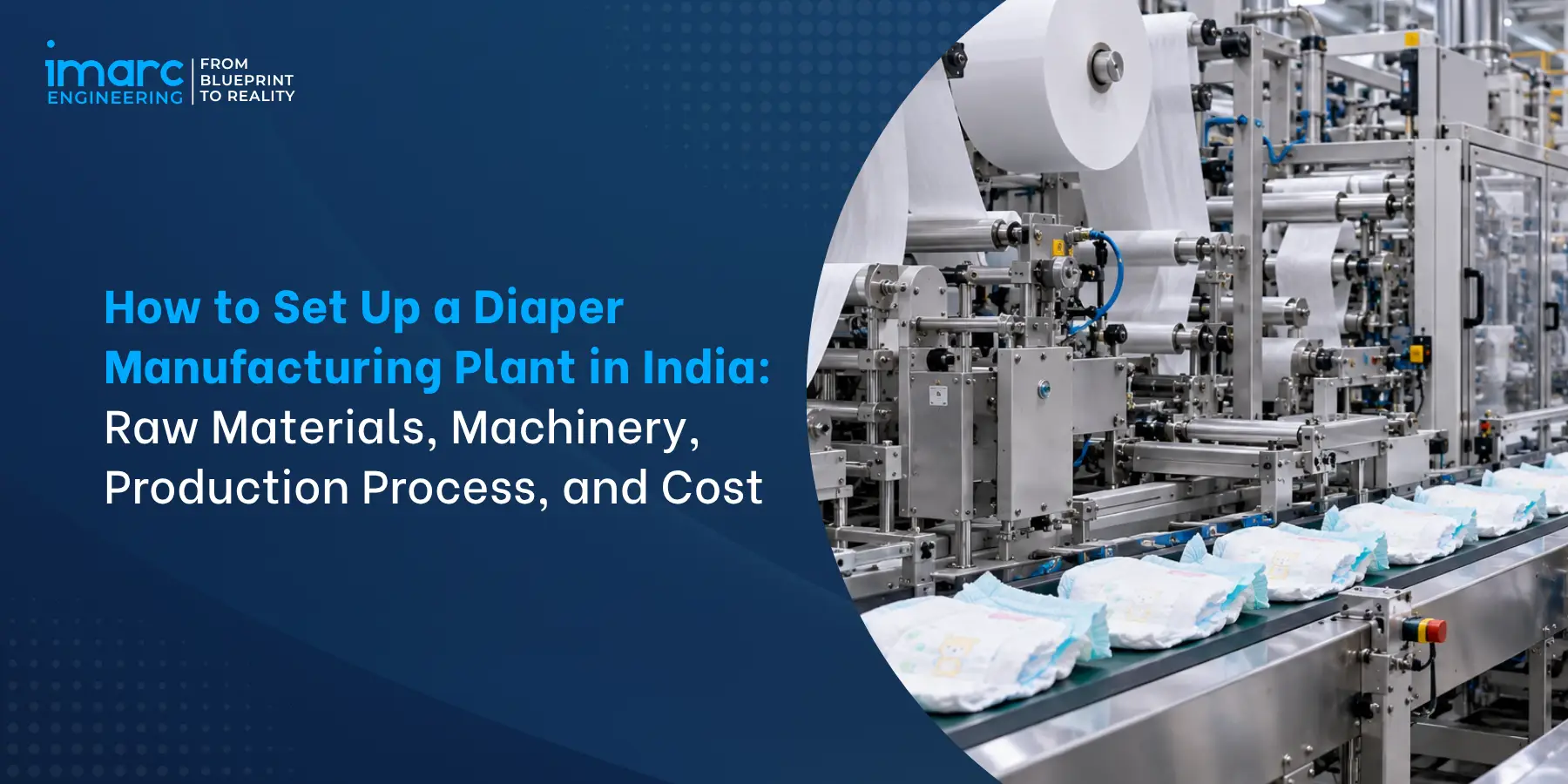
The line begins with raw material unwinding stations - automatic unwinders feed topsheet nonwoven, backsheet polyethylene film, ADL nonwoven, elastic strands, and release-paper fastening tapes into the production flow. Splicing systems join new rolls to running rolls without stopping the line, maintaining continuous operation. Tension control, edge guidance, and web alignment systems keep each layer precisely positioned. Fluff pulp bales are fed into the defibrator which grinds them into fluff for core formation.
2.2 Absorbent Core Formation and SAP Dosing
The absorbent core is built on a vacuum-assisted forming drum. Defibrated fluff pulp and precisely metered SAP (super absorbent polymer) are co-deposited into cavities on the rotating drum - the drum profile defines core shape and distribution of SAP within the core. Dosing systems control SAP mass per core to specification (typically 10-20 g for baby diapers, higher for adult diapers). The formed core is extracted and wrapped in a carrier nonwoven - the core wrap keeps SAP contained during use.
2.3 Layer Assembly and Elastic Application
The formed core moves to layer assembly where topsheet nonwoven is laid above and backsheet polyethylene film below the core. The acquisition distribution layer (ADL) is positioned between topsheet and core to accelerate fluid intake and distribute wetness across the core. Elastic strands are stretched and applied along the leg cuffs and waist areas - creating the diaper's conforming fit. Hot-melt adhesive applicators bond the layers at precisely defined paths and quantities, matching construction, elastic, and positioning glue grades to their functions.
2.4 Cutting Folding Fastening and Packaging
The continuous web of assembled diaper material passes through cutting stations that cut individual diapers to length, folding units that fold them to pack configuration, and fastening-tape applicators that attach hook/loop tape systems at the correct positions. Quality vision systems inspect each unit at line speed - rejecting non-conforming pieces. Diapers are counted, stacked, and fed to primary packaging (polyethylene bag), then to secondary packaging (carton), labelled, palletised, and dispatched to warehouse.
3. Raw Materials and Components for Diaper Manufacturing
Understanding diaper manufacturing raw materials is central to specification, cost, and quality control. Each component has a defined function - substitutions change performance.
3.1 Core Absorbent Materials
The core consists of fluff pulp - typically bleached softwood kraft pulp sheets (SBSK) that are defibrated at the line into fluff, providing bulk and initial fluid intake. The second core component is super absorbent polymer (SAP) - sodium polyacrylate granules capable of absorbing and retaining many times their weight in fluid. SAP grade (fast-absorbing vs retention-focused), particle size distribution, and gel strength determine performance. Typical SAP content is 10-20 g per large baby diaper and 15-25 g per adult diaper - specification depends on absorbency target.
3.2 Nonwoven Fabrics
Multiple nonwoven fabric grades are used. The topsheet (skin-contact layer) is polypropylene (PP) spunbond or spunbond-meltblown-spunbond (SMS) nonwoven - treated for softness and quick strike-through. Leg cuff and waistband use SMS or SMMS for liquid barrier combined with breathability. The acquisition distribution layer (ADL) is a resin-bonded or through-air-bonded nonwoven that temporarily holds fluid and distributes it across the core. Core wrap nonwoven contains the SAP and fluff.
3.3 Backsheet and Film Materials
The backsheet is a polyethylene (PE) film - either a conventional PE film or a breathable microporous PE film laminated with nonwoven for cloth-like feel. Breathable backsheet reduces skin heat buildup. Backsheet weight (gsm) and perforation pattern affect comfort and leakage resistance. Many premium diapers use film-nonwoven laminate for a soft, textile-like outer surface. Backsheet width tolerance and splice management are tightly controlled on high-speed lines.
3.4 Elastics Adhesives and Fastenings
Elastic strands (polyurethane spandex, such as Lycra) provide stretch and a secure fit around the leg and waist regions. Hot-melt adhesives serve different functions in diaper construction: construction adhesives bond nonwoven and film layers, while elastic adhesives secure stretched elastic strands. Specialised adhesives may also be used for absorbent-core stabilisation and fastening components, depending on the product design.
Adhesive selection depends on bonding strength, application temperature, material compatibility and production-line speed. Fastening systems use hook-and-loop tapes for tape-style diapers, while pants-type diapers typically use bonded or sealed side seams. Wetness indicator inks change colour upon contact with moisture and are generally applied to the backsheet or designated indicator layer.
3.5 Raw Material Summary
| Material | Function | Typical Supply |
|---|---|---|
| Fluff pulp (SBSK) | Core bulk, initial fluid intake | Imported or domestic kraft mills |
| SAP (sodium polyacrylate) | Fluid absorption and retention | Domestic + imported |
| PP spunbond nonwoven | Topsheet, leg cuffs | Domestic + imported |
| PE breathable film | Backsheet (with/without laminate) | Domestic + imported |
| ADL nonwoven | Fluid acquisition and distribution | Mostly imported for premium |
| Hot-melt adhesives | Construction, elastic, positioning | Domestic + imported |
| Spandex / elastics | Leg and waist stretch | Domestic + imported |
4. Machinery and Production Line Configuration for Diaper Manufacturing
Understanding diaper manufacturing machinery selection links target capacity, product mix, and automation to line specification and investment.
4.1 Line Speed Options
Modern diaper production lines are classified by output speed. Entry-level lines run around 150-250 pieces per minute - suited for smaller operations, regional players, or private label contract manufacturing with modest volumes. Mid-range lines around 400-500 pieces per minute offer better unit economics and are the common choice for growing national brands. High-speed lines running 800-1200 pieces per minute (industry best up to 1500) are used by large-volume manufacturers and multinational contract production. Line speed directly drives raw material unwinding capability, splicing automation, vision systems, and dust/scrap handling capacity.
4.2 Key Machine Modules
A standard baby diaper making machine line integrates unwinders with automatic splicers (for topsheet, backsheet, core wrap, ADL, leg cuff, waist nonwovens), a fluff pulp defibrator and SAP dosing system, forming drum for core assembly, embossing and perforation units, elastic strand applicators and tensioners, hot-melt adhesive applicators with pumps and heated hoses, lamination units, cutting and folding stations, fastening tape applicator, inline vision inspection for every piece, counting and stacking units, bagging unit for primary pack, and secondary cartoner. Pants-type (training pant) diaper lines add side-seam sealing modules.
4.3 Baby vs Adult Diaper Lines
Baby and adult diaper lines share common architecture but differ in capacity scaling, core sizes (larger for adult diapers), SAP dosing range, and dimensional tolerances. Dedicated adult diaper lines accommodate a wider waist range, higher absorbency targets, and additional product variants (tape style, pants style, inserts). Dual-product lines with changeover tooling allow smaller operations to serve both markets, at the cost of changeover time and some capacity compromise. Dedicated single-product lines deliver higher sustained output and lower unit cost.
4.4 Automation and Controls
High-speed lines are PLC/SCADA controlled, with servo-driven material handling, real-time quality vision inspection, automatic reject diversion, and recipe management for product changeover. Data acquisition systems log line speed, downtime, scrap rate, and quality parameters per shift - supporting OEE improvement. Vision inspection cameras check for correct core position, elastic tension, adhesive pattern integrity, print registration, and visible defects. Automated reject systems divert out-of-specification pieces before packaging - protecting outbound quality.
5. Utilities Infrastructure and Hygiene Systems for a Diaper Manufacturing Plant
Understanding utility requirements and hygiene systems avoids under-sizing that compromises uptime, product quality, and regulatory compliance.
5.1 Compressed Air Power and HVAC
Electrical power is a major utility requirement for diaper manufacturing, supplying production-line drives, fluff pulp defibration, vacuum generation, compressed-air systems, dust extraction, HVAC and packaging equipment. Compressed air supports pneumatic actuators, material handling and selected automation functions, while dedicated vacuum systems support absorbent-core formation and web handling. Air compressors with suitable dryers and filtration systems should be selected according to equipment specifications and air-quality requirements.
HVAC systems with appropriate filtration (HEPA where required) control temperature, humidity and airborne particulates, while dedicated dust extraction captures fine particles generated during fluff pulp processing. Stable electrical supply, voltage protection and appropriately sized UPS systems for critical controls help minimise production disruptions. Utility capacities should be determined using machinery supplier specifications and planned production loads.
5.2 Water Dust Extraction and Humidity Control
Water is used for cleaning, chillers, humidification, and sanitary utilities. Dust extraction is a dedicated system - large cyclones and bag filters capture fluff pulp dust from the defibrator area and SAP dust from dosing stations. Captured dust is recycled where quality permits or disposed as waste. Humidity should be controlled within a range appropriate to the raw materials, product specifications and equipment requirements. Fluff pulp bales and SAP bags need climate-controlled dry storage - moisture or heat damage material value.
5.3 Hygiene Zoning and GMP Practices
Diaper manufacturing follows product-contact hygiene discipline. The production hall is zoned - raw material staging, process area, packaging, and warehouse have defined cleanliness tiers. Workers in product-contact zones wear hair coverings, gloves, and dedicated footwear. Hygiene control under Good Manufacturing Practice (GMP) covers personnel practices, cleaning schedules, pest control, product contact surface sanitation, and traceability of raw material lots to finished product batches. These systems are checked during BIS factory audits for ISI certification - inadequate controls are an audit finding.
5.4 Waste Scrap Management
Scrap management drives both environmental compliance and cost. Line scrap (reject pieces, start-up material, changeover offcuts) is collected and compacted. Where possible, dry scrap is sold to downstream users (secondary absorbent products, insulation industries); contaminated scrap goes for safe disposal under state pollution control board requirements.
Dust captured by extraction is handled as solid waste. Post-production diaper waste, generated by consumers, falls under the Environment Protection (EPR for Packaging) Rules 2024 (effective 1 April 2026), which include sanitary products in their scope.
6. Quality Control and BIS Compliance for Diaper Manufacturing in India
Understanding quality control requirements under IS 17509:2021 (baby) and IS 17508:2020 (adult) is essential - BIS certification is mandatory before any product reaches the market.
6.1 BIS Mandatory Certification Framework
The Medical Textiles (Quality Control) Order 2023 (as amended through the Second Amendment Order 2025 effective 30 July 2025) was issued by the Ministry of Textiles under Section 16 of the BIS Act 2016. It makes BIS ISI certification mandatory for disposable baby diaper and adult diaper products in India.
Certification is through Scheme I of the BIS (Conformity Assessment) Regulations 2018 - requiring factory audit by BIS officers, product sample testing, grant of licence, ISI mark affixation, and periodic surveillance. Products without valid licence cannot be manufactured, imported, sold, distributed, or stored for sale in India. Export-only consignments are typically outside the Order's scope.
6.2 Key Quality Tests under IS 17509:2021
IS 17509:2021 specifies quality and performance requirements for disposable baby diapers, including applicable test methods and acceptance criteria. Quality evaluation covers relevant parameters such as absorption capacity, rate of absorption, rewet performance, leakage resistance, material quality and skin-contact safety, as prescribed by the standard. Manufacturers should also assess dimensional consistency, construction integrity and fastening performance through appropriate in-house quality-control procedures. Additional testing, including microbiological evaluation and biocompatibility assessment, should be conducted where required by the applicable standard or product specifications.
Testing should follow the prescribed methods and acceptance criteria, with laboratory testing conducted in accordance with BIS certification requirements. Manufacturers should maintain a documented testing matrix distinguishing mandatory IS 17509:2021 requirements from additional internal quality checks. Raw materials should also be evaluated against applicable material specifications to ensure consistent product performance and safety.
6.3 In-Process Quality Control
Beyond final-product testing, inline quality control is embedded in the line. Vision inspection systems check every piece for correct core placement, elastic alignment, glue pattern, and visible defects. Operators sample finished pieces at defined intervals for weight check (confirming SAP and fluff dose), dimensional check (length, width, waist), and visual grading.
Shift-level composite samples are tested at the in-house laboratory for key parameters, with full IS test method validation sent to BIS-recognised external labs on a defined schedule. Non-conforming batches are quarantined until root cause is resolved.
6.4 Documentation and Traceability
ISI certification requires end-to-end documentation. Raw material receipts link to supplier Certificates of Analysis. Production batch records capture line settings, operator identification, raw material lot numbers, in-process checks, test results, and finished product disposition. Finished product batch codes allow traceability from any consumer unit back to the shift, line, raw material lot, and test records.
This chain supports BIS surveillance audits, customer complaints investigation, and formal recall capability. Document control (ISO 9001-aligned) governs changes to specifications, test methods, and procedures.
7. CAPEX OPEX and Project Economics for Diaper Manufacturing Plant in India
Understanding diaper manufacturing plant cost needs discipline. Universal CAPEX numbers mislead - every project is sized to its own line speed, product mix, and automation choice.
7.1 CAPEX Drivers
Primary CAPEX drivers are the diaper production line (speed, automation level, product type, number of lines), building and civil works (production hall, warehouse, QC lab, utility rooms, offices), utilities build (compressors, HVAC, power distribution, chillers, dust extraction, water treatment), QC laboratory equipment, warehouse racking and material handling, land acquisition or lease premium, licensing fees, EPC margin, and project contingency. The diaper line itself typically dominates CAPEX. Higher-speed lines and dual-product capability raise CAPEX disproportionately but reduce per-unit cost at full utilisation.
7.2 OPEX Drivers
Primary OPEX components are raw materials (SAP, fluff pulp, nonwovens, PE film, hot-melt adhesive, elastics, tapes, inks, packaging), utilities (power, compressed air, HVAC, water), labour (operators, QC, maintenance, warehouse, management), consumables, maintenance and spare parts, scrap and giveaway, logistics, insurance, and overheads. Raw materials typically dominate direct cost - SAP, fluff pulp, and nonwovens are market-linked commodities whose prices move with pulp and petrochemical cycles. Utilisation rate (actual production hours over scheduled hours) and scrap rate are the two biggest operational drivers of unit cost.
7.3 Capacity Cost Sensitivity
| Line Category | Typical Speed | Automation Level | Suitability |
|---|---|---|---|
| Entry / starter | 150-250 pcs/min | Semi-automatic | Regional, private-label |
| Mid-range | 400-500 pcs/min | Automatic | National brand, contract mfg |
| High-speed | 800-1200 pcs/min | Fully automatic | Large-volume national/export |
7.4 Unit Economics
Unit cost is the sum of material cost (SAP, fluff, topsheet, ADL, backsheet, elastics, tapes, adhesive, packaging), conversion cost (power, labour, maintenance, scrap allowance), and allocated overhead and depreciation. Material cost dominates and is sensitive to SAP and pulp pricing. Realised price depends on channel (retail, private label, institutional, export) and brand positioning. Payback follows line utilisation, product mix, and offtake stability. Projects secure medium-term offtake before committing to high-speed line CAPEX.
8. Regulatory Approvals and Project Lifecycle for Diaper Manufacturing Plant in India
Understanding regulatory stack and project phasing keeps the diaper manufacturing plant setup moving across parallel approvals, engineering, procurement, and ramp-up workstreams.
8.1 Regulatory Approvals
The regulatory stack includes BIS certification under IS 17509:2021 and IS 17508:2020 via BIS Scheme I (mandatory under the Medical Textiles QC Order), SPCB Consent to Establish and Consent to Operate under the Water Act 1974 and Air Act 1981 (diaper plants are typically Green or Orange category with modest effluent and air emissions), Factory Licence under the Occupational Safety Health and Working Conditions Code 2020 effective 21 November 2025 which has replaced the Factories Act 1948, Fire NOC per NBC 2016 Part 4, Legal Metrology (Packaged Commodities) Rules 2011 for mandatory declarations on retail packs, Hazardous Waste Rules 2016 compliance for scrap and waste streams, and GST registration.
EPR registration with CPCB under the Plastic Waste Management Rules 2016 (as amended) applies to plastic packaging; the Environment Protection (EPR for Packaging) Rules 2024 effective 1 April 2026 cover sanitary products including diapers.
8.2 Project Phasing
A typical greenfield diaper manufacturing plant project runs pre-feasibility (market, offtake assessment, technology shortlist), feasibility and DPR (site selection, line specification, utilities estimation, CAPEX/OPEX, financials), parallel regulatory applications (SPCB CTE, land/building permits, factory layout approval, Fire NOC), FEED and detailed engineering (process flow, mechanical, electrical, instrumentation drawings, HVAC and dust extraction design), order placement for the line and utilities, civil construction, equipment installation, utility commissioning, line pre-commissioning (dry runs, material loading), trial production, BIS factory audit and ISI licence grant, and production ramp-up.
8.3 Trial Production and Ramp-Up
Trial production begins with low-speed line operation using the specified raw materials, focusing on fine-tuning splice management, SAP dosing accuracy, elastic tension, adhesive application patterns, and vision inspection calibration. Finished samples undergo in-house quality testing and applicable testing at BIS-recognised laboratories against IS 17509:2021 for baby diapers or IS 17508:2020 for adult diapers. Successful trial runs help validate production consistency and support the BIS certification process, including factory inspection and licence approval.
Following commissioning, successful trials and applicable certification, commercial production ramps up progressively as operators gain experience, process parameters stabilise, scrap rates decline, and raw material supply becomes consistent. The ramp-up period depends on production-line configuration, product specifications, automation level, operator capability and demand. Plant performance should be evaluated using actual production output, quality yield, scrap rates and overall equipment effectiveness (OEE), rather than nameplate line speed alone.
8.4 Timeline
Indicative project timeline for a greenfield diaper plant is 18-30 months from pre-feasibility to commercial production - driven by line delivery lead time (10-16 months after order), civil construction, utilities build, BIS certification, and ramp-up. Projects with imported high-speed lines and complex utilities skew to the longer end. Projects using domestic entry-level lines on existing industrial sheds achieve shorter timelines. Parallel-track approval and engineering workstreams keep the critical path on equipment delivery and installation.
Conclusion
An effective diaper manufacturing plant in India should align product and capacity with secured offtake, reliable raw material sourcing, suitable production lines, hygiene-focused utilities, BIS requirements, quality control, regulatory approvals, and an execution schedule. Sponsors should focus on three priorities: design for BIS compliance from the start, secure reliable supplies of key materials such as SAP and nonwovens and select line capacity based on confirmed demand rather than projected growth.
PLANNING A DIAPER MANUFACTURING PLANT IN INDIA?
IMARC Engineering supports diaper manufacturing projects with product and offtake validation, production line and machinery selection, raw material sourcing, DPR and feasibility studies, plant and utility design, QC and certification support, regulatory approvals, CAPEX/OPEX modelling, EPC/EPCM strategy, construction supervision, commissioning, and production ramp-up.
→ Schedule a free diaper plant project scoping consultation with an IMARC specialist
Frequently Asked Questions
A diaper manufacturing plant in India requires product selection (baby/adult), capacity planning, raw material sourcing (SAP, fluff pulp, nonwovens, PE film), high-speed line, utilities, quality systems, SPCB CTE/CTO, Factory Licence under OSH Code 2020, and mandatory BIS ISI certification under IS 17509:2021 or IS 17508:2020.
The disposable diaper manufacturing process includes raw material unwinding, absorbent core formation (fluff pulp + SAP dosing), topsheet and backsheet lamination, ADL placement, elastic application at legs and waist, hot-melt adhesive bonding, cutting and folding, fastening tape application, inspection, and packaging on continuous high-speed lines.
Diaper manufacturing raw materials include fluff pulp (bleached softwood kraft), super absorbent polymer (SAP, sodium polyacrylate), nonwoven fabrics (polypropylene spunbond for topsheet), polyethylene breathable backsheet film, acquisition distribution layer (ADL) nonwoven, hot-melt adhesives, elastic strands (spandex), fastening tapes, wetness indicator inks, and primary/secondary packaging materials.
Diaper manufacturing machinery includes unwinders for roll materials, defibrator and SAP dosing system for core formation, forming drum, embossing units, adhesive applicators, elastic strand applicators, lamination units, cutting and folding stations, fastening tape applicator, quality vision inspection, and cartoning/packaging equipment on an integrated high-speed line.
Diaper manufacturing plant cost in India depends on line speed (200/400/800+ pieces per minute), product mix (baby/adult sizes), automation level, raw material storage, utilities build, quality lab, and overall plant footprint. Universal CAPEX figures mislead - costing requires line speed, product specifications, and automation configuration.
Production capacity drives machinery choice. Lower-speed lines (200 pcs/min) use simpler automation and modest utilities. Mid-range lines (400-500 pcs/min) need better feeders, air, vision inspection. High-speed lines (800+ pcs/min) demand sophisticated controls, higher compressed air, HVAC, utility redundancy, more raw material buffers, and larger footprint.
Diaper manufacturing utilities include clean compressed air for pneumatics and material transfer, HVAC with filtration for hygiene control, stable voltage power for electronic drives, water for cleaning and chillers, dust extraction for fluff pulp handling, humidity control, waste collection, fire protection, and raw material storage.
Disposable diaper quality tests per IS 17509:2021 include absorbency capacity, rewet characteristics, rate of absorption, leakage resistance, pH, bacterial and fungal bioburden, biocompatibility, dimensional consistency, construction integrity, fastening system strength, and skin-contact suitability. Testing uses accredited laboratories under the BIS ISI Scheme I certification process.
Diaper manufacturing cost in India depends on raw material prices (SAP, fluff pulp, nonwovens, PE film), line speed and utilisation, product specifications (absorbency, size), scrap and giveaway rates, utility costs (power, compressed air), labour, quality compliance, logistics, and packaging. Material cost typically dominates per-piece economics.
Diaper manufacturing regulatory requirements include mandatory BIS ISI certification under IS 17509:2021 (baby) or IS 17508:2020 (adult) per Medical Textiles QC Order, Factory Licence under OSH Code 2020, SPCB CTE/CTO, Fire NOC under NBC 2016, Legal Metrology Packaged Commodities Rules 2011, and plastic waste EPR.
Recent Post


Trusted by Industry Leaders
We partner with global enterprises and ambitious businesses across sectors to deliver operational excellence, strategic insights, and sustainable growth through integrated solutions.












Success in Their Words
Real feedback from clients across industries. Discover how our solutions delivered measurable impact and operational excellence.

I wanted to express my sincere appreciation for your efforts in handling this matter. Your dedication and commitment have been truly commendable, and it is evident that you have put in tremendous hard work and expertise into resolving the issues at hand. We are greatly interested in continuing our collaboration with you in the future, as your professionalism and reliability have made you a trusted partner. Thank you once again for your invaluable contribution. We look forward to strengthening our partnership ahead.

It has been a pleasure working with the IMARC team. The insights provided were structured, clear, and highly valuable, helping us strengthen both our technical and financial planning with confidence. We deeply appreciate the team’s professionalism, responsiveness, and attention to detail throughout the engagement. Every requirement was well understood and effectively incorporated, resulting in a comprehensive and actionable output. Overall, our experience has been excellent, and I would gladly recommend IMARC to organizations seeking a reliable research partner.

Your service is truly exceptional. Working with the IMARC team has been a seamless and professional experience. The clarity of communication, responsiveness to queries, and consistent support at every stage made the entire engagement highly efficient. The insights shared were well-structured, practical, and perfectly aligned with our requirements, helping us make informed decisions with confidence. Overall, the dedication and professionalism demonstrated by your team stand out, and I would be glad to recommend IMARC as a reliable and trustworthy research partner.

IMARC did an outstanding job in preparing our study. They were punctual, precise, and consistently responsive throughout the entire process. The team delivered all the data we required in a clear, well-organized, and highly professional format. Their strong attention to detail, combined with their ability to meet every deadline without compromising quality, truly set them apart. Overall, their reliability and commitment made them an exceptional partner for our project, and we would gladly work with them again in the future.

IMARC made the whole process incredibly easy from start to finish. Everyone I interacted with via email was polite, professional, and straightforward to deal with, always keeping their promises regarding delivery timelines and remaining consistently solutions-focused. From my very first contact, I appreciated the professionalism and support shown by the entire IMARC team. I highly recommend IMARC to anyone seeking timely, affordable, and reliable information or advice. My experience with IMARC was excellent, and I truly cannot fault any aspect of it.

I’d like to express my sincere gratitude for the excellent work you accomplished with the study. Your ability to quickly understand our requirements and deliver high-quality results under tight timelines truly reflects your expertise, exceptional work ethic, and unwavering commitment to your customer’s success. The professionalism and responsiveness you demonstrated throughout the process made a significant difference. Our entire team and company are incredibly thankful for your dedication, reliability, and support. Once again, thank you for your outstanding contribution.