Manufacturing
October 09 2026
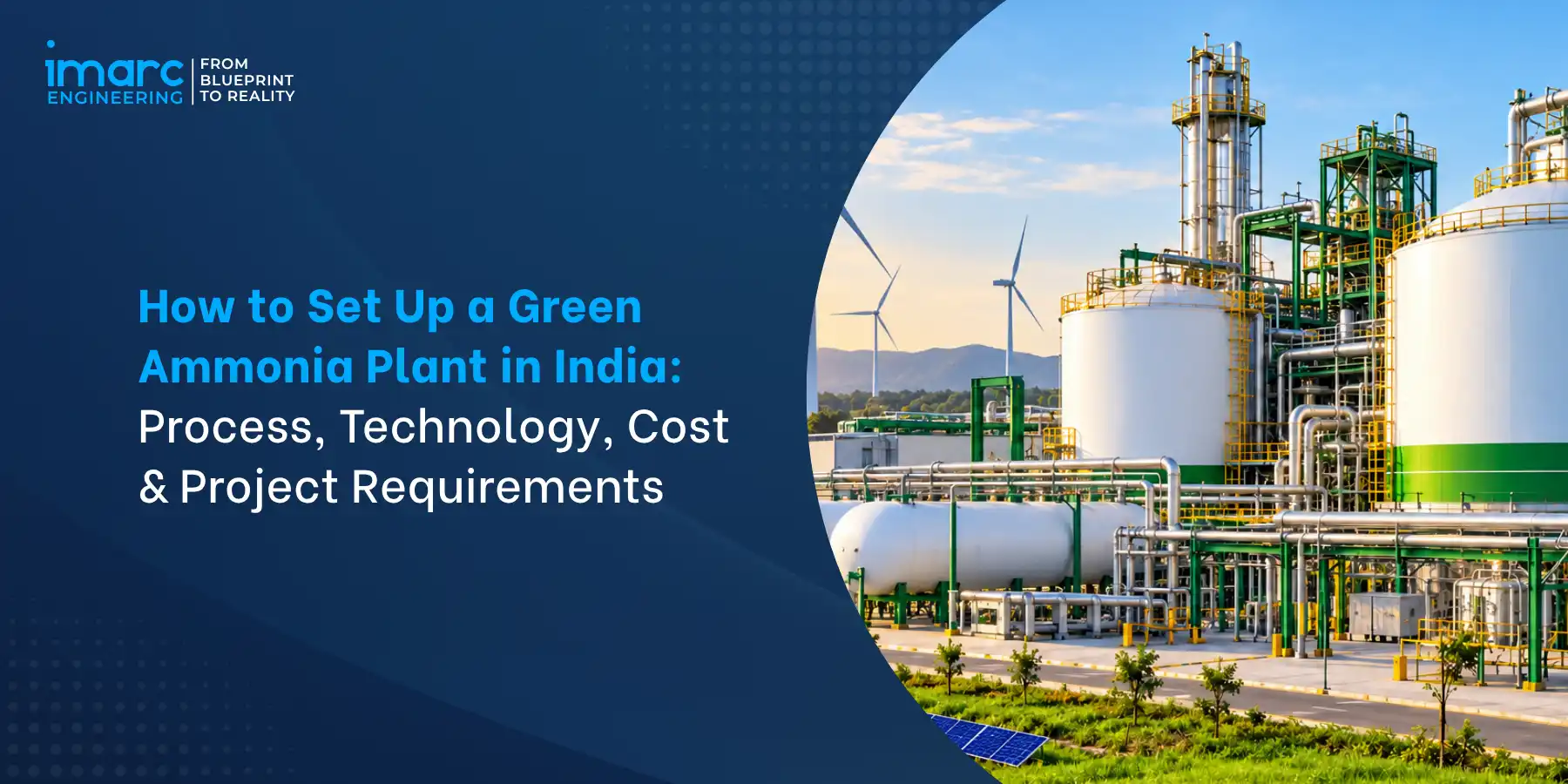
How to Set Up a Green Ammonia Plant in India: Process, Technology, Cost & Project Requirements (2026 Guide)
Introduction
For investors, project developers, and industrial sponsors planning a green ammonia plant in India, the project is an integrated decision spanning renewable power sourcing, water electrolysis, nitrogen generation, Haber-Bosch synthesis, storage, logistics, and offtake - not simply an ammonia production exercise. The National Green Hydrogen Mission (approved 4 January 2023 with an outlay of INR 19,744 crore till FY 2029-30) and the SIGHT Mode 2A green ammonia tender awarded by SECI for 7,24,000 MT per annum have created the first commercial demand corridor for green hydrogen derivatives in India.
Scope of the Guide
This guide walks through planning a green ammonia manufacturing plant from production process and technology selection through site selection, utilities, storage, logistics, regulatory and safety approvals, CAPEX/OPEX, and the full project lifecycle from feasibility to commissioning - calibrated to the policy framework operating in 2026 and anchored to project-specific assumptions rather than universal claims.
Table of Contents
- Introduction
- Why Green Ammonia Matters for India in 2026
- Green Ammonia Production Process from Renewable Power to Haber-Bosch Synthesis in India
- Technology and Equipment Selection for Green Ammonia Production in India
- Site Selection, Water and Renewable Power Requirements for a Green Ammonia Plant in India
- Utilities Storage Logistics and Infrastructure Planning for Green Ammonia Plant in India
- Regulatory Environmental and Safety Approvals for Green Ammonia Plant in India
- CAPEX OPEX and Project Economics for Green Ammonia Plant in India
- Project Lifecycle from Feasibility to Commissioning for Green Ammonia Plant in India
- Conclusion
1. Why Green Ammonia Matters for India in 2026
Four drivers make green ammonia project investment strategically significant in India in 2026.
1.1 National Green Hydrogen Mission and SIGHT Mode 2A
The National Green Hydrogen Mission approved on 4 January 2023 is the policy anchor. The Mission targets 5 MMT per annum of green hydrogen production capacity by 2030 with associated renewable energy addition of around 125 GW and expected investment of INR 8 lakh crore. Within the SIGHT programme (Strategic Interventions for Green Hydrogen Transition, outlay INR 17,490 crore till 2029-30), Mode 2A targets green ammonia for the fertilizer sector.
The annual allocation was expanded on 22 June 2024 from 5,50,000 to 7,50,000 tonnes per annum - and SECI has already awarded 7,24,000 MT per annum to 13 fertilizer units at discovered prices between INR 49.75 and INR 64.74 per kg. As of June 2026, supply agreements for 6.7 lakh MTPA have been signed with 11 fertilizer plants.
1.2 Decarbonising the Fertilizer Sector
India produces around 20 million tonnes of ammonia annually - predominantly consumed as feedstock for urea and other fertilizers. Conventional (grey) ammonia uses natural gas via steam methane reforming or coal via gasification - carbon-intensive processes dependent on imported fossil fuels. Transitioning to green ammonia production in India reduces import dependence, cuts scope 1 emissions for fertilizer manufacturers and aligns with India's net-zero commitments. The SIGHT Mode 2A fertilizer corridor is the first large-scale decarbonisation lever for Indian ammonia demand.
1.3 Export and Maritime Fuel Potential
Global demand for over 100 MMT of green hydrogen and derivatives (particularly green ammonia) is expected to emerge by 2030, with import-dependent countries including Japan, South Korea, EU member states, and Singapore actively contracting supply. India's renewable energy potential and coastal access position the country as a competitive supplier.
The International Maritime Organization's push toward alternative marine fuels open green ammonia bunkering demand at Indian ports. ACME Cleantech, Reliance, Adani Green, L&T, and Renew Power are among the Indian players building toward domestic and export markets.
1.4 Standards and Certification Framework
MNRE notified the Green Hydrogen Standard for India on 18 August 2023 - defining green hydrogen as having well-to-gate emissions not exceeding 2 kg CO2 equivalent per kg H2 (12-month average), covering water treatment, electrolysis, gas purification, drying, and compression. The Green Hydrogen Certification Scheme of India (GHCI) launched in 2025 provides the certification framework through third-party verification bodies accredited by the Bureau of Energy Efficiency, with a final certification fee of INR 5 per 100 kg of hydrogen. Standards for green ammonia and green methanol derivatives have been finalised. This certification clarity is essential for export credibility and for Indian fertilizer-sector offtake under the SIGHT framework.
2. Green Ammonia Production Process from Renewable Power to Haber-Bosch Synthesis in India
Understanding the green ammonia production process clarifies the integrated process chain that converts renewable electricity into merchant-grade ammonia.
2.1 Renewable Power to Green Hydrogen
The process starts with renewable electricity from solar PV, wind, or a hybrid captive renewable power source - either behind-the-meter or wheeled through the grid under renewable energy banking arrangements. Treated water (demineralised to meet electrolyser feed specifications) enters the electrolyser, where DC electricity splits water (H2O) into hydrogen and oxygen.
Produced hydrogen is cooled, dried, and compressed to buffer storage (typically 30-200 bar depending on electrolyser type and downstream requirements). Oxygen is vented or captured for industrial sale where economics permit. This upstream segment produces the green hydrogen production feedstock for ammonia synthesis.
2.2 Nitrogen Generation
Nitrogen for ammonia synthesis comes from air separation. Larger plants use a cryogenic Air Separation Unit (ASU) that cools and liquefies air, separating N2, O2, and argon through distillation at approximately -195°C. Smaller plants may use Pressure Swing Adsorption (PSA) or membrane separation at lower CAPEX but higher operating cost per tonne. Stoichiometrically, 0.82 tonnes of nitrogen is needed per tonne of ammonia. The nitrogen must be high-purity (>99.9 percent) with controlled oxygen and moisture to protect the ammonia synthesis catalyst.
2.3 Haber-Bosch Synthesis
The Haber-Bosch process combines three parts hydrogen with one part nitrogen (3H2 + N2 → 2NH3) over an iron-based catalyst at approximately 400-500°C and 150-300 bar. Compressed and preheated feed gas enters the synthesis reactor, where equilibrium conversion per pass is limited to 15-25 percent - unreacted gas is cooled to condense ammonia and recycled. The synthesis loop includes feed compression, make-up compression, reactor, heat recovery, condensation at low temperature, ammonia separation, and recycle compression.
Low-pressure Haber-Bosch variants (below 100 bar, ruthenium-based catalysts) are emerging but iron-catalyst high-pressure designs remain the proven industrial standard. Stoichiometric hydrogen requirement is 0.178 tonnes per tonne of ammonia; practical requirement with losses runs around 0.18-0.19 tonnes.
2.4 Storage and Dispatch
Liquid ammonia moves to ammonia storage tanks sized for several days of production plus offtake buffer. Three modes are used - refrigerated atmospheric (approximately -33°C), pressurised bullet tanks (17-18 bar at ambient), and semi-refrigerated hybrid designs. Ammonia is dispatched by road tanker, rail tanker, pipeline, or ship. Export facilities need loading jetties, loading arms, and vapour return. Fertilizer-plant-adjacent projects often use continuous pipeline transfer, eliminating most storage CAPEX.
3. Technology and Equipment Selection for Green Ammonia Production in India
Understanding green ammonia production technology selection is central to plant configuration, CAPEX, and operability.
3.1 Electrolyser Selection
The electrolyser is the plant's single largest capital item and determines water, power, and auxiliary requirements. Four technologies are in commercial or near-commercial play. Alkaline electrolyser (AWE) is the mature workhorse - lower CAPEX per MW, large unit capacities (10 MW+ per stack), typical specific energy around 50-55 kWh per kg H2, but slower dynamic response. PEM electrolyser (Proton Exchange Membrane) handles intermittent renewable input well, offers compact footprint and high current density, with specific energy around 50-60 kWh per kg H2 - at higher CAPEX than AWE and reliance on noble-metal catalysts. AEM (anion exchange membrane) is emerging as a cost compromise.
SOEC (solid oxide) offers high efficiency with steam feed but is at early commercial stage. Projects targeting intermittent renewable supply typically favour PEM or an AWE-PEM hybrid; projects with firm renewable or hybrid solar-wind-battery supply often use AWE for CAPEX efficiency.
3.2 Air Separation Unit for Nitrogen
Nitrogen generation choice follows plant capacity. For green ammonia plants above 100 tonnes per day of NH3, cryogenic ASUs deliver high-purity N2 at lower unit cost - sized to match ammonia synthesis demand with a modest safety margin. For smaller or pilot plants, PSA offers lower CAPEX but higher power consumption per tonne of N2. ASUs integrate with the synthesis loop through compression, drying, and oxygen control. Nitrogen purity, oxygen slip, and moisture are specified tight to protect synthesis catalyst life.
3.3 Haber-Bosch Synthesis Loop
The ammonia synthesis loop package covers synthesis gas compression, make-up and recycle compressors, synthesis reactor with internal heat exchange, ammonia condensation refrigeration, ammonia separator, and purge gas handling. Traditional high-pressure iron-catalyst designs (150-300 bar) have decades of operating reference and are offered by established licensors.
Lower-pressure designs (below 100 bar, ruthenium-based catalysts) are suited for dynamic operation with intermittent renewable supply but at higher catalyst cost. Modular small-scale Haber-Bosch units (0.5-50 tonnes per day) are commercialising for distributed green ammonia production - though per-tonne CAPEX is higher than large plants.
3.4 Hydrogen Buffer, Compression, and Purification
Between electrolyser and synthesis, a hydrogen buffer absorbs supply-demand mismatches during variable renewable input - either compressed gas storage at moderate pressure (30-200 bar) or small liquid buffer. Compression stages lift electrolyser-outlet hydrogen (typically 1-30 bar) to synthesis-loop pressure (150-300 bar for conventional Haber-Bosch), using reciprocating or centrifugal compressors with intercooling. Hydrogen must be dried and purified of trace oxygen before reaching catalyst.
3.5 Equipment Comparison
| Technology | Specific Energy | Suitability | Maturity |
|---|---|---|---|
| Alkaline (AWE) | ~50-55 kWh/kg H2 | Large-scale projects with relatively stable or managed renewable power supply | Commercially mature |
| PEM | ~50-60 kWh/kg H2 | Projects requiring flexible operation and faster response to variable power input | Commercially mature |
| AEM | Technology-dependent; limited commercial benchmarks | Emerging alternative combining aspects of alkaline and membrane-based electrolysis | Emerging |
| SOEC | Depends on steam and heat integration; electricity-only figures are not directly comparable | Projects with access to suitable high-temperature steam and heat integration | Early commercial |
4. Site Selection, Water and Renewable Power Requirements for a Green Ammonia Plant in India
Understanding site selection drivers for a green ammonia plant setup in India is foundational - a site mismatched to renewable, water, or logistics realities compromises project economics permanently.
4.1 Renewable Power Potential
Site evaluation begins with renewable electricity potential. Rajasthan, Gujarat, Andhra Pradesh, Karnataka, and Tamil Nadu offer the highest solar irradiance (global horizontal irradiance above 5.5 kWh per square metre per day). Gujarat (Kutch), Tamil Nadu (Tirunelveli), and parts of Rajasthan, Karnataka, and Andhra Pradesh offer strong wind resource. Hybrid solar-wind-battery configurations improve capacity utilisation of the electrolyser compared with single-resource plants.
Captive behind-the-meter renewable supply avoids inter-state transmission charges; wheeled grid supply allows siting the ammonia plant near offtake, with renewable energy procured through PPAs or exchanges under the inter-state transmission waiver available for green hydrogen projects under NGHM.
4.2 Water Availability
Water is a second site driver. Theoretical water electrolysis demand is 9 kg of water per kg of hydrogen; practical demand including demineralisation and losses runs 10-15 kg water per kg H2. For a 100 tonnes per day green ammonia plant (approximately 18 tonnes per day H2), freshwater demand is roughly 180-270 cubic metres per day plus utility water.
Freshwater-constrained sites (large parts of Rajasthan, Gujarat Kutch) are evaluated for desalinated seawater supply (viable at coastal sites) or treated effluent reuse. Water availability permission from the state water resources department and groundwater board clearances (where applicable) are gating approvals.
4.3 Land, Environmental Category, and Safety
Land requirement runs to tens of hectares for a mid-scale plant including electrolyser hall, ASU, synthesis loop, utilities, storage, and safety setbacks - with additional captive renewable land requirements several times the plant footprint (hundreds to thousands of hectares for solar). Industrial zoning, environmental category (large chemical/fertilizer projects are Category A under the EIA Notification 2006), proximity to protected areas, and safety setbacks for ammonia storage drive site filtering. Elevation, soil bearing capacity, seismic zone (Zone II/III preferred), and flood risk are evaluated during site due diligence.
4.4 Offtake Proximity and Logistics
Site selection depends on the offtake model. SIGHT Mode 2A fertilizer projects benefit from siting adjacent to existing urea/complex-fertilizer plants - minimising ammonia transport. Export-oriented projects favour coastal sites with port access and bunkering infrastructure. Projects targeting multiple offtakes may locate at logistics-hub industrial parks. State-level renewable energy policies (concessional land, wheeling waivers, open access rules) often tilt the final site decision between candidate states.
5. Utilities Storage Logistics and Infrastructure Planning for Green Ammonia Plant in India
Understanding utility requirements, storage, and logistics for a green ammonia production plant avoids retrofit cost and operational constraints that undermine project returns.
5.1 Power, Water, and Process Utilities
Beyond the primary renewable power for electrolysis, the plant needs utilities for ASU compressors, synthesis gas compression, refrigeration for ammonia condensation and storage, cooling water circulation, instrument air, demineralised water generation (RO plus multi-stage polishing to electrolyser feed quality), process steam for ASU regeneration and site heating, and emergency power through diesel generator backup for safe shutdown. Power quality (voltage, frequency, harmonics) requirements are tight for electrolysers - rectifier transformer sizing and reactive power compensation are specified during FEED.
5.2 Ammonia Storage Infrastructure
Choice of ammonia storage depends on capacity, dispatch mode, and site. Refrigerated atmospheric storage (double-wall insulated tanks at -33°C) is standard for large volumes - supporting continuous production with buffer against dispatch disruption. Pressurised bullet tanks (approximately 17-18 bar at ambient) suit smaller inventory.
Storage CAPEX scales nonlinearly with capacity - large refrigerated tanks have lower unit cost but higher absolute investment. Safety setbacks per PESO and NBC 2016 norms must be factored into plot plan early. Vapour recovery, flare, scrubber systems, and emergency isolation are integrated with storage design.
5.3 Dispatch Logistics
Dispatch infrastructure matches offtake. Road tanker filling bays require weighbridges, loading arms, and vapour return. Rail siding and ammonia-specification tank wagons suit medium-distance bulk dispatch. Pipeline transfer (continuous or batch) is the lowest unit cost mode for adjacent-plant fertilizer offtake.
Marine export requires a jetty, loading arms designed for cryogenic ammonia, and vapour management - with Harbour Master and port authority approvals. Logistics mode is decided jointly with offtake contract structure during the DPR stage - retrofit changes are costly.
5.4 Hydrogen and Oxygen Handling
Between electrolyser and synthesis loop, hydrogen storage buffer, compression, and purification need site integration. Oxygen produced is typically vented but at some sites can be sold to adjacent industrial users. Hazardous area classification per BIS and IEC codes drives electrical equipment selection, instrumentation, and ventilation design across hydrogen and ammonia process areas.
6. Regulatory Environmental and Safety Approvals for Green Ammonia Plant in India
Regulatory planning is a critical part of green ammonia project development. Applicable approvals depend on plant capacity, manufacturing processes, location, water consumption, emissions, hazardous chemical inventory and storage configuration. Identifying these requirements during feasibility helps developers plan approval timelines alongside engineering, procurement and construction.
6.1 Pollution Control and Environmental Clearance
Green ammonia projects should assess applicable Consent to Establish (CTE) and Consent to Operate (CTO) requirements under the Water (Prevention and Control of Pollution) Act, 1974, and Air (Prevention and Control of Pollution) Act, 1981, through the relevant State Pollution Control Board.
Prior Environmental Clearance applicability must be determined under the prevailing EIA Notification, 2006, and subsequent amendments, based on the specific project activity and configuration. Where applicable, the process may involve Terms of Reference, an Environmental Impact Assessment, public consultation and appraisal by the competent authority.
Additional requirements may include hazardous-waste authorisation under the Hazardous and Other Wastes Rules, 2016, and permissions for water abstraction or groundwater use, depending on the project's waste streams and water sources.
6.2 Factory Licence and Labour Compliance
Green ammonia plants must assess applicable factory registration, licensing and occupational safety requirements under the prevailing labour and industrial safety framework, including the Occupational Safety, Health and Working Conditions Code, 2020, and relevant state rules.
Given the hazards associated with hydrogen production and anhydrous ammonia handling, project developers should incorporate process safety assessments, emergency response planning, hazardous-area classification and worker safety measures during engineering.
Hazard and Operability (HAZOP) studies, Quantitative Risk Assessments (QRA), safety audits and emergency planning should be undertaken as required by applicable regulations, project risk assessments and engineering standards.
6.3 PESO and Explosives/Hazardous Chemicals Rules
Anhydrous ammonia is a hazardous chemical, and its manufacture, storage and handling require assessment under the applicable chemical safety and industrial regulatory framework, including the Manufacture, Storage and Import of Hazardous Chemicals (MSIHC) Rules, 1989.
Depending on hazardous chemical inventory and applicable thresholds, additional requirements may include major accident hazard assessments, safety reporting, emergency planning and related regulatory submissions.
PESO-administered approvals may apply to specific equipment, gases, pressure systems or storage activities covered by the relevant regulations. Their applicability should be established based on the proposed hydrogen and ammonia handling systems rather than assumed for every green ammonia facility.
Storage tank design, pressure relief, gas detection, ventilation, emergency isolation, fire protection and safety distances should follow applicable engineering codes and statutory requirements. Fire-safety approvals should be assessed according to state regulations and the facility's risk profile.
6.4 Green Hydrogen Standards and Certification
Green hydrogen used in ammonia production should be assessed against India's applicable Green Hydrogen Standard, including the prescribed greenhouse-gas emissions threshold and accounting methodology.
Certification requirements under the Green Hydrogen Certification Scheme of India should be evaluated based on the project's intended market, applicable incentive scheme, offtake agreements and export requirements.
Project developers should also verify the prevailing certification procedures, monitoring and reporting requirements, applicable fees and any additional green-ammonia certification requirements before finalising their compliance strategy.
7. CAPEX OPEX and Project Economics for Green Ammonia Plant in India
Understanding green ammonia plant cost in India requires discipline. Universal numbers divorced from capacity, technology, and renewable-power configuration mislead investors - every project is sized to its own supply, demand, and site profile.
7.1 CAPEX Drivers
Primary CAPEX drivers for a green ammonia project are plant capacity (TPA/TPD), electrolyser technology and sizing, captive renewable power build (solar/wind/BESS) versus wheeled procurement, ASU capacity and type, Haber-Bosch synthesis loop configuration (high-pressure iron catalyst vs lower-pressure ruthenium), ammonia storage mode and volume, dispatch infrastructure (road, rail, pipeline, jetty), utilities (power distribution, water treatment, cooling, steam, DM), civil and infrastructure, land, EPC margin, and project contingency.
For export-oriented plants, port and marine loading infrastructure add significantly. The electrolyser plus captive renewable power typically dominates total project CAPEX, often exceeding 60-70 percent of hard cost.
7.2 OPEX Drivers
Primary OPEX components are renewable electricity cost (dominant - captive LCOE for solar-wind-battery hybrids, or wheeled PPA tariff plus transmission charges), water (freshwater, desalinated, or treated effluent), electrolyser stack replacement provisions (typically every 7-10 years for AWE, 5-10 years for PEM), catalyst and consumables, maintenance and overhauls, labour (plant operators, maintenance crews, HSE, management), insurance, logistics and distribution to offtake, and administrative overhead.
Project returns depend on realised ammonia price (SIGHT fertilizer tender discovered INR 49.75-64.74 per kg range), SIGHT incentive flow for green hydrogen production, utilisation of captive renewable energy, and capacity utilisation of the electrolyser-synthesis chain.
7.3 Risk and Sensitivity
| Risk Driver | Mitigation |
|---|---|
| RE price volatility | Long-term PPA or captive hybrid solar-wind-battery |
| Electrolyser CAPEX | Phased capacity, SIGHT Mode 1 electrolyser incentive |
| Water availability | Desalination option or treated-effluent reuse at coastal sites |
| Offtake price risk | SIGHT Mode 2A long-term offtake agreement or export binding contract |
| Technology obsolescence | AWE for firm supply; PEM for intermittent; design modular capacity |
7.4 Financing Framework
Financing combines promoter equity, viability gap funding (where applicable), debt from Indian banks and multilateral institutions (IREDA, PFC, World Bank, ADB climate windows), green bonds, and SIGHT incentive monetisation. SECI-awarded fertilizer offtake under long-term agreements provides bankable revenue visibility. Export projects typically bring strategic equity from offtaker-country utilities or sovereign funds (Japan, Korea, EU, Singapore). Project-finance structures with ring-fenced SPVs are the norm for green-field investments at this scale.
8. Project Lifecycle from Feasibility to Commissioning for Green Ammonia Plant in India
Understanding the green ammonia project development lifecycle keeps the project moving through parallel approval, engineering, and commercial workstreams - typical greenfield delivery runs 36-48 months from pre-feasibility to commercial operations.
8.1 Pre-Feasibility and Feasibility Study
The project begins with a feasibility study covering offtake market analysis (fertilizer, export, bunkering), site options with renewable power potential, water availability and route to supply, technology shortlist, indicative capacity, and preliminary economics. Pre-feasibility output supports a go/no-go decision and the choice of lead site and configuration. Full feasibility extends with site-specific renewable energy assessments (solar radiation, wind measurement), hydrogeology, environmental baseline, offtake negotiation, preliminary HAZOP, and DPR-level financial model.
8.2 Detailed Project Report and Approvals
The Detailed Project Report (DPR) consolidates technology selection, process block diagrams, mass and energy balance, equipment list, utilities estimation, plot plan, CAPEX/OPEX, financial projection, risk register, and project schedule. The DPR supports regulatory applications: SPCB Consent to Establish, Environmental Clearance (ToR, EIA, public hearing, final EC), state factory licence pre-approvals, water allocation, land acquisition or allotment, and electricity connection application. For projects seeking SIGHT support, DPR underpins bid submission under the applicable Mode and tranche.
8.3 FEED and Detailed Engineering
Front-End Engineering Design (FEED) and detailed engineering follow licensor selection and define process flow diagrams, piping and instrumentation diagrams, equipment specifications, 3D plant model, civil/structural drawings, electrical single-line diagrams, instrumentation and control architecture, and procurement specifications. HAZOP, SIL assessment, Quantitative Risk Assessment, and firefighting design are refined during this phase. EPCM (Engineering, Procurement and Construction Management) or lump-sum turnkey EPC contracting strategy is finalised with the owner's project organisation.
8.4 Procurement, Construction, and Commissioning
Long-lead procurement (electrolyser stacks, ASU cold box, synthesis compressors, synthesis reactor, storage tanks) begins immediately after FEED, often 18-24 months before mechanical completion. Construction covers civil, mechanical, piping, electrical, instrumentation, and insulation across process units and renewable power.
Pre-commissioning (hydrostatic tests, equipment alignment, instrument loop checks), cold commissioning (utilities first, then process on inert medium), and hot commissioning (introduction of feed gases, catalyst activation, process start-up) follow a defined sequence.
Performance guarantee runs confirm nameplate capacity, specific energy, and product quality. GHCI certification process begins at this stage. Commissioning and ramp-up to commercial operations typically take 6-9 months after mechanical completion for a greenfield green ammonia complex.
Conclusion
An effective green ammonia project in India requires early offtake validation, site selection based on renewable power and water availability, technology matched to the renewable supply profile, appropriate storage and logistics, parallel regulatory approvals, and a bankable financing and execution plan. A 36-to-48-month schedule should integrate FEED, procurement, renewable power development, construction and commissioning.
Three priorities matter most: secure offtake early because it drives capacity and infrastructure; match electrolyser technology to the power profile; and run approvals, engineering, procurement and renewable power development in parallel to avoid schedule delays and protect project returns.
PLANNING A GREEN AMMONIA PROJECT IN INDIA?
IMARC Engineering supports green ammonia projects with market and offtake validation, site selection, renewable power and water assessment, electrolyser and nitrogen-generation technology selection, Haber-Bosch synthesis, storage and logistics planning, DPR and bankable feasibility, HAZOP/QRA, regulatory approvals, GHCI compliance, CAPEX/OPEX modelling, financing support, FEED and detailed engineering, EPC/EPCM contracting, construction supervision, commissioning and ramp-up across the project lifecycle.
→ Schedule a free green ammonia project scoping consultation with an IMARC specialist
Frequently Asked Questions
Green ammonia comes from green hydrogen (water electrolysis with renewable electricity) combined with nitrogen (air separation) in the Haber-Bosch process. Conventional ammonia uses hydrogen from natural gas steam reforming or coal gasification - green ammonia qualifies under MNRE's 2 kg CO2e per kg H2 standard.
A green ammonia plant setup in India requires renewable power (solar/wind), electrolyser selection (alkaline/PEM), ASU for nitrogen, Haber-Bosch synthesis loop, ammonia storage, SPCB CTE/CTO, Environmental Clearance under EIA 2006, Factory Licence under OSH Code 2020, PESO approvals, and SIGHT scheme participation under NGHM 2023.
Green ammonia production technology includes solar/wind renewable power, water treatment (DM/RO), alkaline or PEM electrolyser, hydrogen compressor and buffer storage, air separation unit (ASU) for nitrogen, Haber-Bosch synthesis loop (reactor, recycle compressor, refrigeration), ammonia storage tanks (refrigerated/pressurised), utilities, and control systems with hazardous area infrastructure.
Site selection for a green ammonia plant evaluates renewable power potential (solar irradiance, wind speed), grid connectivity, water (freshwater or desalinated seawater), port access for export projects or fertiliser plant proximity for domestic offtake, land availability, environmental category, safety setbacks, and state renewable energy policies.
Green ammonia plant cost in India depends on capacity (TPD/TPA), electrolyser technology (alkaline/PEM) and sizing, captive renewable power vs grid, ASU capacity, synthesis loop configuration, storage, and site conditions. Universal CAPEX figures without defined scope mislead - benchmarking requires capacity, technology, and power configuration specification.
Green ammonia plant requirements include substantial renewable power for electrolysis (~50-55 kWh/kg H2 for alkaline electrolysers), demineralised water (~10-15 kg water/kg H2 including purification losses), hydrogen (~0.18 tonnes H2/tonne NH3), nitrogen from ASU/PSA, process steam, cooling water, instrument air, and refrigeration utilities for ammonia storage.
Green ammonia plant regulatory requirements include SPCB CTE/CTO under Water Act 1974 and Air Act 1981, Environmental Clearance under EIA Notification 2006, Factory Licence under OSH Code 2020, PESO licence, Fire NOC per NBC 2016, MSIHC Rules 1989 compliance, and GHCI certification for green hydrogen.
The green ammonia project in India lifecycle covers pre-feasibility, DPR with technology/site selection, SIGHT bidding under NGHM, Environmental Clearance, SPCB CTE, FEED, detailed engineering, procurement, construction, pre-commissioning, cold and hot commissioning, performance guarantee runs, and ramp-up to commercial operations - typically 36-48 months.
Recent Post
Trusted by Industry Leaders
We partner with global enterprises and ambitious businesses across sectors to deliver operational excellence, strategic insights, and sustainable growth through integrated solutions.





Success in Their Words
Real feedback from clients across industries. Discover how our solutions delivered measurable impact and operational excellence.

I wanted to express my sincere appreciation for your efforts in handling this matter. Your dedication and commitment have been truly commendable, and it is evident that you have put in tremendous hard work and expertise into resolving the issues at hand. We are greatly interested in continuing our collaboration with you in the future, as your professionalism and reliability have made you a trusted partner. Thank you once again for your invaluable contribution. We look forward to strengthening our partnership ahead.

It has been a pleasure working with the IMARC team. The insights provided were structured, clear, and highly valuable, helping us strengthen both our technical and financial planning with confidence. We deeply appreciate the team’s professionalism, responsiveness, and attention to detail throughout the engagement. Every requirement was well understood and effectively incorporated, resulting in a comprehensive and actionable output. Overall, our experience has been excellent, and I would gladly recommend IMARC to organizations seeking a reliable research partner.

Your service is truly exceptional. Working with the IMARC team has been a seamless and professional experience. The clarity of communication, responsiveness to queries, and consistent support at every stage made the entire engagement highly efficient. The insights shared were well-structured, practical, and perfectly aligned with our requirements, helping us make informed decisions with confidence. Overall, the dedication and professionalism demonstrated by your team stand out, and I would be glad to recommend IMARC as a reliable and trustworthy research partner.

IMARC did an outstanding job in preparing our study. They were punctual, precise, and consistently responsive throughout the entire process. The team delivered all the data we required in a clear, well-organized, and highly professional format. Their strong attention to detail, combined with their ability to meet every deadline without compromising quality, truly set them apart. Overall, their reliability and commitment made them an exceptional partner for our project, and we would gladly work with them again in the future.

IMARC made the whole process incredibly easy from start to finish. Everyone I interacted with via email was polite, professional, and straightforward to deal with, always keeping their promises regarding delivery timelines and remaining consistently solutions-focused. From my very first contact, I appreciated the professionalism and support shown by the entire IMARC team. I highly recommend IMARC to anyone seeking timely, affordable, and reliable information or advice. My experience with IMARC was excellent, and I truly cannot fault any aspect of it.

I’d like to express my sincere gratitude for the excellent work you accomplished with the study. Your ability to quickly understand our requirements and deliver high-quality results under tight timelines truly reflects your expertise, exceptional work ethic, and unwavering commitment to your customer’s success. The professionalism and responsiveness you demonstrated throughout the process made a significant difference. Our entire team and company are incredibly thankful for your dedication, reliability, and support. Once again, thank you for your outstanding contribution.