Manufacturing
October 09 2026
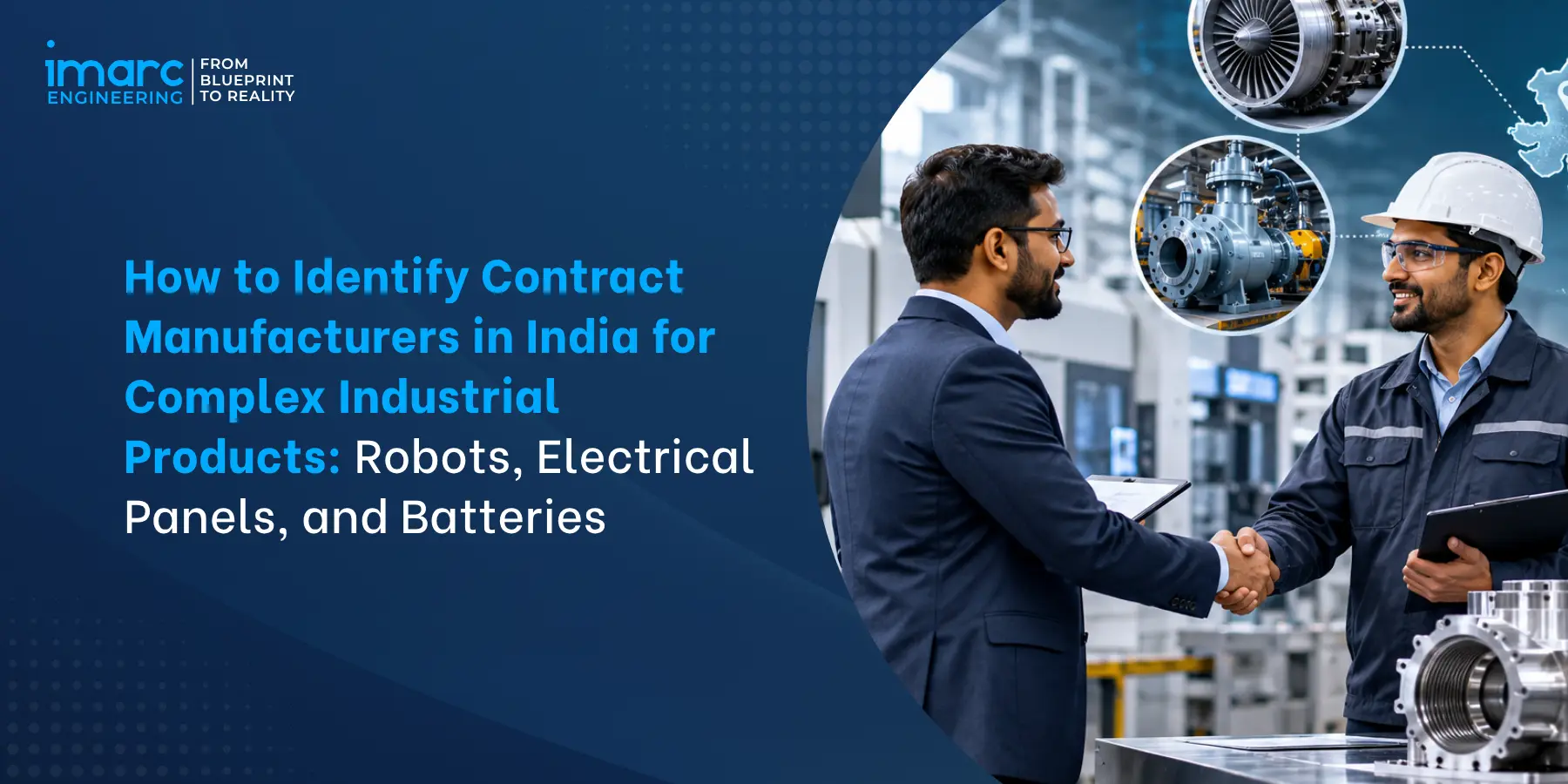
How to Identify Contract Manufacturers in India for Complex Industrial Products: Robots, Electrical Panels, and Batteries
Introduction
For OEMs, product companies, and sourcing teams pursuing contract manufacturing for industrial products in India - whether robots, electrical panels, batteries, or other technically complex products - manufacturer selection goes well beyond vendor rate cards. Engineering capability, machinery capability, component sourcing ecosystem, quality management systems, product-specific certifications, and scalable production capacity need deliberate evaluation before commitment. A wrong manufacturer choice costs months of lost time, failed certifications, IP exposure, and reputational damage.
Scope of this Guide
This guide walks through identifying contract manufacturers for industrial products in India - the technical documents to prepare, the factory audit framework, product-specific evaluation criteria for robots, panels, and batteries, IP protection discipline, and progression from prototype through trial production to commercial scale - anchored to verifiable Indian and international standards in effect in 2026.
Table of Contents
- Introduction
- Why Contract Manufacturing for Industrial Products in India Requires Deeper Technical Evaluation
- Technical Documentation and Specification Readiness Before Approaching Contract Manufacturers in India
- How to Evaluate Contract Manufacturers for Robots in India
- How to Identify Electrical Panel Contract Manufacturing Partners in India
- How to Evaluate Battery Contract Manufacturers in India
- Factory Audit and Manufacturing Capability Verification for Industrial Contract Manufacturing in India
- IP Protection NDAs and Contracting Discipline for Industrial Contract Manufacturing in India
- Prototyping Trial Production and Scale-Up with Contract Manufacturers in India
- Conclusion
1. Why Contract Manufacturing for Industrial Products in India Requires Deeper Technical Evaluation
Outsourcing an industrial product is a different exercise from outsourcing a consumer product. Four distinctions drive the technical evaluation depth.
1.1 Product Complexity Beyond Standard Outsourcing
An industrial contract manufacturing India assignment typically involves products with multiple engineering disciplines (mechanical, electrical, electronic, firmware, software), long bills of materials (BOMs) with regulated components, product-specific safety certifications, and integration into larger industrial systems. A robot combines precision mechanics, servo drives, control electronics, firmware, and safety-rated circuits. An electrical panel integrates switchgear, protection devices, bus bars, control wiring, and metering to type-tested assemblies. A battery pack combines certified cells, battery management systems (BMS), thermal management, and mechanical enclosure. Each discipline brings its own quality gates - a weakness in any one disqualifies the finished product.
1.2 Regulated Component Ecosystem
Industrial products embed regulated and certified components. Lithium-ion cells, contactors, circuit breakers, servo motors, PLCs, specific grades of copper and steel, and connector systems carry their own BIS registrations, CE marks, UL listings, or sector-specific certifications. The contract manufacturer's component selection, approved vendor list (AVL), and traceability discipline determine whether the finished product meets its own certification. Component substitution without engineering change notice is a common root cause of certification failures and field incidents.
1.3 Product-Specific Standards
Each product category sits under its own standards. Industrial robots follow ISO 10218-1:2025 and ISO 10218-2:2025. Low-voltage electrical panels and switchgear assemblies follow the IEC 61439 series (adopted as IS/IEC 61439 in India).
Lithium-ion batteries for portable applications are subject to BIS requirements under the Compulsory Registration Scheme (CRS), including the applicable IS 16046 standards. Contract manufacturers should understand these requirements to ensure the battery products they manufacture can meet applicable certification and compliance requirements.
1.4 Investment and Switching Cost
Industrial product outsourcing involves tooling investment, process engineering, firmware integration, training, trial runs, certification cycles, and ramp-up over 6-18 months (indicative, may vary). Switching manufacturers mid-programme restarts most of this cost. The upfront evaluation effort is modest against the switching cost - every day spent qualifying the right partner saves weeks of recovery later.
2. Technical Documentation and Specification Readiness Before Approaching Contract Manufacturers in India
Before any serious conversation with a prospective contract manufacturer for industrial products, the sourcing team needs a complete technical pack - without it, quotations are guesses and shortlisting is noise.
2.1 Product Requirement Specification
The Product Requirement Specification (PRS) is the single most important document. It records intended function, performance targets (speed, load, accuracy, capacity, cycle life, environmental ratings), operating envelope, interface requirements (electrical, mechanical, communication protocols), applicable technical specifications and standards, certification targets, and lifecycle expectations. For a robot - payload, reach, repeatability, axes, safety rating. For a panel - rated voltage, current, short-circuit withstand, IP rating. For a battery - nominal voltage, capacity, cycle life, charge/discharge rates, safety standard target. A specification gap at this stage carries through the entire project.
2.2 Engineering Drawings and 3D Models
Mechanical assembly drawings, exploded views, part drawings with GD&T, 3D CAD models (STEP/IGES), electrical schematics, PCB Gerber files, wiring diagrams, and panel layout drawings form the manufacturing-level definition. Drawings must carry revision control, title block compliance, and material/finish specifications. Incomplete or inconsistent drawings are a leading cause of quotation variance and prototype errors. For panels, the single-line diagram, control schematic, and layout drawing must align.
2.3 Bill of Materials and Approved Vendor List
The BOM lists every part-by-part number, description, quantity per unit, specification reference, approved vendor(s), and alternates. For critical components (safety-rated devices, lithium-ion cells, certified connectors), the Approved Vendor List (AVL) names acceptable sources and prohibits substitutions without engineering change authorisation. A clear AVL protects certification continuity and quality. BOM accuracy at RFQ stage drives quotation accuracy.
2.4 Test and Acceptance Protocols
Factory Acceptance Test (FAT) protocols, routine test schedules, type test references, inspection checkpoints, and acceptance criteria need to be defined before manufacturing starts. These flow from applicable standards (ISO 10218 for robots, IEC 61439 for panels, IS 16046 for batteries) and customer-specific additions. The manufacturer uses these to design in-process controls and final inspection. Clarity here prevents disputes over what passes and what fails.
3. How to Evaluate Contract Manufacturers for Robots in India
Evaluating a prospective robot manufacturing India partner needs discipline across precision mechanics, drive electronics, safety-rated controls, and firmware integration.
3.1 Engineering and Design Capability
Verify the manufacturer's engineering bench strength - mechanical design (3D CAD, FEA, kinematics), electrical and electronic design (motor drives, servo controllers, safety circuits), firmware and controls (PLC, embedded, ROS where used), and manufacturing engineering (process planning, assembly fixturing). Engineering capability shows up in prior projects - ask for case studies, sanitised customer references, and demonstrations of their own IP or licensed designs they have built to volume.
Manufacturers specialising in assembly from supplied kits may be suitable where the OEM retains design responsibility. However, projects requiring design adaptation, manufacturing engineering, troubleshooting, or product development should prioritise partners with demonstrated engineering capabilities.
3.2 Precision Machinery and Assembly Capability
Robot joints, gearboxes, and mounting interfaces need tight tolerances. The manufacturer must demonstrate CNC machining, grinding, laser cutting, or sourcing arrangements that deliver the required precision. Assembly capability includes torque-controlled fastening, servo alignment procedures, encoder calibration, backlash measurement, repeatability verification using laser trackers, and burn-in testing. A visit to the shop floor during an active robot build is more informative than any brochure.
3.3 Safety-Rated Design and Testing
Industrial robot manufacturers should demonstrate alignment with ISO 10218-1:2025, which addresses safety requirements for industrial robots. ISO 10218-2:2025 addresses robot applications and integration and is particularly relevant where the contract manufacturer also supplies complete robotic cells or integrated systems. Manufacturers should demonstrate competence in safety-rated control architecture, emergency stop functions, protective stopping, risk assessment, and speed and separation monitoring where applicable. For exports, conformity assessment and certification requirements depend on the destination market, product configuration, and applicable legislation. For the European Union, manufacturers should assess the Machinery Directive 2006/42/EC and the transition to Regulation (EU) 2023/1230.
3.4 Component Ecosystem
Robot BOMs include servo motors and drives (Yaskawa, ABB, Siemens, Mitsubishi, Delta, domestic alternatives), harmonic drives or RV reducers, encoders, safety PLCs, cables, and connectors. A capable Indian manufacturer has established supplier relationships, buffer inventory for long-lead items, and alternate-vendor qualification. Ask specifically about their lead time for critical items, how they manage obsolescence, and whether they can procure directly in volume or depend on distributor channels (which can affect pricing and supply security at scale).
4. How to Identify Electrical Panel Contract Manufacturing Partners in India
Shortlisting an electrical panel contract manufacturing partner needs discipline across sheet metal fabrication, bus bar engineering, panel wiring, type testing, and brand associations.
4.1 Fabrication and Panel-Building Infrastructure
Panel manufacturing starts with sheet metal - the manufacturer needs CNC turret punching, laser cutting, press brakes, powder coating, and welding to build enclosures to IP specifications. Bus bar fabrication requires copper cutting, bending, insulation sleeving, and torque-controlled jointing. Panel wiring needs trained wiremen, ferrule marking systems, cable ducting discipline, and routing per approved drawings. Inspection of a running shop floor shows whether these capabilities are routine or occasional.
4.2 IEC 61439 Compliance
Low-voltage switchgear and controlgear assemblies should be evaluated against the applicable IEC 61439 series, adopted in India as IS/IEC 61439. Part 1 specifies general requirements, Part 2 covers power switchgear and controlgear assemblies, and Part 3 addresses distribution boards intended for operation by ordinary persons. Manufacturers should demonstrate applicable design verification through testing, comparison with a reference design, or assessment where permitted by the standard.
Relevant evidence includes short-circuit withstand capability, temperature-rise verification, degree of protection, dielectric properties, and protective circuit integrity. Routine verification must also be performed on completed assemblies. Where a manufacturer uses an OEM's verified assembly system, the proposed configuration should remain within the verified design limits.
4.3 OEM Switchgear Brand Associations
Panels embed branded switchgear - ACBs, MCCBs, MCBs, contactors, relays, meters, and PLCs from Schneider, Siemens, ABB, Legrand, L&T, C&S, and others. Panel manufacturers often operate under formal partnership programmes with these OEMs (authorised panel builder arrangements) which include training, approved design templates, and brand co-marking rights. These associations signal both engineering discipline and sustained volume - a manufacturer serving one or two OEM programmes at scale is typically more reliable than one claiming to work with everyone.
4.4 Quality and Documentation
The quality system should produce complete panel documentation at dispatch - as-built single-line diagrams, wiring diagrams, test certificates, torque records for critical joints, IP test certificates where applicable, calibration certificates for installed meters and relays, and operating manuals. For export projects, documentation language and certification formats must match destination requirements. A manufacturer who treats documentation as an afterthought creates installation and commissioning headaches at the end-user site.
5. How to Evaluate Battery Contract Manufacturers in India
Evaluating a battery contract manufacturing India partner requires discipline across cell sourcing, BMS integration, mechanical pack design, environmental testing, and certification pathways.
5.1 Scope - Cell Manufacturer vs Pack Assembler
Clarify scope early. Cell manufacturing (building the electrochemical cells themselves from active materials) is a vastly different industrial exercise from battery pack assembly (building packs using purchased cells, BMS, housing, and cables). Most Indian contract manufacturers are pack assemblers - sourcing cells from Chinese, Korean, Japanese, or increasingly domestic sources, and integrating them into application-specific packs. A smaller number of players are building cell manufacturing capacity under the PLI scheme. Match the scope to the manufacturer category.
5.2 Cell Sourcing and Traceability
Cell selection directly influences battery pack performance, safety, reliability, and certification. The manufacturer should demonstrate established sourcing arrangements for suitable cell chemistries, such as NMC, LFP, or LCO, and appropriate form factors, including cylindrical, prismatic, or pouch cells. Supplier qualification should cover cell specifications, quality documentation, batch traceability, incoming inspection, and approved substitution procedures.
For portable lithium-ion cells and batteries, applicable BIS Compulsory Registration Scheme (CRS) requirements should be assessed against IS 16046 (Part 2):2018 and relevant government notifications. Any additional rated-capacity verification requirements and implementation deadlines should be confirmed against the latest official MeitY and BIS notifications. Industrial and automotive battery applications should be evaluated separately according to their intended use and applicable standards.
5.3 BMS Thermal and Mechanical Design
Battery pack performance and safety rest on the battery management system (BMS) - cell balancing, voltage/current/temperature monitoring, protection algorithms, state-of-charge estimation, and communication interface. Thermal management systems, including passive cooling, forced-air cooling, liquid cooling, or phase-change materials where appropriate, help maintain operating temperatures within specified limits and reduce thermal-related safety risks. However, thermal management alone cannot eliminate the possibility of thermal runaway.
Mechanical pack design covers cell holders, interconnects, enclosure, vibration/shock rating, and ingress protection. Ask about the manufacturer's BMS platforms - in-house, licensed, or outsourced - and the environmental testing they have performed on similar packs.
5.4 Certification Pathway
Portable lithium-ion cells and batteries covered by the BIS Compulsory Registration Scheme are assessed against IS 16046 (Part 2):2018, aligned with IEC 62133-2:2017. For electric vehicle applications, the applicable standards depend on the vehicle category and battery configuration. The IS 16893 series addresses relevant traction-cell testing requirements, while AIS-156 applies to rechargeable electrical energy storage systems used in specified electric vehicle categories. AIS-038 requirements may apply to other vehicle categories. Contract manufacturers should identify the applicable testing, approval, and certification pathway before finalising the battery design and manufacturing process.
Lithium cells and batteries intended for transport should meet applicable dangerous-goods transport requirements, including UN 38.3 testing and test-summary documentation where required by the relevant transport regulations. End-of-life management falls under the Battery Waste Management Rules 2022 (notified 24 August 2022) which require EPR registration with CPCB. The manufacturer should be able to describe which certifications apply to the planned pack and how they are achieved - with timelines.
5.5 Product-Specific Standards Summary
| Product | Primary Standards | Applicable Framework |
|---|---|---|
| Industrial robots | ISO 10218-1:2025; ISO 10218-2:2025 for applications and integration | Applicable machinery safety and market-specific conformity requirements |
| LV switchgear and control gear assemblies | IEC 61439 / IS/IEC 61439 | Design verification and routine verification |
| Portable lithium-ion cells and batteries | IS 16046 (Part 2):2018 | BIS CRS, where applicable |
| EV traction cells | IS 16893 series | Applicable automotive cell-testing requirements |
| EV battery packs / REESS | AIS-156 or applicable AIS-038 provisions | Vehicle-category-specific automotive approval requirements |
| Lithium battery transport | UN Manual of Tests and Criteria, subsection 38.3 | Applicable dangerous-goods transport requirements |
6. Factory Audit and Manufacturing Capability Verification for Industrial Contract Manufacturing in India
The factory audit converts shortlist to selection. A thorough audit covers physical infrastructure, quality system discipline, people, and financial sustainability.
6.1 Physical Infrastructure
Walk the shop floor. Check whether listed machinery is operational and in regular use (not a static showpiece). Verify calibration status on measurement instruments and torque tools. Observe inventory stacking, work-in-progress discipline, line layout, material flow, and finished-goods staging. For regulated products, verify ESD-protected zones, cleanroom areas (where applicable), temperature/humidity logging, and segregated storage for incoming inspection, approved stock, quarantine, and rejected items. Visible 5S discipline is a reliable indicator of day-to-day operational quality.
6.2 Quality Management System
Verify ISO 9001 certification currency and scope - but go further. Review quality management system procedures for incoming inspection, in-process controls, final inspection, non-conformance management, corrective and preventive action, calibration, document control, and training records. Check how BOM changes are controlled (engineering change notice process), how customer complaints are investigated, and how batch records are maintained. Ask to see sample first-article inspection reports, control plans, and process FMEAs for recently delivered products.
6.3 People and Technical Capability
Industrial contract manufacturing is people-intensive. Verify qualifications of design engineers, manufacturing engineers, quality personnel, and skilled operators (certified wiremen for panels, trained BMS technicians, calibrated servo-alignment staff). Review training records, attrition rates in critical roles, and succession for key engineering positions. A manufacturer with high turnover in critical roles cannot sustain quality consistently.
6.4 Financial and Commercial Due Diligence
A technically excellent manufacturer who runs into working capital stress will delay deliveries and compromise quality. Review audited financials, order book, customer concentration, banker references, working capital health, and insurance coverage. For strategic programmes, verify ownership structure, related-party transactions, and litigation history.
Potential red flags include excessive dependence on a small number of customers, prolonged payment cycles, working capital constraints, and recurring quality disputes. Customer concentration should be assessed against the manufacturer's business model, financial position, and contractual commitments rather than a universal percentage threshold.
7. IP Protection NDAs and Contracting Discipline for Industrial Contract Manufacturing in India
Intellectual property protection separates serious contract manufacturing partner India engagements from informal arrangements. Discipline begins before the first drawing changes hands.
7.1 NDAs and MOUs Before Information Exchange
A written Non-Disclosure Agreement (NDA) is signed before any proprietary information - BOMs, drawings, firmware, test methods, customer identities - is shared. Under the Indian Contract Act 1872, enforceable NDAs name parties, define confidential information precisely, exclude publicly available information, set the obligations, specify permitted use, define duration, carve out return/destruction of material at termination, and include governing law and jurisdiction clauses. For sensitive programmes, an NDA is followed by an MOU or Letter of Intent before full contracting - allowing the manufacturer to begin quotation and feasibility work under confidentiality.
7.2 Information Compartmentalisation
Share technical information progressively based on the manufacturer's evaluation stage and scope of work. Initial shortlisting may require only functional specifications and selected technical details, while accurate quotations may require detailed Bills of Materials (BOMs), engineering drawings, and manufacturing requirements. Prototype development and commercial production may require additional design files, firmware, and complete manufacturing documentation, depending on the manufacturer's responsibilities.
Phased disclosure helps protect intellectual property (IP) while ensuring manufacturers receive sufficient information for technical evaluation and production planning. All documents should be shared under appropriate confidentiality agreements, with access controls, revision tracking, and watermarked drawings where necessary to maintain traceability and reduce the risk of unauthorised disclosure.
7.3 IP Ownership in the Manufacturing Agreement
The master manufacturing or supply agreement must address IP ownership clearly - background IP (what each party brings), foreground IP (what emerges during the engagement), tooling and fixture ownership, firmware/software licensing, and improvements. For contract manufacturing where the customer's design is being manufactured, customer IP typically remains customer-owned and the manufacturer gets a limited licence to produce for the customer. Manufacturer-contributed tooling may be customer-owned (if customer paid for it) or shared-use. Patents Act 1970, Designs Act 2000, Copyright Act 1957, and Trade Marks Act 1999 provide the Indian legal basis for IP enforcement.
7.4 Scope of Rights and Exclusivity
The manufacturing agreement should clearly define permitted use of customer-owned intellectual property, restrictions on unauthorised production or sale of customer-designed products, handling of excess and rejected inventory, and confidentiality obligations. Exclusivity and restrictions involving competing products should be negotiated according to the commercial arrangement and reviewed for enforceability under applicable Indian law.
For strategic programmes, exclusivity in a geography or application may be negotiated - with volume commitments supporting the manufacturer's capacity reservation. These terms affect both IP risk and commercial price.
8. Prototyping Trial Production and Scale-Up with Contract Manufacturers in India
Progression from engagement to commercial supply follows disciplined phases. Each gate validates the contract manufacturer for industrial products before the next commitment.
8.1 Prototype Build
Prototype build is the first production exercise - typically 1-5 units. The purpose is to validate drawings, BOM accuracy, process steps, assembly sequence, and basic performance. Prototype manufacturing surfaces design-for-manufacturability issues (parts that will not fit, tolerances that cannot be held, assembly operations that need jig/fixture support). Expect prototype outcomes to drive drawing and BOM revisions - this is normal and better than discovering issues in volume. The manufacturer's engineering team should document observations and raise formal engineering change requests.
8.2 Trial Production
Trial production (pilot run) typically covers 10-50 units at near-line conditions. The purpose is to validate production-rate feasibility, workstation cycle times, operator training, in-process inspection, and consistency across units. Trial production units undergo full test protocols including type-equivalent tests where applicable. Scrap and rework rates are measured against targets. First-article inspection reports are signed. Trial production typically takes 4-12 weeks depending on product complexity and material lead times.
8.3 Qualification and Certification
Trial production units support product qualification, applicable regulatory testing, and customer-specific acceptance requirements. For portable lithium-ion batteries, this may include BIS CRS testing and registration. Electrical panel manufacturers should demonstrate applicable IEC 61439 design verification and routine verification, while robot manufacturers should validate relevant safety requirements under ISO 10218 and applicable destination-market regulations.
External testing or certification may be required depending on the product, market, and customer specifications. Commercial production should begin only after the applicable mandatory approvals and agreed qualification criteria have been satisfied. Early coordination with testing laboratories and certification bodies helps reduce design changes and delays during commercialisation.
8.4 Commercial Scale-Up
Commercial production ramps up progressively as operators establish stable processes, quality performance improves, and component supply becomes consistent. The time required to reach steady-state production depends on product complexity, manufacturing capacity, automation, supplier readiness, and customer demand.
The contract manufacturer's scalability is tested here - whether they can double capacity if demand doubles, whether critical component supply can scale, whether second shifts or line expansions are feasible. Monthly business reviews, quarterly operational reviews, and formal supplier scorecards (quality, delivery, cost, responsiveness) are embedded during this phase. Mature relationships evolve into joint planning, cost reduction partnership, and new product collaboration.
Conclusion
Effective contract manufacturing requires strong technical documentation, product-specific manufacturer screening, factory audits, IP protection, certification planning, and controlled progression from prototype to trial production and commercial scale-up. Sourcing teams should focus on three priorities: maintain complete and controlled documentation, shortlist manufacturers based on relevant product standards and capabilities, and use phased commitments from NDA and prototype through trial production and commercialisation.
IDENTIFYING INDUSTRIAL CONTRACT MANUFACTURERS IN INDIA?
IMARC Engineering supports OEMs and product companies with contract manufacturer identification and qualification, covering technical documentation, supplier shortlisting, factory audits, QMS and IP reviews, commercial agreements, prototype and trial production, certification support, supplier scorecards, and production scale-up.
→ Schedule a free manufacturer identification scoping consultation with an IMARC specialist
Frequently Asked Questions
Finding a contract manufacturer for industrial products in India starts with a complete technical pack, product-specific capability screening (robots per ISO 10218, panels per IEC 61439, batteries per IS 16046), industry referrals, factory audits, financial due diligence, NDA-protected shortlisting, and phased prototype-trial-commercial progression.
An industrial contract manufacturer selection checks engineering capability, machinery and process capability, product-specific standard compliance, BOM and Approved Vendor List discipline, QMS maturity (ISO 9001 and beyond), skilled workforce, financial sustainability, IP protection discipline, prior customer references, and demonstrated scalability for the target volume.
A robot contract manufacturer evaluation checks compliance with ISO 10218-1:2025 and ISO 10218-2:2025, precision machining and assembly capability, servo/drive electronics competence, safety-rated control architecture per ISO 13849, firmware integration, calibration/burn-in process, servo and reducer sourcing relationships, and prior robot build volumes.
Panel partner identification checks sheet metal fabrication (CNC punching, laser cutting, powder coating), bus bar engineering, panel wiring discipline, IEC 61439 type-tested design verification from CPRI/ERDA or KEMA/ASTA, IP ratings per IS/IEC 60529, OEM switchgear brand authorisation (Schneider, Siemens, ABB, L&T), and documentation quality.
A battery contract manufacturer evaluation checks cell sourcing and traceability (BIS-registered cells under IS 16046), BMS competence, thermal and mechanical pack design, environmental testing, certification pathway, and EPR under Battery Waste Rules 2022.
Before approaching a contract manufacturer, prepare the Product Requirement Specification, mechanical and electrical engineering drawings with revision control, 3D CAD models (STEP/IGES), complete BOM with Approved Vendor List, applicable standards and certification targets, Factory Acceptance Test protocols, routine test schedules, and packaging/dispatch specifications.
A factory audit verifies machinery and calibration status, shop floor discipline (5S, work-in-progress, segregated inspection zones), ISO 9001 QMS procedures, engineering change management, incoming/in-process/final inspection records, people qualifications and attrition, financial sustainability, and demonstrated recent builds of comparable products with first-article inspection evidence.
BOM, drawings and specifications should be shared only under a signed NDA, in phased releases matched to engagement stage (envelope specs for shortlisting, full drawings for quotation, firmware at prototype), with watermarked and version-controlled documents, defined permitted use, and return/destruction obligations on termination.
IP protection uses NDAs under the Indian Contract Act 1872, phased disclosure limited to engagement stage, clear IP ownership clauses in the master supply agreement, protections under the Patents Act 1970, Designs Act 2000, Copyright Act 1957, and Trade Marks Act 1999, and controlled tooling.
Prototype build (1-5 units) validates drawings, BOM accuracy, and basic performance, surfacing design-for-manufacturability issues. Trial production (10-50 units) validates production rate, workstation cycle times, operator training, in-process inspection, and consistency - and supports external certification before commercial scale-up and full volume commitment.
Recent Post


Trusted by Industry Leaders
We partner with global enterprises and ambitious businesses across sectors to deliver operational excellence, strategic insights, and sustainable growth through integrated solutions.












Success in Their Words
Real feedback from clients across industries. Discover how our solutions delivered measurable impact and operational excellence.

I wanted to express my sincere appreciation for your efforts in handling this matter. Your dedication and commitment have been truly commendable, and it is evident that you have put in tremendous hard work and expertise into resolving the issues at hand. We are greatly interested in continuing our collaboration with you in the future, as your professionalism and reliability have made you a trusted partner. Thank you once again for your invaluable contribution. We look forward to strengthening our partnership ahead.

It has been a pleasure working with the IMARC team. The insights provided were structured, clear, and highly valuable, helping us strengthen both our technical and financial planning with confidence. We deeply appreciate the team’s professionalism, responsiveness, and attention to detail throughout the engagement. Every requirement was well understood and effectively incorporated, resulting in a comprehensive and actionable output. Overall, our experience has been excellent, and I would gladly recommend IMARC to organizations seeking a reliable research partner.

Your service is truly exceptional. Working with the IMARC team has been a seamless and professional experience. The clarity of communication, responsiveness to queries, and consistent support at every stage made the entire engagement highly efficient. The insights shared were well-structured, practical, and perfectly aligned with our requirements, helping us make informed decisions with confidence. Overall, the dedication and professionalism demonstrated by your team stand out, and I would be glad to recommend IMARC as a reliable and trustworthy research partner.

IMARC did an outstanding job in preparing our study. They were punctual, precise, and consistently responsive throughout the entire process. The team delivered all the data we required in a clear, well-organized, and highly professional format. Their strong attention to detail, combined with their ability to meet every deadline without compromising quality, truly set them apart. Overall, their reliability and commitment made them an exceptional partner for our project, and we would gladly work with them again in the future.

IMARC made the whole process incredibly easy from start to finish. Everyone I interacted with via email was polite, professional, and straightforward to deal with, always keeping their promises regarding delivery timelines and remaining consistently solutions-focused. From my very first contact, I appreciated the professionalism and support shown by the entire IMARC team. I highly recommend IMARC to anyone seeking timely, affordable, and reliable information or advice. My experience with IMARC was excellent, and I truly cannot fault any aspect of it.

I’d like to express my sincere gratitude for the excellent work you accomplished with the study. Your ability to quickly understand our requirements and deliver high-quality results under tight timelines truly reflects your expertise, exceptional work ethic, and unwavering commitment to your customer’s success. The professionalism and responsiveness you demonstrated throughout the process made a significant difference. Our entire team and company are incredibly thankful for your dedication, reliability, and support. Once again, thank you for your outstanding contribution.