Manufacturing
October 26 2026
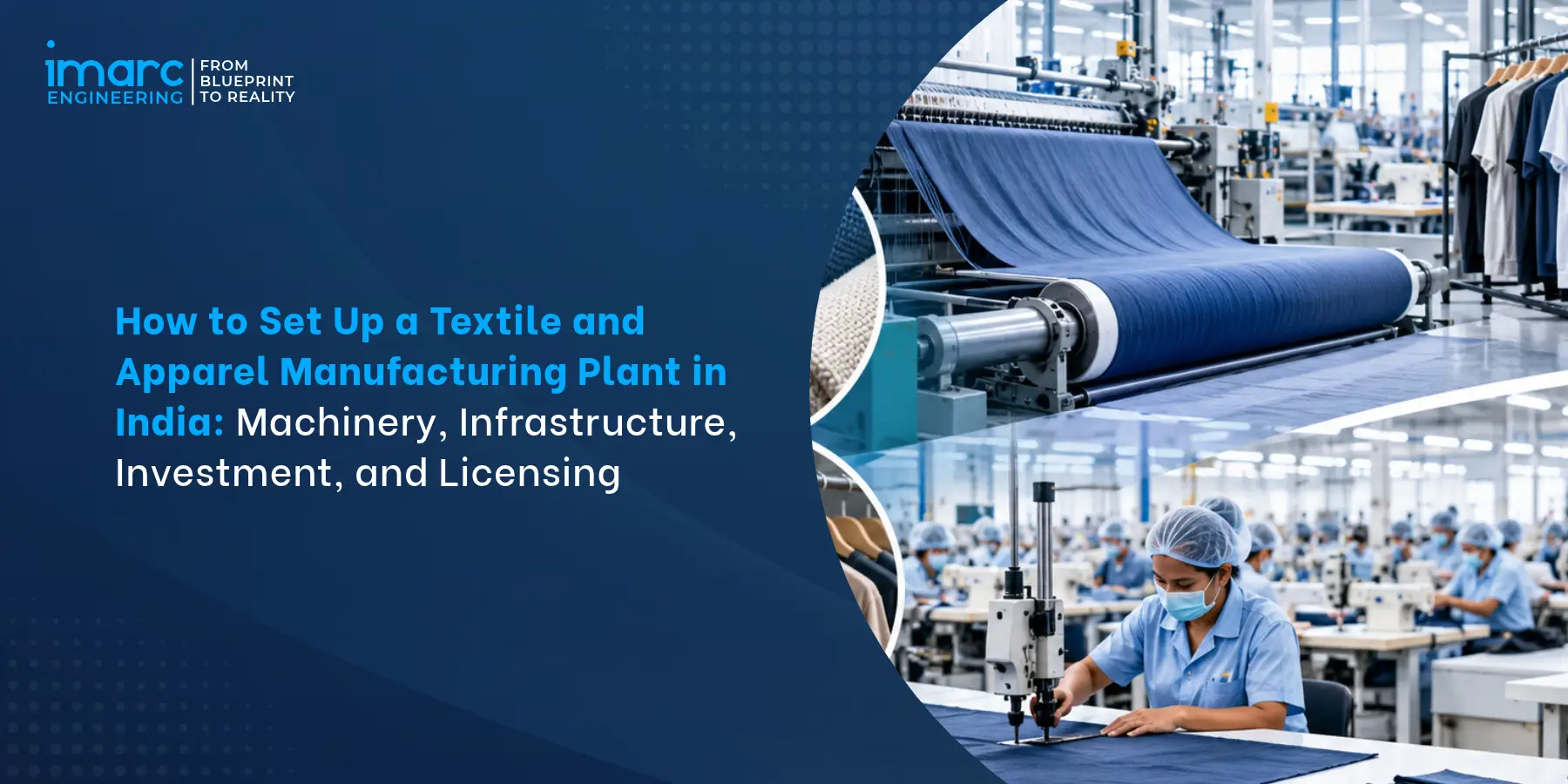
How to Set Up a Textile and Apparel Manufacturing Plant in India: Machinery, Infrastructure, Investment, and Licensing
Introduction
India's textile and apparel value chain runs from cotton bales in Gujarat and Maharashtra through yarn, greige fabric, dyed and finished cloth and, finally, cut-and-sew garments, and it is one of the few manufacturing sectors where a single country hosts every processing stage at commercial scale. That breadth is also the central planning problem.
A spinning mill, an air-jet weaving shed, a circular-knit dye house and a garment assembly unit share a sector but almost nothing else: Spinning mills, weaving units, knitting facilities, dyeing plants and garment manufacturing units have distinct machinery, building, utility and environmental requirements. Their investment structures and operating costs vary significantly according to the manufacturing process, production capacity, automation level and degree of integration.
For investors, project sponsors and manufacturers, a textile and apparel manufacturing plant setup in India is a segment-selection, utility-balance and compliance-sequencing problem long before it is a marketing problem. This guide sets out the engineering and commercial architecture of a bankable facility segment economics, machinery specification, capacity logic, raw materials and process chemistry, utilities, effluent and the licence stack so capital is committed against verified assumptions rather than vendor brochures.
Scope of this Guide
This guide answers one question: how can investors plan and establish a textile or apparel manufacturing plant in India, from selecting the production segment and machinery to infrastructure development, licensing, and commissioning? It treats spinning, weaving, knitting, dyeing and finishing, and garment manufacturing as five businesses that share a value chain but not a plant design, and compares them on equipment, utilities, investment drivers and regulatory exposure. Capacity, land, utility and cost figures are indicative planning ranges to be replaced by site data, vendor quotations and a project-specific detailed project report.
Table of Contents
- Introduction
- Why Textile and Apparel Manufacturing Plant Setup in India Matters for Investors in 2026
- What a Textile and Apparel Manufacturing Plant Setup in India Is and Why It Matters
- Textile and Apparel Manufacturing Plant Setup in India: Segment Selection and Capacity Planning
- Raw Materials, Fibres and Chemicals for Textile and Apparel Manufacturing Plant Setup in India
- Core Process Steps for Textile and Apparel Manufacturing Plant Setup in India: Fibre to Fabric
- Core Process Steps for Textile and Apparel Manufacturing Plant Setup in India: Dyeing, Finishing and Garment Assembly
- Machinery, Cleanroom and Utilities for Textile and Apparel Manufacturing Plant Setup in India
- Effluent, Licences and Project Economics for Textile and Apparel Manufacturing Plant Setup in India
- Conclusion
1. Why Textile and Apparel Manufacturing Plant Setup in India Matters for Investors in 2026
Four structural conditions shape a disciplined textile and apparel manufacturing plant setup in India in 2026, and each one changes the technical configuration an investor should fund.
1.1 Import Dependence, Localisation and the Man-Made Fibre Shift
India is among the world's largest cotton producers and yarn exporters, yet remains a net importer of man-made fibre apparel, specialist fabrics and technical textiles, because processing and garmenting depth has lagged spinning capacity. The defensible position for a new entrant is depth in one stage combed compact yarn, wide-width woven fabric, knit processing with zero liquid discharge, or a vertical garment unit with in-house fabric rather than a small composite mill that performs every stage poorly. Fibre mix matters too: polyester and its blends set global apparel demand, so a cotton-only project faces a narrower order book.
1.2 Policy Framework, PM MITRA Parks and Textile PLI
India’s textile manufacturing sector receives policy support through industrial infrastructure programmes, central schemes and state-level incentives. However, the availability of benefits depends on the manufacturing segment, project location, investment structure and applicable eligibility conditions.
The PM Mega Integrated Textile Region and Apparel (PM MITRA) scheme aims to develop seven integrated textile parks across Tamil Nadu (Virudhunagar), Telangana (Warangal), Gujarat (Navsari), Karnataka (Kalaburagi), Madhya Pradesh (Dhar), Uttar Pradesh (Lucknow) and Maharashtra (Amravati). The scheme has an outlay of INR 4,445 crore for 2021–22 to 2027–28. Planned infrastructure includes developed industrial sites, roads, power and water systems, wastewater facilities, and other common infrastructure. Investors should confirm land availability, utility readiness, allotment terms and the status of facilities directly with the relevant park authority before selecting a site.
The Production Linked Incentive (PLI) Scheme for Textiles supports eligible manufacturing of man-made fibre (MMF) apparel, MMF fabrics and specified technical textile products. The Ministry of Textiles extended the application window for new applicants until 31 March 2026. As this deadline has passed, prospective investors should verify whether a subsequent notification has reopened applications before including PLI benefits in their project financial model.
State governments may also provide incentives under their applicable industrial or textile policies. These can include eligible capital subsidies, interest assistance, stamp duty concessions or electricity-related benefits, depending on the state and scheme. Investors should verify the current policy, application deadlines, eligible expenditure, maximum assistance and conditions for disbursement with the relevant state authority. Incentives should be included in project projections only after eligibility and applicable terms have been confirmed.
1.3 Investment Ecosystem and Cluster Depth
Cluster depth determines operating cost more than land price does. Coimbatore and Dindigul anchor spinning and textile machinery; Surat anchors polyester texturising and processing; Tiruppur anchors knit dyeing and garmenting; Bhilwara, Solapur and Ichalkaranji anchor woven processing; Ludhiana anchors hosiery and worsted; Panipat anchors home textiles and fibre recycling; Noida and Bengaluru anchor organised export garmenting.
Each cluster supplies trained operators, job-work process houses, spare-part dealers and accredited testing laboratories, and a plant built outside one typically saves on land while losing on maintenance response and rework cycle time.
1.4 The Cost of Poor Planning
Poor capacity planning can create bottlenecks when fibre preparation, spinning, weaving or finishing equipment is not balanced against the intended production volume. Equipment nameplate capacity alone does not establish achievable saleable output. Wet-processing facilities also require early assessment of wastewater characteristics, treatment capacity and applicable discharge conditions. Zero liquid discharge (ZLD) should be incorporated where required by regulatory conditions or project-specific requirements.
Delays in obtaining Consent to Establish or finalising environmental requirements can affect plant layout, infrastructure investment and implementation schedules. These risks should be assessed during feasibility studies and detailed project planning.
2. What a Textile and Apparel Manufacturing Plant Setup in India Is and Why It Matters
A textile and apparel manufacturing plant setup in India is defined by what it is licensed to process, what it can measure in its laboratory, and where the facility boundary sits.
2.1 Definition and Facility Boundary
A textile plant converts fibre, yarn or greige fabric into a saleable intermediate or finished product, and the boundary between stages is a commercial decision as much as an engineering one. A spinner sells yarn; a weaver sells greige or finished fabric; a processor sells job-work dyeing; a garment unit sells a sewn, packed and labelled article.
An integrated textile facility may combine multiple production stages, such as spinning, weaving, processing and garment manufacturing, within a coordinated manufacturing operation. The required utilities, environmental approvals and wastewater-treatment arrangements depend on the processes, plant configuration and applicable regulations. Integration may improve production coordination but generally increases project complexity and capital requirements.
2.2 Spinning, Weaving, Knitting, Processing and Garmenting as Separate Businesses
Spinning drafts and twists fibre into yarn on ring, compact, rotor or air-jet systems, and is capital and power heavy but water-light. Weaving interlaces warp and weft on shuttleless looms after warping and sizing, and is dominated by power, humidity and loom efficiency. Knitting loops yarn on circular or flat machines at high speed and low capital per kilogram.
Dyeing and finishing is wet, chemical and effluent intensive, and carries the heaviest pollution-control exposure. Garment manufacturing is labour intensive, with low fixed capital and high working capital per rupee of equipment.
2.3 Scale Determinants for a Textile and Apparel Production Facility
Scale is fixed by four variables: the product and count range, since a 40s combed compact yarn runs at a very different rate from a 10s open-end yarn; machine utilisation, with ring spinning using a realistic utilisation assumption based on equipment specifications, maintenance schedules, product mix, shift pattern and operating data from comparable facilities; order size and shade continuity in processing, where frequent colour changes destroy efficiency; and utility capacity, because power and steam rather than floor space usually cap output.
Capacity should be stated as kilograms of yarn, metres or kilograms of fabric, or pieces per day at a defined construction and mix, never as nameplate spindle count (Figures are indicative in nature, may vary).
2.4 Plant Sections
| Section | Function | Key Equipment |
|---|---|---|
| Bale and fibre store | Receipt, blending, conditioning | Bale opener, weighbridge |
| Spinning | Fibre to yarn conversion | Card, comber, ring frame |
| Weaving or knitting | Yarn to greige fabric | Warper, sizing, air-jet loom |
| Wet processing | Desize, bleach, dye, finish | Jet dyeing, stenter, calender |
| Garment unit | Cut, sew, finish, pack | Auto cutter, lockstitch line |
| Quality laboratory | Fibre, shade, shrinkage testing | Spectrophotometer, tensile tester |
| Utility block | Power, steam, air, water | Boiler, chiller, compressor, DG |
| Effluent treatment | Treat process wastewater to meet applicable discharge or reuse requirements | ETP, filtration, RO and evaporation systems where required |
| Finished goods store | Warehousing and dispatch | Racking, pallet trucks |
| Administration and EHS | Offices, canteen, fire safety | Fire pumps, hydrant system |
The sections and machinery listed are illustrative. Actual requirements vary by manufacturing segment, production capacity and degree of integration. Garment assembly facilities, for example, may not require the wet-processing infrastructure used in dyeing and finishing plants.
3. Textile and Apparel Manufacturing Plant Setup in India: Segment Selection and Capacity Planning
Segment selection precedes plant design, because each stage imposes a different machinery set, building geometry, humidity band and effluent load.
3.1 Product Types and Fibre Mix
Product definition should specify fibre (cotton, polyester, viscose, blends, elastane), yarn count and type, fabric construction (plain, twill, rib, interlock, fleece), finished width and grams per square metre, and fastness class. Product specifications should define the intended construction, weight, width, performance and end-use requirements.
For example, apparel, shirting and home-textile products have different fabric-weight and dimensional-stability targets. Technical textiles, including medical, filtration and hygiene products, may require specialised environmental controls depending on the product, contamination risks and customer specifications. Set these requirements against the applicable product standards and buyer requirements.
3.2 Capacity Planning and Indicative Throughput
Capacity planning should begin with the required saleable output and work backwards from the constraining process. For spinning, assess spindle count, yarn count, twist, spindle speed, operating hours, efficiency and quality losses. For weaving and knitting, account for machine configuration, fabric construction, operating speed, changeovers and downtime. For wet processing and garmenting, include batch sizes, cycle times, style changes and finishing or inspection capacity. Validate assumptions against supplier data and production trials.
3.3 Product Mix and Vertical Integration
Vertical integration decisions should be based on production economics, supply-chain reliability, quality requirements, customer demand and available capital. Integrating spinning, weaving, knitting, processing or garment manufacturing can improve production coordination but may increase investment, operational complexity and working-capital requirements. Investors should compare integrated manufacturing with outsourced or job-work arrangements using realistic capacity utilisation, input costs, conversion costs, lead times and quality-control requirements.
Product mix should be aligned with market demand, equipment flexibility, production scheduling and customer specifications to minimise changeover losses and maintain operating efficiency. Restrict the product architecture to two or three fabric constructions in year one, because shade and style proliferation erodes both loom and stitching efficiency.
3.4 Segment Comparison and Location Selection
Cluster selection weighs fibre and yarn availability, effluent disposal route and water allotment, power tariff and reliability, port or inland container depot distance for export orders, and skilled-operator density. Tiruppur and Surat carry the deepest processing and garment ecosystems but the tightest water and effluent constraints; Gujarat and Madhya Pradesh offer land and power at lower cost; Tamil Nadu and Telangana host PM MITRA parks with common infrastructure.
Land requirements depend on the selected process route, machinery layout, storage, internal roads, fire setbacks, utility facilities, effluent treatment, future expansion and local development rules. Establish the plot area through a concept layout and site due diligence rather than relying on a generic acreage benchmark.
4. Raw Materials, Fibres and Chemicals for Textile and Apparel Manufacturing Plant Setup in India
Fibre and chemical specification determines yield, shade reproducibility and effluent load far more than machine branding does in any textile and apparel manufacturing plant setup in India.
4.1 Fibre Inputs and Quality Parameters
Raw-material specifications should match the fibre type, yarn count, fabric construction and end-use requirements. For cotton, assess relevant characteristics such as staple length, micronaire, strength, trash and contamination. For man-made fibres, specify polymer type, denier or decitex, cut length, tenacity and other properties required for the intended process. Define sampling, testing and contamination-control procedures according to supplier specifications, risk assessment and the plant's quality plan.
4.2 Process Chemistry: Sizing, Desizing, Scouring, Bleaching and Dyeing
Process chemistry depends on the fibre, yarn and fabric construction, dye class, finishing objective and equipment used. Sizing, desizing, scouring, bleaching, mercerisation and dyeing require process-specific recipes and controlled operating conditions. Establish chemical dosages, temperature, pH, treatment time, liquor ratio and recovery targets through supplier guidance, laboratory trials and production validation. Assess chemical consumption and wastewater loads as part of the process and effluent balance.
4.3 Dyes, Auxiliaries and Consumables
Textile dyeing uses different dye classes depending on fibre composition, product requirements and the selected process. Reactive dyes are widely used for cellulosic fibres, while vat, indigo and sulphur dyes serve specific applications. Disperse dyes are commonly used for polyester, with dyeing temperatures and pressure conditions determined by the equipment and dye formulation.
Processing auxiliaries may include wetting agents, sequestrants, levelling agents, antifoams, fixing agents and softeners. Chemical dosages and finishing treatments should be established according to fibre characteristics, dye chemistry, supplier recommendations and validated production recipes.
Water quality directly influences dyeing consistency, shade reproducibility and finishing performance. Parameters such as hardness, iron content, dissolved solids and pH should be evaluated against source-water characteristics, process requirements and product-quality specifications.
Water-treatment systems may include softening, filtration, reverse osmosis or other technologies, depending on the required water quality and reuse strategy. Final treatment specifications should be established through source-water testing, equipment requirements and a project-specific water balance.
4.4 Chemical Storage, Handling and Safety
Chemical storage and handling systems should be designed for the chemicals and concentrations used, considering compatibility, containment, ventilation, temperature control, spill response, fire protection and worker exposure.
Select tank materials and secondary-containment capacity in accordance with applicable regulations, engineering standards and chemical-supplier guidance. Segregate incompatible chemicals and maintain current safety data sheets, operating procedures, emergency arrangements and occupational safety controls under the applicable legal framework.
5. Core Process Steps for Textile and Apparel Manufacturing Plant Setup in India: Fibre to Fabric
Textile production typically progresses through fibre preparation, yarn formation and fabric production, with the exact route depending on the selected segment. Machine specifications and operating parameters should be established for the intended fibre, yarn count, fabric construction and quality requirements. Validate throughput, yield, energy consumption and process capability against supplier data and production trials.
5.1 Blow Room, Carding and Combing
Cotton spinning begins with bale opening, blending and cleaning in the blow room. The equipment removes foreign matter and prepares a consistent fibre feed for carding. Machine configuration should reflect the incoming cotton quality, contamination level, fibre characteristics, required production capacity and the yarn specifications.
Carding separates and individualises fibres, removes remaining impurities and forms a continuous sliver. Auto-levelling systems can help control sliver uniformity by adjusting to variations in the incoming material. Equipment selection should consider fibre damage, cleaning efficiency, waste generation, sliver quality and compatibility with downstream spinning processes.
Combing may be used when the required yarn quality calls for additional removal of short fibres and impurities. The decision depends on the target yarn count, fibre properties, end use and acceptable raw-material loss. Comber configuration, operating settings and noil extraction should be established through machinery-supplier recommendations and production trials.
Draw frames further improve fibre blending and sliver uniformity before the material moves to roving or other downstream spinning operations. Monitor sliver evenness, nep content, waste levels and fibre utilisation against the plant's quality specifications.
5.2 Roving and Ring Spinning
Roving prepares the sliver for ring spinning by reducing its linear density and inserting a controlled amount of twist to provide sufficient cohesion for handling. The need for roving and the selection of the roving frame depend on the spinning system, fibre characteristics, yarn count and downstream process requirements. Machine settings should be selected to maintain consistent roving quality and minimise fibre breakage and process interruptions.
Ring spinning draws the roving to the required yarn count, inserts twist and winds the yarn onto cops. The frame specification should account for the intended count range, fibre type, twist requirements, spindle configuration, automation level and production target. Drafting settings, spindle operating conditions, traveller selection and winding parameters should be established for the specific yarn and equipment rather than applied as universal values.
Compact spinning may be considered where the required yarn properties justify its use. Its effect on yarn hairiness, strength, appearance and downstream performance depends on fibre quality, machine design, process settings and the comparison baseline. Evaluate the benefits using supplier data and yarn-testing results. Quality monitoring should cover yarn count variation, evenness, imperfections, hairiness, tensile properties and ends-down performance, with acceptance limits based on product specifications and validated production capability.
5.3 Winding, Warping, Sizing and Weaving
Winding transfers yarn from spinning packages into packages suitable for downstream processes. Automatic winders may incorporate electronic yarn clearers and splicing systems to detect or remove selected yarn faults and restore yarn continuity. Winding speed, package dimensions, clearing settings, and splice quality should be selected according to yarn characteristics, package requirements, downstream use, and machine specifications.
Warping arranges the required number of yarns ends in a defined sequence and transfers them onto a warp beam. Beam configuration, yarn tension, end-break monitoring and package build should be matched to the intended fabric width, construction and loom requirements. Sizing may be applied to warp yarns to improve their resistance to abrasion and mechanical stress during weaving. The sizing recipe, application conditions, and add-on should be determined by yarn material, construction, weaving conditions, and the required balance between yarn performance and subsequent desizing requirements.
After drawing-in or other preparation appropriate to the production system, the warp and weft yarns are interlaced on the loom to produce greige fabric. Air-jet, rapier, and other loom technologies should be evaluated against fabric construction, width, yarn characteristics, product mix, changeover requirements, and energy consumption. Specify loom performance using supplier data and trials for the intended fabric, rather than relying on a universal speed or efficiency benchmark.
Environmental conditions in the weaving shed should be designed around the fibre type, yarn behaviour, static-control needs, machine requirements, and local climate. Establish temperature, relative humidity, and ventilation requirements through equipment guidance and production trials. Monitor fabric defects, warp and weft breaks, loom utilisation, fabric quality and energy use to assess operating performance.
5.4 Circular and Flat-Bed Knitting
Knitting forms fabric by interlooping yarn using needles and associated machine components. Circular knitting machines are commonly used for tubular fabrics and a range of jersey, rib and interlock constructions. Flat-bed knitting machines support shaped panels, collars, cuffs and fully fashioned garments, depending on machine capability and product design.
Machine selection should be based on the intended fabric construction, yarn type and count, gauge, working width or diameter, needle configuration, feeder arrangement, pattern requirements, and production volume. Operating speed and achievable output depend on these factors, as well as stitch length, yarn-feed conditions, machine condition, fabric weight, design complexity, and downtime. Obtain performance data for the proposed product range from the equipment supplier and validate it through sample production or trials.
Needles, sinkers, cylinders, cams, yarn feeders and tension-control systems influence loop formation and fabric quality. Preventive maintenance and correct machine setup help reduce defects such as dropped stitches, holes, needle lines, and uneven fabric appearance. Fabric spirality and dimensional stability should also be evaluated against yarn characteristics, knitting structure, and subsequent finishing conditions. Establish quality-control procedures for fabric weight, width, appearance, dimensional stability and other product-specific requirements before commercial production.
6. Core Process Steps for Textile and Apparel Manufacturing Plant Setup in India: Dyeing, Finishing and Garment Assembly
Finishing and verification convert greige fabric and cut panels into a shade-matched, dimensionally stable, packable product that buyers and auditors will accept.
6.1 Preparatory Processing and Dyeing
Dyeing parameters depend on fibre composition, dye class, fabric construction, machine design and the required shade and fastness properties. Batch and continuous processing routes should be selected according to production volume, product mix, water and energy consumption, and changeover requirements. Establish liquor ratios, temperatures, cycle times, chemical dosages and shade tolerances through validated recipes, equipment-supplier guidance and production trials.
6.2 Mechanical and Chemical Finishing
Finishing operations may include heat setting, drying, calendering, sanforising, compacting, brushing, sueding, printing and chemical finishing. Equipment selection and operating conditions depend on fibre composition, fabric construction, finishing objectives and required performance. Establish temperatures, line speeds, chemical application and dimensional-stability targets through validated recipes, supplier recommendations, and production trials.
6.3 Cutting, Stitching and Garment Assembly
Garment production typically involves fabric inspection and relaxation where required, marker planning, spreading, cutting, bundling, stitching, finishing, and packing. Line design depends on garment complexity, fabric characteristics, style mix, operator skill, machine configuration, and production targets. Estimate output using operation-level cycle times, staffing, changeovers, downtime and expected quality losses. Validate fabric utilisation through marker trials and production planning.
6.4 Testing, Inspection and Standards
Textile quality testing may include fibre composition, yarn strength, fabric weight, dimensional stability, colour fastness, pilling and other performance characteristics relevant to the intended product.
Applicable test methods may include the ISO 105 series for colour fastness, ISO 6330 for domestic washing procedures and ISO 12945 for fabric pilling. Test selection and acceptance criteria should follow relevant product standards, buyer specifications and intended market requirements.
Inspection plans may include in-process checks, final product inspection and acceptance sampling where appropriate. Additional product-safety testing may be required for children's apparel, protective clothing and specialised textile applications.
7. Machinery, Cleanroom and Utilities for Textile and Apparel Manufacturing Plant Setup in India
Machinery, controlled environments and utilities account for the majority of capital and almost all of the technical risk in a textile and apparel manufacturing plant setup in India.
7.1 Machinery Selection and Technical Specification Drivers
Specify spinning equipment on ends-down performance, power per kilogram of yarn and auto-doffing, not on spindle speed alone. Specify looms on picks per minute at the actual reed width, energy per square metre and style-change time, because a mill running forty shades needs changeover speed more than raw speed. Specify dyeing machines on liquor ratio, reproducibility and cycle time, and stenters on thermal efficiency, temperature uniformity across the width and exhaust volume. Guarantees should be tied to yarn quality, fabric quality, and energy per unit.
7.2 Controlled Environments and Cleanroom Requirements
Temperature, relative humidity, ventilation, and dust control should be designed around the fibre, production process, equipment, and product-quality requirements. Spinning and weaving may require humidity control to manage fibre behaviour and static, while wet processing and garment cutting have different environmental needs. Cleanroom classification and specialised filtration should be considered only where the product, contamination risk, applicable standards or customer specifications justify them.
7.3 Utilities: Power, Steam, Water and Compressed Air
Utility demand depends on the selected production route, equipment efficiency, operating hours, product mix, and level of integration. Calculate connected load and maximum demand from the machinery schedule, then account for compressors, HVAC, lighting, boilers, pumps, effluent treatment and other auxiliary systems. Estimate steam, compressed air, process water and cooling requirements using supplier data and a process-wise utility balance. Confirm water-treatment specifications from source-water analysis and the requirements of the selected process.
7.4 Plant Layout and Material Handling
Structural loading, slab flatness, drainage, machine foundations and equipment access should be established by the structural and process engineers from vendor loads, geotechnical conditions, applicable codes, and the proposed layout. Locate boilers, effluent-treatment facilities and other utility areas according to safety requirements, environmental conditions, access, prevailing site conditions and statutory approvals.
7.5 Key Machinery
| Category | Main Equipment | Selection Criteria |
|---|---|---|
| Fibre preparation | Bale openers, blow-room and carding equipment | Fibre compatibility, cleaning efficiency, throughput and fibre loss |
| Spinning | Combers, draw frames and spinning frames | Yarn count range, yarn quality, output, energy consumption and automation |
| Winding | Automatic winder with splicer | Yarn count, winding speed, package specifications, clearing performance and splice quality |
| Weaving | Warping, sizing and shuttleless looms | Fabric width and construction, production efficiency, energy use and style-change time |
| Knitting | Circular or flat-bed knitting machines | Gauge, diameter, fabric construction, yarn compatibility and changeover requirements |
| Dyeing and Finishing | Dyeing machines, stenters and finishing equipment | Batch capacity, liquor ratio, shade reproducibility, energy and water consumption |
| Garmenting | CAD systems, spreading, cutting and sewing machines | Product range, operation cycle times, style flexibility, fabric utilisation and labour requirements |
| Testing and inspection | Fibre, yarn, fabric and garment testing equipment | Required test methods, measurement accuracy, throughput and customer standards |
8. Effluent, Licences and Project Economics for Textile and Apparel Manufacturing Plant Setup in India
Effluent, residues and approvals determine whether an otherwise sound textile and apparel manufacturing plant setup in India is ever allowed to run at design capacity.
8.1 Effluent Treatment and Zero Liquid Discharge
Textile dyeing and finishing operations may generate wastewater containing colour, dissolved salts, organic matter, suspended solids and residual processing chemicals. Effluent characteristics vary according to fibre composition, dye classes, chemical formulations, production processes and water consumption.
Wastewater-treatment systems should be designed using process-specific effluent characteristics, wastewater volumes, treatment objectives and applicable regulatory requirements. Treatment may include equalisation, physicochemical processes, biological treatment, filtration and additional polishing, depending on the wastewater composition and required discharge quality.
Reverse osmosis, evaporation, salt recovery or zero liquid discharge (ZLD) systems may be required depending on the manufacturing process, water balance, discharge route, applicable environmental standards and State Pollution Control Board consent conditions.
Applicable discharge limits should be determined from relevant textile-industry standards and the facility's consent conditions, considering the receiving environment and wastewater discharge or reuse arrangements. Final treatment specifications should be established through wastewater testing, detailed engineering and a site-specific compliance assessment.
8.2 Licences and Approvals for Textile Manufacturing in India
The approvals required depend on the selected process, site, installed equipment, water source, waste streams and applicable state requirements. They may include Udyam registration, Consent to Establish and Consent to Operate from the relevant State Pollution Control Board or Pollution Control Committee, factory registration or licensing, building-plan approval, fire-safety approvals, boiler registration where applicable, electrical-safety approvals, groundwater permissions where required, and hazardous-waste authorization where regulated waste is generated.
Packaged goods requirements should be assessed separately under applicable Legal Metrology rules. Environmental Clearance applicability should be assessed against the current EIA Notification, its amendments and the specific project configuration, including any captive power or other associated facilities. Obtain a project-specific regulatory assessment before finalising the site and plant design.
8.3 Step-by-Step How to Set Up a Textile and Apparel Manufacturing Plant in India
Step 1: Select the manufacturing segment
Choose spinning, weaving, knitting, dyeing and finishing, garmenting or an integrated model. Define the target products, fibre types, fabric construction, and customer requirements.
Step 2: Assess market demand and feasibility
Evaluate customer demand, competition, raw-material availability, expected selling prices and operating costs. Identify potential buyers and assess whether the proposed capacity matches realistic demand.
Step 3: Prepare a Detailed Project Report
Develop a DPR covering production capacity, machinery, process flow, layout, utility requirements, environmental controls, capital expenditure, operating costs and working capital. Validate major assumptions with equipment suppliers.
Step 4: Select the site
Compare locations based on land costs, labour availability, supplier access, logistics, power reliability, water availability and wastewater-disposal options. Assess PM MITRA parks where relevant, confirming plot availability and infrastructure readiness with the park authority.
Step 5: Identify approvals and incentives
Determine the applicable pollution-control consents, building and fire approvals, factory requirements, utility permissions and waste authorisations. Check eligibility and application windows for central and state incentive schemes before including benefits in the financial model.
Step 6: Complete engineering and procure equipment
Finalise the plant layout, machinery specifications, structural requirements, utility balance and environmental-control systems. Obtain supplier quotations and confirm equipment performance against the required product specifications.
Step 7: Construct and install the facility
Complete civil works, utilities, effluent treatment where required, equipment installation and safety systems. Coordinate these activities with regulatory approvals and supplier schedules.
Step 8: Commission and validate production
Conduct equipment trials, establish operating parameters, verify product quality and implement maintenance and quality-control procedures. Begin commercial production after confirming applicable approvals and customer requirements.
8.4 CAPEX and OPEX Composition
Capital expenditure depends on the manufacturing segment, degree of integration, equipment specifications, site development, and environmental-control requirements.
- Spinning: Spinning machinery, fibre preparation, power infrastructure, and material handling.
- Weaving and knitting: Looms or knitting machines, yarn preparation, maintenance and fabric handling.
- Dyeing and finishing: Wet-processing equipment, heating, water treatment, chemical handling and effluent management.
- Garmenting: Cutting and sewing equipment, production layout, labour infrastructure and material handling.
- Integrated facilities: Additional machinery, inter-stage handling, utilities, storage and coordination across production stages.
Operating expenditure should be modelled using segment-specific consumption of raw materials, power, fuel, water, chemicals, labour, maintenance, logistics, and compliance. Estimate costs from supplier quotations, production assumptions, expected yield and utilisation, rather than applying one percentage breakdown across unlike facilities.
8.5 Project Economics
Investment requirements vary with the manufacturing segment, production capacity, machinery configuration, degree of integration, site conditions and environmental-control requirements. A garment unit has a different cost structure from a spinning mill or a wet-processing facility.
Prepare a project-specific investment model covering land, civil works, machinery, installation, utilities, environmental systems, pre-operative expenses, contingency and working capital. Estimate operating costs from raw-material consumption, energy, labour, chemicals, maintenance, logistics and expected production yield. Use supplier quotations and documented project assumptions to assess financial feasibility and test sensitivity to changes in capacity utilisation, input prices and selling prices.
Conclusion
Establishing a textile and apparel manufacturing plant in India requires coordinated planning across manufacturing segment selection, production capacity, machinery, utilities, environmental management and regulatory approvals. Spinning, weaving, knitting, dyeing and garment manufacturing have distinct technical requirements, investment structures and operational considerations.
Investors should conduct a detailed feasibility assessment, validate production assumptions and develop project-specific CAPEX and OPEX estimates before committing to land, machinery and infrastructure. Decisions regarding vertical integration, outsourcing and production technology should be based on commercial viability, customer requirements and available resources.
Early assessment of water availability, power requirements, wastewater treatment, statutory approvals and incentive eligibility can help reduce implementation risks. A well-structured detailed project report, supported by engineering, procurement and commissioning planning, provides a stronger foundation for a commercially viable manufacturing facility.
PURSUING A TEXTILE AND APPAREL MANUFACTURING PLANT IN INDIA?
IMARC Engineering supports investors, project sponsors and manufacturers with capacity and feasibility planning, site selection, plant layout, equipment selection, utilities planning, effluent treatment, regulatory approvals, scheme structuring and capital investment planning. The advisory covers spun yarn, woven and knitted fabric, dyeing and finishing and cut-and-sew garment formats, including spinning, weaving, knitting, wet processing, cutting, stitching and finishing stages, with project-specific infrastructure and commissioning planning.
→ Schedule a textile and apparel plant scoping consultation with an IMARC specialist
Frequently Asked Questions
Define the product and manufacturing segment, assess market demand, prepare a detailed project report (DPR), evaluate locations, and plan machinery, utilities and plant layout. Identify applicable environmental, factory, building and safety approvals. Then complete procurement, construction, installation, commissioning and quality-system implementation according to project requirements.
Investment depends on the manufacturing segment, production capacity, machinery, automation, land, utilities, effluent treatment and working capital. Spinning, weaving, dyeing and garmenting have different cost structures. Prepare a project-specific cost estimate using supplier quotations, site requirements, infrastructure costs and financial projections.
Machinery depends on the selected production stages. Spinning may require blow-room equipment, cards, combers and spinning frames. Weaving and knitting require looms or knitting machines. Wet processing uses dyeing and finishing equipment, while garmenting requires cutting, stitching and finishing machines. Testing equipment depends on product and buyer requirements.
Textile manufacturing converts fibre into yarn and yarn into fabric through spinning, weaving or knitting, dyeing and finishing, and is capital, power and effluent intensive. Apparel manufacturing converts finished fabric into garments through relaxation, spreading, cutting, fusing, stitching, finishing and packing, and is labour intensive with low fixed capital but high working capital. The two carry different licences, utilities, skill profiles, and factory layouts.
Land requirements depend on production capacity, process configuration, machinery layout, storage, internal roads, utilities, fire-safety provisions and future expansion. Infrastructure planning should consider structural loads, power, water, ventilation, drainage and effluent treatment. Determine the required plot and built-up area through a project-specific layout and site assessment.
Depending on the project, approvals may include SPCB Consent to Establish and Consent to Operate, factory registration or licensing, building-plan approval, fire-safety approvals, boiler registration, electrical-safety approvals and groundwater permissions. Hazardous-waste authorisation may apply where regulated waste is generated. Confirm requirements under current central and state regulations.
Utility requirements depend on machinery, production capacity, operating hours and product mix. Spinning and weaving need electricity and appropriate environmental controls. Dyeing requires process water, heating and wastewater treatment. Garmenting primarily needs electricity, lighting and ventilation. Determine power, steam, compressed air, cooling and water demand through a project-specific utility balance.
Potential support includes eligible PM MITRA park infrastructure, applicable central schemes and state textile-policy incentives. Benefits depend on the project's location, investment, products and eligibility. Check current official notifications, application windows and scheme conditions before including incentives in the financial model. Do not assume eligibility or incentive approval in advance.
CAPEX covers land, buildings, machinery, utilities and environmental-control systems. OPEX includes raw materials, electricity, fuel, labour, chemicals, maintenance, logistics and compliance. Spinning is influenced by machinery and power costs, wet processing by water, chemicals and effluent treatment, and garmenting by labour, fabric utilisation and production efficiency.
DPR and EPCM consultants assess feasibility, compare manufacturing options, estimate capacity and project costs, develop layouts and utility balances, and support machinery selection. They can also coordinate regulatory planning, procurement, construction and commissioning. Incentive eligibility and applications should be assessed against the applicable scheme conditions.
Recent Post



Trusted by Industry Leaders
We partner with global enterprises and ambitious businesses across sectors to deliver operational excellence, strategic insights, and sustainable growth through integrated solutions.












Success in Their Words
Real feedback from clients across industries. Discover how our solutions delivered measurable impact and operational excellence.

I wanted to express my sincere appreciation for your efforts in handling this matter. Your dedication and commitment have been truly commendable, and it is evident that you have put in tremendous hard work and expertise into resolving the issues at hand. We are greatly interested in continuing our collaboration with you in the future, as your professionalism and reliability have made you a trusted partner. Thank you once again for your invaluable contribution. We look forward to strengthening our partnership ahead.

It has been a pleasure working with the IMARC team. The insights provided were structured, clear, and highly valuable, helping us strengthen both our technical and financial planning with confidence. We deeply appreciate the team’s professionalism, responsiveness, and attention to detail throughout the engagement. Every requirement was well understood and effectively incorporated, resulting in a comprehensive and actionable output. Overall, our experience has been excellent, and I would gladly recommend IMARC to organizations seeking a reliable research partner.

Your service is truly exceptional. Working with the IMARC team has been a seamless and professional experience. The clarity of communication, responsiveness to queries, and consistent support at every stage made the entire engagement highly efficient. The insights shared were well-structured, practical, and perfectly aligned with our requirements, helping us make informed decisions with confidence. Overall, the dedication and professionalism demonstrated by your team stand out, and I would be glad to recommend IMARC as a reliable and trustworthy research partner.

IMARC did an outstanding job in preparing our study. They were punctual, precise, and consistently responsive throughout the entire process. The team delivered all the data we required in a clear, well-organized, and highly professional format. Their strong attention to detail, combined with their ability to meet every deadline without compromising quality, truly set them apart. Overall, their reliability and commitment made them an exceptional partner for our project, and we would gladly work with them again in the future.

IMARC made the whole process incredibly easy from start to finish. Everyone I interacted with via email was polite, professional, and straightforward to deal with, always keeping their promises regarding delivery timelines and remaining consistently solutions-focused. From my very first contact, I appreciated the professionalism and support shown by the entire IMARC team. I highly recommend IMARC to anyone seeking timely, affordable, and reliable information or advice. My experience with IMARC was excellent, and I truly cannot fault any aspect of it.

I’d like to express my sincere gratitude for the excellent work you accomplished with the study. Your ability to quickly understand our requirements and deliver high-quality results under tight timelines truly reflects your expertise, exceptional work ethic, and unwavering commitment to your customer’s success. The professionalism and responsiveness you demonstrated throughout the process made a significant difference. Our entire team and company are incredibly thankful for your dedication, reliability, and support. Once again, thank you for your outstanding contribution.