Manufacturing
November 25 2026
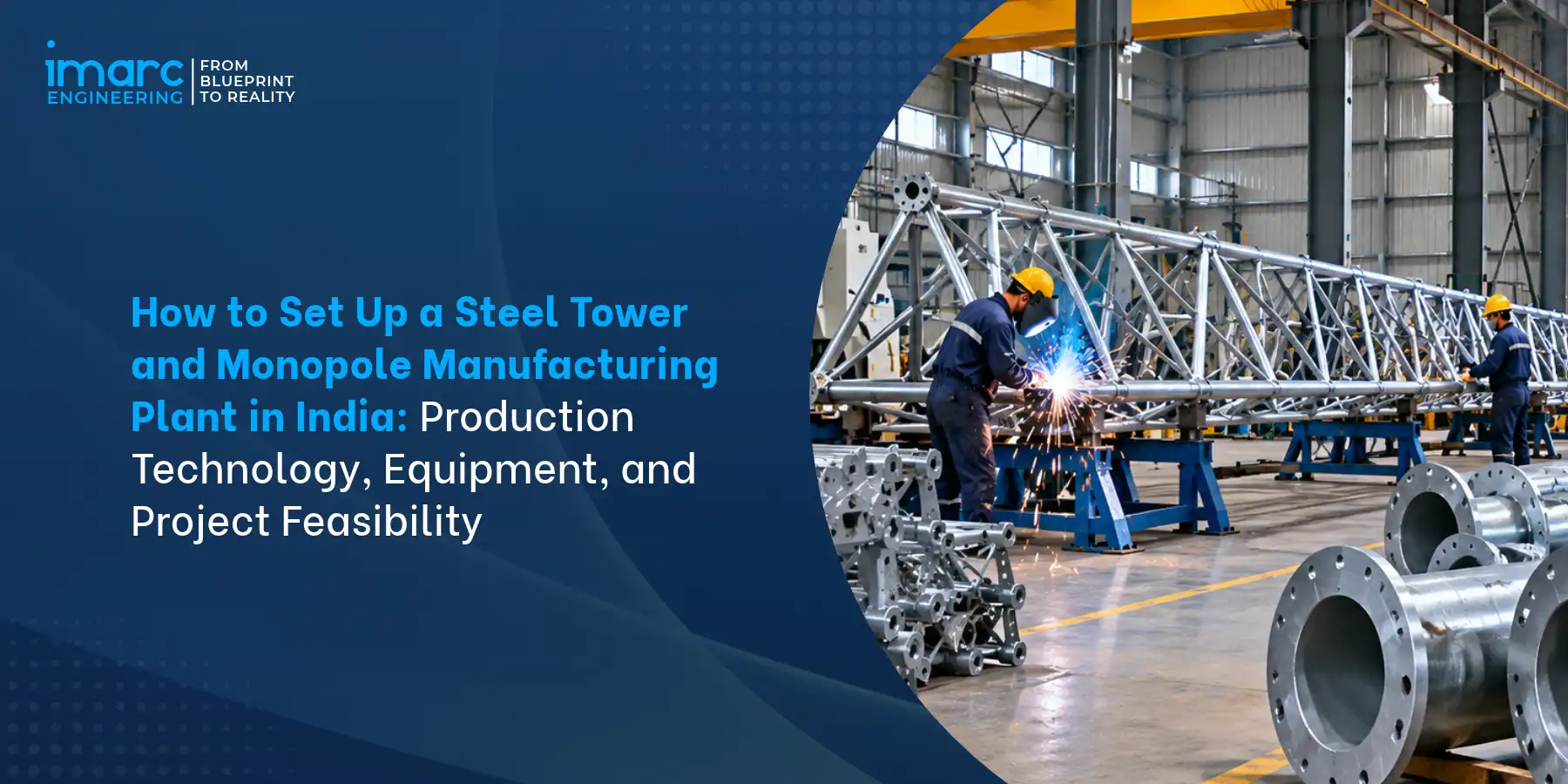
How to Set Up a Steel Tower and Monopole Manufacturing Plant in India: Production Technology, Equipment, and Project Feasibility
Introduction
For fabricators, EPC contractors, infrastructure investors and project sponsors evaluating a steel tower and monopole manufacturing plant in India, the project is a heavy-fabrication and quality-system business, not a construction business. Telecom networks, transmission corridors, renewable-energy evacuation, railway electrification, high-mast lighting and public infrastructure all depend on galvanized steel structures made in controlled workshops. This guide covers that manufacturing side only, not tower erection or line construction.
Disciplined planning matters because product mix, steel sourcing, galvanizing route and customer approvals together decide yield, cash cycle and bankability. The guide compares lattice tower and tubular monopole fabrication, then covers setup route, process, raw materials, quality control, approvals, machinery, layout, CAPEX, OPEX and DPR logic. Figures that vary by project are indicative planning ranges to be replaced by vendor quotations, customer specifications and site data.
Scope of this Guide
This guide answers one question: what technical, machinery, infrastructure, regulatory and financial requirements should investors evaluate before setting up a steel tower and monopole manufacturing unit in India? It separates angle-based lattice fabrication from plate-based tubular monopole fabrication and addresses integrated facilities. It covers process steps, steel procurement, galvanizing arrangements, quality control, approvals, utilities and economics. Investment figures come from one clearly labelled illustrative project, not from market benchmarks.
Table of Contents
-
Introduction
-
Why a Steel Tower and Monopole Manufacturing Plant in India Matters for Investors in 2026
-
Types of Steel Tower and Monopole Manufacturing Facilities
-
How to Set Up a Steel Tower and Monopole Manufacturing Plant in India
-
Production Process and Technology for a Steel Tower and Monopole Manufacturing Plant in India
-
Raw Materials, Steel Procurement and Production Planning
-
Quality Control, Regulatory Approvals and Standards
-
Machinery, Plant Layout and Utility Requirements
-
Steel Tower Manufacturing Plant Cost, CAPEX, OPEX and DPR
-
Conclusion
1. Why a Steel Tower and Monopole Manufacturing Plant in India Matters for Investors in 2026
Four conditions shape the investment case for a steel tower and monopole manufacturing plant in India in 2026, and each affects the plant configuration worth funding.
1.1 Industrial Applications Across Telecom, Transmission and Infrastructure
Lattice steel structures carry high-voltage conductors and substation equipment, while tubular steel monopoles serve telecom antennas, urban and rooftop sites, street and high-mast lighting, signage and some distribution and railway uses. Each application brings different load cases, wind and seismic criteria, heights and approval regimes, so the plant's product scope should follow the chosen customer segment rather than the machinery that happens to be available.
1.2 Demand Drivers and Policy Context
Demand follows network densification, transmission and renewable-evacuation expansion, urban lighting, and rail and highway programmes. These are project-cycle drivers, so order flow is lumpy and tender-linked. Investors should verify utility tender calendars, programme pipelines and customer vendor-registration rules at DPR stage instead of relying on aggregate growth projections. Incentives, where a project is eligible, are upside rather than the basis of viability.
1.3 Customer Ecosystem and Cluster Selection
Customers include central and state transmission utilities, EPC contractors, telecom infrastructure companies, tower operators and lighting developers. Utilities and large EPCs usually run vendor qualification that reviews track record, test facilities and quality systems, which can slow a new entrant's first orders. Fabrication clusters in western, southern and central India offer steel service centers, galvanizers, welders and port access; the right choice depends on target customers and steel and zinc logistics.
1.4 The Cost of Poor Planning
Installing machinery for one product and then bidding for the other, committing to a galvanizing kettle shorter than the longest monopole section, buying steel without mill-certificate discipline so traceability fails at customer audit, and under-funding working capital because steel is bought well ahead of billing. Each is a planning error that costs more to correct than to avoid.
2. Types of Steel Tower and Monopole Manufacturing Facilities
A tower plant is defined by the structure family it builds, because lattice and tubular products use different raw forms, machines and inspection methods.
2.1 Lattice Steel Towers
Lattice towers are assembled from rolled angle sections, gusset plates, bracing members and bolted joints, and are used for transmission lines, telecom masts and substation structures. Members are cut, punched or drilled, marked and galvanized individually, then bolted on site. Output is a large count of geometry-critical parts, so hole position, hole diameter, member length and part marking matter more than welding.
2.2 Tubular Steel Monopoles
A monopole is a self-supporting tapered tubular pole, and it is not necessarily circular. Common forms are tapered polygonal sections, formed on a press brake, and circular tubular sections, formed on plate rolls. Sections join by slip-fit overlap or flanged connections and carry base plates, door openings, cable entries and mounts. Fabrication is plate-based, with longitudinal seams, flange welds and tight control of taper, straightness and overlap fit.
2.3 Types of Manufacturing Facilities
Three configurations exist: angle-based lattice-only plants, plate-based monopole-only plants, and integrated facilities. Lattice plants invest in CNC angle lines and a tower trial-assembly yard; monopole plants invest in plate cutting, large press brakes or rolls, seam welding and flange stations; integrated plants carry both and share cranes, stores, galvanizing arrangements and quality control. Integration smooths demand cycles but raises capital, skills and management load.
2.4 Plant Sections
| Section | Function | Key Equipment |
|---|---|---|
| Raw material yard | Receive, inspect, store steel | EOT cranes, racks, magnets |
| Angle processing bay | Mark, punch, drill, cut angles | CNC angle line, shear |
| Plate cutting and forming bay | Profile and bend plates | CNC plasma/laser, press brake, rolls |
| Welding and flange bay | Seam and flange welding | SAW, GMAW, positioners |
| Fit-up and trial assembly | Verify fit before coating | Jigs, trestles, cranes |
| Galvanizing (in-house or outsourced) | Hot-dip zinc coating | Pickling tanks, zinc kettle |
| Inspection and QC area | Dimensional, weld and coating inspection | Gauges, UT/MT equipment and coating-thickness meters |
| Finished goods and dispatch | Bundle, store, load trucks | Trailers, forklifts, weighbridge |
| Utilities | Power, air, gases, water | Transformer, DG, compressors |
| Effluent and waste handling | Manage process-specific waste streams | Effluent treatment, neutralisation and waste-storage systems, where required by the process and approvals |
3. How to Set Up a Steel Tower and Monopole Manufacturing Plant in India
Setup is a sequenced decision chain, and capacity is derived from product mix and the true bottleneck rather than from machine count.
3.1 Feasibility, Product Selection and Site Selection
Begin with target customers and their specifications, then choose lattice, monopole or both. Site criteria include proximity to steel suppliers and galvanizers, highway and port access for long loads, flat land able to carry heavy stacks, power availability, zoning and drainage. Road limits on length and width of finished monopole sections should be checked against dispatch routes of target projects before the site is fixed.
3.2 Capacity, Product Mix, Bottlenecks and Shift Planning
Capacity is stated in fabricated tonnes per year at a defined product mix, yield and shift pattern, never by machine count alone. Angle processing usually runs faster than bundling, marking and galvanizing, while monopole lines are often limited by fit-up and welding. Cutting and forming can run two shifts with welding added as the order book justifies. CNC data fed directly from detailing software lifts yield and removes drawing transcription errors.
Illustrative Production Capacity Calculation
For a plant targeting 12,000 tonnes of annual fabricated steel output, assuming 300 scheduled operating days and 80% effective capacity utilisation:
- Annual installed capacity: 12,000 tonnes
- Scheduled operating days: 300
- Effective utilisation: 80%
- Annual saleable output: 9,600 tonnes
- Average saleable output per scheduled operating day: 32 tonnes
The 12,000 TPA figure represents installed annual capacity, while actual production depends on equipment availability, fabrication bottlenecks, product mix, shift schedules and customer orders. The DPR should validate the capacity of cutting, forming, welding, trial assembly and material-handling operations separately.
3.3 In-House versus Outsourced Galvanizing
Hot-dip galvanizing is the usual corrosion protection for towers and monopoles, though the specification depends on customer and environment. Outsourcing lowers capital and environmental burden but creates dependence on job-work capacity, scheduling, transport and coating quality. In-house galvanizing adds a zinc kettle, pickling and rinse tanks, fluxing, drying, fume extraction and spent-acid handling, and suits sustained volumes and long monopole sections. The decision turns on volume, kettle length, local galvanizer availability and pollution approvals.
3.4 Machinery Procurement, Installation and Commissioning
Specification is followed by vendor evaluation, crane-bay and foundation design, installation, power and air connections, calibration and trial production on actual customer drawings. Commissioning should include first-article inspection, welding procedure qualification, welder tests and a trial assembly before any customer batch. Lead times depend on vendor and machine type and should be confirmed through written quotations.
4. Production Process and Technology for a Steel Tower and Monopole Manufacturing Plant in India
The two product families follow different workflows, and technology choices differ at each station.
4.1 Lattice Tower Manufacturing Process
Angles are inspected against mill certificates, then loaded onto a CNC angle line that marks part numbers, punches or drills holes and cuts to length, with notching or cropping as needed. Gussets and base plates are plasma or laser cut. Bending follows where required, then parts are grouped into bundles by tower panel, galvanized, inspected, packed with bolts and nuts, and dispatched. Where specified by the approved inspection and test plan, selected tower panels or prototype assemblies undergo trial assembly before galvanizing to verify dimensional accuracy, hole alignment and component fit.
4.2 Tubular Monopole Manufacturing Process
Plates are inspected and cut by CNC plasma or laser to tapered blanks, with edge preparation. Polygonal sections are formed in successive bends on a long-bed press brake; circular sections are rolled. The longitudinal seam is welded, commonly by submerged arc welding, and the section is checked for taper and straightness. Flanges and base plates are fitted and welded circumferentially, and door frames and accessories attached before galvanizing.
4.3 Welding, Trial Assembly and Galvanizing Handoff
Welding follows a qualified welding procedure specification and qualified welders, with consumables matched to the steel grade and fluxes stored dry. Trial assembly then confirms hole alignment on lattice panels and overlap, alignment and flange match on monopole stacks. Hollow sections require appropriately sized and positioned vent and drain holes, designed in consultation with the galvanizer. Inadequate venting or drainage can trap air, moisture or process liquids, creating serious safety risks during immersion in molten zinc and affecting coating quality.
4.4 Technology Comparison: Lattice versus Monopole
The choice between lattice towers and monopoles depends on structural requirements, manufacturing capabilities, available investment and project specifications. Both technologies require different production processes, equipment configurations and skill sets, as outlined below.
Lattice towers: CNC angle processing, punching or drilling, low welding content, high part count, bundling discipline.
Monopoles: plate profiling, press brake or roll forming, seam and flange welding, heavy lifting, long-section galvanizing.
Capital and skills: monopole lines are generally more capital-intensive and weld-skill-dependent, though actual cost depends on automation level and scale.
5. Raw Materials, Steel Procurement and Production Planning
Steel is the dominant material and working-capital item, so grade control, traceability and cutting efficiency are commercial decisions.
5.1 Structural Steel Grades, Angles, Plates and Sections
Lattice towers use hot-rolled equal angles, while monopoles use structural steel plates selected for the required strength, toughness and weldability. Material grades should conform to the applicable current Indian Standard or an approved equivalent specified in the customer drawings.
Structural steel angles, plates and sections should conform to the applicable editions of IS 2062, IS 808 and other relevant Indian Standards, or to approved equivalent specifications identified in the customer drawings. Material grade selection should consider strength, toughness, weldability, dimensional tolerances and galvanizing requirements. The applicable standard edition and material specifications should be confirmed during engineering and procurement.
5.2 Fasteners, Flanges and Galvanizing Zinc
Bolts, nuts and washers should conform to the applicable Indian Standards and customer specifications for the intended structural connection. Fastener grade, dimensions, mechanical properties, galvanizing requirements and testing should be determined by the approved tower or monopole design.
Flanges and base plates should follow the specified material and fabrication requirements. Zinc is bought as high-purity ingot to the galvanizing specification, with consumption tied to coating thickness, steel surface area and dross loss.
5.3 Material Traceability and Supplier Qualification
Each heat should carry a mill test certificate with chemistry and mechanical properties, and plates and sections should be tagged by heat number through cutting, with transfer procedures where cutting erases marks. Incoming checks on dimensions and thickness, positive material verification where specified, and supplier audits reduce the risk of non-conforming steel entering production.
5.4 Production Planning and Steel Yield
Planning links tender drawings to steel purchase through plate nesting and angle cutting-list optimization, which together determine offcut and scrap generation. Yield is project-specific; nesting efficiency, remnant reuse and cut-length optimization are the main levers. Scrap is segregated by grade, valued and sold or reused. Price volatility is managed through back-to-back ordering or price-variation clauses where contracts allow.
6. Quality Control, Regulatory Approvals and Standards
Quality and compliance gate customer approval; the standards and approvals below should be confirmed for the specific project, customer and jurisdiction.
6.1 Factory Approvals and Environmental Requirements
The approval framework includes company and applicable business registrations, land-use and building-plan approval, factory registration and licensing under the Occupational Safety, Health and Working Conditions Code, 2020 and applicable rules, fire and electrical approvals, and SPCB Consent to Establish and Consent to Operate under the Water Act, 1974 and Air Act, 1981, as applicable.
Requirements should be confirmed with the relevant state authorities. An in-house hot-dip galvanizing operation involves pickling, surface treatment and zinc coating, generating process emissions and waste streams such as spent pickling liquor, zinc ash and dross.
The environmental classification and consent requirements for in-house hot-dip galvanizing should be verified against the current CPCB industrial categorisation and the relevant SPCB requirements, considering the pickling, surface-treatment, coating and waste-management processes involved.
The project must assess applicable SPCB consents, hazardous-waste authorisation, effluent treatment, fume extraction and waste-disposal arrangements. Waste classification and handling requirements should be confirmed against the applicable schedules and SPCB conditions.
6.2 Structural Steel, Welding and Galvanizing Standards
Common references are IS 800:2007 for steel construction, IS 802 for transmission tower loading and design, IS 875 for loads and IS 2062 for steel. Telecom structures often follow customer-adopted loading codes. Welding references include ISO 3834, ISO 15614-1 and ISO 9606-1, or AWS D1.1 where specified.
Galvanized structural steel should meet the applicable product and customer specifications. IS 16732:2019 covers galvanized structural steel, while IS 2629 (Part 1):2025 provides a code of practice for the process, design, testing and application of batch hot-dip galvanizing.
Where ISO 1461:2022 is specified, its coating-thickness requirements depend on the base steel thickness. For non-centrifuged steel articles thicker than 6 mm, the minimum local and average coating thicknesses are 70 μm and 85 μm, respectively. The applicable standard and acceptance criteria should be confirmed against the product and customer specification.
6.3 Dimensional, Weld, NDT and Galvanizing Inspection
Dimensional checks cover member length, hole pitch and diameter, edge distance, taper, straightness, ovality and flange flatness, using calibrated gauges, templates, tapes and total stations. Weld inspection includes visual testing under ISO 17637 and, where required by the applicable specification, magnetic particle testing under ISO 17638, ultrasonic testing under ISO 17640 or radiographic testing.
Testing methods, inspection extent and acceptance criteria should follow the approved inspection plan and customer requirements. NDT personnel should be qualified under an accepted certification or employer-based qualification scheme, such as ISO 9712 or ASNT SNT-TC-1A, where accepted by the customer.
6.4 Trial Assembly, Type Testing and Documentation
Trial assembly of sample towers or monopole stacks before galvanizing verifies fit, and customers may require witnessed assembly. Prototype load testing at a tower testing station may be specified by utilities and telecom customers, and plants often use external facilities. A data book per lot, holding mill certificates, welding procedures, welder IDs, NDT reports, galvanizing reports and dispatch records, supports audit. ISO 9001 certification is commonly requested.
7. Machinery, Plant Layout and Utility Requirements
Machinery, layout and utilities carry most of the capital and determine whether the stated capacity is actually achievable.
7.1 Machinery Selection by Product Line
A lattice line needs a CNC angle punching, drilling, marking and shearing line, CNC plate processing for gussets, and notching tools. A monopole line needs a CNC plasma or laser plate cutter with bevel head, a long-bed press brake or plate rolls, edge-beveling, submerged arc welding with seam manipulators, flange-welding positioners, flange drilling and a stack-fit jig. Specify machines on the largest section and thickest plate in the order book, and add detailing software that outputs NC files.
7.2 Land, Plant Layout and Material Flow
Layout flows from steel stores through cutting, forming, welding, trial assembly, galvanizing or outbound staging, final inspection and dispatch. Separate angle and plate bays prevent crane clashes; allow long laydown for monopole sections and a trial-assembly area for full tower panels. Floors should be designed for plate stacks and crane loads. Land need depends on capacity and whether galvanizing is in-house, with room kept for expansion and truck turnaround.
7.3 Utilities and Infrastructure
Power is sized from a load list with diversity applied, since connected load is not maximum demand, with HT supply and DG backup as justified. Other needs are compressed air for plasma and tools, shielding gases and flux handling, cooling water, fume extraction, fire protection and drainage. In-house galvanizing adds kettle fuel, rinse water and acid storage. Gas cylinders and fuel storage may attract additional safety approvals.
7.4 Key Machinery
| Category | Equipment | Selection basis |
|---|---|---|
| Angle processing | CNC punching, drilling, marking and cutting line | Largest angle size, thickness and production throughput |
| Plate cutting | CNC plasma or laser cutting machine | Maximum plate length, width, thickness and cutting accuracy |
| Plate forming | Long-bed press brake or plate rolls | Maximum section length, plate thickness, taper and forming geometry |
| Welding | SAW systems, seam manipulators and flange-welding stations | Weld size, joint configuration, production rate and section dimensions |
| Drilling and finishing | Radial drills, flange drilling and beveling equipment | Hole diameter, flange dimensions and machining tolerances |
| Material handling | EOT cranes, forklifts and trailers | Maximum plate, component and finished-section weights |
| Inspection | UT and MT equipment, dimensional gauges and coating-thickness meters | Customer inspection plan and applicable quality standards |
Final equipment capacities and quantities should be established through product drawings, throughput calculations, vendor quotations and the plant's material-handling study.
8. Steel Tower Manufacturing Plant Cost, CAPEX, OPEX and DPR
The economics below describe one illustrative project, a 12,000 tonne per year integrated plant on two shifts with a 60:40 lattice-to-monopole mix and outsourced galvanizing, and they are not a market benchmark (Figures are indicative in nature, may vary).
8.1 CAPEX and OPEX Composition
CAPEX heads are land, sheds and foundations, machinery and cranes, galvanizing arrangements (job-work agreements or an in-house plant), utilities, installation, software and test equipment, pre-operative costs and contingency. OPEX is led by steel, followed by welding consumables and gases, power, skilled labor, galvanizing job work or zinc, acid and fuel, freight, testing, maintenance and overheads. Working capital is large because steel is bought ahead of billing, and should be modelled by order cycle and customer payment terms.
Illustrative Project Assumptions
| Parameter | Project basis |
|---|---|
| Annual installed capacity | 12,000 tonnes of fabricated steel |
| Production configuration | Integrated lattice and monopole fabrication |
| Product mix | 60% lattice towers and 40% monopoles |
| Shift pattern | Two shifts |
| Galvanizing | Outsourced |
| Annual operating days | To be established in the production plan |
| Capacity utilisation | To be supported by the order book and ramp-up plan |
| Steel input requirement | Calculated from finished output and expected fabrication yield |
| Steel procurement cost | Based on grade-wise supplier quotations |
| Galvanizing cost | Based on job-work quotations and coating specifications |
| Selling price | Based on customer contracts or tender rates |
The DPR should use these assumptions to prepare annual production, revenue, operating-cost, cash-flow and debt-servicing projections. Sensitivity analysis should cover capacity utilisation, steel prices, fabrication yield, galvanizing charges, selling prices and customer payment periods.
8.2 DPR for a Steel Tower and Monopole Manufacturing Plant
A Detailed Project Report (DPR) for a steel tower and monopole manufacturing plant should cover the technical, commercial, operational and financial feasibility of the proposed facility. Key components include:
- Market and Customers: Demand assessment, target industries, customer specifications, competition and potential order pipeline.
- Product Mix: Lattice towers, tubular monopoles or integrated manufacturing.
- Production Capacity: Annual fabricated steel output in tonnes, product-wise capacity and shift planning.
- Raw Materials: Structural steel sourcing, material grades, quality requirements and supplier assessment.
- Machinery and Technology: Equipment selection, manufacturing processes and automation requirements.
- Galvanizing: Evaluation of in-house versus outsourced hot-dip galvanizing.
- Land and Infrastructure: Site selection, plant layout, storage, utilities and material handling.
- Quality Control: Welding procedures, material traceability, dimensional inspection, NDT and trial assembly.
- Regulatory Approvals: Applicable factory licensing, environmental consents, fire safety and other statutory requirements.
- Project Costs: CAPEX, OPEX, working capital and contingency provisions.
- Production Efficiency: Steel yield, scrap generation, fabrication bottlenecks and capacity utilisation.
- Financial Feasibility: Revenue projections, cash flow, IRR, NPV, DSCR, break-even analysis and sensitivity assessment.
- Implementation and Risks: Project execution schedule, procurement timelines, customer qualification and risk mitigation.
The DPR should use project-specific technical assumptions, machinery quotations, material costs and customer requirements to support investment planning and financing decisions.
8.3 Financial Feasibility, Risks and Implementation
Profitability depends on order book, steel pass-through terms, yield, utilization, galvanizing cost, working capital and customer payment behavior, so no universal margin applies. Principal risks are steel price volatility, changing customer specifications, yield loss, galvanizing capacity, logistics and collections. Schedule depends on land, approvals, machine delivery and vendor qualification, and is best modelled with parallel approvals and engineering. Engineering consultants support feasibility, site selection, layout, CAPEX and OPEX planning, machinery sourcing and project management.
8.4 Project Economics
The following investment estimate represents a hypothetical 12,000 TPA integrated steel tower and monopole fabrication plant operating on two shifts, with a 60:40 lattice-to-monopole production mix and outsourced galvanizing. The figures are preliminary, concept-level planning assumptions rather than validated vendor-quoted costs or industry benchmarks.
Actual investment will depend on project location, land and civil construction costs, machinery specifications, plant layout, production capacity, utility requirements and installation scope. The estimates exclude working capital and should be validated through detailed engineering assessments and vendor quotations during DPR preparation.
| Cost head | Current estimate | Required clarification |
|---|---|---|
| Land and civil works | INR 20–22 crore | Separate land acquisition, site development and building costs. Five acres should be treated as a project assumption, not a standard requirement |
| Plant and machinery | INR 38–44 crore | Support with vendor quotations and equipment specifications |
| Utilities and installation | INR 4–6 crore | Identify the connected load, transformer, DG, compressed air and installation basis |
| Engineering and pre-operative | INR 3–4 crore | State the engineering, software, approvals and commissioning scope |
| Contingency | INR 5-6 crore | Explain the contingency calculation and cost base |
| Total | INR 70-82 crore | Retain only as an illustrative estimate subject to validation |
Conclusion
A viable steel tower and monopole manufacturing plant in India requires customer-led product selection, suitable fabrication technology, compliant structural steel and galvanizing specifications, qualified welding and inspection systems, appropriate infrastructure and realistic financial planning. Key decisions include the product mix, galvanizing route, machinery capacity, material traceability, statutory approvals, working capital and customer qualification requirements.
Three factors are critical to project success. First, define the target customer segments and their vendor approval requirements before finalising machinery specifications. Second, determine the galvanizing approach early, considering section dimensions, processing capacity and regulatory requirements, as these influence product range and delivery schedules. Third, integrate material traceability, welding qualification and trial assembly into project planning and commissioning to strengthen quality assurance, support customer approvals and improve operational reliability.
PURSUING A STEEL TOWER AND MONOPOLE MANUFACTURING PLANT IN INDIA?
IMARC Engineering supports fabricators, EPC contractors, infrastructure investors and project sponsors with capacity and feasibility planning, location analysis and site selection, plant layout and process flow design, equipment selection and technical specification drafting, utilities planning, regulatory approval and licensing, CAPEX and OPEX planning, and greenfield project management. The advisory covers lattice transmission and telecom towers and tubular steel monopoles, including cutting, forming, welding, trial assembly and galvanizing arrangements, with project-specific infrastructure and commissioning planning.
→ Schedule a steel tower and monopole manufacturing scoping consultation with an IMARC specialist
Frequently Asked Questions
Fix target customers and specifications, choose lattice, monopole or both, then prepare a feasibility study and DPR. Select a site with steel, galvanizing and highway access, finalize machinery, secure factory, fire and pollution approvals, install and commission, and complete welding qualification and trial assembly before customer vendor approval.
Core machinery includes a CNC plasma or laser plate cutter, long-bed press brake or plate rolls, beveling equipment, submerged arc welding with seam manipulators, flange-welding positioners, flange drilling and boring, EOT cranes, and inspection equipment for ultrasonic, magnetic particle and coating thickness checks.
Angles are inspected against mill certificates, then processed on a CNC angle line for marking, punching or drilling and cutting. Gussets are plasma or laser cut, parts are bent where needed and bundled by panel, galvanized, inspected, packed with fasteners and dispatched, with trial assembly on samples.
Plates are cut to tapered blanks, edge-prepared and formed on a press brake into polygonal sections or rolled into circular ones. Longitudinal seams are welded, flanges and base plates fitted and welded, openings added, and sections checked for taper, straightness and overlap fit before galvanizing.
Both depend on product mix, automation, land and galvanizing route. Capacity should be stated in fabricated tonnes per year at a defined yield and shifts. The illustrative 12,000 tonne per year project in this guide indicates roughly INR 70-82 crore excluding working capital (Figures are indicative in nature, may vary).
Hot-dip galvanizing is the usual protection for towers and monopoles, though the requirement follows the customer specification and environment. It can be outsourced to qualified job-work galvanizers, which lowers capital but adds scheduling, logistics and quality dependence, and kettle length must suit the longest section.
Requirements depend on capacity and whether galvanizing is in-house. Key needs are crane bays, heavy-duty floors, long laydown and trial-assembly areas, HT power with backup, compressed air, welding gases, fume extraction, fire protection, drainage and road access for long loads.
Commonly referenced standards include IS 2062, IS 800, IS 802, IS 4759 and ISO 1461, plus ISO 3834 and ISO 15614-1 for welding, subject to customer specification. Tests include dimensional checks, visual, magnetic particle and ultrasonic weld inspection, coating thickness and trial assembly.
A DPR should cover customers, product mix, tonnage capacity, steel sourcing, machinery, galvanizing route, layout, quality systems, CAPEX, OPEX, working capital, yield, IRR, NPV, DSCR, break-even, timeline and risks. Consultants support feasibility, site selection, layout, machinery sourcing and project management.
Profitability is project-specific, depending on order book, steel price pass-through, yield, utilization, galvanizing cost, working capital and customer payment terms. Steel volatility and specification changes are key risks, so viability should be tested through sensitivity analysis in the DPR rather than assumed.
Recent Post




Trusted by Industry Leaders
We partner with global enterprises and ambitious businesses across sectors to deliver operational excellence, strategic insights, and sustainable growth through integrated solutions.











Success in Their Words
Real feedback from clients across industries. Discover how our solutions delivered measurable impact and operational excellence.

I wanted to express my sincere appreciation for your efforts in handling this matter. Your dedication and commitment have been truly commendable, and it is evident that you have put in tremendous hard work and expertise into resolving the issues at hand. We are greatly interested in continuing our collaboration with you in the future, as your professionalism and reliability have made you a trusted partner. Thank you once again for your invaluable contribution. We look forward to strengthening our partnership ahead.

It has been a pleasure working with the IMARC team. The insights provided were structured, clear, and highly valuable, helping us strengthen both our technical and financial planning with confidence. We deeply appreciate the team’s professionalism, responsiveness, and attention to detail throughout the engagement. Every requirement was well understood and effectively incorporated, resulting in a comprehensive and actionable output. Overall, our experience has been excellent, and I would gladly recommend IMARC to organizations seeking a reliable research partner.

Your service is truly exceptional. Working with the IMARC team has been a seamless and professional experience. The clarity of communication, responsiveness to queries, and consistent support at every stage made the entire engagement highly efficient. The insights shared were well-structured, practical, and perfectly aligned with our requirements, helping us make informed decisions with confidence. Overall, the dedication and professionalism demonstrated by your team stand out, and I would be glad to recommend IMARC as a reliable and trustworthy research partner.

IMARC did an outstanding job in preparing our study. They were punctual, precise, and consistently responsive throughout the entire process. The team delivered all the data we required in a clear, well-organized, and highly professional format. Their strong attention to detail, combined with their ability to meet every deadline without compromising quality, truly set them apart. Overall, their reliability and commitment made them an exceptional partner for our project, and we would gladly work with them again in the future.

IMARC made the whole process incredibly easy from start to finish. Everyone I interacted with via email was polite, professional, and straightforward to deal with, always keeping their promises regarding delivery timelines and remaining consistently solutions-focused. From my very first contact, I appreciated the professionalism and support shown by the entire IMARC team. I highly recommend IMARC to anyone seeking timely, affordable, and reliable information or advice. My experience with IMARC was excellent, and I truly cannot fault any aspect of it.

I’d like to express my sincere gratitude for the excellent work you accomplished with the study. Your ability to quickly understand our requirements and deliver high-quality results under tight timelines truly reflects your expertise, exceptional work ethic, and unwavering commitment to your customer’s success. The professionalism and responsiveness you demonstrated throughout the process made a significant difference. Our entire team and company are incredibly thankful for your dedication, reliability, and support. Once again, thank you for your outstanding contribution.