Manufacturing
November 25 2026
How to Set Up a Smart Protein Manufacturing Plant in India: Plant-Based Processing, Fermentation Technology, and Project Feasibility (2026)
Introduction
Investors, food companies and project sponsors evaluating a smart protein manufacturing plant in India in 2026 are entering alternative protein manufacturing in India, a sector where the technology is proven in parts and unproven in others. Plant-based protein extrusion runs on commercially available, well-documented equipment, biomass fermentation is established in food-grade applications, precision fermentation is scaling in a handful of markets, and cultivated protein is approved for sale in only a few countries, such as Singapore, the US, Israel and Australia, with no approved commercial route in India. Treating these as one investment class is the most common and most expensive error in the sector. Disciplined planning matters because the capital decisions are largely irreversible.
A line specified for low-moisture texturized vegetable protein cannot be converted cheaply into a high-moisture whole-cut line, a fermentation train sized without matching recovery capacity produces broth it cannot sell, and a licence route assumed rather than confirmed can keep a finished product off the market for a year. This guide sets out plant types, process routes, machinery, raw materials, layout, utilities, capacity arithmetic, CAPEX and OPEX structure, the DPR contents investors should demand, and Indian regulatory requirements.
Scope of this Guide
This guide answers one question: what technical, manufacturing, regulatory and financial factors should investors evaluate before setting up a smart protein manufacturing plant in India? It covers the three production pathways, the equipment and utilities each requires, capacity and yield arithmetic, ingredient sourcing, hygienic plant design, FSSAI and factory approvals, quality control, and the DPR and financial model a lender or investment committee will test. Illustrative calculations are clearly labelled as assumptions and are not market benchmarks. Capacity, cost and utility values must come from vendor quotations, site data and a confirmed regulatory position for the specific product.
Table of Contents
-
Introduction
-
Why Smart Protein Manufacturing in India Matters for Investors in 2026
-
Types of Smart Protein Manufacturing Plants in India
-
How to Set Up a Smart Protein Manufacturing Plant in India: Product, Capacity and Site Planning
-
Smart Protein Manufacturing Processes Across the Three Pathways
-
Plant-Based Protein Extraction, Texturization and Extrusion Technology
-
Fermentation-Based Protein Production and Cultivated Protein Infrastructure
-
Machinery, Raw Materials, Plant Layout and Utilities
-
Plant Cost, DPR, Regulatory Approvals and Quality Control
-
Conclusion
1. Why Smart Protein Manufacturing in India Matters for Investors in 2026
Four conditions shape the investment case for a smart protein manufacturing plant in India in 2026, and each changes the technical configuration worth funding.
1.1 What Smart Proteins Are and Where They Are Used
Smart proteins are proteins produced from plants, fungi, algae or microorganisms, or grown from animal cells, and sold either as ingredients or as finished foods. Demand splits into analogue products for retail and food service, protein fortification of bakery, snacks, beverages and sports nutrition, and industrial or pet food uses where cost per kilogram of protein dominates. The target pool must be fixed before equipment, because an ingredient plant needs fractionation and drying capacity while a finished-goods plant needs forming, cooking, chilling and packing capacity.
1.2 The Three Production Pathways
Plant-based processing concentrates protein from pulses, soy, cereals and oilseeds and then texturizes it. Fermentation divides into biomass fermentation, where the organism itself is the product, and precision fermentation, where an engineered strain excretes a specific protein such as heme, whey or egg white that is recovered and purified. Cultivated protein grows animal cells in bioreactors to form muscle and fat tissue. The pathways differ in feedstock, equipment, utilities, downstream recovery, regulatory route and capital intensity, and they should be evaluated as separate businesses even under one ownership.
1.3 Policy Framework and the Indian Market Context
The regulatory frame is the Food Safety and Standards Act, 2006, administered by FSSAI, supported by the FSS (Licensing and Registration of Food Businesses) Regulations, 2011, the FSS (Labelling and Display) Regulations, 2020, the FSS (Vegan Foods) Regulations, 2022 and, for ingredients without an existing standard, the FSS (Approval of Non-Specified Food and Food Ingredients) Regulations, 2017. On the policy side, the BioE3 (Biotechnology for Economy, Environment and Employment) Policy approved by the Union Cabinet in August 2024 lists functional foods and smart proteins among its thematic sectors, with biomanufacturing hubs and DBT and BIRAC research and innovation funding.
The Production Linked Incentive scheme for the food processing industry runs from 2021-22 to 2026-27 with beneficiaries selected in earlier rounds, so it is generally not open to new entrants; Pradhan Mantri Kisan SAMPADA Yojana components and state food park and capital subsidy policies are the more likely support routes. Eligibility for a specific smart protein product must be confirmed against current scheme guidelines before any incentive is modelled, and incentives should be treated as upside rather than as the basis of viability.
1.4 The Cost of Poor Planning
Four failures recur. A technology is selected from a vendor brochure before protein content and texture targets are fixed, and the line then cannot make the product the customer wants. An extruder is bought without matched cooling-die, dryer, chiller and cold-store capacity, so throughput is set by the weakest downstream step. A licensing route is assumed from a competitor's label rather than confirmed with FSSAI. Working capital is under-budgeted because modern trade pays on extended terms and chilled stock carries a short shelf life.
2. Types of Smart Protein Manufacturing Plants in India
The plant you build depends on the pathway chosen, because the facility boundary, building services and regulatory position all change with it.
2.1 Plant-Based Processing Facilities
A plant-based protein manufacturing plant is defined by how far it integrates. At minimum it buys protein concentrate or isolate and operates mixing, extrusion, cooking, chilling and packing. An integrated plant adds dry fractionation of pulses, or wet extraction with alkaline solubilisation, isoelectric precipitation near pH 4.5 and spray drying. Integration lowers ingredient cost and protects supply but adds effluent load, water demand, boiler capacity and a second quality scope. Most Indian entrants begin as converters and add fractionation once volume justifies the capital.
2.2 Fermentation-Based Plants: Biomass and Precision Fermentation
A biomass fermentation plant, producing microbial biomass protein, is a large-volume, lower-value operation: seed train, main fermenter, heat treatment, homogenisation, dewatering and drying, with the organism sold as the food. A precision fermentation plant is smaller-volume and higher-value, and most of its capital sits in recovery, comprising cell separation, homogenisation, membrane filtration, polishing and drying. Biomass plants are dominated by aeration power and cooling duty; precision plants by clean steam, chilled water and purified water for downstream steps.
2.3 Cultivated Protein Facilities and Scale Determinants
Cultivated protein facilities are pilot and demonstration scale in most jurisdictions, including India, and should be planned as development assets rather than commercial factories. They need cell culture labouratories, single-use or stainless bioreactors, media preparation, aseptic handling and analytical capacity, and their cost driver is growth medium rather than building area. Across all pathways, scale is fixed by product mix, line throughput, batch size, recovery capacity, packing speed and cold-chain capacity, and the slowest of these limits the plant.
2.4 Plant Sections
The infrastructure requirements of a smart protein manufacturing plant depend on the selected production pathway and level of process integration. The table below outlines the key plant sections, their functions and associated equipment across plant-based processing, fermentation and cultivated protein production.
| Section | Function | Key Equipment |
|---|---|---|
| Raw material intake and storage | Receive, sample and store flours, isolates, media and cultures | Weighbridge, silos, sifters, metal detectors, cold rooms |
| Dry fractionation and milling | Size reduction and protein concentration by air classification | Pin mill, air classifier, cyclones, dust collection |
| Extraction and separation | Solubilise, precipitate and separate protein from fibre | Extraction tanks, decanter centrifuge, UF membranes |
| Texturization | Form fibrous or expanded protein structures | Twin-screw extruder, cooling die, cutter |
| Fermentation | Grow biomass or express the target protein | Seed fermenters, main bioreactor, aeration and cooling skid |
| Downstream processing | Recover, purify, concentrate and dry product | Homogeniser, centrifuges, membrane skids, spray dryer |
| Thermal processing and chilling | Cook, pasteurise and cool finished products | Steam-jacketed kettles, heat exchangers, blast chiller |
| Packing and cold storage | Fill, seal, label and hold product at temperature | Form-fill-seal lines, tray sealers, cold store |
| Quality control labouratory | Test protein, microbiology, allergens and shelf life | Kjeldahl unit, PCR, HPLC, incubators, texture analyser |
| Utilities and effluent treatment | Supply power, steam, water, air and treat wastewater | Boiler, chillers, RO plant, compressor, ETP |
3. How to Set Up a Smart Protein Manufacturing Plant in India: Product, Capacity and Site Planning
Smart protein plant setup decisions run in a fixed order: product, market, site, capacity, then technology. Reversing that order is what makes plants expensive.
3.1 Product Selection and Market Assessment
Product selection fixes protein source, format and channel. Each combination carries its own texture target, shelf life and price ceiling, and the texture target decides whether low-moisture extrusion, high-moisture extrusion through a cooling die, or another forming route is required. Market assessment should test channel concentration and payment terms as closely as volume, because a single quick-service customer can justify a dedicated line and simultaneously hold the plant to one specification.
3.2 Site Selection and Cluster Logic
Site selection weighs proximity to pulse and soy growing belts, food parks with common utilities and effluent infrastructure, cold-chain logistics to target cities, power reliability, water availability and discharge options. Confirm zoning, groundwater permission, State Pollution Control Board jurisdiction, and fire and factory authority requirements before land is contracted, since these decide the approval timeline more than plot price does.
3.3 Capacity Planning: Theoretical, Installed, Actual and Saleable
How smart protein manufacturing capacity is calculated: production capacity must be stated at four levels. Theoretical capacity assumes nameplate rate for every available hour; installed capacity applies the planned shift pattern and calendar; actual throughput applies realistic operating efficiency; and saleable output deducts rejection, moisture loss and packing loss. The illustrative calculation below uses assumptions only.
| Capacity Level | Formula / Assumption | Result |
|---|---|---|
| Line rating | Assumption: high-moisture extrusion line | 1,000 kg/h |
| Theoretical capacity | 1,000 kg/h × 24 h × 350 days | 8,400 t/yr |
| Installed capacity | 1,000 kg/h × 16 h (two shifts) × 300 days | 4,800 t/yr |
| Actual throughput | 4,800 × 80% operating efficiency | 3,840 t/yr |
| Saleable output | 3,840 × (1 − 2% process loss) × (1 − 1% packing rejection) | About 3,725 t/yr |
This illustration assumes that the 1,000 kg/hour line rating and subsequent throughput figures are expressed on a consistent product-mass basis. Actual saleable output must be calculated using the product's moisture content, formulation additions, process mass balance and measured losses. High-moisture extrusion output should not be treated as equivalent to dry protein ingredient output.
Every downstream unit, from cooling die and dryer to chiller, packing line and cold store, must be checked against the saleable figure, not against nameplate. For fermentation, the same logic runs from vessel volume, titre and cycle time through recovery yield to saleable powder.
3.4 Technology Selection and Commercial Readiness
Alternative protein production technology should be scored on demonstrated commercial runtime, not pilot performance. Ask for reference plants running the same product at comparable scale, guaranteed throughput and protein content at the die, and a clear vendor responsibility boundary across extruder, cooling die, dryer and controls. For fermentation, ask for achieved volumetric productivity and final titre on a defined medium, because those two numbers, not reactor volume, set the cost of the recovery train.
3.5 Commercial Scale-Up and Process Bottlenecks
Commercial scale-up risk concentrates in heat and mass transfer, because larger extruders and fermenters do not scale linearly in mixing, aeration or cooling, so recipes and control strategies must be re-established at every step. Throughput is set by the slowest unit: in plant-based lines this is often the cooling die, dryer, chiller or packing line; in fermentation it is usually batch cycle time or the recovery train. Equipment utilisation should be planned below nameplate, with batch size, changeover and cleaning time built into the schedule, and buffers placed ahead of the bottleneck. Profitability factors are covered in Section 8.6.
4. Smart Protein Manufacturing Processes Across the Three Pathways
The three pathways share hygiene and packing discipline but almost nothing else in process sequence, so no single workflow applies to every smart protein technology. The illustrative manufacturing pathways below are shown separately.
4.1 Plant-Based Workflow: Flour to Textured Product
Flour or isolate is sieved, then blended with water, oil, salt, binders and flavour. The blend passes through a preconditioner that hydrates and partially cooks the protein, then a twin-screw extruder where mechanical shear and steam texturize it. Low-moisture extrusion at roughly 20 to 35% in-barrel moisture produces expanded texturized vegetable protein that is dried and packed dry. High-moisture extrusion at roughly 40 to 60% passes the melt through a long cooling die that aligns fibres and yields chilled whole-cut or mince products.
Illustrative plant-based process flow:
- Low-moisture extrusion: Protein Flour or Isolate → Sieving → Blending and Hydration → Preconditioning → Twin-Screw Extrusion → Cutting → Drying → Cooling → Packaging → Dry Storage.
- High-moisture extrusion: Protein Concentrate or Isolate → Blending and Hydration → Twin-Screw Extrusion → Cooling Die → Cutting or Forming → Optional Further Processing → Chilling or Freezing → Packaging → Temperature-Controlled Storage.
4.2 Fermentation Workflow: Inoculation to Dry Powder
Medium is prepared and sterilised, a seed train is built through progressively larger vessels, and the main fermenter runs in batch or fed-batch under controlled temperature, pH and dissolved oxygen. Biomass fermentation is harvested by centrifuge or membrane, heat treated, homogenised, formulated and dried. Precision fermentation continues into cell disruption, solid-liquid separation, membrane concentration and diafiltration, then polishing before drying. Sterility failure upstream is a total batch loss, so cleaning and sterilisation validation carry real commercial weight.
Illustrative fermentation process flow:
- Biomass fermentation: Media Preparation → Sterilisation → Seed Train → Production Fermentation → Biomass Harvesting → Required Heat Treatment or Stabilisation → Dewatering → Formulation → Drying or Other Product-Specific Finishing → Packaging.
- Precision fermentation: Media Preparation → Sterilisation → Seed Train → Production Fermentation → Cell Removal or Cell Disruption (depending on whether the target protein is secreted or intracellular) → Clarification → Product-Specific Concentration and Purification → Formulation → Drying or Other Finishing → Packaging.
4.3 Cultivated Protein Workflow and Its Commercial Limits
Cells are expanded from a working cell bank in medium containing amino acids, salts, vitamins and growth factors, then seeded into a production bioreactor, often on microcarriers or scaffolds. Harvested tissue is washed, formulated and structured. The constraints are biological and economic rather than mechanical: growth factor cost, the shift to chemically defined media, oxygen transfer at volume, and the absence of an approved commercial pathway in India. Such a facility should be planned as a pilot with defined milestones.
Illustrative cultivated protein process flow:
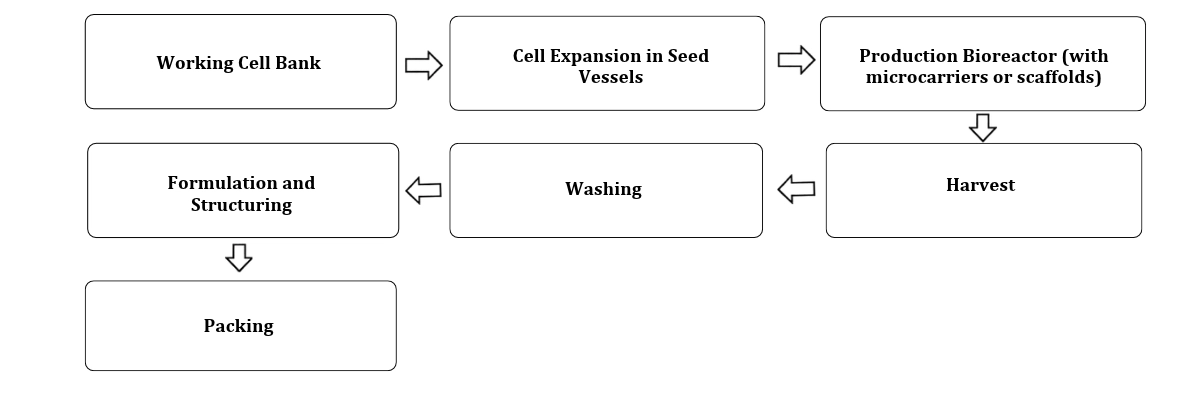
This flow is shown for pilot planning only, as no cultivated protein product has an approved commercial route in India.
4.4 Pathway Comparison
| Pathway | Feedstock | Core Equipment | Typical Output | Commercial Readiness in India | Principal Constraint |
|---|---|---|---|---|---|
| Plant-based processing | Pea, soy, chickpea or fava flour and isolates | Dry fractionation, mixer, preconditioner, twin-screw extruder, cooling die, dryer | Mince, chunks, patties, nuggets, texturized vegetable protein | Industrial scale and established | Texture match and ingredient cost |
| Biomass fermentation | Food-grade sugar or starch, nitrogen salts, minerals | Seed train, airlift or stirred fermenter, homogeniser, dewatering, dryer | Mycoprotein and algal protein for analogue products | Limited commercial food use | Aeration power and cooling load |
| Precision fermentation | Purified sugar, defined media, engineered strain | Fed-batch bioreactor, homogeniser, membrane skids, polishing steps | Heme, whey, egg-white and other functional proteins | Early stage, ingredient approval case by case | Titre, media cost and recovery cost |
| Cultivated protein | Cell line, growth medium, scaffolds | Cell expansion vessels, production bioreactor, aseptic handling | Structured muscle and fat tissue | Pre-commercial, no approved retail product | Media cost and regulatory pathway |
Difference between plant-based and cultivated protein: plant-based protein is made by extracting and texturising proteins from crops such as pea and soy using established food-processing equipment, and it is sold commercially in India today. Cultivated protein is grown from animal cells in sterile cell culture bioreactors using costly growth media, and it remains at research and pilot stage in India, with no approved commercial pathway.
5. Plant-Based Protein Extraction, Texturization and Extrusion Technology
Protein extrusion technology is where a plant-based business is won or lost, and it depends on everything upstream and downstream of the die.
5.1 Protein Concentration and Isolation
Dry fractionation can produce protein-enriched fractions, while wet extraction can achieve higher protein purity through solubilisation, separation, precipitation and drying. Actual protein concentration depends on the crop, feedstock composition, extraction method and process yield. Product specifications should be established through laboratory analysis and pilot trials. Wet routes give higher purity and functionality but generate high-COD streams, so effluent design belongs in the same protein isolation decision.
5.2 Formulation and Binding Systems
A formulation is a binding system as much as a flavour system. Methylcellulose, starch, fibre, gluten and hydrocolloids hold particles together through cooking and freezing, and the choice depends on whether the product is a patty, nugget, sausage or whole-cut fillet. Water holding, fat release, colour and freeze-thaw stability shift with binder and protein source, so trials must run on the actual extruder and chiller before the recipe and label claims are locked.
5.3 Texturization and Extrusion
In a twin-screw extruder the barrel is assembled from conveying, mixing and shearing elements, and screw profile, barrel temperature profile, water injection rate, screw speed and die geometry together determine fibre formation and hardness. Low-moisture extrusion relies on steam expansion at the die and is followed by drying; high-moisture extrusion uses a long cooled die and is followed by chilling. Drive torque, specific mechanical energy, die pressure and cooling-die residence time should be guaranteed in the purchase contract.
5.4 Finished-Product Processing and Packaging
In plant-based meat manufacturing, products are cooked or pasteurised, blast chilled to below about 4 degrees Celsius, and packed, often under modified atmosphere. Retort or frozen formats substitute sterilisation or freezing for the chill chain and change packaging material and utility load. Metal detection, checkweighing, seal integrity testing and lot coding follow packing, and allergen changeover cleaning is mandatory where soy, wheat or gluten lines share equipment. Cold-store capacity should be sized from saleable output, not extruder throughput.
6. Fermentation-Based Protein Production and Cultivated Protein Infrastructure
Fermentation converts a cheap carbon source into a high-value protein, and the economics depend on what happens after the vessel as much as inside it.
6.1 Strain Selection and Media Design
Strain choice determines product, growth rate, oxygen demand, by-product profile and food-safety status; organisms with a history of food use, such as filamentous fungi and certain yeasts, reduce regulatory friction compared with engineered strains. Media design then fixes cost: carbon source, nitrogen as ammonium salts or complex nutrients, phosphate, trace metals and antifoam. Complex nutrients improve growth but are costly and variable, so a defined medium sustaining the required growth rate is usually the target.
6.2 Bioreactor Operation and Fermentation Control
Industrial vessels are stirred tank, airlift or bubble column, with working volumes from pilot scale up to several hundred cubic metres for biomass fermentation. Control covers temperature, pH, dissolved oxygen, foam, feed rate and, in fed-batch, specific growth rate. Aeration and agitation dominate power draw, and cooling demand follows the metabolic heat released, so the chiller and power connection are sized from the fermentation heat balance. Sterile boundary design and cleaning validation decide batch success rates.
6.3 Downstream Processing and Product Recovery
Recovery begins with broth cooling and cell separation, followed by heat treatment where texture setting or nucleic acid reduction is needed, homogenisation, and concentration by ultrafiltration and diafiltration. Intracellular products require cell disruption before clarification. Final steps are formulation, stabilisation and drying. Recovery yields compound, so five steps at 90% each return roughly 59% overall; the number of unit operations is therefore itself a cost decision, and each additional polishing step must be justified.
6.4 Cultivated Protein Infrastructure and Scale-Up Constraints
Cultivated protein infrastructure includes cell banking and aseptic suites, media preparation and filtration, single-use seed bioreactors, production cell culture bioreactors and analytics for cell count, metabolites and sterility. Constraints are oxygen transfer and mixing at volume, the cost of recombinant growth factors, and the difficulty of building structured tissue rather than unstructured cells.
Cultivated protein manufacturing remains at an early development stage in India. Commercial food applications require product-specific regulatory assessment and confirmation of the applicable FSSAI approval pathway before investment in production facilities.
7. Machinery, Raw Materials, Plant Layout and Utilities
Equipment, ingredients, layout and utilities form one design problem, and a wrong choice in any of them appears as a hygiene, capacity or cost failure in the others.
7.1 Machinery and Equipment by Pathway
Smart protein manufacturing machinery differs by pathway. Plant-based lines need sifters, ribbon or vacuum mixers, preconditioners, twin-screw extruders with cooling dies, cutters, belt dryers, chillers, cookers, formers and packaging. Fermentation plants need media preparation and sterilisation skids, seed and production bioreactors with aeration, agitation and cooling, centrifuges, homogenisers, membrane skids, heat exchangers and spray dryers. Cultivated facilities need cell culture vessels, incubators, biosafety cabinets, and analytics.
Equipment and utility requirements vary by manufacturing pathway. Fermentation and cultivated protein facilities generally require more extensive aseptic processing, sterilisation and contamination-control systems. Plant-based processing facilities require cleaning, hygiene, cooling and utility systems appropriate to their equipment and product specifications. CIP, SIP, clean steam and specialised air-handling systems should be specified according to the process requirements rather than assumed for every facility.
7.2 Raw Materials and Ingredient Sourcing
Plant-based production consumes pea protein, soy protein, chickpea and fava flours and isolates, wheat gluten, vegetable oils, binders, starches, fibres, hydrocolloids, colours, flavours, salt and vitamins. Specifications should fix protein on a dry basis, fat, moisture, particle size, microbial load, allergen declaration and functional behavior in the actual formulation. Fermentation consumes food-grade glucose or sucrose, nitrogen and mineral sources, vitamins, antifoam and cultures held in a validated bank.
Pulses and soy should also be tested for pesticide residues, mycotoxins and heavy metals against FSSAI contaminant limits, and supply should be contracted across more than one growing region because crop quality and price vary by season. Small shifts in protein functionality change yield at the die.
7.3 Plant Layout, Zoning and Hygienic Design
The layout of a smart protein production facility follows product and personnel flow from intake to dispatch, separating high-care and low-care zones and preventing raw and cooked paths from crossing. Hygienic design means washable floors with correct falls and drainage, coved junctions, food-grade contact surfaces, filtered air in high-care packing, positive pressure in sensitive rooms and negative pressure in wet or dusty areas. Wet extraction and fermentation belong away from dry blending and packing, and staff, raw material and waste routes should be physically separated.
7.4 Utilities: Water, Steam, Cooling, HVAC and CIP
Water demand covers ingredient, cleaning and boiler feed, and a wet extraction plant needs softening, reverse osmosis and sometimes ultrafiltration, with an effluent plant sized for high-COD streams. Steam drives preconditioning, cooking and sterilisation; chilled water and glycol serve fermentation cooling, chillers and cold stores; compressed air must be oil-free and dry for food contact and instruments.
HVAC delivers filtered air to high-care areas and dehumidification to dry blending and packing. CIP circuits should be designed alongside the equipment list, since tank and pipe layout drive cleaning validation effort. Utility requirements are indicative and must be validated against equipment specifications and project-specific operating conditions.
7.5 Machinery and Equipment Requirements by Pathway
Machinery selection varies according to the manufacturing technology, production capacity and product specifications. The following table identifies the principal equipment required for each smart protein production pathway and its role in the manufacturing process.
| Pathway | Machinery / Equipment | Application |
|---|---|---|
| Plant-based | Pin mill and air classifier (if integrated) | Dry fractionation of pulses into protein concentrate |
| Plant-based | Extraction tanks, decanter, spray dryer (if integrated) | Wet extraction of protein isolate |
| Plant-based | Preconditioner and ribbon or vacuum mixer | Hydrating and blending ingredients before extrusion |
| Plant-based | Twin-screw extruder with cooling die | Texturising protein into fibrous or expanded structures |
| Plant-based | Cutter, former, cooker, belt dryer, blast chiller | Finished-product forming, cooking, drying and chilling |
| Fermentation | Media preparation and sterilisation skid | Preparing sterile growth medium |
| Fermentation | Seed and production bioreactors with aeration and cooling | Growing biomass or expressing the target protein |
| Fermentation | Centrifuge, homogeniser and membrane (UF/DF) skids | Cell separation, disruption and protein concentration |
| Fermentation | Spray dryer | Converting concentrate into stable powder |
| Cultivated (pilot) | Cell culture vessels, incubators, biosafety cabinets | Cell banking and expansion under aseptic conditions |
| Cultivated (pilot) | Production cell culture bioreactor and media filtration | Growing cells on microcarriers or scaffolds |
| All pathways | CIP/SIP systems, clean steam, oil-free air, chillers | Hygiene, sterilisation and utilities |
| All pathways | Form-fill-seal or tray-sealing line, metal detector, checkweigher | Packing, gas flushing and coding |
| All pathways | QC labouratory (Kjeldahl, PCR, HPLC, incubators) | Protein, microbiology, allergen and shelf-life testing |
8. Plant Cost, DPR, Regulatory Approvals and Quality Control
Approvals, quality systems and the financial model are drafted together, because a regulatory answer changes product mix and therefore the revenue line.
8.1 Regulatory Approvals and Food Safety Requirements
All food businesses require FSSAI registration or licence under the FSS (Licensing and Registration of Food Businesses) Regulations, 2011, with a state licence for most manufacturers and a central licence where turnover and operating criteria cross the prescribed thresholds; Schedule 4 sets hygiene and GMP requirements and a food safety management system based on HACCP principles.
Ingredients without an established standard, including many precision fermentation proteins, need prior approval under the FSS (Approval of Non-Specified Food and Food Ingredients) Regulations, 2017, and the FSS (Health Supplements, Nutraceuticals, Food for Special Dietary Use, Food for Special Medical Purpose, Functional Food and Novel Food) Regulations, 2016 also define novel food.
Not every smart protein category is approved for commercial sale: cultivated meat would currently need non-specified food approval, FSSAI has said it is drafting dedicated regulations, and no cultivated protein product has been approved in India.
Plant-level approvals include a factory licence and plan approval under the Occupational Safety, Health and Working Conditions Code, 2020 (in force from 21 November 2025, replacing the Factories Act, 1948), SPCB consent to establish and operate under the Water Act, 1974 and Air Act, 1981, hazardous waste authorisation where applicable, registration under the Boilers Act, 2025 where a steam boiler is installed, EPR registration for plastic packaging, legal metrology and fire no-objection.
Environmental Clearance applicability depends on whether any activity falls within the scheduled activities of the EIA Notification, 2006 and its amendments, so the actual manufacturing scope should be assessed. Applicability depends on product, capacity and state, and each requirement must be confirmed for the specific project.
| Requirement | Authority / Basis | Applicability |
|---|---|---|
| FSSAI licence | FSS (Licensing and Registration) Regulations, 2011 | All manufacturers; state or central licence by criteria |
| Non-specified food approval | FSS (Approval of Non-Specified Food and Food Ingredients) Regulations, 2017 | Ingredients without a standard, including many fermentation-derived proteins |
| Labelling and vegan claims | FSS (Labelling and Display) Regulations, 2020; FSS (Vegan Foods) Regulations, 2022 | All packaged products; vegan logo where claimed |
| Factory licence and plan approval | OSH Code 2020 and state rules | Where the factory threshold is met |
| Consent to Establish/Operate | SPCB, Water Act 1974 and Air Act 1981 | All plants; effluent load drives conditions |
| Environmental Clearance | EIA Notification 2006 | Only if an activity falls within its schedule |
| Boiler registration | Boilers Act, 2025 | Where a steam boiler covered by the Act is installed |
| Plastic packaging EPR | Plastic Waste Management Rules, 2016 | Brand owners and producers using plastic packaging |
| Legal metrology | Legal Metrology (Packaged Commodities) Rules, 2011 | Pre-packaged products |
| Fire NOC | State fire authority | All plants |
8.2 Quality Control and Product Testing
Routine testing covers protein by Kjeldahl with the appropriate nitrogen factor, moisture, fat, ash, texture and colour, plus microbiological counts, pathogens and shelf-life studies at accelerated and real-time conditions. Allergen control uses validated cleaning verification and, where needed, ELISA or PCR checks on surfaces and finished product. Ingredient and finished-product specifications should be written separately, with acceptance limits, sampling plans and method references, backed by a retained sample library that allows a complaint to be traced to a batch. Fermentation-derived ingredients additionally need checks for absence of the viable production organism, residual DNA where relevant, and contaminants, while protein quality (PDCAAS or DIAAS) should be tested where nutrition claims are made. Many retail and export customers also expect GMP and a certified food safety system such as FSSC 22000.
8.3 CAPEX, OPEX and Working Capital
Smart protein plant cost in India splits into CAPEX and OPEX heads, as summarised below. Working capital is a separate requirement and must not be folded into either: it funds raw material and packaging inventory, chilled finished goods and receivables.
| CAPEX | OPEX |
|---|---|
| Land and factory development | Raw materials and feedstocks |
| Processing machinery | Labour and technical supervision |
| Extrusion or fermentation equipment | Electricity, steam and cooling |
| Utilities and hygienic infrastructure | Cultures, nutrients and processing aids |
| Quality control labouratory | Equipment maintenance |
| Water and wastewater treatment | Packaging and transportation |
| Installation and commissioning | Product testing and quality assurance |
| Technology licensing, where applicable | Waste management and working capital |
Each head should be estimated from vendor quotations, consumption norms and tariffs for the specific project rather than from generic percentages.
8.4 DPR Contents and Financial Feasibility
A bankable alternative protein plant DPR should cover the 12 elements below.
| DPR Requirement | What to Cover |
|---|---|
| Product selection and target market | Format, channel, customers, price points |
| Technology pathway and commercial readiness | Plant-based, fermentation or cultivated; reference plants |
| Manufacturing capacity and product yield | Installed, actual and saleable output; yield by stage |
| Raw material and feedstock sourcing | Pulses, soy, sugars, cultures; specifications and suppliers |
| Process flow, equipment and utility requirements | Line configuration, machinery list, utility balance |
| Site selection and plant layout | Location, zoning, hygienic design, expansion |
| Regulatory and food safety assessment | FSSAI route, approvals, FSMS |
| CAPEX, OPEX and working capital | Vendor-quote CAPEX, operating costs, inventory and receivables |
| Revenue assumptions and unit production costs | Prices by channel, cost per kilogram |
| Financial projections | IRR, NPV, DSCR and break-even |
| Technology scale-up and commercialisation risks | Scale-up, yield, regulatory and market risks |
| Implementation timeline and project milestones | Schedule, long-lead items, approval milestones |
Model utilisation below nameplate in the early years, apply yield losses at the die, dryer and packing, and escalate raw material and energy separately so that each driver can be tested independently.
8.5 Smart Protein Manufacturing Investment by Technology and Scope
Investment requirements for smart protein manufacturing depend on the selected technology, production capacity, equipment specifications, infrastructure and level of process integration. The table outlines the main investment drivers and CAPEX considerations for each plant configuration. Actual costs should be established through vendor quotations and project-specific feasibility assessments.
| Plant Configuration | Main Investment Drivers | Key CAPEX Considerations |
|---|---|---|
| Plant-based converter | Mixers, extruders, cooling dies, chilling, packaging and cold storage | Extrusion capacity, automation, product formulation requirements and downstream processing equipment |
| Integrated plant-based | Protein fractionation or wet extraction, spray drying and effluent treatment | Additional extraction infrastructure, water and energy requirements, drying capacity and wastewater treatment |
| Biomass fermentation | Industrial fermenters, aeration, cooling, dewatering and drying | Bioreactor capacity, sterilisation systems, utility infrastructure and biomass recovery equipment |
| Precision fermentation | Bioreactors, protein recovery and purification systems, clean utilities | Fermentation scale, product-specific purification requirements, filtration systems and contamination control |
| Cultivated protein (pilot) | Aseptic facilities, cell culture bioreactors, media preparation and analytical equipment | Pilot-scale infrastructure, controlled environments, specialised equipment and research and development requirements |
8.6 Manufacturing Challenges and Profitability Factors
The main manufacturing challenges are technology cost (particularly extruders with cooling dies, bioreactors and recovery trains), yield at the die, dryer or recovery stage, energy demand for aeration, refrigeration and drying, raw material availability and price swings in pulses, soy and sugars, scale-up from pilot to commercial volume, and customer acceptance of taste, texture and price against conventional protein. Ramp-up timing usually decides returns, because fixed costs are carried by very few tonnes at low utilisation.
Profitability can be tested with three relationships:
- Contribution per kilogram = Selling price − Variable cost per kilogram (raw materials, packaging, utilities, variable labour, logistics)
- Operating profit = (Contribution per kilogram × Saleable output) − Fixed manufacturing, administrative and selling costs
- Break-even volume = Fixed costs ÷ Contribution per kilogram
8.7 How IMARC Engineering Supports Smart Protein Plant Setup
IMARC Engineering supports food technology manufacturing in India from feasibility through commissioning. For smart protein projects, its scope covers feasibility studies and DPR preparation, pathway and technology assessment, site selection, plant layout and hygienic design, machinery sourcing and technical specifications, CAPEX and OPEX planning, regulatory approval support and project management, scoped to plant-based, biomass fermentation or precision fermentation configurations.
Conclusion
Setting up a smart protein manufacturing plant in India is not one engineering problem but three, and the choice between them is made before the first drawing. Plant-based extrusion is an established manufacturing business whose risks are formulation, yield and utilisation. Biomass and precision fermentation are bioprocess businesses whose risks sit in aeration, sterility and downstream recovery. Cultivated protein remains a development programme with scientific and regulatory risk that no plant layout can resolve. Investors who match capital structure and staged milestones to the pathway avoid funding a research project at factory scale.
Three priorities decide outcomes. Fix the product, format and channel before selecting a line, because the texture target determines the extruder, the die and much of the downstream equipment. Prove yield on the actual machine and model saleable output after rejection, moisture loss and packing loss, since nameplate capacity is the most common source of cost overrun. Run regulatory classification, quality system design and effluent planning in parallel with engineering, because an unconfirmed ingredient route can strand a fully commissioned plant. Everything else in the DPR can be revised; these three are expensive to reverse.
PURSUING A SMART PROTEIN MANUFACTURING PLANT IN INDIA?
IMARC Engineering supports investors, food manufacturers and project sponsors with capacity and feasibility planning, site selection, plant layout and process flow design, equipment selection and technical specification drafting, utilities planning, waste management system planning, regulatory approval and licensing, and capital investment planning. The advisory covers plant-based, biomass fermentation and precision fermentation configurations, including ingredient preparation, extrusion, fermentation, downstream recovery, packing and cold chain, with project-specific infrastructure and commissioning planning.
→ Schedule a free smart protein plant scoping consultation with an IMARC specialist
Frequently Asked Questions
Fix the product, format and channel first, then select the pathway and run trials on the actual extruder or fermenter. Prepare a DPR with rejection-adjusted capacity, confirm the FSSAI classification of every ingredient, secure site and pollution consents, and validate hygiene and shelf life before commercial release.
There are four main types: plant-based processing, which extracts and texturises protein from pulses and soy; biomass fermentation, which grows and sells the organism itself; precision fermentation, which recovers a specific protein made by an engineered strain; and cultivated protein, which grows animal cells in bioreactors. Plant-based is industrially established in India, fermentation is partly commercial, and cultivated protein remains at research and pilot stage.
Sifters, ribbon or vacuum mixers, preconditioners, twin-screw extruders with cooling dies, cutters, belt dryers or chillers, cookers, formers and packaging lines, supported by CIP, clean steam, chillers and a quality labouratory. Selection is driven by screw diameter, torque, die geometry and cooling capacity, matched to the texture target and hourly output.
Medium is sterilised, a seed train is built, and a main bioreactor runs under controlled temperature, pH and dissolved oxygen. Biomass fermentation harvests and dries the organism; precision fermentation disrupts cells, separates solids, concentrates by membrane filtration and dries the purified protein. Aeration, cooling and recovery dominate cost.
It depends on pathway and scope. A plant-based converter buying isolates needs far less capital than an integrated fractionation and extrusion plant, and fermentation facilities need more again because of bioreactors and recovery equipment. Any figure must come from a project-specific DPR based on vendor quotations; this guide compares relative capital intensity by technology instead of quoting generic numbers.
A building with adequate floor loading and clear height, steam and chilled water, dry oil-free compressed air, dehumidified air for dry blending, dust extraction, washable drainage, and matched drying, chilling, cold storage and packing capacity. Power quality and cooling headroom matter because extruders draw high torque and reject heat continuously.
Media preparation and sterilisation skids, seed and production bioreactors with agitation, aeration and cooling, sterile air supply, antifoam dosing, centrifuges or membrane units, homogenisers, heat exchangers, ultrafiltration skids and spray dryers, all served by SIP and CIP systems and a validated strain bank.
An FSSAI licence is mandatory, and most manufacturers hold a state licence. Ingredients without an established standard, including many precision fermentation proteins, need prior approval under the FSS (Approval of Non-Specified Food and Food Ingredients) Regulations, 2017, and vegan claims follow the FSS (Vegan Foods) Regulations, 2022. FSSAI is drafting regulations for cultivated meat, and no cultivated protein product has been approved in India.
Product and market, technology and commercial readiness, capacity and yield, feedstock sourcing, process flow and utilities, site and layout, regulatory assessment, CAPEX, OPEX and working capital, unit costs and revenue, IRR, NPV, DSCR and break-even, scale-up risks, and a milestone schedule, each driver traceable and sensitivity tested.
Protein or media cost per kilogram, yield through extrusion or recovery, line utilisation, energy for aeration, refrigeration and drying, packaging, channel price and payment terms, and cold-chain cost. Fixed costs are carried by very few tonnes at low utilisation, so ramp-up timing usually decides returns.
Recent Post
Trusted by Industry Leaders
We partner with global enterprises and ambitious businesses across sectors to deliver operational excellence, strategic insights, and sustainable growth through integrated solutions.









Success in Their Words
Real feedback from clients across industries. Discover how our solutions delivered measurable impact and operational excellence.

I wanted to express my sincere appreciation for your efforts in handling this matter. Your dedication and commitment have been truly commendable, and it is evident that you have put in tremendous hard work and expertise into resolving the issues at hand. We are greatly interested in continuing our collaboration with you in the future, as your professionalism and reliability have made you a trusted partner. Thank you once again for your invaluable contribution. We look forward to strengthening our partnership ahead.

It has been a pleasure working with the IMARC team. The insights provided were structured, clear, and highly valuable, helping us strengthen both our technical and financial planning with confidence. We deeply appreciate the team’s professionalism, responsiveness, and attention to detail throughout the engagement. Every requirement was well understood and effectively incorporated, resulting in a comprehensive and actionable output. Overall, our experience has been excellent, and I would gladly recommend IMARC to organizations seeking a reliable research partner.

Your service is truly exceptional. Working with the IMARC team has been a seamless and professional experience. The clarity of communication, responsiveness to queries, and consistent support at every stage made the entire engagement highly efficient. The insights shared were well-structured, practical, and perfectly aligned with our requirements, helping us make informed decisions with confidence. Overall, the dedication and professionalism demonstrated by your team stand out, and I would be glad to recommend IMARC as a reliable and trustworthy research partner.

IMARC did an outstanding job in preparing our study. They were punctual, precise, and consistently responsive throughout the entire process. The team delivered all the data we required in a clear, well-organized, and highly professional format. Their strong attention to detail, combined with their ability to meet every deadline without compromising quality, truly set them apart. Overall, their reliability and commitment made them an exceptional partner for our project, and we would gladly work with them again in the future.

IMARC made the whole process incredibly easy from start to finish. Everyone I interacted with via email was polite, professional, and straightforward to deal with, always keeping their promises regarding delivery timelines and remaining consistently solutions-focused. From my very first contact, I appreciated the professionalism and support shown by the entire IMARC team. I highly recommend IMARC to anyone seeking timely, affordable, and reliable information or advice. My experience with IMARC was excellent, and I truly cannot fault any aspect of it.

I’d like to express my sincere gratitude for the excellent work you accomplished with the study. Your ability to quickly understand our requirements and deliver high-quality results under tight timelines truly reflects your expertise, exceptional work ethic, and unwavering commitment to your customer’s success. The professionalism and responsiveness you demonstrated throughout the process made a significant difference. Our entire team and company are incredibly thankful for your dedication, reliability, and support. Once again, thank you for your outstanding contribution.