Manufacturing
November 23 2026
How to Set Up a Rainwater-Based Bottled Water Plant in India: Water Treatment, Sustainable Packaging, and DPR
Introduction
For investors, project sponsors and manufacturers screening a rainwater-based bottled water plant in India, the central question is not whether rain can be collected. It is whether rain can be collected, stored and purified reliably enough to support a branded drinking-water business through the dry months. Rainfall in India is strongly seasonal, harvested rainwater is not naturally safe to drink, and packaged drinking water is regulated by FSSAI as a food. A project that ignores any of these three realities is exposed before the first bottle is filled.
The concept sits at the intersection of two trends: rising consumer interest in packaged water with a traceable, sustainability-linked source story, and growing pressure on groundwater in many Indian districts. Neither trend removes the engineering discipline required. A rainwater plant is, in effect, a small water-storage utility feeding a food factory, and it should be appraised with the rigour applied to both.
Scope of this Guide
This guide answers one question: how can investors establish a commercially viable rainwater-based bottled water plant in India while addressing water-source reliability, treatment, packaging safety and regulatory compliance? It covers commercial facilities that use harvested rainwater as the principal source, from rainfall assessment and water balance through collection, treatment, packaging, approvals, machinery, capacity, layout, costs, and DPR content. Worked figures belong to a single illustrative project and are not market benchmarks. Regulatory points should be confirmed with FSSAI and state authorities before capital is committed.
Table of Contents
- Introduction
- Why a Rainwater-Based Bottled Water Plant in India Merits Investor Attention in 2026
- How a Rainwater-Based Bottled Water Plant in India Works: Business Model and Plant Sections
- Rainfall Availability, Site Selection and Water Balance for a Rainwater-Based Bottled Water Plant in India
- Rainwater Collection, Storage and Pretreatment for a Rainwater-Based Bottled Water Plant in India
- Rainwater Treatment, Purification and Validation for a Rainwater-Based Bottled Water Plant in India
- Packaging, Regulatory Approvals and Quality Control for a Rainwater-Based Bottled Water Plant in India
- Machinery, Capacity and Plant Layout for a Rainwater-Based Bottled Water Plant in India
- Cost, DPR and Commercial Feasibility of a Rainwater-Based Bottled Water Plant in India
- Conclusion
1. Why a Rainwater-Based Bottled Water Plant in India Merits Investor Attention in 2026
Four considerations frame the concept, its applications and its feasibility limits before any engineering begins.
1.1 Concept and Potential Applications
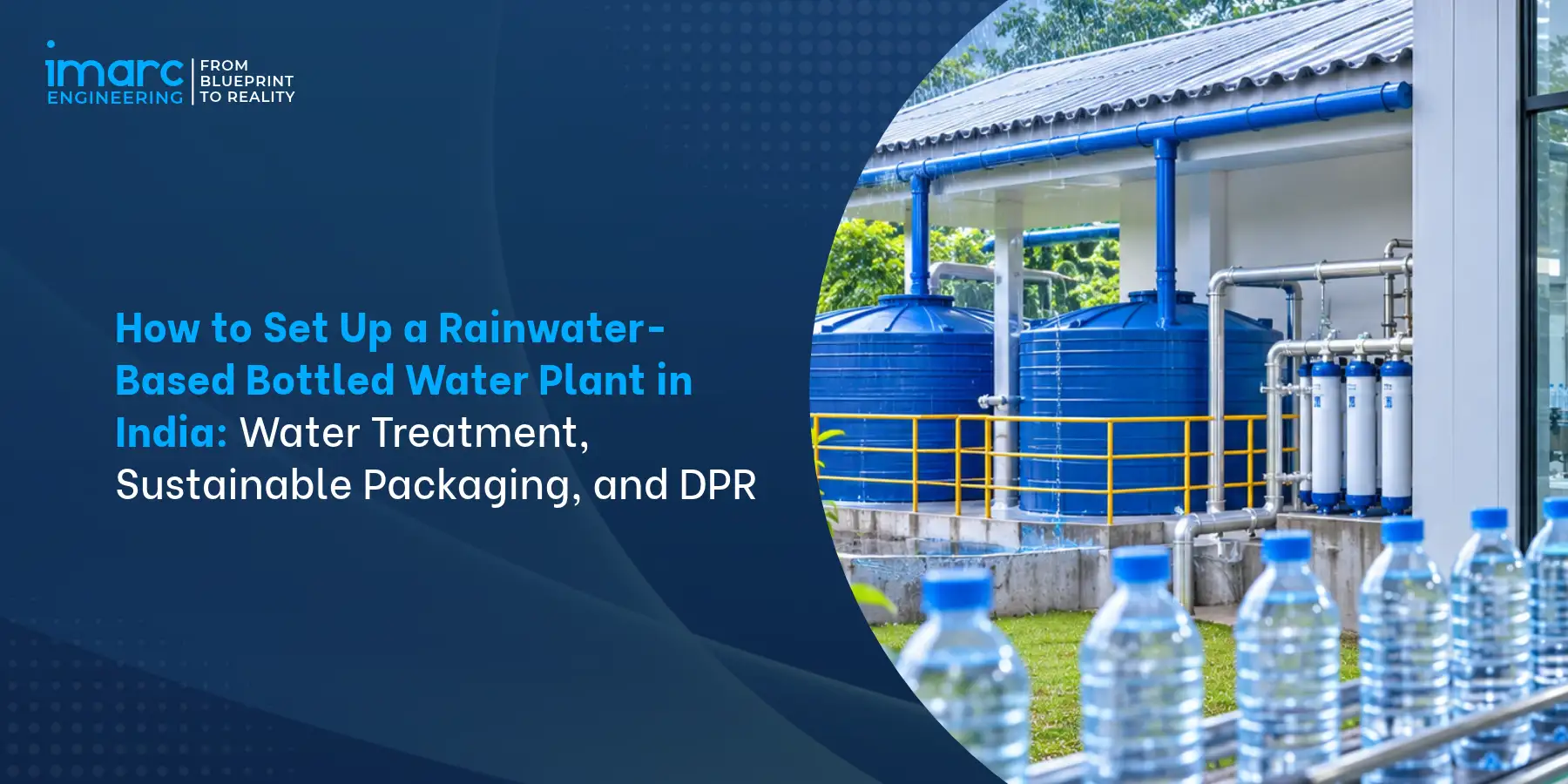
Rainwater-based drinking water manufacturing harvests rain from engineered catchments, typically large factory, warehouse or institutional roofs, stores it in closed tanks and treats it to the packaged drinking water standard. Credible applications include premium and sustainability-positioned brands, hospitality and corporate campuses, bottling co-located with industrial roofs, and regions where groundwater extraction faces regulatory or physical limits. The proposition rests on a verified source story and a dependable supply, not on rain being inherently pure.
The strongest commercial fits are usually closed-loop or captive channels. A hotel group, a technology campus or an airport-linked facility can supply its own rooms, cafeterias and events in returnable glass or jars, which shortens distribution, reduces packaging waste and allows a premium that general retail would struggle to sustain. Large logistics parks and manufacturing estates with several hectares of roof also offer catchment that already exists, so the incremental cost of collection is lower than on a purpose-built site.
1.2 Policy and Water-Stress Context
National water-conservation campaigns, including the Jal Shakti Abhiyan: Catch the Rain initiative, have raised the profile of rainwater harvesting. Separately, groundwater abstraction by industrial users, including packaged drinking water units, is regulated by the Central Ground Water Authority and state authorities in notified areas, and approval conditions differ by location. Rainwater can reduce dependence on abstraction permits, but it does not replace the food-safety approvals covered in Section 6.
Water stress is uneven across the country. Parts of Rajasthan, Gujarat, Punjab, Haryana, Karnataka and Tamil Nadu have seen sustained groundwater decline, and several blocks are classified as over-exploited, which makes new borewell-based bottling hard to permit. In such areas a rainwater source can be a differentiator with local authorities as well as consumers. Conversely, high-rainfall regions such as the Western Ghats, the Konkan coast, Kerala and the north-east offer larger yields per square meter of roof, although humidity, algae growth and long wet seasons raise tank hygiene demands.
1.3 Major Feasibility Constraints
Five constraints decide viability: strong seasonality of rainfall, the large storage volume needed to bridge dry months, low-mineral and slightly acidic rainwater chemistry, packaging that must protect a premium claim, and regulatory acceptance of the source and process. Roof contaminants, such as bird droppings, dust, leaf litter and metal leaching, add risk. These constraints are manageable, but each adds capital or operating cost that conventional bottling projects do not carry.
The interaction between constraints matters as much as each one alone. Larger storage improves dry-season security but increases the holding time of water, which raises microbial and algal risk and therefore treatment and monitoring effort. Similarly, a premium price needed to carry high storage cost raises scrutiny of the sustainability claim. Feasibility analysis should test these linkages rather than treat each constraint as an independent line item.
1.4 The Cost of Poor Planning
Three errors recur. Buying treatment and bottling equipment before a monthly water balance exists produces a plant that idles in the dry season. Treating harvested water as clean, and skipping source testing, leads to a treatment train that does not address the actual contaminants. Making unverified sustainability claims about packaging exposes the brand to labelling and consumer-protection risk. Each error is cheaper to correct at feasibility stage than after tanks and lines are installed.
A fourth, quieter error is assuming that the catchment will remain available. Roofs may be re-sheeted, shaded by new construction or leased to third parties during the project life. Securing long-term rights over the catchment, whether through ownership or a registered lease, belongs in the project documents alongside the land and building arrangements.
2. How a Rainwater-Based Bottled Water Plant in India Works: Business Model and Plant Sections
The business model is defined by its water source, the treatment burden that source creates and the product category it is sold into.
2.1 Business Model and Process Overview
The plant converts seasonal rainfall into a year-round packaged product. Rain falls on a designated catchment, is conveyed through first-flush diversion and screening into closed storage, is treated through filtration, membrane and disinfection stages, and is filled into qualified packaging. Because inflow is seasonal and bottling is continuous, storage is the economic bridge between the two, and its size is the largest single driver of rainwater bottling plant setup cost.
Revenue typically comes from a mix of retail packs, bulk jars and institutional contracts. Institutional contracts give predictable offtake that can be matched to the storage plan, while retail volumes are more variable and sensitive to distribution reach. A sound model fixes a minimum contracted share so that dry-season production is not left to spot demand.
2.2 Distinction from Packaged Drinking Water and Natural Mineral Water
Conventional packaged drinking water usually draws on borewell or municipal supply with steady availability. Natural mineral water, as defined by FSSAI, depends on a natural source, typically underground, with characteristic mineral composition, so harvested rainwater does not fit in that category. Rainwater-based packaged drinking water belongs in the packaged drinking water category, where finished-product quality and process control matter. Whether a rainwater source is accepted should be confirmed with the licensing authority during DPR preparation.
This distinction has marketing consequences. Because the product cannot be positioned on mineral heritage, its differentiation must come from source traceability, taste profile, packaging, and the credibility of the quality system. Brands that try to borrow mineral water language risk labelling action.
2.3 Scale Determinants
Scale is set by usable roof area, local rainfall and its distribution, runoff efficiency, available storage and the amount of backup supply. Demand is set by the product mix, such as 500 mL to 1 L bottles, 20 L jars or institutional supply. The binding constraint is almost always water, not bottling speed, which is why capacity is fixed from the water balance in Section 3 and only then matched to a filling line.
Because roof area scales linearly with output while storage scales with the length of the dry season, plants in regions with a short dry spell, such as the wet coastal belt, need proportionally less storage per litre sold than plants in semi-arid regions with eight or nine dry months. This is why identical plants can have very different capital intensity depending on location.
2.4 Plant Sections
| Section | Function | Key Equipment |
|---|---|---|
| Catchment and conveyance | Collect roof runoff | Gutters, downpipes, screens |
| First-flush diversion | Reject initial dirty runoff | Diverter chambers, float valves |
| Raw water storage | Seasonal buffering | Closed RCC or HDPE tanks |
| Pretreatment | Remove solids, organics | Sand filter, carbon filter |
| Purification | Remove microbes, particulates | Cartridge filters, ultrafiltration |
| Disinfection and polishing | Control microbial risk | UV reactor, ozone generator |
| Bottling and packaging | Fill, cap, label, code | Rinser-filler-capper, labeller |
| QC laboratory | Release testing | Incubators, autoclave, meters |
| Utilities | Power, air, backup | Transformer, DG set, compressor |
| Effluent and reject handling | Collect, segregate, treat and manage filter backwash, cleaning wastewater and treatment rejects | Collection sump, equalisation tank, settling or treatment system, reuse and authorised disposal arrangements |
Wastewater streams generated by filtration, membrane cleaning, disinfection and bottling operations should be collected and managed through an appropriately designed treatment, reuse or disposal system. Filter backwash and cleaning wastewater should be assessed according to their quality, while RO reject, where generated, should be managed in accordance with applicable SPCB consent conditions. A soak pit should not be assumed to be an acceptable disposal route without specific technical and regulatory approval.
3. Rainfall Availability, Site Selection and Water Balance for a Rainwater-Based Bottled Water Plant in India
Rainfall feasibility should be settled before machinery is discussed, because the water balance determines whether the plant has a business at all.
3.1 Rainfall Data Analysis and Seasonal Availability
Rainfall data analysis should use at least a decade of daily records, drawn from India Meteorological Department stations or gridded data, and should include dry-year and drought-year percentiles rather than only the mean. Most regions receive the majority of rain in the southwest monsoon of June to September, while parts of Tamil Nadu and the east coast depend heavily on the northeast monsoon. Monthly distribution, not annual total, sets storage and dry-season supply risk.
Daily data also reveals rainfall intensity and the number of rain days. A site receiving 1,000 mm in a few extreme events loses more to overflow and splash than one receiving the same total in many moderate showers, so effective capture can be lower than a simple annual calculation suggests. Climate variability, including delayed onset and long breaks within the monsoon, should be reflected in the drought percentile chosen for design.
3.2 Site Selection and Catchment Suitability
Site choice favors large, clean, low-slope or well-drained roofs of metal sheet, coated tile or concrete, away from industrial stacks, heavy traffic, trees and bird roosts. Asbestos sheet, lead-based paint and bitumen-coated surfaces are poor catchments because of leaching risk. Tank sites should be shaded, accessible for cleaning and above flood levels, with gravity flow from the catchment preferred. Location should also consider market access and the availability of backup water under valid permissions.
Air quality near the site deserves attention. Roofs downwind of cement plants, brick kilns, thermal power stations or busy highways collect heavier deposits of particulates and, occasionally, metals, which raises pretreatment load. Where a choice exists, a coated metal or concrete roof in a low-emission zone usually yields cleaner runoff than a larger roof in an industrial cluster.
3.3 Rainwater Yield and Storage Calculation
Rainwater yield is estimated using catchment area, annual rainfall and a runoff coefficient, adjusted for first-flush and other collection losses. One millimetre of rainfall over one square metre produces one litre of gross runoff.
For an illustrative plant producing 6,000 litres per operating day over 300 days, annual finished-water demand is approximately 1,800 m³. Assuming an 8% treatment loss, the estimated raw-water requirement is approximately 1,957 m³ annually.
For preliminary assessment, assume annual rainfall of 1,000 mm, a runoff coefficient of 0.80 and a 10% first-flush loss. These assumptions produce an estimated net annual yield of 0.72 m³ per square metre of catchment. The resulting theoretical catchment requirement is approximately 2,720 m². This is a preliminary estimate, not a final design requirement. Actual catchment area may be higher after accounting for conveyance losses, roof condition, rainfall intensity, overflow, dry-year rainfall and periods when runoff cannot be captured.
The assumed rainfall distribution is also important. If approximately 80% of annual rainfall occurs during four monsoon months, the plant must capture and store sufficient water during that period to meet demand during subsequent low-rainfall months. A preliminary allowance for additional catchment may be considered during site screening, but a fixed drought margin should not replace location-specific rainfall analysis.
Final catchment and storage requirements should be established through a monthly water balance using historical rainfall data. The model should account for monthly inflows, first-flush and conveyance losses, treatment recovery, operating demand, overflow and available tank capacity under normal and dry-year conditions. The resulting analysis should determine whether the proposed roof area and storage system can support the planned production schedule.
3.4 Alternative-Source and Contingency Planning
A rainwater-only design leaves the business exposed to a poor monsoon. Contingency options include oversizing storage and catchment, adding adjacent roofs, curtailing the dry-season production plan, or arranging a permitted backup source such as municipal or tanker water, which then needs the same testing and treatment. Backup use affects both the product claim and the licensing position, so its share should be defined in the DPR rather than left to operations.
A practical approach is to define trigger levels, for example a tank level below which production is reduced or a backup source is activated, and to record each activation. This keeps the rainwater claim defensible and gives lenders visibility into how often the contingency is actually used.
4. Rainwater Collection, Storage and Pretreatment for a Rainwater-Based Bottled Water Plant in India
A rainwater collection and storage system protects the treatment plant by removing the bulk of contamination before water is stored.
4.1 Rooftop Collection and First-Flush Diversion
Roof gutters and downpipes in food-grade or inert material, such as UPVC or stainless steel, convey runoff to first-flush diverters that reject the initial, most contaminated volume. Diversion is commonly designed as a fixed depth of rainfall over the catchment, often in a range of about 0.5-2 mm, set from roof cleanliness and local conditions. Diverters should drain to waste automatically, and the discarded volume should be included in the water balance (Figures are indicative in nature, may vary).
Gutters need leaf guards and regular cleaning before each monsoon, and downpipes should be sized for peak intensity so that heavy storms do not overflow and bypass the system. Where the first rains of the season follow a long dry spell, the diversion depth may be set at the higher end of the range, because accumulated dust and droppings are heaviest then.
4.2 Closed Storage Design
Rainwater storage tanks should be closed, opaque, accessible for cleaning and constructed from suitable food-contact or appropriately lined materials, such as approved HDPE, stainless steel or RCC with a suitable internal lining. Design provisions should include insect-proof vents, screened overflows, inspection manholes, sloped floors, drain points and outlets positioned to minimise sediment intake. Multiple compartments can allow inspection and cleaning without interrupting the entire water supply.
Storage capacity should be determined through a monthly water balance rather than a fixed percentage of annual demand. The calculation must consider rainfall seasonality, the longest expected dry period, treatment recovery, operating days, first-flush and conveyance losses, tank cleaning requirements and dry-year conditions. For the illustrative project, 1,500 m³ may be retained as a preliminary planning scenario. However, it should not be treated as the final storage requirement until the monthly inflow and withdrawal model confirms its adequacy.
Tank location and construction should also account for temperature, groundwater ingress, flood exposure, soil conditions and structural loading. Partly buried or shaded tanks may help limit temperature fluctuations, but structural design must address groundwater pressure and flotation risks when tanks are empty. RCC tanks should undergo appropriate water-tightness testing before commissioning.
4.3 Pretreatment Before Storage
Coarse screens, a settling or sedimentation chamber and a roughing or cartridge filter remove leaves, grit and suspended solids before water enters the main tank. Light chlorination or periodic tank dosing may be used to control biological growth in storage, with residual chlorine removed ahead of the membrane stages. Pretreatment lowers fouling load on downstream membranes and extends cartridge and media life.
Dechlorination is typically done with activated carbon or a sodium metabisulphite dose, depending on membrane material. Any chemical used in contact with water must be of food or potable grade, and its dosing and residual checks should be documented.
4.4 Raw Water Monitoring and Tank Hygiene
Raw water should be monitored for turbidity, pH, conductivity, total coliforms and temperature at tank outlets. Tanks need scheduled draining, cleaning and inspection, documented in a hygiene log. Mosquito, algae and bird ingress controls should be verified before every monsoon. Stored water older than a defined holding period should be recirculated or re-treated, and the holding limit should be written into the SOP.
Staff handling tank cleaning should be trained in confined-space safety and hygiene, and should use dedicated footwear and tools. Cleaning chemicals must be rinsed out and verified before refilling, since residues can compromise both safety and taste.
5. Rainwater Treatment, Purification and Validation for a Rainwater-Based Bottled Water Plant in India
Rainwater treatment for drinking water must be designed from tested source-water quality, because harvested rain is not safe to drink untreated.
5.1 Rainwater Characteristics and Source Testing
Rainwater is low in dissolved minerals and often slightly acidic, but it picks up dust, organic matter, microbes and, from some roofs, metals and atmospheric pollutants. Before design, composite samples from the first, middle and late monsoon should be tested for physical, chemical and microbiological parameters, including heavy metals and, where relevant, pesticide residues. Results define the treatment train and the frequency of routine testing.
Sampling should also capture the first rains after a dry spell and storage water after several months, since quality changes with both roof deposits and holding time. Sampling protocols, accredited laboratories and chain-of-custody records should be set up at this stage so the data can later support regulatory discussions.
5.2 Treatment Train
A typical train comprises multimedia or sand filtration, activated carbon, cartridge filtration to about 5 and 1 micron, ultrafiltration for particulate and microbial removal, and final disinfection by UV and/or ozone. Reverse osmosis is usually unnecessary for low-TDS rainwater and may be added only if source testing shows chemical contaminants that need it. Choosing the lightest effective train lowers capital cost, reject water and energy use.
Avoiding RO also preserves water, which matters when every liter must be stored through the dry season. Ultrafiltration recoveries are high, and backwash water can be settled and reused for non-product purposes such as cleaning or landscaping, improving overall water efficiency.
5.3 pH Correction and Mineral Balance
Rainwater generally has low dissolved mineral content and may be slightly acidic. Treatment may therefore include pH correction or remineralisation, depending on source-water testing and the required finished-water characteristics. Options include calcite or magnesia contact filters and the controlled addition of suitable mineral ingredients.
Under FSSAI's packaged drinking water standard, remineralisation is permitted as part of the treatment process, provided the ingredients used are of food-grade or pharmaceutical-grade quality. Manufacturers should maintain specifications and test certificates for the ingredients and verify that the finished water meets all applicable product standards. Any mineral-related claims or label declarations should comply with the applicable FSSAI labelling requirements. The treatment process and final mineral composition should be documented and reviewed with the relevant licensing authority before commercial production.
Pilot testing and sensory evaluation can help establish a consistent taste profile. Mineral addition should be based on water-quality results and process requirements rather than an assumed formulation.
5.4 Validation and Ongoing Monitoring
Each treatment stage should be validated through challenge or performance testing, with online monitoring of turbidity, UV intensity, ozone residual and conductivity where feasible. Finished-water testing should cover the parameters prescribed for packaged drinking water, with microbiological testing on every batch or at the frequency set in the food safety plan. Records should show that dry-season and wet-season source variations remain within the design envelope.
Membrane integrity tests, UV lamp hour logs and scheduled replacement of cartridges and media should be part of preventive maintenance. Trend analysis of these records can flag drift before it becomes a compliance failure.
6. Packaging, Regulatory Approvals and Quality Control for a Rainwater-Based Bottled Water Plant in India
Packaging, licensing and quality control determine whether the product can legally be sold and whether a premium claim can be defended.
6.1 Packaging Options and Sustainable Packaging
Packaging selection for a rainwater-based bottled water plant should consider food-contact safety, regulatory compliance, product shelf life, distribution requirements, cost and end-of-life management. FSSAI specifies requirements for drinking-water containers, including hygiene, transparency, tamper protection and compliance with applicable food-contact material standards.
The principal packaging options should therefore be evaluated as follows:
| Packaging type | Potential advantages | Key considerations |
|---|---|---|
| Biodegradable packaging | May reduce long-term persistence of packaging waste under specified degradation conditions | Material composition, food-contact safety, degradation conditions, barrier performance and shelf-life suitability must be validated |
| Compostable packaging | Can be designed to break down under specified composting conditions | Requires applicable certification, food-contact compliance and suitable composting infrastructure. Industrial compostability does not mean the package will degrade rapidly in ordinary disposal conditions |
| Recyclable packaging | PET bottles have established recycling pathways and are widely used for packaged drinking water | Packaging must meet FSSAI food-contact requirements. Recycled PET can be used only through compliant and approved food-contact processes. Collection and recycling arrangements should also be considered |
| Reusable packaging | Returnable glass bottles and suitable reusable containers can reduce single-use packaging demand over repeated cycles | Requires validated washing and disinfection, inspection, reverse logistics and controls against damaged or contaminated containers |
Biodegradable and compostable materials should not automatically be treated as suitable for bottled drinking water. Their use depends on the applicable Plastic Waste Management Rules, CPCB certification requirements where relevant, FSSAI food-contact requirements, and the suitability of the material for the intended product and storage period. Compostable packaging should also be assessed against the applicable compostability standard and the availability of suitable processing infrastructure.
Recyclable PET and reusable glass or approved returnable containers may be considered where they meet the relevant FSSAI requirements. Recycled PET intended for direct food contact must come from an approved and compliant process. Packaging selection should also account for migration limits, light exposure, closure integrity, transport conditions, and shelf-life validation.
The final packaging decision should be supported by supplier documentation, food-contact compliance evidence, product compatibility testing, and a practical collection, reuse or recycling plan. Cartons and aluminum containers should not be assumed to be acceptable for packaged drinking water without confirming their suitability under the applicable FSSAI packaging requirements. Plastic packaging producers and brand owners must also assess their Extended Producer Responsibility obligations under the Plastic Waste Management Rules.
6.2 FSSAI Licensing and Product Standards
Packaged drinking water is regulated under the Food Safety and Standards Act, 2006, and the applicable FSSAI regulations. Manufacturers must obtain the relevant FSSAI registration or licence based on their eligibility and comply with the prescribed product standards, hygiene requirements, and testing scheme. Mandatory BIS certification for packaged drinking water was removed in October 2024.
However, FSSAI's Scheme of Testing for Packaged Drinking Water and Mineral Water has been mandatory since 1 January 2026. Packaged drinking water manufacturers are also covered under FSSAI's high-risk food category requirements, including pre-licence inspection, annual inspections and applicable third-party food safety audits.
6.3 Other Approvals
Other approvals typically include factory or establishment registration, state pollution control board consent, fire safety clearance, power connection, GST registration, Udyam registration where applicable, trademark filing and Legal Metrology registration for packaged commodities. If any backup groundwater is used, the applicable Central Ground Water Authority or state permission is required. The list and timelines vary by state and should be verified locally.
Approval sequencing should be built into the implementation schedule. Some consents are prerequisites for others, and construction of large storage tanks may need building or structural permissions from local bodies. Running these in parallel with detailed engineering shortens the time to first production.
6.4 Labelling and Claims
Labels must follow FSSAI labelling and display regulations and Legal Metrology rules, including product name, batch, manufacture or packing date, best-before information, licence number, net quantity and any declared mineral content. The label must not describe the product as natural mineral water. Claims such as rainwater-sourced, sustainable or carbon-neutral should be backed by documented source records and evidence, since misleading claims attract consumer-protection action.
If backup water is used in some batches, the label and marketing should not imply an exclusively rainwater source. Batch-level records of the source blend, linked to the traceability system, allow the producer to prove the claim for each lot sold.
6.5 Quality Control System
A QC laboratory should test incoming packaging, in-process water and finished product against a documented food safety management plan, such as HACCP, with traceability by batch. Retention samples, calibration records, supplier approvals, cleaning validation and a recall procedure form the minimum system. Periodic testing by an FSSAI-notified or NABL-accredited laboratory supports audit readiness.
A small plant can run a lean in-house laboratory for microbiology and basic physico-chemical tests, and outsource heavy-metal and pesticide analysis to an accredited laboratory at set intervals. Trained technical staff and a clear release authority are as important as the equipment.
7. Machinery, Capacity and Plant Layout for a Rainwater-Based Bottled Water Plant in India
Machinery is selected after the water balance fixes the sustainable daily volume.
7.1 Machinery and Equipment
Core equipment includes collection and first-flush hardware, storage tanks, raw water and booster pumps, pressure sand and carbon filters, cartridge housings, ultrafiltration skid, UV reactor, ozone generator and mixing tank, a rinser-filler-capper, labeller, date coder, shrink wrapper and conveyors, plus a QC laboratory, air compressor, DG set and effluent facilities. Equipment should be sized with a clear difference between peak filling speed and average daily output.
Food-contact parts should be stainless steel of suitable grade or approved polymers, with sanitary fittings and clean-in-place provisions where possible. Vendor selection should weigh after-sales service, spare-part availability and validation support, since downtime in a small plant directly cuts output from a limited water budget.
7.2 Capacity Planning
For the illustrative project, 6,000 L/day equals about 250 L/hour over 24 hours, or about 750 L/hour over an 8-hour shift. A small semi-automatic or compact automatic line can therefore meet demand in a single shift, leaving room to expand only if catchment and storage are enlarged. Matching a high-speed line to a small water budget wastes capital, so line speed should follow the water balance (Figures are indicative in nature, may vary).
Treatment equipment can be sized for the same single-shift duty, with a modest treated-water buffer tank between purification and filling. This keeps membranes and UV units running at steady flow rather than starting and stopping with the filler, which improves performance and lamp and membrane life.
7.3 Plant Layout and Hygienic Zoning
Layout should follow one-way flow from raw water to dispatch, with separation between the raw water and treatment area, the filling hall and the packaging and storage areas. The filling area should be an enclosed, positive-pressure hygienic zone with controlled entry, washable surfaces and drainage that does not cross product paths. Space should be reserved for tank cleaning access, laboratory, packaging store, finished-goods warehouse, utilities and a future expansion bay.
Truck movement for inbound packaging and outbound dispatch should be kept away from the filling hall and tank area to limit dust and contamination. Where the plant is co-located on an existing industrial roof or campus, the layout must also respect existing fire, traffic and utility corridors.
8. Cost, DPR and Commercial Feasibility of a Rainwater-Based Bottled Water Plant in India
Cost is dominated by storage and catchment works, which conventional bottling projects do not carry at this scale.
8.1 Indicative Capital Cost
Capital expenditure for a rainwater-based bottled water plant depends on catchment area, validated storage capacity, treatment requirements, bottling capacity, packaging format, and site infrastructure. Storage and civil works can represent a significant share of project investment, particularly where large tanks must be constructed.
The main CAPEX components and their estimation basis are outlined below.
| Cost Head | Key Costing Considerations |
|---|---|
| Catchment, gutters and first-flush works | Roof area, material, gutter and downpipe specifications, conveyance distance and installation |
| Storage tanks | Validated storage volume, construction material, foundations, compartments, site conditions and structural requirements |
| Treatment plant and disinfection | Source-water quality, treatment capacity, filtration, membrane systems, disinfection and reject management |
| Filling, packaging and coding line | Bottling capacity, automation level, packaging format, container handling and line configuration |
| Quality-control laboratory | In-house testing scope, laboratory equipment, calibration and outsourced testing requirements |
| Building, utilities and effluent facilities | Building area, electrical systems, pumps, compressors, drainage and wastewater management |
| Approvals, pre-operative expenses and contingency | Regulatory applications, engineering, commissioning, validation and project-specific implementation risks |
A reliable investment estimate should be developed using site-specific engineering, validated storage requirements and budgetary quotations from equipment and construction vendors. The DPR should separately identify civil works, machinery, utilities, installation, pre-operative expenses and contingency. The total investment should be finalised only after the project scope and major procurement requirements are established.
8.2 Operating Cost and Economics
Operating costs include power, packaging materials, labour, laboratory testing, consumables such as cartridges and UV lamps, tank maintenance, licences and audits, distribution and marketing. Because water itself is nearly free, packaging is typically the largest variable cost, so pricing and channel strategy matter more than raw-material cost. Break-even depends on realised price per litre, product mix and utilisation, and should be tested through sensitivity cases on price, volume and dry-season output.
Because the plant is small and storage-heavy, depreciation and financing cost on tanks form a large fixed burden per litre. Premium pricing, institutional contracts and returnable formats are the main ways to carry it. Lenders will usually expect a downside case in which a poor monsoon forces reduced output or higher backup use.
8.3 DPR Contents
A bankable DPR should include rainfall and water-balance analysis, catchment and storage design, source-water test results, treatment design and validation plan, packaging and sustainability strategy, regulatory and approval roadmap, machinery list with quotations, layout, utilities, manpower, capital and operating cost, financial projections with sensitivity analysis, risk register and implementation schedule.
8.4 Key Risks and Mitigation
Principal risks are a poor monsoon, contamination of stored water, regulatory non-acceptance of the source, unsubstantiated sustainability claims, and high packaging cost. Mitigation includes storage capacity validated through normal- and dry-year water-balance scenarios, strict tank hygiene and monitoring, early engagement with the licensing authority, evidence-backed labelling and a defined, permitted backup source.
Additional risks include loss of catchment rights, equipment downtime, and brand damage from a single contamination event. Insurance, preventive maintenance, a recall plan, and documented catchment tenure reduce these exposures and should be reflected in the risk register.
Conclusion
A rainwater-based bottled water plant in India is viable only when the water balance, storage design, source-tested treatment and regulatory position are established before equipment is bought. Rainfall seasonality sets the scale, storage bridges the dry months, treatment must be built around measured water quality, and packaging and labelling claims must be provable. Investors who begin with rainfall data, a monthly water balance and early regulator engagement, and who convert the findings into a detailed DPR, are best placed to decide whether the project should proceed, be resized or be redesigned.
The practical path is staged: confirm catchment and rainfall, test the water, size storage, engage the regulator, then commit to machinery and civil works. Projects that follow this order keep options open at low cost, and those that skip it tend to discover their constraints after the capital is spent.
PURSUING A RAINWATER-BASED BOTTLED WATER PLANT IN INDIA?
IMARC Engineering supports investors and water processing businesses with feasibility studies and business planning, capacity assessment, CAPEX and OPEX planning, site selection, plant layout, process design, equipment selection, utilities planning, regulatory approvals, licensing, and project scheduling. The advisory covers rainwater harvesting and collection, raw water treatment, filtration, disinfection, quality monitoring, bottling and packaging, with project-specific infrastructure, storage, and commissioning planning.
→ Schedule a rainwater-based bottled water plant scoping consultation with an IMARC specialist
Frequently Asked Questions
A rainwater-based bottled water plant collects rainwater from suitable catchment surfaces, stores it in protected tanks, treats it to meet packaged drinking water standards and fills it into approved containers for commercial distribution.
FSSAI's packaged drinking water standard allows water from specified sources and other consistent sources, subject to prescribed treatment and quality requirements. Investors proposing harvested rainwater should obtain clarification from the relevant FSSAI licensing authority on source acceptance before finalising the project.
No. Harvested rainwater does not qualify as natural mineral water, which is associated with water from natural or drilled underground sources and its characteristic mineral composition. A rainwater-based product should be assessed under the packaged drinking water category, subject to FSSAI requirements.
Harvesting potential is estimated using catchment area, rainfall and runoff coefficient, adjusted for first-flush and collection losses. Monthly rainfall distribution, overflow, treatment recovery and dry-year conditions must also be considered. The final catchment requirement should be established through a site-specific water balance.
Storage depends on daily production, treatment losses, rainfall seasonality and the duration of low-rainfall periods. The 1,500 m³ figure in this guide is a preliminary planning scenario, not a confirmed requirement. Final capacity should be determined through a monthly water balance covering normal and dry-year conditions.
Treatment may include screening, sedimentation, sand and activated carbon filtration, cartridge filtration, ultrafiltration and UV or ozone disinfection. The treatment sequence should be selected using source-water test results and applicable FSSAI standards. Finished water must meet all prescribed quality and microbiological requirements.
Packaging options include compliant PET and other permitted food-grade plastic containers, as well as sterile glass bottles. Materials must meet applicable FSSAI food-contact, hygiene, transparency and tamper-proof requirements. Returnable formats also require validated washing, disinfection and inspection procedures.
Biodegradable bottles should not be selected without confirming their compliance with FSSAI food-contact and packaged drinking water requirements. Applicable CPCB certification and Plastic Waste Management Rules must also be considered. Material performance, moisture protection, product compatibility and shelf life require validation before commercial use.
No. Mandatory BIS certification for packaged drinking water was removed in October 2024. Manufacturers must obtain the applicable FSSAI licence and comply with the mandatory Scheme of Testing for Packaged Drinking Water and Mineral Water, effective from 1 January 2026.
Investment depends on catchment area, validated storage capacity, treatment technology, bottling line, packaging and site infrastructure. A reliable estimate requires engineering assessments and vendor quotations. The DPR should cover rainfall analysis, monthly water balance, storage design, water testing, machinery, approvals, CAPEX, OPEX, working capital and financial projections.
Recent Post


Trusted by Industry Leaders
We partner with global enterprises and ambitious businesses across sectors to deliver operational excellence, strategic insights, and sustainable growth through integrated solutions.











Success in Their Words
Real feedback from clients across industries. Discover how our solutions delivered measurable impact and operational excellence.

I wanted to express my sincere appreciation for your efforts in handling this matter. Your dedication and commitment have been truly commendable, and it is evident that you have put in tremendous hard work and expertise into resolving the issues at hand. We are greatly interested in continuing our collaboration with you in the future, as your professionalism and reliability have made you a trusted partner. Thank you once again for your invaluable contribution. We look forward to strengthening our partnership ahead.

It has been a pleasure working with the IMARC team. The insights provided were structured, clear, and highly valuable, helping us strengthen both our technical and financial planning with confidence. We deeply appreciate the team’s professionalism, responsiveness, and attention to detail throughout the engagement. Every requirement was well understood and effectively incorporated, resulting in a comprehensive and actionable output. Overall, our experience has been excellent, and I would gladly recommend IMARC to organizations seeking a reliable research partner.

Your service is truly exceptional. Working with the IMARC team has been a seamless and professional experience. The clarity of communication, responsiveness to queries, and consistent support at every stage made the entire engagement highly efficient. The insights shared were well-structured, practical, and perfectly aligned with our requirements, helping us make informed decisions with confidence. Overall, the dedication and professionalism demonstrated by your team stand out, and I would be glad to recommend IMARC as a reliable and trustworthy research partner.

IMARC did an outstanding job in preparing our study. They were punctual, precise, and consistently responsive throughout the entire process. The team delivered all the data we required in a clear, well-organized, and highly professional format. Their strong attention to detail, combined with their ability to meet every deadline without compromising quality, truly set them apart. Overall, their reliability and commitment made them an exceptional partner for our project, and we would gladly work with them again in the future.

IMARC made the whole process incredibly easy from start to finish. Everyone I interacted with via email was polite, professional, and straightforward to deal with, always keeping their promises regarding delivery timelines and remaining consistently solutions-focused. From my very first contact, I appreciated the professionalism and support shown by the entire IMARC team. I highly recommend IMARC to anyone seeking timely, affordable, and reliable information or advice. My experience with IMARC was excellent, and I truly cannot fault any aspect of it.

I’d like to express my sincere gratitude for the excellent work you accomplished with the study. Your ability to quickly understand our requirements and deliver high-quality results under tight timelines truly reflects your expertise, exceptional work ethic, and unwavering commitment to your customer’s success. The professionalism and responsiveness you demonstrated throughout the process made a significant difference. Our entire team and company are incredibly thankful for your dedication, reliability, and support. Once again, thank you for your outstanding contribution.