Manufacturing
November 24 2026
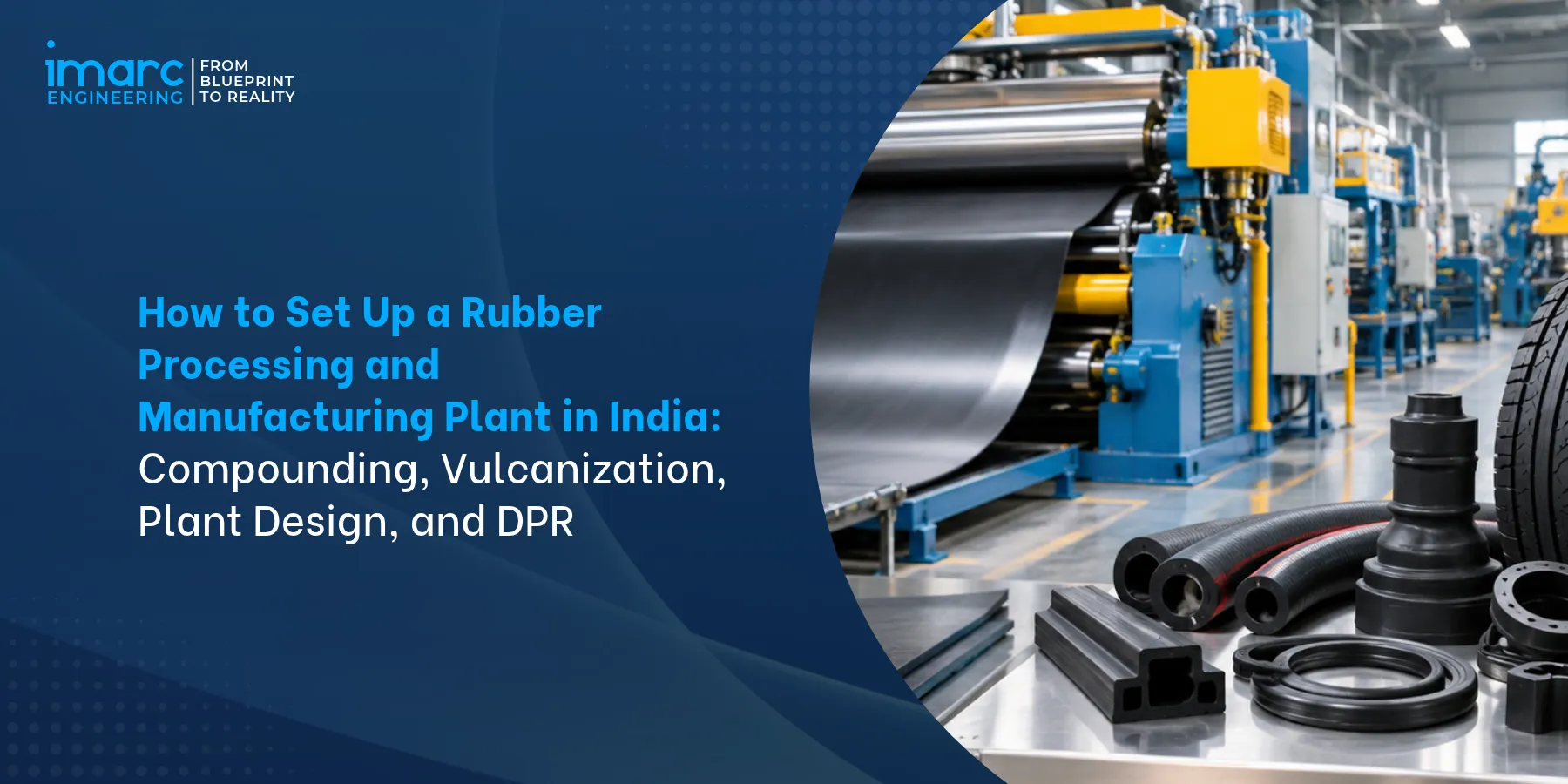
How to Set Up a Rubber Processing and Manufacturing Plant in India: Compounding, Vulcanization, Plant Design, and DPR
Introduction
Establishing a rubber manufacturing plant in India requires careful planning of formulations, mixing processes and vulcanization systems before finalising the site or machinery. Key cost and performance factors include compound cost per kilogram, curing cycle time, and press utilisation. These should be evaluated during the feasibility and process-design stages to develop an efficient production model.
Rubber manufacturing encompasses distinct facility types, including natural rubber processing units, rubber compounding plants, moulded-product facilities, and tyre manufacturing plants. Each involves different machinery, investment, infrastructure and regulatory requirements. Defining the facility scope at the outset helps ensure that plant design and equipment selection align with the intended products and production capacity.
Scope of this Guide
This guide outlines the technical, infrastructure, machinery and financial considerations involved in setting up a rubber manufacturing plant in India. It covers natural rubber processing, rubber compounding, moulded and extruded products, calendaring, vulcanization, machinery selection, plant layout, utilities, CAPEX and OPEX planning, regulatory approvals and Detailed Project Report (DPR) preparation. Tyre manufacturing is included only for comparison, as its production processes and investment requirements differ significantly from conventional rubber manufacturing facilities.
Table of Contents
- Introduction
- Why a Rubber Manufacturing Plant in India Matters for Investors in 2026
- What a Rubber Manufacturing Plant in India Is: Plant Types and Product Scope
- How to Set Up a Rubber Manufacturing Plant in India: Feasibility, Product Selection and Capacity Planning
- Rubber Manufacturing Process in a Rubber Manufacturing Plant in India: Step-by-Step
- Rubber Compounding and Mixing Technology in a Rubber Manufacturing Plant in India
- Rubber Moulding, Extrusion, Calendaring and Vulcanization in a Rubber Manufacturing Plant in India
- Machinery, Plant Layout and Utilities for a Rubber Manufacturing Plant in India
- Rubber Manufacturing Plant Cost in India: DPR, Approvals and Project Economics
- Conclusion
1. Why a Rubber Manufacturing Plant in India Matters for Investors in 2026
Four structural conditions shape the investment case for a rubber manufacturing plant in India in 2026, and each one changes the technical configuration worth funding.
1.1 Domestic Availability and Import Dependence
India's rubber manufacturing industry depends on both domestic and imported raw materials. According to the Rubber Board, natural rubber production reached approximately 8.75 lakh tonnes in 2024–25, compared with domestic consumption of 14.10 lakh tonnes. Imports stood at around 5.51 lakh tonnes during the same period. This supply gap makes procurement planning and inventory management important for rubber compounders and finished-product manufacturers.
Synthetic elastomers such as SBR, BR, EPDM, NBR, CR and FKM are sourced through a combination of domestic manufacturers and imports, depending on grade and application. Specialty chemicals, carbon black, silica and processing additives also require supplier qualification and price-risk assessment. These factors should be reflected in the plant's sourcing strategy, working-capital estimates and product-cost model.
1.2 Policy and Incentive Framework
The investment case for a rubber manufacturing plant may be influenced by central and state industrial policies, MSME support programmes, infrastructure incentives and location-specific concessions. Depending on the state, eligible projects may qualify for capital investment assistance, interest subsidies, electricity duty concessions, stamp duty exemptions or SGST-linked incentives. Eligibility depends on the product category, investment size, location, employment commitments and applicable scheme conditions.
Customs duties on natural rubber, synthetic elastomers, carbon black, chemicals and finished rubber products also vary by tariff classification and applicable notifications. Investors should verify the prevailing incentive and customs provisions before incorporating them into the project financial model. Incentives should be treated as conditional benefits rather than assured project revenue.
1.3 Cluster Depth and Supplier Ecosystem
Rubber goods manufacturing clusters where the supporting trades already exist: Kochi and Kottayam for plantation-linked and latex-based products, Coimbatore and Chennai for automotive and pump-industry mouldings, Pune and Chakan for vehicle components, Ahmedabad and Vadodara for industrial rubber, and the Noida–Ghaziabad and Faridabad belts for general moulded goods. Cluster depth delivers mould and die shops, elastomer distributors, carbon black and silica supply, calibration and testing laboratories, and operators who have run a mill before. A site outside these clusters adds supplier development time.
1.4 The Cost of Poor Front-End Planning
There is a cost attached to mismanaged front-end planning. Press tonnage and cavity counts are ordered before formulation and cure time are fixed, producing presses that are either cure-limited or clamp-limited. A mixing line is bought without dust extraction and fume control, and the consent or factory licence then forces a retrofit into a hall with no space for it. Compound conditioning is omitted, so unvulcanized stock scorches in a hot store. Mould lead times of several weeks per tool, multiplied across a wide SKU range, are discovered at the end of the programme rather than the beginning.
2. What a Rubber Manufacturing Plant in India Is: Plant Types and Product Scope
Plant type decides the process route, the capital profile and the approvals stack, and the five categories below are not interchangeable.
2.1 Definition and Facility Boundary
A rubber manufacturing plant converts an elastomer, fillers, process oils and a cure system into a shaped, crosslinked article. The boundary is commercial before it is technical: a compounding-only plant sells compound by the kilogram and carries no mould inventory, a finished-goods plant sells parts and carries tooling, cure capacity and customer approvals, and a natural rubber processing unit sells raw material to both. Boundary choice fixes the machinery list, the working-capital cycle and the licence scope, so it belongs in the feasibility report.
2.2 Natural Rubber Processing Plants
Natural rubber processing plants convert field latex or field coagulum into commercially saleable forms such as ribbed smoked sheets, technically specified block rubber and concentrated latex. In sheet rubber production, latex is collected, filtered, diluted where necessary, coagulated using a suitable acid solution, passed through sheeting rollers and dried or smoked under controlled conditions. Block rubber production involves cleaning, size reduction, washing, granulation, drying and baling, followed by grading against the applicable technical specification.
Latex concentrate is generally produced through centrifugation or another recognised concentration process, with preservation and storage conditions selected to maintain product quality. The required process equipment, chemical consumption, water demand and drying capacity depend on the feedstock, target grade and production capacity. Natural rubber processing standards and product specifications should be confirmed before finalising the process design.
2.3 Compounding and Finished Product Plants
A rubber compounding plant blends natural or synthetic elastomers with fillers, processing oils, curing agents, accelerators, activators and other additives to produce a compound with defined processing and performance characteristics. The compound may be supplied as sheets, strips, slabs or other forms to downstream manufacturers.
A finished rubber products plant takes the compound through shaping, vulcanization, finishing and inspection to manufacture products such as gaskets, O-rings, seals, diaphragms, hoses, profiles, sheets and anti-vibration components. Some facilities integrate compounding and finished-product manufacturing, while others purchase ready-mixed compounds to reduce initial investment and formulation complexity.
2.4 Reclaimed Rubber and Tyre Plants
Reclaimed rubber manufacturing involves processing selected vulcanized rubber waste into reusable rubber material through sorting, contaminant removal, size reduction and suitable reclaiming or devulcanization processes. Depending on the feedstock and product requirements, the process may also include refining and quality testing. Reclaimed rubber is commonly blended with virgin elastomers in applications where its properties meet the required specifications. The machinery, environmental controls and investment requirements differ from conventional rubber compounding facilities.
Tyre manufacturing is a separate and more integrated production activity. It typically involves tyre-specific compound preparation, component extrusion and calendaring, textile or steel-cord reinforcement, bead preparation, tyre building, curing in moulds and final inspection. The machinery configuration, tooling, process controls, testing requirements and capital investment are substantially different from those of a general rubber moulding or compounding facility.
Tyre plants also require product-specific quality validation and compliance with applicable automotive and tyre standards. This guide treats tyre manufacturing as a separate facility category rather than detailing its complete production process.
2.5 Plant Sections
| Section | Function | Key Equipment |
|---|---|---|
| Raw material stores | Polymer, filler and oil storage | Pallet racking, bulk silo |
| Weighing and dispensing | Accurate batch weights | Loss-in-weight feeders, weighing booth |
| Mixing | Masterbatch and final compound | Internal mixer, two-roll mill |
| Compound conditioning | Cooling, rest and release | Batch-off line, stillage racks |
| Shaping | Preform, profile or sheet | Preformer, extruder, calender |
| Curing | Vulcanization of compound | Hydraulic press, autoclave |
| Finishing and packing | Trim, deflash, mark, pack | Deflashing unit, trim press |
| Quality laboratory | Compound and product testing | Mooney viscometer, MDR, UTM |
| Utilities block | Power, steam, chilled water, air | Boiler, chiller, compressor |
| Effluent and dust control | Pollution abatement | ETP, bag filter, fume hood |
3. How to Set Up a Rubber Manufacturing Plant in India: Feasibility, Product Selection and Capacity Planning
Setting up a rubber manufacturing plant in India is a sequence of feasibility, product, capacity and site decisions that must be resolved before machinery is specified.
3.1 Market Feasibility and Product Selection
Demand anchors differ. Original-equipment supply to automotive, appliance, pump and valve makers brings volume, drawing-based specifications and PPAP-style approval cycles; aftermarket demand brings higher margins and fragmented SKUs; export brings conformity to ASTM D2000 line callouts, ISO 3302-1 dimensional tolerance classes and customer-specific test schedules.
Product selection should consider the buyer's technical specification, applicable product standards, dimensional tolerances, operating environment, annual demand, mould cost per cavity, cure-cycle economics and customer qualification requirements. Standards such as ASTM D2000 and ISO 3302-1 may be relevant for particular products, but the applicable standard must be identified from the product specification and target market.
3.2 Capacity Planning: Compound Tonnes Versus Product Units
Plant capacity should be calculated separately for rubber compounding and finished-product manufacturing. Compounding capacity is estimated from the usable batch weight, actual batch cycle, operating hours, working days and achievable equipment utilisation.
The calculation must also account for weighing, material charging, discharge, mill processing, batch-off cooling, cleaning and formulation changeovers. Finished-product capacity is determined by the number of moulding presses or production lines, cavity configuration, actual cycle time, loading and unloading time, rejection rate and planned operating hours.
Illustrative Mixing and Moulding Capacity Calculation
Consider a facility with an internal mixer having a usable batch weight of 500 kg. Assume a total mixing cycle of 30 minutes, including charging, mixing, discharge and routine handling. At two batches per hour, operating for 16 hours a day over 300 days, with an assumed effective utilisation of 80%, the annual mixing capacity is:
Annual mixing capacity = 500 kg × 2 batches/hour × 16 hours/day × 300 days × 80% = 3,840,000 kg, or 3,840 tonnes per year
The assumed 500 kg batch weight represents a hypothetical large-capacity mixing configuration and should not be treated as a standard mixer specification for rubber manufacturing plants.
Moulding capacity must be calculated separately. Assume the facility has 20 hydraulic presses, each fitted with a four-cavity mould. If the complete moulding cycle is eight minutes, each press can theoretically complete 7.5 cycles per hour. At the same operating schedule and 80% effective utilisation, annual gross moulding output is:
Annual gross output = 20 presses × 4 cavities × 0.25 kg per part × 7.5 cycles/hour × 16 hours/day × 300 days × 80% = 576,000 kg, or 576 tonnes per year
If the assumed rejection rate is 3%, saleable output would be:
Saleable output = 576 tonnes × 97% = 558.72 tonnes per year
In this illustration, the moulding section is the production bottleneck. The mixing line can supply substantially more compound than the presses can convert into finished products. The plant's saleable output is therefore governed by moulding capacity, not the rated capacity of the mixer.
These figures are illustrative assumptions, not standard production benchmarks. Actual calculations should use validated batch weights, mixing cycles, mould cavity counts, part weights, loading and unloading times, cure cycles, equipment availability, changeovers and rejection rates. The DPR should also account for compound losses during processing and any rework or scrap recovery permitted by the product specification.
3.3 Site Selection and Land Requirement
Land requirements depend on the product mix, production capacity, process integration, machinery footprint, storage policy, material-handling system and scope for future expansion. A plant with in-house compounding requires space for polymer and chemical storage, weighing, mixing, batch-off cooling and compound conditioning in addition to shaping, curing and finishing areas. A facility purchasing ready-mixed compound may require less mixing infrastructure but still needs suitable storage, production and quality-control areas.
Site selection should evaluate industrial land-use permissions, power availability, water supply, drainage, road access, ground conditions for heavy machinery, fire access, pollution-control requirements and proximity to suppliers and customers. Plot area and built-up area should be established through a project-specific layout rather than a generic acreage assumption.
3.4 Production Automation and Material Handling
Automation pays where it removes variation, not where it removes headcount. Automated weighing, controlled filler and oil feeding, recipe-based mixer operation, temperature monitoring and interlocked discharge systems can improve batch repeatability when correctly specified, calibrated and maintained.
The selection of these systems should consider formulation complexity, production volume, dust-control requirements and the customer's quality and process-capability expectations. Robotic press tending, automatic deflashing and vision inspection become economic at higher volumes. Set the automation level against repeatability targets and operator availability rather than as a fixed plant standard.
4. Rubber Manufacturing Process in a Rubber Manufacturing Plant in India: Step-by-Step
The rubber manufacturing process runs from bale and bag to packed, tested part through four controlled stages, and each stage carries parameters that belong in the equipment specification.
4.1 Raw Material Preparation and Weighing
Raw material preparation begins with inspection, identification and controlled storage of natural rubber, synthetic elastomers, fillers, oils and chemical additives. Rubber bales may require cutting, warming or mastication to achieve suitable feeding and processing characteristics, depending on their grade and storage condition. Powders and fine chemicals should be stored in dry, segregated conditions with suitable dust-control arrangements.
Liquid additives should be stored and transferred using systems designed for their viscosity and handling requirements. Each ingredient is weighed according to the approved formulation, with weighing accuracy and dispensing controls established through process validation. Cure-system chemicals and other sensitive additives should be handled separately to minimise contamination and formulation errors.
4.2 Mixing, Compound Testing and Release
Rubber mixing is generally carried out in an internal mixer, followed by processing on a two-roll mill or another suitable finishing system. The formulation, rotor design, mixer fill factor, mixing sequence, ram pressure, rotor speed and cooling capacity determine the mixing cycle and discharge temperature. In many formulations, the polymer and reinforcing fillers are mixed in a masterbatch stage, while curing agents and accelerators are incorporated during a separate final-mixing stage under controlled conditions to reduce the risk of premature vulcanization.
The compound is then sheeted or formed into strips, cooled and conditioned. Release to production should be based on defined quality limits, including Mooney viscosity, cure characteristics and any formulation-specific dispersion or physical-property tests. All critical mixing parameters should be established through laboratory and production-scale trials.
4.3 Shaping, Vulcanization and Finishing Sequence
Released compound moves to shaping through preformed blanks cut on a preformer, an extruded profile, calendered sheet or a weighed preform. It then moves to curing, where controlled heat, and pressure where applicable, promote crosslinking of the uncured rubber compound through vulcanization.
Finishing follows: trimming, cryogenic or mechanical deflashing, buffing, surface treatment, assembly of inserts and metal bondings, marking and packing. Compound storage and handling conditions must be controlled because excessive storage time, heat exposure, contamination or premature crosslinking can affect processability and increase rejection rates.
4.4 Inspection, Testing and Product Release
Rubber Product Testing and Quality Control
The testing programme should be based on the compound formulation, product specification and end-use conditions. Typical tests include:
- Compound properties: Mooney viscosity, cure characteristics, scorch time and rheometer torque measurements.
- Mechanical properties: Tensile strength, elongation at break, modulus, hardness and tear strength.
- Durability and resistance: Compression set, heat ageing, oil resistance, ozone resistance and abrasion resistance, where relevant to the product.
- Product-specific tests: Hose pressure and impulse testing, adhesion testing for rubber-to-metal or rubber-to-fabric bonding, dimensional inspection, dynamic stiffness and other performance tests required by the customer.
- Process and batch controls: Compound identification, batch traceability, dimensional checks, visual inspection and monitoring of rejection rates.
Applicable test methods may include ASTM, ISO and relevant Indian Standards. The test plan should identify the applicable standard, specimen preparation, conditioning requirements, acceptance criteria and testing frequency for each product.
5. Rubber Compounding and Mixing Technology in a Rubber Manufacturing Plant in India
Compounding creates most of a rubber plant's cost and nearly all of its quality variation, and the mixing equipment installed sets the practical limits.
5.1 Formulation Design and Compound Economics
Rubber formulations are generally expressed in parts per hundred rubber (phr), with the polymer content taken as 100 parts by weight. A formulation may include reinforcing fillers such as carbon black or silica, processing oils, zinc oxide, stearic acid, antidegradants, sulphur and accelerators. The type and quantity of each ingredient depend on the elastomer, processing method and required properties, including hardness, tensile strength, abrasion resistance, ageing performance and compression set.
Carbon black grades such as N330 and N550, for example, offer different reinforcement and processing characteristics. Formulation development should therefore be based on laboratory trials, raw material specifications, customer requirements and production-scale validation. Compound cost should be calculated from the actual formulation and current supplier quotations rather than assumed ingredient ratios.
5.2 Internal Mixers: Tangential and Intermeshing Rotors
The Banbury-type internal mixer is the workhorse, from a 1.5-litre laboratory chamber to production chambers of 110-370 litres. Tangential and intermeshing rotor designs differ in their mixing action, heat generation, material circulation and energy requirements. The preferred configuration should be selected based on the elastomer, filler system, dispersion requirements, batch size and production cycle.
High-filler or silica-based compounds may require staged mixing and specific temperature-control strategies, which should be confirmed through trials. Rotor speed is set by a variable-frequency drive, chamber cooling water controls the temperature ramp, and ram pressure and discharge gate complete the control set. High-silica or heavily loaded compounds are mixed in two or three stages.
5.3 Two-Roll Mills and Dump Milling
A two-roll mill is used for sheet formation, compound finishing and the controlled incorporation of ingredients such as curing agents and accelerators. Roll diameter, face length, friction ratio, speed, nip adjustment and cooling arrangement depend on the required throughput and compound characteristics. The mill should be specified with suitable guarding, emergency stop arrangements, braking systems and safe material-handling provisions. Operators must follow defined procedures for feeding, cutting, folding and removing compound from the rolls. Risk assessment and machine safeguarding should be incorporated into equipment selection and plant design.
5.4 Mixing Temperature, Cycle Time and Batch Consistency
Mixing consistency depends on the combined control of batch weight, ingredient sequence, rotor speed, ram pressure, mixing time, energy input and temperature. Excessive heat can affect polymer properties or initiate premature curing, while insufficient mixing can result in poor filler dispersion and inconsistent compound performance. Peroxide-cured compounds and other heat-sensitive formulations require particular attention to the processing sequence and temperature exposure.
Batch-to-batch consistency should be monitored through process records, Mooney viscosity, rheometer characteristics and other relevant laboratory tests. Batch-off cooling and compound storage conditions should also be defined to maintain processability and reduce the risk of scorch or contamination.
6. Rubber Moulding, Extrusion, Calendaring and Vulcanization in a Rubber Manufacturing Plant in India
Shaping and curing routes follow directly from part geometry, volume and tolerance, and the options below are selected on that basis rather than on equipment availability.
6.1 Compression, Transfer and Injection Moulding
Compression moulding places a measured rubber preform into an open heated mould, which is then closed under pressure to shape and cure the component. It is commonly used for gaskets, seals, pads and other moulded parts, particularly where tooling cost and production volume favour this process. Transfer moulding uses a transfer pot and runner system to move compound into closed cavities, making it suitable for components with inserts or more complex mould configurations.
Injection moulding plasticises and injects rubber compound into a heated mould, supporting repeatable production and reduced manual handling in suitable high-volume applications. The choice depends on product geometry, compound rheology, annual volume, tooling cost, dimensional requirements and cycle time. Press clamping force should be calculated from the projected mould area, required cavity pressure, mould configuration and an appropriate design allowance. Injection pressure and mould cavity pressure should be treated as separate machine and process parameters.
6.2 Extrusion and Continuous Vulcanization
Rubber extrusion forces a compound through a die to produce continuous products such as hoses, profiles, seals, strips and other constant-section components. Extruder selection depends on the compound's viscosity, feed characteristics, profile geometry, required output and dimensional tolerances. The extruded product may then be vulcanized through a suitable continuous or batch curing system. Available methods include hot-air tunnels, microwave-assisted hot-air systems, salt-bath curing and autoclave curing, depending on the material, product design and process requirements. Die design, extrusion temperature, screw configuration, line speed and curing conditions should be established through trials and equipment supplier validation. Output should be based on demonstrated production rates rather than catalogue capacity alone.
6.3 Calendaring
Rubber calendaring produces continuous sheets or coats textile and reinforcement materials with rubber compound. The process uses a two-, three- or four-roll calender, depending on the required product and operation. Roll configuration, temperature, speed, friction ratio, nip adjustment and line tension determine sheet thickness, surface finish and dimensional consistency. Applications include rubber sheets, conveyor-belt components, hose reinforcement and other coated fabric products. Sheet thickness, width and tolerance should be specified according to the end product and validated through production trials. Cooling, liner application, winding and storage arrangements should be integrated into the line design.
6.4 Vulcanization and Curing Systems
Vulcanization is the chemical process through which rubber polymer chains form crosslinks, improving elasticity, strength and resistance to heat, deformation and environmental exposure. Sulphur-based curing systems are widely used for many natural rubber and unsaturated synthetic rubber compounds. Peroxide curing is used for selected elastomers and applications where particular heat-ageing or compression-set properties are required. Other elastomers may use metal-oxide, resin or addition-cure systems, depending on their chemistry.
Curing may be carried out in compression, transfer or injection moulding presses, autoclaves or continuous vulcanization lines. Cure temperature, pressure and time depend on the compound formulation, product thickness, mould design and heat-transfer characteristics. Rheometer data, including scorch and cure characteristics, helps establish the curing window, but production cure time must be validated using the actual product and process conditions. Certain products, including selected silicone and fluorocarbon rubber components, may also require post-curing.
7. Machinery, Plant Layout and Utilities for a Rubber Manufacturing Plant in India
Machinery, building and utilities account for the bulk of capital, and they are specified together because layout decisions constrain equipment choices.
7.1 Machinery Selection by Product Type
Equipment selection follows product mix and manufacturing technology, and a rubber hose plant, a gasket facility and a sheet rubber unit will not require identical machinery. A hose line pairs an extruder with braiding or spiralling machines, mandrels and an autoclave or salt bath; a gasket unit runs compression presses, die cutting and deflashing; a sheet plant is built around a calender and a vulcanization drum or autoclave. Mixer size follows annual compound tonnage, press tonnage follows projected area and cavity pressure, and extruder size follows profile cross-section.
Natural rubber processing facilities require a different equipment configuration, which may include latex collection and filtration systems, coagulation tanks, sheeting or creping rollers, washing equipment, dryers, smokehouses or centrifuges, depending on the product route. Reclaimed rubber facilities may require sorting, shredding, grinding, reclaiming, refining and finishing equipment. These lines should be evaluated separately from conventional rubber compounding and finished-product machinery because their feedstock preparation, material handling, emissions and waste-management requirements differ.
7.2 Plant Layout and Material Flow
Layout runs one way: raw material stores, weighing, mixing, compound conditioning, shaping, curing, finishing, packing and dispatch, with no route crossing another. Carbon black and fine chemicals sit in separate, dry, enclosed stores; the weighing room is conditioned and under negative pressure; the mixing hall is placed on an external wall for fume extraction; curing is separated from the laboratory to keep heat and vibration from instruments.
Building height, equipment clearances, aisle widths, crane or forklift movement, press foundations and maintenance access should be determined from the selected machinery, material-handling method, applicable building and fire-safety requirements, and future expansion provisions.
7.3 Ventilation, Dust Collection and Fire Safety
Rubber manufacturing facilities require engineered controls for dust, fumes, heat and fire risks. Carbon black and other powdered additives should be handled through enclosed transfer systems, suitable weighing booths and local exhaust ventilation connected to an appropriately designed dust-collection system. Mixing and curing operations may generate fumes and odours, so extraction points and treatment systems should be selected according to the process, compound composition and emission characteristics.
Ventilation design should consider worker exposure, equipment heat loads, air movement and the location of emission sources. Fire prevention measures should address combustible materials, storage arrangements, electrical systems, hot surfaces, solvent-based adhesives and other site-specific hazards.
Fire detection, hydrants, extinguishers, emergency access and other protection systems should be designed in accordance with applicable state requirements and relevant fire-safety provisions. Occupational exposure limits should be checked against the applicable Indian rules and standards rather than assuming that a foreign guideline is the statutory limit.
7.4 Utilities: Power, Water, Steam and Air
Utility requirements should be calculated from the selected production equipment, operating schedule and process design. Electrical demand depends on mixer motor ratings, hydraulic presses, extruders, calenders, cooling systems, compressors, material-handling equipment and auxiliary loads. Steam may be required for autoclaves or steam-heated equipment, while electrically heated systems may reduce or eliminate the need for a process boiler.
Cooling-water or chilled-water systems should be designed around mixer, mill and equipment heat loads. Compressed-air demand depends on pneumatic controls, actuators and material-handling systems. Water requirements include cooling, cleaning, domestic use and any process-specific consumption.
The DPR should include a utility balance covering connected load, maximum demand, backup power, water balance, steam balance, compressed air, cooling capacity and fuel requirements. Final capacities should be established through equipment data sheets and engineering calculations.
7.5 Key Machinery
| Category | Equipment | Key Specifications / Selection Criteria |
|---|---|---|
| Mixing | Internal mixer | Chamber volume, usable batch weight, rotor design, drive power and cooling capacity |
| Mixing | Two-roll mill | Roll diameter, face length, friction ratio, nip adjustment and throughput |
| Extrusion | Cold-feed extruder | Screw diameter, L/D ratio, screw design, head configuration and product output |
| Calendaring | Three- or four-roll calender | Roll configuration, face width, thickness range and line speed |
| Moulding | Hydraulic compression press | Clamping force, platen size, daylight, stroke and mould configuration |
| Moulding | Rubber injection moulding machine | Injection unit capacity, injection pressure, clamping force and mould dimensions |
| Curing | Steam autoclave | Working dimensions, operating temperature, pressure and batch loading capacity |
| Testing | MDR rheometer and UTM | Test methods, measurement range, temperature capability and calibration requirements |
Machinery specifications should be finalised after product drawings, compound formulations, annual production volumes and process trials are available. Equipment capacity should be checked against upstream and downstream operations to avoid underutilised machinery or production bottlenecks.
8. Rubber Manufacturing Plant Cost in India: DPR, Approvals and Project Economics
Cost structure, DPR discipline and the approvals sequence decide whether a technically sound rubber manufacturing plant in India becomes a financed project.
8.1 CAPEX and OPEX Composition
The capital cost of a rubber manufacturing plant depends on the product portfolio, production capacity, process integration, machinery configuration, automation level and site conditions. CAPEX generally includes land, site development, civil construction, process machinery, moulds and tooling, electrical systems, utilities, ventilation, dust collection, pollution-control equipment, laboratory facilities, material-handling systems, engineering and pre-operative expenses. OPEX includes natural and synthetic rubber, fillers, chemicals, processing oils, energy, labour, maintenance, tooling replacement, packaging, testing, waste handling and other operating expenses.
Raw material costs can form a significant share of product cost, but their contribution varies by formulation and product type. Project estimates should be prepared from a defined capacity basis, equipment quotations, formulation-level material consumption, utility calculations and operating assumptions. Working capital should be assessed separately based on inventory, supplier credit, customer payment terms and production lead times.
8.2 Detailed Project Report Contents
DPR Structure for a Rubber Manufacturing Plant
| DPR component | Information to be covered |
|---|---|
| Product and market assessment | Product portfolio, target applications, customer specifications, drawings, applicable standards, dimensional tolerances, demand assessment and customer qualification requirements |
| Capacity and production planning | Proposed capacity in compound tonnes and saleable units, shift pattern, operating days, equipment availability, changeover time, planned maintenance, product yield and rejection assumptions |
| Technology and process design | Rubber formulations, manufacturing route, mixing and shaping technology, vulcanization system, process flow and product-specific production requirements |
| Raw material and procurement planning | Natural and synthetic rubber sourcing, fillers, chemicals, vendor qualification, import exposure, supplier lead times, procurement terms and foreign-exchange risks |
| Machinery and tooling | Equipment specifications, line configuration, moulds, dies, fixtures, tooling maintenance and replacement requirements |
| Site, layout and infrastructure | Site selection, land and building requirements, plant layout, material flow, storage areas, utilities, ventilation, dust collection, fire protection and environmental controls |
| CAPEX and OPEX | Land, civil works, machinery, moulds, utilities, installation, commissioning, raw materials, labour, power, maintenance, testing and other operating expenses |
| Working capital | Raw material, work-in-progress and finished-goods inventory; inventory holding periods; supplier credit; customer payment terms; receivables and operating cash requirements |
| Production and cost model | Utility consumption per tonne or finished unit, product-wise material consumption, contribution margins, selling-price assumptions, customer concentration and sensitivity to raw material prices |
| Financial assessment | Funding structure, promoter contribution, debt servicing, interest costs, repayment schedule, revenue projections, cash flow, IRR, NPV, DSCR and break-even analysis |
| Regulatory and implementation planning | Applicable approvals, consent requirements, factory and boiler compliance, environmental controls, implementation schedule and commissioning plan |
| Risk assessment | Technical, operational, procurement, market and financial risks, with proposed mitigation measures and responsible owners |
The DPR should support its assumptions with equipment quotations, supplier estimates, process calculations, product trials, utility balances and project-specific financial projections. Inventory and working-capital estimates should be linked to actual procurement lead times, production schedules and customer credit terms rather than treated as separate, overlapping cost assumptions.
8.3 Regulatory Approvals and Environmental Compliance
A rubber manufacturing project may require several approvals depending on its products, processes, installed capacity, location and material-handling arrangements. The principal environmental approvals generally include Consent to Establish (CTE) before construction and Consent to Operate (CTO) before commercial operations, from the relevant State Pollution Control Board or Pollution Control Committee under the Water (Prevention and Control of Pollution) Act, 1974 and the Air (Prevention and Control of Pollution) Act, 1981. The applicable consent category and conditions should be confirmed with the concerned authority.
Factory registration, plan approval and licensing are governed by the Occupational Safety, Health and Working Conditions Code, 2020, which came into force on 21 November 2025 and replaced the Factories Act, 1948 as the central statutory framework. The Code provides for factory plan approval and licensing, while the applicable state rules, notifications and transitional provisions determine the procedures and requirements for a particular project.
Fire-safety approvals should be obtained under the relevant state fire-service legislation, building regulations and local requirements. The National Building Code of India, 2016 may inform the design, but the applicable statutory requirements depend on its adoption by the relevant authority.
Boiler registration, inspection and certification, where a project uses a boiler covered by the legislation, are governed by the Boilers Act, 2025, which came into force on 1 May 2025. PESO approvals or licences are not required for every rubber plant. Their applicability depends on the substances stored or handled, their classification, quantities, storage arrangements and the relevant rules governing petroleum, explosives or compressed gases. For example, solvent storage should be assessed against the applicable Petroleum Rules and prescribed licensing thresholds.
Hazardous-waste authorisation is required where the facility generates waste falling within the categories regulated under the Hazardous and Other Wastes (Management and Transboundary Movement) Rules, 2016. Waste oil, chemical residues and certain process wastes may fall within the regulated categories, but the classification of each waste stream must be established against the applicable schedules and conditions. ETP sludge should not automatically be classified as hazardous without checking its source and applicable classification criteria.
Environmental Clearance under the EIA Notification, 2006 is not automatically required solely because a project manufactures conventional rubber goods. However, an integrated project that includes synthetic rubber, chemical or other activities listed in the notification may require prior Environmental Clearance, depending on the activity, scale, location and applicable thresholds. Each proposed process and associated facility should therefore be screened against the current notification and amendments before the project scope is frozen.
BIS certification is required only where the specific product is covered by an applicable Quality Control Order or another mandatory certification provision. The project should also assess applicable waste-management, emissions, effluent-discharge and workplace-safety requirements. Effluent treatment, dust collection and fume-extraction systems should be designed around the actual process and the consent conditions issued by the relevant authorities. The approvals schedule should be prepared for the selected state and site rather than treated as a uniform checklist for every rubber manufacturing facility.
8.4 Challenges and Profitability Factors
Raw material volatility is structural: natural rubber tracks tapping seasons and international prices, carbon black follows crude-linked feedstock, and synthetic grades move with their monomers, so compound cost can shift within a contract period unless pricing clauses are written. Cured rubber scrap cannot generally be remelted like a thermoplastic. However, selected scrap streams may be reused through grinding or reclaiming, depending on their composition, contamination and required end-use properties.
Such recovery routes do not necessarily restore the original compound performance, and their economics should be assessed separately. Press utilisation, mould changeover time, cavity count, mixing yield and energy per kilogram decide margin, alongside customer approval cycles that can hold revenue back for months.
Profitability also depends on product-wise contribution margins, customer concentration, order stability, raw material price pass-through, tooling utilisation and the time required for customer qualification. A plant operating with a high installed capacity may still report weak financial performance if production is fragmented across low-volume SKUs, changeovers are frequent or curing presses remain underutilised. Financial projections should therefore model utilisation, rejection rates, raw material price movements, selling prices and working-capital requirements under multiple scenarios.
8.5 Project Economics
Illustrative Cost Heads for a Rubber Manufacturing Plant
The investment required for a rubber manufacturing plant in India should be estimated from the selected product portfolio, manufacturing route and production capacity. The DPR should separately assess the following cost heads:
| Cost Head | Main Components |
|---|---|
| Land and site development | Land purchase or lease, site preparation, drainage and internal roads |
| Civil and structural works | Production halls, warehouses, laboratory, utilities and administrative facilities |
| Process machinery | Internal mixers, mills, presses, extruders, calenders and curing systems, as applicable |
| Moulds and tooling | Product-specific moulds, dies, fixtures and replacement tooling |
| Utilities | Electrical systems, cooling, compressed air, steam and water systems |
| Environmental and safety systems | Dust collection, ventilation, effluent treatment, fire protection and chemical storage |
| Laboratory and quality control | Rheometer, Mooney viscometer, tensile tester, hardness tester and product-specific testing equipment |
| Installation and commissioning | Equipment foundations, erection, electrical integration, trial production and validation |
| Pre-operative expenses | Engineering, consultancy, approvals, recruitment and initial training |
| Working capital | Raw material inventory, work-in-progress, finished goods, receivables and operating cash requirements |
The project estimate should be supported by vendor quotations, civil estimates, utility calculations, product-wise tooling requirements and a working-capital assessment. Any illustrative investment figure should state the capacity, product mix, technology configuration, location, cost year and items included or excluded.
How IMARC Engineering Supports Rubber Manufacturing Plant Setup?
IMARC Engineering supports investors, rubber product manufacturers and project developers planning rubber manufacturing facilities in India through feasibility studies, business planning, location analysis and site selection, plant layout and process flow design, equipment selection and technical specification drafting, regulatory approval and licensing, and CAPEX and OPEX planning. The advisory covers natural rubber processing, rubber compounding and finished rubber products, including moulded, extruded and calendered components. Project planning can address production capacity, machinery configuration, raw material handling, utilities, ventilation, environmental controls and implementation requirements based on the proposed product mix and manufacturing technology.
Conclusion
A successful rubber manufacturing plant in India requires careful planning of product formulations, mixing and curing capacity, and environmental controls. These factors determine machinery selection, plant layout, utilities and overall investment. Investors should finalise the product mix, facility scope and process requirements before procuring equipment to avoid costly modifications.
Key priorities include defining the manufacturing scope and formulation, integrating mixing and curing operations, and addressing ventilation, dust collection and effluent management during the layout stage. Aligning these decisions early helps improve production efficiency, control costs and minimise implementation risks.
PURSUING A RUBBER MANUFACTURING PLANT IN INDIA?
IMARC Engineering supports investors, project sponsors and rubber goods manufacturers with capacity and feasibility planning, site selection, plant layout, equipment selection, utility planning, waste management system planning, regulatory approvals, incentive advisory and capital investment planning. The advisory covers natural rubber processing, rubber compounding and moulded, extruded and calendered products, including raw material preparation, mixing, shaping, vulcanization and finishing, with project-specific infrastructure and commissioning planning.
→ Schedule a rubber manufacturing scoping consultation with an IMARC specialist
Frequently Asked Questions
Fix the facility boundary first, compounding only, finished goods or both, then select products by volume, tolerance class and cure economics. Prepare a DPR covering formulation, capacity, machinery, layout, utilities and approvals, secure Consent to Establish and factory plan approval, order long-lead mixers, presses and moulds, then validate compound and cure parameters by trial before commercial release.
Depending on the process, location and facility configuration, a rubber manufacturing plant may require Consent to Establish and Consent to Operate from the State Pollution Control Board, factory registration and licensing under the Occupational Safety, Health and Working Conditions Code, 2020, and applicable fire-safety approvals. Boiler registration under the Boilers Act, 2025 is relevant where a regulated boiler is installed. PESO licences, hazardous-waste authorisation, Environmental Clearance and BIS certification apply only where the substances, waste streams, scheduled activities or products fall within the relevant regulatory requirements. The exact approvals should be confirmed with the concerned state and central authorities before construction and commissioning.
A rubber compounding plant generally requires an internal mixer or two-roll mill, weighing and dispensing systems, a dump mill, a batch-off cooling line and suitable compound storage facilities. A laboratory may include a Mooney viscometer, moving-die rheometer, tensile testing machine and other equipment required for compound validation. Bulk filler handling, oil storage and dust collection systems may also be required depending on the formulation and production scale.
Investment depends on the facility type, product portfolio, annual production capacity, machinery configuration, tooling requirements, site location and level of process integration. A compounding-only plant has a different cost structure from a finished rubber products facility with moulding presses, extruders and curing systems. The project estimate should cover land, civil works, machinery, moulds, utilities, pollution-control systems, laboratory equipment, installation, pre-operative expenses and working capital.
Rubber compounding involves blending natural or synthetic elastomers with fillers, processing oils, activators, antidegradants and curing ingredients to achieve the required processing and product properties. Ingredients are weighed according to the formulation and mixed in an internal mixer or in a two-roll mill. Depending on the compound, mixing may be carried out in masterbatch and final-mixing stages. The compound is then cooled, conditioned and tested for properties such as Mooney viscosity and cure characteristics before being released for shaping and vulcanization.
The quality-testing programme depends on the rubber formulation, product design, applicable standards and end-use conditions. Common tests include Mooney viscosity and cure characteristics for compounds, and tensile strength, elongation, modulus, hardness, tear strength and compression set for finished products. Heat ageing, ozone resistance, oil resistance, abrasion, adhesion, dimensional inspection and product-specific performance tests may also be required. For example, hoses may require pressure and impulse testing, while rubber-to-metal components may need adhesion and dynamic-performance testing. The test plan should specify the applicable method, acceptance limits, specimen preparation and inspection frequency.
Extrusion forces compound through a die to produce continuous profile, hose tube or tread, cured afterwards in a salt bath, microwave line or autoclave. Moulding forms discrete parts in a closed cavity under a press, by compression, transfer or injection. Extrusion suits long constant-section products; moulding suits complex three-dimensional parts with inserts and tighter dimensional tolerances.
Land requirements depend on production capacity, product type, machinery configuration, material storage, utilities, environmental controls and expansion plans. A plant with in-house compounding requires additional space for raw material storage, weighing, mixing and compound conditioning, while a finished-product facility purchasing ready-mixed compound may have a different layout. The land assessment should also consider building setbacks, fire access, vehicle movement, warehousing, drainage and applicable industrial zoning requirements.
Calculate mixing and curing separately. Mixing capacity is batch weight times batches per hour times productive hours times utilisation; curing capacity is available press hours divided by cycle time, where cycle time includes loading, cure at t90 with a safety margin, and unloading. Report capacity in compound tonnes and in saleable units, because the smaller of the two governs the plant.
Product portfolio, capacity in tonnes and units, formulation and process route, raw material sourcing, machinery specifications, site and layout, utilities and environmental controls, CAPEX and OPEX, working capital, yield and rejection assumptions, revenue and margin build-up, and financial analysis with IRR, NPV, DSCR and break-even. It should also carry the approvals schedule and a risk register with owners and mitigations.
Recent Post

Trusted by Industry Leaders
We partner with global enterprises and ambitious businesses across sectors to deliver operational excellence, strategic insights, and sustainable growth through integrated solutions.












Success in Their Words
Real feedback from clients across industries. Discover how our solutions delivered measurable impact and operational excellence.

I wanted to express my sincere appreciation for your efforts in handling this matter. Your dedication and commitment have been truly commendable, and it is evident that you have put in tremendous hard work and expertise into resolving the issues at hand. We are greatly interested in continuing our collaboration with you in the future, as your professionalism and reliability have made you a trusted partner. Thank you once again for your invaluable contribution. We look forward to strengthening our partnership ahead.

It has been a pleasure working with the IMARC team. The insights provided were structured, clear, and highly valuable, helping us strengthen both our technical and financial planning with confidence. We deeply appreciate the team’s professionalism, responsiveness, and attention to detail throughout the engagement. Every requirement was well understood and effectively incorporated, resulting in a comprehensive and actionable output. Overall, our experience has been excellent, and I would gladly recommend IMARC to organizations seeking a reliable research partner.

Your service is truly exceptional. Working with the IMARC team has been a seamless and professional experience. The clarity of communication, responsiveness to queries, and consistent support at every stage made the entire engagement highly efficient. The insights shared were well-structured, practical, and perfectly aligned with our requirements, helping us make informed decisions with confidence. Overall, the dedication and professionalism demonstrated by your team stand out, and I would be glad to recommend IMARC as a reliable and trustworthy research partner.

IMARC did an outstanding job in preparing our study. They were punctual, precise, and consistently responsive throughout the entire process. The team delivered all the data we required in a clear, well-organized, and highly professional format. Their strong attention to detail, combined with their ability to meet every deadline without compromising quality, truly set them apart. Overall, their reliability and commitment made them an exceptional partner for our project, and we would gladly work with them again in the future.

IMARC made the whole process incredibly easy from start to finish. Everyone I interacted with via email was polite, professional, and straightforward to deal with, always keeping their promises regarding delivery timelines and remaining consistently solutions-focused. From my very first contact, I appreciated the professionalism and support shown by the entire IMARC team. I highly recommend IMARC to anyone seeking timely, affordable, and reliable information or advice. My experience with IMARC was excellent, and I truly cannot fault any aspect of it.

I’d like to express my sincere gratitude for the excellent work you accomplished with the study. Your ability to quickly understand our requirements and deliver high-quality results under tight timelines truly reflects your expertise, exceptional work ethic, and unwavering commitment to your customer’s success. The professionalism and responsiveness you demonstrated throughout the process made a significant difference. Our entire team and company are incredibly thankful for your dedication, reliability, and support. Once again, thank you for your outstanding contribution.