Manufacturing
October 27 2026
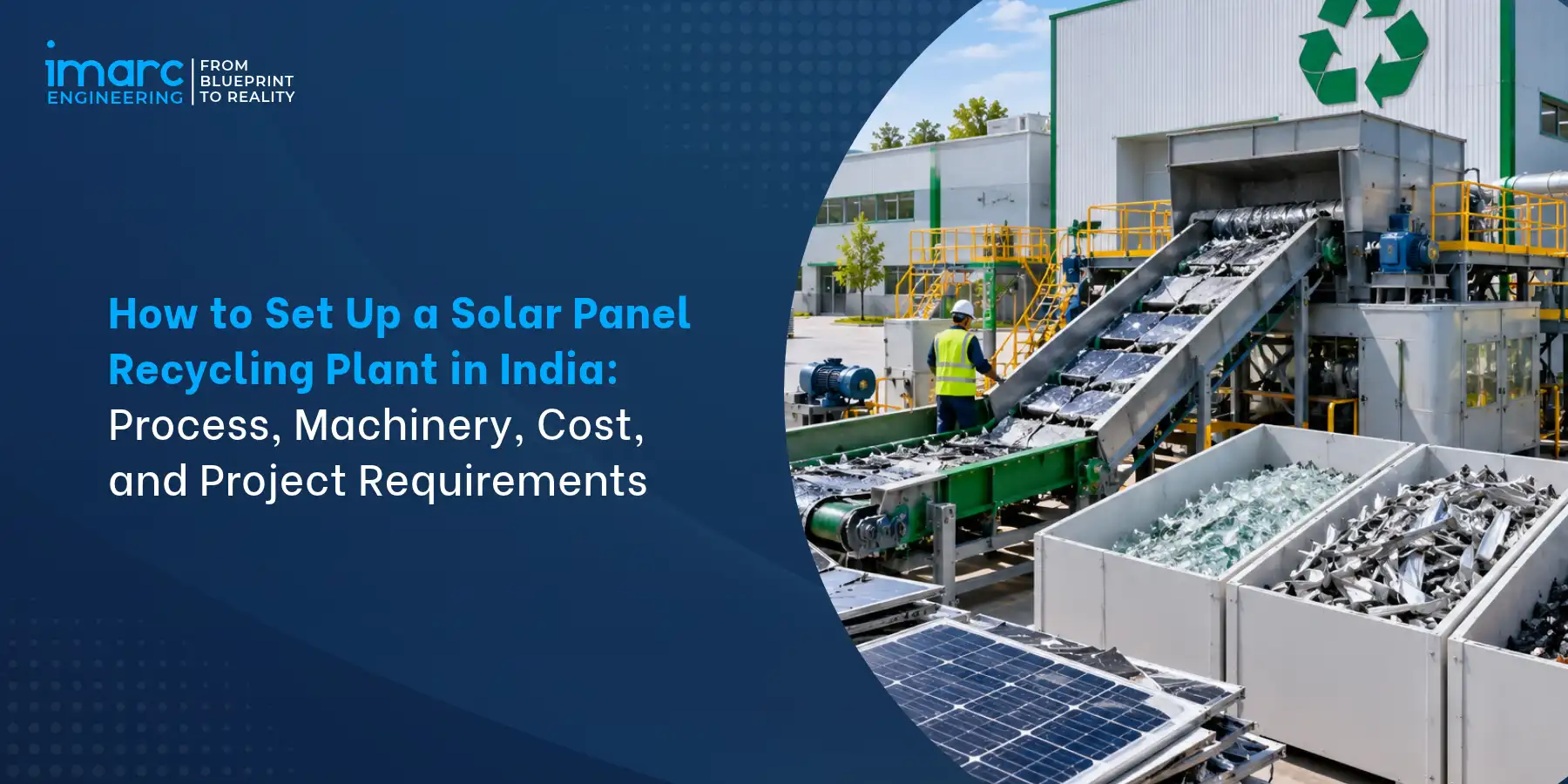
How to Set Up a Solar Panel Recycling Plant in India: Process, Machinery, Cost, and Project Requirements
Introduction
India's solar fleet has moved from pilot scale to one of the largest installations in the world, and the modules commissioned during the first utility-scale wave are now entering the replacement, repowering and failure-substitution window. In parallel, the E-Waste (Management) Rules, 2022 brought solar photovoltaic modules into the regulated e-waste stream, converting a fragmented informal scrap trade into a compliance-driven value chain with documented material flows and producer obligations.
For investors, project sponsors and manufacturers, a solar panel recycling plant setup in India is therefore no longer a speculative bet on future waste volumes. It is a feedstock-access, technology-selection and approval-sequencing problem that rewards disciplined engineering. The failure modes are well understood: over-built plants without contracted feedstock, mechanical lines that cannot liberate silver and silicon, thermal routes commissioned without adequate off-gas control, and consents obtained only after civil construction has begun.
This guide sets out the engineering and commercial architecture of a bankable facility process chemistry, machinery specification, capacity logic, utilities, effluent and emission control, licences, and CAPEX and OPEX composition so capital is committed against verified assumptions rather than generic templates.
Scope of this Guide
This guide answers one question: how can investors set up a commercially viable solar panel recycling plant in India, from feasibility assessment and technology selection to regulatory approvals and commissioning? It covers crystalline-silicon and thin-film photovoltaic module recycling only, and deliberately excludes module manufacturing and general e-waste processing. Technology comparisons, machinery specifications, utility loads, effluent limits, licence stacks and cost structures are presented as indicative planning ranges to be replaced by project-specific mass balances, vendor quotations and site data during the detailed project report stage.
Table of Contents
- Introduction
- Why Solar Panel Recycling Plant Setup in India Matters for Investors in 2026
- What a Solar Panel Recycling Plant Setup in India is and Why It Matters
- How to Set Up a Solar Panel Recycling Plant
- Solar Panel Recycling Plant Setup in India: Module Types, Technology and Capacity Planning
- Raw Materials, Feedstock and Chemicals in Solar Panel Recycling Plant Setup in India
- Core Process Steps in Solar Panel Recycling Plant Setup in India: Dismantling to Material Liberation
- Core Process Steps in Solar Panel Recycling Plant Setup in India: Refining, Testing and Quality Control
- Machinery, Cleanroom and Utilities in Solar Panel Recycling Plant Setup in India
- Effluent, Licences and Project Economics in Solar Panel Recycling Plant Setup in India
- Revenue and ROI Considerations
- Conclusion
1. Why Solar Panel Recycling Plant Setup in India Matters for Investors in 2026
Four structural drivers make a disciplined solar panel recycling plant setup in India commercially relevant in 2026, and each shapes the technical configuration an investor should fund.
1.1 Regulatory Pull from the E-Waste Rules and Producer EPR
Solar photovoltaic modules, panels, and cells are covered by the E-Waste (Management) Rules, 2022. Manufacturers and producers are required to register on the E-Waste EPR Portal and maintain the required inventory and records for solar PV waste. Under the current framework, solar PV waste is subject to a special regime, including storage provisions up to 2034-35, rather than the standard recycling-target mechanism applicable to other covered electrical and electronic equipment. Recyclers are also required to register on the CPCB E-Waste EPR Portal. Applicability should be checked against the latest CPCB requirements before underwriting any EPR-linked revenue.
1.2 The Repowering and Replacement Window
Feedstock does not appear the day a plant is commissioned. India's end-of-life flow is built from four streams: manufacturing scrap such as broken cells, rejected laminates and edge trim; transport and installation breakage; field failures from potential-induced degradation, hotspots and backsheet cracking; and repowering, where older, lower-wattage modules may be replaced by higher-wattage modules on existing sites. Manufacturing scrap is available today and should anchor the first plant; field returns scale later. Contract actual tonnage before sizing equipment.
1.3 Localization, Downstream Offtake and Cluster Logic
Recovered glass, aluminium and copper move into commodity channels; silicon-rich fines go to alloy and ferrosilicon makers; silver requires either in-house refining or a toll arrangement with a precious-metal refiner. The value of recovered silicon and silver depends on recovery purity, downstream processing capability and buyer specifications. Silver can be an important high-value recovery stream, but its contribution should be established through feedstock assays and project-specific recovery estimates. Siting near module manufacturing clusters and e-waste recycling hubs in Gujarat, Rajasthan, Maharashtra, Tamil Nadu, Karnataka and Delhi-NCR shortens freight on low-value, high-volume glass.
1.4 The Cost of Poor Planning
Three planning errors destroy returns. The first mistake is investing in a mechanical-only recycling line without assessing whether the resulting mixed material fractions can be sold commercially or require additional processing to recover valuable materials such as silver and silicon. Selecting thermal delamination without sizing the off-gas train for hydrogen fluoride released from PVF and PVDF backsheets, forcing a retrofit scrubber, is the second. Committing civil works before Consent to Establish, when the SPCB subsequently imposes stack height, buffer or zero-liquid-discharge conditions, is the third. Each is a capital problem created before commissioning, and each is avoidable at DPR stage.
2. What a Solar Panel Recycling Plant Setup in India is and Why It Matters
A solar panel recycling plant setup in India is defined by what it is licensed to do, what it can physically liberate, and where the material boundary of the facility ends.
2.1 Definition and Facility Boundary
A solar PV recycling facility receives end-of-life, damaged or rejected photovoltaic modules, dismantles them, separates glass, aluminium, copper, junction-box plastics, backsheet and encapsulant, and upgrades the cell fraction into saleable silicon, silver and metal concentrates. The boundary matters commercially: a dismantler that removes frames and sells whole laminates for crushing operates under a different licence category and a different margin structure from an integrated recycler running thermal and hydrometallurgical stages. Define the boundary before applying for consent.
2.2 Scale Determinants
Scale is set by four variables: contracted feedstock tonnage and its seasonality; module wattage and mass per unit, module mass varies by module technology, dimensions, glass configuration and manufacturer, so tonnes per MW should be established from the actual feedstock mix; the recovery route chosen, since thermal and chemical stages have minimum economic throughputs; and effluent and emission capacity.
Plant capacity and technology selection should be determined from contracted feedstock, module composition, recovery targets, technology economics, utility requirements and downstream offtake. Any capacity threshold should be established through project-specific feasibility analysis.
2.3 Plant Sections
| Section | Function | Key Equipment |
|---|---|---|
| Receiving and Weighbridge | Inbound verification, mass balance | 60 t weighbridge, radiation portal |
| Feedstock Store and Quarantine | Segregation, batch control | Racking, pallet trucks, labelling |
| Manual Dismantling Line | Frame, junction box, cable removal | Frame puller, cable stripper, benches |
| Delamination and Glass Liberation | EVA release, intact glass recovery | Hot-knife table, IR heater, hot wire |
| Comminution and Separation | Size reduction, material split | Two-shaft shredder, hammer mill, screens |
| Thermal Treatment | Backsheet and EVA removal, off-gas control | Rotary kiln, afterburner, quench, bag filter |
| Hydrometallurgical Refining | Silver, copper, silicon recovery | Leach reactors, filter press, electrowinning |
| Glass Washing and Grading | Cullet cleaning, sizing | Wash drum, attrition scrubber, dryer |
| Quality Control Laboratory | Assay, purity, moisture | XRF, ICP-OES, sieve shaker, balances |
| Effluent Treatment and Utilities | Water reuse, emissions, power | ETP with MEE, scrubber, DG, compressor |
3. How to Set Up a Solar Panel Recycling Plant
Setting up a solar panel recycling plant requires a staged approach covering feedstock, technology, site selection, engineering, approvals, equipment procurement and commissioning. A practical implementation sequence is:
3.1 Assess and Secure Feedstock
Identify available manufacturing scrap, damaged modules, installation waste and decommissioning volumes. Characterise the expected module mix, including technology, construction, glass type and material composition. Secure sufficient feedstock through supply agreements before finalising plant capacity.
3.2 Conduct a Feasibility Study
Evaluate the feedstock volume and composition, recovery route, expected material yields, downstream buyers, utilities, site requirements, regulatory obligations and project economics. Use the findings to establish the appropriate plant capacity and processing configuration.
3.3 Select the Recycling Technology
Compare mechanical, thermal, chemical and hydrometallurgical routes based on module composition, recovery objectives, product specifications, environmental requirements and operating costs. The selected process should be supported by feedstock testing and, where necessary, pilot trials.
3.4 Select the Site and Develop the Plant Layout
Assess candidate locations based on feedstock logistics, industrial zoning, power and water availability, effluent disposal, transport access, labour and proximity to downstream buyers. Develop the material flow, equipment arrangement, storage areas, utilities and environmental-control systems.
3.5 Complete Detailed Engineering and Equipment Selection
Prepare the process flow, material balance, utility balance and equipment specifications. Select dismantling, delamination, size-reduction, separation, refining, pollution-control and effluent-treatment equipment based on the project's actual throughput and feedstock characteristics.
3.6 Obtain Regulatory Approvals
Identify and secure the applicable CPCB registration, SPCB consents, hazardous-waste authorisation and other site-specific approvals before commissioning. Environmental Clearance and other permissions should be assessed based on the project's activities and applicable regulations.
3.7 Procure, Install and Integrate Equipment
Procure equipment against approved technical specifications and vendor guarantees. Complete civil works, utilities, pollution-control systems, material-handling systems and process integration before trial operation.
3.8 Commission and Validate the Plant
Begin with controlled trial runs and progressively increase throughput. Validate material recovery, product quality, emissions, effluent treatment, waste handling and equipment performance against the project design basis and applicable consent conditions.
3.9 Start Commercial Operations and Optimise Performance
Move to commercial production after successful commissioning. Track feedstock utilisation, recovery yields, product quality, energy and reagent consumption, waste generation and operating costs. Use these results to optimise throughput and profitability.
4. Solar Panel Recycling Plant Setup in India: Module Types, Technology and Capacity Planning
Technology and capacity decisions in a solar panel recycling plant setup in India must be taken together, because the module type fixes the chemistry and the chemistry fixes the machinery.
4.1 Module Types and Recycling Implications
Crystalline-silicon modules dominate Indian installations and come in glass-backsheet and glass-glass construction. Glass-backsheet modules with PVF/PET/PVF backsheets delaminate readily by heat or knife and release hydrogen fluoride when thermally treated. Glass-glass bifacial modules with dual 2.0-3.2 mm tempered glass separate poorly and require thermal or chemical delamination. Thin-film CdTe and CIGS modules, a small but non-zero share, carry cadmium and selenium and must run on dedicated lines under hazardous-waste controls. Mixed loads must be sorted at the gate, not inside the plant.
4.2 Technology Routes and Commercial Limits
Mechanical recycling uses frame removal, size reduction and physical separation to recover materials such as glass, aluminium and copper, but recovery of silver and silicon depends on the downstream separation route. Thermal delamination can remove encapsulant and backsheet materials and requires appropriately designed combustion and off-gas treatment systems.
Chemical and hydrometallurgical routes can improve recovery of selected high-value fractions but introduce reagent consumption, effluent treatment and additional process-safety requirements. Technology performance and economics should be established through feedstock testing, pilot work and vendor guarantees.
4.3 Capacity Planning and Throughput
Capacity should be stated as tonnes per annum of module input at a defined availability, never as a nameplate hourly rate. Required equipment capacity should be calculated from annual throughput, operating hours, availability, batch characteristics and the actual process bottleneck. Vendor sizing should be based on the complete material balance rather than nominal shredder capacity.
Equipment sizing should incorporate a project-specific design margin based on variations in module composition, operating availability and intermediate-material reprocessing. Feedstock storage requirements should be determined from contracted supply schedules, plant throughput, storage conditions, fire safety and applicable regulatory requirements.
4.4 Location, Cluster and Site Selection
Site selection weighs feedstock radius, industrial-zoning status, power reliability, water availability for washing and scrubbing, effluent disposal route, and proximity to glass and aluminium buyers. Land requirements depend on throughput, process configuration, storage requirements, utilities, effluent-treatment facilities, fire-access requirements and provision for future expansion. Site area should therefore be established through a project-specific layout. Buffer distance from habitation, fire access and truck turning radii are fixed constraints; retrofitting them onto a constrained plot is usually impossible (figures are indicative in nature, may vary).
5. Raw Materials, Feedstock and Chemicals in Solar Panel Recycling Plant Setup in India
Feedstock characterisation and consumable specification determine recovery yield far more than machinery brand does in any solar panel recycling plant setup in India.
5.1 Feedstock Characterisation and Acceptance
Every incoming batch should be sampled for module type, wattage, glass construction, backsheet chemistry, junction-box plastic and frame alloy, and screened for thin-film, cracked or fire-damaged units. A radiation portal and a visual protocol screen for orphan sources and non-conforming scrap. Assay each batch for silver and copper by XRF on cell samples, because silver loading varies by a factor of two to three between cell generations and directly drives revenue. Reject contaminated loads at the gate; contamination discovered inside the plant becomes a disposal cost.
5.2 Module Bill of Materials and Recoverable Chemistry
The composition of a crystalline-silicon module varies with module design, cell technology, glass configuration, frame construction and manufacturing generation. Glass and aluminium generally account for major portions of module mass, while the remaining fractions include encapsulants, silicon, backsheet materials, copper and smaller quantities of silver and other metals. Representative feedstock should be sampled and assayed before equipment sizing and revenue modelling. Silver content varies substantially with cell technology and metallisation design and should be established through representative feedstock assays rather than a universal per-module assumption.
5.3 Consumables, Specifications and Ranges
Consumables depend on the selected hydrometallurgical route, feedstock composition and target recovery fractions. Potential consumables may include acids, alkalis, precipitation agents, neutralising agents, filtration media and water-treatment chemicals. Reagent selection, concentration, consumption and recovery should be established through laboratory or pilot testing and incorporated into the project mass balance and operating-cost model.
5.4 Chemical Storage, Handling and Safety
Chemical storage and handling systems should be designed according to the properties, compatibility and inventory of the acids, alkalis and other reagents used in the selected recycling process. Suitable chemical-resistant tanks, secondary containment, bunded storage areas, ventilation and spill-control measures should be incorporated in accordance with applicable hazardous-chemical, fire-safety and environmental requirements.
Leaching and refining areas should include appropriate local exhaust ventilation, fume extraction and gas-treatment systems based on process-specific hazards. Where nitric acid leaching is used, nitrogen oxide emissions must be assessed and controlled. Thermal treatment operations should similarly evaluate potential carbon monoxide and acid-gas emissions, including hydrogen fluoride where fluorinated module materials are processed.
Personal protective equipment, emergency showers, eyewash stations, chemical spill-response arrangements and gas-detection systems should be specified through a process-specific risk assessment. Final safety measures should be validated during detailed engineering and commissioning.
6. Core Process Steps in Solar Panel Recycling Plant Setup in India: Dismantling to Material Liberation
The production flow in a solar panel recycling plant setup in India runs from inbound verification to material liberation through four controlled stages, each with defined parameters.
6.1 Receiving, Testing and Batch Dismantling
Modules arrive palletised from decommissioning sites or in bulk from manufacturers. Each consignment is weighed using an appropriately sized weighbridge or other suitable weighing system, photographed and logged into a batch register that supports material traceability throughout the recycling process. Where modules are being screened for potential reuse, electrical and visual testing should follow the applicable testing protocol and buyer or refurbishing requirements.
Modules destined directly for recycling can be classified according to the recycler's feedstock-acceptance procedure. Dismantling may be manual, semi-automated or automated depending on module condition, labour availability, reuse objectives and required throughput. Equipment and staffing should be sized through project-specific time-and-motion and capacity analysis.
6.2 Frame, Junction Box and Cable Removal
Frame and junction-box removal time depends on module construction, equipment configuration and operator intervention. Recovered aluminium and copper should be quantified through the project material balance and feedstock assay. Junction boxes are cut with an oscillating blade or hot knife, and cables stripped of copper. Lead-bearing solder and other potentially hazardous residues should be segregated and classified according to their composition and the applicable hazardous-waste requirements. Frames are baled for secondary aluminium smelters and copper ribbon graded as bright bare copper.
6.3 Delamination and Glass Separation
Three broad routes can be considered. Hot-knife or hot-wire systems use controlled heating to facilitate encapsulant separation and may support intact glass recovery. Thermal delamination uses controlled heating to remove encapsulant and backsheet materials and requires appropriately designed combustion and off-gas treatment. Chemical delamination uses solvents or chemical treatment to separate encapsulant and other bonded layers where the process objective justifies it. Operating temperatures, residence times, and off-gas treatment requirements should be established through feedstock testing, process design, and vendor data.
6.4 Comminution and Mechanical Separation
Delaminated material is size-reduced and separated through a combination of screening, magnetic separation, eddy-current separation, air classification, and other physical separation technologies as appropriate. Particle size and separator configuration should be selected according to feedstock characteristics, target product specifications, and downstream recovery requirements. Dust-control systems should be designed based on the materials handled and the applicable occupational and environmental requirements.
7. Core Process Steps in Solar Panel Recycling Plant Setup in India: Refining, Testing and Quality Control
Finishing, refining and verification turn recovered fractions into saleable, documented products that downstream buyers and EPR auditors will accept.
7.1 Hydrometallurgical Recovery of Silver, Copper and Silicon
Hydrometallurgical recovery conditions depend on the feedstock, target recovery fractions, reagent system and selected process route. Leaching, precipitation, electrowinning and residue-treatment parameters should be established through laboratory or pilot testing and detailed process design. Further processing of recovered cell fractions may produce silicon-rich material, depending on the selected technology and contamination levels.
Chemical purification routes require careful evaluation of reagent hazards, recovery efficiency, effluent treatment and final product specifications. The suitability of recovered silicon for metallurgical or other industrial applications must be verified through laboratory testing and downstream buyer acceptance.
7.2 Glass Cullet Washing and Grading
Recovered glass may contain encapsulant residues, metallisation and dust. Washing, scrubbing, rinsing, drying, screening and other cleaning processes may be required to meet downstream buyer specifications. The final processing route should be selected according to contamination levels, particle-size requirements and intended applications. Wash sludge and other process residues should be characterised and managed through appropriate treatment and disposal systems.
7.3 Testing, Inspection and Standards
Quality control covers cullet purity and moisture, metal assay by XRF and ICP-OES, silver by fire assay or ICP-OES, silicon purity by ICP-OES after digestion, sieve analysis using the applicable test method and buyer specification, loss on ignition, and effluent parameters per consent conditions. Buyers increasingly require ISO 9001, ISO 14001 and ISO 45001 certification, and downstream refiners ask for R2v3 or equivalent environmentally sound management evidence.
Batch traceability from receipt to dispatch supports regulatory reporting, material accounting and downstream buyer documentation. Any EPR-related documentation or revenue should be based on the applicable CPCB framework for solar PV waste and should not be assumed to follow the standard EPR certificate mechanism applicable to other e-waste streams.
7.4 Packaging, Traceability and Downstream ESM Compliance
Glass ships in bulk bags or tipper loads, aluminium and copper in bales, silver as bar or sponge under sealed weighment with an assay certificate, and silicon fines in 1-tonne FIBCs. Every outbound load carries a batch number, assay and destination record, forming the evidence base for CPCB returns and producer EPR audits. Downstream buyers must be able to demonstrate environmentally sound management; if they cannot, the recycler's own registration is exposed.
8. Machinery, Cleanroom and Utilities in Solar Panel Recycling Plant Setup in India
Machinery, controlled areas and utilities account for the majority of capital and almost all of the technical risk in a solar panel recycling plant setup in India.
8.1 Machinery Selection and Specification Drivers
Specify equipment against feedstock, not catalogue capacity. A module shredder needs low-speed, high-torque shafts with hardened cutters so tempered glass does not shatter the whole laminate into unusable fines, and screen sizes are set by the downstream separation cut. Thermal kilns are specified on residence time, indirect versus direct heating and off-gas loading rather than tonnage alone. Leach reactors are sized on full batch cycle time including fill, heat, leach, cool and discharge. Vendor guarantees should be tied to recovery percentage by fraction, not throughput.
8.2 Controlled Process Areas and Ventilation
Solar panel recycling facilities require appropriately designed ventilation, dust-control and containment systems based on the hazards associated with each processing stage. Leaching and refining areas should incorporate suitable local exhaust ventilation, chemical containment, negative-pressure arrangements where required, and scrubbed exhaust systems based on process chemistry and occupational exposure risks.
Laboratory environmental controls should be established according to the analytical equipment and testing methods used. Dismantling and shredding areas should have ventilation and local exhaust systems appropriate to the dust and material hazards, with dust collection designed around the process equipment and applicable occupational and environmental requirements.
8.3 Utilities: Power, Water, Gases and Thermal Energy
Utility requirements should be established from the selected process route, throughput, equipment configuration, operating schedule, water-reuse strategy and off-gas-treatment system. The DPR should include project-specific power, water, compressed-air and thermal-energy balances.
8.4 Plant Layout and Material Handling
Layout follows one-way material flow: weighbridge and inbound quarantine, feedstock store, dismantling, delamination, comminution, separation, refining, product stores and dispatch, with the effluent plant and utility block at the perimeter. Clean and dirty traffic never cross. Floor construction, drainage gradients, chemical-resistant finishes, lifting equipment and material-handling systems should be specified according to equipment loads, chemical exposure, drainage requirements and the project layout. Lifting and material-handling equipment should be selected based on equipment weights, lifting heights, maintenance requirements, material-flow patterns and the final plant layout.
8.5 Key Machinery
| Category | Equipment | Key Sizing Parameters |
|---|---|---|
| Dismantling | Frame puller, junction box cutter | Modules per shift, labour productivity, automation requirements |
| Size reduction | Two-shaft shredder, hammer mill | Input throughput, module dimensions, particle size |
| Separation | Eddy current, magnetic, electrostatic | Material flow, separation efficiency, recovery targets |
| Thermal treatment | Rotary kiln, afterburner, bag filter | Batch/continuous throughput, residence time, emissions |
| Hydrometallurgy | Leach reactors, filter press, electrowinning | Batch cycle, metal loading, reagent consumption |
| Glass processing | Wash drum, attrition scrubber, dryer | Glass throughput, contamination, product specification |
| Laboratory | XRF, ICP-OES, fire assay kit | Samples per day, analytical methods, turnaround time |
| Material handling | Weighbridge, forklift, baler | Daily receipts, storage inventory, lifting requirements |
9. Effluent, Licences and Project Economics in Solar Panel Recycling Plant Setup in India
Effluent, residues and approvals determine whether an otherwise sound solar panel recycling plant setup in India is ever allowed to operate at design capacity.
9.1 Effluent Treatment and Emission Control
Solar PV recycling operations may generate wastewater containing glass fines, suspended solids, dissolved metals, process chemicals and other contaminants, depending on the selected recycling route. Effluent treatment should be designed around wastewater characterisation, applicable discharge or reuse standards and SPCB consent conditions.
Treatment may include neutralisation, coagulation-flocculation, metal precipitation, filtration and, where required, membrane or evaporative systems for water recovery and zero-liquid-discharge operation. Thermal processing facilities should also incorporate suitable off-gas treatment and emission monitoring based on process chemistry and applicable regulatory requirements.
9.2 Hazardous Waste and Residue Management
Acid-leach sludge, spent electrolyte, spent solvent, bag-filter dust, kiln ash and contaminated process residues should be characterised and managed under the applicable hazardous-waste and e-waste requirements. Where classified as hazardous waste, they require the relevant authorisation, storage, manifesting and authorised disposal or recovery route. Thin-film CdTe and CIGS modules carry cadmium and selenium and should be segregated from crystalline-silicon feedstock and processed only through a route designed and authorised for the relevant hazardous constituents.
Lead-bearing solder and junction-box residue are segregated at source. Storage periods should comply with the applicable requirements for the relevant waste stream under the E-Waste (Management) Rules, 2022 and Hazardous and Other Wastes Rules, 2016, as applicable.
9.3 Licences, Registrations and Approvals
The core stack is CPCB registration as an e-waste recycler under the E-Waste (Management) Rules, 2022; SPCB Consent to Establish and Consent to Operate under the Water Act, 1974 and Air Act, 1981; hazardous-waste authorisation; and an approved environmentally sound management plan. Add factory licence and building plan approval under the Factories Act, 1948 and state rules, fire NOC, trade licence, weighbridge stamping, DG-set and air-conditioning consents, and CGWA or state groundwater clearance where abstraction exceeds local thresholds.
Environmental Clearance applicability should be checked against the EIA Notification, 2006 for any captive thermal or hazardous-waste storage component. Import of end-of-life modules is restricted and cannot serve as a feedstock strategy.
9.4 CAPEX, OPEX and Revenue Composition
CAPEX is driven by the recycling route, equipment configuration, civil works, utilities, pollution-control systems, effluent treatment, laboratory requirements, land and pre-operative costs. OPEX is influenced by feedstock acquisition and logistics, electricity and fuel, labour, reagents, maintenance, waste treatment and compliance. Project economics should be established through a project-specific financial model using vendor quotations, feedstock contracts, recovery assumptions and realised material prices.
9.5 Project Economics
| Configuration | Scale Assumption | Investment (INR) (Indicative, may vary) |
|---|---|---|
| Mechanical line, stand-alone | 1,000 TPA module input | INR 4-8 crore |
| Semi-automated with glass separation | 3,000 TPA module input | INR 12-18 crore |
| Thermal delamination, integrated | 5,000 TPA module input | INR 24-35 crore |
| Thermal plus hydrometallurgical refining | 10,000 TPA module input | INR 45-65 crore |
10. Revenue and ROI Considerations
The financial performance of a solar panel recycling plant depends on both recovered-material revenues and the cost of securing, processing and selling the feedstock. Revenue modelling should therefore be based on the actual module mix, recovery route, utilisation and downstream selling arrangements rather than generic industry payback assumptions.
10.1 Recovered Material Sales
Primary revenue can come from recovered glass, aluminium, copper, silicon-containing fractions and precious metal-bearing products. The realised value depends on recovery efficiency, material purity, contamination, product specifications, and prevailing market prices. Each recovered fraction should therefore have a defined quality specification and potential downstream buyer.
10.2 Processing and Service Fees
Depending on the commercial model, recyclers may also receive processing or treatment fees for accepting end-of-life or damaged modules. The availability and level of such fees depend on feedstock contracts, producer arrangements, and the applicable regulatory framework. They should be included in the financial model only where supported by actual commercial agreements or verifiable market evidence.
10.3 Plant Utilisation
Utilisation has a direct impact on unit processing costs. A plant with secured feedstock but low utilisation may carry high fixed costs per tonne, while excessive capacity relative to available feedstock can reduce returns on invested capital. The financial model should therefore test realistic utilisation levels rather than assuming continuous operation at nameplate capacity.
10.4 Operating Contribution
Operating contribution should be calculated from realised revenue per tonne less variable processing costs such as electricity, fuel, reagents, consumables, waste treatment, packaging and logistics. Fixed costs, maintenance, labour and administrative expenses should then be incorporated to determine operating profitability.
10.5 Working Capital and Cash Flow
Working-capital requirements can arise from feedstock purchases, inventory held during processing, customer credit periods, reagent purchases and payment timing for recovered materials. The project model should therefore include inventory days, receivable days, payable days, and the resulting cash-conversion cycle.
10.6 Sensitivity Analysis
Because solar-panel recycling economics can change significantly with feedstock cost, material recovery, utilisation and commodity prices, the financial model should test multiple scenarios. Key variables should include feedstock availability and price, silver and other material recovery, recovered-material selling prices, energy and reagent costs, plant utilisation, waste-treatment costs, and financing assumptions.
10.7 ROI Assessment
Return on investment should be calculated from the project's actual CAPEX, operating cash flows, working-capital requirements, and financing structure. Rather than applying a generic payback period, investors should assess project-specific measures such as operating margin, cash flow, payback period, IRR, and NPV under base-case, downside and upside scenarios.
Conclusion
A bankable solar panel recycling plant in India is built backwards from three fixed points: verified feedstock, a recovery route that can actually sell what it liberates, and an approval pathway that has been sequenced before the first concrete pour. Feedstock defines capacity; capacity defines whether mechanical separation alone is adequate or whether thermal delamination and hydrometallurgical refining are justified; the chosen route defines utilities, effluent treatment, controlled areas and the licence stack. Investors who treat these as one integrated design problem get a plant that can flex between glass-backsheet and glass-glass modules and between manufacturing scrap and field returns as the waste stream matures.
The three priorities are unambiguous. First, contract feedstock and assay it for silver and copper before ordering machinery, because silver paste loading determines whether the plant earns a commodity margin or a refining margin. Second, design the off-gas and effluent trains to the strictest plausible consent condition from day one, since retrofit scrubbers, quench systems and evaporators cost more after commissioning than before. Third, secure CPCB registration, SPCB consents and hazardous-waste authorisation as critical-path activities in parallel with engineering, not after it. Everything else equipment brands, automation levels, building aesthetics is negotiable.
PURSUING A SOLAR PANEL RECYCLING PLANT IN INDIA?
IMARC Engineering supports investors, project sponsors and manufacturers with capacity and feasibility planning, site selection, plant layout, equipment selection, utilities planning, effluent treatment design, CPCB and SPCB regulatory compliance support, solar PV waste management advisory and capital investment planning. The advisory covers crystalline-silicon and thin-film module recycling formats, including dismantling, delamination, mechanical separation, thermal treatment and hydrometallurgical refining, with project-specific infrastructure and commissioning planning.
→ Schedule a solar panel recycling scoping consultation with an IMARC specialist
Frequently Asked Questions
Start with feedstock: contract manufacturing scrap and decommissioning tonnage, assay it for silver and copper, then size capacity. Prepare a DPR covering mass balance, technology route and layout, apply for CPCB recycler registration and SPCB. Consent to Establish, secure hazardous-waste authorization and fire NOC, then build. Commission in phased trials before commercial operation.
A typical line runs a 60-tonne weighbridge, hydraulic frame puller, junction box cutter and cable stripper, hot-knife or hot-wire delamination table, two-shaft shredder, hammer mill, trommel or vibrating screens, overband and rare-earth magnets, eddy-current and corona-electrostatic separators, air classifier, bag-filter dust collection, and for integrated plants a rotary kiln with afterburner, quench and caustic scrubber, leach reactors, filter press and electrowinning cell.
The cost of a solar-panel recycling plant varies substantially with processing route, capacity, automation, site development, utilities, pollution-control systems, effluent treatment, laboratory facilities and material-recovery scope. A mechanical recycling facility will generally have a different investment profile from an integrated thermal and hydrometallurgical facility. A reliable project cost should be developed from vendor quotations, site data and detailed engineering rather than a universal cost benchmark.
A crystalline-silicon module can yield glass, aluminium, silicon-containing fractions, copper, polymers and smaller quantities of silver and other materials. The exact composition varies with module design, cell technology and manufacturing generation. Recovery yields and material quality also depend on the recycling route. Silver content should be established through representative feedstock assays rather than a fixed grams-per-module assumption.
Mechanical recycling uses dismantling, size reduction and physical separation to recover materials such as glass, aluminium and copper. Thermal delamination can remove encapsulant and backsheet materials but requires appropriate off-gas treatment. Chemical and hydrometallurgical routes can be used to recover selected high-value fractions, with process chemistry and recovery conditions determined by feedstock characteristics and target product specifications.
A solar-panel recycling facility generally needs CPCB registration as an e-waste recycler, applicable SPCB Consent to Establish and Consent to Operate, and hazardous-waste authorisation where applicable to its waste streams. Other approvals may include fire-safety approval, factory-related approvals under applicable state and occupational-safety requirements, and groundwater permissions where groundwater abstraction is proposed. Environmental Clearance should be assessed against the EIA Notification, 2006 based on the project's specific activities and scheduled categories. The final approval list should be confirmed for the selected state, site, and recycling process.
There is no universal minimum tonnage for a viable solar-panel recycling facility. Required feedstock depends on the technology route, plant capacity, recovery targets, operating costs, feedstock price and downstream material revenues. Capacity should be established through project-specific feasibility analysis and secured feedstock contracts.
Solar-panel recycling profitability depends on feedstock cost and availability, module composition, recovery efficiency, silver and other material recovery, energy and reagent consumption, waste-treatment costs, downstream selling prices, EPR-related revenues where applicable, financing and plant utilisation. Profitability should be established through a project-specific financial model rather than a universal payback period.
Key challenges include securing consistent feedstock, processing mixed module designs, recovering high-value materials economically, controlling dust and process emissions, managing hazardous residues, meeting site-specific water and effluent requirements, and developing reliable downstream markets for recovered materials.
They build the mass and energy balance, select between mechanical, thermal and hydrometallurgical routes, specify machinery with recovery guarantees, design layout, utilities, effluent and off-gas trains, sequence CPCB and SPCB approvals, structure CAPEX and OPEX, and manage procurement, construction, installation and commissioning through EPCM delivery so that performance is verified against contracted recovery rates.
Recent Post
Trusted by Industry Leaders
We partner with global enterprises and ambitious businesses across sectors to deliver operational excellence, strategic insights, and sustainable growth through integrated solutions.











Success in Their Words
Real feedback from clients across industries. Discover how our solutions delivered measurable impact and operational excellence.

I wanted to express my sincere appreciation for your efforts in handling this matter. Your dedication and commitment have been truly commendable, and it is evident that you have put in tremendous hard work and expertise into resolving the issues at hand. We are greatly interested in continuing our collaboration with you in the future, as your professionalism and reliability have made you a trusted partner. Thank you once again for your invaluable contribution. We look forward to strengthening our partnership ahead.

It has been a pleasure working with the IMARC team. The insights provided were structured, clear, and highly valuable, helping us strengthen both our technical and financial planning with confidence. We deeply appreciate the team’s professionalism, responsiveness, and attention to detail throughout the engagement. Every requirement was well understood and effectively incorporated, resulting in a comprehensive and actionable output. Overall, our experience has been excellent, and I would gladly recommend IMARC to organizations seeking a reliable research partner.

Your service is truly exceptional. Working with the IMARC team has been a seamless and professional experience. The clarity of communication, responsiveness to queries, and consistent support at every stage made the entire engagement highly efficient. The insights shared were well-structured, practical, and perfectly aligned with our requirements, helping us make informed decisions with confidence. Overall, the dedication and professionalism demonstrated by your team stand out, and I would be glad to recommend IMARC as a reliable and trustworthy research partner.

IMARC did an outstanding job in preparing our study. They were punctual, precise, and consistently responsive throughout the entire process. The team delivered all the data we required in a clear, well-organized, and highly professional format. Their strong attention to detail, combined with their ability to meet every deadline without compromising quality, truly set them apart. Overall, their reliability and commitment made them an exceptional partner for our project, and we would gladly work with them again in the future.

IMARC made the whole process incredibly easy from start to finish. Everyone I interacted with via email was polite, professional, and straightforward to deal with, always keeping their promises regarding delivery timelines and remaining consistently solutions-focused. From my very first contact, I appreciated the professionalism and support shown by the entire IMARC team. I highly recommend IMARC to anyone seeking timely, affordable, and reliable information or advice. My experience with IMARC was excellent, and I truly cannot fault any aspect of it.

I’d like to express my sincere gratitude for the excellent work you accomplished with the study. Your ability to quickly understand our requirements and deliver high-quality results under tight timelines truly reflects your expertise, exceptional work ethic, and unwavering commitment to your customer’s success. The professionalism and responsiveness you demonstrated throughout the process made a significant difference. Our entire team and company are incredibly thankful for your dedication, reliability, and support. Once again, thank you for your outstanding contribution.