Manufacturing
August 26 2026
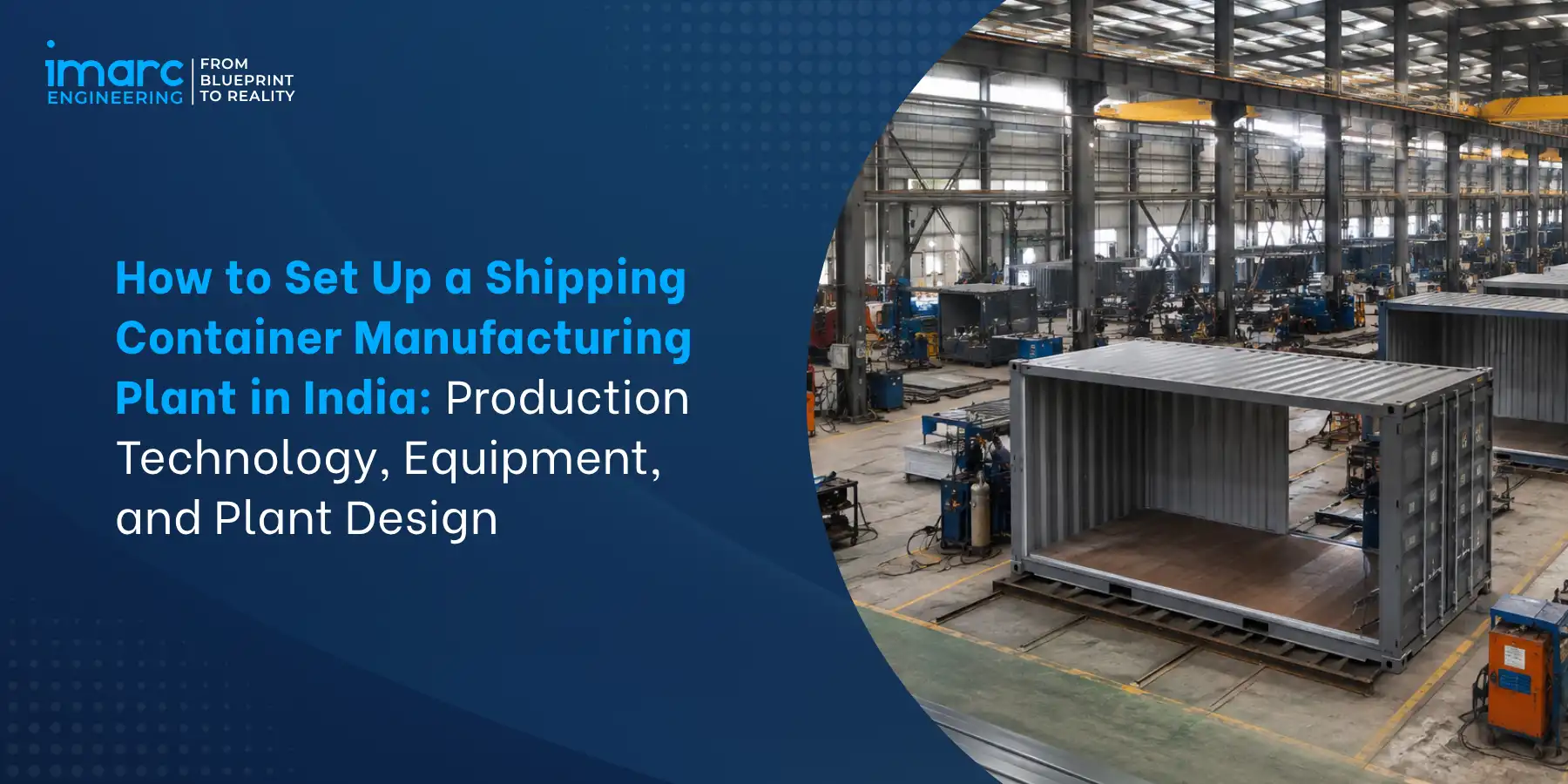
How to Set Up a Shipping Container Manufacturing Plant in India: Production Technology, Equipment, and Plant Design
Introduction
For investors, industrial groups, and logistics sector sponsors evaluating India's emerging shipping container manufacturing opportunity in 2026, establishing a shipping container manufacturing plant in India requires disciplined evaluation across container specifications, steel supply chain, fabrication technology, welding processes, coating systems, plant layout, quality testing against applicable ISO standards and safety approval under the International Convention for Safe Containers (CSC).
This guide focuses specifically on ISO intermodal freight containers used in international maritime and inland transport rather than portable cabins, modular buildings, packaging containers, or generic storage containers.
Scope of this Guide
This guide answers the sponsor's project question directly. How can manufacturers establish a facility by selecting the right production technology and equipment, designing an efficient facility, and meeting quality and testing requirements for intermodal freight containers? It walks through the market opportunity, setup roadmap, product strategy, raw materials, equipment, quality standards under ISO 668, ISO 1161, ISO 1496-1, and ISO 6346 alongside CSC certification, regulatory approvals, and the practices distinguishing well-planned ISO container manufacturing in India from opportunistic entry.
Table of Contents
- Introduction
- Why Shipping Container Manufacturing Matters in India
- How to Set Up a Shipping Container Manufacturing Plant in India
- Shipping Container Types Specifications and Product Strategy in India
- Shipping Container Raw Materials and Fabrication Technology in India
- Shipping Container Manufacturing Equipment and Production Line Design in India
- Shipping Container Quality Standards Testing and Certification in India
- Regulatory Approvals and Compliance for Shipping Container Manufacturing in India
- Capex, Opex, and Feasibility for Shipping Container Projects in India
- Conclusion
1. Why Shipping Container Manufacturing Matters in India
Four drivers make shipping container manufacturing a strategic opportunity for Indian investors and industrial sponsors in 2026.
1.1 Historic Import Dependence and Domestic Substitution
India has historically been a substantial container consumer with limited domestic manufacturing capacity, importing the majority of intermodal freight containers used across its ports, railways, and logistics infrastructure. India's container throughput across major ports supports substantial replacement demand alongside net additions.
Domestic substitution opportunity is genuine given trade volumes, container fleet age profiles, and the strategic case for reducing import dependence on a critical logistics asset that dominant global manufacturers historically supplied.
1.2 First Indigenous Container and Government Support
India's first indigenously manufactured ISO shipping container was unveiled in July 2026 by the Union Minister of Ports, Shipping and Waterways, produced by DCM Shriram Group at its Dadri plant as part of an initial order of 1,000 units for Maersk. The container successfully passed ISO 1496 prototype testing and received full CSC safety approval.
The Union Budget 2026 proposed a INR 10,000 crore for indigenous shipping container manufacturing developed in consultation with Government, manufacturers, and shipping lines, substantially improving shipping container manufacturing investment economics for approved domestic projects.
1.3 Logistics Infrastructure Expansion
Container demand grows with expanding port infrastructure at Jawaharlal Nehru Port (JNPT), Mundra, Kandla, Chennai, Visakhapatnam, and Kolkata plus Sagarmala Programme initiatives. Container Corporation of India (CONCOR) and private inland container depots (ICDs) expand rail-based container transport.
Dedicated Freight Corridors reducing rail freight cost supporting containerised movement. Multi-modal Logistics Parks (MMLPs) supporting integrated logistics infrastructure. Growing containerised trade across manufacturing sectors including automotive, pharmaceuticals, textiles, and engineering supports sustained fleet growth.
1.4 Strategic Autonomy and Global Supply Chain Positioning
Global container supply concentration in a small number of manufacturers creates strategic vulnerability that domestic manufacturing addresses. Container shortage cycles during 2020-2022 disrupted Indian exporters significantly. Strategic autonomy in intermodal container supply supports both commercial and national logistics security considerations.
India's positioning as trusted manufacturing base supports export potential to global shipping lines seeking supplier diversification. Domestic manufacturing supports Indian shipping line and container leasing company procurement strategies while enabling export-oriented projects.
2. How to Set Up a Shipping Container Manufacturing Plant in India
Understanding how to set up a shipping container manufacturing plant in India helps sponsors sequence project decisions correctly. Setup integrates product strategy, feasibility, technology and equipment selection, plant engineering, construction, commissioning, and CSC certification into coherent multi-year execution.
2.1 The Setup Roadmap
| Stage | Activities | Typical Duration |
|---|---|---|
| Product and Customer Assessment | Container type mix, offtake engagement | 3-6 months |
| Feasibility and DPR | Techno-commercial evaluation, financial modelling | 2-4 months |
| Technology and Partner Selection | Design licensor, equipment vendors, classification society | 3-6 months (parallel) |
| Site Selection and Approvals | Port/logistics hub proximity, environmental clearance | 4-9 months |
| Detailed Engineering | Process design, plant layout, equipment specifications | 3-6 months |
| Procurement and Construction | Equipment sourcing, civil works, installation | 12-18 months |
| Commissioning and CSC Certification | Prototype testing per ISO 1496, factory approval, commercial ramp | 6-12 months |
2.2 Capacity Planning and Site Selection
Capacity planning and site selection for shipping container plants in India matters significantly given the logistics-intensive nature of finished goods. Sites should be reasonably proximate to major ports (JNPT, Mundra, Kandla, Chennai) or inland container depots reducing outbound logistics cost.
Steel supply chain proximity supports raw material inbound economics. Land parcel typically 40-100 acres supporting the facility, container storage yard, and expansion. Rail siding access preferred for finished goods dispatch. State-level industrial policy alignment supporting incentives beyond Central schemes.
2.3 Manufacturing Model Selection
Manufacturing model selection during shipping container plant setup affects both capital intensity and market positioning. Focused dry freight container production supports the highest-volume standard segment with mature equipment and predictable economics. Multi-product facilities covering dry freight, reefer (refrigerated), open top, and specialty containers require additional flexibility but access broader market.
Joint venture with established international container manufacturer supports technology transfer and market access. Standalone Indian manufacturer positioning supports strategic autonomy but requires longer capability development. Model selection matched to promoter capability and market strategy supports commercial viability.
3. Shipping Container Types Specifications and Product Strategy in India
Shipping container types of specifications and product strategy in India establishes the foundation on which all subsequent engineering decisions rest. Container type mix affects capital, equipment, workforce, and market positioning.
3.1 Standard Container Types Under ISO 668
| Container Type | Dimensions (L x W x H) | Application |
|---|---|---|
| 20ft standard (1CC) | 6.058 x 2.438 x 2.591 m | General cargo, high-density loads |
| 40ft standard (1AA) | 12.192 x 2.438 x 2.591 m | General cargo, larger volumes |
| 40ft high cube (1AAA) | 12.192 x 2.438 x 2.896 m | Volumetric cargo, low-density goods |
| 45ft high cube (1EEE) | 13.716 x 2.438 x 2.896 m | Regional trade routes, larger volumes |
3.2 Specialised Container Categories
- Dry freight containers (dry vans): the most common category accounting for the majority of global fleet supporting dry freight container manufacturing as typical facility starting point
- Reefer (refrigerated) containers: temperature-controlled cargo with integrated refrigeration units and insulation
- Open top containers: cargo loading from above using cranes, tarpaulin cover
- Flat rack containers: heavy or oversized cargo without side walls
- Tank containers: bulk liquids, chemicals, and food-grade liquids (specialised manufacturing)
- Ventilated containers: cargo requiring air circulation
- Half height containers: heavy dense cargo like machinery, minerals
3.3 Product Strategy Decisions
Product strategy decisions affect capital, complexity, and market positioning. Focused strategy on 20ft and 40ft dry freight containers supports the highest-volume standard segment with mature equipment ecosystem. Multi-format strategy adding high cube and 45ft variants captures broader market at moderate additional complexity.
Specialty product addition including reefers, open tops, or flat racks requires substantially different manufacturing capability and typically follows successful dry freight production establishment. Product strategy should reflect target container production capacity matched to committed customer demand rather than speculative build-out.
3.4 Customer and Offtake Considerations
Container offtake typically covers global shipping lines (Maersk, MSC, CMA CGM, Hapag-Lloyd, ONE, Evergreen), container leasing companies (Beacon Intermodal, SeaCastle, Triton International, Textainer, Florens), Indian shipping operators, and CONCOR for domestic containerised transport.
Direct engagement with prospective customers during feasibility supports commercial viability that speculative production cannot achieve. CSC certification, ISO test compliance, and customer-specific quality requirements typically drive supplier qualification cycles lasting 6-18 months per customer (indicative in nature, may vary).
4. Shipping Container Raw Materials and Fabrication Technology in India
Shipping container raw materials and fabrication technology in India determine the technical foundation of finished product quality and cost economics. Material selection and fabrication process choices directly affect certification, durability, and unit economics.
4.1 Steel Raw Materials
Weathering steel for shipping containers (Corten grade or equivalent) is the primary raw material accounting for approximately 70-80 percent of container weight. Weathering steel provides atmospheric corrosion resistance through a protective patina layer supporting extended service life in marine environments. Typical grades include ASTM A588, ASTM A606, or equivalent JIS G3125 SPA-H specifications.
Steel supplied as hot-rolled sheet or coil in standard thicknesses (1.6-4.5 mm depending on component). Domestic steel supply from major Indian producers including SAIL, Tata Steel, JSW Steel, and JSPL supports substantial localisation potential though specific weathering grades may require initial imports.
4.2 Non-Steel Materials
- Marine plywood flooring: typically Apitong hardwood or bamboo composite, 27-28 mm thickness
- Corner castings: 8 per container, ISO 1161 compliant steel castings
- Door hardware: hinges, locking rods, cam handles
- Rubber gaskets: door seals for weathertightness
- Paint systems: primer (zinc-rich) plus top coat (polyurethane or alkyd)
- Container decals and markings
- Ancillary consumables: welding wire, fasteners, sealants
4.3 Fabrication Technology
Container steel fabrication combines panel forming, welding, surface preparation, painting, and assembly technologies. Container panel forming through roll forming machines produces the characteristic corrugated side, roof, and end walls providing structural stiffness.
Container welding process typically uses MIG/MAG (Metal Inert Gas / Metal Active Gas) welding with automation and robotics for critical joints. Sub-assembly welding produces side walls, front wall, roof, floor frame, and doors separately. Main assembly (marrying) joins sub-assemblies into complete container.
4.4 Surface Preparation and Coating
Container surface preparation uses shot blasting to Sa 2.5 standard (near-white metal) removing mill scale, rust, and contamination supporting coating adhesion. Container painting and coating typically applies electrostatic spray application of zinc-rich primer followed by polyurethane or alkyd top coat with total dry film thickness typically 200-320 microns depending on customer specification.
Curing in ovens at controlled temperature ensures coating cure. Coating system quality directly affects container service life in aggressive marine environments.
5. Shipping Container Manufacturing Equipment and Production Line Design in India
Shipping container manufacturing equipment and production line design in India translate process design into operational infrastructure. Equipment selection and line layout together determine achievable throughput, quality consistency, and unit cost.
5.1 Steel Processing and Panel Forming Equipment
- Uncoiling lines with straightening for steel coil processing
- CNC cutting and slitting lines for panel blank preparation
- Roll forming machines for corrugated side, roof, and end panels
- Press brakes for door frames, cross members, and structural elements
- Corner post forming equipment
- Shear and punch systems for detail work
5.2 Welding and Sub-Assembly Equipment
- Robotic MIG/MAG welding stations for side wall, roof, and front wall assembly
- Sub-assembly welding fixtures with precise dimensional control
- Floor frame welding fixtures with cross members and forklift pockets
- Door frame welding fixtures with hardware provisions
- Container floor assembly stations for marine plywood installation on floor frame with mechanical fastening
- Container door assembly stations for door leaf, hardware, gaskets, and locking gear integration
- Main assembly (marrying) stations combining sub-assemblies into complete container
5.3 Surface Treatment and Painting Equipment
- Shot blasting chambers with automated container handling to Sa 2.5 standard
- Electrostatic spray paint booths with primer and top coat stations
- Paint curing ovens with controlled temperature profiles
- Coating thickness monitoring systems
- Decal application and marking stations per ISO 6346 (BIC code)
- Paint waste management including solvent recovery and effluent treatment
5.4 Production Line Design and Material Flow
Shipping container plant design sequences the shipping container production line supporting material flow from steel receipt through panel forming, sub-assembly, main assembly, surface treatment, painting, and testing to finished goods dispatch. Cellular manufacturing for related sub-assemblies (side walls, front wall, floor frame, doors) supports parallel throughput.
Overhead crane infrastructure supporting panel and sub-assembly movement. Automated Guided Vehicles (AGVs) or conveyor systems where volume justifies investment. Storage yards for finished containers awaiting dispatch requiring substantial acreage. Plant layout directly affects unit cost that inefficient handling routinely increases.
6. Shipping Container Quality Standards Testing and Certification in India
Shipping container quality standards testing and certification in India represent the compliance framework distinguishing internationally acceptable containers from those unable to enter global supply chains. Quality and certification capability is prerequisite for commercial viability rather than optional differentiator.
6.1 ISO Standards Framework
| Standard | Scope |
|---|---|
| ISO 668 | Classification, external dimensions, and ratings for Series 1 freight containers |
| ISO 1161 | Corner and intermediate fittings for Series 1 freight containers |
| ISO 1496-1 | Specification and testing for general cargo containers |
| ISO 1496-2 | Thermal containers (reefer specification) |
| ISO 1496-3 | Tank containers |
| ISO 6346:2022 | Coding, identification, and marking including BIC code |
| ISO 3874 | Handling and securing |
6.2 CSC Convention Certification
Convention for Safe Containers (CSC) established by International Maritime Organization (IMO) in 1972 governs mandatory safety approval for containers used in international transport. Freight containers within the scope of the CSC and used in applicable international transport require valid safety approval and the prescribed Safety Approval Plate.
The CSC Safety Approval Plate contains prescribed safety-approval information, including the country of approval and approval reference, date of manufacture, maximum operating gross mass, allowable stacking load and transverse racking test load. Examination information is managed according to the applicable periodic examination or approved continuous examination programme.
6.3 Prototype Testing and Certification Process
Container structural testing and prototype certification precedes commercial production. Design assessment reviewed by classification society (Indian Register of Shipping (IRClass)) authorised by Directorate General of Shipping for CSC certification in India, alongside international societies Lloyd's Register, Bureau Veritas, DNV, and American Bureau of Shipping). Prototype construction under classification society oversight.
Prototype testing per ISO 1496-1 including stacking test, racking test (transverse and longitudinal), floor strength test, end wall strength, side wall strength, roof strength, forklift pocket test, grappler arm test, and weathertightness test. Factory approval covering production capability, quality systems, and inspection procedures. Ongoing production inspection typically at defined intervals.
6.4 Production Quality Testing
- Container dimensional inspection verifying external dimensions per ISO 668 tolerances
- Corner fitting dimensional inspection per ISO 1161
- Water tightness test (weathertightness) per ISO 1496-1 typically using spray test
- Weld inspection through visual, dimensional, and non-destructive testing (NDT)
- Paint coating thickness measurement across production units
- Interior height, door opening, and internal clear dimensions verification
- Marking and BIC code verification per ISO 6346
- Sample structural tests on production units per acceptance sampling plan
- Ongoing IICL inspection standards compliance
7. Regulatory Approvals and Compliance for Shipping Container Manufacturing in India
Regulatory approvals and compliance for shipping container manufacturing in India span environmental clearances, factory establishment, safety compliance, and container-specific certifications. Compliance planning during feasibility prevents project delays.
7.1 Central and State Manufacturing Approvals
| Approval | Authority | Trigger |
|---|---|---|
| Environmental Clearance | MoEFCC or SEIAA per EIA 2006 | Category A or B project scale |
| Consent to Establish | State Pollution Control Board | Pre-construction |
| Consent to Operate | State Pollution Control Board | Pre-commissioning |
| Factory Licence | State Directorate of Factories | Under OSH Code 2020 |
| Fire NOC | State Fire Services | Per NBC 2016 Part 4 |
| Hazardous Waste Authorisation | SPCB under HOWM Rules 2016 | Paint sludge, solvent waste |
| PESO Licence | PESO under Explosives Act 1884 | Paint, solvent, LPG storage |
7.2 Container Certification Framework
Container certification operates under International Convention for Safe Containers 1972 (IMO), implemented in India through the Directorate General of Shipping under Ministry of Ports, Shipping and Waterways. Indian Register of Shipping (IRClass) authorised by DG Shipping for CSC certification alongside international classification societies.
Certification process includes design assessment, factory approval, prototype testing per ISO 1496 series, and ongoing production surveillance. Certification maintenance through Approved Continuous Examination Programme (ACEP) or Periodic Examination Scheme with re-examination typically at 30-month intervals following initial 5-year certification period.
7.3 Government Scheme and Central Support
The Government proposed INR 10,000 crore outlay for shipping container manufacturing in the Union Budget 2026 which aims to support domestic manufacturing establishment. This framework developed through consultation between Ministry of Ports, Shipping and Waterways, manufacturers, and shipping lines targeting commercial viability of Indian container production.
Specific scheme guidelines, eligibility criteria, and disbursement conditions to be verified with current Ministry notifications. Additional State-level industrial policy incentives supplement Central support in various states.
7.4 Environmental and Export Compliance
Environmental compliance covers paint booth emissions, solvent handling, wastewater treatment from surface preparation and painting, hazardous waste management under Hazardous and Other Wastes (Management and Transboundary Movement) Rules 2016 as amended, and Volatile Organic Compound (VOC) emission control.
Directorate General of Foreign Trade (DGFT) Foreign Trade Policy 2023 covers container export operations. Bureau of Indian Standards (BIS) certification for steel materials where applicable. Occupational Safety Health and Working Conditions Code 2020 in force from 21 November 2025 governing workforce safety in fabrication and painting operations.
8. Capex, Opex, and Feasibility for Shipping Container Projects in India
Capex, opex, and feasibility for shipping container projects in India scale with production capacity, container type mix, and vertical integration scope. Financial framework aligned with realistic capacity ramp-up supports credible investment planning.
8.1 Capex Ranges by Scale
- Small facility (2,000-5,000 TEUs per year): typically, INR 100-300 crore capex
- Medium facility (5,000-20,000 TEUs per year): typically, INR 300-800 crore
- Large facility (20,000-50,000 TEUs per year): typically, INR 800-2,000 crore
- Giga-scale facility (above 50,000 TEUs per year): typically, INR 2,000-5,000 crore
- Ranges exclude land, working capital, and pre-operative expenses
- Vertical integration including steel processing adds substantially to capex
8.2 Opex Structure and Container Economics
Container manufacturing opex is dominated by steel raw material typically representing 55-70 percent of unit cost. Marine plywood flooring, hardware, and coating systems together typically 10-15 percent. Direct labour, utilities, and consumables typically 10-15 percent. Depreciation and overheads across the capital base.
Container unit cost trajectory depends on scale-driven volume purchasing, yield improvement, and material supply chain maturation. Global reference pricing for standard 20ft and 40ft dry containers provides benchmark though domestic pricing reflects government support, logistics economics, and customer relationships.
8.3 Feasibility Determinants
- Committed customer demand from shipping lines, leasing companies, or CONCOR
- Steel supply chain reliability with weathering grade availability
- Site proximity to major ports supporting outbound logistics
- Government Scheme eligibility and alignment
- Plant infrastructure supporting target production capacity
- Classification society partnership for CSC certification pathway
- Workforce capability across fabrication, welding, painting, and quality
- Capital availability across capex and working capital cycles
Note: Data ranges are indicative in nature, may vary as per project
Conclusion
Establishing a shipping container manufacturing plant in India requires validated product strategy, reliable steel and flooring supply chains, suitable fabrication technology, equipment selection, plant design, quality compliance, and CSC certification. Emerging domestic production and policy support strengthen the opportunity.
Sponsors should validate product focus before committing capital. Classification society engagement should begin during feasibility, covering design review, testing, certification, and surveillance requirements. Customer qualification with shipping lines and leasing companies can take several months, making working-capital planning essential. A disciplined approach to quality, certification, capacity ramp-up, and customer development will help manufacturers build sustainable operations and compete effectively in India’s growing container manufacturing market.
PLANNING YOUR SHIPPING CONTAINER MANUFACTURING PLANT?
IMARC Engineering supports shipping-container manufacturing projects across feasibility and DPR preparation, product and capacity planning, site selection, plant layout and process engineering, equipment specification, utility planning, CAPEX/OPEX assessment, regulatory planning, certification-pathway coordination, procurement, installation, and commissioning support.
→ Schedule a free shipping container manufacturing scoping consultation with an IMARC specialist
Frequently Asked Questions
Setting up a shipping container plant involves product strategy and capacity planning, feasibility and DPR preparation, site selection near ports or logistics hubs, detailed engineering, equipment procurement including panel forming and welding systems, construction, commissioning, and CSC certification. Total programme typically extends 24-42 months.
Shipping container manufacturing process involves steel panel forming through roll forming, sub-assembly welding of side walls, roof, front wall, floor frame, and doors, main assembly marrying components, marine plywood floor installation, surface preparation, painting, marking, and testing per ISO 1496-1 and CSC certification.
Shipping container raw materials include weathering steel (Corten grade or equivalent) for panels and structure, marine plywood (typically Apitong wood or bamboo composite) for flooring, steel castings for corner fittings, door hardware, gaskets, paint systems (primer plus polyurethane top coat), and ancillary consumables.
Shipping container manufacturing equipment includes uncoiling and slitting lines, roll forming machines for corrugated side and roof panels, press brakes, robotic MIG/MAG welding stations, sub-assembly fixtures, main assembly stations, shot blasting chambers, paint spray booths, curing ovens, dimensional inspection systems, and water tightness testing chambers.
Shipping container plant design follows product flow across panel forming, sub-assembly welding, main assembly, surface preparation, painting, curing, dimensional inspection, and testing. Layout supports material flow minimising handling, cellular manufacturing for related sub-assemblies, adequate paint booth ventilation, and quality inspection points integrated throughout production.
Shipping containers must comply with ISO 668 (dimensions and ratings), ISO 1161 (corner fittings), ISO 1496-1 (specification and testing for general cargo), ISO 6346 (marking and identification), and CSC certification under International Convention for Safe Containers 1972. IICL standards govern inspection and repair.
Shipping container plant CAPEX scales substantially with production capacity and container type mix. Small facilities producing 2,000-5,000 TEUs per year typically require INR 100-300 crore. Medium facilities producing 5,000-20,000 TEUs per year typically require INR 300-800 crore. Large facilities require INR 800-2,000 crore or more.
Feasibility depends on committed customer demand from shipping lines and container leasing companies, site proximity to major ports, steel supply chain reliability, plant infrastructure supporting production capacity, workforce availability, capital availability across long capex and working capital cycles, and CSC certification capability development.
Recent Post




Trusted by Industry Leaders
We partner with global enterprises and ambitious businesses across sectors to deliver operational excellence, strategic insights, and sustainable growth through integrated solutions.












Success in Their Words
Real feedback from clients across industries. Discover how our solutions delivered measurable impact and operational excellence.

I wanted to express my sincere appreciation for your efforts in handling this matter. Your dedication and commitment have been truly commendable, and it is evident that you have put in tremendous hard work and expertise into resolving the issues at hand. We are greatly interested in continuing our collaboration with you in the future, as your professionalism and reliability have made you a trusted partner. Thank you once again for your invaluable contribution. We look forward to strengthening our partnership ahead.

It has been a pleasure working with the IMARC team. The insights provided were structured, clear, and highly valuable, helping us strengthen both our technical and financial planning with confidence. We deeply appreciate the team’s professionalism, responsiveness, and attention to detail throughout the engagement. Every requirement was well understood and effectively incorporated, resulting in a comprehensive and actionable output. Overall, our experience has been excellent, and I would gladly recommend IMARC to organizations seeking a reliable research partner.

Your service is truly exceptional. Working with the IMARC team has been a seamless and professional experience. The clarity of communication, responsiveness to queries, and consistent support at every stage made the entire engagement highly efficient. The insights shared were well-structured, practical, and perfectly aligned with our requirements, helping us make informed decisions with confidence. Overall, the dedication and professionalism demonstrated by your team stand out, and I would be glad to recommend IMARC as a reliable and trustworthy research partner.

IMARC did an outstanding job in preparing our study. They were punctual, precise, and consistently responsive throughout the entire process. The team delivered all the data we required in a clear, well-organized, and highly professional format. Their strong attention to detail, combined with their ability to meet every deadline without compromising quality, truly set them apart. Overall, their reliability and commitment made them an exceptional partner for our project, and we would gladly work with them again in the future.

IMARC made the whole process incredibly easy from start to finish. Everyone I interacted with via email was polite, professional, and straightforward to deal with, always keeping their promises regarding delivery timelines and remaining consistently solutions-focused. From my very first contact, I appreciated the professionalism and support shown by the entire IMARC team. I highly recommend IMARC to anyone seeking timely, affordable, and reliable information or advice. My experience with IMARC was excellent, and I truly cannot fault any aspect of it.

I’d like to express my sincere gratitude for the excellent work you accomplished with the study. Your ability to quickly understand our requirements and deliver high-quality results under tight timelines truly reflects your expertise, exceptional work ethic, and unwavering commitment to your customer’s success. The professionalism and responsiveness you demonstrated throughout the process made a significant difference. Our entire team and company are incredibly thankful for your dedication, reliability, and support. Once again, thank you for your outstanding contribution.